67‒83 2015年3月
■論 文
A Concurrent Method Case Study in the Montessori Environment for Children with Special Needs:
A Review of Positive Effectiveness in Conjunction with Other Methods
Akiko HARA
*Keyword: Special Needs, Montessori, Inclusive Education, Mixed Method
I. INTRODUCTION
Montessori Education is known as the Montessori Method and has been developed by Dr. Maria Montessori through her remarkable observation of children. Dr. Mon- tessori began her work with children with mental disabili- ties. Through observation and research of them, she estab- lished the importance of educating and coordinating children’s movement. This entails refining the child’s sense organs through the child’s own activities by means of didactic special apparatus with meaningful purpose. In addition, Montessori derived that the normal child could achieve a better result if he/she is provided with these op- portunities for training and education.
According to Montessori, Absorbent Mind helps the child under the age of 6. The child can take in everything around him/her unconsciously and has potentialities that can bloom under educational guidance. Montessori states that “education must be understood [as] the active help given to the normal expansion of the life of the child”
(Montessori, 1912, p. 121). Every child is unique and dif- ferent from others. According to his/her own needs and pace, each child needs to be allowed to grow in a suitable environment in order to develop his/her potential.
Montessori Education promotes the child’s self-edu-
cation or auto education. As Montessori explains, “If any educational act is to be efficacious, it will be only that which tends to help toward the complete unfolding of this life” (Montessori, 1912, p. 114) and “The child is a body which grows, and a soul which de-develops” (Montessori, 1912, p. 121). Montessori believes that the child has an innate ability to educate himself/herself in his/her own way and at his/her own pace. In order to promote this self-education, Montessori introduced many different types of apparatus based on the ideas of Itard and Séguin.
These apparatus have the purpose of fostering self-learning and self-correction through the child’s own activities with apparatus. These apparatus are known as Montessori ma- terials, which are used in the standard Montessori class- room throughout the world and presented by a trained Montessori teacher to the child.
In the Montessori classroom
1, there are five areas:
Practical Life, Sensorial, Mathematics, Language, and Culture. Each area consists of a different type of activities involving purposeful materials. When the child enters the Montessori preschool as the first stage of social life, he/she starts to use the materials in Practical Life; including the preliminary exercise as the first activity.
The activities, practices, or exercises in Practical Life
connect to the child’s daily life. The child acquires the
skills of taking care of himself/herself (such as dressing
and undressing himself/herself, washing his/her hands, and brushing his/her teeth), as well as of taking care of the environment through activities such as cleaning the room and arranging the flowers for the classroom.
The direct purpose of each activity is for the child to acquire the skill through his/her own activities with mate- rials. This skill enables him/her to be a part of a group and take turns carrying out the duties in his/her life in a class- room, as well as in a house. However, the indirect purpose is to enable the child to promote his/her hand-eye coordi- nation, concentration, and independence. The Montessori teacher introduces the material and how to use it to the child individually and step by step according to his/her needs thus helping to develop him/her for further develop- mental stages. The presentation that the Montessori teacher gives shows how to use the material and is carried out with precise and slow motions, without words, in order to bring the child’s attention to the teacher’s movement.
Just before every presentation, the Montessori teacher says
“Watch” in order to engage the child’s attention. The pre- sentation is then started.
In addition to this, gymnastic exercises such as
“Walking on the Line” are carried out in Practical Life.
These entail holding objects, which fosters the child’s proper balance and motor coordination and thereby helps with the muscular coordination of movement.
The prepared environment in the classroom responds to the child’s developmental needs. This prepared environ- ment provides a safe and comfortable atmosphere, a beautiful and harmonious classroom setting, and special- ized educational and child’s size materials. Children of a mixed age range between 2 and 6 are encouraged to help one another and engage in three hours work-time with as- sistance from trained Montessori teachers.
In this classroom, freedom of movement and choice (within the limits that represent the child’s responsibility) is secured for every child. This freedom is a birthright of every individual and an essential element for the child’s spontaneous development, as well as self-discipline. The child can keep doing his/her chosen activities until he/she
gains a feeling of satisfaction from having completed them. Through the child’s repeated activities with his/her chosen materials in the prepared environment, the deep concentration that represents his/her spontaneous disci- pline leads to his/her normalization. “Normalization” in Montessori terms is the healthy state of being that results when the natural laws of development are followed. Con- centration is the key to normalization, because the child’s interest must be aroused in order for concentration to occur (McDonell, 2014). The Montessori teacher works as a dy- namic link between himself/herself, the child, and the en- vironment.
According to research on the actual situation in nursery fields by Hirasawa, Fujitsuka, and Yamane (2005, pp. 256–267), as well as by Iguchi (2000, pp. 1–16), some children in the class seem to behave differently. In the Montessori class, along with other nursery fields, some children manifest behavior that includes impulsivity, hy- peractivity, delayed language development, poor coordi- nation of movement, lack of self-control, sensorial inte- gration problems, lack of communication skills, and aggression. This behavior is similar to the diagnostic of developmental disorder, though any diagnoses are not provided yet. The number of these types of children has been increasing more rapidly every year. Many factors causing the child’s difficulties should be carefully consid- ered from various angles. Such factors include his/ her growing environment, limited resources from adults, pov- erty, parents’ unrest, and his/ her inherent conditions (such as medical issues). However, in this case, these types of children have no clear reasons that are fully understood, so their behavior can appear perplexing.
Montessori says “Education as an Aid to Life”. All
trained Montessori teachers have learned the concrete
manner in which to deal with materials in the Montessori
environment. However, in order to help children and
Montessori teachers, the established treatments and tech-
niques for the diverse symptoms of each child are not
prepared yet. In fact, various approaches to treating chil-
dren with special needs on a daily basis have been dealt
with and challenged by Montessori teachers, and better, more positive methods have been sought. However, under present circumstances, current assistances almost always depend on the teacher’s experience, knowledge, and skill.
This can consequently make the teacher uncomfortable due to too much stress. Moreover, this situation hides the teacher’s clear goal about childcare, as pointed out by Araki (2011, pp. 90–96). In addition, parents’ lack of un- derstanding about the issues of their undiagnosed child may foster a sense of alienation in the teacher.
The foundational Montessori principles include in- clusive education. Various case studies regarding the mal- adjusted child in a Montessori setting with Montessori teachers and trainers indicate that Montessori Education promotes understanding of the natural laws of human de- velopment; regardless of the presence or absence of dis- abilities. According to Smith (2014), it is necessary to un- derstand that Montessori Education does not equal Montessori classroom environments. Thus, the basic Montessori theories of child development are true to every child and are not exclusive to our Montessori prepared environments or any piece of Montessori didactic material.
According to Ida and Tanaka (1987, pp. 50–55), Montessori Education includes elements of special needs education. However, the introduction of Montessori Edu- cation to the child with special needs should be considered with regard to four points of attention: the child’s needs (including his/her growing environment), the proper guidance plan, the link between the class activities and real life, and social development.
Association Montessori Internationale (AMI) an- nounced the new “Inclusive Education Course, A Course for Students with Special Needs” starting from June in 2014. In the introduction to the course, AMI describes Montessori teachers as needing to provide help and effec- tive assistance to the child with special needs so as to be successful (AMI, 2013). This shows that special needs education (SNE) is not included in the standard teacher’s training course, and most teachers who have no opportuni- ties to attend the special course need to seek the assistance
themselves.
The situation of the child with diagnosis and the child with special needs without diagnosis is different. The for- mer can gain the participation and cooperation of parents while the latter not only cannot expect this but also requires the achievement of expected results; regardless of the child’s condition. Any Montessori teacher needs to deal with the child appropriately according to the special needs then and there; in spite of their teacher training contents.
II. PURPOSE OF THIS STUDY
The goal for Montessori teachers is to help the child create his/her foundation as a member of society. Foster- ing normalization is pivotal within Montessori Education.
According to the Montessori principle, the concentration achieved through repetition of the child’s own activities with Montessori materials leads the child to normalization.
The current problem is that, in the first place, the child is not able to initiate enough activities by means of using the materials fully, as his/her behavior is not ready to be in- volved with work in the Montessori environment.
As individual programs for Autism Spectrum Disor- ders (ASD), various treatments such as TEACCH, ABA, AIT, DTT, FC, the Lovaas Method, PECS, the Higashi Method, and Sensory Integration Therapy are provided.
Even if some differences exist between these treatments, the importance of providing early detection and interven- tion, appropriate support, and a prepared environment are commonly recognized. These are also effective for the child with special needs because of similar characteristics to ASD.
In order to help the child with special needs as effec- tively and meaningfully as possible, the Montessori class- room meets the requirement of the above recommendation.
Montessori Education commonly provides not only early detection and intervention but also a prepared environ- ment in all Montessori standard classrooms.
The purpose of this study is to investigate effective
ways to help the child with special needs adjust to the
work with Montessori materials, regardless of the Montes- sori teacher’s experience and knowledge, by introducing the SNE means to the Montessori environment in specific ways. The effectiveness of the result is examined by ana- lyzing observation records, in which the progress of the selected children with special needs is tracked using the Hongo’s checklist
2for set periods by the same four teach- ers.
In this study, two children who have similar charac- teristics of hyperactivity are picked out through assess- ment by means of the checklist. The result of introducing extra support for up to one and a half years starting from the x month of the year of 20xx is analyzed and reviewed every period through the teachers’ observation records and the checklist.
Once the child concentrates on the work using this effective method as a jumpstart to success, the subsequent standard means could present a way of fostering normal- ization. This assumes that these effective methods may help promote the child’s social and learning skill develop- ment for the further elementary school stage instead of the child missing opportunities in earlier treatment when he/
she is undiagnosed.
III. OVERVIEW OF SPECIAL NEEDS ED- UCATION
1. Characteristics of the Child with Special Needs According to Hongo, Iijima, Sugimura, Hirakawa K., and Hirakawa M. (2010, pp. 2–3), remarkable difficulties in creating a good relationship with other children, hyper- activity, attention-deflection, selfish behavior, and rule breaking are characterized as the behavior of the child with special needs. Beppu (2006, pp. 8–13) reports that the issues that make a nursery teacher struggle in the class- room are the child’s lack of attention (which interferes with the group activity), lack of communication skills due to low self-discipline, and violent behavior towards other children and materials. These children have no diagnosis,
so nursery teachers do not recognize the correct reason why they manifest such kinds of behavior. In order to help the teachers understand the child and his/her issues to- gether, the mutual understanding between nursery teachers about the world of “the child with special needs” is re- quired (Kuboyama, Saito, Nishimaki, Tomijima, Fujii, and Takigawa, 2009, pp. 55–76).
2. The Importance of Early Intervention
In the initial stage of the child’s group life, Montes- sori teachers, as well as parents, tend to lose opportunities to provide any special treatment because of the child’s age and lack of time for adaptation to the environment. It may be that the child’s behavior does not manifest the charac- teristics of developmental disorders that reach the stan- dards of diagnosis. The child and his/her relationship with other children and parents helps teachers recognize the call of the child with special needs.
Daily careful observation is the tool by which teach- ers can ascertain a child’s needs. They should not ignore any developmental delay as intervention is very important;
regardless of the range in seriousness. Early intervention provides the proper treatment so that the child can adapt to his/her environment. Earlier adaptation also avoids need- less rebuke and helps preserve the child’s self-esteem.
IV. METHOD
As stated in Chapter I, the repetition of the material
that the child chose himself/herself leads the concentration
towards normalization. The subject of this study is the
child who has undiagnosed special needs. The teachers
have recognized his/her differences from other children
through the daily observation. Additionally, he/she has not
been able to start working according to the Montessori
principles and has spent a certain period in the classroom
since starting his/her school life. This child has the charac-
teristics of difficulty in working by means of the materials,
as well as staying still. These characteristics cause a lack
of deep concentration towards normalization. As stated in
Chapter I, the purpose of this study is to investigate effec- tive ways to orient the child and involve him/her in the activities with materials in order to connect to the repeti- tion for the sake of a basic Montessori approach.
In this study, a checklist is introduced for each assess- ment. This establishes each teacher’s exact perception that the child has special needs based on certain standards.
First of all, the child is selected by means of the checklist for this study. Some common and teacher-friendly SNE means are introduced and used in the Montessori environ- ment for not only the child with special needs but other children too. Each teacher keeps track of progress using observation records and the checklist.
1. Setting
A standard Montessori classroom, which includes children between the ages of 2 and 6 as a mixed age class, is observed. A standard Montessori classroom has a pre- pared environment in which trained teachers present a se- ries of Montessori materials. This setting is considered as not being practically affected by differences of teachers and environment in this study.
The Montessori school for this study has approxi- mately 20 children between the ages of 2 and 6 (prior to elementary school entry in Japan) and provides the stan- dard Montessori environment by a trained teacher. During the research period, the same four teachers are involved in daily school childcare by means of the Montessori Method.
Throughout the whole class time, various help and observation is provided for the child. However, the obser- vation period for this study is the core time of 3 hours from 9 a.m. to 12 p.m.; that is, the Montessori working hours with materials. This observation record by the teachers is dealt with as the analysis of principal elements. However, on a case by case basis, the observation record of extra hours is added to the analysis.
2. Procedures The Checklist
The Behavior Checklist for Children with Special
Care (BCCS), established by Hongo, is the checklist for clarifying a child’s behavior problems without major intel- lectual delay, thus helping nursery teachers understand the child well. This checklist consists of five areas: (1). Rela- tionship to teachers, (2). Relationship to other children, (3). Behavior in a group setting, (4). Behavior in everyday life and play, (5). Others. Areas (1) through (4) suggest the nursery teachers’ concerns about the child regarding the relationship between him/her and teachers or other chil- dren, as well as his/her behavior in various situations. The area of (5) consists of the characteristics of pervasive de- velopmental disorder (PDD) (Hongo, 2006, pp. 5–12).
In addition to these five areas, there are three more areas that help ascertain the readiness of the child for his/
her own activities with materials, along with the guard- ians’
3relationship to the child. These are (6). Behavior when receiving the presentation, (7). Behavior in activities with materials, (8). Behavior of guardians (Relationship to the child).
Each point that consists of numbers one through five in each item of eight areas is calculated by each area.
Hongo categorizes the characteristics of the child with special needs in early childhood using five factors. These are (i). Interpersonal Troubles, (ii). Hyperactivity, (iii).
Low Adaptability, (iv). Rule Violation, (v). Impulsivity.
(Hongo, 2006, pp. 5–12)
According to the Hongo’s checklist, the thirty items of the four areas (1) through (4) are each assigned one of the above five factors. The points by each factor suggest the kind of problems nursery teachers have in engaging with the child (Hongo, 2006, pp. 5–12).
Validity and Reliability
In this study, the validity and reliability of the check- list is identified using Hongo’s BCCS by means of the exact correspondence of five factors to five original areas (Hongo, 2006, pp. 5–12).
The Manner of Operation
Four Montessori teachers who are involved in class
every day carry out the first assessment in order to recog- nize the child with special needs after approximately two months of his/her starting school life. In general, the child would have adapted to the new environment by that time.
This date marks the commencement of special support to the child. In order to meet the child’s needs, plans of extra support are made by the teachers. The following assess- ment is carried out on Monday of the last week of the month after three months, six months, one year, and one and a half years. At the monthly review meeting, the four teachers examine the validity of the extra support for the child. They then design plans according to his/her current needs using the result of the checklist for his/her improve- ment.
Four Montessori teachers assess the child and create the observation record using the checklist. This observa- tion record includes the teacher’s impression about the child’s behavior. Their impression record is verbalized on an ascending risk scale of one to five in order to grasp the meaning of the impression according to Hongo’s BCCS usage (Hongo, 2006, pp. 5–12). Each teacher has a differ- ent type of impression, so their own standard of the score and words are acceptable to keep the same level for each.
Each teacher needs to record this without engaging in any conversation so as to remain free of others’ influence. The special concerns about the child’s behavior are written down in detail in the remarks column along with each teacher’s own comments regarding further analysis. Each average score by areas and factors is calculated for analy- sis.
Selected Children for this Study
As subjects of this study, two children who had simi- lar behavior problems were picked out. They showed the same type of behavior problems, which had the same characteristics as those observed through teachers’ obser- vation, as well as the result of the checklist.
Child A
a) Observation record for the first two months through one year
Child A, a boy, attended this Montessori preschool from the age of two and a half. At the beginning of his school life, he neither cried nor missed his mother and he never looked back at her face when he departed from her car. After approximately one week, he started kicking and hitting other children, running in the classroom, and throwing the materials. His violent behavior has been dis- played over one year until the commencement date of the extra support of this study; in spite of the teachers’ help according to the Montessori standard manner.
Child A is constantly on the move and walking around. He finds it quite difficult to maintain eye contact and turns his face away from others who catch his eyes. He avoids physical contact and talks to himself, repeating the same phrases. His parents report that he has a superior memory and the teachers’ observation report shows that he can memorize the names of objects quickly. However, he just parrots whatever they say instead of taking part in in- teractive communication. He has no self-discipline and exhibits an emotional rollercoaster of ups and downs.
Any presentation provided by the teachers does not work well because of his difficulty in sitting still during the presentation, as well as his lack of his attention. For him, the material is a toy for throwing and playing with.
The teacher’s story time with a picture book in the group attracts him. Nevertheless, his disturbing behavior always breaks the group activities. He can hardly join the group activities, nor can he stay still.
His readiness to go home is ill-timed and he is late for class activities in the morning every day. His slow prepara- tion of putting away his belongings makes his class time shorter. Everything seems to stem from his lack of atten- tion. This causes another problem in that he does not have enough time to interact with other children. This subse- quently makes him lose the opportunity of peer learning.
During the check-up at a public healthcare center at
the age of three, no problems are detected because of the
Figure 1. Average Score by Areas Figure 2. Average Score by Factors
child’s unusual good behavior. His mother did not reveal
anything about his behavior problems there. After that, she has never changed their lifestyle and continues to arrive late every morning; despite our request to come to school on time.
Child A has not been provided with any support for his special needs in this study until the age of three and a half. A variety of help in the Montessori standard manner has been provided in the prepared environment, though it did not meet with any better results.
b) Result with the Checklist
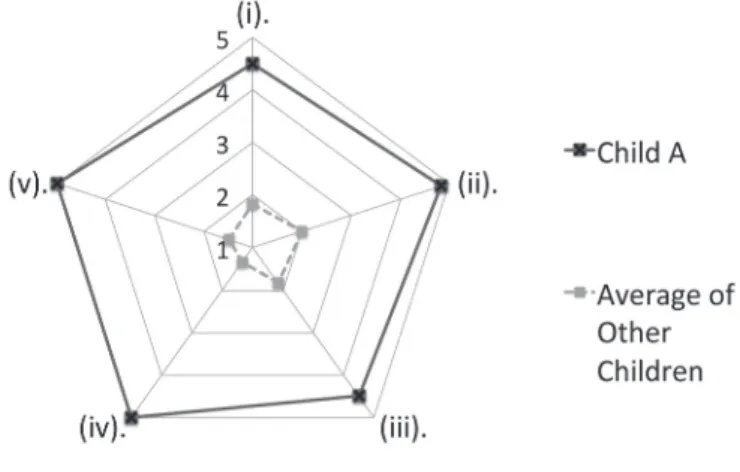
As shown in Fig. 1, the average score by the areas shows high levels in all items. The high level of (1) through (3) shows that Child A has serious communication difficulties in both group and one to one settings. The high level of (4) shows that the teachers have concerns about his behavior in any situation. The high level of (5) sug- gests that Child A has characteristics of developmental disorder. The high level of (8) suggests his parents give the impression that they do not take enough care in order to support him as his guardians; at least in his school life.
As shown in Fig. 2, the average score from the factors shows high levels in almost all the items. This result of both points of view corresponds with the teachers’ obser- vation records and suggests without a doubt that Child A is the child with special needs.
Child B
a) Observation Record for the First Two Months Child B, a boy, attended this Montessori preschool at the age of two and a half. For the first two weeks, he whimpered and sobbed all day, missing his mother. Since approximately the third week, he has started to bite other children in the arm, leg, shoulder, and cheek impulsively, without saying anything.
Child B bites unreasoningly and impetuously a few children who play together. When he is upset or excited about something, he seems to bite other children instead of expressing himself with words. He runs around and wan- ders around by himself a lot. When a teacher or a child remarks on that, he tends to bite the teacher or child a little later on. He has language delay and talks rarely. It seems to be very difficult for him to maintain eye contact and respond to any greeting.
Child A and Child B run round and round the class- room together. However, they do not seem to recognize each other as a friend to play with; they just seem to do the same act physically without any mental relationship, as they do not choose each other in group activities.
b) Result with the Checklist
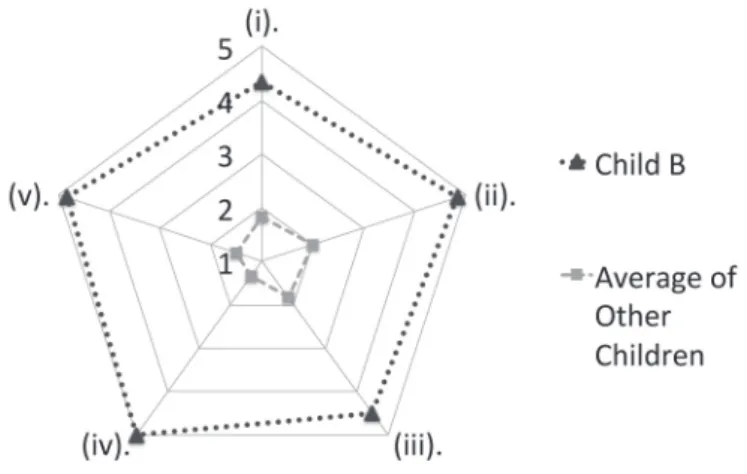
As shown in Fig. 3 and 4, Child B’s result of the aver- age score by the areas is similar to Child A’s, as well as the average score by the factors, though his parents seem to take care of him well.
The results show that Child B as well as Child A is the
Figure 3. Average Score by Areas Figure 4. Average Score by Factors
child with undiagnosed special needs corresponding to the teachers’ observation records.
Concrete Ways for Extra Support / Help
In the Montessori classroom, the teacher explains the instruction and rules verbally to create a rich language environment. In the Grace and Courtesy lesson, just like the Practical Life presentation, the teacher shows how to behave in the situation, saying “Watch.” However, the child needs to watch the teacher’s motion from beginning to end to understand the flow. It is difficult for the child with special needs to pay attention throughout that period.
According to Uehara (2011, pp. 18–19), the child with special needs has difficulties regarding invisible matters such as understanding meaning, making decisions for himself/herself, and taking a holistic view. The envi- ronment that respects his independent efforts without any clues causes a sense of choking. As stated in Chapter I, the child’s own activities regarding conscious movement, manual movement to promote his/her own hand control, visible signals, and special word offering are effective in helping the child with special needs. Single and simple instructions that avoid confusion and picture cards for di- rect enhancement of communication are not always pro- vided in the standard Montessori environment.
In this study, the other methods that are installed to the Montessori environment in order to help the child en-
tail involving him in activities by means of the materials and leading him to his concentration through his own ac- tivities. After the first month and then three and six months into the installation, the four Montessori teachers review each assessment with the teachers’ observation records and the checklist.
These other methods are picked out of standard, case-based, and visible types of SNE. They are teacher- friendly and fit in with the Montessori Method, which is not geared towards a specialist such as an occupational therapist or a speech therapist. Also, they do not disturb the Montessori environment. This does not make either the child or others feel singled out, as it gives opportunities for other children to participate freely. They therefore work as a defense against the child’s isolation, preventing him/her from feeling lonely.
In this study, the following nine methods are intro- duced in the Montessori environment.
a) Instruction Picture Card
In the Montessori classroom, when the teacher is sit- ting still without saying anything in a group the children would realize what they should do due to feeling tension.
That is, they could sit still like the teacher eventually. The
child with special needs has difficulty reading the situation
that he/she is in, failing to notice differences from others
spontaneously. An Instruction Picture Card, with a simple
picture on the white card saying a single corresponding
word, helps the child understand the teacher’s instruction visibly and clearly. One card shows a single instruction so as to make the child concentrate on one concept. In the group activities, this card would keep being shown not only to the child with special needs but to other children until they understood the meaning of the word of the in- struction.
b) Rule Picture Card
Like the Instruction Picture Card, the Rule Picture Card helps the child to understand appropriate behavior according to the situation instead of the verbal instruction.
A single card shows one minimum rule in order to make the children recognize the concept that they should follow.
c) SST Picture Card
The SST (Social Skill Training) Picture Card is intro- duced to the small group activity as one of the Grace and Courtesy lessons as a Montessori small group activity that teaches how to behave properly in a certain situation. The child with special needs and other young children were invited to the group. However, older children were not in- vited because they lost interest once they noticed the meaning of the group by means of this card. According to the Montessori manner, the teacher shows the card in a specific way. That is, the standard manner of SST Picture Card presentation is modified.
d) TEACCH Material Setting with Clue Box
The TEACCH Material Setting is similar to the Montessori material setting. It includes color coordinated, precise preparation and the purpose of each activity alongside the material. TEACCH provides the visible clue to how to use the material in the setting. On the other hand, the Montessori material setting has no clue to the Montes- sori materials; rather, usage is explained by the teacher’s presentation. In this study, instead of the direct clue on the setting, the clue box (a visible clue card in the box beside the material) is instructed. The child could choose the box himself if he needs the clue.
e) Switch-of-Mood Space
According to Nakao (2010, pp. 55–56), the small space at the corner of the classroom separated by low par-
titions is set aside in order to restore the child’s calm when he/she needs to switch his/her mood.
f) Emotion Picture Card
The card that shows a change of pictures from an an- gry or sad look to a calm look helps the child predict the sequential feeling on him/her (Nakao, 2010, pp. 56–57).
g) Time Table
The Time Table helps the child to recognize the daily flow of learning visibly and encourages him/her to get in- volved in class activities spontaneously.
h) A Small Class
A small class, which has a limited number of materi- als on the shelves according to the child’s developmental needs (including three sets of a table and chair), is set on the side of the classroom, separated by partitions. This small class is provided for three or four children at a time;
including the child with special needs. Ten selected sets of Montessori materials for the child with special needs, as well as three picture books, are provided. Two sets of ma- terials and one picture book are renewed every week.
i) Procedure Picture Card
The Procedure Picture Card shows how to use the material. This card is put in the box behind the material on the shelf. This has a concept similar to that of the clue box of the TEACCH Material Setting.
V. RESULTS AND ANALYSYS
1. Results of Child A Observation Record
After three months, Child A has not shown any re- markable, observable change for the better. His behavior of hyperactivity and rule violation has disturbed the other children’s activities and disrupted the environment. The more the teacher inhibits the child, the worse the child seems to behave.
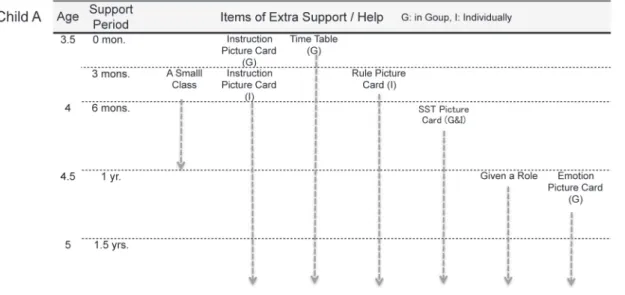
In addition to the Instruction Picture Card and Time
Table, A Small Class and Rule Picture Card are introduced
to the child in the following months (See Fig. 5 for the
Figure 5. Item and Period of Extra Support to Child A
process of introduction). The Small Class causes fewer negative effects on the other children outside the Small Class. In the Small Class, meanwhile, Child A’s violent behavior, such as throwing the materials, running round, hitting, kicking, and acting out by throwing a tantrum if he does not get his way, has improved. As an effect of the Instruction Card and Rule Card, Child A seems to have developed the ability to accept the teacher’s instruction with words a little better than before. He also seems more able to initially stop his unpalatable behavior by the teacher’s verbal inhibition, though he repeats same behav- ior soon afterwards. Child A seems to enjoy the presenta- tion by means of these Picture Cards. He memorizes almost perfectly the object names corresponding to the cards;
moreover, he talks to himself repeatedly using the same word and always parrots what someone says when he is spoken to. Child A seems to have a desire to do something with other children, though he gets out of line continually.
The more opportunities to join a group are given, the more the change to the child would develop.
Child A’s hyperactive, impulsive, and violent behav- ior causes frequent inhibition and reprimand given by the teachers and other children in all aspects of daily school life. This leads to a vicious cycle of his unacceptable vio- lent behavior. The introduction of a SST Picture Card in every situation, according to the issue, for the following
months would allow him to learn how to behave properly on the spot. In order to provide a sense of community to Child A, a small role in a group such as calling names and taking cards as an assistant is always given. Child A is out of the Small Class because he is aged four and starts the activities of Math area in the standard Montessori environ- ment with other children.
After one year of the introduction of extra methods, the child seems to have developed proper behavior accord- ing to the situation. The application of Picture Cards to Child A, instead of words of inhibition, has brought him less reprimand. However, these words are separated for the most part already. Child A has become able to express a smile for responding to the call.
The less violent behavior the child has shown, the more he has been seen smiling. This has brought more opportunities for creating a good relationship between him and other children, though communication is not always possible.
Given the role of an assistant that teaches the names
of Picture Cards to younger children seems to have given
Child A confidence. His precise presentation is effective
for younger learners and seems to foster trust in a different
way. Other children’s acceptance of him, as well as his less
violent behavior, seems to develop his social skills in a
group. The more his behavior has improved, the more his
Figure 6. The Change of Average Score by Areas Figure 7. The Change of Average Score by Factors
concentration on activities seems to be increasing little by
little. The improvement of his self-discipline is seen through his controlling movement at karate lessons, as well as his sitting still on the chair longer than before. He could not take part in karate lesson before because of be- havior issues such as breaking away from the group fre- quently.
Providing the opportunity to try challenging activities through finding the point of his interest would promote the child’s engagement and concentration through his own activities. His achievement in higher levels of Math areas that have more visible materials and take advantage of his good memorization seems effective in bringing about more self-esteem.
Result with the Checklist
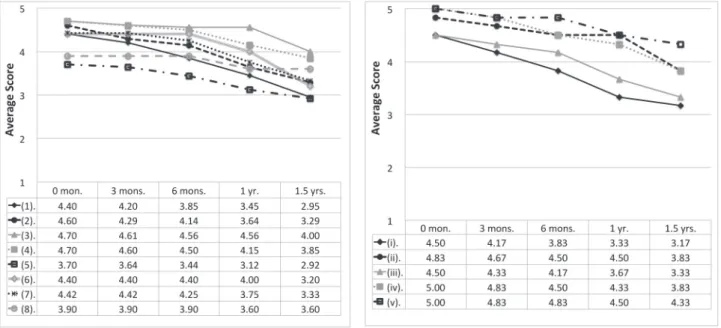
As shown in Fig. 6, the result of the average scores by areas is correlated highly with the result of the average scores by factors. When the teacher perceives fewer be- havior issues on the checklist by areas, the score by factors of hyperactivity indicates a lower level, as shown in Fig. 7.
In this study, the results of the checklist have analogous properties with the teachers’ observation records.
Analysis
The introduction and practice of various visual methods of SNE causes a higher frequency of Child A’s own activities with his choice. The most recent observa- tion record shows his concentration on the work with at least four kinds of materials. He completed each of these himself, and this frequency is not very low compared with others; however, the quality of his work is not sufficient because of his rough manner.
In this study, then, the concurrent method in conjunc- tion with other methods in the Montessori environment is effective for the development of Child A, who is the child with special needs.
2. Results of Child B Observation Record
In the three months since extra support has com- menced, Child B’s violent and hyperactive behavior has not shown any improvement. However, his face seems to express feelings of regret after he has bitten someone. He seems to understand the meaning of unacceptable behavior by the introduction of the Rule Picture Card. The SST Picture Card seems to help him become aware of others’
feelings through their facial expressions. Less impulsive
movement towards others (compared to his previous vio-
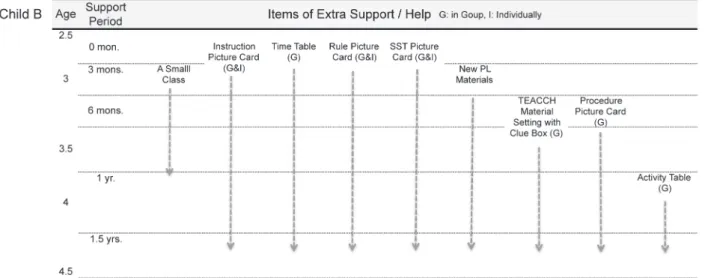
Figure 8. Item and Period of Extra Support to Child B
lent behavior) shows his improvement. The Instruction Picture Card clearly helps him to understand how he needs to behave according to the teacher’s advice, though he does not seem to understand the meaning of the instruction exactly (See Fig. 8 for the process of introduction).
As a next step, various Picture Cards as visual clues were introduced according to the child’s needs, the aim being to broaden his language development so that he is able to express himself with words. These visual aids have caused the improvement of his behavior based on his confidence, as he seems to have recognized the proper manner already through Picture Cards.
His better understanding of rules and proper behavior has changed his means of interacting with other children.
The more he acquires the language needed to express himself, the easier the communication with others will become.
The continuous introduction of Procedure Picture Cards has promoted his interest towards his own activities.
Through the observation of his activities, the teacher would take away these cards after he had gained confi- dence.
After one and a half years, Child B has been able to communicate with other children in an almost proper manner according to the situation. The level of his deviate behavior is comparable to other children’s. He can choose
his work and concentrate until he completes it, though his attention sometimes lapses.
The four teachers have the impression that he is not the child with special needs; therefore, the standard Mon- tessori education is provided to him according to his de- velopmental stage. However, they can introduce the extra supportable method of SNE to the environment whenever they recognize the child’s needs.
Result with the Checklist
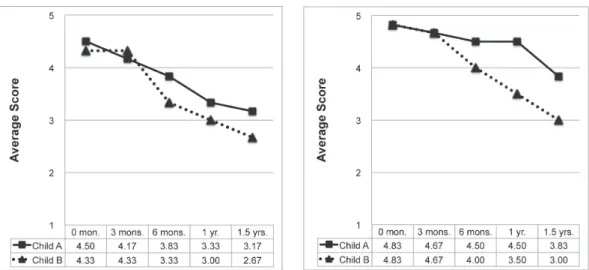
As shown in Fig. 9 and 10, the result of the average scores by areas is correlated highly with the result of the average scores by factors, as well as the result of Child A.
In this study, the result indicates a link between the results of the checklist and the teachers’ observation records at each period.
Analysis
The introduction and practice of various visual methods of SNE helps the child recognize the whole view and thus gain better understanding. This predictable view of what comes next seems to make him feel comfortable.
The more he understands the flow, the less he expresses
deviate behavior. After one and a half years, his concentra-
tion is of a similar level to that of other children. As a result,
none of teachers considers him as the child with special
3 6 9 12 15 18 21
3 6 9 12 15 18 21
24 27 30
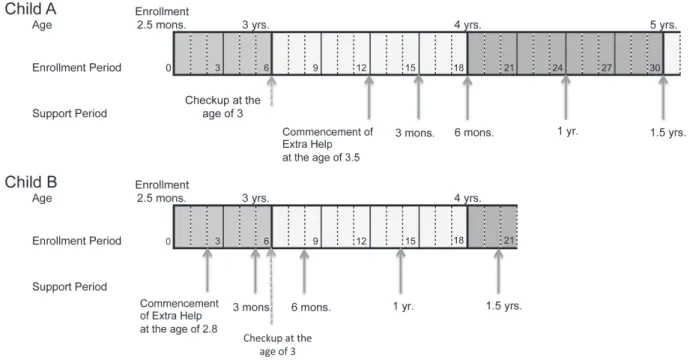
Figure 11. Age of Commencement and Support Period for Child A and Child B
Figure 9. The Change of Average Score by Areas Figure 10. The Change of Average Score by Factors
needs through their observation as well as the checklist’s assessment.
Thus, the concurrent method in conjunction with other methods in the Montessori environment in this study worked effectively for the development of Child B, who was the child with special needs.
3. Analysis of the Comparison of Child A and Child B regarding the Change
Child A and Child B had similar characteristics of
difficulties according to the teachers’ observation records
and the results of the checklist as shown in Fig. 1, 2, 3, and
4. As shown in Fig. 11, the starting age of the extra support
to Child A is different from that of Child B. The period
Figure 12. (i). Interpersonal Troubles Figure 13. (ii). Hyperactivity
Figure 14. (iii). Low Adaptability Figure 15. (iv). Rule Violation
Figure 16. (v). Impulsivity
after enrollment is approximately one year apart from each other. Simply comparing the change between each child from the view of the support period alone would be not enough for reviewing the differences of each effect.
As shown in Fig. 12 to 16, the comparison of the hands-on results of Child A and Child B will be effective based on each child’s differences in terms of their needs and situation. The differences of physical, inner, and cog- nitional developmental stages between them are consid- ered.
Looking back at the commencement of extra support, Child A and Child B displayed similar behavior that caused teachers concern. However, after three months, each score by areas shows different points. The score by areas is linked closely to the score by factors. The faster change of Child B would indicate that earlier intervention allows for better effectiveness.
VI. DISCUSSION
In this study, the concurrent method (that is, mixed methods for SNE in the Montessori environment) is car- ried out on the assumption that the child will achieve the expected normalization through his/her repeated activities once he/she is ready to focus on working with materials in the right manner. Particular methods of SNE are intro- duced to Preliminarily exercises as the preparation for Practical Life exercises and group activities according to the needs of the child. The Montessori environment has been kept as it should be and any standard Montessori manners (including the presentation of the materials) has not been changed for this study. Additional particular methods are considered in handling the fair treatment be- tween the individual child and other children, regardless of the special needs and his/her presentation hours, and his/
her freedom of choice is respected.
It could be said that any children can develop them- selves if the word “change” is focused on; even if any special supports are not provided. Some improved self- development may bring the same result as the support
provided.
The teachers’ observation is based on a sober sense of reality, taking emotion out of the issue. However, these records, in addition to the time record taken by hand, may not be enough to constitute perfect scientific data for all situations. The four teachers analyze their observation re- cords and the result of the checklist. They also review the link between the change by areas and the change by fac- tors. Nevertheless, this analysis and review may not go far enough to verify the scientific change and variation of the child’s development.
The checklist, filled in using five levels with words, is employed in the exact same manner in order to avoid waving in purpose. However, the same result might not be found, even if subjects are in the same situation, were an outside teacher to carry out assessment with the same checklist. In this study, these four teachers had a lot of opportunities to share information about the child with each other. This might cause a similar result based on their impression and the view of the child unconsciously. That each teacher is not isolated is beneficial, yet the group or- ganized by the teachers who have the same points of view might involve the risk of stereotyped observation due to the lack of a different view.
VII. CONCLUSION
In conclusion, the introduction of SNE methods uti- lizing visual aids would promise a certain level of effec- tiveness in helping the child with special needs, thus leading him/her to normalization in the Montessori envi- ronment if his/her characteristics are captured with a cer- tain level of exactness. In Montessori Education, the intro- duction of the extra support of SNE to the Montessori environment promotes the development of the child with special needs. The child who has difficulties getting in- volved in his own activities with the materials would cre- ate his/her foundation in order to become ready for activi- ties with the materials.
In the Montessori environment, the child’s own
awareness of the situation is expected. The imitation is a type of learning. Here, the child is expected to consciously notice that he/she needs to copy the teacher or other chil- dren to learn proper behavior as a member of the commu- nity. However, it would be difficult for the child to perceive what people want or want to say by looking at their expres- sions or by observing the atmosphere at the time. Even if the teacher provides verbal explanation, there is a high probability that the child may struggle with verbal com- prehension because of his/her language delay. Particular SNE methods help the child grasp the instruction and the meaning of the rule using impression through the initial sight of visual aids. This approach seems to serve the child with special needs better in comparison with the standard Montessori manner, which entails both verbal expression and a sequence of presentation for proper behavior.
In the first place, it is important that the teacher has clear knowledge of the child’s needs according to his/her developmental stage. To clarify the teacher’s concern by means of the checklist, as well as to focus narrowly on the proper supports, is the first essential step for the review of the support manner. The checklist provides a better under- standing of the child’s behavior as a certain level of cor- roborative evidence. However, the checklist basically works only as a corroborative tool for the teacher’s obser- vation record. The teacher’s improvement and daily up- dates regarding observation skills and knowledge is re- quired for better active support. The environment that prompts the teachers’ improvement is provided in order to avoid settling into a groove.
Montessori teachers might be faced with various dif- ficult problems in obtaining a realistic understanding by parents and other staff regarding the child with undiag- nosed special needs; in particular, the need for the extra support and a strengthening of the corroboration among relevant organizations. The cooperation of human re- sources, as well as material resources, would not always be provided to help the teacher deal with the problems. All Montessori teachers are expected to have the basic knowledge and manners of SNE in order to respond to the
child’s special needs.
Introducing the particular manner of SNE would en- able the child to focus his/her attention more easily on the basic facts that need to be recognized in order to adapt to the environment. To be provided with the proper environ- ment according to his/her needs allows the child to adapt to the environment as early as possible and to corroborate so as to gain opportunities to promote his/her develop- ment. As shown by the results of this study, the child with special needs requires a more stress-free approach than the standard Montessori manner, as this would trigger the change in his/her behavior needed to make the child com- fortable in the environment.
On the side of the teacher’s view, the introduction would provide the opportunity to supply the child with enough room to think instead of conveying a sense of un- certainty and anxiousness to the child. This brings the chance of broadening the teacher’s knowledge of educa- tion, as well as improving himself/herself as a Montessori teacher in order to create a dynamic link between the teacher, the child, and the environment.
All Montessori teachers who hold a diploma passed the serious training and the required exam. During the teacher’s training course, they have been trained in the concrete teaching technique and manner. However, the training course does not include SNE. Even if the Montes- sori Education includes the concept that SNE covers, most Montessori teachers without enough experience with the child with special needs would encounter difficulties in dealing with the problem at hand. This is because they are not Dr. Maria Montessori, who is a physician.
In this study, only two children are reviewed. Further reviews of similar case studies are needed for more con- crete results.
Montessori Education needs to consider introducing a wider knowledge and manner of SNE to the standard teacher-training course.
Acknowledgements
I am grateful to many people who have supported me through-
out the case study. Thank you Professor Rie Yamamoto for all of the guidance you have offered me. I appreciate the continual support and feedback.
Note
1 In this study, the ages of 2 to 6 are focused on as constituting preschool age. A Montessori school and classroom in this study refers to this age group of children, though Montessori Education caters to a wide age range (between birth and 23).
2 “The Behavior Checklist for Children with Special Care” es- tablished by Hongo (2006).
3 Here, “guardian (Hogosha)” is defined as the adult spending substantial time with the child in a similar manner to that of a parent or a grandparent.
References
Araki, H. (2011) Hoiku Konnan kara Senmonka eno Sodan ni itaru made, in Hatano, E. and Yamazaki, A., eds, Hoiku no Naka deno Rinsho Hattatsu Shien, Kyoto: Minerva Shobo, pp. 90–96.
Association Montessori Internationale. (2013) Announcement of Inclusive Education Course, Accessed June 6, 2013, http://
ami-global.org/events/inclusive-education-course.
Beppu, E. (2006) Chotto Ki ni naru Kodomo no Rikai, Enjyo, Hoiku, Tokyo: Hitonaru Shobo.
Hirasawa, N., Fujiwara, Y. and Yamane, M. (2005) Hoikusho/En ni okeru “Ki ni naru/ Komatte iru Kodo” wo shimesu Kodomo ni kansuru Chosa Kenkyu – Shogai Gun kara mita Gaito Ji no Jittai to Hoikusha no Taio oyobi Ukete iru Shien kara –, Hattatsu Shogai Kenkyu, 26(4), pp. 256–267.
Hongo, K. (2006) Hoiku Genba ni okeru “Ki ni naru” Kodomo no
Rikai to Taio – Tokubetsu Shien Kyoiku eno Setsuzoku -, Tokyo:
Brain Shuppan Sha.
Hongo, K., Iijima, N., Sugimura, R., Hirakawa, K. and Hirakawa, M. (2010) “Ki ni naru” Kodomo no Hoiku to Hogosha Shien, Tokyo: Ken Paku Sha.
Ida, N. and Tanaka, H. (1987). Montessori Shougaiji Kyoiku. In Montessori Kyoiku no Riron to Jissen, Gekan, Tokyo: Enderle Shoten, Chapter 8, pp. 25–56.
Iguchi, H. (2000) Hoikusha ga Mondai ni suru “Ki ni naru Ko” ni tsuite no Keiko Bunseki, Nagasaki Daigaku Kiyo, 59, pp. 1–16.
Kuboyama, S., Saito, Y., Nishimaki. K., Tomijima, S., Fujii, S. and Takigawa, K. (2009) “Ki ni naru Kodomo”, “Ki ni naru Hogo- sha” ni tsuite no Hoikusha no Ishiki to Taio ni kansuru Chosa – Yochien/ Hoikusho eno Kikan Shien de fumaeru beki Shiten no Teigen, Kenkyu Kiyo: Kokuritsu Tokubetsu Shien Kyoiku Kenkyusho (National Institute of Special Needs Education), 36, pp. 55–76.
McDonell, J. (2014) Overview of Normalization, Paper presented at the Lecture of Inclusive Education, Montessori Institute of San Diego, July 22, 2014, In Inclusive Education Course, CA: As- sociation Montessori Internationale.
Montessori, M. (1912) The Montessori Method in Gutek, G. L., ed., (2004), MD: Rowman & Littlefield Publishers, Inc.
Nakao, S. (2010) Zero Sai kara no Tokubetsu Shien Kyoiku, Tokyo:
Meiji Tosho Shuppan.
Smith, M. (2014) Montessori Approach for Children who have Special Needs, Paper presented at the Lecture of Inclusive Edu- cation, Montessori Institute of San Diego, July 7 – 11, 2014, In Inclusive Education Course, CA: Association Montessori In- ternationale.
Uehara, F. (2011) Ki ni naru Ko ni Dou Taio sureba ii?, Tokyo:
Sekai Bunka Sha.