Abstract
Since the Great East Japan Earthquake, many entities such as nonprofit organiza- tions have been engaged in support activities for child disaster victims. In this paper, the targets of the analysis will primarily be financial support in the form of cash pay- ments to reduce the financial burden of children's education, such as cash grants in the form of scholarships; payments to individual disaster victims; and loans.
In order to swiftly and fairly take immediate action during times of disaster, when the number of children in need of financial support due to a disaster affecting their guardians increases, I believe that it is important to create national minimums for measures against child poverty and financial support for children's education even in normal times. I also believe it is important to build a system with as little disparity as possible between both the municipalities in which children live and the methods of support.
Key words:Great East Japan Earthquake, Financial Support, Special School Expense Temporary Subsidies
被災した子どもの教育支援
Educational Support for Child Disaster Victims
鳫
がん
咲 子
Sakiko GAN
1: The Significance of Financial Support for Child Disaster Victims
Since the Great East Japan Earthquake, many entities such as nonprofit organizations (NPOs) have been engaged in support activities for child disaster victims. In this paper, the targets of the analysis will primarily be financial support in the form of cash pay- ments to reduce the financial burden of children’s education, such as cash grants in the form of scholarships; payments to individual disaster victims; and loans.
The School Expense Subsidy System is an important system that deals with child pov- erty by having municipalities make cash payments equivalent to expenses for school lunches, supplies, commutes, field trips, and some medical expenses, to the guardians of school-age children who are deemed to have difficulty attending school for financial rea- sons1. After the Great East Japan Earthquake, when greater numbers of children had financial difficulty attending school due to the disaster and it became necessary to ex- pand support to respond to evacuation circumstances, the Child Disaster Victim School Expense Subsidy Program was established with special temporary subsidies to cover the school expenses of child disaster victims, and since then support has been given in the form of cash payments similar to those of the School Expense Subsidy System.
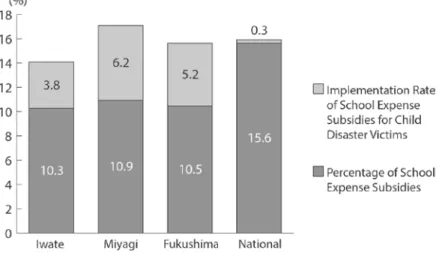
In fiscal year 2012, the rate of school expense subsidies2 and the number of recipients in the three prefectures hit by the disaster (Iwate, Miyagi, and Fukushima) and the en- tire nation were as follows: Iwate, 10.3% (10,639 people); Miyagi, 10.9% (20,298 people);
Fukushima, 10.5% (16,656 people); nationwide, 15.6% (1,552,023 people)3. Additionally, since the Child Disaster Victim School Expense Subsidy Program was focused on the three disaster-struck prefectures, if these are added together, the proportion of total pub- lic elementary and junior high school students receiving aid for school lunches and so on in fiscal year 2012 came to 14.1% in Iwate, 17.1% in Miyagi, and 15.6% in Fukushima.
Recipients of subsidy program support in the three disaster-struck prefectures in- creased by 140-160%, and one in every six to seven elementary or junior high school stu- dents began to receive financial assistance. Financial support to reduce the burden of children’s education on households affected by the disaster is crucial from the perspective of guaranteeing children equal access to education, even in the event of a large-scale dis- aster.
However, the overall level of school expense subsidies, including their rate of
implementation for child disaster victims, in these disaster-struck prefectures has re- mained about the same as the nationwide average of 15.9%. When looking at this in re- lation to free school lunches, the rate of single-parent households, and the municipal economic power in these prefectures, it is conceivable that this situation developed be- cause the disaster-struck prefectures’ rates of school expense subsidies before the Great East Japan Earthquake were low relative to the national level (Gan 2013, pp. 25-26, 56- 57). The overall level of school expense subsidies in these prefectures finally reached the national average thanks to special measures for full payment from the national budget after the disaster. If these measures had not been taken, it would have been very diffi- cult for disaster-struck municipalities to implement school expense subsidies for child disaster victims at the current levels.
Figure 1 Percentage and Implementation Rate of School Expense Subsidies for Child Disaster Victims in the Three Prefectures Affected by the Disaster (Fiscal Year 2012)
Note: Regarding the percentages, children in need of protection or those in semi-need of protec- tion (percentage of school expense subsidies), and children who became the recipients of school expense subsidies for child disaster victims, are the percentage accounted for, re- spectively, of the total number of children at public elementary and junior high schools.
Source: MEXT. “Heisei 24 nendo yohogo oyobi junyohogo jidou seitosu ni tsuite [On the Number of Children in Need of or in Semi-Need of Protection],” 2014; and MEXT. “Hisai jido seito shugaku shien nado rinji tokurei kofukin, Heisei 24 nendo shikko jisseki [Special School Expense Temporary Subsidies for Child Victims of Disaster, Results of Services in 2012].”
Prepared in 2014.
2: The Status of Financial Support
According to a report by the Japanese Business Federation, which I will cover in more detail later, cash donations as a part of the total assistance for people and areas affected by the Great East Japan Earthquake made by member businesses and organizations as of September 2011 were about ¥71.5 billion4. Included in the cash donations were ¥2.9 billion in scholarships and subsidies managed by members’ own companies (or groups), as well as contributions sent to victims, aid money for NPO activities, etc. From the per- spective of supporters, all of these cash donations were considered financial support, but in this paper, the main subject for consideration will be cash grants and loans to indi- vidual victims for alleviating the burden of children’s educational expenses, in the form of scholarships and other payments.
Financial support for children can be classified by supporting body (public organiza- tions like national and local governments, or nongovernmental organizations), by support target (age group, orphan status, etc.), and by support details (the distinction between loan payments, etc.). Below I will discuss the support targets, details, and methods for each of the two types of supporting body, national and local governments, and nongovernmental organizations.
3: Support by National and Local Governments
First, regarding support by national and local governments, I will discuss support for elementary and secondary education (up to high school) and that for higher education (university, etc.) separately. Furthermore, the Ministry of Education, Culture, Sports, Science and Technology (MEXT) offered networking aid through the “Great East Japan Earthquake Children’s Learning Support Portal Site,” to mediate the exchange of infor- mation between the support offered by each group, whether public or private, and the needs of children in affected areas.
3.1 Support for Elementary and Secondary Education (up to High School)
Regarding the acknowledgement and provision of school supplies and lunch expenses to children in need because of the disaster, MEXT appealed to all boards of education for swift and flexible action5. Furthermore, the ministry created a Q&A document about the flexible operation of kindergarten attendance promotion programs and the flexible accep- tance of child disaster victims into public schools, and distributed it to the relevant boards of education6.
However, immediately following the disaster, responses differed depending on locality, and under the Disaster Relief Act some municipalities prioritized the provision of school supplies, some had set up school expense subsidies prior to the disaster, and some de- cided their response after arrangements were made for revised subsidy budgets, which I will mention later (Suzuki 2012, p.125).
Furthermore, since no specific details were provided about the “swift and flexible re- sponses to the greatest extent possible,” there were cases in which municipalities’ re- sponses were no different than usual, even toward those who had evacuated as instructed with nothing but the clothes on their backs (National School Administrative Staff Institution Research Society 2012, p.133).
3.1.1 Special School Expense Temporary Subsidies for Child Disaster Victims
In order to support kindergarten and school attendance of children from households facing financial problems due to the Great East Japan Earthquake, in existing School Expense Subsidies programs, the new burdens on prefectures that were anticipated be- cause of increases in recipients and costs, started being backed in total by the national budget. In the revised budget for the 2011 school year, “special school expense temporary subsidies for child disaster victims” (hereinafter “subsidies”) of about ¥41.1 billion were issued to the prefectures, and in order to make high school free of charge they were in- creased and the funds were managed separately from the “high school student support funds” already in place in the prefectures.
Thanks these funds, as of fiscal year 2014 the following support has been given: (1) kindergarten attendance promotion programs (kindergarten expense subsidy programs for child disaster victims) that reduce daycare and kindergarten enrollment fees; (2) school expense subsidy programs (school expense subsidy programs for child disaster victims)
that assist with costs of school supplies, commuting (including fees for school bus serv- ices operated by municipalities), and school lunches for elementary and junior high school students; (3) scholarship programs for senior high school students; (4) cost- reduction programs for tuition fees at private high schools; (5) school attendance promo- tion programs (school attendance promotion programs for special support education for child disaster victims) that assist with necessary costs for children attending special- needs schools; and (6) cost-reduction programs for vocational school tuition fees.
Thanks to special measures for full-sum payments by the national treasury through the establishment of funds, the municipal burden of supporting child disaster victims was alleviated. I brought up examples of school expense subsidies in Section 1, but to disaster-struck municipalities and child disaster victims, the special measures paid for in full by the national treasury were very significant. Furthermore, in addition to existing programs, it became possible to support general courses at special vocational schools and cost-reduction programs for vocational school tuition.
The reason that these were implemented in a fund system was that the Great East Japan Earthquake was an unprecedented disaster, and in the immediate aftermath it was difficult to determine the scope of the necessary programs to support child disaster victims. Furthermore, from the refugee situation in each prefecture, and in particular that caused by the Fukushima Nuclear Power Plant accident, it was explained that the necessary sums for four years of program implementation via a fund system for urgent issues were secured in order to allow municipalities to unilaterally implement programs that guaranteed opportunities for education and school expense subsidies to children7.
In great disasters before the Great East Japan Earthquake, school expense subsidies were implemented through measures in the annual budget without needing a fund sys- tem; also, through the Disaster Relief Act, payment in kind for school supplies was available. For example, after the Great Kobe Earthquake of 1995, child disaster victim educational subsidies (52,940 subsidies, ¥1.74 billion) and special education funds for child disaster victims (466 funds, ¥350 million) were distributed from donated money8.
Regarding support this time around, about seven months after the disaster struck, the following issues were recognized by MEXT staff9:
● Municipalities themselves were victims of the disaster and some staff were miss- ing; detailed information about program implementation policy was not dissemi- nated smoothly.
● After responding to initial demands from municipalities, the response to new re- quests to accompany changing needs did not go smoothly.
● Regarding the naming of “special school expense temporary subsidies for child dis- aster victims” and all kinds of notices about the school expense subsidies, it was unclear if “infants” and “kindergarteners” were included, and officials lodged com- plaints.
● Coordination between concerned departments and divisions that hold jurisdiction over the system is essential even in normal times.
● When implementing programs, it is necessary to adequately account for the assem- bly schedules of each municipality because approval is needed from their legisla- tive assemblies.
However, they also acknowledged that “the practical application of existing systems for school expense subsidies had no major problems in municipalities, and was effective while also leading to swift responses.”
In the 2012 fiscal year budget, based on requests from municipalities that were ex- pected to have insufficient funding during that year, the necessary expenses (about ¥330 million) were allocated, reaching a total of about ¥44.4 billion (full payment by the na- tional treasury). According to MEXT, the results (preliminary figures) up to the 2013 fis- cal year showed an implementation rate of 66.7%. The number of recipients was about 68,000 in 2011, 58,000 in 2012, and 52,000 in 2013, showing a downward trend. Of the three prefectures affected by the disaster, Miyagi’s implementation results accounted for, as a part of the total, 53.7% of recipients and 62.6% of implementation result financials sums, far surpassing those of Fukushima and Iwate Prefectures (see Table 1)10.
3.1.2 Assessment of Subsidy Program Contents
The “Special School Expense Temporary Subsidies for Child Disaster Victims” were featured in the “2014 Fiscal Year Reconstruction Agency Administrative Program Review Open Process” and received an assessment from outside expert committee members that stated that “radical improvement to the entire program” was necessary11.
In the assessments of the program contents, the following comments were given:
● These are important programs from the perspective of guaranteeing school atten- dance opportunities in areas struck by the disaster, but in order ensure a soft
Table 1 Special School Expense Temporary Subsidies for Child Disaster Victims (Records from 2011‐2013 Fiscal Years) (Preliminary Figures)
Recipients by Location (Total Recipients from 2011‐2013 Fiscal Years)
(Number of People) [Preliminary Figures]
Source: Created by the author with reference to MEXT documents.
Program Title Recipients Iwate Miyagi Fukushima Other
Prefectures Kindergarten Attendance Support Programs for
Child Disaster Victims
31,365 842 21,118 5,266 4,139
School Expense Subsidy Programs for Child Disaster Victims
91,520 11,960 34,473 24,901 20,186 -Number of Recipient Children in Elementary
School
60,185 7,177 21,991 15,992 15,025
-Number of Recipient Children in Junior High School
31,335 4,783 12,482 8,909 5,161
Scholarship Programs 20,702 573 16,197 3,873 59
Cost-Reduction Programs for Private School Tuition Fees
27,881 631 20,520 4,026 2,704
School Attendance Promotion Programs for Special-Needs Education for Child Disaster Victims
1,068 1 334 380 353
Cost-Reduction Programs for Vocational School Tuition Fees
5,891 381 3,260 634 1,616
Total 178,427 14,388 95,902 39,080 29,057
Percentage of Total 8.1 53.7 21.9 16.3
Total Implemented Amounts, Results for 2011-2013 Fiscal Years (in Millions of Yen) Program Title
Total Sum Results of Implementation for FY 2011-2013 (Total Funds Used)
Iwate Miyagi Fukushima Other Prefectures
Kindergarten Attendance Support Programs for Child Disaster Victims
3,525 96 2,467 550 412
School Expense Subsidy Programs for Child Disaster Victims
10,876 1,496 4,909 3,094 1,377
Scholarship Programs 4,978 143 3,884 934 17
Cost-Reduction Programs for Private School Tuition Fees
6,283 95 5,093 717 378
School Attendance Promotion Programs for Special-Needs Education for Child Disaster Victims
26 0.03 7 9 10
Cost-Reduction Programs for Vocational School Tuition Fees
1,678 116 765 108 689
Total 27,366 1,946 17,125 5,413 2,883
Percentage of Total Implemented Amounts, Results for 2011-2013 Fiscal Years
- 7.1 62.6 19.8 10.5
landing back to existing programs from a long-term perspective, they should pro- mote a concrete review of support time periods and percentages. When doing this, it will be essential to establish indicators for not only the number of support re- cipients, but also ones that measure effective outcomes.
● Verification of the results that includes more qualitative aspects, such as relevant programs, relevant costs, and people that did not need support, is needed.
● They must accurately grasp the financial circumstances of target households, re- duce the proportion of assistance when improvements are shown, and so on, to en- sure a soft landing back to existing programs.
● If support will continue beyond fiscal year 2015, it will be difficult to come to a conclusion about the causes of poverty. They should closely consider the dangers of falling into a situation of repeated poverty in spite of temporary recovery.
Consequently, a summary was made saying “these are programs having a high degree of necessity, but in order to determine their termination, it will be necessary to make an effort to inspect outcomes that grasp the circumstances of the households to whom sup- port has been given.”
3.1.3 Assessments of Subsidy Program Methods
In the same open public process, regarding the methods of the programs, urgent issues accounted for the rise of implementation to 66.7%, and responses differed by prefecture.
However, there were comments that the national budget should be used to remove un- fairness, the fund system based on the state of the disaster for each prefecture should be reconsidered, and a transition should be made toward enacting measures for each separate fiscal year. The assessment was summarized as follows: “Regarding the con- tinuation of these programs, a review of the fund system and its details including lower- ing the support rate based on changes of circumstance since the disaster, is necessary.”
The assessment concerning the details and methods of the subsidy programs reflects Japan’s current economic difficulties, and can be said to prioritize restoring public fi- nance over the propriety of support methods for disaster victims.
Until now, because prefectures and municipalities had used existing systems, there were considerable differences in the average payments per person under subsidy pro- grams (1) through (6) listed above in the three disaster-struck prefectures and in other
prefectures. In subsidy programs (1), (2), and (4), the payment amounts per person were all highest in Miyagi Prefecture. Looking at the index, with 100 representing the highest sum paid per person, the level of non-disaster prefectures at 48 for (2) School Expense Subsidies Programs for Child Disaster Victims, the level of non-disaster prefectures at 56 for (4) Cost-Reduction Programs for Private School Tuition Fees, and the level of Fukushima Prefecture at 40 for (6) Cost-Reduction Programs for Vocational School Tuition Fees, are all remarkably low (Figure 2). The standards and details of the School Expense Subsidy Programs have been previously identified as having large discrepancies between municipalities (Gan 2013, pp. 52-71; Yuda 2009, pp. 141-149).
Subsidy program (6) Cost-Reduction Programs for Vocational School Tuition Fees is the only one for which two-thirds is covered by national subsidies, but all of the other subsidy programs have a high rate of national subsidy, at 10 out of 10. However, the substantial differences in payment amount between the municipalities and prefectures that implement each program, and the fact that the national government has not grasped the particular details of the programs, is not adequate. The fact that the Figure 2 Comparison of Support Levels per Person of Special Temporary Subsidy
Programs for Child Disaster Victims
Note: Indexed from the highest sum paid per person being 100.
Source: Created by the author with reference to MEXT documents.
municipalities made use of existing programs as emergency measures was unavoidable.
However, having the full sum for financial support of children of municipalities struck by a large-scale disaster charged to a national expenditure can be nothing but a guaran- tee of the national minimum level12. It is not enough to leave the levels of support at the discretion of municipalities; rather, the national government, in addition to investing public funds, must take responsibility for the nation and demonstrate the support levels that should be guaranteed.
MEXT officials have also gained some insight into the evacuee situation three years after the disaster, and so even though the movement of evacuees is somewhat unsettled, they can anticipate it to a certain extent. By way of becoming able to grasp the scale of programs for each prefecture, they mention that they are reviewing the inclusion of methods other than the fund system, such as annual budgetary provisions13.
3.2 Support for Secondary Education (University Students, etc.)
At MEXT, appeals were sent regarding the deferment or reduction of matriculation and tuition fees at all universities and colleges14, and tuition reduction, scholarships, and lodging assistance were implemented at many universities across the country. The fol- lowing lessons about these kinds of support were recognized: “the need to plan for con- tinuous support for disaster victim students who are expected to have difficult economic circumstances going forward” and that “regarding tuition cost reduction at private uni- versities, generally, subsidies for tuition-fee reduction are issued in March. However, con- sidering the management of disaster-struck universities, part of the necessary expenses were accelerated and issued in July for tuition reductions for student disaster victims as well as regular tuition reductions. The reason was to lower the burden on student disas- ter victims, and this was effective.”15
However, looking at the tuition fee reduction situation for national and public univer- sity students from earthquake victim households, the implementation result figures are decreasing. In particular, the implementation amount for private universities was ¥8.1 billion issued to 25,000 people in fiscal year 2011, but fell to ¥4.3 billion issued to 14,000 people in fiscal year 2012 and ¥2.3 billion issued to 7,000 people in 2013, a dras- tic reduction when compared to national and public universities (see Table 2 and Figure 3).
Table 2 Tuition Fee Reductions for Students from Great East Japan Earthquake Victim Households
Note: Anticipated numbers for public universities for fiscal year 2014 are from a MEXT inde- pendent survey. Tuition fee reductions at public universities are not provided for in the MEXT budget because they are supported through local government finance measures.
Fields marked “ - ” indicate missing data.
Source: MEXT documents.
FY 2011
Initial Anticipated Number of Tuition Fee Reduction Recipients
Actual Number of Tuition Fee Reduction Recipients
Budget Amount
Actual Amount
Amount Per Person Per Month National
Universities
2,861 2,861 ¥1.766 billion ¥1.766 billion -
Public Universities
- 1,165 - ¥411 million ¥29,399
Private Universities
12,000 25,000 ¥4.7 billion ¥8.1 billion -
FY 2012
Initial Anticipated Number of Tuition Fee Reduction Recipients
Actual Number of Tuition Fee Reduction Recipients
Budget Amount
Actual Amount
Amount Per Person Per Month National
Universities
2,289 2,289 ¥1.413 billion ¥1.413 billion -
Public Universities
- 765 - ¥269 million ¥29,343
Private Universities
19,000 14,000 ¥6.1 billion ¥4.3 -
FY 2013
Initial Anticipated Number of Tuition Fee Reduction Recipients
Actual Number of Tuition Fee Reduction Recipients
Budget Amount
Actual Amount
Amount Per Person Per Month National
Universities
1,716 1,716 ¥1.061 billion ¥1.061 billion -
Public Universities
- 610 - ¥223 million ¥30,475
Private Universities
16,000 7,000 ¥5 billion ¥2.3 billion -
FY 2014
Initial Anticipated Number of Tuition Fee Reduction Recipients
Actual Number of Tuition Fee Reduction Recipients
Budget Amount
Actual Amount
Amount Per Person Per Month National
Universities
1,145 - ¥705 million - -
Public Universities
424 - - - -
Private Universities
11,000 - ¥3.5 billion - -
The investment methods and percentages of public finance funds for tuition fee reduc- tion at each national and public university differ depending on their institutional struc- tures. At national universities that implemented tuition fee reductions, the additional step of subsidies for the operating expenses of the universities’ corporations is added.
Tuition fee reductions at public universities are supported through local government fi- nance measures. For tuition fee reductions at private universities, two-thirds of the nec- essary expenses are supplemented by public funding. It is thought that the responsibility for the final one-third of expenses accounts for the decline in implementation results at private universities.
The Japan Student Services Organization also issued interest-free loans so that stu- dents from households affected by the Great East Japan Earthquake would not have to abandon their studies for financial reasons. From fiscal year 2011 to 2014 (as of August), they accepted all disaster victim applicants who satisfied the loan criteria. There have also been changes to the restrictions on all interest-free loans, and the number of disas- ter victim students receiving interest-free loans has increased over fivefold in the space of three years (Table 3). It can be said that the emphasis of support for students from households affected by the disaster is shifting from tuition fee reduction to interest-free student loans from the Japan Student Services Organization. The creation of a system for normal times that can also respond in times of crisis is now needed.
Figure 3 Changes in Tuition Fee Reductions for Students from Great East Japan Earthquake Victim Households
Source: Created by the author with reference to MEXT documents.
3.2.1 Survey of Financial Aid for Student Disaster Victims at Universities and Junior Colleges
Below are the results of the “Survey of Financial Aid for Student Disaster Victims at Universities and Junior Colleges” (Graduate School of Education, Faculty of Education, Tohoku University; led by Eiichi Aoki and Shuji Tobishima), carried out in February 2014 on financial aid for disaster victim students by national and public universities16. This survey asked about whether or not the following six types of aid were given from fiscal year 2011 to 2013: (1) tuition fee reduction, (2) matriculation fee reduction, (3) school entrance examination fee reduction, (4) scholarships, (5) student loans, and (6) provision of housing or dormitories (Figure 4).
(1) Tuition fee reduction and (2) matriculation fee reduction are, in order of total im- plementation rate over three years (the proportion of colleges that implemented aid that account for valid responses), more prevalent at national followed by public and then pri- vate universities, and are trending downward, same as with the results mentioned above concerning the MEXT survey results about tuition fee reduction. For (3) school entrance examination fee reduction, (4) scholarships, and (6) provision of housing or dormitories, the rates were lower at public universities than private ones, with the order being na- tional, private, then public universities. No categories leveled off and all are trending downward, but (3) school entrance examination fee reduction was higher in 2012 than in 201117. (5) Student loans have a low level of implementation.
As can be seen in Figure 4, although a student may be from a disaster victim house- hold, there will be large disparities in their opportunities to receive support in the form of tuition, matriculation, and entrance exam fee reduction; scholarships and loans; and provision of housing or dormitories, depending on whether his or her educational institu- tion is national, public, or private. From the perspective of fairness amongst students from households affected by the disaster, we should review methods for efficiently and Table 3 Changes and Percentages of Recipients (Actual Results) of Interest-Free Loans
from the Japan Student Services Organization
Loan Recipients (A) (Number of People)
Of (A), Students from Disaster Victim Households (B) (Number of People)
Percentage of Recipients from Disaster Victim Households (B/A) (%)
FY 2011 379,195 1,649 0.43
FY 2012 402,092 5,922 1.47
FY 2013 427,423 8,429 1.97
Source: MEXT documents.
Figure 4 Financial Aid for Student Disaster Victims at Universities and Junior Colleges
Source: Created by the author based on the “Survey of Financial Aid for Student Disaster Victims at Universities and Junior Colleges” (Graduate School of Education/Faculty of Education, Tohoku University; led by Eiichi Aoki and Shuji Tobishima).
promptly issuing cash assistance to individual students, in place of indirect measures by universities. Perhaps the arrangement in the school expense subsidy system for senior high schools, in which school officials receive support money in place of the students themselves and counterbalance some or all of the tuition fees, can be used as a reference18.
As we get further from the disaster, the topic of discontinuing support has been com- ing up. In the long term, the continuous guarantee of funding terms for interest-free stu- dent loans by the Japan Student Services Organization will be an essential measure for soft landing.
3.3 Networking Support via the “Great East Japan Earthquake Children’s Learning Support Portal Site”
MEXT opened the “Great East Japan Earthquake Children’s Learning Support Portal Site” from April 2011 to May 2012, to make it easier for children and students affected by the disaster and in need of support to receive it more easily by allowing for the ex- change of information about support needs in disaster-struck areas and potential support offered by various groups. This site created a network for financial support, covering such matters as funds for school supplies and scholarship information. MEXT determined that in the roughly one year that the site was open, there were 926 offers of support, 416 requests for support, and a total of 2,289 matches made19.
4: Support by Nongovernmental Organizations
On the “Great East Japan Earthquake Children’s Learning Support Portal Site” men- tioned above, information about scholarships20 was also provided, including some about scholarship programs for children who had difficulty attending school for financial rea- sons after the disaster; the funds came from private businesses, NPOs, charitable corpo- rations, universities, and local governments. The scholarships mainly consisted of donations from private capital, but financial aid such as scholarships from nongovernmental organizations often targeted orphans only.
Furthermore, according to the Japan Business Federation, the results of a survey of member businesses and organizations showed that aid to earthquake victims and
stricken areas by businesses and organizations as of September 2011 was about ¥101.1 billion21. Of the aid given by these groups, cash donations constituted about ¥71.5 bil- lion, and the rest consisted of donations of goods and matched donations. About 5% of the cash donations, or about ¥2.9 billion, were given by 34 companies (or groups) to
“scholarships or subsidies managed in-house.”
In the Japan Business Federation follow-up survey, businesses’ support programs were classified into seven categories: (1) community support, (2) industrial recovery and job creation support, (3) next-generation training and education support, (4) mental health care, (5) support for disadvantaged people, (6) support for intermediary support groups, and (7) support for evacuees outside the prefecture22. In the “next-generation training and education support” category, 11 cases were published of financial support to indi- viduals in the form of scholarships and so on.
4.1 Survey on the Implementation Status of Financial Support for Child Disaster Victims
In the “Survey on Incorporated NPO Support for Child Victims of the Great East Japan Earthquake”, I classified incorporated NPO support for children into the catego- ries “study support,” “financial support,” “mental health care,” and “livelihood support”;
I then conducted an aggregate survey of the staff that operated these programs and ana- lyzed the results.
In September 2014, I carried out the “Survey on the Implementation Status of Financial Support for Child Disaster Victims,” focusing on groups providing financial support for children23.
The main survey items covered the status of support implementation, such as recipi- ents, details, amounts, adoption numbers, the application process, and other forms of the financial support given by each group (scholarships, payments, one-time payments, and loans). Financial support by incorporated NPOs often took the form of donations or sup- port money for the activities of NPOs and other groups, even if the support given was a monetary payment by a relevant corporation.
Furthermore, among the types of financial support, there were support for individuals and support targeted not directly at individuals but at organizations. Below I will focus on 9 instances of support by 8 incorporated NPOs and 23 other instances of support by 21 organizations for a total of 32 instances of support for individuals. The classification
of the 21 organizations is as follows: 8 private businesses, 6 local governments (inde- pendent programs), 5 public utility foundations, and 1 labor union or independent ad- ministrative corporation.
There were a total of 17 (53.1%) instances of support targeted only at disaster or- phans, and adoption numbers reached 3,750 (63.6%), but, with the exception of 1 case, the source of funding for support expenses was donations (including fundraising and trust properties) from individuals, organizations, and businesses. These kinds of support backed by private funds included many examples that only targeted disaster orphans.
Detailed survey results are as follows.
4.1.1 Recipients of Support
As for the recipients of support, of the 32 cases, 20 (62.5%) targeted disaster orphans, 14 (43.8%) targeted a different category of disaster orphans (children who lost one par- ent in the Great East Japan Earthquake, aged under 18 at the time of the disaster, in- cluding children who were not yet born at the time of the disaster), and 10 (31.3%) targeted child disaster victims regardless of orphan status (multiple answers were al- lowed). In addition, there were three instances from two groups of support for children living with foster parents or in child care institutions.
There were eight cases (25%) of support targeting children who were so-called inde- pendent evacuees from the nuclear disaster, but of these five were scholarships targeting university, graduate, and technical college students, and in the survey no support cases targeted independent evacuees who were preschool-aged or high school students.
Furthermore, there were no instances of support for children attending schools for for- eign citizens, such as so-called Korean schools.
4.1.2 Details of Support
For the 21 cases in which support amounts were paid monthly, the range was from
¥10,000 to ¥100,000. Furthermore, there were 12 cases in which lump sums were paid at the time of school enrollment or graduation, the largest of which was ¥2 million, and the smallest of which was ¥30,000. As for the education levels supported, 3 cases (9.4%) gave support through high school graduation, 12 (37.5%) through university graduation, and 4 (12.5%) through junior high school graduation. The aforementioned support typi- cally began in 2011, with 21 cases (65.6%). The number of people accepting support as
of fiscal year 2013 was, for the 32 cases, 5,894 in total (including some anticipated re- cipients).
4.1.3 Support Methods
The methods for notifying and publicizing the support included 15 cases (46.9%) that
“sent materials to schools in affected areas,” 8 (25.0%) that “sent materials to affected local governments,” and 14 (43.8%) that “publicized on the organization’s website” (mul- tiple answers were allowed). In addition, there were two cases that placed notices in newspapers. Application processes included 19 cases (59.4%) with “application via schools,” 13 (40.6%) with “direct application to the organization,” 2 (6.3%) with
“application through local governments,” and 3 (9.4%) with other methods.
Sources for support costs were in 24 cases (75.0%) donations (including fundraising and trust properties) from individuals, organizations, and businesses, and in 3 cases (9.4%) came from public funds such as subsidiary aid or prefectural government pro- grams.
4.1.4 Other
There were 15 (51.7%) organizations that had websites about their support for child disaster victims, and 11 (37.9%) that did not. Non-financial support for child disaster vic- tims by the relevant organizations included 13 cases (44.8%) of “mental health care,” 4 cases (13.8%) of “study support,” 9 cases (31.0%) of “other kinds of support,” and 9 cases (31.0%) that “did not offer other kinds of support” (multiple answers were allowed).
“Other kinds of support” included such things as holding social gatherings and providing material goods. For the guardians of child disaster victims, 15 organizations (51.7%) en- gaged in some kind of support, and 11 (37.9%) did not. Nine organizations (31.0%) had engaged in support activities for child disaster victims from before the Great East Japan Earthquake, and 17 (58.6%) had not.
Support carried out by organizations in relation to the Great East Japan Earthquake included “support for children” (20 cases, 69.0%), “mental healthcare” (8 cases, 27.6%),
“support for evacuees outside the prefecture” (6 cases, 20.7%), “industrial recovery and job creation support” (5 cases, 17.2%), “community support” (4 cases, 13.8%), “support for disadvantaged people” (1 case, 3.4%), and “support for intermediary support organizations” (1 case, 3.4%) (multiple answers were allowed).
5: Conclusion: Issues with Financial Support for the Education of Child Disaster Victims
Support by means of private funds is largely targeted solely at orphaned disaster vic- tims. Among support by nongovernmental organizations and others, there was also sup- port for targeted children who were independent evacuees from the nuclear disaster.
With private funds, as with support through the “Great East Japan Earthquake Children’s Learning Support Portal Site,” there is the advantage of being able to quickly and flexibly respond. However, in the “Survey on the Implementation Status of Financial Support for Child Disaster Victims” this time, there was no support for child disaster victims attending schools for foreigners, such as Korean schools.
Financial support to reduce the burden of education for children from households af- fected by the disaster is important from the perspective of guaranteeing children equal access to education, even in times of disaster. As with the examples of school expense subsidies I mentioned in Chapter 1, if there were no special measures for full payment by the national treasury, it would have been difficult for local governments affected by the disaster to grant school expense subsidies to child disaster victims at current levels.
However, the following issues remain and need to be resolved.
The “Special School Expense Temporary Subsidies for Child Disaster Victims,” which is the central system for financial support by national and local governments to children in households affected by the Great East Japan Earthquake up to high school age, was part of an existing system originally implemented by the prefectures and municipalities.
For that reason, there were large disparities in the average payment sums per person for these subsidy programs. That is, there arose large disparities in the financial support one could receive depending on the municipality from which one evacuated. Disparities in the details of support arose because support methods used existing programs with in- herent discrepancies between municipalities that emphasized the efficiency and speed of subsidy distribution.
Furthermore, full payment by the national treasury for financial support of children in municipalities during times of large-scale disasters is nothing but a guarantee of a cer- tain national minimum. Therefore, it is not appropriate for the national government to not have a grasp of the details of these programs and to leave everything, such as the
payment amounts per person, up to the discretion of the municipalities and prefectures that implement each program. First of all, even in normal times, we should plan for the increase and restoration24 of the percentage of the population subsidized by the national government in order to reduce disparities between municipalities in existing programs that implement financial support for children’s education. Resolving the institutional issue in existing programs of large disparities between municipalities during normal times will lead to smooth responses in times of large-scale disaster.
Moreover, regarding university students from households affected by the Great East Japan Earthquake, large disparities arose in the details of the support, such as tuition, matriculation, and entrance examination fee reductions; scholarships and loans; and pro- vision of housing or dormitories, depending on the differences between national, public, and private universities. Regarding fairness amongst university students from affected households, subsidies should not be given indirectly by the universities, but rather ways to efficiently and quickly give cash support to university students individually should be considered from now on. For example, there could be a system where schools accept sub- sidies in place of individuals, similar to the one carried out under the Senior High School Expense Subsidies System. The continual guarantee of loan quotas for interest- free loans by the Japan Student Services Organization is also very important.
In order to swiftly and fairly take immediate action during times of disaster, when the number of children in need of financial support due to a disaster affecting their guardi- ans increases, I believe that it is important to create national minimums for measures against child poverty and financial support for children’s education even in normal times. I also believe it is important to build a system with as little disparity as possible between both the municipalities in which children live and the methods of support.
Acknowledgment
This work was supported by japan Society for the Promotion of Science(JSPS).
Works Cited
Aoki, Eichi. Fukkyu fukko e mukau chiiki to gakko [Communities and Schools on the Road to Recovery and Reconstruction]. Toyo Keizai Shimposha, 2015.
Omori, Naoki. Daijinsai de wakatta gakko no daimondai: Hisaichi no kyoshitsu kara no teigen [Serious School Issues that Came to Light in the Great Earthquake: Proposals from Disaster-Struck
Classrooms]. Shogakukan, 2011, 101 New Edition.
Gan, Sakiko. Kodomo no hinkon to kyoiku kikai no fubyodo: shugaku enjo, gakko kyushoku, boshi katei wo megutte [Child Poverty and Unequal Access to Education: On School Expense Subsidies, School Lunches, and Fatherless Families]. Akashi Shoten, 2013.
Suzuki, Hisayuki. “[Fukushima, Nihonmatsushi] Dou kangaeru? Gakko no okane, hisai katei no kodomo wo kangaeru.” [(Nihonmatsu City, Fukushima) What Do You Think? Considering School Money and Children of Disaster Victim Households.] National School Administrative Staff Institution Research Society, “End Child Poverty!”, nationwide network edition, Genki ga deru shugaku enjo no hon: Kodomo no manabi wo sasaeru seifutii netto. [The Book for Bringing Energy to School Expense Subsidies: Safety Nets to Support Children’s Learning].
Kamogawa Publishing, 2012, pp. 122-132.
National School Administrative Staff Institution Research Society, “End Child Poverty!”, nation- wide network edition, Genki ga deru shugaku enjo no hon: Kodomo no manabi wo sasaeru seifutii netto [The Book for Bringing Energy to School Expense Subsidies: Safety Nets to Support Children’s Learning]. Kamogawa Publishing, 2012.
Yuda, Shinichi. Shirarezaru shugaku enjo: Kyogaku no shichoson kakusa [The Untold Story of School Expense Subsidies: Shocking Disparities between Municipalities]. Gakushi Publishing, 2009.
Documents
Kobe City Board of Education. “Hanshin-Awaji daishinsai: Kobe no kyoiku no saisei to sozo he no ayumi” [The Great Hanshin-Awaji Earthquake: Steps Toward the Restoration and Creation of Education in Kobe], 1996. (http://www.city.kobe.lg.jp/child/education/program/
kobe_ayumi.html). Viewed on 11 October 2016.
Japanese National Land Agency. Heisei hachi nen han bosai hakusho [1996 Disaster Prevention White Paper]. Ministry of Finance Printing Works, 1996.
Cabinet Office. “Heisei nijuroku nen han shoshika shakai taisaku hakusho” [2014 White Paper on Countermeasures for Declining Birth Rates], 2014. (http://www8.cao.go.jp/shoushi/
shoushika/whitepaper/measures/w-2014/26pdfhonpen/26honpen.html). Viewed on 11 October 2016.
Japan Business Federation Societal Contribution Promotion Committee 1% Club. “Higashi nihon daishinsai ni okeru keizaikai no hisaisha, hisaichi shien katsudo ni kan suru hokokusho:
Keizaikai ni yoru kyojo no torikumi” [Report on Support Activities for Victims and Areas in the Business World Affected by the Great East Japan Earthquake: Cooperation Efforts by the Business Community], 2012a. (http://www.keidanren.or.jp/policy/2012/011.html). Viewed on 11 October 2016.
Japan Business Federation Societal Contribution Promotion Committee 1% Club. “2011 nendo shakai koken katsudo jisseki chosa kekka (bessatsu) higashi nihon daishinsai kanren foro appu chosa jireishu” [Fiscal Year 2011 Survey Results for Society Contribution Activity Achievements, Supplementary Volume: Follow-Up Investigation Collection of Cases Related to the Great East Japan Earthquake], 2012b. (http://www.keidanren.or.jp/policy/2012/070_
jirei.pdf). Viewed on 11 October 2016.
Japan Business Federation Societal Contribution Promotion Committee 1% Club. “2012 nendo shakai koken katsudo jisseki chosa kekka shakai koken katsudo jirei chosa higashi nihon daishinsai fukko shien jireishu” [Fiscal Year 2012 Survey Results for Society Contribution Activity Achievements, Societal Contribution Activity Case Studies, Case Collection of Reconstruction Support for the Great East Japan Earthquake], 2013. (http://www.keidanren.
or.jp/policy/2013/084_shinsai.pdf). Viewed on 11 October 2016.
National Recovery Administration. “Heisei 26 nendo fukko cho gyosei jigyo rebyu kokai purosesu” [Fiscal Year 2014 Administrative Program Review Open Process], 2014. (http://
www.reconstruction.go.jp/topics/main-cat8/sub-cat8-3/20140529135658.html). Viewed on 11 October 2016.
MEXT. “Jigyo seika hokokusho (Miyagi ken)” [Report on Program Results (Miyagi Prefecture)], 2011a. (http://www.mext.go.jp/a_menu/shotou/uneishien/detail/1309703.htm). Viewed on 11 October 2016.
MEXT. “Chuo kyoiku shingikai (dai 76 kai) haifu shiryo shiryo 3 higashi nihon daishinsai ni tai suru monbukagakusho no kore made no omo na torikumi to kongo no kadai” [Central Council for Education (76th) Handout No. 3: MEXT’s Main Efforts Until Now and Future Issues for the Great East Japan Earthquake], 2011b. (http://www.mext.go.jp/b_menu/shingi/
chukyo/chukyo0/gijiroku/attach/1305642.htm). Viewed on 11 October 2016.
MEXT. “Higashi nihon daishinsai kara no fukkyu fukko no torikumi ni kan suru chukanteki na kensho kekka no matome (dai ichi ji hokokusho) ni tsuite” [On the Intermediary Inspection Results Concerning Efforts for Restoration and Reconstruction after the Great East Japan Earthquake (First Report)], 2011c. (http://www.mext.go.jp/a_menu/saigaijohou/syousai/
1314588.htm). Viewed on 11 October 2016.
MEXT. “Higashi nihon daishinsai ni kan suru chiho kokyo dantai nado kara no yobo he no taio jokyo ni tsuite (11 gatsu 25 nichi)” [On the Status of Local Public Bodies’ Responses to Demands Concerning the Great East Japan Earthquake (November 25th)], 2011d.
(http://www.mext.go.jp/component/a_menu/other/detail/__icsFiles/afi eldfi le/2011/12/01/
1305089_1125_1.pdf). Viewed on 11 October 2016.
MEXT. “Higashi nihon daishinsai ni tai suru omo na torikumi jokyo ni tsuite (kyoiku kankei)
6 gatsu 3 ka” [On the Status of Main Efforts toward the Great East Japan Earthquake (Education-Related) June 3rd], 2011e. (http://www.mext.go.jp/component/b_menu/shingi/
toushin/__icsFiles/afieldfile/2011/07/21/1308135_5.pdf). Viewed on 11 October 2016.
MEXT. “Higashi nihon daishinsai fukko kanren jigyo chekku shiito (heisei 23 nendo dai 3 ji hosei yosan)” [Checksheet for Programs Related to Great East Japan Earthquake Restoration (2011 Third Revised Budget)], Program No. 0015, 2011f. (http://www.mext.go.jp/
component/a_menu/other/detail/__icsFiles/afieldfile/2011/11/25/1313279_15.pdf). Viewed on 11 October 2016.
MEXT. “Heisei 23 nen gyosei jigyo rebyu shiito” [Review Sheet for 2011 Administrative Programs], Program No. 0018, 2011g. (http://www.mext.go.jp/component/a_menu/other/
detail/__icsFiles/afieldfile/2011/10/20/1311082_5.pdf). Viewed on 11 October 2016.
MEXT. “Heisei 24 nen gyosei jigyo rebyu shiito” [Review Sheet for 2012 Administrative Programs], Program No. 0121, 2012. (http://www.mext.go.jp/component/a_menu/other/
detail/__icsFiles/afieldfile/2012/09/06/1322996_19.pdf). Viewed on 11 October 2016.
MEXT Higher Education Department, Student and Exchange Student Division. “Shogakukin jigyo ni okeru higashi nihon daishinsai hisaisha he no omona taio” [Main Support Responses for Victims of the Great East Japan Earthquake Regarding Scholarship Programs]. Dokuritsu gyosei hojin Nippon gakusei shien kiko no arikata ni kan suru yushikisha kentokai dai 1 waakingu guruupu (dai 1 kai) haifu shiryo shiryo 4 (doku) nippon gakusei shien kiko (JASSO) shogakukin taiyo jigyo no gaiyo. [Expert Review Meeting on the State of the Japan Student Services Organization, First Working Group (First Meeting) Handout No. 4: Outline of Japan Student Services Organization (JASSO) Student Loan Programs], 2012a, p.47.
(http://www.mext.go.jp/b_menu/shingi/chousa/koutou/052/052_01/siryou/__icsFiles/afieldfile/
2012/06/13/1321934_02_1.pdf). Viewed on 11 October 2016.
MEXT Higher Education Department, Student and Exchange Student Division. “Shogakukin jigyo ni okeru higashi nihon daishinsai hisaisha he no omo na taio” [Main Support Responses for Victims of the Great East Japan Earthquake Regarding Scholarship Programs]. Dokuritsu gyosei hojin Nippon gakusei shien kiko no arikata ni kan suru yushikisha kentokai dai 1 waakingu guruupu (dai 2 kai) haifu shiryo shiryo 2 (doku) nippon gakusei shien kiko (JASSO) shogakukin taiyo jigyo no gaiyo. [Expert Review Meeting on the State of the Japan Student Services Organization, First Working Group (Second Meeting) Handout No. 2:
Outline of Japan Student Services Organization (JASSO) Student Loan Programs], 2012b, p.55. (http://www.mext.go.jp/b_menu/shingi/chousa/koutou/052/052_01/siryou/__icsFiles/afieldfile/
2012/07/17/1323448_01.pdf). Viewed on 11 October 2016.
MEXT. Heisei 24 nendo monbu kagakusho hakusho [2012 MEXT White Paper], 2013.
MEXT. “Heisei 24 nendo yohogo oyobi jun yohogo jido seitosu ni tsuite” [On the Number of Children in Need or in Semi-Need of Protection, 2012], 2014a. (http://www.mext.go.jp/b_
menu/houdou/26/02/1344115.htm). Viewed on 11 October 2016.
MEXT. Heisei 25 nendo monbu kagakusho hakusho [2013 MEXT White Paper], 2014b. (http://www.
mext.go.jp/b_menu/hakusho/html/hpab201401/1350715_009.pdf). Viewed on 11 October 2016.
Note
1 The “Outline for Measures Against Child Poverty” made by a cabinet decision in August 2014 and based on the “Law for the Promotion of Measures Against Child Poverty” enacted in 2013, places the planning for the use and improvement of School Expense Subsidies as a strategic policy.
2 The number of children in need of protection or in semi-need of protection (receiving pay- ments for School Expense Subsidies only) is the percentage accounted for in total number of students in public elementary and junior high schools.
3 MEXT “On the Number of Children in Need or in Semi-Need of Protection in Fiscal Year 2012,” 2014.
4 Japan Business Federation Societal Contribution Promotion Committee 1% Club (2012a), pp.
I-3, II-3, II-4, II-8.
5 MEXT “On Securing School Attendance Opportunities for Children in Areas Affected by the Great East Japan Earthquake of 2011 (Report),” line 22 first item, No.1714, March 14th, 2011.
6 MEXT “On Kindergarten Attendance Promotion Programs for Children Affected by the Great East Japan Earthquake,” MEXT Elementary and Secondary Education Department Early Childhood Education Division Promotion Desk Report, March 31st 2011; MEXT “On Sending Q&A Compilations Regarding the Flexible Acceptance of Children Affected by the Great East Japan Earthquake into Public Schools,” MEXT Elementary and Secondary Education Department Planning Division Education System Reform Desk Report, April 7th, 2011.
7 National Recovery Administration “Fiscal Year 2014 Administrative Program Review (Open Process) Proceedings,” 2014, p.5.
8 General Affairs Agency Administration Inspection Department Compilation “Toward Improving Provisions for Earthquake Disasters: Lessons from the Great Hanshin-Awaji Eart hquake,” 1998, p.123.
9 MEXT “Compilation of Intermediary Inspection Results on Restoration and Reconstruction Efforts After the Great East Japan Earthquake (First Report),” December 22nd, 2011, pp.64, 98.
10 The number of people covered by kindergarten attendance support programs for child disas- ter victims in Miyagi Prefecture was 4,380 in fiscal year 2011, and nearly double that at 8,135 in fiscal year 2012. The reason was that MEXT is a body that depends on the layout of Miyagi Prefecture program systems, and Miyagi Prefecture provided payment to guardians all at once, including “infant disaster victims” in the event of “tuition fee reduction” as well, in order to centralize payments to guardians. In fiscal year 2011, the requirements to apply for “tuition fee reduction” were lax, and the applications that were filed under “tuition fee reduction” rather than “infant disaster victim” in that year were filed under the opposite cate- gory in fiscal year 2012, when the application requirements for “tuition fee reduction” became somewhat stricter. Accordingly, the increase in recipients is explained as being dependent on the system rather than on the circumstances of the disaster victims.
11 National Recovery Administration “Fiscal Year 2014 Administrative Program Review (Open Process) Proceedings,” 2014, p.14; National Recovery Administration “Fiscal Year 2014 Administrative Program Review Open Process Collected Comments,” 2014, p.1.
12 The lower limit of living standards guaranteed to citizens by the national government.
13 National Recovery Administration “Fiscal Year 2014 Administrative Program Review (Open Process) Proceedings,” 2014, p.5.
14 MEXT “Considerations for Students Affected by the Great East Japan Earthquake (Report),”
Line 22 Item No.1254, March 14th, 2011; MEXT “On Support for Students After the Great East Japan Earthquake (Report),” Line 23 Item No.43, April 8th, 2011.
15 MEXT “Compilation of Intermediary Inspection Results on Restoration and Reconstruction Efforts After the Great East Japan Earthquake (First Report),” December 22nd, 2011, p.70.
16 This survey was sent to 1,119 universities and junior colleges (not including graduate schools) that were included in the fiscal year 2013 edition of “Nationwide List of Universities”
(Education Association). There were 595 valid responses, for a collection rate of 53.3% (re- sponse numbers and rates by institution type are as follows: national: 62 universities, 75.6%;
public: 65 universities, 63.1%; private: 468 universities, 50.1%).
17 However, there is the possibility that responses that kept the reduction of fiscal year 2011 entering students’ entrance examination fees in mind, and responses that considered entrance examination fees for exams held in 2011 (targeting students entering in fiscal year 2012), were mixed together.
18 For more on the new system of making senior high school tuition-free, see MEXT “Outline of Financial Attendance Support System (New System) for Senior High Schools,” (http://www.
mext.go.jp/a_menu/shotou/mushouka/1342605.htm, viewed on October 19th, 2014).
19 The number of actual matches made may exceed this because it was possible for both par-
ties to make direct contact via the website. On p.98 of MEXT’s “Compilation of Intermediary Inspection Results on Restoration and Reconstruction Efforts After the Great East Japan Earthquake (First Report),” on the topic of “Great East Japan Earthquake Children’s Learning Support Portal Site,” it was unclear until when operations would continue, and under what circumstances operations would cease. There was even the comment “Before I knew it the pro- gram continued until June, and it was increasing the sense of burden on the staff in each de- partment responsible for the above website.”
20 As of October 30th, 2015, it was moved to the MEXT site “The Great East Japan Earthquake Recovery: Through Places of Education” (http://fukkokyoiku.mext.go.jp/links.html);
there is information about “Scholarships for Child Disaster Victims: Kindergarten through Senior High School” (as of June 4th 2012) (http://fukkokyoiku.mext. go.jp/links/pdf/120606_hisai- syougakukin-ichiran.pdf), and a link to the Japan Student Services Organization’s “Scholarsh ips for Student Victims of the Great East Japan Earthquake” (http://www.jasso.go.jp/about_
jasso/shinsai_shougakukin_etc.html).
21 Japan Business Federation Societal Contribution Promotion Committee 1% Club (2012a), pp.
I-2-3, II-3, 4, 8. However, support amounts for children are unclear.
22 Japan Business Federation Societal Contribution Promotion Committee 1% Club (2012b), Ibid. (2013).
23 In the “Survey for Incorporated NPO Support Activities for Child Victims of the Great East Japan Earthquake,” the target was 469 incorporated NPOs that responded as engaging in
“financial support” in the recorded examples from the Japan Business Federation report, and 58 other organizations that had been recorded on the above-mentioned MEXT website or had their support information obtained otherwise, for a total of 527 organizations. There were re- sponses from 153 incorporated NPOs (32.6% response rate), and 21 other groups (23 cases of support, response rate of 36.2%).
24 For example, the School Expense Subsidies system was converted into a general funding source due to the trinity of reforms of existing government subsidies (Gan 2013, pp.51-71).