原著
Development of Japanese Read-sentence Database for Non-native Speakers of Japanese
Kimiko YAMAKAWA
*, Shigeaki AMANO
*, Mariko KONDO
**山川仁子,天野成昭,近藤眞理子
ABSTRACT
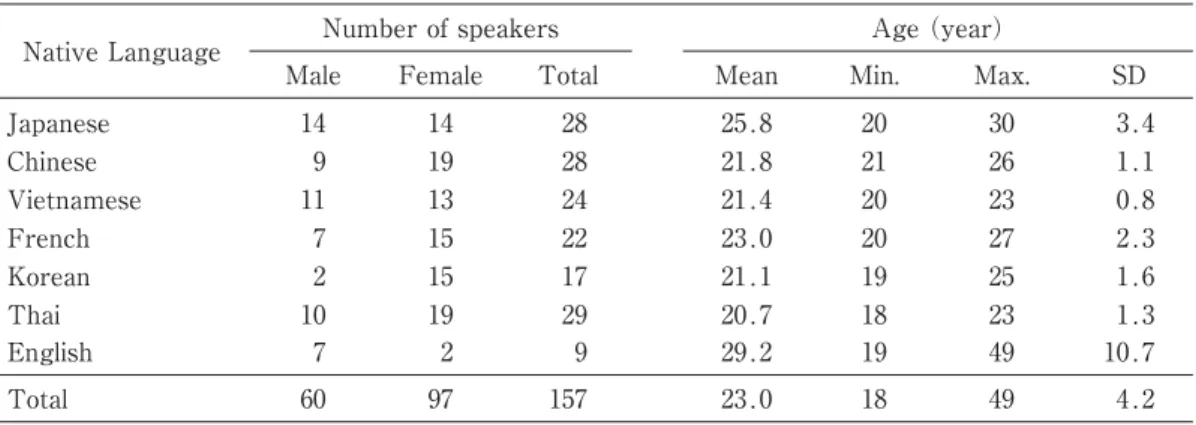
A Japanese read-sentence database was developed with 129 non-native speakers of Japanese, including Korean, Chinese, Thai, Vietnamese, French, and English speakers, and with 28 native speakers of Japanese. Two versions of Aesop;s fable, "The North Wind and The Sun," were used as Japanese sentence materials for recording, and each recorded sentence of the story was registered in the database. The database will contribute to development of a computer-aided language learning system for Japanese speech education of non-native speakers. It will also contribute to scientific research that reveals characteristics of Japanese utterances by non-native speakers in terms of phonemes, prosody, and other aspects of speech.
Keywords : Non-native speaker, read sentence, Japanese
1. INTRODUCTION
Computer-aided language learning (CALL) is an effective and efficient method for language education for non-native speakers. CALL will become more popular with progress in computer technology and increasing Internet use. However, to develop a reliable and high-performance CALL system, a speech database of non- native speakers is necessary as a resource for statistical training and system parameter setting.
Speech databases of non-native speakers have been developed in several languages. For example, English across Taiwan (EAT) (Chen, Yu, & Wang, 2010) is a database for English spoken by Chinese speakers in Taiwan. English Read by Japanese (ERJ) (Minematsu, 2010) is another example database for English spoken by Japanese speakers.
As for the Japanese language, Nishina (2010) constructed a database for utterances of 141 non-native speakers of Japanese, including Chinese, Korean, Thai, Vietnamese, Malaysian, Indonesian, Arabic, Spanish, French, and English speakers. The database contains read speech of sentences, minimal-pair words, and dialogues.
We developed a read-sentence database to supply additional speech data of non-native speakers of Japanese. The database can be expected to contribute to development of a CALL system, as previous databases have done. It will also contribute to scientific research that reveals characteristics of Japanese utterances by non-native speakers in terms of phonemes, prosody, and other aspects of speech.
*
Aichi Shukutoku University
**