Anal ys i s of t he Pat i ent Anxi et y t o Upper Gas t roi nt es t i nal Endos copy
Yoshiyuki HOYA ,Idumi MATSUMURA,and Katsuhiko YANAGA Digestive Endoscopy Service, Kumagaya Geka Hospital Department of Surgery, The Jikei University School of Medicine
ABSTRACT
Purpose:Patients feel anxi ety to gastroscopy. By removing such an adverse feeling,the patient can receive gastroscopy smoothly. We anal yzed the cause and the level of the patientsʼ anxiety to gastroscopy,and examined the necessity of the strategy for such a problem.
Methods:The subjects 24 were all outpatients who underwent gastroscopy at the Kumagaya Geka Hospital from January through April 2005. We investigated by interviewing the indication for gastroscopy,and the cause as well as the change of patient anxiety before and after gastroscopy.
The systolic blood pressure(SBP)of the patient was measured before and after gastroscopy and compared with the values when arriving at the hos pital.
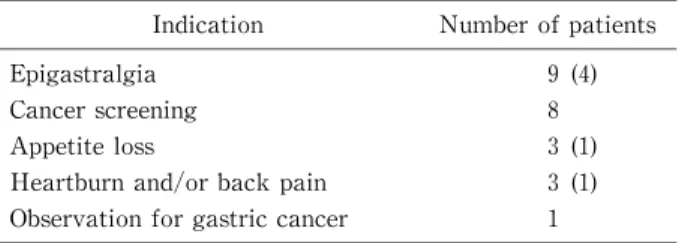
Results:Patientsʼindications for gastroscopy are listed in Table 1. Main reasons for anxiety to gastroscopy are shown in Table 2. The anxiet y evaluated by the face scale score increased by visiting the hospital(from 3.08±0.83 to 3.58±0. 88)(P=0.0011)but improved after gastroscopy (2.42±1.21)(P=0.001). The systolic blood pressures before gastroscopy(146.3±28.3 mmHg)was significantly higher than one at visiting the hos pital(129.5±23.5 mmHg)(P=0.0006),and not improved promptly after gastroscopy(142.5±25. 4 mmHg)(P=0.2727).
Conclusions:Since the patientsʼanxiety to gastroscopy and the systolic blood pressure in- creased before and during gastroscopy,it is important to develop a strategy to minimize anxiety during gastroscopy by some measures and enough consideration. (Jikeikai Med J 2006;53:1‑5)
Key words:gastroscopy,patient anxiety,systolic blood pressure
INTRODUCTION
Recently,upper gastrointestinal endoscopy(gas- troscopy)has become a popular procedure that can be performed safely. The cal iber of the gastroscope has decreased,and the maneuvabi lity has improved.
Therefore,gastroscopy has become much easier to perform. However,it is not a comfortable procedure for the patient. Naturally,t he patient feels anxiety to gastroscopy. By removi ng such an adverse feel- ing,the patient can receive gastroscopy smoothly,and the endoscopist can perf orm gastroscopy without undue tension. In many hos pitals,use of the intra-
venous sedative after throat anesthesia has improved tolerance to gastroscopy. Phar macotherapy can achieve adequate control of patientsʼanxiety during gastroscopy examination. However ,the patientsʼ
anxiety to gastroscopy has not yet been fully inves- tigated today.
In this study,we analyzed the cause and the level of the patientsʼanxiety to gastroscopy with the face scale score and the sys tolic blood pressure and examined the necessity of strategy for such a prob- lem.
Received for publication,October 3,2005 保谷 芳行,松村いづみ,矢永 勝彦
Mailing address:Yoshiyuki HOYA,Department of Surgery,Daisan Hospital,The Jikei University School of Medicine,4‑11‑1, Izumihon‑cho,Komae‑shi,Tokyo 201‑8601,Japan.
1
Jikeikai Med J 2006;53:1‑5
PATIENTS AND METHODS
The subjects 24 were all outpatients to whom I had perform gastroscopy at the Digestive Endoscopy Service,Kumagaya Geka Hos pital on Wednesday from January 2005 through April 2005.
The age of the patients was 64.5±16.7 years,and 8 of them were women.The number of pr evious gastroscopy was 3.71±2.39 times.
The patients who underwent endoscopy for the first time were six.
In this hospital,basically,neither the sedative nor the antispasmodic (butyl s copolamine bromide or glucagon)to inhibit digest ive motility had been used as premedications for gas troscopy,due to hesitation for possible decrease in the cardiopulmonary function.
We investigated by interviewing the patient char- acteristics,the indication for gastroscopy,and the causes as well as changes i n patientsʼanxiety before and after gastroscopy. The patient anxiety level was evaluated by the face scal e score (Fig.1) . The systolic blood pressure of the patient was measured before and after gastroscopy and compared with the values when arriving at the hospital. The Studentʼs paired t‑tests were used f or statistical analysis.Dif- ferences with a p values less than 0.05 were considered significant,and data were pr esented as a mean±stan- dard deviation.
RESULTS
Patientsʼindications for gastroscopy consisted of epigastralgia in 9,secondar y medical examination in 8,appetite loss in 3,hear tburn and back pain in 3 and observation for gast ric cancer in one patient
(Table 1).
Main reasons for anxiety to gastroscopy consist- ed of gastroscopy itself in 17,the state of disease in 5 patients,while the other t wo patients were anxiety free. Moreover main reas ons for anxiety of the patients who underwent endos copy for the first time consisted of gastroscopy it self in all(Table 2).
The anxiety evaluated by the face scale score increased by visiting the hos pital(from 3.08±0.83 to 3.58±0.88)(P=0.0011)but i mproved after gastroscopy (2.42±1.21)(P=0.001)(Fig.2).
The systolic blood pressures before gastroscopy (146.3±28.3 mmHg)was significantly higher than one at visiting the hospital ( 129.5±23.5 mmHg) (P= 0.0006),and not improved promptly after gastroscopy (142.5±25.4 mmHg)(P=0.2727)(Fig.3).
DISCUSSION
It is well‑known that the patient scheduled for gastroscopy is often anxious and frightened. High levels of anxiety may res ult in more difficulty and
Y.HOYA ,et al. Vol.53,No.1 2
Fig.1.Face scale score
0:No anxi ety at all,1:Little anxiety,2:Slight anxiety,3:Moderate anxiety 4:Considerable anxiety,5:Intolerable anxi ety
Table 1. Patientsʼindication for gastroscopy
Indication Number of patients
Epigastralgia 9(4) Cancer screening 8 Appetite loss 3(1) Heartburn and/or back pain 3(1) Observation for gastric cancer 1
():Patients who underwent endoscopy for the first time
Table 2. Main reasons for anxiety to gastroscopy
Main anxiety Number of patients
Procedure itself 17(6) State of disease 5 Anxiety free 2
():Patients who underwent endoscopy for the first time
painful procedures.
The benefit of the use of sedatives as premedica- tion for gastroscopy is to reduce patient anxiety. On the other hand,the risk of cardiopulmonary hypo‑
activity is pointed out in elderly patients . There- fore,the non‑pharmacological and non‑invasive inter- ventions to reduce the patient anxiety are necessary.
In this study,the patients had more anxiety to the procedure itself than the s tate of disease. Neverthe- less,the patientsʼanxiety may be influenced by vari-
ables such as their experience with gastroscopy,symp- toms of disease and patient characteristics.
It is reported that the systolic blood pressure increase by the tension caus ed by anxiety . And our results in this study proved it.Moreover,the systolic blood pressure did not impr ove promptly after gas- troscopy because of response through the endocrine and sympathetic nerve sys tem after the mental stress decreases .
In this study,main reasons for anxiety of the
The Patient Anxiety to Gastroscopy March,2006
Fig.2.Changes in anxiety level
The anxiety evaluated by the face scale score increased by visiting the hospital(from 3.08±0.83 to 3.58±0.88) but improved after gastroscopy(2.42±1.21)(*P=0.0011,**P=0.001).
Fig.3.Changes in systolic blood pressure
The systolic blood pr essures before gastroscopy(146.3±28.3 mmHg)was significantly higher than one at visiting the hospital(129.5±23.5 mmHg)(*P=0.0006) ,and not improved promptly after gastroscopy(142.5±
25.4 mmHg)(**P=0.2727).
3
patients who underwent endoscopy for the first time consisted of gastroscopy it self in all(Table 2). There is a report emphasizing t he importance of detailed written and videotaped inf ormation about the safety and comfort of gastroscopy,es pecially for those who undergo endoscopy for the f irst time,which reduce anxiety and allow better execut ion of gastroscopy . The patientsʼanxiety has increased before and during gastroscopy as judged by t he change of the face scale score and the systolic blood pressure.
There is a report that the visual analog scale such as face scale score was appr opriate as the objective indicator of the anxiety,and we adopt ed it in this research .
It is necessary to offer the optimal soothing envi- ronment to reduce the patientsʼanxieties in the wait- ing room and during gastroscopy. Moreover it was reported that the holistic,al ternative and complemen-
tary approach,lavender odorants ,music interven- tion (Mozartʼs tune etc.) ,and optimal soothing environment were associ ated with reduced mental stress and reported to be ef fective in improving the hospital environment .
In conclusion,the patientsʼanxiety to gastroscopy and the systolic blood pres sure increased before and during gastroscopy,for whi ch a strategy to minimize anxiety and pain during gas troscopy by some mea- sures and enough consideration seems important to improve their compliance.
REFERENCES
1. Abuksis G,Mor M,Segal N,Shemesh I,Morad I,Plaut S,et al. A patient education pr ogram is cost‑effective for preventing failure of endos copic procedures in a gastroenterology department . Am J Gastroenterol 2001;96:1786‑90.
2. Herr KA,Mobily PR,Kohout FJ,Wagenaar D. Evalua- tion of the faces pain scale for use with the elderly. Clin J Pain 1998;14:29‑38.
3. Whaley L,Wong D. Effective communication strategies for pediatric practice. Pedi atr Nurs 1985;11:429‑32.
4. Miro J,Huguet A. Evaluation of reliability,validity, and preference for a pediatric pain intensity scale:the Catalan version of the faces pain scale‑revised. Pain 2004;111:59‑64.
5. Levy N,Landmann L,Stermer E,Erdreich M,Beny A, Meisels R. Does a detailed explanation prior to gastros-
copy reduce the patientʼs anxiety? Endoscopy 1989;21:
263‑5.
6. Abraham NS,Fallone CA,Mayrand S,Huang J,Wiec- zorek P,Barkun AN. Sedation versus no sedation in the performance of diagnostic upper gastrointestinal endos- copy:a Canadian randomized controlled cost‑outcome study. Am J Gastroenterol 2004;99:1692‑9.
7. Hashimoto T,Adachi K,Ishimura N,Hirakawa K, Katsube T,Kurotani A,et al. Safety and efficacy of glucagons as a premedication for upper gastrointestinal endoscopy:a comparative s tudy with butyl scopolamine bromide. Aliment Pharmacol Ther 2002;16:111‑8.
8. Trevisani L,Sartori S,Gaudenzi P,Gilli G,Matarese G, Gullini S,et al. Upper gastrointestinal endoscopy:are preparatory intervention or cons cious sedation effec- tive? A randomized trial. World J Gastroenterol 2004;10:3313‑7.
9. Christe C,Janssens JP,Armenian B,Herrmann F,Vogt N.Midazolam sedation for upper gastrointestinal endos- copy in older persons:a randomaized,double‑blind, placebo‑controlled study. J Am Geriatr Soc 2000;48:
1398‑403.
10. Vollert JO,Stork T,Rose M,Mockel M.Music as adjuvant therapy for coronar y heart disease:therapeu- tic music lowers anxiety,stress and beta‑endorphin concentrations in patients f rom a coronary sport group.
Dtsch Med Wochenschr 2003;128:2712‑6.
11. Falaschi P,Proietti A,De Angelis C,Martocchia A, Giarrizzo C,Biselli R,et al. Effects of mental stress on cardiovascular and endocr ine response in Air Force Academy cadets. Neuro Endocr inol Lett 2003;24:
197‑202.
12. Callaghan P,Chan HC. The effect of videotaped or written information on Chi nese gastroscopy patientsʼ clinical outcomes. Patient Educ Couns 2001;42:225‑
30.
13. Cain AJ,Murray DP,McClymont LG. The use of topi- cal nasal anaesthesia before flexible nasoendoscopy:a double‑blind,randomized cont rolled trial comparing cophenylcaine with placebo. Cl in Otolaryngol Allied Sci 2002;27:485‑8.
14. Motomura N,Sakurai A,Yotsuya Y.Reduction of mental stress with lavender odor ant. Percept Mot Skills 2001;93:713‑8.
15. Hayes A,Buffum M,Lanier E,Radahl E,Sasso C. A music intervention to reduce anxiety prior to gastrointes- tinal procedures. Gastroenterol Nurs 2003;26:145‑9.
16. Chan YM,Lee PW,Ng TY,Ngan HY,Wong LC. The use of music to reduce anxi ety for patients undergoing colposcopy:a randomized t rial. Gynecol Oncol 2003;
91:213‑7.
17. Wesa KM,Grimm RH Jr. Recommendation and guide- lines regarding the preferred research protocol for inves- tigating the impact of an optimal healing environment on patients with hypertension. J Altern Complement Med 2004;10:245‑50.
Y.HOYA ,et al. Vol.53,No.1 4
18. Osuch E,Engel CC Jr. Research on the treatment of
trauma spectrum responses:t he role of the optimal healing environment and neurobiology. J Altern Com- plement Med 2004;10:211‑21.
5 The Patient Anxiety to Gastroscopy March,2006