
高エネルギー物質研究会
羽生 宏人 宇宙航空研究開発機構 (研究会座長)
三宅 淳巳 横浜国立大学大学院 和田 有司 産業技術総合研究所 熊崎 美枝子 横浜国立大学大学院 小駒 益弘 上智大学
田中 邦翁 上智大学 桑原 卓雄 日本大学 高橋 賢一 日本大学 吉野 悟 日本大学 加藤 勝美 福岡大学
和田 英一 宇宙航空研究開発機構 藤里 公司 東京大学大学院
松永 浩貴 横浜国立大学大学院
松本 幸太郎 日本大学大学院
生出 翔 日本大学大学院
永山 清一郎 福岡大学大学院
まえがき
高エネルギー物質研究会は,エネルギー物質に関する研究の基盤強化および利用促進を図るべ く平成21年度より精力的かつ継続的に活動を推進している.
本年度は活動開始以来継続して研究を進めているアンモニウムジニトラミド(ADN)の合成と基 礎熱分解特性,化学安定性を中心に,固体推進薬への適用を考慮した ADN 系固体推進薬の着火特 性に関して検討を行った.
高エネルギー物質に共通する高い吸湿性の改善を目論み,結晶粒子の表面処理に関する研究に も引き続き力を入れた.昨年度の研究では,大気圧プラズマ法を用いると膜厚10ナノメートル 級の超薄膜ポリマ被覆を結晶表面に付着させることに成功し,処理粒子の表面の電子顕微鏡観察 の結果から,鱗片状にポリマが付着していることが明らかとなった.さらにコーティングを強化 することで,高水溶性の硝酸アンモニウム粒子が撥水性を持って水に浮く現象を確認するに至っ た.コーティングの技術については固体推進薬分野に限らず幅広く応用されるポテンシャルを有 していることから,更なる発展を目指して研究を継続する考えである.
高エネルギー物質の研究は多くの課題がある中で一歩づつ着実に成果を挙げている.本研究会 の活動を通じて物質合成の基盤が整備され人材育成も進んだ. 次年度以降も引き続き活動を進め,
より大きな成果につなげたい.
平成25年3月 宇宙航空研究開発機構 宇宙科学研究所 羽生 宏人
目 次
1 Combustion wave structure of ADN-based composite propellant ... 1 Koji Fujisato, Hiroto Habu, Hidefumi Shibamoto, Xiuchao Yu, Atsumi Miyake, Keiichi Hori
2 高性能酸化剤アンモニウムジニトラミドの経時変化に伴う熱挙動の変化... 9 松永浩貴,羽生宏人,三宅淳巳
3 ADN/AN系推進薬中におけるMg-Al粒子の着火特性 ... 23 松本幸太郎,笹木隆史,加藤吉揮,生出翔,高橋賢一,桑原卓雄,于秀超,芝本秀文,羽生宏人
4 ポリマーを含有した硝酸アンモニウム/硝酸カリウム微粒子の調製および吸湿性の評価 ... 33 永山清一郎,加藤勝美,東英子,中野勝之,林政彦,熊谷恒佑,羽生宏人,和田有司,新井充 5 低コストガスジェネレータ推進薬の研究... 41 羽生宏人,加藤勝美,永山清一郎,藤里公司,田中邦翁,小駒益弘,徳留真一郎
平成24年度 研究発表実績等
【査読付論文】
1. H. Matsunaga, H. Habu, A. Miyake, Thermal behavior of new oxidizer ammonium dinitramide, Journal of Thermal Analysis Calorimetry (2012) online published
【表彰】
1. 藤里公司
火薬学会秋季年会講演会優秀講演賞,講演題目 "ADNの燃焼機構",2012.11
【国際会議】
1. Koji Fujisato, Hiroto Habu, Hidefumi Shibamoto, Xiuchao Yu, Atsumi Miyake, Keiichi Hori, A.B.
Vorozhtsov, ”Combustion wave structure of ADN-based composite propellant”, the fifteenth seminar on New Trends in Research of Energetic Materials, Pardubice, the Czech Republic, April 18th – 20th (2012.4)
2. A. Miyake, K. Kajiyama, H. Matsunaga, M. Kumasaki, Thermal behavior of oxidizers for firework and pyrotechnic compositions, 13th International Symposium on Fireworks, Valletta, Malta, April 23-27 (2012)
3. H. Matsunaga, H. Habu, A. Miyake, Influences of aging on thermal decomposition mechanism of new oxidizer ammonium dinitramide, 15th International Congress on Thermal Analysis and Calorimetry (ICTAC 15), Higashi-Osaka, Japan, August 20-24 (2012)
4. Koji Fujisato, Hiroto Habu, Hidefumi Shibamoto, Xiuchao Yu, Atsumi Miyake, Keiichi Hori, A.B.
Vorozhtsov, ”Combustion Mechanism of ADN-Based Composite Propellant”, 43rd International Annual Conference of the Fraunhofer ICT, Karlsruhe, Germany, June 26 – 29 (2012.6)
5. Shinichiro Tokudome, Hiroto Habu, Kyoichi Ui, Fumio Shimizu, Yusaku Yachi and Naruhisa Sano,”Solid Propulsion Systems for Epsilon Launch Vehicle”, 48th AIAA/ASME/SAE/ASEE Joint Propulsion Conference, 2012-4212, (2012.8)
6. Hiroto Habu, Fujisato Koji, Shinichiro Tokudome, Keiichi Hori, Seiichiro Nagayama, Katsumi Katoh, Kunihito Tanaka and Masuhiro Kogoma, “AN-based solid propellant for the launch vehicle side jet system”, 2nd Korean International Symposium on High Energetic Materials, O-16, Sep. 17-20, Inha University, Inchon, Korea, (2012.9)
【国内会議】
7. 羽生宏人,“高エネルギー物質研究戦略”,講演番号1,火薬学会春季年会講演会,慶応大学日吉 キャンパス,2012.5
8. 于秀超,芝本秀文,藤里公司,羽生宏人,堀恵一,“ADN の合成に関する研究”,講演番号19,
火薬学会春季年会講演会,慶応大学日吉キャンパス,2012.5
9. 松永浩貴,羽生宏人,三宅淳巳,“アンモニウムジニトラミドの熱分解に及ぼす硝酸アンモニウム の影響”,講演番号20,火薬学会春季年会講演会,慶応大学日吉キャンパス,2012.5
10. 藤里公司,羽生宏人,芝本秀文,于秀超,三宅淳巳,堀恵一,A.B. Vorozhtsov,“ADN 系推進薬 における添加物の効果”,講演番号21,火薬学会春季年会講演会,慶応大学日吉キャンパス,
2012.5
11. 永山清一郎,加藤勝美,東英子,中野勝之,藤里公司,羽生宏人,徳留真一郎,堀恵一,“硝酸ア ンモニウムを用いた次世代ロケット固体推進薬に関する研究”,講演番号36,火薬学会春季年会 講演会,慶応大学日吉キャンパス,2012.5
12. 永山清一郎,加藤勝美,東英子,中野勝之,原圭一郎,林政彦,羽生宏人,和田祐典,新井充,
“噴霧乾燥法による硝酸アンモニウムの防湿化および相安定化(第1 報)”,講演番号52,火薬学 会春季年会講演会,慶応大学日吉キャンパス,2012.5
13. 永山清一郎,加藤勝美,東英子,中野勝之,羽生宏人,和田祐典,和田有司,塚原祐介,熊谷恒 佑,新井充,“噴霧乾燥法による硝酸アンモニウムの防湿化および相安定化(第 2 報)”,講演番 号53,火薬学会春季年会講演会,慶応大学日吉キャンパス,2012.5
14. 松本幸太郎,笹木隆史,加藤吉揮,生出翔,高橋賢一,桑原卓雄,于秀超,芝本秀文,羽生宏人,
"ADN/AN系推進薬中における金属粒子(Mg/Al等)の着火特性",講演番号16,火薬学会秋季年 会講演会,鹿児島,2012.11
15. 藤里公司,羽生宏人,芝本秀文,三宅淳巳,堀恵一,"ADNの燃焼機構",講演番号31,火薬学会 秋季年会講演会,鹿児島,2012.11 (優秀講演賞受賞)
16. 松永浩貴,羽生宏人,三宅淳巳,"アンモニウムジニトラミドの熱分解生成物解析",講演番号 33, 火薬学会秋季年会講演会,鹿児島,2012.11
17. 永山清一郎,加藤勝美,東英子,中野勝之,林政彦,熊谷恒佑,羽生宏人,和田有司,新井充,"
ポリマーを含有した硝酸アンモニウム/硝酸カリウム微粒子の感度および潮解過程の観察",講演 番号35,火薬学会秋季年会講演会,鹿児島,2012.11
18. 羽生宏人, 永山清一郎, 藤里公司, 加藤勝美, 田中邦翁, 小駒益弘, 徳留真一郎, 堀恵一,“低 コスト型ガスジェネレータ固体推進薬の研究”,講演番号1B15,第56回宇宙科学技術連合講演会,
別府,2012.11
19. 徳留真一郎, 宇井恭一, 清水文男, 和田英一, 羽生宏人, 堀 恵一, 反野晴仁, 中野信之, 佐野 成寿,“イプシロンロケットの推進系”,講演番号 1B03,第 56 回宇宙科学技術連合講演会,別府,
2012.11
20. 松永浩貴, 羽生宏人, 三宅淳巳,“高性能酸化剤アンモニウムジニトラミドの研究”,講演番号 1B16,第56回宇宙科学技術連合講演会,別府,2012.11
(2012年12月時点)
Combustion wave structure of ADN-based composite propellant
Koji Fujisato*, Hiroto Habu**, Keiichi Hori**, Hidefumi Shibamoto***, Xiuchao Yu***, Atsumi Miyake****
*Graduate School of the University of Tokyo, Bunkyo-ku, Japan
** Japan Aerospace Exploration Agency, Sagamihara, Japan
*** Hosoya Pyro-Engineering Co., Ltd., Akiruno, Japan
****Yokohama National University, Yokohama, Japan [email protected]
Abstract:
Combustion characteristics of pelletized ammonium dinitramide (ADN) and ADN-based propellants have been studied. Micron-meter-sized particles of Al, Fe2O3, TiO2, NiO, Cu(OH)NO3, Cu and CuO, and nano-meter-sized Al (Alex) and CuO (nanoCuO) were em- ployed as the additives for pelletized ADN. Only nanoCuO and Alex show the remarkable effects, so they are also added to ADN-based propellant. The binder of ADN-based propel- lant is thermoplastic elastomer (TP), and three kinds of mixtures (TP:ADN = 30:70, 20:80 and 10:90 mass%) were prepared .The burning rates of pelletized ADN and ADN-based propellants were measured under the pressure range from 0.6 to 6.2 MPa, and the surface temperature profiles were obtained about ADN-based propellants. Nano-sized CuO en- hanced the burning rate of pelletized ADN. Alex-incorporated ADN burned with flames even at 0.55 MPa under which pure ADN does not form the flame. Burning rate of non- additive ADN-based propellants has extremely high pressure dependency. In the case of TP/ADN (30:70), burning rate jump are found from the critical pressure approximately 3.2 MPa. The temperature profiles of TP/ADN (30:70) were measured, and the combustion structure was discussed. Both nanoCuO and Alex improved the burning rate characteris- tics, and the pressure exponents are 0.54 and 0.76 respectively.
Keywords: ADN; burning rate; surface temperature; burning rate modifier; nanoparticle
1 Introduction
The development of environmentally friendly propellants should be encouraged in addition to improvements of the prolusion performance. ADN is considered as the most expected sub- stitution of AP because it has the high oxygen balance and formation energy. The manufacture process of ADN has been improved over the last twenty years and the cost has become cheaper than before. In spite of these advantages, ADN has not been put into practical use for solid propellant due to low thermal stability and undesirable combustion characteristics. This re- search aims to comprehend combustion wave structure of ADN-based propellants.
There are several reports about ADN-based propellants. Parr et al. investigated about the
flame structure of ADN/binder-sandwich-propellant with PLIF below 1.5 MPa [1]. It was re-
ported that ADN showed weak diffusion flame that are too far from the surface to control the
burning rate. Price et al. reported the burning behavior of various compositions [2, 3]. They
used PBAN and HTPB as the binder and also investigated about the effects of ultra-fine Fe
2O
3,
Al and Alex as the additive. They concluded that the pressure exponents are high at any com-
position. Korobeinishev et al. studied about Polycaprolactone/ADN propellant and the effect of
CuO as the burning rate catalyst [4]. The stoichiometric composition was formulated and 2
mass% of CuO was added in it. They reported that CuO can suppress the pressure exponent and CuO enhances the condensed phase reaction catalytically. Weiser et al. studied about Par- affin/ADN, and the mass ratio was 10 and 90 % respectively [5]. They measured real-time temperature profile and the gas species during decomposition with UV/VIS and IR spectra.
Menke et al. developed GAP/HMX/ADN propellant [6] and they suggested the new curing system. GAP/HMX/ADN propellant shows practicable pressure exponent (n=0.52). Wingborg et al. conducted the motor test with GAP/ADN (30:70 mass%) propellant [7]. This is the first report of firing test of ADN-based propellant and the specific impulse was 233 s. The same re- search group reported the ballistic properties of ADN/Al/HTPB propellant [8]. The burning rate is 12.8 mm/s at 6 MPa and the pressure exponent is 0.9. These values are almost the same as our experiment [9] of ADN/HTPB propellant which does not contain Al.
Additives are important factor for development of solid propellants. Strunin et al. reported about the effects of additives for ADN-pellet, and they added Al, Cu
2O and K
2Cr
2O
7. K
2Cr
2O
7is effective catalyst for AN, however it has no effects on the burning behavior of ADN. They reported that Al (20 mass%) and Cu
2O (2 mass%) accelerated ADN burning rate.
There are many studies of combustion catalyst for AN, AP and double-base propellant.
Recently, nanoparticles of metal and metal-oxide are attracting attentions as burning rate modi- fiers. These materials were employed in this report. Many kinds of additives are added to ADN-pellet and ADN-based propellant, and the burning rates were measured. In addition, burning surface temperature profiles of ADN-based propellant were obtained to analyze the combustion wave structures.
2 Experimental 2.1 ADN pellets
ADN was synthesized in house and the melting point was 360363 K, which means that the purity is high enough because that of highly purified ADN is 365 K. UV-spectroscopic analyses indicated approximately 96-99 % purity and the impurity was identified as ammoni- um nitrate by the TG-DTA thermal analysis. ADN were ground before mixing with additives.
Micron-meter-sized particles of Al, Fe
2O
3, TiO
2, NiO, Cu(OH)NO
3, Cu and CuO, and nano- meter-sized Al (Alex) and CuO (nanoCuO) were selected for the additives. The content frac- tion of additives is 2.0 parts of ADN. As for Alex and nanoCuO, 0.5 parts-incorporated sam- ples were also prepared. These additives and ADN were mixed in dichloromethane and dried in vacuum. The obtained powder was pressed under 110 MPa, and the density was 1.65-1.75 g/cm3. The diameter of the pellets was 6.0 mm and the length was 20 mm. Samples were burned in a strand burner purged with nitrogen. Burning rate was measured with the pictures recorded with high speed video camera.
2.2 ADN-based propellants
Thermoplastic elastomer (TP) which consists mainly of paraffin was employed as the binder. Rubber-like and low- melting TP shown in Fig. 1 was supplied for this study by Katazen Co., Ltd. It was specially prepared to show the lower melting point than ADN and the melting temperature was 343 K. TP/ADN samples have been prepared by the following procedures, ADN were well mixed with the melt- ed TP at 343 K and the mixture was casted and pressed in a mould. Additives are dispersed in melted TP before addition
of ADN. The strand sample was solidified after cool down
Figure 1: Thermoplastic elastomer2 宇宙航空研究開発機構研究開発報告 JAXA-RR-12-005
to the room temperature. No changes were observed apparently while the propellant was stored at room condition for a month. Table 1 shows the composition of samples. Burning rate was measured with the same method as that of ADN pellet. Surface temperature profiles of TP/ADN (30:70) were also measured. Thermocouples which are Pt Pt/Rh (13 %)-25 m-dia are embedded into the sample.
3 Results 3.1 ADN pellets
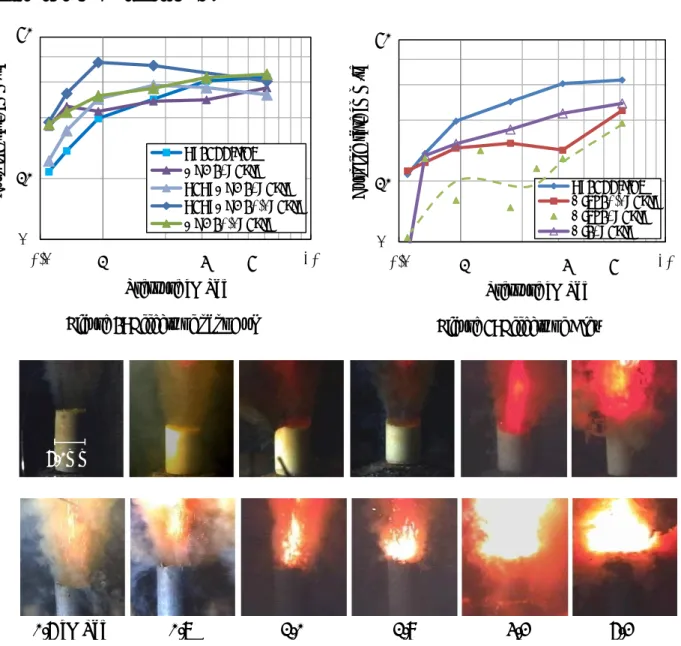
Burning rates of pelletized ADN with and without additives are shown in Fig. 2-5. In Fig.
2, the additives are micron-sized Al, Fe
2O
3, TiO
2, NiO and CuO. Fe
2O
3has the most negative effect among them and the burning rate slows down under all experimented pressures com- pared to no-additive sample. Burning rates of copper compounds are compared at Fig. 3. These additives generate more smoke than no-additive sample during the combustion and darkzones can clearly be seen above 3 MPa. Cu has a little higher effect than CuO above 1 MPa. Cu is easily oxidized by ADN, and the color of the mixed powder turns smoky blue after drying of dichloromethane. The burning rate of Cu(OH)NO
3decreases above 2 MPa. These copper com- pounds generate residues during combustion, and the color was black which seems CuO at all compounds.
In Fig.4 normal CuO and nanoCuO were compared. The mass amounts of additives were 2.0 and 0.5 parts of ADN weight. Burning rates of CuO-0.5 parts sample is a little faster than CuO-2.0 parts. On the other hand, nanoCuO drastically enhance the burning rate particularly below 3.2 MPa. Therefore, nanoCuO is superior to normal CuO to enhance the burning rate.
Table 1: Sample Composition
Sample Binder Oxidizer Additive Mass ratio
TP/ADN (30:70) TP ADN - 30:70
TP/ADN (20:80) TP ADN - 20:80
TP/ADN (10:90) TP ADN - 10:90
TP/AP (20:80) TP AP - 20:80
TP/ADN/Alex TP ADN Alex 30:70:2
TP/ADN/nanoCuO TP ADN nanoCuO 30:70:2
5
0.5 10
no_additive Al_2parts CuO_2parts Fe2O3_2parts TiO2_2parts NiO_2parts
5
0.5 10
no_additive Cu_2parts CuO_2parts Cu(OH)NO3_2parts
Figure 2: Effects of copper compound Figure 3: Effects of normal additives
50
10
50
Burning rate [mm/s] 10
Burning rate [mm/s]
1 3 5 1 3 5
Pressure [MPa]
Pressure [MPa]
3 高エネルギー物質研究会 平成 24 年度研究成果報告書
In Fig.5, burning rates of samples incorporated with Alex were shown. Alex was added 0.5 and 2.0 parts of ADN weight. Alex-0.5 parts was close to normal Al-2.0 parts. Figure 6 is re- corded photos of ADN (upper) and ADN incorporated with 0.5 parts-Alex (lower). ADN does not form the flame below 1.8 MPa, however Alex can be ignited in the gas phase even at 0.55 MPa and it helps to form the flame at higher pressure. The results of Alex-2.0 parts are scat- tered below 3.2 MPa because the burning rates vary depending on the presence or absence of flames. A little different of the experimental condition influences the formation of flame. In the case of Alex, combustion residues are not found though normal Al agglomerates and it remains inside the combustion chamber.
3.2 ADN-based propellants
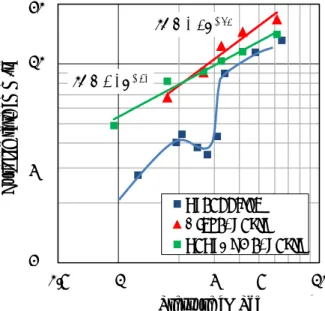
The linear burning rates were plotted in Fig.7. The results of TP/ADN (20:80) and (30:70) increases from approximately 3 MPa. TP/ADN (10:90) has not measured enough, but accord- ing to Weiser et al. Paraffin/ADN (10:90) [5], which is almost the same composition as TP/ADN (10:90) shows plateau between 2 and 3 MPa and the trend changes and increases from 3 MPa. The surface temperature profiles of TP/ADN (30:70) were obtained with 50 m- dia-thermocouples and the results are shown in Fig.8. Temperature-constant-region was found at 1.3 and 2.1 MPa, and the temperature was between 700 and 800 K. However, there is no
5
0.5 10
no_additive Alex_0.5parts Alex_2parts Al_2parts
5 0.5 10
no_additive CuO_2parts nanoCuO_2parts nanoCuO_0.5parts CuO_0.5parts
Figure 4: Effects of nanoCuO Figure 5: Effects of Alex
Figure 6: Photos of ADN (upper) and Alex-incorporated ADN (lower)
0.6 [MPa] 0.7 1.0 1.8 3.2 6.2
50
10
50
Burning rate [mm/s] 10
Burning rate [mm/s]
Pressure [MPa]
Pressure [MPa]
1 3 5 1 3 5
6.0mm
4 宇宙航空研究開発機構研究開発報告 JAXA-RR-12-005
such region at 4.8 MPa. Figure 9 is the result measured with 25 m-dia-thermocouple at 3 and 4 MPa where the burning rate behavior changes.
Stepwise curve are found at the temperature range 750-1050 K on the result of 3 MPa The adiabatic temperature seems to be around 1800 K on both profiles.
Figure 10 shows the burning rate of TP/ADN (30:70) with Alex and nanoCuO. Both additives enhanced the rates and peculiar behav- ior between 2.1-3.4 MPa was improved. The pressure exponents were 0.76 and 0.54, respec- tively. TP/ADN/Alex extinguishes at 0.95 MPa.
nanoCuO has little effect above 3 MPa, however it enhances below 3 MPa and stable combustion is observed even at 0.95 MPa.
4 Discussion
ADN-based propellant show high pressure exponent in all of the compositions (Fig. 7). The burning rate behavior involves plateau and mesa type. Particularly, TP/ADN (30:70) shows the burning rate jump between 3 and 4 MPa.
nanoCuO and Alex enhanced the burning rate of both pelletized ADN and ADN-based propel- lants. It is important to comprehend the mecha- nism to improve their characteristics.
In Fig. 9, gasification temperatures can be found at 1050 K on the profile of 3 MPa, and 750 K at 4 MPa. The temperature difference is wide though the pressure increases only 1 MPa.
The combustion wave structure changes at this pressure. Below the gasification point, there is a noticeable difference between 3 MPa and 4 MPa,
50
20 10
2 1
㼞㼎㻌㻩㻌㻠㻚㻢㻼㻜㻚㻣㻢㻌
㼞㼎㻌㻩㻌㻡㻚㻠㻼㻜㻚㻡㻠㻌
㻜㻚㻡㻌 㻝㻜㻌
no_additve Alex_2parts nanoCuO_2parts
Burning rate [mm/s]
Distance [mm]
Temperature[K]
Distance [mm]
X
Figure 7: Burning rate of TP/ADN and TP/AP
Figure 8: Surface temperature of TP/ADN
(30:70) at 1.3, 2.1 and 4.8 MPa Figure 9: Surface temperature of TP/ADN (30:70) at 3 and 4 MPa
Temperature[K]
20
10
3
1
Burning rate [mm/s]
Pressure [MPa]
0.4 1 3 5 10 20 Pressure [MPa]
0.5 1 3 5 10
Figure 10: Effect of Alex and nanoCuO for burning rate of TP/ADN (30:70)
1050K 750K Gasification
point 3MPa
4MPa 2.1MPa
1.3MPa 4.8MPa
Gasification
point
5 高エネルギー物質研究会 平成 24 年度研究成果報告書
which is indicated as zone X on Fig. 9. The temperature range is approximately from 750 to 1050 K and the width is 50 m, which close to ‘Aerosol zone’ reported by Sinditskii et al [10].
According to the report, aerosol zone is between burning surface and first flame zone on pelletized ADN combustion. The initial temperature of aerosol zone is the range of 850 900 K at 3 MPa. This value is about 100 – 150 K higher than the initial temperature of zone X. The first reaction depends only on the heat of condensed phase reaction, and it is not influenced by heat feedback from the gas phase, thus the achieving temperature can be calculated by specific heat of ADN (2.0 J/g ・ K) referred from [10] and that of binder (2.2 J/g ・ K). The calculated tem- perature of ADN/TP (70:30) is between 671 and 706 K. This is good agreement because the binder does not become the same temperature as ADN, and the calculated temperature should be lower than experiments. The final temperature of aerosol zone which equals the initial tem- perature of first flame zone is 1300 K in the case of pelletized ADN. This temperature depends on the composition, and in the case of ADN/TP (70:30) it seems to be 1050 K at 3 MPa be- cause each experiment at 3 MPa shows the same temperature though at 4MPa it changes varia- ble. Aerosol zone of pelletized ADN become narrow upper 4MPa and can be found as the break of the temperature profile. In Fig. 9, the small broken line can be recognized just below the gasification point, and the temperature is 750 K. It shold be more studied why aerosol zone disappears at 4MPa. However one reason can be raised from Fig.8. Comparing 1.3 and 2.1 MPa above the gasification point, the temperature gradient increases with the pressure increase.
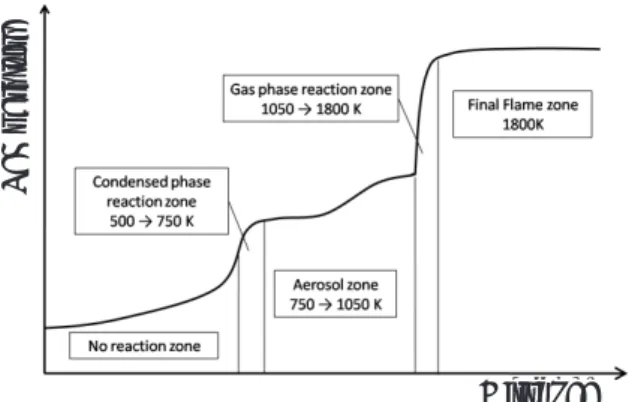
Accordingly, the increased heat feedback from gas phase reaction goes through the aerosol zone. Once the flame achieves the condensed phase reaction zone, it might be difficult that aerosol zone be formed again. From the above discussions, the combustion wave structures can be described like Fig. 11 and 12. Zone X is written as aerosol zone.
First reaction occurs quickly at condensed phase at 500 K or lower and the temperature is raised to 700 – 800 K. It is sometimes difficult to find this zone at higher than 4 MPa. Next step is slower than condensed phase reaction, and it is known as aerosol zone or fizz zone for double-base propellants. Decompositions proceeds relatively slowly, and the temperature grad- ually increases below 3 MPa. When the temperature reaches the ignition point which seems to be 1050 K, the gas reactions start. It is the important point that ADN is not directly heated by the gas phase reaction. It might be covered by the melting binder in the aerosol zone. On the other hand, aerosol zone is not be formed upper 4 MPa at which the heat feedback enhances the degradation of ADN directly, and the gasification becomes very high rate and the binder is blown off before enough mixing with ADN and degradation. It can be confirmed by Fig. 9 and 8. At Fig. 9, the gas reaction zone of 4 MPa is wider than that of 3 MPa, and the achieving temperature of gas phase reaction zone is 1600 and 1700 K, respectively. At 3 MPa, ADN and binder are well mixed each other in the aerosol zone, so it takes shorter time for reaction and
Distance Distance
Temperature
Temperature
Figure 11: Conbustion wave structure (P < 3 MPa) Figure 12: Conbustion wave structure (P > 4MPa)
6 宇宙航空研究開発機構研究開発報告 JAXA-RR-12-005
the achieving temperature becomes higher than 4 MPa. At Fig. 8, the rate of temperature in- crease of 4.8 MPa is slower than that of 2.1 and 1.3 MPa. Gas phase reaction is different from pelletized ADN because the released gases are pre-mixed. This reaction is faster and the reac- tion heat is higher than pelletized ADN, thus the temperature gradient and heat feedback are high.
The contribution of additives for combustion wave structure of ADN-based propellant is future work.
5 Conclusion
nanoCuO and Alex has remarkable effets on the burning behavior of pelletized ADN and ADN-based propellant. nanoCuO is the most effective to enhance the burning rate of pelletized ADN particularly below 3 MPa, and more effective than normal CuO. Alex was ignited in the gas phase even at low pressures under which pure ADN does not form the flame.
Burning rates of ADN-based propellants were obtained and they have critical pressure be- tween 3 and 4MPa. The combustion wave structure of ADN-based propellants was presented based on the surface temperature measurements.
References
[1] T. P. Parr, D. M. Hanson-Parr, Solid Propellant Diffusion Flame Structure, Twenty-Sixth Symposium (International) on Combustion, p. 1981-1987, 1996.
[2] E. W. Price, S. R. Chakravarthy, J. M. Freeman, Combustion of Propellants with Ammo- nium Dinitramide, A98-35220. 34
thAIAA/ASME/SAE/ASEE Joint Propulsion Conference, Cleveland, July 13-15, 1998
[3] Satyanarayanan R. Chakravarthy, Jeffrey M. Freeman, Edward W. Price, Robert K.
Sigman, Combustion of Propellants with Ammonium Dinitramide, Propellants, Explosives, Pyrotechnics, 29, No. 4, 2004
[4] O. P. Korobeinichev, A. A. Paletsky, A. G. Tereschenko, E. N. Volkov, Combustion of Ammonium Dinitramide/PolyCaprolactone Propellants, Proceeding of the Combustion In- stitute, p. 2955-2961, Vol 29, 2002
[5] Volker Weiser, Norbert Eisenreich, Andrea Baier, Wilhelm Eckl, Burning Behaviour of ADN Formulations, Propellants, Explosives, Pyrotechnics, p. 163 – 167, 24, 1999
[6] Klaus Menke, Thomas Heintz, Wenka Schweikert, Thomas Keicher, Horst Krause, For- mulation and Properties of ADN/GAP Propellants, Propellants, Explosives, Pyrotechnics, p. 218 – 230, 34, 2004
[7] Niklas Wingborg, Sten Andreasson, John de Flon, Mats Johnsson, Mattias Liljedhl, Carl Oscarsson, Ake Pettersson, Marita Wanhatalo, Development of ADN-based Minimum Smoke Propellants, AIAA2010-6586, 46
thAIAA/ASME/SAE/ASEE Joint Propulsion Con- ference, Nashville, July 25-28, 2010
[8] John de Flon, Sten Andreasson, Mattias liljedahl, Carl Oscarson, Marita Wanhatalo, Niklas Wingborg, Solid Propellants based on ADN and HTPB, AIAA2011-6136, 47
thAIAA/ASME/SAE/ASEE Joint Propulsion Conference, San Diego, July 31 – Aug 03 , 2011 [9] Koji Fujisato, Hiroto Habu, Hidefumi Shibamoto,Xiuchao Yu, Atsumi Miyake, Keiichi
Hori, Combustion characteristics of ADN-based solid propellants, S1c-64, Europyro2011, Reims, France, May, 2011
[10]Valery P. Sinditskii, Viacheslav Y. Egorshev, Anton I. Levshnkov, and Valery V.
Serushkin, Combustion of Ammonium Dinitramide, Part2: Combustion Mechanism, Jour- nal of Propulsion and Power, Vol22, No. 4, July-August 2006
7 高エネルギー物質研究会 平成 24 年度研究成果報告書
高性能酸化剤アンモニウムジニトラミドの経時変化に伴う熱挙動の変化 松永 浩貴*1,羽生 宏人*2,三宅 淳巳*1
Changes of thermal behavior of high performance oxidizer ammonium dinitramide with aging Hiroki Matsunaga*1, Hiroto Habu*2, and Atsumi Miyake*1
ABSTRACT
Ammonium dinitramide (ADN) is one of the promising new energetic oxidizers for solid propellant. For practical use of ADN, one of the important characteristics is chemical stability. ADN is known to degrade to ammonium nitrate (AN) during long term storage, which will affect to performance of rocket motor. In this study, to get better information about aging effects on thermal behavior of ADN, thermal behavior and decomposition gases from ADN and nitrates mixtures during constant rate heating were measured. From the results of these analyses about ADN and nitrates mixtures, the exotherm and gas generation at low temperature side could not be observed.
Two possible reasons were proposed, decrease in the acidity of the material due to the presence of AN, or inhibition of the acidic dissociation of dinitramic acid by NO3-.
Keywords: ammonium dinitramide, solid propellant, thermal decomposition, aging 概要
アンモニウムジニトラミド(ADN)は固体ロケット推進薬の新規高エネルギー酸化剤とし て期待されている物質の一つである。固体ロケット推進薬での実用に向け重要な情報の一 つに化学的安定性が挙げられる。ADNは長期間貯蔵すると硝酸アンモニウム(AN)に分解す ることが知られており,それによりロケットモーターの性能低下につながる可能性がある。
本研究では,経時変化が ADN の熱分解に与える影響を検討するため,ADN/硝酸塩混合物 の定速昇温時の熱挙動および分解生成ガスの分析を行った。ADN/硝酸塩混合物では低温側 での発熱およびガス生成が観測されなかった。その要因として,硝酸塩による系の酸強度
*1 横浜国立大学大学院 環境情報研究院・環境情報学府
(Graduate School of Environment and Information Sciences, Yokohama National University)
*2 宇宙航空研究開発機構 宇宙科学研究所 宇宙飛翔工学研究系
(Division for Space Flight Systems, Institute of Space and Astronautical Science, Japan Aerospace Exploration Agency)
の低下およびジニトラミド酸の酸解離の抑制が考えられた。
1. はじめに
固体ロケット推進薬の酸化剤は熱分解により高温の酸化性ガスが生成することが求めら れる。現在の固体推進薬は,高い酸素バランス,エネルギー密度を有し,低価格であるこ とから,過塩素酸アンモニウム(AP, NH4ClO4)を酸化剤とした AP 系推進薬が世界中で広く 用いられている。
しかし,APは燃焼ガスとして塩酸を生成するため,発射場周辺などの環境負荷が予てか ら指摘されている。さらに,APを始めとした過塩素酸塩類を規制する方針が米国環境保護 庁より発表される(EPA,2011年)など,昨今APは排出塩酸以外にも環境問題に対してネガ ティブな材料と指摘されるようになった。そのため,高エネルギーかつ環境負荷の小さい 固体推進薬の開発が求められている。固体推進薬による環境負荷低減のためにはハロゲン フリー化が必要であり,唯一の解決策は他のエネルギー物質によるAPの代替である。これ までに高性能で低環境負荷である推進薬の開発に向け多くの研究が行われてきた1-12).
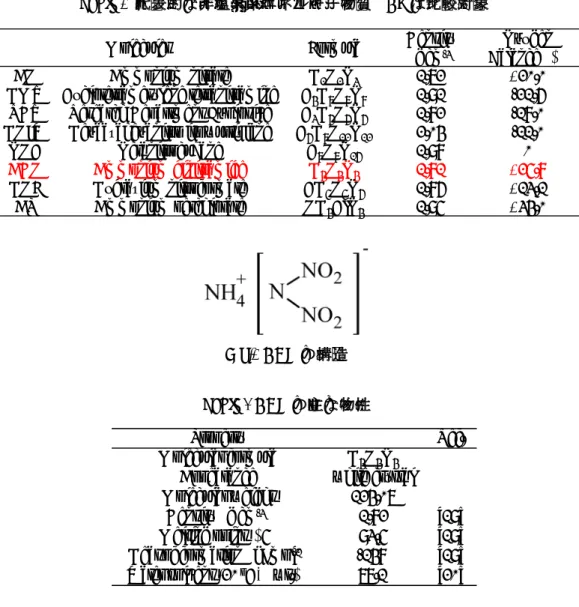
Table 1にハロゲンを含まないエネルギー物質の代表的な化合物を示す。この中で酸化剤
としての適用の可能性があるのは,酸素バランスが正である物質である。硝酸アンモニウ ムNH4NO3(AN)は古くから知られている物質で,ハロゲンフリーの酸化剤であり,APと比 較して低価格で安全性が高いという利点があるが,エネルギー密度および燃焼性が低いと いう欠点がある。アンモニウムジニトラミド[ADN, NH4N(NO2)2, Fig.1] 13-15)は新規高エネル ギー酸化剤として特に期待されている物質である。ADNの主な物性をTable 2に示す。ADN はハロゲンフリー,高エネルギー密度,高酸素バランスであることから,APに代わる固体 ロケットの酸化剤として期待されている。
本研究では,ADN 系推進薬の実用化に向け,まず ADN の基礎的な特性の把握を行うこ ととした。固体推進薬に求められる性質の一つとして,貯蔵時の安定性が挙げられる。固 体ロケット推進薬に用いられるエネルギー物質は貯蔵中に徐々に分解して性質が変化し,
それがロケットモーターの性能や安全性の低下につながることが懸念される。したがって,
貯蔵時の分解メカニズム,分解速度,貯蔵後の試料の性能について把握する必要がある。
これまでの研究で ADN は長期貯蔵中に硝酸アンモニウム(AN)に分解することがわかった
16)。また,ANを混合すると,ADN推進薬の着火遅れ時間が大きくなること17)およびADN の燃焼速度が著しく低下すること18)が報告されている。本研究では,ADNの熱分解機構に 与える経時変化の影響について検討した。
10 宇宙航空研究開発機構研究開発報告 JAXA-RR-12-005
Table 1 代表的な非塩素系エネルギー物質 (APは比較対象)
Molecules Formula Density
/ g cm-3 Oxygen
Balance /%
AN Ammonium nitrate H2N2O3 1.72 +20.0
HMX Cyclotetrametylene tetranitramine C4H8N8O8 1.91 -21.6 RDX Research Department Explosive C3H6N6O6 1.82 -18.0 HNIW Hexaazahexanitro isowurtiziane C6H8N12O12 2.04 -11.0
ONC Octanitrocubane C8N8O16 1.98 0
ADN Ammonium dinitramide H4N4O4 1.81 +25.8 HNF Hydrazium nitroformate CH5N5O6 1.86 +13.1
AP Ammonium perchlorate NH4ClO4 1.95 +34.0
Fig.1 ADNの構造
Table 2 ADNの主な物性
Property Ref.
Molecular formula H4N4O4 Appearance white crystal Molecular weight 124.07
Density /g cm-3 1.82 [19]
Melting point /℃ 93.5 [19]
Heat of formation /kJ mol-1 -148 [19]
Water solvent (20oC) /wt.% 78.1 [20]
・ ADNの熱分解機構
ADN の熱分解機構については,これまでに様々な方法を用いて多くの検討が行われてき た10, 21-31)。これらの研究によれば,ADN は N2O,NO2,NO,NH4NO3(AN),HNO3,N2, HONO,H2O,NH3など様々な物質へ分解するとされている。
昨年度の報告 31)では,示差熱天秤-赤外分光分析(TG-DTA-IR),示差熱天秤-質量分析 (TG-DTA-MS)を用い,定速昇温時(5 K min-1)の熱挙動,生成ガスの同時測定を行った。ADN のTG-DTA-MS測定結果をFig.2に示す。既往の研究10, 21-30)と合わせて,昇温中のADNの 熱分解機構を以下のように推定した。
まず,ADNは約90℃ で融解し,他のアンモニウム塩と同様にNH3とHDN[HN(NO2)2]に 解離する[式(1)]。
NH
4N(NO
2)
2→ NH
3+ HN(NO
2)
2 (1)11 高エネルギー物質研究会 平成 24 年度研究成果報告書
続いて,低温側(150-175C)ではHDNの一部が分解する。HDNは強力な酸(pKa=-5.6)32)で あるため,式(2)のようにHDNは自身によって分解が促進する。
HN(NO
2)
2 H
N
2O NO
2 H
2O N
2O HNO
3 H
(2) 170Cの残留物の分析においてANの存在が確認されたことから,低温側では式(3)のよう なANの生成反応も進行する。
NH
3 HNO
3 NH
4NO
3 (3)また,生成ガス分析において NH3が観測されず,これらの反応は凝縮相中での反応である と考えられる。
高温側では,2種類の反応の進行が観測された。1つ目はHDNのN2Oと凝縮相成分への 分解である。低温側とは異なるガス生成挙動を示したことから,低温側とは異なる機構で の反応であると考えられる。2つ目の反応はHDNの分解により生じたAN,HNO3,NH3の NO2,N2,H2Oへの分解反応である。高温側の反応で凝縮相中のすべての物質がガスへ分解 する。
本報告では,以上の分解機構を基にADNの経時変化生成物のANが及ぼす影響について 検討した。
0 50 100 150 200 250 300 350
0 20 40 60 80 100
Weight[%]
Temperature [oC]
EndoExoDTA m/z=18
m/z=30 m/z=44 m/z=46 m/z=17
m/z=28
Intensity [-]
Fig.2 ADNのTG-DTA-MS測定結果
2. 実験方法
測定試料として細谷火工製のADNおよび和光純薬工業製のAN,硝酸カリウム(KN),硝 酸ナトリウム(NaN),SiO2,-AlO4を精製せずにそのまま用いた。ANはADNの経時変化生
0 50 100 150 200 250 300 350
0 20 40 60 80 100
Mass loss /%
Temperature /oC
EndoExoDTA m/z=18
m/z=30 m/z=44 m/z=46 m/z=17
m/z=28
Intensity /-
Fig.2 ADNのTG-DTA-MS測定結果 12 宇宙航空研究開発機構研究開発報告 JAXA-RR-12-005
50 100 150 200 250 300 350 ADN/AN=0/10
ADN/AN=3/7 ADN/AN=5/5 ADN/AN=8/2 4 W g-1
ADN/AN=10/0
Temperature /oC
Heat flow /W g-1
成物である16)ことから,ADNと混合することで長期貯蔵後のADNを再現した。KN,NaN, SiO2,α-AlO4は比較対象としてADNと混合した。
熱分解特性把握のため,Mettler Toledo社製HP DSC827eを用いた密封セル-示差走査熱量 測定(SC-DSC)による昇温試験を行った。SII社製SUS303セルに試料を約1.5 mg秤量して密 封し,温度範囲を25-350℃,昇温速度を1,3,5,10 K min-1とした。
定速昇温時の熱分解生成ガスを把握するため,示差熱天秤-赤外分光分析(TG-DTA-IR), 示差熱天秤-質量分析(TG-DTA-MS)を用いた。TG-DTA-IR では,島津製作所製示差熱天秤 DTG-50に島津製作所製IRPrestige-21を接続した複合装置を用いた。試料約4 mgをアルミ ニウム開放セルに秤量し,昇温速度5 K min-1,到達温度300 ,キャリアーガスをAr(20 mL
min-1)とした。TG-DTA-MS はリガク製示差熱天秤 TG8120 に島津製作所製ガスクロマトグ
ラフ質量分析計GCMS-QP2010を接続し行った。試料約4 mgをアルミニウム開放セルに秤 量し,昇温速度5 K min-1,到達温度300 ,キャリアーガスをHe(200 mL min-1)とした。
3. 結果と考察
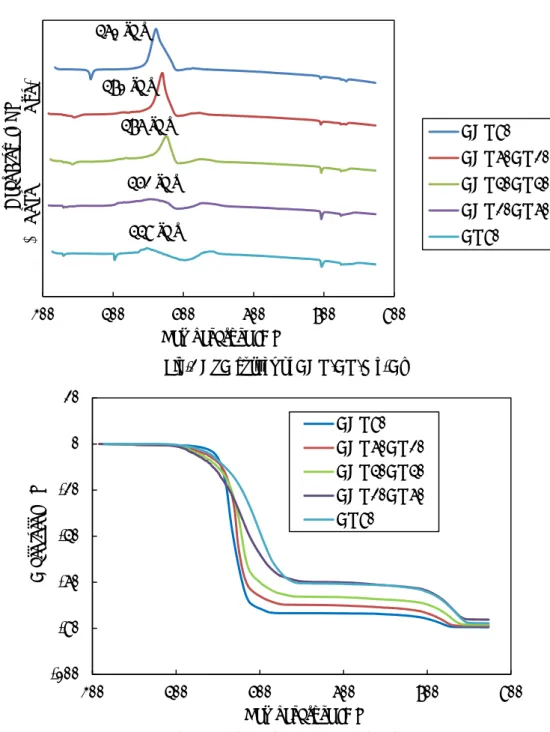
ADN/AN(10:0,8:2,5:5,3:7,0:10,重量比)のSC-DSC(5 K min-1)の測定結果をFig.3に示 す。ADNを含む試料では,130-210 oC (第1ピーク) でADNの分解,210-260 oC (第2ピー ク) でADNの分解生成物であるANの分解に由来するとされる発熱16, 22)が観測された。第 1ピークの発熱開始温度TDSC,ピーク温度Tp,発熱量QDSCをTable 3に示す。AN混合によ り,融点の低下,TDSC,Tpの上昇,QDSCの低下が観測された。TDSC,Tp,QDSCの変化量は,
ANの割合増加とともに大きくなった。また,ADNの第 1 ピークでは複数の発熱が重なっ て観測されたが,ADN/ANでは1段階のみ観測された。以上のように,ANを加えることに よりADNの熱分解挙動が変化することがわかった。
Fig.3 ADN/ANのDSC曲線
Decomposition of ADN
℃
℃
13 高エネルギー物質研究会 平成 24 年度研究成果報告書
Table 3 ADN/ANのDSC測定結果 Sample
(Weight ratio) TDSC /oC Tp/oC QDSC /kJ g-1 ADN/AN (10/0) 124 161, 177 2.2
ADN/AN (8/2) 133 178 1.9
ADN/AN (5/5) 140 185 1.6
ADN/AN (3/7) 155 200 0.7
次に,AN混合時の熱挙動の変化について,①変化の要因,②反応機構への影響,③反応 性への影響を検討した。
① 熱挙動変化の要因
AN を混合した試料において観測された熱挙動の変化が AN由来であるか,ADN 量由来 であるかを把握するため,ADN に等重量比(8:2)で AN,SiO2,-AlO4を混合した試料につ
いてSC-DSC昇温試験を行い,結果を比較した。ADN単体および重量比8:2の各混合試料
のDSC測定結果をFig.4に,TDSC,Tp,QDSCをTable 4に示す。QDSCの低下はどの混合試料 においても観測された。したがって,これはADN量に由来する変化であることが示された。
一方,融点低下,TDSC,Tpの上昇,ピーク形状の変化は ADN/ANにおいてのみ観測され,
ANの影響であることがわかった。
50 100 150 200 250 300 350
ADN/Al2O3=8/2 ADN/SiO2=8/2 ADN/AN=8/2 4 W g-1
ADN
Temperature /oC
Heat flow /W g-1
Fig.4 ADN,ADN/AN,ADN/SiO2,ADN/-Al2O3のDSC曲線
Decomposition of ADN
14 宇宙航空研究開発機構研究開発報告 JAXA-RR-12-005
Table 4 ADN,ADN/AN,ADN/SiO2,ADN/-Al2O3のDSC測定結果 Sample
(Weight ratio) TDSC /oC Tp/oC QDSC /kJ g-1 ADN/AN (10/0) 124 161, 177 2.2
ADN/AN (8/2) 133 178 1.9
ADN/SiO2(8/2) 120 163 1.9
ADN/-Al2O3(8/2) 127 170 2.0
さらに,ADN/KN,ADN/NaNについても熱挙動の観測を行い,ADN/ANと比較した。ADN
単体およびADN/硝酸塩(7:3,モル比)のDSC測定結果をFig.5に,TDSC,Tp,QDSCをTable 5 に示す。ADN/KN,ADN/NaNにおいてもADN/AN同様,TDSC,Tpの上昇,ピーク形状の変 化が観測された。したがって,これらの変化の要因の一つとしてNO3-の影響が考えられた。
50 100 150 200 250 300 350
ADN/NaN ADN/KN ADN/AN 4 W g-1
ADN
Temperature /oC
Heat flow /W g-1
Fig.5 ADN,ADN/AN,ADN/KN,ADN/NaNのDSC曲線
Table 5 ADN,ADN/AN,ADN/KN,ADN/NaNのDSC測定結果 Sample
(mole ratio) TDSC /oC Tp/oC QDSC /kJ g-1 ADN/AN (10/0) 124 161, 177 2.2
ADN/AN (7/3) 137 178 1.9
ADN/KN (7/3) 131 185 1.6
ADN/NaN (7/3) 126 200 0.7
Decomposition of ADN
15 高エネルギー物質研究会 平成 24 年度研究成果報告書
② 反応機構への影響
ADNの熱分解機構への影響を検討するため,ADN/ANについてTG-DTA-MS昇温試験(5 K min-1)を行い,ADN単体と比較した。ADN/AN(7:3,モル比)の測定結果をFig.6に示す。ADN
単体ではFig.2のように2段階の発熱,重量減少および3段階のガス生成が観測された。一
方ADN/ANでは,昨年度報告したADN/AN (6:4,重量比)の結果31)と同様,発熱および重量 減少は1段階のみ観測され,そのピーク温度はADN単体の高温側のピークと類似であった。
生成ガスの質量分析の結果,ガス生成についても低温側では観測されず,生成割合も変化 した。また,ADNおよびADN/ANの熱分解生成ガスの赤外分光分析の結果をFig.7,8に示 す。赤外スペクトルからはANを混合した場合でも生成ガスの種類に変化は観測されなかっ た。以上より,AN は ADN の熱分解機構に影響を及ぼすこと,特に低温側における ADN のN2Oへの分解反応[式(6)]を抑制することが考えられた。
0 50 100 150 200 250 300
100806040200
Mass loss /%
Temperature /oC
EndoExoDTA
m/z=18
m/z=30 m/z=44 m/z=46 m/z=17
m/z=28
Intensity /-
Fig.6 ADN/AN(7:3,モル比)のTG-DTA-MS測定結果 16 宇宙航空研究開発機構研究開発報告 JAXA-RR-12-005
4000 3500 3000 2500 2000 1500 1000 H2O
H2O
N2O
NO2 NO2
N2O
N2O
Wave number /cm-1
Absorbance /-
N2O
Fig.7 ADNの熱分解生成ガスのIRスペクトル
4000 3500 3000 2500 2000 1500 1000
Absorbance /-
Wave number /cm-1 H2O H2O
N2O
NO2 NO2
N2O
N2O N2O
Fig.8 ADN/AN(7:3,モル比)の熱分解生成ガスのIRスペクトル
また,ADN/KNのTG-DTA-MS(5 K min-1)の測定結果をFig.9に示す。混合比はADN/AN 同様,モル比で7:3である。ADN/AN同様に,低温側の発熱,重量減少,ガス生成が観測さ れなかった。さらに,ADN/NaNについても同様の結果が得られた。これらの結果より,ADN の低温側での熱分解反応[式(6)]がNO3-の影響により抑制されることが考えられた。
17 高エネルギー物質研究会 平成 24 年度研究成果報告書
0 50 100 150 200 250 300 100806040200
Mass loss /%
Temperature /oC
EndoExoDTA m/z=18
m/z=30 m/z=44 m/z=46 m/z=17
m/z=28
Intensity /-
Fig.9 ADN/KN(7:3,モル比)のTG-DTA-MS測定結果
以上の結果より,ADNの低温側の熱分解反応が観測されなくなった理由を考察した。
まず,昨年度の報告31)でも挙げた酸強度の影響が考えられる。上述のように,ADNの分 解反応は酸により促進される24)。ADN は融解し,NH3とHDNに解離するとされている。
HDNは強力な酸(pKa=-5.62)である 32)ため,ADNの分解が促進される。一方,ADN/AN 混 合物は, ADNとANが同時にそれぞれHDNとHNO3(pKa=-1.3)に解離する。HDNと比べ 酸強度の低いHNO3に混合することで系の酸強度が低下し,低温側の反応[式(6)]が抑制され ることが考えられる。
酸強度の低下のほかの要因としてNO3-の影響が考えられる。式(6)におけるH+はHDNの 酸解離により供給される。しかし,NO3-の存在により式(8)の反応によりHDNの酸解離が抑 制され,式(6)の分解反応が抑制されることが考えられる。
- 3 2 3
2
2
) NO N(NO ) HNO
HN(NO
2
(8)③ 反応性への影響
AN がADNの熱に対する反応性へ与える影響を検討するため,SC-DSCより得られた結 果を用いて速度論解析を行った。ADN/AN(10:0,8:2,6:4,5:5,3:7,重量比)について昇温 速度1,3,5,10 K min-1で測定を行い,得られた発熱挙動をFriedman法33)により解析した。
Fig.10に解析により得られたADN/ANの熱分解における反応率と活性化エネルギーの関係
を示す。反応率<0.15についてはADN:ANが10:0から5:5の試料については活性化エネル 18 宇宙航空研究開発機構研究開発報告 JAXA-RR-12-005
ギーがANの増加に伴い増大する傾向にあった。一方,ADN:AN=3:7の試料ではこの傾向は 観測されなかった。したがって,AN を混合すると,ADN 量が大きいとき,反応初期にお ける反応性が低下することが考えられた。また,α>0.15では AN量と活性化エネルギーに は相関は観測されなかった。ADN:AN=5:5,3:7 についてはそのほかの試料と曲線の傾向が 大きく異なることから,反応機構が異なる可能性がある。
0.0 0.2 0.4 0.6 0.8 1.0
100 120 140 160 180
ADN/AN=6/4
ADN/AN=3/7 ADN/AN=8/2 ADN/AN=10/0
Activation energy/kJ mol-1
Reaction progress /- ADN/AN=5/5
Fig.10 ADN/ANの熱分解の活性化エネルギー
4. まとめ
ADNの熱分解機構に与える経時変化の影響を把握するため,ADNにその経時変化生成物 であるANを混合して熱挙動および熱分解生成ガスの観測を行い,以下の知見を得た。
ADN/ANのSC-DSC昇温試験により,ADNの熱挙動に与えるAN影響を検討した。観測
された変化のうち,融点の低下,発熱開始温度の上昇,ピーク形状の変化,ピーク温度の 上昇はANによることがわかった。生成ガス分析の結果より,分解機構への影響を検討した。
ANにより特にADNの低温側における N2O を生成する反応を抑制されることがわかった。
その要因として,ANの解離により生じるHNO3による系の酸強度の低下,NO3-によるHDN の酸解離反応の抑制が考えられた。さらに,DSCの速度論解析結果より,ANにより ADN の熱に対する反応性が変化することが示された。
19 高エネルギー物質研究会 平成 24 年度研究成果報告書
謝辞
本研究を進めるにあたり,ADN試料をご提供いただきました細谷火工株式会社に感謝の 意を表します。
参考文献
1) J. F. Guerya, I. S. Chang, T. Shimada, M. Glick, D. Boury, E. Robert, J. Napior, R. Wardle, C.
Perut, M. Calabro, R. Glick, H. Habu, N. Sekino, G. Vigier, B. D. Andrea, Solid propulsion for space applications: An updated roadmap, Acta Astronautica, 66 (2010), pp.201-219
2) P. F. Pagoria, G. S. Lee, A. R. Mitchell, R. D. Schmidt, A review of energetic materials synthesis, Thermochim. Acta, 384 (2002), pp.187-204
3) M. B. Talawar, R. Sivabalan, T. Mukundan, H. Muthurajan, A. K. Sikder, B. R. Gandhe, A. S.
Rao, Environmentally compatible next generation green energetic materials (GEMs), J.
Hazardous Materials, 161 (2009), pp.589-607
4) K. Okamoto, M. Kohga, K. Hasue, Thermal behavior and tensile property of PTHF/HTPB blend, Sci. Tech. Energetic Materials, 70 (2009), pp.87-93
5) Y. Wada, Y. Seike, N. Tsuboi, K. Hasegawa, K. Kobayashi, M. Nishioka, K. Hori, Combustion mechanism of tetra-ol glycidyl azide polymer, Sci. Tech. Energetic Materials 69 (2008), pp.143-148
6) M. Pandey, S. Jha, R. Kumar, S. Mishra, R. R. Jha, The pressure effect study on the burning rate of ammonium nitrate-HTPB-based propellant with the influence catalysts, J. Therm. Anal.
Calorim., 107 (2012), pp.135-140
7) S. M. Pourmortazavi, M. Rahimi-Nasrabadi, I. Kohsari, S. S. Hajimirsadeghi, Non-isothermal kinetic studies on thermal decomposition of energetic materials KNF and NTO, J. Therm. Anal.
Calorim., (2011), doi:10.1007/s10973-011-1845-6
8) K. Z. Xu, Y. S. Chen, M. Wang, J. A. Luo, J. R. Song, F. Q. Zhao, R. Z. Hu, Synthesis and thermal behavior of 4,5-dihydroxyl-2-(dinitromethylene)-imidazolidine (DDNI), J. Therm.
Anal. Calorim., 105 (2011), pp.293-300
9) S. Venkatachalam, G. Santhosh, K. N. Nian, An overview on synthetic routes and properties of ammonium dinitramide (ADN) and other dinitramide salts, Propel. Explos. Pyrotech., 29 (2004), pp.178-187
10) G. Santhosh, A. H. Ghee, Synthesis and kinetic analysis of isothermal and non-isothermal decomposition of ammonium dinitramide prills, J. Therm. Anal. Calorim., 94 (2008), pp.263-270
11) H. Thomas, H. Pontius, J. Aniol, C. Birke, K. Leisinger, W. Reihard, Ammonium dinitramide 20 宇宙航空研究開発機構研究開発報告 JAXA-RR-12-005
(ADN)-prilling, coating, and characterization, Propel. Explos. Pyrotech., 34 (2009), pp.231-238 12) U. Teipel, T. Heintz, H. H. Krause, Crystallization of spherical ammonium dinitramide (ADN)
particles, Propel. Explos. Pyrotech., 25 (2000), pp.81-85
13) J. C. Bottaro, R. J. Schmidt, P. E. Penwell, D. S. Ross, World Intellectual Property Organization, International Application Number PCT/US91/04268, December 26, (1991) 14) J. C. Bottaro, P. E. Penwell, R. J. Schmitt, 1,1,3,3-tetraoxo-1,2,3-triazapropene anion, a new
oxy anion of nitrogen: the dinitramide anion and its salts, J. Am. Chem. Soc., 119 (1997), pp.9405-9410
15) Z. Pak, Some ways to higher environmental safety of solid rocket propellant application, Proc.
AIAA/SAE/AS-MEASEE 29th Joint Propulsion Conf. and Exhibition., (1993), Monterey, CA, USA
16) H. Matsunaga, Y. Yoshino, M. Kumasaki, A. Miyake, H. Habu, Aging characteristics of the energetic oxidizer ammonium dinitramide, Science and Technology of Energetic Materials 72 (2011), pp.131-135
17) K. Takahashi, K. Matsumoto, K. Nakadai, S. Oide, T. Kuwahara, X. Yu, S. Shibamoto, H.
Habu. Ignition characteristics of AN/ADN composite propellants, Proc. Int’l Symp. on Energetic Materials and Their Applications (ISEM2011), (2011), Okinawa, Japan
18) V. A. Starunin, A. P. D’Yakov, G. B. Manelis, Combustion of ammonium dinitramide, Combust. Flame, 117 (1999), pp.429-434
19) H. Östmark, U. Bemm, A. Langlet, R. Sandén, N. Wingborg, The properties of ammonium dinitramide (ADN): Part 1, basic properties and spectroscopic data, Journal of Energetic Materials, 18 (2000), pp.123-138
20) N. Wingborg, Ammonium dinitramide-water: interaction and properties, Journal of Chemical and Engineering Data, 51 (2006), pp.1582-1586
21) T. Brill, P. J. Brush, D. G. Patil, Thermal decomposition of energetic materials 58. chemistry of ammonium nitrate and ammonium dinitramide near the burning surface temperature, Combust.
Flame, 92 (1993), pp.172-186
22) J. C. Oxley, J. L. Smith, W. Zheng, E. Rogers, M. D. Coburn, Thermal decomposition studies on ammonium dinitramide (ADN) and 15N and 2H isotopomers, J. Phys. Chem. A., 101 (1997), pp.5642-5652
23) S. Vyazokin, C. A. Wight, Ammonium dinitramide: kinetics and mechanism of thermal decomposition, J. Phys. Chem. A., 101 (1997), pp.5653-5658
24) S. Löbbecke, H. Krause, A. Pfeil, Thermal analysis of ammonium dinitramide decomposition, Propel. Explos. Pyrotech., 22 (1997), pp.184-188
25) A. I. Kazakov, Y. I. Rubtsov, B. Manelis, Kinetics and mechanism of thermal decomposition of dinitramide, Propel. Explos. Pyrotech., 24 (1999), pp.37-42
21 高エネルギー物質研究会 平成 24 年度研究成果報告書
26) A. N. Pavlov, V. N. Grebennikov, L. D. Nazina, G. M. Nazin, G. B. Manelis, Thermal decomposition of ammonium diniramide and mechanism of anomalous decay of dinitramide salts, Russ. Chem. Bull., 48 (1999), pp.50-54
27) A. S. Tompa, Thermal analysis of ammonium dinitramide (ADN), Thermochim. Acta. 357-358 (2000), pp.177-193
28) I. B. Mishra, T. P. Russell, Thermal stability of ammonium dinitramide, Thermochim. Acta., 384 (2002), pp.47-56
29) A. G. Shmakov, O. P. Korobenichev, T. A. Bol’shova, Thermal decomposition of ammonium dinitramide vapor in a two-temperature flow reactor, 38 (2002), pp.284-294
30) H. Matsunaga, H. Habu, A. Miyake, Thermal behavior of new oxidizer ammonium dinitramide, J. Therm. Anal. Calorim. (2012), doi:10.1007/s10973-012-2441-0
31) 松永浩貴, 羽生宏人, 三宅淳巳, アンモニウムジニトラミドの熱分解機構および分解速 度に関する研究, 宇宙航空研究開発機構研究開発報告, JAXA-RR-11-005 (2012),pp.9-24 32) V. A. Tartakovsky, O. A. Luk’yanov, Synthesis of Dinitramide Salts, Proc. 25th Int’l Annual
Conf. ICT, (1994), Karlsruhe, Germany
33) H. L. Friedman, Kinetics of thermal degradation of char-forming plastics from thermogravimetry, Application to a phenolic plastic, J. Polym. Sci. C., 6 (1963), pp.183-195 22 宇宙航空研究開発機構研究開発報告 JAXA-RR-12-005
ADN/AN系推進薬中におけるMg-Al粒子の着火特性
松本幸太郎*1,笹木隆史*1,加藤吉揮*1,生出翔*1,高橋賢一*1,桑原卓雄*1, 于秀超*2,芝本秀文*2,羽生宏人*3
Ignition Characteristics of Mg-Al Particles in ADN/AN based Propellants
Koutarou Matsumoto*1,Takafumi Sasaki*1,Yoshiki Katou*1,Syou Oide*1,Kenichi Takahashi*1, Takuo Kuwahara*1,Xiuchao Yu*2,Hidefumi Shibamoto*2,Hiroto Habu*3
ABSTRACT
Solid rockets are required ‘environmentally friendly’, ‘high performance’, and ‘low cost’ at the present day. Ammonium dinitramide (ADN) is a new oxidizer for the solid propellants.
Ammonium dinitramide is the environmentally friendly oxidizer because ADN has no halogen.
Ammonium dinitramide based propellants have higher performance than ammonium perchlorate (AP) based propellants. However, ADN is more expensive than AP. Therefore, we suggested ADN/ammonium nitrate (AN) based propellants. Ammonium nitrate is the very inexpensive oxidizer which has no halogen. The solid propellants are added the metal particles in order to achieve the high performance. However, ignition and combustion characteristics of the metal particles contained ADN/AN based propellants are not investigated. In this research, we investigated reaction and ignition characteristics of magnalium (Mg-Al) particles in ADN / AN. As a result, it is considered that Mg-Al particles reacted with the decomposition products of ADN/AN.
Ignition delay time of Mg-Al particles increased with increasing the concentration of AN. Ignition delay time of Mg-Al particles increased at the concentration of AN between 20 mass% and 60 mass%.
Keywords: Solid propellant, Ammonium dinitramide, Ammonium nitrate, Ignition, Magnalium
*1 日本大学理工学部 航空宇宙工学科
(
Department of Aerospace Engineering, College of Science and Technology, Nihon University)
*2 細谷火工株式会社
(Hosoya Pyro-Engineering CO., LTD.)
*3 宇宙航空研究開発機構 宇宙科学研究所 宇宙輸送工学研究系
(Division for Space Propulsion and Propellants, Institute of Space and Astronautical Science, Japan Aerospace Exploration Agency)
概要
本研究では,ADN/AN 系推進薬に混合された金属粒子の着火特性を得るために,
ADN/AN/Metal混合試料を用いて熱分析実験及び着火実験を行った.熱分析実験より,Mg-Al
粒子は ADN/AN分解生成物と反応し,Al粒子はADN/AN 分解生成物とは反応していない
と考えられる.着火実験より,AN混合量が大きくなると,ADN/AN分解ガス中でのMg-Al 粒子の着火遅れ時間が長くなることがわかった.また,Mg-Al粒子の着火遅れ時間はAN混
合量20~60 mass%間で大きく変化することがわかった.
1. はじめに
現行の固体推進薬は酸化剤に過塩素酸アンモニウム(AP : NH4ClO4)を用いている.APを用 いたAP系推進薬は燃焼生成物中に多量の塩化水素(HCl)を含む.このHClは酸性雨の要因 の一つである.これまで,固体推進薬中に金属粒子等の添加物を混合させる対策等が行わ れてきたが,HClの低減は十分ではない.
将来の固体推進薬には,低環境負荷及び低コスト化が望まれている.近年,APに替わる 新しい酸化剤の一つとして,アンモニウムジニトラミド(ADN : NH4N(NO2)2)が注目されてい
る1)-10).ADNは分子中に塩素原子を含まないため,HClを発生することがない.よって,
ADNはAPと比較して,低環境負荷な酸化剤である.また,ADN系推進薬はAP系推進薬 と同等以上の推進性能を有している.Figure 1にNASA-CEA11)より求めた真空比推力を示す.
ADN 系推進薬のコストを抑える方法として,ADN の一部を硝酸アンモニウム(AN : NH4NO3)に置き換える方法が挙げられる.ANはADNと同様に分子中に塩素原子を含まな
200 220 240 260 280 300 320 340 360
50 60 70 80 90 100
Ivac [s]
ξ(Oxide) [mass%]
ADN/HTPB AP/HTPB
Pc= 5.0[MPa]
Ae/At= 100 [-]
Fig.1 Vacuum specific impulse of the solid propellants 24 宇宙航空研究開発機構研究開発報告 JAXA-RR-12-005
いため低環境負荷な酸化剤である12).また,ANの価格はAPの10分の1程度である.し たがって,ANを用いることで固体推進薬の原材料コスト低減が可能である.以上より,ADN の一部をANに置き換えたADN/AN系推進薬に着目した13).
固体ロケットは,推進薬中にアルミニウム(Al)等の金属粒子を混合することで推進性能を 向上させている14).しかし,金属粒子を混合したADN/AN系推進薬の燃焼特性に関する研 究報告は少ない.また,金属粒子を混合したADN/AN系推進薬の着火特性に関する研究報 告はほとんどない.そこで,我々はADN/AN系推進薬中での金属粒子の着火特性に着目し た.
本 研 究 で は ,ADN/AN 混 合 比 と 金 属 粒 子 の 着 火 特 性 の 関 係 を 求 め る た め に ,
ADN/AN/Metal 混合試料を製作した.ADN/AN と金属粒子の反応について調べるために,
ADN/AN/Metal混合試料を用いてTG-DTA熱分析実験を行った.さらにADN/AN分解ガス
中での金属粒子の着火遅れ時間を求めるために,ADN/AN/Metal混合試料を液滴状態で電気 炉内に落下させる着火実験を行った.
2. TG-DTA熱分析実験 2.1 実験方法及び実験条件
ADN/AN系推進薬の燃焼表面はADN/ANが融解し,液相であると考えられる.したがっ
て,ADN/AN と金属粒子の反応について調べる必要がある.そこで,TG-DTA 熱分析実験
を行った.Table 1に試料組成を示す.また,Table 2に熱分析実験条件を示す.
Table 1 Sample compositions [mass%]
Sample ADN AN Metal ADN80 80 0 20 ADN60AN20 60 20 20 ADN40AN40 40 40 20 ADN20AN60 20 60 20
AN80 0 80 20
Table 2 Experimental conditions 最高温度[K] 773
昇温速度 [K/min] 20
セル Al開放型
雰囲気ガス He
圧力 大気圧
金属粒子 Mg-Al (28 [μm])
Al (16 [μm])
25 高エネルギー物質研究会 平成 24 年度研究成果報告書


![Table 2 Experimental conditions 最高温度 [K] 773 昇温速度 [K/min] 20 セル Al 開放型 雰囲気ガス He 圧力 大気圧 金属粒子 Mg-Al (28 [μm]) Al (16 [μm]) 25高エネルギー物質研究会 平成 24 年度研究成果報告書](https://thumb-ap.123doks.com/thumbv2/123deta/6786781.2223634/30.892.275.617.936.1132/TableExperimental最高温度昇温速度KminセルAl開放雰囲気ガス大気圧エネルギー.webp)
![Table 3 Sample compositions [mass%]](https://thumb-ap.123doks.com/thumbv2/123deta/6786781.2223634/34.892.278.615.174.375/table-sample-compositions-mass.webp)
