Transforming Tax System in Malaysia: Fiscal Federalism
*Lau Sim Yee
Reitaku University
1.Introduction
“Inequality: the Basis of society. We combined and put things in common to protect the weak against the strong” (Lord John Acton, 1848). How can we achieve the state of wellbeing in Malaysia as the same condition as Lord John Acton pronounced 170 years ago? Fiscal federalism is the path to derive the answer. Malaysia is a federal state (Federal Constitution, Article 1(1), 2019, p. 13), where federal (or national) government shares power and responsibility with its states.
Like in any other countries with a market-based economic system, the allocation of resources in Malaysia becomes efficient when Pareto optimal is attained in production possibilities frontier. Pareto optimal is the condition when no one can be better off without making other people worse off in the allocation of resources. The following illustrates an example. Two individuals X and Y are assumed to live in Federation of Harapan where a reallocation of resource for X does not affect Y at all is thus a situation where X has achieved the condition of Pareto optimal. The condition of Pareto efficiency is also adaptable for measuring utility of X and Y too.
This means utility possibilities curve can substitute production possibilities frontier. Welfare economics stipulates̶in a competitive market̶X and Y have achieved Pareto optimal in utility when their marginal rate of transformation is equal to each individualʼs marginal rate of substitution. However, Pareto optimal in utility does not guarantee the outcome of fairness for assuring the highest state of economic welfare in the society. This weakness is correctable in order to ensure the attainment of the desirable situation, viz., fairness, when economic welfare is at the highest level where indifference utility possibilities curves of X and Y intersect. This desirable
situation is Pareto optimal for Xʼs and Yʼs utility. Although this example is the simplified illustration of the society in reality, it is not an exaggeration to say that fiscal federalism is in fact the means to facilitate redistribution of income from the wealthy to the poor under the condition of Pareto optimal and fairness.
Pareto optimal and fairness is a dual goal for the normative analysis in welfare economics.
Federalism is in fact de jure but it is practically de facto a centralized government tax system in Malaysia since independence. The Federal Constitution Part VII Chapter 1, Chapter 2 (pp. 89-101, pp. 187-189), Tenth Schedule (pp.
203-206) specify financial provision for national and state governments but the formation and the execution of fiscal policy was and still is practically centrally controlled by national government. The trade off between efficiency and fairness is not inevitable. Their conflict is avoidable if the condition for efficiency and fairness are harmonized according to the two fundamental theorems of welfare economics as elucidated in earlier paragraph. Pareto efficiency and fairness are desirable on one hand, and both are mutually inclusive and mutually reinforcing on other hand. The present state of affairs, with a centralized fiscal policy, still has not deliver the desirable wellbeing in terms of Pareto efficient and fairness for Malaysiaʼs society.
Fiscal federalism is the subject matter that is contentious between de facto advocates and de jure proponents in both sides of the aisle. Ceteris paribus, the navigation on ethical, political, and a broader scope of social issues landscape is certainly a herculean task. But, constitutionally and also for enhancing the identity of the reborn homeland, the government and rakyat in Malaysia Baru are in need of a fiscal system that can foster their endeavors in securing not only desirable but also a higher welfare standard set up by efficiency, fairness,
* This paper originally was entitled “Enhancing Fiscal Federalism: De Jure,” which was submitted to the policy-making community in Malaysia in September 2019. Also, the essence of this paper was published in New Straits Times Malaysia on 7 November 2019, p. 51, entitled “Game Changer: Fiscal Federalism” (https://www.nst.com.my/ opinion/columnists/2019/11/536393/game-changer-fiscal-federalism).
Vol.27, No.1, December 2019
effectiveness, equity, and social justice. For this purpose, issues pertinent to fiscal federalism must be examined from both side of the equation, i.e., government revenue and government expenditure. Parliament is granted that authority by the Federal Constitution. Against this backdrop, this paper intends to examine how fiscal federalism can facilitate the desirable state of resource allocations that brings a better wellbeing in national and states level.
2. Centralization ratio of federal and state governmentsʼ expenditure
The scope of fiscal federalism is not necessarily definite.
The conventional measurement is to compute the intensity of centralization of fiscal resources. Hence fiscal federalism varies across federal states. The intensity is defined as the ratio of national governmentʼs and state governmentsʼ expenditures except transfer made to other governmental units (Fisman and Gatti, 2002, p. 340, cited in Rosen and Gayer, 2014, pp. 499- 500). Put differently, centralization ratio explains the extent of the federal governmentʼs authority has upon state governmentsʼ freedom in approving the priority of expenditures (Rosen and Gayer, op. cit., p. 499). The ratio is 8.70% and 7.42% in 2016, 2017, respectively (Table 2). For comparison, France, Canada, the US is 81%, 43%, and 48%, respectively, in early 2000s (Rosen and Gayer, op. cit. p. 499). Consolidated government revenues increased substantially in 2017 but consolidated state government revenues increased only a little more than 0.3%.
Although this slight rise is from 2016 to 2017, undoubtedly in preceding years the degree of centralization was similar because the practice was repeated, so called precedent, every year by the previous coalition government, viz., Barisan Nasional̶ the most ardent advocate for centralization, since 1973. The record of fiscal policy shows that it is not an exaggeration to say the present state of practice in Malaysia is the extension of a highly centralized fiscal system. This problem was created not because of but was in spite of the federalism [guaranteed]
by the Federal Constitution since the formation of Malaysia.
Hence, in looking forward to consolidating the reborn Malaysia, the urgent need for transforming to a clear and a decentralized fiscal federalism in long horizon is undoubtedly of paramount importance for the struggle of achieving the sustained process of efficient, fair, equitable and just social economic progress.
Income redistribution using revenue (direct and indirect taxes) and expenditure (grant and transfer, development expenditure) is a powerful and an effective method for correcting disparity between states. This correction improves equitable income distribution. However, presently and previously in Malaysia, consolidated national and state governments financial positions have not caused concrete improvement in equitable income redistribution. This study
examines it by using the Gini coefficient̶a metric for inequality̶in Malaysia in 2017 and 2018 in terms of per capita gross domestic product (GDP) and population of 13 states and 3 Federal Territories. The value is 0.489 and 0.490 for 2017 and 2018, respectively. This metric has declined from 2017 but its magnitude is neglible. The degree of inequality is dependent on the mean and the variance of per capita GDP. Per capita income is directly influenced by the size of population in each state/Federal Territory. A better equitable income distribution, after income redistribution by fiscal policy, is of utmost importance for a multi-racial country.
Otherwise, inter racial conflicts can be easily instigated, which disrupts the united harmonious society of pluralism. Standard deviation̶the spread of per capita income from the mean̶of per capital GDP in this calculation in 2017 and 2018 is RM204 and RM208, respectively. If we assume standard deviation can explain 25% of Gini index then the disparity gap can improve by about RM50 toward the mean. This correction means standard deviation is decreased to roughly RM154 and RM158 in 2017 and 2018, respectively. The amount that is required to add to the income redistribution is about RM 1,600 million per year in 2017 and 2018, respectively. The additional income re-transfer is equivalent to about 8% of Consolidated States Governments financial position in each corresponding year. While the size of additional transfer from national to state governments help to improve inequality but in reality it still does not help in reducing the centralization ratio significantly. Thus it is both urgent and imperative to completely re-examine how fiscal federalism can contribute and also what is the minimum amount of redistribution can help in strengthening decentralization. These efforts in turn will bring about desirable level of fairness, equitable, socially just, effective and efficient allocation of fiscal resources for the purpose of enhancing a better wellbeing of the society at large in coming years.
3. Fiscal federalism and decentralization of economic responsibility
The insistence for centralizing economic responsibility in national government rather than delegating a desirable larger portion of it to local governments was and still is entrenched by a small group of “elites” who are overwhelmingly self- interested in their own personal profit and political power.
Without dispute, federal government is responsible for national defense, foreign affairs, building national infrastructure, international trade and commerce, money supply, currency and foreign exchange, immigration, postal, communications, broadcasting, air travel, social services, pension, delivery of other public goods and services of national nature. These activities are presently being categorized into operating expenditure and development expenditure. On the contrary,
decentralizing economic responsibility on social services (education and training, health, housing), the construction of infrastructure in a state level, public security in state level, and delivery of goods and service of local characteristics in state level is still contentious even though there is a redistribution of financial transfers from central government in the form of grants and transfers and development expenditures. Hence the crucial question to be answered is: How to divide economic responsibility between national and state governments that can provide a higher level of efficiency and fairness? The answer ought to encompass, at least, a socially just initiative in income redistribution that places resolute focus on cooperative or supportive relationship in the allocation of fiscal resources from national government to every state authority that consolidates Pareto efficiency and fairness for every Malaysian.
In a democratic country, the decision of establishing and of executing fiscal federalism, which is [guaranteed by the Federal Constitution], is politically doable. The task is not difficult because advantages are greater than disadvantages.
Malaysian citizens or more specifically voters certainly support this political decision because it is constitutionally correct. In a simplified election form, political decision is influenced by voters who choose the best representative in their constituent who can maximize their utility while their choice is reciprocated by each candidateʼs desire to receive majority votes. Hence a candidate will undoubtedly position him or her in a situation where the majority votes are concentrated in the middle distribution of preferences so that it is also a situation where at the same time the best preference of voters could be satisfied. This voting behavior is called “the median voter theorem.” Unanimous agreement in an election is extremely difficult, if not impossible (unless in a dictatorial regime where there is no democracy). Therefore, for the hypothetical Federation of Harapan, the outcome of the desirability for the amount of a public good (or a set of public goods) for two individuals X and Y with respect to each burden of tax share is the same as the mechanism of demand and supply curves that are constructed based on quantity and price in the competitive market. Graphically, the vertical axis is tax burden (in ratio of income) and the horizontal axis is the quantity of a public good both X and Y each desires to get. Then the actual quantity of a public good is determined by the intersection of the demand curve of X with that of Y. That point of equilibrium is the tax burden for X and Y, respectively. Even though the respective ratio in income share is mutually opposite (i.e., if X was high then Y was low, or vice versa). This mechanism is explained by Lindahlʼs hypothesis.
Fiscal federalism characterizes in Boadwayʼs words (2017): “An important feature of federations is the extent of cooperation between levels of government. Much of the fiscal federalism literature emphasizes non-cooperative or competitive decision-making, and asks whether
intergovernmental competition is beneficial or not” (Boadway, 2017, p. 2). He then underlines:
“Tiebout (1956) had argued that competition among government, analogous to that among firms, contributed to efficient levels of public goods and taxation, and efficient allocations of population” (Boadway, op. cit., p. 2).
The advantages are, among other things, enhanced intergovernmental competition, the promotion of delivering goods and services that are innovative and creative to people who live in states or local regions. These are in fact public services that suit the taste of local people. The opponents are skeptical. They caution that fiscal federalism exacerbates efficiency and equitable distribution of public goods and services. Their warning is exaggerated, if not it was cooked up to fool all rakyat. Although disadvantages have merit but representatives in the federal level are able to mitigate, if not to eliminate them entirely. The theorems of welfare economics, viz., Pareto efficiency and fairness, can insulate disadvantages in fiscal federalism by the desirable income redistribution by means of shared responsibility in revenues and expenditure between national and local governments. The trade off is arguable but it is not an irremovable hindrance because Lindahlʼs model points out clearly that this is not a zero sum game but a positive one instead even though shared burden of tax in income ratio is different for every category of income brackets. This logic is justifiable because the utility of each citizen lies on the same indifferent curve of the utility function on one hand, whereas high proportion of citizen can achieve fairness in utilizing public goods and services provided by state governments through fiscal federalism on other hand.
The debate of advantages and disadvantages of fiscal federalism can go on indefinitely but the most important question to answer is: how to establish fiscal federalism that symbolizes the right of Rakyat in Federation Malaysia under the Federal Constitution, viz., government of, government by and government for the people. These are the Three Principles of the People. The constitutional right is unshakable and they ought to become the most important foundation of Malaysia Baru in navigating in a vast ocean where sometimes even a changeable weather influences high wind and waves along with huge storms are predictable but to a certain extent the degree of uncertainty varies from time to time. Looking forward, even the sail is rough in the voyage, the mindset of every Rakyat still desires to arrive at the destiny where fiscal federalism, based on the Three Principles of the People, is in place for the long lasting politic, economic and social progress engraved in pluralistic Malaysia.
4. Issues of welfare economics in fiscal federalism
(1)Market failure
Market failures cause inefficient allocation of resources.
Market fails in the coordination of demand and supply because of market power (viz., monopoly and oligopoly), externality (positive and negative), and information failure (imperfect and asymmetry). Market power dictates prices of goods and services. Thus government ought to intervene to prohibit monopoly and oligopoly by setting price level (i.e., price ceiling and price floor) through legislations and/or regulations.
Externality is an action by an individual or a group of people that affects another person or another group of people positively or negatively. This mechanism is also known as the spillover effect. The former relates to the relationship between personal marginal benefit-social marginal benefit and private marginal cost-social marginal cost. For example, education, health care and clean environment such as clean air, hygienic water and garbage free public spaces are notable areas where positive externality is generated.
In the case of education, every studentʼs private marginal benefit is in equilibrium with his/her private marginal cost because that point is where the demand of education (determined by personal private marginal benefit) intersects with the supply (by personal marginal cost that equates with social marginal cost too). In this equilibrium state, social benefit is larger than social marginal benefit cost even the price for education has risen for accommodating larger beneficiaries in society at large. In a competitive market, a larger number of people will not choose to invest in education because the cost is higher. This situation defeats the positive outcome for the society at large that generated by more educated people. This is a market failure. In order to prevent this from happening, government ought to intervene by providing subsidy in education so that a larger number of people can attend schools at lower investment costs. The subsidy practically fills the gap between a lower tuition fee and the different between a market price (i.e., tuition fee) set by the intersection between social marginal benefit and social marginal cost (which has similar value as private marginal cost). Health care and mitigation of environmental problems function in similar way too. The former generates healthy people while the latter gives a cleaner environment for the society at large.
The problem of free rider is also a market failure. This problem especially prevails in pure public goods and services.
A pure public good is non rivalrous and non excludable in consumption. Clean air is a pure public good because no one can deny another person or group of people from enjoying it.
When an individual enjoys smoking cigarettes in public space, he or she is a free rider if there was no smoking restriction.
Government can prevent a free rider from exploiting unavoidable property of non-rivalrous and non-excludability
in polluting clean air by using law for imposing punishment.
Information failures occur in two distinct different ways. Firstly, imperfect information occurs when institution and organization are not functioning satisfactory caused by the lower development level in a developing country.
In an advanced country, the society also faces this type of problem because of institutional dysfunction and restriction of information access. As a consequence, this situation impedes information processing by the people at large. Secondly, asymmetric information occurs widely in “lemon market,” insurance (life and property) market, labor market, banking and capital market. Hence government ought to correct market failures due to information failures. Intervention can come in the form of regulation, compliance, transparency, accountability and other related rules that are put in place to prohibit intentional actions in causing information failures.
(2)Market to support the poor does not exist
The assertion that market exists naturally for every good or service is not true. Income redistribution by reallocating taxes paid from a wealthier group of citizens to poorer people is one of the most acceptable means for helping the poor. This redistribution is the key channel for the purpose of transferring fiscal resources for improving living standards of poor beneficiaries. However, market does not exist for facilitating the transfer of income tax from richer people in the form of income subsidy for the poor. This study assumes that poverty in the poorer cohort in B40 is an externality to the society at large. There is no market to facilitate the redistribution of a portion of tax revenues to them. This problem is critically impairing poorer of the poor or it has caused those people who live in dismal economic situation to become increasingly stressful. Providing additional subsidy̶the context of income redistribution̶to support these financially vulnerable citizens is not only politically and economic viable but the decision is even socially just. In this regard, there is practically no economic agent who intends to act voluntarily in donating even RM10 to vulnerable people. A huge proportion of private donation is mainly attributed to philanthropists, private foundations, wealthy individuals, charitable organizations established by individuals, non-governmental organizations, community-based groups or social development groups created by like-minded individuals. But their altruistic efforts are still not able to influence the formation of supply curve because there is no such type of market for helping the poor.
Therefore without a market then there is no “invisible hand” for coordinating income redistribution or financial support from the rich to the poor. The fate of Malaysia Baru on the new elevation where there is plentiful of efficient, fair and socially just progress lies in the hands of every citizen who cares, tolerates, just and enthusiastic in accomplishing the journey.
This sail might be rough but it is certainly a politically and
practically doable navigation.
5. Designing fiscal federalism
(1)Rationale
Taxes are necessary and unavoidable in any country because of the need to receive public goods and services. The crucial concern in taxation is fairness regarding the burden of tax.
Fairness is different from equality if job descriptions were the same. In other words, a worker ought to receive a higher payroll because of more works than other workers who worked less in the same job category. This outcome is fair whereas workers were given equal opportunity, i.e., equality, for undertaking tasks. “If any one bears less than his fair share of the burden, some other person must suffer more than his share, and the alleviation to the one is not, ceteris paribus, so great a good to him, as the increased pressure upon the other is an evil. Equality of taxation, therefore, as a maxim of politics, means equality of sacrifice” (John Stuart Mill, 1866, p. 804).
Hence a diligent worker has to sacrifice a portion of his or her income by the burden of higher income tax. The sacrifice is bigger if income was higher. Just like the burden of personal income tax and other indirect taxes, the allocation of revenue and expenditure also faces challenges from national and state governments especially from advocates who are most ardent for centralization against peers who insist in giving a higher allocation to the poorer state governments in order to improve equalization. The challenge is understandable but this does not mean parliamentarians ought to keep the de facto fiscal system that is highly centralized and quite easily being abused by special interest groups. Hence the justly correction is the sine qua non of fiscal federalism. Needless to say, the task is easier said than done. Legislation has to work out within the framework of the Federal Constitution with the minimum number of amendment or revision and/or adding new Article to ensure the legislature power in the oversight of revenue and expenditure under fiscal federalism.
(2)Fundamental approach at national level
For corporate and individual income taxes, beside tax fairness, the collection of tax revenues lies on at least two basic requirements, i.e., progressive and regressive tax rates.
These principles must also give emphasis on the aspects of horizontal equity, vertical equity and generational equity. The role at national level is two-fold: first, they ought to ensure the consistency of these principles and requirements are in line with the Federal Constitution; second, they ought to make political decisions with regard to the range of income tax rates (corporate and personal incomes) assign to the lowest to the highest bracket progressively. In this regard, progressive tax rates are directly tied to vertical equity and horizontal equity.
The former clearly means higher income group pays higher
taxes than people who earn lesser. The latter implies similar tax rate for people who are in the same income bracket.
Practically, progressive tax rate means any taxpayerʼs marginal tax rate is higher than their average tax rate. Legislation can, like previously, delegate the operational aspect of tax collections to Inland Revenue Board. As explained, parliament ought to use these fundamental principles to define the degree of fairness and equality of taxpayersʼ tax burden. Otherwise, they are against the strong expectation of voters who have elected them.
For achieving a better level of fairness and equality in direct tax areas, real property gains tax (or capital gains tax) plays a crucial role in narrowing the gap between the rich and poor. This redistribution is also the means for enhancing generational equity. This direct tax is already put in place but tax rates and corresponding disposal period (i.e., the period from the time of purchase to the time of disposal) ought to revise upward. For example, 30% tax rate for less than three years, 20% for the fourth year, 15% for the fifth year, 5% for the 6th year and beyond, can be revised to 50% for less than 6 years, 40% for 7th year, 35% for 8th year, 30% for 9th year, 25% for 10th year, 15% for 11th year and beyond. Equally crucial, a higher tax rate for initial 6 years also prevents speculation in real estates while subsequent tax rates are for the purpose of enhancing generational equity in terms of redistributing capital gains tax to the same cohort of people who earned less and thus they can only own less or none at all in assets. At the same time, this design in fact lessens the disparity gap between the cohorts of next generation as they move up their social standings by motivation, hard work and dedication.
Presently, national government does not tax gift, wealth, estate, and inheritance. For these reasons, the disparity between
“have” and “have not” is expanding along with economic growth because the rich make more in tangible and intangible assets as their income and assets expand faster and their asset values rise higher in economic growth. This is the classical case of “money makes more money.” The “have not” are shaking their heads miserably by watching the rich peopleʼs game of
“money makes more money.” Do we want to become the silent audience? The answer is no. It is of utmost importance that Malaysia ought to put in place these instruments so that more resources are available for mitigating inequality̶especially in vertical equity̶and also for improving fairness by income redistribution. Also, it is worthy to note these taxes also bring about Pareto improvement in resource allocation between the rich and poor.
Stamp duty is also another area for revision. Property transfer is 1% for first RM100,000, it is subsequently increased to 2% and 3% for next RM400,000 and excess of RM500,000, respectively. These tax rates are disproportionate because richer people instead of paying higher duty, they are in fact paying relatively low average tax than the poorer people (whose
property transfers are most likely lie below RM100,000).
Take property transfer of three individuals in the sequence of RM100,000, RM500,000, and RM2,000,000 as an example.
The value of the second and of the third individual is 5 and 20 multiples of the first individual but their average tax rate is in the sequence of 1%, 1.8%, and 2.7%. The different is 1.8 and 2.7 multiples of the first individual. This experiment clearly shows present stamp duty generates larger vertical inequality.
Hence these tax rates ought to be revised with progressively higher tax rates so that not only vertical equality is improved but also the enlarged tax revenue is used for improved income redistribution to the poorer citizens. If similar practice is also applied in gift, wealth, estate, and inheritance taxes, positive outcomes are realistic as demonstrated in earlier example.
Collection of indirect taxes such as sales and service tax, export duty, import duty and excise duty are the jurisdiction of Royal Malaysian Customs Department. Tax rates are reasonable but still have a sufficient space for improvement.
Export duty is required especially for natural resources because it fills the differential between production costs and international market prices to prevent resource curse that drives up exchange rate, which in turn negatively affects manufacturing exports in price competiveness. In import front, national government ought to narrow the range for import duty because this indirect tax inhibits stronger economic linkages or integration with the rest of the world. The inhibition comes in the form of loss economic welfare (smaller consumer and producer surpluses and also deadweight loss) caused by higher domestic prices after tax instead of allowing citizens to benefit from lower international prices. If taxes were unavoidable then there is a need to channel a share of tax revenues to research and development or equivalent activities that will strengthen labor productivity to offset the welfare loss. In this context, parliament ought to organize periodical dialogues with industrialists, business representatives, scholars and public intellectuals to set the priority of allocating resources in strengthening this area of policy actions.
To a certain extent, same argument applies to excise duty. However, taxes of demerit goods such as cigarette and alcohol̶that create negative externality̶can reduce the quantity by imposing higher prices for correcting market failures. This situation is similar to environmental problems.
The consumption of demerit goods is reduced because marginal social benefit (less than marginal private benefit) intersects with marginal private cost (equals to marginal social cost) and marginal social cost by using a sin tax instrument.
This situation theoretically generates welfare loss but the question is to ask what is the size of the reduction in healthcare expenditures contributed by a larger number of healthier citizens. This is not the debate on pro and con but it relates to the benefit derives from sin tax in terms of lower healthcare expenditure. Sin tax can create special interest groups thus to
avoid this negative outcome, national legislators can replace it by setting minimum prices for demerit goods. Skeptics might argue otherwise. But this method is applied not because of the source of revenue. Rather it can actually eliminate negative spill over, which in turn creates a greater good to the society at large where income redistribution improves efficiency and also enhances socially fair and just in reallocation of resources.
Luxury tax does not exist but it is lump into sales and service tax. Luxury cars and other extravagance goods are taxed by higher rates. However, these tax rates are not necessarily proportionate (similar to stamp duty). Therefore, instead of a different tax rate for a successive price bracket in present set up, a new luxury tax regime provides clearer and accountable tax charges from the perspective of using those revenues for income redistribution from the wealthier people to the poorer strata of citizens.
Present tax regime for use taxes such as gasoline tax, highway toll, and public facility use fee are reasonable but subsidy from national government needs to be eliminated when investment amount is recovered. After that point, fees ought to be collected for each usage category so that its revenues is used for maintaining use of public infrastructures by every citizen comfortably, viz., a well defined users-pay principle that is transparent and fair. Parliament must work on this area in order to ensure results are achieved as anticipated.
(3) Rooms for improvement in proportional tax schemes
Employees Provident Fund (EPF) and unemployment insurance are taxes in the category of proportional equity. Legislators at national level have an obligation to ensure efficient, effective, and fair functioning of these institutions regardless of the choice of centralized fiscal system or fiscal federalism. In any case, this does not create a contentious debate between representatives and voters. Following paragraphs explain the details.
Practically, EPF is a force savings rather than a federal tax.
Its performance has been satisfactorily for both employed and self-employed. However, it is worthy to say what is good today can certainly do better tomorrow if better management styles for operations and a higher quality of professional expertise to oversee investment portfolios in terms of the selection, monitoring, and the divestment are introduced. Although EPF is a federal statutory institution, for the purpose of monitoring, parliament certainly can ask for a quarterly operational report in the oversight committee in parliament. This committee can expand its mandates to ask business leaders, professionals, public intellectuals, scholars, representatives of unions to give suggestions for at least: one, how to improve the operational (with regard to Account I and Account II and other pertinent issues) and investment aspects; next, is the monthly payout for every beneficiary is appropriate for a decent living and also
whether the withdrawal age is consistent with legal retirement age and the prolonged longevity of each beneficiary. EPF is a force savings thus a prolong period of employment (in physically and mentally healthy condition) does not defeat the purpose as long as his/her payroll is affordable for a descent living. A larger pool of workers certainly facilitate a sustained economic growth whereas a beneficiary continuously receives a payroll does not lower the scale of private final consumption, which in fact has a positive feedback to growth too.
Unemployment insurance is a vital social safety net.
In short, for a certain period (e.g., it ranges from 90 to 360 days in Japan), it provides a benefit of monetary value in cash and a certain type of unemployed individual can receive support such as re-training, job search matching or/and information sharing and other relevant benefits in order to be reemployed. Malaysia introduced unemployment insurance scheme this year. Similar to EPF, employees and employers share proportionally in paying insurance fee. Every month a worker pays 0.2% of salary whereas an employer pays 0.4%.
The benefit of insured workers in unemployed period, he or she receives 30-80% of monthly salary as severance and also receives financial support for job search and re-training. There are still disagreements regarding the principle of proportional share in paying insurance fees as well as whether the scheme will deliver benefits as stipulated by the scheme. Behaviors like agree to disagree, disagree to agree, and refusal of burden sharing by employers due to cost happen quite common in a democratic country. Every citizen or worker/employer has the right to agree or to disagree or to refuse but from all dimensions the opponents do not have an alternative but to grudgingly accept the majority decision because the law is legislated in Parliament where elected representatives are obliged to fulfill responsibility to their voters. In spite of this political reality, all kind of complaints will still go on indefinitely. This shortcoming is inevitable but it is not catastrophic because in Winston Churchillʼs words: “No one pretends that democracy is perfect or all-wise. Indeed it has been said that democracy is the worst form of Government except for all those other forms that have been tried from time to time” (Churchill, 1947).
Having said that, however, Malaysian citizens especially workers and employers will undoubtedly expect a practical and effective scheme. Therefore parliament certainly has to constantly play a crucial role in making certain the safety net provides care to rakyat who have lost their jobs.
(4)Fair and equitable income redistribution
Fiscal federalism, res ipsa loquitur, must at least focus on strengthening fiscal relation in a cooperative manner between national and state governments in tandem with efficient and fair redistribution of fiscal resources between them. The former is already stated in Section 3. The latter refers to the role of national government in undertaking fiscal equalization
between states. Every state is clearly obliged to provide public goods and services but the concern is none other than the financial capability of each state. Every state in our federation generates its own fiscal revenues but disparity between one another is unavoidable because of different economic capacity.
National government has worked extremely hard to dilute the disparity between states and also between itself and state governments. In spite of dedicated efforts, centralization ratio remains high and Gini coefficient in terms of per capital GDP has yet to show impressive improvement. Hence, can every representative stay out of this spectrum of challenges in political economy? Running away is not a choice. Rakyat in general and voters in particular want a better tomorrow that is of the greater good to Malaysian society at large.
Fiscal federalism is the sine qua non. Persistent let down and discontent of rakyat caused by national government insistence on de facto tax system will only create a disunited Malaysia Baru.
Necessary condition is already in place for the Federal Constitution has in principle guaranteed the administration of federal tax system. The shift to decentralizing national government by delegating a higher level of responsibility to state governments requires a politically acceptable sufficient condition, of which state governments, rakyat or voters are favorably anticipating positively. This study intends to suggest three areas that will launch fiscal federalism. These are: an improved method for equitable, fair and socially just redistribution of fiscal revenues from national to state governments; health and medical supports of proportional equity to every rakyat; support of B40 group by conditional cash transfer programs.
(a)Fiscal equalization
The first area deals with fiscal equalization between states because of two crucial problems. First, national and state governments consolidated financial position has a high centralization ratio. Second, different economic capacity in generating local fiscal revenues because of uneven economic endowments and development level in each state certainly requires additional transfer or redistribution from national government. The key principles are equitable, fair and socially just. Equally crucial, the effort of fiscal equalization has to produce Pareto improvement in resource reallocations from national to local governments. The second component in this area will resolve the challenge poses by the first component.
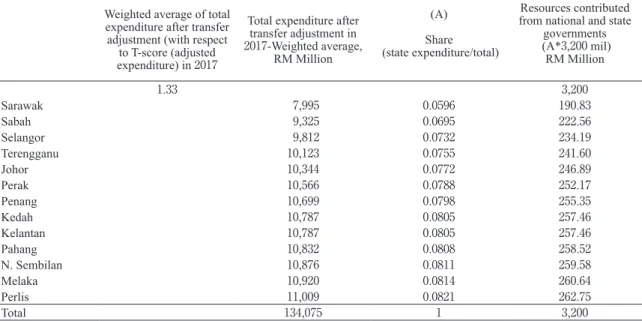
This paper uses fiscal expenditures of State Governments in 2017 to demonstrate how fiscal equalization is logically doable.
Table 3 shows the result of this empirical example.
Although the sample has only 13 states but financial expenditures from them were converted to a normally distributed sample by using T-score (mean is 5 and standard
deviation is 1). Then the gap between transformed value and actual expenditure in 2017 for each state is showed in the share of actual total expenditure. This share is multiplied by the computed total amount of additional fiscal resources (i.e., total value of 13 states) so as to determine the needed amount of additional redistribution from national government to each local government based on earlier calculated normally distributed spread (i.e., T-score). Additional redistributed fiscal resources are added to actual expenditure in 2017 produced a better and an even more appropriate fiscal position by this method of equalization. Total amount required to add more fiscal resources to local governments is RM122.66 billion, which raised total expenditure level in local governments to RM151.36 billion. This scale is significantly more desirable to rakyat. The total amount of additional transfer is about 6 times of that in 2017. The newly total amount of fiscal expenditure in this example shows centralization ratio has improved from 7.42% to 57.04%. The result shows fiscal equalization in fiscal federalism has strengthen decentralization from national to local governments. Equally important, transforming actual expenditures to a normal distributed spread actually ensures the redistribution enhances equality, fairness and socially just outcome in Malaysia Baru. Moreover, this method also logically promotes Pareto efficiency. That is a condition that should not be tampered with in this new redistribution. This new fiscal equalization does not interfere but it in fact assists in adding higher impact on the customary distribution of grants and transfers and development expenditures to state governments.
(b)Universal health care system
In the area of health and medical support to rakyat, universal health care (UHC) system does not exist in Malaysia yet.
Although the intention is being strongly promoted by Ministry of Health and a wide spectrum of civil society organizations but the journey for establishing the proposed institution is still at present a long and winding one. Dzulkefly said: "We recognize that UHC is about equity and access to healthcare services for all, without them incurring catastrophic financial hardship" (The Star Online, 21 May 2019). He further stressed:
“However, its out of pocket (OOP) expenditure stood at 38% in 2018 although the WHO recommends that the OOP expenditure should be at around 20%” (The Star Online, op.
cit.). These statements exemplify the present unsatisfactory condition of health and medical support that requires urgent attention from parliamentarians in Malaysia Baru.
Malaysia was ranked 57th in Human Development Index (HDI) in 2017. HDI is a “statistical metric being used for measuring a countryʼs overall achievement in its social and economic dimensions (UNDP, 1990, p. 109). UNDP defines
“this index is a composite of three crucial indicators, viz., life expectancy at birth (i.e., life expectancy index), knowledge
accumulated over expected years of schooling and means year of schooling (i.e., education index), and a decent standard of living (i.e., GNI̶gross national income̶per capita in US Dollar purchasing power parity̶PPP)” (UNDP, op. cit., p.109). Between 2009 and 2017, although Malaysia spent quite a higher GDP share in education but the shares in health and social welfare were quite lower when compared with other countries that were ranked higher in HDI (Lau, 2019, p. 10).
In sailing to a healthier and a more secure living environment, Malaysia crucially requires relentless efforts in overcoming high tides in the sea of health and social welfare. Without any doubt, this is an important policy issue. By and large, a higher per capita income raises peopleʼs aspiration to pursuit stronger physical and mental health, which in turn lengthens their longevity.
UHC is the ground floor of enhanced health and medical care. It ought to allow all citizens to receive health and medical assistance in the case of illness (physically and mentally), injury, and other threats to health. Also, private insurance schemes in reality can add force to health and medical care for every rakyat is equally important. This part is especially encouraging for those rakyat who are affordable. For UHC, every beneficiary is obliged to pay the insurance premium in order to acquire the entitlement of receiving assistance. On the other hand, affordable persons can concurrently buy additional insurance from private insurance entities. Hence private insurance schemes sit on the second floor above UHC̶the ground floor.
UHC is a mutual assistance among members. In the nutshell, UHC performs the provision of health and medical assistance to members from the pooling of insurance premium.
The premium can be determined proportionately to income brackets. This method strengthens both vertical and horizontal equity. Wealthier people might not want to associate with UHC because they are affordable. However, in the context of operational efficiency, it is not necessary to ask and wait.
Instead, legislate UHC as a compulsory insurance for every rakyat without solicitation. In order to prevent inefficient troubles with rakyat, the legislation can include an “Op-out” clause for wealthier citizens. If there was no formal submission of “Op-out” forms then insurance payment is still mandatory.
Intuitively, skeptics will certainly argue UHC will not work.
This logic is not well founded. There was no UHC in Malaysia in last six decades. Therefore, it is not an exaggeration at all in objecting that baseless logic.
Effective, efficient, and fair operation of UHC is really not complicated. But this system must not be centrally managed because of at least two reasons. Firstly, Federation of Malaysia is not an authoritarian state and thus centrally based information storing and processing are costly and ineffective. Digital economy and the emerging Industry 4.0 are classical illustrations. They clearly show every connectivity is