日一英コードスイッチング
古 屋 則 子*
Attitudes Toward ]apanese-English Code-Switching N oriko Furuya
要 旨 パイリンガノレあるいはマノレチリンガノレはコードスイッチイングをする事が知られている。 二
言語関におけるコードスイッチイングには規則性があるにもかかわらず, 多くの人々は当現象に対し批 判的である。 当研究はモノリンカソレの日本人が日一英コードスイッチイングをどのように受け止めてい るかをmatched guise techniqueを用い, 調査したものである。 210名の参加者の評価を統計的に分析し たところ, 日一英コードスイッチイングは必ずしも否定的に評価されないとし、う結果が得られた。
Introduction
Code-switching, the use of two or more languages in a single utterance, is a phenomenon that is practiced throughout the world by bilinguals and mulitilinguals. (e.g., Romaine, 1995; Appel &
Muysken, 1987; Auer, 1984; Heller, 1988; Grosjean, 1982; Poplack, 1980) has classi企ed code
switching into three types: tag switching, intersentential, and intrasentential. The first is the sim
plest, as a tag is easily inserted in any part of a monolingual utterance without affecting its grammatω icality. This can be seen in:
Englishj J apanese
They're polite children ne.
(They're polite children, you know.) (Nishimura, 1995, p. 171) Intersentential code-switching takes place after a clause or a sentence, where the speaker starts the utterance in one language and ends in the other. It is thought to require a higher degree of fluen田 cy in the two languages than tagωswitching as grammaticality is required for relatively long sections of an utterance. Examples of this kind of code switching are:
EnglishjSpanish
Sometimes I'll start a sentenαin English y termino en Es_ραnol.
(Poplack, 1980, p. 594) Englishj J apanese
He包a good teacher but tokidoki wakarinikui.
(He's a good teacher but sometimes hard to under
stand.)
Intrasentential code-switching, where the switch takes place within a clause or sentence bound
ary, has been seen to be the most complex of the three types. This type of code-switching is exem
plified in the following:
*本学講飾 社会言語学
- 29
Japanese/English
Dakara, me wa I'm thinking 01 quitting this shitogoto at the end 01 this keiyakukikan.
(That' s why I'm thinking of quitting this job, at the end of this contract.)
Spanish/English
El cuarto de master bedroom tiene un closet grande.
(The master bedroom has a large closet.) (Goldman, 1986, p. 25)
Code-switching, although a widespread phenomenon, has been on the whole viewed n巴gatively,
not only by monolinguals but even by those that code蜘switch themselves. (Chana & Romaine, 1984;
Gibbons, 1983; Schmied, 1991; Milroy & Milroy, 1985; Haugen, 1977) It has been referred to in terms primarily stigmatizing it as just a grammarおss haphazard mishmash of the two languages
Tex回Mex(the mixing of English and Spanish in the southwest in the U.S., Franglais (the mixing of French and English in Canada) , Hinglish (the mixing of Hindi and English in India) and Taglish (the mixing of Tagalog and English in the Philippines) . (Grosjean, 1982; Kamwangamalu, 1986;
Goldman, 1986) In Japan, code-switching is most commonly referred to as “chanpon" or “mix up,"
a term while being descriptive, conveys a derogatory nuance when used to describ巴 language. Con
trary to such views however, code-switching of any two languages is a rule輔governed system (e.g.,
Pfaff, 1979; Poplack, 1980; Di Sciullo, Muysken, & Singh, 1986; Nishimura, 1986; Myers-Scotton,
1993) Furthermore, in order to be a “自uent switcher" (Appel & Muysken, 1980, p. 120), one must have a high degree of profìciency in both languages. A study investigating the relationship between profìciency levels and types of code-switching demonstrated that only those with high degrees of profìciency in both Spanish and English could partake in intrasentential code-switching, where ad
herence to the grammaticality of both languages is necessa可(Poplack, 1980) .
Since the 1960's studies have been done to evaluate 呂ttitudes toward language varieties, and the speakers of those languages. Bilingual speakers were often evaluated differently on certain traits such as intelligence and attractiveness when they were speaking language A, or language B. (e.g.,
Lambert, 1967; Lambert, Anisfìeld & Yeni-Komshian, 1965; Vorster & Proctor, 1976; Bentahila,
1983) Some studies hav巴 focused on attitudes towards code-switchers (Chana & Romaine, 1984;
Gibbons, 1983) with researchers fìnding that depending on whether the speakers used code-switched language involving language X and Y, and when using only X or Y, they were evaluated differently.
When the two languages represent two contrasting cultures, often the speakers will assume very di鉦erent characteristics depending on the language. Lyczak, Fu, and Ho (1976) found that when studying bilingual English/Cantonese, English speakers were seen as more competent, good-look
ing and intelligent, while Chinese speakers were seen as more considerate, humble, and honest.
Although Japan on the whole, is primarily a monolingual society, there is a community of Eng
lish/Japanese bilingual speakers, who, because of the very nature of bilingualism, partake in code
switching as one of their language choices.ν1any of these individuals are found in the various inter
national schools in Japan where English is the primary medium of instruction. They usually fall into one of the following categories. First, there are the children of international families, where typical-
- 30 -
臼一笑コードスイッチング
ly one of the parents is from an English-speaking country, and the other, from Japan. (Fotos, 1990) . Next, there are the non-Japanese children of various nationalities, who due to various reasons, such as early exposure to J apanese or length of time in J apan, have become bilingual in J apanese and En
glish. Children of missionaries, often having spent most of their formative years in Japan, or even having been born in Japan, are typical of this second type. The third are so called “returnees," chil
dren of Japanese parents whose jobs led them to overseas transfers and who returned to Japan at the termination of the job assignment. Finally, in any international school there will be a number of non-returnee Japanese students who never resided outside of Japan, but were enrolled in these schools so that they would have access to a bilingual background.
When these Japanese/English bilinguals codeωswitch extensively, how are they evaluated by monolingual Japanese? Given that language and identity are inextricably bound (e.g., Appel &
Muysken, 1987; Giles & Powesland, 1975; Fasold, 1984; Wardhaugh, 1986) it is hypothesized that:
1. Japanese-English code-switchers will be given more Western characteristics when using code
switched speech as opposed to when they are speaking only Japan巴se.
2. A corollary to 1. is that they will be attributed more Japanese characteristics when using only Japanese.
3. Code-switchers will be viewed more negatively owing to the prevalent conception that they are using an“impure" form of language.
Method
Materials
The matched guise technique, one of the most popular ways to elicit people's reactions regarding language attitudes, (Lambert, 1967) was used for this study. The procedure involves the reactions of listeners to a taped recording of bilinguals using the two languages concerned. Upon listening to the taped voices, participants are asked to evaluate the speakers on personal qualities such as com鮒 petence and intelligence based on a seven-point rating scale called semantic differential scales. (Os
good, Suci & Tannenbaum, 1957)
The speakers whose voices were used for the matched guises are two Japanese women bilingual in English and Japanese. Both are representative of those commonly referred to as the type of bilin
gual or“equilingual," whose pro:ficiency in the two languages is equivalent to monolingual speakers of those languages. CBaetenシBeardsmore, 1986) as a result of having been in a non餅Japanese en
vironment throughout their schooling years. They will be referred to as Naoko and Keiko (not their real names) .
Two versions of recordings were prepared so that in one version Naoko used Japanese/English code-switched speech, and Keiko used only Japanese, and in the other, Keiko used code同switched speech, and Naoko used only Japanese. They were asked to tell the directions to their home from Shinjuku station, a topic which was considered to be neutral enough so that the topic itself would not have any effect on the listeners' evaluations, (Fasold, 1984) in code-switched speech and in in-
-
3
1 -formal ]apanese. Informal ]apanese was considered to be the equivalent of code-switched speech in terms of register, as code-switched speech is typically used in relaxed conversation among acquain
tances (Gibbons, 1983) .
A rating sheet based on the semantic differential format (Osgood, Suci, & Tannenbaum, 1957) in
volving 29 personality traits was devised, where participants were註sked to rate the speakers on a scale of 1 (lowest) to 7 (highest) with 4 being neutral. The personality traits were based on those used by Lambert in his language study done on French and English Canadians in 1967. (See Apperト dix A.)
In addition to the semantic differential ratings participants were asked to answer open-ended questions regarding the speakers' linguistic ability as it could be judged from the taped samples.
Pαγticゆα:ntsα:nd Proceduiγes
210 ]apanese monolinguals (75 male and 135 female) in English classes in three private colleges in Tokyo served as participants. Table 1 shows the breakdown of participants. The teachers of these classes gave permission for time to be used in the fìrst or last 20 minutes of their classes. The students' ages ranged from 18 to 21. 110 students (34 male and 76 female) heard Version 1 where Keiko used code-switched language and Naoko used ]apanese, and 100 students (41 male and 59 fe
male) heard Version 2, where Naoko used code-switched language and Keiko used ]apanese. At the beginning of the session, the students were told that th巴y would be asked to evaluate two speak
ers,“A san" and “B san", based on what they heard on the taped samples. N
0indication was given as to the nationality or ethnicity of the speakers. All instructions were given in ]apanese to avoid any misunderstanding. The researcher herself conducted the experiment in Institutions T and B,
and in Institution A, the class teacher, a ]apanese female instructor・, was requested to do so on her
Breakdown of the participants Table 1
n Version
ワム つム qL 1i M=9
Mヱヱ7 M=l1 M=9 F=2
F=9 F=7 Institution
Class 1 Class 2 Class 3 Class 4 T
11 噌i 1i nL qL 9ω F=14
F=13 F=33 F=13 F=14 F口13 Class 1
Class 2 Class 3 Class 4 Class 5 Class 6 B
1 2 M=25
M=14 F=9
F=8 Class 1
A
n=110 n=100
32 -
Version 1
Version 2
TOTAL
日一英コードスイッチング
behalf. Because the experiment was conducted 12 times in total, every effort was made to maintain the same conditions for all administrations.
Results
The participants who heard Version 1 were labeled Group 1, and those who heard Version 2 were labeled Group 2. For purposes of analysis, 24 of the 29 traits were grouped into four categories as follows:
Comþetence
including questions on Ambition, Leadership, Self-confidence, Competence at work,
Taking initiative, Future success
Social attractiveness
including questions on Good personality, Kindness, Friendship potential, Enter
taining-ness, Sociability, Being well-mannered
International-orientation
including questions on Flexibility, Creativity, Having international perspeひ tive, Being cosmopolitan, Standing out, Being fashionable
]aþanese-ness
including questions on Being harmonious, Humility, Taking care of elders, Being reserved, Being a good wife and mother, Conservatism
The above items were checked for reliability, and the Cronbach alpha reliability estimates are shown in Table 2. Overall, the questionnaire seems to have reasonably high reliability for the items investigated.
Table 2 Cronbach Alpha Reliability Estimates
Competence 0.844
Social attractiveness 0.841 International orientation 0.899
Japanese-ness 0.908
Total 0.951
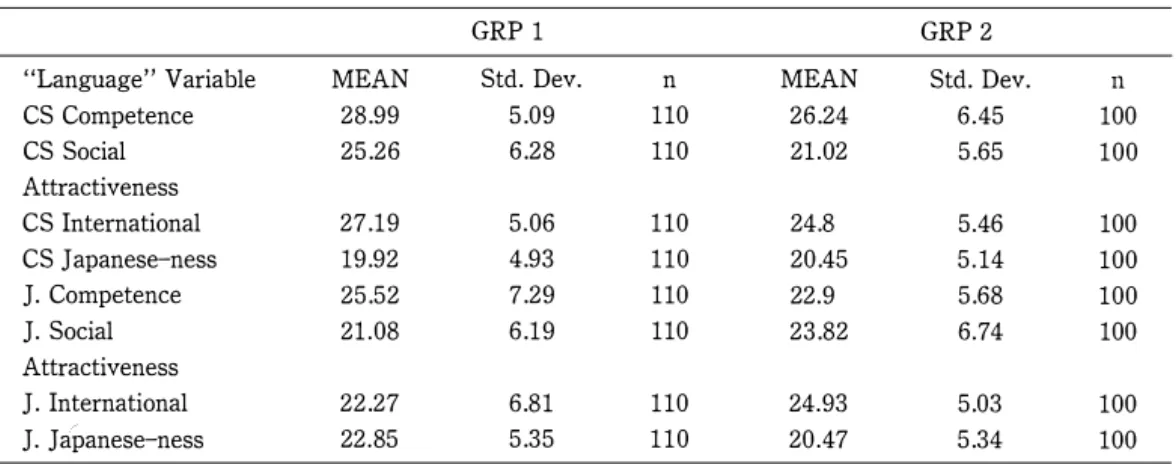
Table 3 Descriptive Statistics
GRP 1 GRP 2
“Language" Variable MEAN Std. Dev. n MEAN Std. Dev.
日CS Competence 28.99 5.09 110 26.24 6.45 100
CS Social 25.26 6.28 110 21.02 5.65 100
Attractiveness
CS International 27.19 5.06 110 24.8 5.46 100
CS J apanese-ness 19.92 4.93 110 20.45 5.14 100
J. Competence 25.52 7.29 110 22.9 5.68 100
J. Social 21.08 6.19 110 23.82 6.74 100
Attractiveness
J. International 22.27 6.81 110 24.93 5.03 100
J. Japanese-ness 22.85 5.35 110 20.47 5.34 100
33一
The descriptive statistics in Table 3 show normal distributions. Some interesting tendencies can be seen. Both groups evaluated the speakers using code-switching (hereafter to be referred to as CS) to be considerably higher in terms of the variable Competence with means of 28.99 and 26.24 as compared to the means for Japanese only speech which had means of 25.52 and 22.9, a difference of 3.47 and 3.34 points, respectively.
For the two variables International-orientation and Japanese-ness, there was a considerable di妊er
ence in the way Group 1 evaluated the CS speakers and the Japanese speakers. For the former varia
ble, CS had a mean of 27.19 whereas the mean for Japanese was 22.27, while the latter variable had a mean of 19.92 for CS as compared to 22.85 for Japanese-only speech. Group 2, however, did not show much difference with regard to these two variables.
Correlational analyses of the variables against each other were carried out and again there seem to be certain tendencies, which could point to some implications about values in Japanese society today. As can be seen in Table 4, the CS Competence variable has a reasonably high correlation with the CS International variable (.6402), as does the J Competence variable does with the J Inter
national variable (.6258) . This could mean that the factors for International orientation may be related to those for Competence regardless of which language is used. The implication here may be that being an“international" person in Japan today is regarded positively and may be a prerequisite for being considered a competitive individual. This makes sense in light of the fact that a keyword in Japan today is internationalism and that in all areas of society, this concept is being incorporated.
This is highly apparent in colleges and universities where the ubiquitous “International Departゅ ment" or “Department of International Studi巴s" will be found even in the smallest institutions. On the other hand, the relatively low correlation for CS Competence and CS Japanese-ness (.2212),
and similarly for J Competence and J Japanese-ness (.2149), may indicate the flip-side of the above.
Perhaps this indicates that the factors related to Japanese-ness (Being harmonious, Humility, Tak
ing care of elders, Being reserved, Being a good wife and mother, Conservatism) are not considered to be compatible with the factors underlying Competence. Japan, an economically developed nation but painfully backward when it comes to opportunities for women, has seen a certain degree of im
provement for job opportunities for Japanese women with the passing of the Equal Opportunity Law in 1986, and most likely the virtu巴s of the legendary traditional Japan巴se woman are out of
Table
4
CorrelationsCS COMP CS SOCL CS INTL CS]PN ]. COMP ]. SOCL J, INTL CS SOCL .5196料
CS INTL .6402料 .4947料
CS]PN .2212料 . 5434料 0.1058
]. COMP 0.0727 0.0481 0.1264 -0.0787
]. SOCL 一0.06 -0.0626 一0.0576 0.0262 .4056**
]. INTL …0.0624 -0.0987 0. 0078 -0.0117 .6258料 .5343キ*
]. ]PN . 1654* 0.0615 0.1217 一0.0333 .2149件 .4911同 0.1378
- 34
日英コ ドスイッチング
Table 5 Univariate tests
COMPETENCE
Source SS DF MS
F DGRP 755 1 755 19.18 0.000*
WITHIN CELLS 7736.93 208 37.2
LANG 1215.59 1 1215.59 32.68 0.000本
GRP BY LANG 0.46 1 0.46 0.01 0.911
SOCIAL ATTRACTIVENESS
Source SS DF MS
F ρGRP 59.36 1 59.36 1.52 0.219
明TITHIN CELLS 8002.18 208 38.47
LANG 50.01 1 50.01 1. 3 0.256
GRP BY LANG 1276.68 1 1276.68 33.18 0.000*
INTERNATIONAL
Source SS DF 乱1S
F pGRP 1.86 1 1.86 0.05 0.815
WITHIN CELLS 6262.79 208 30.11
LANG 600.46 1 600.46 19.94 0.000*
GRP BY LANG 667.44 1 667.44 22.17 0.000*
JAP ANESENESS
Source SS DF MS
F PGRP 89.9 1 89.9 3.42 0.066
WITHIN CELLS 5723‘26 208 27.52
LANG 228.91 1 228.91 8.32 0.004ド
GRP BY LANG 222.75 1 222.75 8.1 0.005*
place when it comes to developing a career, especially in the traditionally male dominant work
pl呂ces.
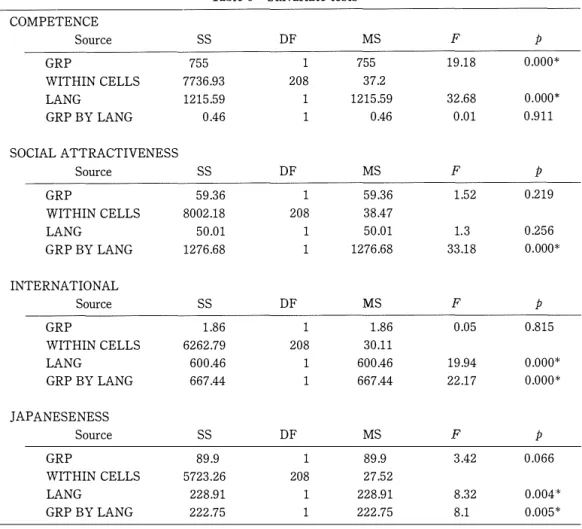
Multivariate tests (Pillais, Hotellings and Wilks) all indicated that there were signifìcant (ρ<.01) e茸ects for group differ巴nces, languages and the groups by languages interaction. There
fore univariate tests were also conducted. (See Table 5.)
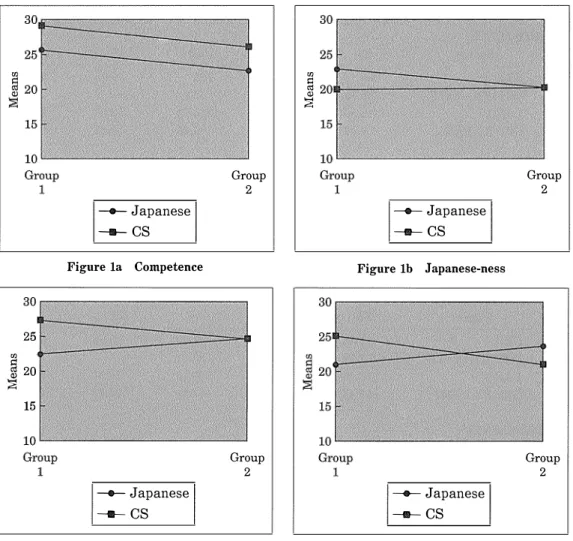
For the Competence variable, there were signifìcant main effects for group differences and lan
guages. (Figure la) Both groups evaluated the CS users higher for this variable than the Japanese speakers.
Japanesè-ness and International-or匂ntation both showed signifìcant main effects (Figure lb and lc) for languages and group by language interaction but not for groups. This was because most of the differences were attributed to Group 1 in both cases.
No signifìcant main effects were seen for Social Attractiveness for group differences or lan-
- 35 -
田口出。毘
Group Group
2
2
一母ー
Japanese 一際-cs
一母-
Japanese
-函-
cs
Japanese園ness Figure 1b
Competence Figure 1a
25
国
320
2君 15
Group Group
2
2
一母一
Japanese 一際-cs
一骨ー
Japanese 一隆一cs
Social attractiveness
guages, so the significant group by language interaction effect was not interpreted. (Figure ld) This was the only variable that showed a contrast in evaluations, that is, where Group 1 evaluated CS higher than for Japanese, Group 2 evaluated the Japanese speaker higher than the CS speaker.
Figure 1d International-orientation
Figure lc
Discussion
The results do seem to indicate that the first hypothesis, that is, that the speakers would be judged to be more Western when using CS, and more Japanese when using only Japanese, can be said to be reasonably valid. However, although it was also hypothesized that the“impure" nature of CS speech would result in negative evaluations of the code-switchers, this did not necessarily seem to have been the case. As mentioned above, both groups evaluated the speakers to be considerably higher in Competence when using CS, compared to when using Japanese. Group 1 evaluated the speakers to be higher for International-orientation when using CS than when using Japanese. This
- 36
日英コ …ドスイッチング
group also evaluated the speakers to be lower in Japanese-ness when using CS than when using only Japanese.
It could be said that the last point indicates that the CS speakers were being evaluated negatively,
if having a high degree of Japanese-ness is considered to be a positive value in modern Japan. At least it can be said that Competence and International orientation do not seem to be compatible with J apanese-ness.
One factor that might be worth mentioning at this point is the language by group interaction as in同 dicated by the univariate tests. Why did the two groups react differently when evaluating three of the four variables? Their evaluations of the speakers seem to indicate that these two groups were not necessarily homogenous groupings, although they were intended to be that way. Because Japan is undergoing so much sociological and economic change at present, could this somehow have had an effect on group evaluations such as those undertaken by this study? It was twenty years ago that Reischauer claimed that the J apanese are “the most thoroughly unified and culturally homogenous large bloc of people in the whole world . . ." (Reischauer, 1977, p. 34.) but perhaps this generaliza同 tion needs to be questioned. Future studies involving groups of Japanese may need to take this faひ tor into account.
In order to explain the evaluations of CS versus Japanese, the following issues may be consi
dered. First, there is the status of English in Japan today. Although diglossia does not exist in Japan, (Ferguson, 1972; Fishman, 1980; Fasold, 1984) where High and Low language varieties co
exist, English is a kind of prestige language, being equated with internationalism, as mentioned earlier. Almost all Japanese students study English for six years as it is a compulsory subject from the 1st year of junior high school. Despite e宜orts by the Ministry of Education to improve the quali
ty of English education in junior and high schools, the primary emphasis of the schools sti1l 1ies on treating it as one of the core subjects for university entrance examinations rather than as a means for communication. Those advocating a better system say, "To take young, impressionable 12- year-olds and subject them to the current English-language teaching provided in most Japanese schools is to create people who for the rest of their lives will never be able to speak English prop
erly." (GregolγClark, Japan Times 100th Issue) Owing to this current state of a鉦�lÌrs regarding En
glish education in Japan, there are sti1l relatively few Japanese people who possess a high degree of English proficiency, especially when it comes to the standards required in the international work縛 place, and thus English sp巴akers are usually regarded with respect. It has been pointed out that one of the main r巴asons why there are few Japanese nationals in global organizations such as the UN is the overall low level of English ski1ls.
Another factor explaining the not so unfavorable attitudes toward CS could be the recent popularization of a variation of it. In Tokyo alone, there are two FM radio stations that extensively use English in their broadcasts. In fact one of them, J“Wave features bilingual DJs who manipulate a carefully contrived type of CS, and whether or not usage of this type of language was an intentional strategy initiated by the station, it has become characteristic of it.
- 37
The following are some excerpts from a recent broadcast (Sunday, September 6th, 1998) : Utterances said in Japanese are in italics.
Example 1
Number 25, The Infiuence . . . Rock With You . . . Number 24, Dakota Moon . . . Another Day Goes By.
. Example 2Stay tuned we'll be right back, following a message from Sapporo Beer.
. . Example 3Jikoku wa gojidesu. Kuuru nichiyoubi, korekarawa
As Wave Sunday
-Minami Mibu no nabigeeto de ookurishimasu. MazuwaJ-Wave Traffic Information.
Shoujisan ni tsutaete moraimasu.This Sunday Tra飴c Information is brought to you by Taito.
(The time is now 5 o'clock. Next we'll be bringing you As Wave Sunday on this funky Sunday. . . . Your DJ is Minami Mibu. But fìrst we have J-Wave Traffic Information. Over to you, Shoujisan. This Sunday Traffic Information is brought to you by Taito.)
Example 4
Entoree san shuume tona問kono kyoku senshuu no jyukyuui kara jyuugopointo uppu. Hayakumo yon i ni tsuketeimasu.
(!t's in its third week, last week it was number 19, this week it's jumped 15 points, and it's this week's number 4.)
That's this week's number 4, Sheryl Crow, My Favorite Mistake.
This type of code-switching may be regarded as “commercial CS" or “おtifìcial CS" as it is highly unlikely that this type of language would be used in a regular contact situation, that is, if the bilin
gual DJ were actually speaking to one of the listeners in person. The interlocutor in this case would be most likely a monolingual Japanese, making this choice of code totally inappropriate. (Fasold,
1984) 狂owever, through the medium of radio, it is justifìed since its main function is simply to give the station an international fiair. The switching behavior exploited by the DJs utilizes just enough English to do this, avoiding extensive streams of English-only utterances which would most cer
tainly exasperate the average listener with their unintelligibility. As the examples above show, En
glish is used primarily for station and sponsor identifìcation, typical DJ-ese, (a.k.a. stay tuned, don't touch that dial) , announcing the ratings of songs on the hit charts, and greetings, all within the boundaries of comprせlensible English. In the case that a rather long passage is said entirely in En
glish, a Japanese translation is provided directly afterwards. These examples could be interpreted as cases of accommodation (Giles, Taylor & Bouris; 1973) where the DJ exhibits convergence by making the English which is used comprehensible, one strategy being translating what has just been said.
Conclusion
This study was an exploratory attempt at studying attitudes held by monolingual J apanese
38
日英コードスイッチング
toward Japanese/Eng1ish code-switching behavior. A1though the findings are not condusive, they seem to indicate that speakers are seen to be more competent, internationa1-oriented, and have a 10wer degree of Japanese-ness when they use Japanese-English code-switched speech than when they use Japanese. The findings a1so show that contrary to what has been said about generally nega
tive attitudes toward code附switching, that is not a1ways the case. Corre1ationa1 ana1yses seem to indi
cate that certain changes have been taking p1ace in Japan regarding traditiona1 va1ues, esp巴cially for women, positioning internationa1ism as a positive va1ue which is re1ated to competence. This cou1d a1so mean that Japanese“ness may not be such a positive or at 1east a necessarγtrait re1ated to competence factors. It was specu1ated that possib1e reasons for the eva1uations of CS were the sta
tus of the Eng1ish 1anguage in Japan, and a1so perhaps the recent exposure of a“commercia1" type of CS, a carefully controlled use of English and Japanese. Perhaps the popu1arity of these ce1ebri
ties on radio has given CS a positive image, in a simi1ar way thatρocho and calo, the code-switching representative of the Chicanos in California and the southwestern part of the U.S., has become ac
cepted, and has become increasing1y used in Chicano 1iterary works. (Gumperz, 1982)
It remains to be seen what the attitudes of other groups of Japanese are toward this phenomenon,
as it is thought that various factors such as age, exposure to CS, and whether or not they are En
glish 1earners will invariab1y affect their eva1uations. The most important imp1ication of this study seems to b巴 that despite what is typically said about code-switching, perhaps there is hope that comω munities around the world will eventually accept this natura1 and inevitab1e aspect of bi1ingua1ism.
年齢 (age)
APPENDIXA 男 (M) 女 (F)
これからテ…プを開いていただ きます。 P1ease 1isten to the tape and eva1uate Speaker A.
Aさんの言っている事を聞いてAさんを 評価して下さい .
各項目で1-7 で評価をして下さい。(Rate the speaker using the following rating sca1e from 1-7.
7 is highest and 1 is 10west on the sca1e.)
(7 は最もその性質が高い, 4 は中間, そして1 は最もその性質が低し、)
例えばl番の知的の場合, とても知的だと思ったら7, とても低 いと思ったらl と いうことです。
ではお願し、し、たします。
1 . 知的度(Intelligence)
7 6 5 4 3 2
2. 意欲的である(Ambition)
7 6 5 4 3 2
3. 政治, 経済等の話ができる(Has know1ege about economics and po1itics)
7 6 5 4 3 2 1
4. リーダーシップをとる素質がある(Leadership)
7 6 5 4 3 2
39 -
5. �言用できる(Trustworthiness)
7 6 5 4 3 2
6. 誠実である(Sincerity)
7 6 5 4 3 2
7. 性格が 良い(Good personality)
7 6 5 4 3 2
8. 思いやりが ある(Kindness)
7 6 5 4 3 2
9. この人と友達になりたし、(Friendship potential)
7 6 5 4 3 2
10. おもし ろい人である(Entertainingness)
7 6 5 4 3 2
11. 社会問題に関心を持っている(Caring about sociel issues)
7 6 5 4 3 2
12. 考え方に柔軟性が ある(Flexibility)
7 6 5 4 3 2
13. 社受的である(Sociability)
7 6 5 4 3 2
14. 礼儀正し い(Being well-mannered)
7 6 5 4 3 2
15. 協調性が ある(Being harmonious)
7 6 5 4 3 2
16. 創造力が ある(Creativity)
7 6 5 4 3 2
17. 謙虚で、ある(Humility)
7 6 5 4 3 2
18. 親を大事に する(Taking care of elders)
7 6 5 4 3 2 l
19. 控え目(Being reserved)
7 6 5 4 3 2
20. 良妻賢母タイプ(Being a good wife and mother)
7 6 5 4 3 2
21. 自分に自信を持っている(Self-confìdent)
7 6 5 4 3 2
22. 仕事が出来る(Competence at work)
7 6 5 4 3 2
23. 国際的な視野を持っている(Having international perspective)
7 6 5 4 3 2
- 40
日英コードスイッチング
24. 都会的(Cosmopolitan)
7 6 5 4 3 2
25. 外見 は派手(Standing out)
7 6 5 4 3 2
26. 積極的(Taking initiative)
7 6 5 4 3 2
27. ファショナフ矛ル(Being fashionable)
7 6 5 4 3 2
28. 考え方が保守的(Conservatism)
7 6 5 4 3 2
29. 社会的に成功する(Future success)
7 6 5 4 3 2
30. Aさんの語学力を 評価して下さい(Please evaluate A's language ability.) a) 日本語の能力(Japanese)
b) 英語能力(English)
31. Aさん はよくこの様に(日本語と英語を混ぜる) 話します。
(A often speaks like this, mixing ]apan巴se and English.) あなたがこの話し方を開いて感じたことを書いて下さい。
(How do you feel about the way she speaks?)
32. あなた はこの様な話し方を聞いた事 はありますか? ( テレビ, ラジオも含む) (Have you ever heard anyone speaking like this, or hear it used on TV or radio?)
記入もれ はありませんか? もう一度確認して下さし、。
ありがとうございました。
(Please check to make sure you have completed all of the items. Thank you for your cooperation.)
References
Appel, R., & Muysken, P. (1987).
Language contact and bilingualism.London: Edward Arnold.
Auer, J. C. P. (1984).
Bilingual conversation.Amsterdam: Benjamins.
Baetens-Beardsmore, H. (1986).
Bilingualism. Basic PrinciPles.Avon: Multilingual Matters Ltd.
Bentahila, A. (1983).
Language attitudes amoηg Arabic句Prench bilinguals in Morocco.Clevedon: Multilingual Matters.
Chana, U. & Romaine, S. (1984). Evaluative reactions to Punjabi/English cod邑- switching.
j(仰rnal 01 Multilin田 gual a抑d Multicultural Development, 6,447-473.
Clark, G. (1989). Japan Times 100th Issue found on the Internet.
41一
DiSciullo, A. M., Muysken, P. & Singh, R. (1986). Government and code-mixing.
Journal 01 Linguistics,22, 1- 24.
Fasold, R. (1984).
The Sociolinguistics 01 Society.Oxford: Basil Blackwe11.
Ferguson, C. A. (1972). Diglossia. In P. Gigliolo (Ed.),
Language and social context(pp. 232-52). Harmon
dsworth: Penguin.
Fishman, A. (1980). Bilingualism and biculturalism as individual and societal phenomena.
Journal 01 Multiliか gual and Multicultural Development,1,3-17.
Fotos, S. (1990). Japan巴se-English Code Switching in Bilingual Children. JALT Journal, 12, 75-98.
Gibbons, J. P. (1983). Attitudes towards languages and code-mixing in Hong Kong.
Journal 01 Multilingual and Multicultural Development,4, 129-147.
Giles, H. & Powesland, P. (1975).
Speech Sかle and Social Evaluation.London: Academic Press.
Giles, H., Taylor, D. M. & Bouris, R. Y. (1973). Towards a theory of interpersonal accommodation through language: some Canadian data.
Language巴in society,2, 177-192.
Goldman, L. (1986). Tex-Mex, where Texas, Mexico, English & Spanish meet.
English Today,5, 23-26.
Grosjean, F. (1982).
Lileωith two Zω19uages. An introducti仰to bilingualism.Cambridge, Mass.: Harvard University Press.
Gumperz, J. J. (1982).
Discourse Strategies.Cambridge: Cambrid日 University Press.
Haugen, E. (1977). Norm and deviation in bilingual communities. In P. Hormby (Ed.),
Bilingualism. Psychological, Soc必1 and Educational ImPlications.
New Y ork: Academic Press.
He11er, M. ed. (1988).
Code-switch仇g. Aηthropological and linguisticμrspectives.Mouton: De Gruyter.
Kamwangamalu, Nkoko M. (1986). Cod巴 Mixing and Modernization Across Cultures. Paper presented at the South Asian Languages Analysis Roundtable. Urbana, Illinois, May 29-31.
Lambert, W. E. (1967). The social psychology of bilingualism.
Journal 01 Social Issues,23, 91-109.
Lambert, W. E., Anisfìeld, M. & Yeni長omshian,G. (1965). Evaluational reactions of Jewish and Arab adoles胡 cents to dial巴ct and language variations.
Journal 01 Personality and SociaZ Psychology,2, 84-90.
Lyczak, R., Fu, S., & Ho, A. (1976). Attitudes of Hong Kong bilinguals toward English and Chinese speakers.
Journal 01 Cross-Cultural Psychology,
7, 425-437.
Milroy, J. & Milroy, L. (1985). Linguistic change. Social network and speaker innovation.]I仰作wl
01 Linguistics,21, 339-384.
Myers-Scotton, C. (1993). Duelling Languages. Grammatical Structure in Code-switching. Oxford: Oxford University Press.
Nishimura, M. (1986). Intrasentential code-switching. The case of language assignment. In J. Vaid (Ed.),
L仰guage Processing in Bilinguals: Psycholinguistic a刊d Neuroþりcholigical Perspectives