まえがき
この論文は、 1967年に創立された History of Education Society (UK) (HES, イギリス教育史学会 President Joyce Goodman, Professor at University of Winchester, UK)が、 ロンドンで開催した2010年の年次研究大会 (HES Annual Conference, 26-28 November 2010 held at Garden Halls, 19-26 Cartwright Gardens London. WC1H 9EF) にお
いて、 筆者が口頭発表 (2010年11月27日) した原稿に若干の加除修正を行なったものである。 この大会のテーマは、
Citizenship, Religion and Educationであった。
当日の発表会場は Falkender Room であり、 同室 (Session 4.3) のテーマは Religion, citizenship & education: na- tional and local case studies であった。
司会は、 かつて立正大学の教室で学生諸君に2度講演をしてくださったこともある旧知の Dr. David Crook, Confer- ence Organiser (Brunel University, UK) であったことは、 ラッキーであった。
この学会には、 毎年日本の教育研究者が若干名参加しているが、 今回は小生のみであり、 若干の寂しさを隠し得なかっ た。 しかし、 2003年の年次研究大会 (At Dublin) で初めてお会いし、 2008年には自宅に招待してくださるとともに、
マン島内のいくつもの学校を案内してくださった Dr. Linda M Cottier (Former teacher at Queen ElizabethHigh School at Isle of Man)にお会いでき、 旧交を温めることができたのは幸運なことであった。
発表内容は、 日本の学校教育における市民性や宗教の取り扱いについての概説及び問題点についてであった。
発表のあと、 イギリスの成人教育の研究をしている若手研究者 Andy Vail (University of Birmingham) や女性教 師から改正教育基本法 (2006年) 後に日本の学校教育はどう変化したのか、 などの厚意ある質問をいただいた。
写真1 (発表する筆者) 写真2 (司会の Dr. David Crook)
*1 立正大学心理学部教授、 Professor of Education at Rissho University, Tokyo, Japan
日本の学校教育における市民性教育及び 宗教教育の歴史的展開の概要
浪 本 勝 年*1
Citizenship and Religion in Japanese Education (1872-2010)
―from the Educational, Historical and Political Perspective―
NAMIMOTO Katsutoshi
Outline of the history of Japanese education system
The following is the main issues of the history of Japanese education system as shown chronologically.
【Before the Second World War (SWW)】
1871:Ministry of Education was established 1872:Japanese Modern education system started
(Rate of primary school attendance in 1873 was 28.1%) 1889:Imperial Constitution was promulgated
1890:Imperial Rescript on Education was promulgated (Rate of primary school attendance 1892 : 55.1%) (Rate of primary school attendance 1902 : 91.6%)
【After the SWW】
1946:Existing New Constitution of Japan was promulgated
1947:Fundamental Law of Education was promulgated (It was revised in 2006, when the spirit of educa- tion was changed.)
1947:School education Law was promulgated (It was partly revised in 2007 according to Basic Act of Edu- cation (2006))
Citizenship, Religion, and Education before the SWW
It was about 140 years ago when Japanese Ministry of Education was established.
Modern Japanese education system started from the year 1872. Since then school education has been completely controlled by the central Government. And this central control system of schools has produced Japans educa- tional characteristic concerning both school system and teaching content.
※※※※※※※※※※※※※※※※※※※※※※※※※※※※※※※※※※※※※※※※※※※※※※※※※※※※※※※※
Abstract
Modern Japanese education system started from the year 1872.
At that time school education had almost no limits in Japan. But Ministry of education adopted the principle of being separate education from religion in 1899. In 1935 the Ministry, however, changed its policy to proceed to cultivate the sen- sitivity of religious mind at schools. Thus religious education should not be allowed in state schools. Only the private schools could do that in education.
In Japan after the Second World War the Fundamental Law of Education (FLE) was established in1947 according to the new Constitution of Japan (1946).
Article 20 of the Constitution of Japan prescribes as follows;
Freedom of religion is guaranteed to all. … The state and all its organs shall refrain from religious education or any other religious activity.
Article 9 of the FLE prescribed religious education as follows:
The attitude of religious tolerance and the position of religion in social life shall be valued in education.
The schools established by the national and local governments shall refrain from religious education or other activi- ties for a specific religion.
Thus in primary and secondary education the civics or citizenship education started in full swing from 1947. Religion education were taught only in private schools and has been formally substituted for moral education since 1958.
In Japan religion and citizenship education are taught mingle-mangle each other.
***************************************************************************************************
1 Citizenship: Before the SWW
Citizenship education primitively started after the popular election Act was promulgated in 1927. In 1931 the subjectCivicswas introduced to secondary school, but it became gradually militaristic toward the war. So it was not an appropriate instruction in terms of citizenship education.
2 Religion: Before the SWW
At the beginning of the modern school system school education had almost no limits in Japan. But Ministry of education adopted the principle of being separate education from religion in 1899.
In 1935 the Ministry, however, changed its policy to proceed to cultivate the sensitivity of religious mind at schools. Only the Japanese traditional religion, Shinto, was factually taught. Thus the other specific religious edu- cation should not be allowed in state schools.
All the school children, however, were forced to worship Emperor as national morality by the Ministry during the SWW.
Citizenship, Religion, and Education after the SWW
1 Existing New Constitution of Japan and Fundamental Law Education (1947)
In Japan after the SWW the Fundamental Law of Education (FLE) was established in 1947 according to the new Constitution of Japan (1946). These laws are overriding factors to education including both citizenship and relig- ion.
These articles below of new Constitution and FLE are deeply connected with the citizenship, religion, and educa- tion.
As shown in the handout in p11, Article 9 of the Constitution of Japan is the one which Japanese should be very proud of after the SWW since it shows that Japanese people killed no one in the world as a sovereign right of the nation.
Article 9:
Aspiring sincerely to an international peace based on justice and order, the Japanese people forever renounce war as a sovereign right of the nation and the threat or use of force as means of settling international disputes.
2 In order to accomplish the aim of the preceding paragraph, land, sea, and air forces, as well as other war po- tential, will never be maintained. The right of belligerency of the state will not be recognized.
Article 20:
Freedom of religion is guaranteed to all. ... The state and all its organs shall refrain from religious education or any other religious activity.
Article 23:
Academic freedom is guaranteed.
Article 26:
All people shall have the right to receive an equal education correspondent to their ability, as provided for by law.
2 All people shall be obligated to have all boys and girls under their protection receive ordinary education as provided for by law. Such compulsory education shall be free.
As for the FLE, shown as the handout in page 11, Article 9 of the FLE (1947) prescribed religious education as follows:
The attitude of religious tolerance and the position of religion in social life shall be valued in education.
The schools established by the national and local governments shall refrain from religious education or other ac- tivities for a specific religion.
2 Citizenship and Religion in school education
Thus in primary and secondary education the civics or citizenship education started in full swing from 1947.
Religious education was taught only in specific private schools, which were established by the specific religion.
Religious education at private schools has been formally substituted for moral education since 1958.
In primary and secondary schools in Japan, citizenship education has been mainly dealt with the subjectSocial Studiessince 1947, and also dealt with the moral education since 1958.
In Japan religion and citizenship education are taught mingle-mangle each other.
3 The present situation of Citizenship and Religion in Japanese school
Now in 21stcentury the standard annual teaching hours of social studies and moral education are shown in Table 2 at page 20, which shows the citizenship education related to social studies and moral education in primary school and junior high school.
In the specific state schools, which are allowed by the Central government, the subjectCitizenshipis set up by the local board of education.
Shown as this, citizenship education has become one of the crucial issues in Japanese education. On the other hand religious education is not so much concerned in general in Japan.
Conclusion
Citizenship, Religion and Education in Japan should be reexamined from the two points of view.
1 Constitution of Japan (1947)
2 Convention on the rights of the Child (1989), adopted by the general assembly of the United Nations, which Japan ratified in 1994.
This is mainly because Constitution of Japan has declared to desire peace for all time, to strive for the preserva- tion of peace, and to respect for democracy and for human rights.
Fundamental human rights should not be ignored or distorted by the political power in Japan. The historical significance of human rights should be taught in the classroom all over Japan.
As for the Convention of the rights of the Child it is to protect the right of the child in the world. This is also a very import document when we think of the citizenship or religion.
Both documents should be stressed strongly when we think of the citizenship or religion education.
【Handouts】
1 The Constitution of Japan p. 5
2 Table 1:Comparison of the revised version of Basic Act on Education (2006) and original version of the Fun- damental Law of Education (1947) (Tentative translation by the Japanese Ministry of Education, Culture,
Sports, Science, and Technology) p. 7
3 Table 2:Standard annual teaching hours (45 minutes) in primary schools
in Japan (effective from 1stApril, 2002): p.14
4 Table 3:The standard number of yearly teaching hours (50 minutes) per compulsory subject and special area in lower secondary schools in Japan (effective from 1stApril, 2002): p.14
5 Imperial rescrip of education (1890, Japan) p.15
次の写真は、 当日の筆者の発表風景の一コマである。
………
………
………
………
………
写真3 会場風景1 写真4 会場風景2
(27thNovember 2010, The University of London)
写真5 (With Dr.Linda M Cottier at the Conference Dinner Party)
【Handout 1】
THE CONSTITUTION OF JAPAN
November 3, 1946 PREFACE
CHAPTER:THE EMPEROR
CHAPTER:RENUNCIATION OF WAR
CHAPTER:RIGHTS AND DUTIES OF THE PEOPLE CHAPTER:THE DIET
CHAPTER:THE CABINET CHAPTER:JUDICIARY CHAPTER:FINANCE
CHAPTER:LOCAL SELF-GOVERNMENT
CHAPTER :AMENDMENTS
CHAPTER:SUPREME LAW
CHAPTER:SUPPLEMENTARY PROVISIONS
CHAPTER:THE EMPEROR Article 1:
The Emperor shall be the symbol of the State and the unity of the people, deriving his position from the will of the people with whom resides sovereign power.
CHAPTER: RENUNCIATION OF WAR Article 9:
Aspiring sincerely to an international peace based on justice and order, the Japanese people forever renounce war as a sovereign right of the nation and the threat or use of force as means of settling international disputes.
2 In order to accomplish the aim of the preceding paragraph, land, sea, and air forces, as well as other war poten- tial, will never be maintained. The right of belligerency of the state will not be recognized.
CHAPTER: RIGHTS AND DUTIES OF THE PEOPLE Article 19:
Freedom of thought and conscience shall not be violated.
Article 20:
Freedom of religion is guaranteed to all. No religious organization shall receive any privileges from the State, nor exercise any political authority.
2 No person shall be compelled to take part in any religious acts, celebration, rite or practice.
3 The State and its organs shall refrain from religious education or any other religious activity.
Article 21:
Freedom of assembly and association as well as speech, press and all other forms of expression are guaranteed.
2 No censorship shall be maintained, nor shall the secrecy of any means of communication be violated.
Article 22:
Every person shall have freedom to choose and change his residence and to choose his occupation to the extent that
it does not interfere with the public welfare.
2 Freedom of all persons to move to a foreign country and to divest themselves of their nationality shall be invio- late.
Article 23:
Academic freedom is guaranteed.
Article 24:
Marriage shall be based only on the mutual consent of both sexes and it shall be maintained through mutual co- operation with the equal rights of husband and wife as a basis.
2 With regard to choice of spouse, property rights, inheritance, choice of domicile, divorce and other matters per- taining to marriage and the family, laws shall be enacted from the standpoint of individual dignity and the essen- tial equality of the sexes.
Article 25:
All people shall have the right to maintain the minimum standards of wholesome and cultured living.
2 In all spheres of life, the State shall use its endeavors for the promotion and extension of social welfare and se- curity, and of public health.
Article 26:
All people shall have the right to receive an equal education correspondent to their ability, as provided for by law.
2 All people shall be obligated to have all boys and girls under their protection receive ordinary education as pro- vided for by law. Such compulsory education shall be free.
【Handout 2】
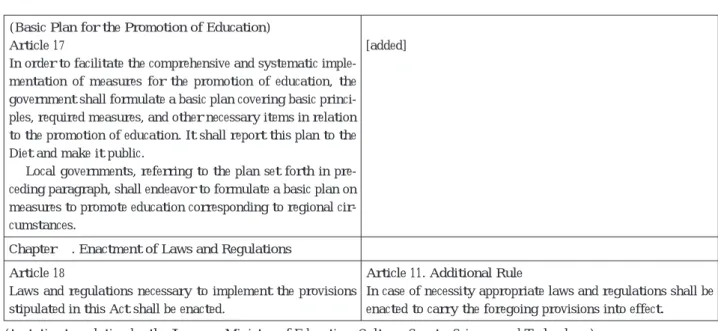
Table 1:Comparison of the revised version of Basic Act of Education (2006) and original version of the Fundamental Law of Education (1947)
Basic Act on Education (Act120 of 2006) The Fundamental Law of Education (Act25 of 1947) Preamble
We, the citizens of Japan, desire to further develop the demo- cratic and cultural state we have built through our untiring efforts, and contribute to the peace of the world and the im- provement of the welfare of humanity.
To realize these ideals, we shall esteem individual dignity, and endeavor to bring up people who long for truth and justice, honor the public spirit, and are rich in humanity and creativ- ity, while promoting an education which transmits tradition and aims at the creation of a new culture.
We hereby enact this Act, in accordance with the spirit of the Constitution of Japan, in order to establish the foundations of education and promote an education that opens the way to our countrys future.
Preamble
Having established the Constitution of Japan, we have shown our resolution to contribute to the peace of the world and wel- fare of humanity by building a democratic and cultural state.
The realization of this ideal shall depend fundamentally on the power of education.
We shall esteem individual dignity and endeavor to bring up people who love truth and peace, while education which aims at the creation of culture general and rich in individuality shall be spread far and wide.
We hereby enact this Act, in accordance with the spirit of the Constitution of Japan, with a view to clarifying the aims of education and establishing the foundation of education for new Japan.
Chapter. Aims and Principles of Education (Aims of Education)
Article 1
Education shall aim for the full development of personality and strive to nurture the citizens, sound in mind and body, who are imbued with the qualities necessary for those who form a peaceful and democratic state and society.
Article 1. Aims of Education
Education shall aim at the full development of personality, striving to nurture the citizens, sound in mind and body, who shall love truth and justice, esteem individual value, respect labour and have a deep sense of responsibility, and be imbued with the independent spirit, as builders of the peaceful state and society.
(Objectives of Education) Article 2
To realize the aforementioned aims, education shall be carried out in such a way as to achieve the following objectives, while respecting academic freedom:
() to foster an attitude to acquire wide-ranging knowledge and culture, and to seek the truth, cultivate a rich sensibility and sense of morality, while developing a healthy body.
() to develop the abilities of individuals while respecting their value; cultivate their creativity; foster a spirit of auton- omy and independence; and foster an attitude to value labor while emphasizing the connections with career and practical life.
() to foster an attitude to value justice, responsibility, equality between men and women, mutual respect and coop- eration, and actively contribute, in the public spirit, to the building and development of society.
() to foster an attitude to respect life, care for nature, and contribute to the protection of the environment.
() to foster an attitude to respect our traditions and culture, love the country and region that nurtured them, together with respect for other countries and a desire to contribute to world peace and the development of the international community.
Article 2. Educational Principle
The aims of education shall be realized on all occasions and in all places. In order to achieve the aims, we shall endeavor to contribute to the creation and development of culture by mu- tual esteem and co-operation, respecting academic freedom, having a regard for actual life and cultivating a spontaneous spirit.
(Concept of Lifelong Learning) Article 3
Society shall be made to allow all citizens to continue to learn throughout their lives, on all occasions and in all places, and apply the outcomes of lifelong learning appropriately to refine themselves and lead a fulfilling life.
[added]
(Equal Opportunity in Education) Article 4
Citizens shall all be given equal opportunities to receive educa- tion according to their abilities, and shall not be subject to dis- crimination in education on account of race, creed, sex, social status, economic position, or family origin.
Article 3. Equal Opportunity in Education
Citizens shall all be given equal opportunities to receive educa- tion according to their abilities, and shall not be subject to dis- crimination in education on account of race, creed, sex, social status, economic position, or family origin.
The national and local governments shall provide support in education to persons with disabilities, to ensure that they are given adequate education in accordance with their condi- tion.
[added]
The national and local governments shall take measures to provide financial assistance to those who, in spite of their abil- ity, encounter difficulties in receiving education for economic reasons.
The national and local governments shall take measures to provide financial assistance to those who, in spite of their abil- ity, encounter difficulties in receiving education for economic reasons.
Chapter. Basics of Education Provision (Compulsory Education)
Article 5
Citizens shall be obligated to have children under their protec- tion receive a general education pursuant to the provisions of other acts.
Article 4. Compulsory Education
Citizens shall be obligated to have children under their protec- tion receive nine-year general education.
The objectives of general education, given in the form of compulsory education, shall be to cultivate the foundations for an independent life within society while developing the abili- ties of each individual, and to foster the basic qualities neces- sary for those who form our state and society.
[added]
In order to guarantee the opportunity for compulsory edu- cation and ensure adequate standards, the national and local governments shall assume responsibility for the implementa- tion of compulsory education through appropriate role shar- ing and mutual cooperation.
[added]
No tuition fee shall be charged for compulsory education in schools established by the national and local governments.
No tuition fee shall be charged for compulsory education in schools established by the national and local governments.
[deleted] Article 5. Co-Education
Men and women shall esteem and cooperate with each other.
Co-education, therefore, shall be recognized in education.
(School Education) Article 6
The schools prescribed by law shall be of a public nature, and only the national government, local governments, and juridi- cal persons prescribed by law shall be entitled to establish them.
Article 6. School Education
The schools prescribed by law shall be of a public nature and, besides the national and local governments, only juridical per- sons prescribed by law shall be entitled to establish them.
The schools set forth in the preceding paragraph shall, in order to fulfill the objectives of education, provide a structured education in an organized way suited to the mental and physi- cal development of the recipients. It shall be carried out in a way that emphasizes instilling the recipients with respect for the discipline necessary to conduct school life, and strengthen- ing their own motivation to learn.
[added]
[see (Teachers) Article 9] Teachers of the schools prescribed by law shall be servants of the whole community. They shall be conscious of their mis- sion and endeavor to discharge their duties. For this purpose, the status of teachers shall be respected and their fair and ap- propriate treatment shall be guaranteed.
(Universities) Article 7
Universities, as the core of scholarship activities, shall culti- vate advanced knowledge and specialized skills, inquire deeply into the truth and create new knowledge, while contributing to the development of society by broadly disseminating the re- sults of their activities.
University autonomy, independence, and other unique char- acteristics of university education and research shall be re- spected.
[added]
(Private Schools) Article 8
Taking into account the public nature of privately established schools and their important role in school education, the na- tional and local governments shall endeavor to promote pri- vate school education through subsidies and other appropriate means, while respecting school autonomy.
[added]
(Teachers) Article 9
Teachers of the schools prescribed by law shall endeavor to fulfill their duties, while being deeply conscious of their noble mission and continuously devoting themselves to research and self-cultivation.
Considering the importance of the mission and duties of the teachers set forth in the preceding paragraph, the status of teachers shall be respected, their fair and appropriate treat- ment ensured, and measures shall be taken to improve their education and training.
(From Article 6, above)
Teachers of the schools prescribed by law shall be servants of the whole community. They shall be conscious of their mis- sion and endeavor to fulfill their duties. For this purpose, the status of teachers shall be respected and their fair and appro- priate treatment shall be ensured.
(Education in the Family) Article 10
Mothers, fathers, and other guardians, having the primary re- sponsibility for their childrens education, shall endeavor to teach them the habits necessary for life, encourage a spirit of independence, and nurture the balanced development of their bodies and minds.
The national and local governments shall endeavor to take necessary measures supporting education in the family, by providing guardians with opportunities to learn, relevant in- formation, and other means, while respecting family auton- omy in education.
[added]
(Early Childhood Education) Article 11
Considering the importance of early childhood education as a basis for the lifelong formation of ones personality, the na- tional and local governments shall endeavor to promote such education by providing an environment favorable to the healthy growth of young children, and other appropriate measures.
[added]
(Social Education) Article 12
The national and local governments shall encourage education carried out among society, in response to the demands of indi- viduals and the community as a whole.
The national and local governments shall endeavor to pro- mote social education by establishing libraries, museums, community halls and other social education facilities, opening the usage of school facilities, providing opportunities to learn, relevant information, and other appropriate means.
Article 7. Social Education
The national and local governments shall encourage education carried out at home, in places of work and elsewhere in soci- ety.
The national and local governments shall endeavor to at- tain the aims of education by the establishment of such insti- tutions as libraries, museums, community halls, etc., by the usage of school facilities, and by other appropriate means.
(Partnership and Cooperation among Schools, Families, and Local Residents)
Article 13
Schools, families, local residents, and other relevant persons shall be aware of their respective roles and responsibilities re- garding education, and endeavor to develop partnership and cooperation.
[added]
(Political Education) Article 14
The political literacy necessary for sensible citizenship shall be valued in education.
The schools prescribed by law shall refrain from political education or other political activities for or against any spe- cific political party.
Article 8. Political Education
The political literacy necessary for sensible citizenship shall be valued in education.
The schools prescribed by law shall refrain from political education or other political activities for or against any spe- cific political party.
(Religious Education) Article 15
The attitude of religious tolerance, general knowledge regard- ing religion, and the position of religion in social life shall be valued in education.
The schools established by the national and local govern- ments shall refrain from religious education or other activities for a specific religion.
Article 9. Religious Education
The attitude of religious tolerance and the position of religion in social life shall be valued in education.
The schools established by the national and local govern- ments shall refrain from religious education or other activities for a specific religion.
Chapter. Education Administration (Education Administration)
Article 16
Education shall not be subject to improper control and shall be carried out in accordance with this and other acts; education administration shall be carried out in a fair and proper man- ner through appropriate role sharing and cooperation between the national and local governments.
Article 10. Education Administration
Education shall not be subject to improper control, but it shall be directly responsible to the whole citizens.
Education administration shall, on the basis of this realiza- tion, aim at the adjustment and establishment of the various conditions required for the pursuit of the aims of education.
The national government shall comprehensively formulate and implement education measures in order to provide for equal opportunities in education and to maintain and raise education standards throughout the country.
[added]
The local governments shall formulate and implement edu- cation measures corresponding to regional circumstances in order to promote education in their respective regions.
[added]
The national and local governments shall take necessary fi- nancial measures to ensure the smooth and continuous provi- sion of education.
[added]
(tentative translation by the Japanese Ministry of Education, Culture, Sports, Science, and Technology)
【Handout 3】
【Handout 4】
(Basic Plan for the Promotion of Education) Article 17
In order to facilitate the comprehensive and systematic imple- mentation of measures for the promotion of education, the government shall formulate a basic plan covering basic princi- ples, required measures, and other necessary items in relation to the promotion of education. It shall report this plan to the Diet and make it public.
Local governments, referring to the plan set forth in pre- ceding paragraph, shall endeavor to formulate a basic plan on measures to promote education corresponding to regional cir- cumstances.
[added]
Chapter. Enactment of Laws and Regulations Article 18
Laws and regulations necessary to implement the provisions stipulated in this Act shall be enacted.
Article 11. Additional Rule
In case of necessity appropriate laws and regulations shall be enacted to carry the foregoing provisions into effect.
Table 2:Standard annual teaching hours (45 minutes) in primary schools in Japan are as follows (effective from 1stApril, 2002):
Curriculum areas Number of teaching hours
Year 1 Year 2 Year 3 Year 4 Year 5 Year 6
Subjects
Japanese language 272 280 235 235 180 175
Social studies ― ― 70 85 90 100
Arithmetic 114 155 150 150 150 150
Science ― ― 70 90 95 95
Living experience 102 105 ― ― ― ―
Music 68 70 60 60 50 50
Drawing and handicrafts 68 70 60 60 50 50
Home-making ― ― ― ― 60 55
Physical education 90 90 90 90 90 90
Moral education 34 35 35 35 35 35
Special activities 34 35 35 35 35 35
General studies ― ― 105 105 110 110
Total 782 840 910 945 945 945
Table 3:The standard number of yearly teaching hours (50 minutes) per compulsory subject and special area in lower sec- ondary schools in Japan are as follows (effective from 1stApril, 2002):
Curriculum areas Number of teaching hours
Year 1 Year 2 Year 3
Compulsory subjects
Japanese language and literature 140 105 105
Social studies 105 105 85
Mathematics 105 105 105
Science 105 105 80
Music 45 35 35
Fine arts 45 35 35
Health and physical education 90 90 90
Industrial arts and home-making 70 70 35
Foreign language 105 105 105
Elective subjects 0-30 50-85 105-165
Special areas
Moral education 35 35 35
Special activities 35 35 35
General studies 70-100 70-105 70-130
Total 980 980 980
【Handout 5】
Imperial Rescript on Education (1890, Japan)
Know ye, Our subjects:
Our Imperial Ancestors have founded Our Empire on a basis b road and everlasting and have deeply and firmly implanted virtue; Our subjects ever united in loyalty and filia piety have from generation to generation illustrated the beauty thereof. This is the glory of the fundamental character of Our Empire, and herein also lies source of Our education. Ye, Our subjects, be filial to your parents, affectionate to your brothers and sisters; as husbands and wives be harmonious, as friends true; bear yourselves in modesty and moderation; extend your benevolence to all; pursue learning and cultivate arts, and thereby develop intellectual faculties and perfect moral powers; fur- thermore advance public good and promote common interests; always respect the Constitution and observe the laws, should emergency arise, offer yourselves courageously to the State; and thus guard and maintain the pros- perity of Our Imperial Throne coeval with heaven and earth. So shall ye not only be Our good and faithful sub- jects, but render illustrious the best traditions of your forefathers.
The Way here set forth is indeed the teaching bequeathed and by Our Imperial Ancestors, to be observed alike by Their Descendants and the subjects, infallible for all ages and true in all places. It is Our wish to lay it to heart in all reverence, in common with you, Our subjects, that we may all thus attain to the same virtue.
The 30thday the 10thmonth Of the 23rdof the Meiji.
Imperial Sign manual. Imperial Seal.
≪付記≫ 英・最高裁判所 (2009年10月1日発足) の新庁舎を訪問 (2010年11月24日) し、 開放的な雰囲気を味わう
とともに親切な案内を受け感激した。
写真6 (最高裁判所入口) 写真7 (最高裁第3法廷の裁判官席にて)
写真8 (最高裁図書館の内部) 写真10
(法廷の模様を放映するモニター画面)
写真11 (全員12人の裁判官)