The Prussians in Nagasaki
On 17 February 1861, two warships of the fledging Prussian navy, carrying a diplomatic and scientific mission to East Asia headed by Count Friedrich zu Eulenburg, arrived in Nagasaki Bay. With the frigate Thetis in tow, the corvette Arcona steamed up close to Deshima and weighed anchor, to the accompaniment of salutes fired from the other foreign warships in the harbour.
1For the next seven days the black-and-white eagle ensign of the kingdom of Prussia flew over Nagasaki, and until the flotilla weighed anchor for Shanghai on 24 February, the diplomats, scientists, artists and photographers comprising Eulenburg’s Ostasiatischer Expedition set about their various duties.
2For the hard-pressed Prussians who had spent almost five months in Edo negotiating a treaty with the bakufu and had just completed an exhausting 17-day voyage from Yokohama, Nagasaki was a welcome change. ‘This paradise of Nagasaki’, as Eulenburg later described it, immediately impressed the Prussians with the beauty of its scenery and the greater freedom of movement it offered to foreign visitors (which four sailors took advantage of by immediately deserting).
3The artists and photographers with the expedition set to work enthusiastically, Eulenburg noting a few days after their arrival, ‘[our artist] Berg is in absolute ecstasy: he maintains that he doesn’t have enough eyes or hands [for the task]. The photographers as well are working hard’.
4One aspect of the Prussian East Asia Expedition which impressed contemporary observers was the provision which had been made for scientific and artistic observation. An anonymous correspondent of the North China Daily News reported from Kanagawa,
‘A better appointed expedition for these purposes, has never visited these islands. Whatever else may or may not be accomplished by it, it is quite certain that the world will be better informed respecting this even now terra incognita, through the explorations and observations of the able corps of scientific men, and the labours of the artists attached to the Prussian Legation’.
5Artists and Photographers
Supervising the artists and photographers was the German-
born Wilhelm Heine, who had been quick to offer his services to the Prussian government when the decision had been made in 1859 to dispatch an expedition to East Asia.
Heine was the ideal candidate for the post of supervising artist: he had served in the same capacity with the United States Expedition to Japan and China during 1853-55, and, although a naturalised American citizen, was an enthusiastic advocate of the initiation of relations between Germany and Japan. At Heine’s suggestion a photographer had also been recruited. His own abilities as a photographer seem to have been limited, but close collaboration with the daguerreotypist Eliphalet Brown during the Perry Expedition had given Heine an appreciation of the value of photography, if only as a means of supplementing his own work in the more traditional media of pencil and watercolour. He later explained his attitude to photography while the mission was in Edo: ‘In many cases, particularly with topography, drawings were sufficient. However, for the sometimes quite complicated architectural details and views of the town, it was necessary to have recourse to photography.’
6The official photographer was therefore designated a ‘photographic assistant’ (photographischer Gehülfe) – in other words, photography was subordinate to more traditional media and was thus under Heine’s complete control. After considering various well-qualified applicants, Eulenburg had selected Carl Bismarck, a 20-year photographer who had only just completed his training.
The choice was based less on Bismarck’s presumed ability as a photographer and his apparent proficiency in English than on the fact that he was Eulenburg’s illegitimate son.
7It soon became apparent that photography was not even Bismarck’s chosen career path. Immediately after he returned to Europe with the remaining members of Eulenburg’s staff in April 1862, Bismarck entered the Prussian consular service as a student-interpreter in Chinese and was back in Peking a few months later. As the diplomat presence of Prussia and, after 1871, the German Empire expanded in China, Bismarck was given increasingly important assignments and by the time his life came to a premature end in 1879, he was serving as German consul in Amoy and had established himself as a recognized Sinologue.
8To assist the artistic work, the mission had at its
The Prussian Expedition to Japan and its Photographic Activity in Nagasaki in 1861
Sebastian Dobson (Independent Photo-Historian)
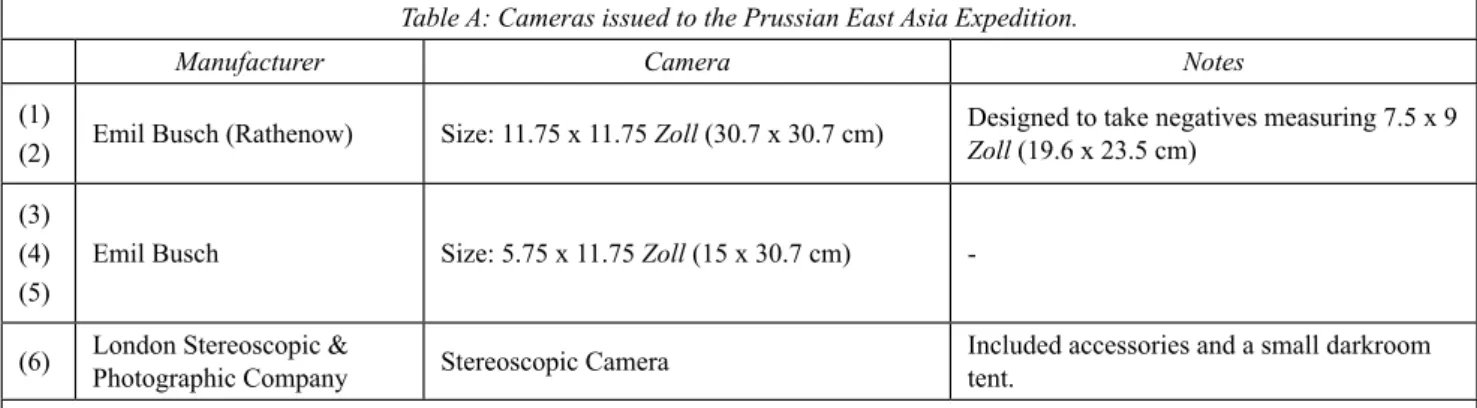
Table A: Cameras issued to the Prussian East Asia Expedition.
Manufacturer Camera Notes
(1)
(2) Emil Busch (Rathenow) Size: 11.75 x 11.75 Zoll (30.7 x 30.7 cm) Designed to take negatives measuring 7.5 x 9 Zoll (19.6 x 23.5 cm)
(3) (4) (5)
Emil Busch Size: 5.75 x 11.75 Zoll (15 x 30.7 cm) -
(6) London Stereoscopic &
Photographic Company Stereoscopic Camera Included accessories and a small darkroom tent.
●
Roughly corresponding to the inch, the Prussian Zoll was equivalent to 2.615 cm.
●
All six cameras were protected by an outer casing of iron.
disposal a surprisingly large quantity of photographic equipment - especially surprising when one considers that provision had only been made for one photographer.
Sixteen ‘enormous’ crates of photographic equipment and supplies comprised part of the baggage of the mission, with over 1,280 Reichsthaler (approximately €33,100 today) having been spent on cameras alone.
9The contents of these crates were itemised in a memorandum submitted while the Prussians were in Edo, and a summary is attached.
10As Table A shows, most of the equipment was purchased from the camera and lens manufacturer Emil Busch of Rathenow, and it was only when acquiring a stereoscopic apparatus and its associated equipment that government funds were spent outside Prussia.
Unfortunately the lenses are not specified, but it is almost certain – with the sole exception of the stereoscopic camera – that they were also produced by Emil Busch. We know from a separate description that one lens measured almost 12 centimetres in diameter: indeed, when the apparatus made its appearance in Edo, it immediately attracted the suspicion of local yakunin, ‘to whom it probably appeared that the large box with its four-and-a- half Zoll lens was a telescope of recent design’.
11In addition to an impressive range of chemicals – 93 bottles, including ether (19), alcohol (13), gun cotton (4), pyrogallic acid (4), hyposulphate of gold (6), sal ammoniac (2), sodium bicarbonate (2 1/2), potassium cyanide (1), nitric acid (1) – there were also enough glass plates in various sizes to take 2,500 photographs.
At the last minute, following a special request from the King of Prussia’s nephew, Grand Duke Friedrich Franz of Mecklenburg-Schwerin, a second artist, Albert Berg, was attached to the expedition though, presumably in order to avoid any perceived conflict with Heine’s duties, he was designated its ‘draughtsman’ (Zeichner).’
Thus, with two artists, one photographer, six cameras and ample photographic supplies on board, the flagship Arcona dropped anchor in Edo Bay on 4 September 1860 and the first stage of the Prussian expedition to East Asia commenced.
Division of Duties.
It is not within the scope of this article to discuss in detail the work of Heine and Bismarck in Edo. However, certain arrangements which had been made in Edo regarding the photographic work were still in place when the mission arrived in Nagasaki in February 1861.
Two weeks after the Prussians arrived in Edo, Heine was complaining that Bismarck was simply unequal to the task.
12Two solutions were found. Firstly, in late October, Eulenburg secured the services of the American photographer John Wilson, on a series of short- term engagements which stretched over eleven weeks.
13Bismarck seems to have benefited from Wilson’s proximity and was soon taking photographs of places of interest.
However, after the mission proceeded to China, he appears to have combined his duties as official photographer with frequent clerical assistance to the diplomatic staff.
Secondly, Bismarck’s assistant, Sachtler, was given more opportunity to develop his evident talent for photography. August Sachter was a telegrapher by profession, having been assigned to the Prussian navy by the Berlin office of Siemens and Halske in order to demonstrate the operation of the telegraphic equipment which comprised one of the official gifts from the King of Prussia to each of the rulers of Japan, China and Siam.
Indeed, Sachtler showed himself after a short time to be a proficient photographer who was capable of taking photographs on his own, and by the time the Prussians were almost ready to leave Edo, he was entrusted with the important task of taking commemorative portraits of the gaikoku bugyô and his staff.
14Sachtler’s fortuitous assignment to the Prussian East Asian Expedition was to make its mark not only upon his future career but also upon the early history of photography in East Asia. As early as the summer of 1861 it was evident that Sachtler intended to pursue a photographic career once he had obtained his discharge from the Prussian Navy, and he was already describing himself as a
‘photographic artist’.
15In 1862, after completing his duties
with the expedition, Sachtler returned to the East Asia and
established a photographic studio in Singapore, which
continued to operate until 1874.
16Thus, by the time the Prussian mission left Edo for Nagasaki, its photographic staff now consisted of two photographers of more or less equal standing, although Sachtler was still officially classified by his naval rank of Artificer 4
thClass (Handwerker IV. Klasse) and was obliged to continue wearing his uniform. In the demarcation of responsibility, it was apparent that while Bismarck was occupied almost entirely with photographing landscapes, Sachtler was an all-round photographer with a particular talent for portrait work.
The Nagasaki Portfolio
After the affairs of the Prussian East Asian Expedition were wound up in the summer of 1862, the authorities in Berlin found themselves at the end of the year in possession of 24 crates containing the remaining photographic equipment and chemicals issued to Eulenburg’s photographers and somewhere between 800 and 1,000 glass plate negatives taken in Japan and China.
17This photographic portfolio has so far been lost to posterity, and the historian of photography must turn to other sources in order to begin identifying it. Space permits only a discussion here of the portfolio created in Nagasaki and I propose to examine the work of the Prussian Expedition photographers undertaken elsewhere in Japan and East Asia, and the fate of the negatives, in a separate article.
The most useful source from which to begin
reconstructing the portfolio is the contemporary magazine Illustrirte Zeitung (LIZ). Published weekly in Leipzig in the Kingdom of Saxony since July 1843, the LIZ was the German-language contemporary of such influential illustrated magazines as The Illustrated London News (established in 1842), Le Monde Illustré (March 1843) and Harper’s Weekly (1857) and certainly deserves to be better known outside the German-speaking world
18. While the Prussian Expedition was in East Asia, the LIZ regularly published reports on its progress, and on 14 September 1861, a letter from Wilhelm Heine in Nagasaki appeared together with three illustrations taken from photographs:
‘The old bridge at Deshima’, ‘The Temple of Sofukuji’ (in fact, Daikôji) and ‘Japanese Women and Girl of Nagasaki’
(Figures 1, 2 & 3).
19All three photographs, the originals of which have yet to be found, are credited to August Sachtler.
The appearance of Deshima is hardly surprising.
Not only was Heine a guest of the Dutch Consul Louis Cornelis Jan Albert de Vogel and lodged at the latter’s house on the island during his stay in Nagasaki, but also one of the photographic assistants recalled that on 19 February ‘the photographer [Bismarck] and I took a boat to Nagasaki to the house of the Dutch consular official, Dr.
(sic) de Vogel, in order to take some photographs of the splendid view from there of the bay’.
20As we shall see, de Vogel’s house served the Prussian photographers on at least one other occasion. Daikôji, on the other hand, is not mentioned in any accounts of the mission.
Figure 1 ‘Die alte Brücke von Dezima – Nagasaky. Nach einer Photographie von A. Sachtler’ [The Old Bridge at Deshima, Nagasaki. After a photograph by A. Sachtler], engraving, Illustrirte Zeitung, 14 September 1861, p.185.
Figure 2 ‘Tempel von Sof-Rutschi in Nagasaky. Nach einer
Photographie von A. Sachtler’ [Temple of Sôfukuji (in fact,
Daikôji) in Nagasaki. After a photograph by A. Sachtler],
engraving, ibid.
Instead, the most important engraving is that showing a group of Japanese women, which offers a vital clue to identifying some other examples of Sachtler’s Nagasaki portfolio. The engraving itself is rather crudely executed, and suggests that some artistic license was applied when copying the original photograph, but one detail is accurate enough to enable reconstruction. Behind the group stands
a painted screen or byôbu, and part of the design, featuring the branches of a tree and stylised clouds, is clearly shown (Figures 3a & 3b). When we compare this section with Figure 3a Detail of Figure 3. Figure 3b Detail of Figure 4.
Figure 4 Attributable to August Sachtler, ‘Japanese Ladies in Court Dress’, stereograph (detail), 1861. (JCII Camera Museum).
Figure 5 Attributable to August Sachtler, ‘Japansch Meiseje te Decima’ [Japanese Girl at Deshima], stereograph (detail), 1861.
(Tokyo National Museum).
Figure 3 ‘Japanesische Frauen und Mädchen aus Nagasaky. Nach
einer Photographie von A. Sachtler’[Japanese Women and Girl of
Nagasaki. After a photograph by A. Sachtler], engraving, ibid.
some hitherto unattributed stereographs held in various collections a positive match emerges (Figures 4, 5, 6 & 7).
In addition to the byôbu, these photographs reveal other
consistent features, in particular the distinctive windows and shutters, indicating that the sitting took place in a Western-style house.
These additional features also appear in an account of the Eulenburg Mission by another of its participants, Gustav Spiess, which was published in 1864. Spiess’ book contains five engravings based on photographs taken in Nagasaki.
21Three are landscapes, one of which, a view of Deshima (Figure 8), is identical to that reproduced from Sachtler’s photograph in the LIZ. Another view shows the temple of Sôfukuji and the area surrounding Figure 6 Attributable to August Sachtler, ‘Chinees/ Secretaris van
den Minister van Policie (Nagasaki)’ [Chinese/ Secretary of the Chief of Police, Nagasaki], stereograph (detail), 1861. (Tokyo National Museum).
Figure 8 [Bridge at Deshima], engraving, Gustav Spiess, Die preussische Expedition nach Ostasien, 1864, p.190.
Figure 7 Attributable to August Sachtler, Japanese Girl, stereograph (detail), 1861. (Nagasaki University Library).
Figure 9 ‘Ansicht von Nagasaki’ [View of Nagasaki], engraving,
ibid, p.211.
it (Figure 9), while the third and last landscape will be discussed hereafter. The remainder of the engravings are portrait studies depicting a mendicant monk and a group of theatrical players. The former shows the same window and shutters identified above, and in the background the bottom part of a byôbu is also visible (Figure 10). The latter, however, indicates a different setting and can be matched with supporting text describing the circumstances under which it was taken (Figure 11). It recalls Heine’s vivid description of a photographic sitting in Deshima on 20 February:
22‘I had expressed the wish that photographs should be taken of Japanese theatrical players. During a single
day Mr. de Vogel summoned to his lodgings more than 30 people - old and young, actors, dancing girls, street performers, conjurers, child performers (Wunderkinder) and I know not what, so that, as long the light was favorable, scenes were enacted and depicted in the most interesting instantaneous photographs’.
23The photograph from which the engraving is taken can be found in two formats: as a stereograph (Figure 12) and as a carte-de-visite.
24A similar match can also be made between another engraving in Spiess’s book showing a pair Figure 10 ‘Japanischer Bettler als Klarinettbläser’ [Japanese
Beggar in the role of Clarinet Player (!)], engraving, ibid, p.201.
Figure 12 Attributable to August Sachtler, ‘Japanese Traveling Players, Nagasaki, Japan’, stereograph (detail), 1861. (JCII Camera Museum).
Figure 11 ‘Japanische Schauspieler’ [Japanese Theatrical Players], engraving, ibid, p.188.
Figure 13 ‘Aussicht in das Thal von Nagasaki vom Gräberberge
aus’ [View of the Valley of Nagasaki from the Cemetery
Mountain], engraving, Spiess, p.215.
of Japanese warriors, and a carte-de-visite held in Nagasaki University Library. However, since the location cannot be specifically identified as Nagasaki, discussion of this particular section of the Prussian portfolio will be reserved for a future article.
One final, tentative attribution can be made. Spiess’
book contains an engraving entitled ‘View of the Valley of Nagasaki from the Cemetery Mountain’ (‘Aussicht in das Thal von Nagasaki vom Gräberberge aus’) which has the same accuracy as the other engravings, and was almost certainly copied from a photograph (Figure 13).
A comparison with a panoramic view of Nagasaki held in Tokyo Metropolitan Museum of Photography strongly suggests that the engraving was based on the extreme right- hand part of a six-part panorama (Figure 14). Whereas the portfolio identified so far can be positively attributed to Sachtler, in my opinion this photograph appears to be the only identifiable example of Bismarck’s work. As mentioned before, Bismarck appears to have been entrusted more often with taking landscapes, and the documentation suggests that panoramas became something of a specialty for him. In September 1860, for example, Bismarck is recorded surreptitiously taking a panoramic view of Edo from the summit of Atagoyama.
25While the Prussians were in Nagasaki, Bismarck is likewise recorded during a trip to Mogi on 21 February 1861 taking ‘a panoramic view from the temple overlooking the village [of Aba
26]. It had a splendid position on a narrow promontory which stuck out into the bay, and one could see the wooded mountains beyond’.
27We should also not ignore a second, and indeed lengthier, visit made by Eulenburg and his staff to Nagasaki later that same year, when the Arcona returned on 21 October and stayed until 5 November. The main preoccupation of the Prussians this time, however, appears
to have been rest and recuperation after an exhausting six months in China.
28In any case, by this time the artistic staff was down to half-strength. Heine and Sachtler had left the mission in July to return to Europe, leaving Berg and Bismarck in charge of the iconography of the mission.
29This may have offered Berg an opportunity to expand his portfolio, but there is no evidence to suggest that Bismarck deployed his camera again in Japan.
Meetings with Scholars
While in Edo, Eulenburg had tried unsuccessfully to initiate contact between the scientists attached to his mission and the shadowy community of scholars of Western Studies which he had been told existed in Japan. The main problem in Edo was that such overtures had to be communicated to representatives of the Bakufu, whose reaction was far from encouraging. Eulenburg described the response to his overtures after a meeting held on 24 September:
‘With the official business over, the meeting quickly turned to informal conversation while we enjoyed champagne, pipes and cigars. I told them that I had many scholars with me and I very much desired that they might have the opportunity to come into close contact with Japanese men of learning. The Governors declared that it would be impossible – there were no true scholars in Japan at all, merely amateurs who dabbled in science and, in any case, they did not reside in Edo, but were scattered across the entire land; it would not be possible to seek them out...’
30Later, however, contact did take place, after a fashion.
In January of the following year, Ichikawa Itsuki of the Institute for the Study of Barbarian Books (Bansho shirabejo) visited the Prussian Mission in Akabane on five separate occasions, ostensibly to learn more about the operation of the telegraph apparatus which was to be presented on behalf of the King of Prussia to the Shôgun.
Ichikawa’s own diary contains only terse descriptions of his visits:
13 January: Went to the Official Foreign Guesthouse in Akabane. Learned how to operate the telegraph apparatus.
14 January: Went to Akabane.
15 January: Went to Akabane.
16 January: We n t t o A k a b a n e . S a w t h e p h o t o g r a p h i c a p p a r a t u s (‘shashinkyô’).
31Fortunately, more detailed documentation exists on the Prussian side and offers a tantalising glimpse of the progress of yôgaku in Edo in general, and the state of Japanese research into photography in particular. On 16 January, the day on which Ichikawa recorded seeing the cameras at the Prussian legation, the geologist Ferdinand Figure 14 Attributable to Carl Bismarck, Panorama of Nagasaki
(detail), albumen print, 1861. (Tokyo Metropolitan Museum of
Photography).
von Richthofen described in his diary his surprise on discovering the extent of Ichikawa’s knowledge of a wide range of subjects:
‘I was even more surprised when I then went with him into the photographer’s darkroom. Here as well nothing was new to him. He made enquiries about the entire proceedings, not as one who had no previous knowledge of them, but rather who wished to learn more. His questions were always put thus: “Wasn’t it the case that pyrogallic acid was used in this way?” “And after that doesn’t one use sodium thiosulphate?” He knew all the names exactly, and furthermore had been able to see the chemicals and their effects.’
32In his official function as one of the telegraphers, Sachtler was also among those who came into contact with Ichikawa.
Nagasaki, on the other hand, offered new possibilities.
Even before Eulenburg’s mission arrived in Japan, Matsumoto Ryôjun had been making enquiries about the scholars attached to it
33. Once in Nagasaki, the Prussians enjoyed far greater freedom of movement than they had ever been granted in Edo. Matsumoto met members of the Prussian expedition on at least three occasions, as did Pompe van Meerdevoort. The botanist Wichura, who had been allowed to proceed to Nagasaki in advance of the mission and therefore spent the longest time there, had frequent contact with Matsumoto Ryôjun, and the warmth of the relations between the two is proved not only by a poem Matsumoto wrote for Wichura on his departure from Nagasaki, but also by Matsumoto’s farewell gift of a Japanese sword, an item which Japanese were prohibited from giving to foreigners.
34The feeling was evidently mutual: ‘I have seldom seen such a beautifully vaulted cranium as his’, Wichura wrote admiringly.
35Through the agency of Matsumoto, Wichura and his colleagues were admitted to the small community of rangakusha in Nagasaki. Richthofen, for example, met not only Matsumoto Ryojun, but also Shiba Ryôkai. Unfortunately, the documentation of these encounters is slight. Richthofen was the only scholar to leave a detailed record of his visit to Nagasaki, and his discussions with Matsumoto and Shiba were concerned mainly with geology (Richthofen was particularly pleased to receive information from Shiba about the state of mining on his native Sado Island).
36We c a n o n l y s p e c u l a t e a b o u t t h e P r u s s i a n photographers and any contact they might have had with Japanese students of photography in Nagasaki. Matsumoto would have served as a useful conduit in this respect, and a surviving stereoscopic portrait of Matsumoto and one of his students (probably Shiba) taken by one of the Prussian photographers (probably Sachtler) hints at some initial contact at the very least.
37Proximity is a compelling argument: while scholars such as Furukawa Shunpei, Maeda Genzô and Kawano Teizô had returned to their home domain of Fukuoka in the previous year, both Ueno
Hikoma and Horie Kuwajirô were, as research by Endô Shôji has convincingly shown, still in Nagasaki in February 1861 awaiting orders from the lord of the Tsu clan to proceed to Edo.
38It is tempting to imagine Matsumoto sending word to his students in the third week of February that foreign photographers were at large in Nagasaki, but until concrete evidence emerges, an encounter between Ueno Hikoma and Horie Kuwajiro on one hand and Wilhelm Heine, Carl Bismarck and August Sachtler on the other can only be imagined.
Conclusion
The Prussian Mission has a lot to tell us about early photography in Nagasaki and Japan generally. It is perhaps the only foreign expedition to have visited Japan before the Meiji Era for which we have an exceptionally detailed inventory of photographic equipment and supplies, and therefore offers us insight into how such photographic teams were equipped. It is also a reminder of how much freedom of movement foreigners enjoyed in Nagasaki.
In contrast to Edo, where their movements were closely observed and their work was often hampered by Bakufu officials, the Prussian photographers were able to move freely and photograph more or less wherever and whatever they wanted. One is left with the impression that in Nagasaki during the third week of February, 1861, the main problem was lack of time, though this was partly compensated for by good weather. Recent researchers have examined the scientific importance of the mission, and, in the case of Fukuoka Mariko of Tokyo University, its relation to the work of Japanese scholars of yôgaku in Edo.
39However, given the close, albeit brief, contact which the Prussian scientists, artists and photographers had with Pompe van Meerdevoort, Matsumoto Ryôjun and Shiba Ryôkai in Nagasaki, there may also be a potentially fruitful line of enquiry to be followed in the context of Western Studies in Nagasaki. Finally, as a historian of photography, I cannot give up the hope that, buried in a neglected corner of the former Kingdom of Prussia, a collection of crates of glass-plate negatives taken during Count Eulenburg’s mission to East Asia has, against the odds, survived willful neglect and two world wars and awaits re-discovery.
Notes
I would like to thank the Daiwa Anglo-Japanese Foundation for awarding a research grant which enabled trips to be made to Berlin in September 2005 and January 2007.
Thanks are also due to Dr. Cord Eberspacher and Dr. Susanne Brockfeld for their kind assistance during my visits to the Geheimes Staatsarchiv in Dahlem, Berlin. All translations are mine.
1 Wilhelm Heine, Eine Weltreise um die nördliche Hemisphäre in Verbindung mit der Ostasiatischen Expedition in den Jahren 1860 und 1861, Leipzig (F.A.
Brockhaus), 1864 (hereafter cited as Heine 1864), Vol. II, pp.71-73. Albert Berg (Ed.), Die Preußische Expedition nach Ost-Asien nach amtlichen Quellen, Vol. I, Berlin (Verlag der Königlichen Geheimen Ober-Hofbuchdruckerei/ R. v.
Decker), 1866 (hereafter cited as Berg 1866), pp.179-187. The Nagasaki phase
or Japan. A tendency to regard the visit to Nagasaki as peripheral was already evident in 1910 when the anonymous diary of a sailor on the Thetis was edited for publication. See P. Koch (Ed.), ‘Ein Matrosen-Tagebuch’ Marine Rundschau, Vol. IX, 1910, pp.1184-1192. Some thirty years later, Friedrich Trautz also omitted this phase of the Prussian East Asian Mission when editing the early Japan letters of the diplomat Karl von Eisendecher, who had served as a cadet on board the Arcona. F.M. Trautz (Ed.), ‘Deutsche Seekadettenbriefe aus Jedo, 1860-1861’, Nippon. Zeitschrift für Japanologie, 7. Jg. (1941), Heft 3, pp.129- 163, reprinted, with annotations and an accompanying Japanese translation, as chapter 1 in Peter Pantzer & Sven Saaler, Japanische Impressionen eines Kaiserlichen Gesandten. Karl von Eisendecher im Japan der Meiji-Zeit/ Meiji shoki no Nihon – Doitsu gaikôkan Aizendehyâ kôshi no shashinchô yori, München (Iudicium), 2007, pp.65-118. Unfortunately, Eisendecher’s original letters were burned after the death of his widow in 1942, thus depriving posterity of his observations after January 1861. Ibid, p.96. Even the most recent compilation of writings by participants in the East Asian Expedition contains no description of the visit to Nagasaki. See Holmer Stahncke, Preußens Weg nach Japan. Japan in den Berichten von Mitgliedern der preußischen Ostasienexpedition 1860-61, München (Iudicium), 2000.
2 For a brief introduction to the Eulenburg Expedition in English see Bernd Martin, ‘The Prussian Expedition to the Far East (1860-1862)’ The Journal of the Siam Society, Vol. 78, Part 1, 1990, pp.35-42, which also appears as Chapter 1 in the same author’s Japan and Germany in the Modern World, Providence/
Oxford (Berghahn Books), 1995, pp.3-16.
This was not the first occasion that the Prussian flag had flown in Nagasaki:
in November 1860 the transport vessel of the expedition, the Elbe, had spent several days in Nagasaki en route for Yokohama. Reinhold Werner, Die preußische Expedition nach China, Japan und Siam in den Jahren 1860, 1861 und 1862. Reisebriefe von Reinhold Werner, Kapitän-zur-See in der kaiserlich deutschen Marine, Leipzig (F.A. Brockhaus), 1863. Berg 1866, pp.114-15.
When the Arcona and Thetis arrived in February 1861, the expedition’s botanist, Max Wichura, was already in Nagasaki, having arrived there on 26 December 1860. Max Wichura, Aus vier Welttheilen: eine Reise-Tagebuch in Briefen von Max Wichura (hereafter cited as Wichura 1868), Breslau (E. Morgenstern), 1868, pp.118-29 and 162. Berg 1866, p.179.
3 Eulenburg to Townsend Harris, 24 October 1861, in Letter Book V, no. 313, Townsend Harris Papers, City College of New York. Information on the deserters from the Arcona kindly supplied by Dr. Herman Moeshart.
4 Letter by Eulenburg dated 20 February 1861, in Graf Philipp zu Eulenburg- Hertefeld (Ed.), Ost-Asien 1860-1862 in Briefen des Grafen Fritz zu Eulenburg (hereafter cited as Eulenburg 1900), Berlin (E.S. Mittler & Sohn), 1900, p.173.
5 North China Herald, 29 December 1860. My thanks are due to Dr. Luke Gartlan for drawing my attention to this reference.
6 Heine 1864, I, p.230.
7 See for example, Hajo Holborn (Ed.), Aufzeichnungen und Erinnerungen aus dem Leben des Botschafters Joseph Maria von Radowitz, Stuttgart, Berlin &
Leipzig (Deutsche Verlags-Anstalt), 1925, Vol. I, p.47. Dr. Cord Eberspächer of the Geheimes Staatsarchiv in Dahlem generously provided confirmation of Bismarck’s parentage from official sources.
8 See Bismarck’s obituary in Japan Gazette, 11 December 1879, p.2.
9 Spiess describes ‘riesige Kisten mit photographischen Apparaten u.s.w.’ being transferred to the flagship Arcona at Singapore. Gustav Spiess, Die preussische Expedition nach Ostasien während der Jahre 1860-1862 (hereafter cited as Spiess 1864), Berlin & Leipzig (Otto Spamer), 1864, p.116. I would like to thank Andreas Lorenz of the Statistical Department of Deutsche Bundesbank and his colleagues Hans-Albert Leifer and Robert Kircher for their advice on the purchasing power of the Prussian Thaler in 1860 relative to the value of the Euro in December 2007.
10 Heine to Eulenburg, 5 November 1860, 2.4.1 Abt. II 5071 (Band 9). Prussian Foreign Ministry Records, Geheimes Staatsarchiv, Dahlem (Germany).
11 Heine 1864, I, p.235.
12 Heine to Schleinitz, 14 October 1860, 2.4.1 Abt. II 5070 (Band 8). Prussian Foreign Ministry Records, Geheimes Staatsarchiv.
13 See the author’s ‘Jon Uiruson – Arata na shiryô kara kaimei sareta kare to nakama no shashinkatachi’ Nihon Shashin Geijutsu Gakkaishi (Bulletin of the Japan Society for Arts and History of Photography), Vol. 16, No. 1, 2007, pp.5- 20 (hereafter cited as Dobson 2007).
14 Sachtler’s portraits of the Japanese commissioners are reproduced in LIZ, No.
935, 1 June 1861, p.373.
15 During their passage to Yokohama on HMS Algerine in July 1861, Heine and Sachtler are described in the ship’s muster as ‘Prussian Officer’ and
‘Photographic Artist’ respectively, despite the latter still nominally being in the service of the Prussian Navy. See entry for 25 July 1861 under the heading
‘Supernumeraries for Victuals at Two-thirds’ in ‘Muster Book of HMS Algerine, commencing 1 July 1861, ending 30 September 1862’, British Admiralty Records: ADM38/2408. National Archives, Kew, (U.K.).
16 John Falconer, A Vision of the Past. A History of Early Photography in Singapore and Malaya. The Photographs of G.R. Lambert & Co., 1880-1910,
Singapore (Times Editions), 1987, pp.21-25. The chronology implied by the photo-dealer Terry Bennett in his recent outline of Sachtler’s career is erroneous.
Terry Bennett, Photography in Japan 1853-1912 (hereafter cited as Bennett 2006a), Tokyo & Singapore (Tuttle Publishing), 2006, pp.126 and 318, and Old Japanese Photographs. Collectors’ Data Guide (hereafter cited as Bennett 2006b), London (Bernard Quaritch), 2006, pp.82 and 230.
17 This was Heine’s estimate, which excludes the photographs taken after his departure from the mission in July 1861. ‘Vorwort’ dated 1 March 1875 in Wilhelm Heine, Japan. Beiträge zur Kenntniss des Landes und seiner Bewohner, Berlin/ Dresden, 1873-75, unpaginated.
18 See Joachim Wachtel (Ed.), Facsimile Querschnitt durch die Leipziger Illustrirte Zeitung, München/ Bern/ Wien (Scherz), 1969, and Wolfgang Weber: Johann Jakob Weber, der Begründer der illustrierten Presse in Deutschland, Leipzig (Lehmstedt Verlag), 2003.
19 [1] ‘Die alte Brücke von Dezima – Nagasaki’, [2] ‘Tempel von Sof-Rutschi in Nagasaki’ and [3] ‘Japanesische Frauen und Mädchen aus Nagasaki’. See
‘Von Berlin nach Japan. Reiseskizzen von W. Heine. XIII,’ Illustrirte Zeitung (hereafter cited as LIZ), No. 950, 14 September 1861, pp.185-86. Nine of the ten engravings in the LIZ based on the so-called “lost photographs” of Wilson and Sachtler are reproduced in Bennett 2006b, 82-84. The missing engraving is based on a group photograph by Sachtler and shows Lieutenant von Imhoff and a picket of Prussian marines guarding the legation in Edo. See LIZ, No. 933, 18 May 1861, p.336. Wilson’s work is discussed in detail in Dobson 2007.
20 Hermann Rose, Meine Erlebnisse auf der preussischen Expedition nach Ostasien, 1860, 1861 und 1862 (hereafter cited as Rose 1895), Kiel, 1895, p.60. Although Rose does not mention the photographer by name, it is more than probable that he was referring to Bismarck, since on the few occasions he mentions Sachtler, he refers to him as ‘my colleague Sachtler’. Rose and Sachtler were both telegraphers and had been assigned to the East Asian Expedition from the Berlin office of Siemens & Halske.
21 Spiess 1864.
22 The date of the sitting can be inferred from Rose, who mentions that on the same day that the theatrical players were photographed, a non- commissioned officer of the Prussian marines (in fact, Petty Officer Rudolf Nickel of the Arcona) died during the night. Rose 1895, p.60.
Spiess slightly complicates attribution by referring to the photograph of the theatrical players reproduced in his book as ‘taken by myself on the spot’ (‘am Ort selbst aufgenommen’) Spiess 1864, p.189. Since the iconography of his book provides the main proof for connecting this and other photographs with the Prussian mission, such a claim cannot be dismissed entirely out of hand.
However, given that there is no reference to Spiess taking photographs at this or any other time, and that there was already an established photographic team consisting of Bismarck, Sachtler and Rose operating –at least nominally- under Heine’s direction, Spiess’s claim is almost certainly spurious. The only connection between Spiess and the mission photographers appears to be the former’s friendship with Carl Bismarck.
23 Heine 1864, II, 75-76. Rose also reports that ‘photographs were taken of several groups of Japanese theatrical players, who afforded us much amusement with their characteristic costume’. Rose 1895, p.60.
24 A stereoscopic version of this photograph is held in the collection of the JCII Camera Museum, while the photographic collection of Nagasaki University Library possesses the same photograph in carte-de-visite format. The stereograph bears the printed label of the studio of E. & H.T. Anthony of New York with the inscription ’Anthony’s Stereoscopic Views./ No. 30./ Japanese Travelling Players, Nagasaki, Japan./ Photo. by M. Miller.’ Miller’s authorship of this and other photographs taken in Nagasaki has been generally accepted despite the lack of any definite evidence that the Hong Kong-based photographer ever visited Japan. See Bennett 2006a, 112-14. Given that the only appearance of contemporary engraved versions of photographs of Japanese subjects hitherto attributed to Miller occurs in German-language publications, it is more likely that these are the work of a photographer connected with the Prussian East Asia Expedition and that Miller somehow acquired the rights subsequently to distribute a small group of images taken in Nagasaki. I would like to thank Mr.
Yano Hiroshi, Director of JCII, for letting me examine the stereoscopes in his collection.
25 Heine 1864, I, pp.234-37.
26 Heine mistakenly refers to the village as ‘Awa’. Heine 1864, II, p.78.
27 Rose 1895, p.60.
28 For the mission’s activities in China, see Bernd Martin, ‘Die preußische Ostasienexpedition in China. Zur Vorgeschichte des Freundschafts-, Handels- und Schiffahrts-Vertrages vom 2. September 1861’, in Kuo Heng- Yü & Mechthild Leutner [Eds.]: Deutsch-chinesische Beziehungen vom 19.
Jahrhundert bis zur Gegenwart. Beiträge des Internationalen Symposiums in Berlin, München (Minerva Publikation), 1991, pp.209-240.
29 Heine and Sachtler took different routes to Europe after separating in Yokohama in September 1861, the latter by the westward sea passage and the former across the Pacific and the United States. While Sachtler eventually arrived in Berlin in March 1862, Heine was not to return until January 1863, having broken off his
journey in New York to enlist in the army of his adoptive country and participate in the American Civil War.
30 Letter dated 24 September 1860, Eulenburg, 79.
31 Ichikawa Itsuki diary, Futensai nikki, 13-16 January 1861. Institute of Historiography, Tokyo University. Quoted in Fukuoka Mariko, ‘Bakumatsu no Doitsu ninshiki no kigen – yôgakusha Ichikawa Itsuki ni okeru “Doitsugaku”
no kôsatsu’ Yôroppa kenkyû (European Studies), special issue, 2005, pp.36-55 (hereafter cited as Fukuoka 2005).
32 Ferdinand von Richthofen, ‘Tagebüchern der Gesandtschaftsreise 1860/61’
in [E. Tiessen, Ed.], Mitteilungen des Ferdinand von Richthofen-Tages 1912, Berlin (D. Reimer/ E. Vohsen), 1912, p.102 (hereafter cited as Richthofen 1912).
Quoted in Fukuoka 2005, p.50.
33 Wichura 1868, p.133; Berg 1866, p.195.
34 Wichura 1868, pp.164-65.
35 Ibid, p.133.
36 Richthofen 1912, p.122.
37 Bennett 2006a, fig. 159, p.126. Significantly the stereograph bears the contemporary German-language caption ‘Japanese Photographer and Engineer’
(‘Japan[esischer]. Photograph u[nd] Maschinist’).
38 Endô Shôji: ‘Shippan shashinjutsu to yôgakusha’, Yôgaku, 2, 1994, pp.114- 116. As Endô points out, this would mean that the date of Spring 1861 given by Ueno for his departure from Nagasaki in the first report of his famous interview with the Tôyô Hi-no-de Shinbun in 1902 was originally correct, but was superseded by the incorrect date of 1860, which crept into a later installment of the interview published a few days later and remained undisputed for almost a century. Endô’s research has yet to be fully incorporated into mainstream photo-history, especially by non-Japanese scholars. While Claude Estebe has taken account of this chronology, more recent works such as Bennett 2006a have not. The implications are significant: Ueno and Horie would still have been resident in Nagasaki when Rossier visited the port in October 1860 and presumably during the visit of the Prussian East Asian Expedition four months later, while the term of their engagement in Edo would have been a more realistic six months between responding to Tôdô’s summons in March and their receiving an order from Tôdô on 16 October 1861 to leave Edo for the Tsu domain. Most importantly, however, scholars must now account for a ‘missing year’, presumably spent in Nagasaki, during Ueno’s early development as a photographer.
39 See Chi-Ni Hsieh: Die Expedition der “ Thetis” in die südostasiatischen Gewässer, MA thesis presented at Freiburg University, 2002.