The Role Played by Goddesses in the Haracaritacintamani
SHIBAZAKI Maho
1 Introduction
The Haracaritacintamani (HCC) by Jayadratha is a collection of religious stories written in Kashmir in the late 12th and early 13th centuries AD.1) As its title (Hara-carita) and the repeated use of the phrase (Siva-(Hara-carita)2) in the preface (HCC 1-1.5, 11,
13, 48) suggest, it is made up of myths and folklore regarding the deeds of Siva. A work steeped in Saivist belief, the HCC contains many explanations of the history and spiritual meaning of holy places, divinities, rituals, holy days and other ele-ments of religious life.
The HCC contains 32 stories, but the endings of two (HCC 29 and HCC 32) are missing. Of the 30 complete stories, 26 are either about Siva or feature him in an important role. However in four almost consecutive stories in the second half of the HCC goddesses-Siva's wives-play a central role, while Siva himself is hardly mentioned. The four stories are as follows: HCC 22: The birth of Durga; HCC 23: Kausiki's defeat of the demons Sumbha, Nisumbha and Mahisa; HCC 25: The self-sacrifice of the Vidyadara prince Jimutavahana to save a serpent's life; HCC 26: The faithful servant Viravara.
This article describes the special characteristics of these goddess stories, consid-ers their place in the HCC as a whole, and offconsid-ers a speculative answer to the ques-tion of why they are included. It focuses in particular on one story, HCC 26 Viravara. By comparing its plot to versions of the story predating the HCC I estab-lish some characteristics of the HCC. Based on this comparison and also on previ-ous research (Shibazaki, 1997 and 1998), I identify common characteristics of the four goddess stories and consider the background to their inclusion in the HCC. I also compare the content of the four goddess stories with the Siva-centric stories as a
ba-(8) The Role Played by Goddesses in the Haracaritacintamani (M. SHIBAZAKI) sis for considering how and why Jayadratha structured the HCC as he did.
2 The Viravara story: outline, versions and analysis
2.1 Outline of the story
HCC 26 tells the story of a faithful servant, Viravara, who sacrifices his son to a goddess in order to prolong his king's life. The crisis is finally resolved by the god-dess. The elements of the story are as follows:
A A Brahman called Viravara comes to a king (called Vikuramatunga in some ver-sions and Sudraka in others) asks to enter his service, and is accepted.
B Viravara then demands a high salary from the king. The king agrees, but has his spies check on Viravara's conduct. Their reports convince the king of Viravara's trustworthiness.
C One night, the king hears someone weeping, and orders Viravara to find out the reason for the sorrow. The king secretly follows Viravara.
D Finding a woman lamenting in the middle of a lake, Viravara asks the reason for her sorrow. The woman, who is a goddess, tells him that the king's life will end three days from now. She also tells him that the only way to save the king is for Viravara to sacrifice his own son to the goddess Candika (Sarvamarngala in Hit.
3.8). Viravara goes home immediately.
E Viravara explains the situation to his family, and sets out with his family to the temple of Candika.
F Cutting off his son Sattvavara's head, Viravara offers it to Candika.
G Seeing her brother's death, Viravara's daughter dies of a broken heart. With Viravara's permission, his wife kills herself in order to be with her children. H Variant H1: His duty fulfilled, Viravara is about to sacrifice himself in order to
follow his family.
Variant H2: His duty fulfilled, Viravara cuts his own head off as a sacrifice to the goddess.
I Observing all this, the king is about to cut his own head off in the hope that Candika will revive Viravara and his family.
J A voice from the air stops him at the last moment, and all of Viravara's family are brought back to life. Everyone returns to their homes.
K The next morning, Viravara tells the king that there is nothing to report about the previous night's weeping. Astonished at his servant's dignity, the king tells the true story to his ministers and rewards Viravara.
2.2 Previous versions of the Viravara story
Several versions of the story exist. One is found in Hitopadesa (Hit.) by Narayana, where it features as an episode in the third chapter "Vigraha". The Kashmirian ver-sions of Brhatkatha, Ksemendra's Brhatkathamahjari (BKM) and Somadeva's Kathasaritsagara (KSS), which were based on the same source, both contain two versions. The first one is adopted as an episode in the main story. The second one is the fourth story of the Vetalapancavimsatika (Vet.) which was included in BKM and KSS as a sub-story. The Viravara story also appears in other versions of the Vet. (Kamimura, 1978, pp. 294-313) but the Vet. versions included in the BKM and KSS are the ones that have the closest relationship with the. compilation of the HCC, so I ex-clude the other Vet. versions here.
The following versions of the Viravara story, then, are known to have existed pri-or to the writing of the HCC: 1. Hit. 3.8 (Peterson, 1887, pp. 112-116); 2. BKM 15.5.190-192 (Shivadatta and Parab, 1982, p.525); 3. KSS 9.3.86-193 (Durgaprasad and Parab, 1915, pp. 267-270); 4. BKM Vet. 4. (BKM 9.6.263-332) (Shivadatta and Parab, 1982, pp. 308-314); 5. KSS Vet. 4 (KSS 12.11.5-123) Durgaprasad and Parab,
1915, pp. 414-417)
2.3 Comparing the versions of the Viravara story
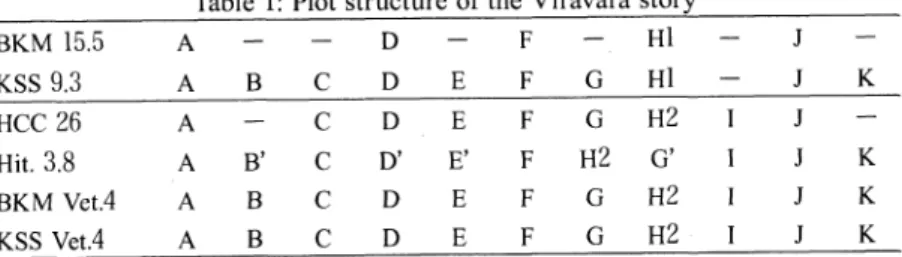
Table 1 shows how the plot elements are arranged in the HCC and the five previ-ous versions.
Table 1: Plot structure of the Viravara story
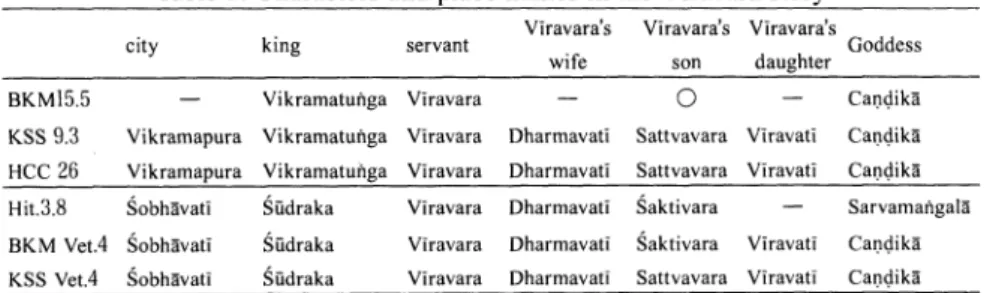
Plot elements marked with an apostrophe differ slightly from the standard version. The names of the city, the king, and Viravara's son differ between versions, as
(10) The Role Played by Goddesses in the Haracaritacintamani (M. SHIBAZAKI) shown in Table 2.
Table 2: Characters and place names in the Viravara story
The six versions differ in the reason given for including the Viravara story in the overall narrative, as shown in Table 3.
Table 3: Reason for including the Viravara story in the overall narrative
Taking the three tables together, the versions fall into three pairs. The first pair, BKM 15.5 and KSS 9.3, stresses the role of the heroic servant, whose self-sacrifice (H1) is the climax of the story. This emphasis is reflected in the plot, in which the king does not feature in the climactic scene, and made explicit in the overall narra-tive, which introduces the Viravara story as an example of a faithful servant. The two versions also use the same character and place names. Let us call this pair Type 1. The second pair, BKM Vet.4 and KSS Vet. 4, gives the leading role to the king, making his would-be sacrifice (I) the climactic scene. They use the same names, and also feature a question-and-answer session at the end of Viravara story which makes it clear that the king is the most courageous character. Let us call this pair Type 2.
The third pair, comprising HCC 26 and Hit. 3.8, does not fall neatly into either of the above groups. HCC 26 has a king-centric plot and gives the importance of the king as the reason for including this story in the overall narrative, but it employs the same names as the versions that stress the role of the servant. Hit. 3.8, on the other hand, has a king-centric plot and uses the same names as the versions that stress the role of the king, but is included in its overall narrative as an example of the faithful
servant. There is no known connection between HCC 26 and Hit. 3.8, and the sig-nificant differences between them allow us to ignore Hit. 3.8 in this study.
These comparisons suggest that the author of HCC 26 wrote his version while re-ferring to at least two previous versions of the story, one Type 1 and one Type 2. Further evidence for this claim comes from the presence in HCC 26 both of verses that parallel KSS 9.3, a Type 1 text, and of verses that parallel KSS 12.11, a Type 2 text. Here are the relevant verses:
HCC 26.36cd-38(F)
naumi tvam devi matpranair jivatv asmat prab-hur nrpah//36
rajyam vikramatungasya bhupad idam akapti-kam/
ity asya-uktavato mata sadhu putrety abhasata// 37
tatab karatal5yatya siro viravarab sisoh/
chittva dadau mahadevyai rajnah sreyo 'stv iti
bruvan//38 HCC 26.50cd-51(I)
slksat krtya samiksya-eva krtakrtyo mahipatih// 50cd
sascaryah savisadas ca salajjas ca vyacintayat/
na drstam na srutam yac ca tatkarma krtavan ayam//51
KSS 9.3.147-149ab(F)
devi murdhopaharena mama jivatv nah prabhub nrpo vikramatungo 'tra sastu ca ksamam akan-takam//147
evam uktavatas tasya sadhu putrety udirya sab/ krstva karatalam sunos chittva viravarah sirah//
148
pradadau candikadevyai rajnah sreyo 'stu iti bruvan/149ab
KSS 12.11.94-95ab(I)
tat alokya akhilam tatra channasthab sudrakah nrpah/
sakulah ca saduhkhah ca sascaryab ca
vyacin-tayat//94
aho kim api anena etat anyatra adrstam asru-tam/95ab
HCC 26 also contains several changes from all the previous versions, both Type 1 and Type 2. Two changes are particularly significant. First, the cause of the king's early death is explained as his lack of devotion to Siva (HCC 26.20-24.ab): this under-lines the importance of respect for Siva-a point made clear by the final verse of the story, HCC 26.65. Second, the king's devotion to the goddess Candika at the climax of the story is the key to the denouement: this underlines the importance of bhakti, which is mentioned in HCC 26.56, 59 and elsewhere.
Despite these differences and its use of different names, HCC 26 adopts the same king-centered perspective on the story as the Type 2 versions. The king's leading
(12) The Role Played by Goddesses in the Haracaritacintamani (M. SHIBAZAKI)
role is also expressed in the story's title "Vikramatunga" -the story does not have its own title in BKM Vet.4 and KSS Vet.4-and in the table of contents (HCC 1-1.41).3) 3 The Goddess stories in Jayadratha's narrative strategy
3.1 The organization of the HCC
HCC 25 relates Prince Jimutavahana's mercy and self-sacrifice, and just as in HCC 26, devotion (bhakti) to a goddess brings a resolution to the story and is there-by recommended to the reader. These two stories also have in common the appear-ance in the climactic scene of Siva's wives Parvati and Candika to save the life of the hero. The two preceding goddess stories, HCC 22 and 23, feature well-known myths of Siva's wives Durga and Kausiki. Thus we have two pairs of stories sharing similar themes.
These pairings lead us to suppose that Jayadratha selected and paired these four stories because of these similarities. Is there evidence of a similar selection method in the HCC as a whole? The stories related to Siva in the HCC do allow a broad classification: HCC 1.2-9: Myths, traditions and lore related to Siva; HCC 10-14: Stories explaining the history of holy places; HCC 15-21, 24: the teachings or mer-its of belief in Siva; HCC 27-29: Myths, traditions and lore related to Siva; HCC 30-31: Explanations of Saiva doctrine.
This grouping suggests a similar selective and organizing purpose on the part of Jayadratha in the Siva stories too. This is a promising topic for future research. 3.2 Sources of the Goddess Stories
What literature did Jayadratha refer to when he composed the goddess stories? An analysis of HCC 22 and 23 remains to be done, but Shibazaki (1997) established close links between HCC 25 and the KSS versions, and Shibazaki (1998) demon-strated that HCC 27, which is the background story of Gunadhya, the author of the Brhatkatha, was written in reference to the KSS. This article has found similar pallels between HCC 26 and KSS texts as the above two papers. We can therefore ar-gue that three sequential stories, two of the goddess stories (HCC 25 and HCC 26) and the Siva story HCC 27, were written based on the same source, the KSS.
In addition to the KSS, we know that Jayadratha referred to at least one sastra, as he mentions it in the preface. In HCC 1.1.5 the words "sastra-drstani caritrani", and
then in HCC 1.1.48 the words "caritany... tani sastratah" may indicate one particular source which is not extant. But it is more likely that they indicate several "sastras" . Jayadratha, however, does not name any particular sastras in the preface.
Jayadratha was born into a highly respected and educated family; his father was a minister of king Rajaraja and his brother was the well-known poet Jayaratha. We have several references attesting to Jayadratha's scholarly life and devotion to Saivism. Thus he would have had access to, and understanding of, a large number of texts. Gupta argued on the basis of text comparisons that Jayadratha refered to the Matsya, Padma and Sivamaha Puranas while writing the HCC.4) Jayadratha probably went through a number of puranas extracting stories that fitted the HCC's themes.
4 Conclusion
Jayadratha seems to have compiled the HCC by collecting stories that fitted his three main themes of Siva legends, holy places, and Saivist devotion and arranging them in thematic groups. The goddess stories discussed in this article form another theme, included towards the end of the collection. One of them, the Viravara story, combines elements of at least two different previous versions of the story and also
adds its own Saivist emphasis.
In the preface Jayadratha explains that his narrative is much more accessible than
his previous works (HCC 1-1.7-1-1.8),5) and people of high (uttamanam), medium (madhyamanam), and low capacity (adhamanam) will all benefit in their different ways from this narrative (HCC 1-1.11-13).6) He may thus have included the goddess
stories in order to make the HCC appeal to a wider audience.
References
De, S. K. (1923). Studies in the History of Sanskrit Poetics. vol.I, London.
Durgaprasad, P. and Parab, K. P. (Eds.) (1915) The Kathasaritsagara of Somadevabhatta, Bombay.
Gode, P. K. (1942) Descriptive Catalogue of the Collections of Manuscripts deposited at the Bhandarkar Oriental Research Institute, Vol. XIII pt. II, Kavya, Poona.
Gupta, K. (1976) The Haracaritacintamani-its Siva legends as compared with those of the Puranas, Purana, XVIII (1), pp. 75-83.
(14) The Role Played by Goddesses in the Haracaritacintamani (M. SHIBAZAKI) Gupta, K. (2002) Sanskrit Saiva Kavyas (From 12th century to 17th century A.D.), Vol. I
: Haracaritacintamani and Bhiksatana, Delhi.
Kamimura, K. (1978) Shiki 25wa (25 tales of Vetdra), Toyo Bunko 323, Tokyo. Krishnamachariar, M. (1974) History of Classical Sanskrit Literature, Delhi.
Peterson, P. (ed.) (1887) Hitopadesa by Ndrayana, Bombay Sanskrit Series 33, Bombay. Shibazaki, M. (1997) A story of Jimutavahana in the Haracaritacintamani, Journal of
In-dian and Buddhist Studies 45 (2), pp. 42-45(L).
Shibazaki, M. (1998) The story of Gunadnya in the Haracaritacintamani, Journal of Indian and Buddhist Studies 46 (2), pp. 51-54(L).
Shivadatta, M. M. and Parab, K. P. (eds.) (1982: repr.) Brhatkathamanjari of Ksemendra, Kavyamala 69, New Delhi.
Sivadatta, M. P. and K. P. Parab (eds.) (1983: repr.) The Haracaritacintamani of Rajaanaka Jayaratha, Kavyamala 61, Bombay.
Notes
1) Nine manuscripts of the HCC are known or thought to exist. The following list was sent by Alex Watson to the Indology mailing list, 24 Aug 2003 (quoted here with the author's permission): 1. No. 7042: Library of the India Office, London; 2. No. 776: Bhandarkar Oriental Research Institute, Poona (Gode, 1942, p.467); 3. No. 757:
Bib-liotheque Nationale de France, Oriental Department, Paris. Watson refers to this MS as "Paris D28"; 4. No. 985: Catalogue of Sanskrit MSS in the Library of his Highness the Maharaja of Ulwar' by Peter Peterson, Bombay 1892; 5. No. 206: Raghunatha Temple Library of the Maharaja of Jammu and Kashmir; 6. Four MSS mentioned in the cata-logue of the University of Kashmir in Srinagar.
2) dese srivijayesasya nivasan preranat tayob/caritrani trinetrasya sastradrstaani gum-phaye//HCC 1-1.5 ucitya tasya caritany adhuna tani sastratah/mayaikatra nivesyante
bhaktidardhyaya dhimatam//HCC 1-1.48
3) saktir ekasya yasyasti vicitra paremesvari/yaya vikramatuhgasya hanta kim kim na sadhitam//HCC 1-1.41
4) Gupta(1976 and 2002, pp. LXXVIII-LXXXIII)
5) vyutpattimatranihsahkavivardhitavivekinam/itaresu madiyelu prabandhesv adhikarita// HCC 1-1.7 iyarp sadharana vani sambhusaktimatah prati/samastalokasubhaga saithi-lyenaiva sobhate//HCC 1-1.8
6) tatra-uttamanam bhagavac caritakarnanad bhavet/svarupalabho
nihsesasamsaraun-mulanaksamab//HCC 1-1.11 madhyamanam sive bhaktir drdhatvam avalambate/ut-padyate kramat sa-eva kathyamana subhavaha//HCC 1-1.12 adhamanam adharmebhyo nivrttau dharmasevanam/upadeya trayanam apy esa tasmad vibhoh katha//HCC 1-1.13
〈 key words〉 Haracaritacintamani, Jayadratha, Viravara story, self-sacrifice