Affine vertex operator algebras and modular linear differential equations
Yusuke Arike1), Masanobu Kaneko2), Kiyokazu Nagatomo3) and Yuichi Sakai4)
1) Division of Mathematics, Faculty of Pure and Applied Sciences,
University of Tsukuba, Tsukuba, Ibaraki 305-8571, JAPAN e-mail: [email protected]
2) Faculty of Mathematics, Kyushu University Fukuoka 819-0395, JAPAN
email: [email protected]
3) Department of Pure and Applied Mathematics Graduate School of Information Science and Technology
Osaka University, Toyonaka, Osaka 560-0043, JAPAN e-mail: [email protected]
4) Yokomizo 3012-2, Oki-machi, Mizumagun, Fukuoka 830-0405, JAPAN e-mail: [email protected]
Abstract
In this paper we list all affine vertex operator algebras of positive integral levels whose dimensions of spaces of characters are at most 5 and show that a basis of the space of characters of each affine vertex operator algebra in the list gives a fundamental system of solutions of a modular linear differential equation. Further we determine the dimensions of the spaces of characters of affine vertex operator algebras whose numbers of inequivalent simple modules are not exceeding 20.
AMS Subject Classification 2010: Primary 11F11, 81T40, Secondary 17B69
Key words: Affine vertex operator algebra, Modular invariance, Modular linear differential equation, 2-dimensional conformal field theory
Introduction
A modular linear differential equation (MLDE for short) of weight k is a linear differential equationϑnkf+∑n−1
j=0P2(n−j)ϑjkf = 0, whereϑkis the Serre derivation of weightkandP2j is a classical modular form of weight 2j. This has a regular singularity atq= 0 whereq =e2πiτ. The MLDEs appear and play important roles in 2-dimensional conformal field theory and number theory. In [15], S. D. Mathur, S. Mukhi and A. Sen classified rational conformal field theories whose partition functions (characters) satisfy 2nd order MLDEs. On the one hand, in number theory, M. Kaneko and D. Zagier ([12]) introduced 2nd order MLDEs (called
Kaneko-Zagier equation) in the study of supersingular j-invariants of elliptic curves. These two 2nd order MLDEs were proved to be equivalent in [11].
In this paper we study some connections between MLDEs and vertex operator algebras (which are the mathematical counterpart of conformal field theories). One of the most im- portant features in the theory of vertex operator algebras (VOAs) is the modular invariance property of characters of simple modules ([19]). The character of a simple module M of a VOA is defined by trMqL0−c/24 (q =e2πiτ), where c is the central charge of V and L0 is the grading operator. In [19] it was shown that if a VOA is C2-cofinite and rational, then there is a linear differential equation with modular coefficients that every character satisfies.
This linear differential equation was shown to be a MLDE in [2, Lemma 6.3]. By using this result it was shown that any character of a simple module converges on the upper-half plane and the space of characters is invariant under the slash action with weight 0 ofSL2(Z). In other words, the characters of simple modules form avector-valued modular formof weight 0 on SL2(Z).
It is known in cases of several affine VOAs ([15]) and Virasoro minimal models ([3, 4, 16, 17]) that there are MLDEs whose spaces of solutions coincide with those of characters.
However, since any solution of the 1st order MLDE of weight 0 is constant, the character of a VOA with a unique simple module (such VOAs are called holomorphic in the theory of VOAs) does not satisfy the 1st order MLDE of weight 0. For instance, the affine VOALE8,1
associated with the finite-dimensional simple Lie algebra of type E8 of level 1 has a unique simple module whose character is j(τ)1/3, where j(τ) is the j-function. It is known in [15]
(also see [11]) that the character ofLE8,1 satisfies the 2nd order MLDE of weight 0. Another example is the affine VOALA2,3 associated with the finite-dimensional simple Lie algebra of typeA2of level 3. The number of inequivalent simpleLA2,3–modules is 10 and the dimension of the space of characters is 6. However, any basis of the space of characters of LA2,3 does not form a fundamental system of solutions of any 6th order MLDE of weight 0 (see Table 4 in §4). Therefore it seems to be natural to ask if the space of characters of a VOA has a MLDE whose fundamental system of solutions is given by a basis of the space of characters.
The VOAs appeared in the classification given in [15] are all affine VOAs of level 1 associated with finite-dimensional simple Lie algebras of the Deligne exceptional series ([1]).
Hence, motivated by this fact, we intensively study spaces of characters of rational and C2-cofinite affine VOAs. Let g be a complex finite-dimensional simple Lie algebra, ˆg the associated affine Lie algebra, and Lg, k the irreducible integrable highest weight ˆg-module with highest weight 0 of positive integral level k. Then Lg, k is a rational and C2-cofinite VOA and Lg, k(Λ), where Λ is a dominant integral weight of level k, forms the complete set of inequivalent simple Lg, k–modules ([5]). In this paper we determine the dimension of the space of characters ofLg, kwith at most 20 simple modules, and we find that the affine VOAs whose bases of the spaces of characters give fundamental systems of solutions of MLDEs if the dimensions of the spaces of characters are at most 5 (except forLE8,1).
An integrable highest weight irreducible ˆg-module Lg, k(Λ) is a module of the Virasoro algebra of central chargecg, k = kdimg/2(k+h∨) by the Sugawara construction (see [8, 5]), where h∨ is the dual Coxeter number. The ˆg-module Lg, k(Λ) is decomposed into a direct sum of finite-dimensional eigenspaces of L0. Then there is a rational number hΛ such that L0-eigenvalues of Lg, k is included in the sethΛ+Z≥0 and hΛ is called the conformal weight
of Lg, k(Λ). The lowest power in q of the character of Lg, k(Λ) ishΛ−cg, k/24. Therefore, if the conformal weights are mutually distinct, by the definition of characters, the dimension of the space of characters coincides with the number of inequivalent simple modules. It happens that inequivalent simple modules have the same conformal weight. Then we may use diagram automorphisms of affine Lie algebras and the theory ofS-matrix to check if the corresponding characters are linear independent or not.
In [14] G. Mason introduced the concept of modular Wronskian of vector-valued modular forms onSL2(Z). It is also proved that component functions of a vector-valued modular form constitute a fundamental system of a MLDE if and only if the modular Wronskian never vanishes on the upper half-plane, which we call non-zero Wronskian condition. In many situations this condition is confirmed by looking at several powers in q of each character.
Particularly, it is not hard to check non-zero Wronskian condition if an affine VOA has mutually distinct conformal weights. It is worthy to say that many affine VOAs have mutually distinct conformal weights.
The paper is organized as follows. In §1 we recall definitions of vector-valued modular forms, modular linear differential equations and non-zero Wronskian condition. In §2 we review the theory of affine Lie algebras and affine VOAs. Several relations between characters and diagram automorphisms are also discussed here. The classification of affine VOAs by the dimensions of the spaces of characters (up to dimension 5) is given in§3. We also take account of non-zero Wronskian condition for these affine VOAs. In§4 we give lists of the dimensions of the spaces of characters of affine VOAs with at most 20 inequivalent simple modules and non-zero Wronskian condition. The dimensions of characters and non-zero Wronskian condition are mostly affirmed only by the information of conformal weights and diagram automorphisms. In some cases we additionally use the action of the transformationτ 7→ −1/τ (S-matrices) as being done in §5.
In this research we often used the program “kac” given by B. Schellekens who kindly gave several introductions to the 3rd author K. N.
1 Vector-valued modular forms and modular linear differential equations
In this paper Γ1 always represents the (full) modular groupSL2(Z) with generators S =
(0 −1 1 0
)
and T = (1 1
0 1 )
,
and holomorphic modular forms on Γ1 are called classical modular forms.
According to [14] we recall the concept of vector-valued modular forms. LetHbe the com- plex upper half-plane andF the space of holomorphic functions onH, andF=t(f1, . . . , fn) a column vector whose entries are elements in F. For a given integer k the weight k slash action|kγ of Γ1 on F is defined by F|kγ = t(f1|kγ, . . . , fn|kγ) for everyγ ∈Γ1, where
f|kγ = (cτ +d)−kf(γ(τ)), γ = (a b
c d )
∈Γ1.
Let ρ : Γ1 → GLn(C) be an n-dimensional complex representation of Γ1. Then we have a right action of Γ1 on Fn by F 7→ ρ(γ)−1F|kγ for every γ ∈ Γ1. A weak vector-valued modular form of weightkis a Γ1-invariant vector-valued function with respect to this action.
Definition. Let F = t(f1, . . . , fn) be a weak vector-valued modular form of weight k.
ThenFis called a (meromorphic) vector-valued modular form of weightk if each component functionfj has a q-expansion which is convergent in a neighborhood of the infinityi∞;
fj(τ) = qλj
∑∞ n=0
an,jqn, λj ∈R, q=e2πiτ(τ ∈H).
Ifλj is non-negative we say thatfj isholomorphic at the infinity, and if eachfj satisfies this condition thenFis called a holomorphic vector-valued modular form.
Remark.Let t(f1, . . . , fn) be a vector-valued modular form of weight k. Then the space spanned byf1, . . . , fn is a Γ1-module by the slash action|k.
Letρbe a complex representation of Γ1. LetMk(ρ) andHk(ρ) denote the associated spaces of meromorphic and holomorphic vector-valued modular forms of weightk, respectively, and setM(ρ) = ⊕
k∈ZMk(ρ) andH(ρ) =⊕
k∈ZH(ρ). Ifρis a trivial representation1, thenH(1) is a ring of classical modular forms on Γ1.
Let t(f1, . . . , fn) ∈ Mk(ρ). If f1, . . . , fn are not linearly independent, then there is a basis{g1, . . . , gm}of the Γ1-module⟨f1, . . . , fn⟩C and a unique (up to equivalence) represen- tationρ′ : Γ1 →GLm(C) such thatt(g1, . . . , gm)∈Mk(ρ′).
Every F = t(f1, . . . , fn) ∈ Mk(ρ) is called normalized if there is an integer 0 ≤ r ≤ n such that
fj(τ) = qλj +· · · (1≤j≤r), λ1 > λ2> . . . > λr, fj = 0 (r+ 1≤j≤n). (1) For any F∈ Mk(ρ) there is an invertible matrix A ∈ GLn(C) such that AF is normalized.
We call AF a normalized form of F. It is obvious that component functions f1, . . . , fn of a vector-valued modular formt(f1, . . . , fn)∈Mk(ρ) are linearly independent if and only if any entry of a normalized form is not 0 (equivalently n=r in (1)).
Let ϑk be the Serre derivation acting on meromorphic functions onH; ϑk = q d
dq − k 12E2, whereE2 is the (quasimodular) Eisenstein series of weight 2;
E2(τ) = 1−24
∑∞ n=1
(∑
d|n
d )
qn.
It obviously follows that ϑk(f|kγ) = (ϑkf)|k+2γ for every f ∈ F and γ ∈ Γ1 and then that each ϑk defines a linear map ϑk : Mk(ρ) → Mk+2(ρ), where ρ is a representation of Γ1 on GLn(C). We define ϑnk = ϑk+2(n−1) ◦ · · ·ϑk+2 ◦ϑk for a positive integer n. Let F=t(f1, . . . , fn) be a meromorphic vector-valued modular form of weight k. The modular Wronskian W(F) introduced in [14] is the n×n determinant given by column vectors as W(F) = det(F, ϑkF, . . . , ϑnk−1F). It is proved in [14, Lemma 3.6] that W(F) does not vanish identically if and only if f1, . . . , fn are linearly independent as usual Wronskian.
Theorem 1([14, Theorem 3.7]). LetF=t(f1, . . . , fn)∈Mk(ρ). Suppose thatf1, . . . , fnare linearly independent and normalized as (1). Set λ=λ1+· · ·+λn. Then there is a classical modular form G ∈ Hn(n+k−1)−12λ(1) such that G(i∞) ̸= 0 and W(F) = Gη24λ, where η is the Dedekind eta function. In particular, we haven(n+k−1)−12λ≥0.
We call the inequalityn(k+n−1)−12λ≥0 in Theorem 1Mason’s inequality. For a vector- valued modular formFwhose component functions are linearly independent, a constantλ1+
· · ·+λnin the theorem does not depend on normalization. We denote λ1+· · ·+λnbyλ(F).
Let F = t(f1, . . . , fn) be a vector-valued modular form of weight k whose component functionsf1, . . . , fnare linearly independent. Then by Theorem 1, there is a classical modular (not cusp) formGof weight n(d+k−1)−12λ(F) such thatW(F) =Gη24λ(F). There is the well-known identity (valence formula)
νi∞(f) +1
2νi(f) +1
3νeπi/3(f) +∑
p
νp(f) = k
12 (2)
for any non-zero classical modular form f of weight k, where p(̸= i, eπi/3) runs over Γ1\H and νp(f) indicates the order of zero at p. Since G is not a cusp form, we see that G has zeroes in H if and only if G has positive weight. Therefore, the modular Wronskian of F never vanishes inHif and only if n(n+k−1)−12λ(F) = 0 (cf. [14, 13]).
Let Lbe a linear differential operator of order nwhich has the form L = ϑkn+
∑n j=1
P2jϑnk−j, (3)
whereP2j is a classical modular form of weight 2j. Since there is no classical modular form of weight 2, the coefficient function P2 must be zero. It is proved in [14] that q = 0 is a (unique) regular singular point of L. The linear differential equation L(f) = 0 is called a modular linear differential equation of weightk (MLDE of weightkfor short and see [13] for more general definition). It is also shown in [14, Theorem 4.1] that the space of solutions of a MLDE is a Γ1-module with respect to the action |k.
Theorem 2 ([14, Theorem 4.3]). Let F = t(f1, . . . , fn) be a meromorphic vector-valued modular form of weight k with respect to a representation ρ : Γ1 → GLn(C). Suppose that f1, . . . , fn are linearly independent and normalized. Then f1, . . . , fn form a fundamental system of solutions of a modular linear differential equation of weight k if and only if W(F) never vanishes in H, i.e. n(n+k−1)−12λ(F) = 0.
Let F = t(f1, . . . , fn) be a vector-valued modular form of weight k whose component functions are linearly independent. We say that F satisfies non-zero Wronskian condition (NZWC for short) ifn(k+n−1)−12λ(F) = 0.
2 Preliminaries on affine vertex operator algebras and their characters
In this section we recall the notion of affine VOAs associated with finite-dimensional simple Lie algebras and their characters as a VOA.
2.1 Affine vertex operator algebras
Letgbe a finite-dimensional complex simple Lie algebra of rank ℓ. Fix a Cartan subalgebra ofgand let ∆, ∆+, Π ={α1, . . . , αℓ} and Π∨ ={α∨1, . . . , α∨ℓ}be sets of roots, positive roots, simple roots, and simple coroots, respectively. We denote by θ the highest root of g and the normalized Killing form by ( | ), i.e. (θ|θ) = 2. Let Λi ∈ h∗ be a fundamental weight which is defined by Λi(αj) =δij for every 1 ≤i≤ℓ, and P =⊕ℓ
i=1ZΛi the weight lattice.
For a positive integer k, we call by a dominant integral weight of level k an element of the setP+k ={Λ∈P|Λ(α∨i )∈Z≥0 for all 1≤i≤ℓand (θ|Λ)≤k}. Let ˆg=g⊗C[t, t−1]⊕CK be the affine Lie algebra associated with g and Lg, k(Λ) the irreducible highest weight ˆg- module with highest weight Λ and levelk, i.e., the central element K acts on Lg, k(Λ) by k.
We denote an element x⊗tn ∈ ˆg by xn. In [5] it is shown that for any positive integer k, the ˆg-module Lg, k(=Lg, k(0)) is a simple VOA. It is known in [5, Theorem 3.1.3] that for a positive integerk, the list of inequivalent simpleLg, k-modules is given by{Lg, k(Λ)|Λ∈P+k}. Since the cardinality ofP+k is finite, the number of simpleLg, k-modules is finite. It follows form the Sugawara construction (see e.g. [5, 8]) that Lg, k(Λ) (Λ ∈ P+k) is a module of the Virasoro algebra of central charge
cg, k = kdimg
k+h∨ , (4)
where h∨ is the dual Coxeter number of g, and that Lg, k(Λ) = ⊕∞
n=0Lg, k(Λ)hΛ+n where eachLg, k(Λ)hΛ+nis a finite-dimensional eigenspace ofL0associated with an eigenvaluehΛ+n.
We call a constant hΛ theconformal weight ofLg, k(Λ) which is known to be given by hΛ = (Λ|Λ + 2ρ)
2(k+h∨) , (5)
whereρ is the Weyl vector, i.e. the sum of all fundamental weights.
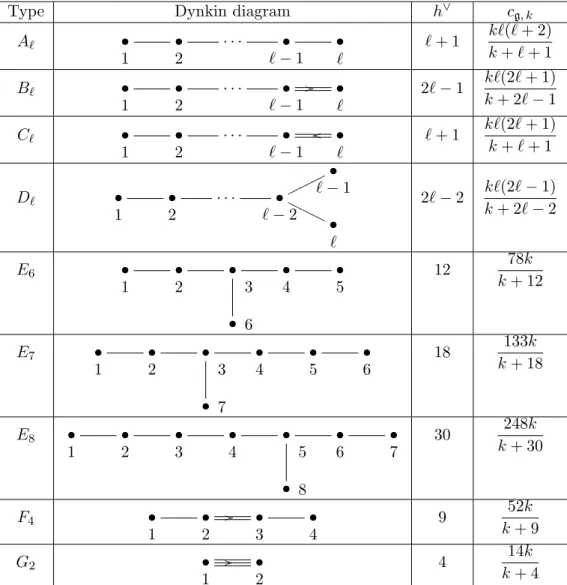
Warning. In this paper we use the notation of Dynkin diagrams used in [8, Chapter 6]. The program “kac” uses the notation of Dynkin diagrams in [6].
2.2 Characters for affine vertex operator algebras
Let g be a finite-dimensional simple Lie algebra and k a positive integer. A character of a simpleLg, k–module Lg, k(Λ) is a formal power series defined by
chΛ(τ) = trLg, k(Λ)qL0−cg,k/24=qhΛ−cg,k/24
∑∞ n=0
dimLg, k(Λ)hΛ+nqn (q=e2πiτ). Since Lg, k(Λ)hΛ is a finite-dimensional irreducible g-module of highest weight Λ as shown in [5], the leading coefficient of the character chΛ (the dimension of Lg, k(Λ)hΛ) is given by Weyl’s dimension formula (see [7, §24.2, Corollary]). It is shown in [9] and [19] that chΛ(τ) absolutely and uniformly converses on the complex upper half-plane and then defines a holo- morphic function on H. We denote by Xg, k the vector space of characters of all simple Lg, k–modules.
Type Dynkin diagram h∨ cg, k
Aℓ •
1
• 2
· · · • ℓ−1
• ℓ
ℓ+ 1 kℓ(ℓ+ 2) k+ℓ+ 1
Bℓ •
1
• 2
· · · • ℓ−1
// •
ℓ
2ℓ−1 kℓ(2ℓ+ 1) k+ 2ℓ−1
Cℓ •
1
• 2
· · · •
ℓ−1 oo • ℓ
ℓ+ 1 kℓ(2ℓ+ 1) k+ℓ+ 1
Dℓ •
1
• 2
· · · • ℓ−2
o• oo oo o ℓ−1
O• OO OO O
ℓ
2ℓ−2 kℓ(2ℓ−1) k+ 2ℓ−2
E6 •
1
• 2
• 3
• 6
• 4
• 5
12 78k
k+ 12
E7 •
1
• 2
• 3
• 7
• 4
• 5
• 6
18 133k
k+ 18
E8 • 1
• 2
• 3
• 4
• 5
• 8
• 6
• 7
30 248k
k+ 30
F4 •
1
• 2
// •
3
• 4
9 52k
k+ 9
G2 •
1
// •
2
4 14k
k+ 4
Table 1: Dynkin diagrams, dual Coxeter numbers of simple Lie algebras and central charges
Theorem 3([9, 19]). Letgbe a finite-dimensional simple Lie algebra andka positive integer.
Then the space Xg, k is a module of SL2(Z) by the slash |0-action and dimXg, k ≤ |P+k|. In particular, the column vector-valued function consisting of characters of all inequivalent simple Lg, k–modules is a meromorphic vector-valued modular form of weight 0.
Remark.Let {f1, . . . , fn} be a normalized basis of Xg, k. If the vector-valued modular form t(f1, . . . , fn) satisfies non-zero Wronskian condition, we say that “Lg, k satisfies non- zero Wronskian condition”.
By the very definition of the characters, we have the following lemma.
Lemma 4. The characters with mutually distinct conformal weights are linearly independent.
We identify the index set{1,2, . . . , ℓ}with the set of vertices of the Dynkin diagram asso- ciated withgin the usual way (see Table 1). Let ¯σbe an automorphism of the Dynkin diagram in Table 1. Then we can extend ¯σ to a Lie algebra automorphism σ: For Chevalley gener- atorse1, . . . , eℓ, α∨1, . . . , α∨ℓ,f1, . . . , fℓ, the automorphism σ of g is defined by σ(ei) =eσ(i)¯ , σ(fi) = fσ(i)¯ ,σ(α∨i) = α∨¯σ(i). Such an automorphism σ is called thediagram automorphism ofg.
Proposition 5 ([7, §12.2]). The groups of automorphisms of Dynkin diagrams are trivial except for Aℓ, Dℓ and E6.
(1) The group of automorphisms of the Dynkin diagram Aℓ isZ2. The non-trivial automor- phism σ¯ is given by σ(i) =¯ ℓ+ 1−i for each 1 ≤i ≤ ℓ, where i is a vertex of the Dynkin diagram.
(2) The group of automorphisms of the Dynkin diagram Dℓ(ℓ > 4) is the permutation group Z2 of the set of vertices ℓ−1 and ℓ.
(3) The group of automorphisms of the Dynkin diagram D4 is isomorphic to the symmetric group S3 of degree 3 which permutes vertices 1,3,4 of the Dynkin diagram.
(4) The group of automorphisms of the Dynkin diagram E6 is isomorphic to Z2. The non- trivial automorphismσ¯ is given by σ(i) = 6¯ −ifor each 1≤i≤5.
Let σ be a diagram automorphism of g. Then we can define an automorphism of ˆg by σ(a⊗tn) = σ(a) ⊗tn and σ(K) = K. Each diagram automorphism σ defines a ˆg- module Lg, k(Λ)σ by (a⊗tn) ·v = (σ(a) ⊗tn)v for every v ∈ Lg, k(Λ) and a⊗tn ∈ ˆg.
Write Λ∈P+k as Λ =∑ℓ
i=1miΛi where eachmi is a non-negative integer. Since (α∨i )0·vΛ = σ(α∨i)0vΛ= Λ(α∨σ(i)¯ )vΛ, the highest weight vectorvΛofLg, k(Λ) is also a highest weight vector ofLg, k(Λ)σ with highest weight∑ℓ
i=1mσ(i)¯ Λi, which is denoted by Λσ. Therefore, it follows from Proposition 5 that Λ∈P+k if and only if Λσ ∈P+k.
Letσbe a diagram automorphism of a finite-dimensional simple Lie algebrag. Thenσcan be extended to an automorphism of the VOALg, k. Since, by definition, any automorphism of a VOA preserves the Virasoro element, the characters chΛ(τ) and chΛσ(τ) must coincide.
Motivated by this fact we introduce an equivalence relation ∼ on P+k; Λ∼Λ′ if and only if there is a diagram automorphismσ such that Λ′ = Λσ, and set Pe+k =P+k/∼. By Lemma 4, we have:
Proposition 6. Let k be a positive integer and Lg, k an affine vertex operator algebra as- sociated with a finite-dimensional simple Lie algebra g. Suppose that conformal weights of simple modules Lg, k(Λ) for Λ ∈Pe+k are mutually distinct. Then the dimension of the space of characters of Lg, k is given by |Pe+k|.
3 Characters and non-zero Wronskian condition for affine vertex operator algebras
In this section we show that a basis of the space of characters of an affine VOA whose dimension of the space of characters is 2, 3, 4, or 5 forms a fundamental system of solutions of a MLDE of weight 0.
Let g be a finite-dimensional simple Lie algebra of type Xℓ. We denote by LXℓ, k(Λ) the irreducible highest weight ˆg-module with highest weight Λ. One of the main results in this paper is:
Theorem 7. An affine vertex operator algebra of positive integral level whose dimension of the space of characters is not exceeding 5 is isomorphic to one of Lg,1 (g =Aℓ (1≤ℓ≤8), Bℓ (ℓ ≥ 2), Cℓ (2 ≤ ℓ≤ 4), Dℓ (ℓ ≥4), E6, E7, E8, G2, F4), and Lg,2 (g = A1, A2, D4, E8, F4, G2), and Lg,3 (g=A1, E8), and LA1,4. These affine vertex operator algebras satisfy non-zero Wronskian condition except forLE8,1.
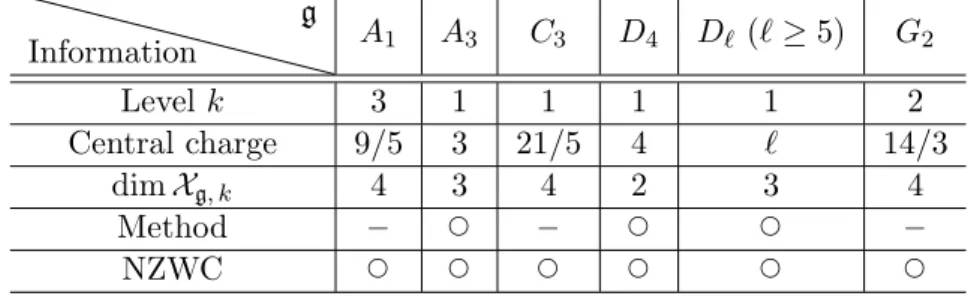
Remark.Affine VOAs with dimXg, k = 3 areLg,1 (g=A3,A4,Bℓ (ℓ≥3),C2,Dℓ (ℓ≥5)), and Lg,2 (g=A1,E8) (see Theorems 9, 11–13 and Table 2).
The remaining of this section is devoted to a proof of this theorem on a case-by-case basis.
First of all, the next lemma is applied to each case, which immediately follows from (5), Lemma 4 and the factP+k ⊂P+k+1.
Lemma 8. Let S⊂P+k be a subset. Then conformal weights of Lg, k+1(Λ)for all Λ∈S are mutually distinct if and only if conformal weights of Lg, k(Λ) (Λ∈S) are mutually distinct.
We start with type A.
(1) Type A. The system of fundamental weights and the highest root of Aℓ are written by using elements ofRℓ+1 as
Λi = 1 ℓ+ 1(
z }|i { ℓ+ 1−i, . . . , ℓ+ 1−i,
ℓ+1−i
z }| {
−i, . . . ,−i), θ= (1,0, . . . ,0,1)
for 1≤i≤ℓ. Then it is not hard to show that (Λi|Λj) =j(ℓ+ 1−i)/(ℓ+ 1) (1≤j≤i≤ℓ) and (Λi|ρ) =i(ℓ+ 1−i)/2 (1≤i≤ℓ). The set of inequivalent simple modules of LAℓ, k is given by
{ LAℓ, k
(∑ℓ
i=1
miΛi)mi∈Z≥0, m1+m2+· · ·+mℓ ≤k }
.
Theorem 9. Let XAℓ, k be the space of characters of LAℓ, k and k, ℓ ≥1 integers. Then we have dimXAℓ,1 = ⌊(ℓ+ 1)/2⌋+ 1, dimXA1, k = k+ 1 and dimXA2,2 = 4. Further LAℓ,1, LA1, k and LA2,2 satisfy non-zero Wronskian condition.
Proof. Since the list of inequivalent simple LA1, k–modules is {LA1, k(jΛ1)|0 ≤j ≤k}, the conformal weights of LA1, k(jΛ1) for 0 ≤ j ≤ k are j(j+ 2)/4(k+ 2), which are mutually distinct. Therefore we have dimXA1, k =k+ 1. Non-zero Wronskian condition immediately follows from
∑k j=0
(j(j+ 4)
4(k+ 2)− 3k 24(k+ 2)
)
= 1
12k(k+ 1).
We next prove that dimXAℓ,1 = ⌊(ℓ+ 1)/2⌋+ 1. Since the list of inequivalent simple LAℓ,1–modules isLAℓ,1,LAℓ,1(Λi) (1≤i≤ℓ), it follows from Proposition 5 that dimXAℓ,1
is at most ⌊(ℓ+ 1)/2⌋+ 1. Conformal weights of LAℓ,1(Λi) (1≤ i≤ ⌊(ℓ+ 1)/2⌋) are given byi(ℓ+ 1−i)/2(ℓ+ 1). Becausei(ℓ+ 1−i)/2(ℓ+ 1) and j(ℓ+ 1−j)/2(ℓ+ 1) are mutually distinct if and only if i=j ori=ℓ+ 1−j, which shows dimXAℓ,1=⌊(ℓ+ 1)/2⌋+ 1.
Finally we prove dimXA2,2 = 4. The set Pe+2 consists of highest weights 0, Λ1, Λ1 + Λ2, 2Λ1 whose conformal weights are 0, 4/15, 2/3, 3/5, respectively. Now, non-zero Wronskian condition follows.
Proposition 10. For each integer k≥2 and ℓ≥1, we have dimXAℓ, k ≥k+ℓ.
Proof. It is obvious thatPe+k contains highest weights Λ1+ Λi (2≤i≤ℓ), jΛ1 (0≤j ≤k) whose conformal weights are (2ℓ2 + 6ℓ−i2 −2i+ 3)/2(ℓ+ 1)(k +ℓ+ 1) (2 ≤ i ≤ ℓ), jℓ(ℓ+j+ 1)/2(ℓ+ 1)(k+ℓ+ 1). The conformal weights of LAℓ, k(Λ1+ Λi) (2 ≤i≤ℓ) are mutually distinct and ones of LAℓ, k(jΛ1) (0 ≤ j ≤ k) are also mutually distinct. Suppose that jℓ(ℓ+j+ 1)/2(ℓ+ 1)(k+ℓ+ 1) = (2ℓ2+ 6ℓ−i2−2i+ 3)/2(ℓ+ 1)(k+ℓ+ 1). Then we have i = 1 and j = 2, which contradicts to the assumption 2 ≤ i ≤ ℓ and 0 ≤ j ≤ k.
Therefore the conformal weights of LAℓ, k(Λ1 + Λi) and LAℓ, k(jΛ1) are mutually distinct, which shows that dimXAℓ,2 ≥(k+ 1) + (ℓ−1) =k+ℓ.
Proof of Theorem 7 for typeA. By Theorem 9, Proposition 10 and Lemma 8, it suffices to prove that dimXA3,2≥6 and dimXA2,3 ≥6. By direct calculation, we see that the number of mutually distinct conformal weights of simple LA3,2–modules and simple LA2,3–modules are 7 and 6, respectively. Therefore it follows that dimXAℓ, k ≤5 if and only if (k, ℓ) = (1, ℓ) for 1≤ℓ≤8, (k, ℓ) = (k,1) for 1≤k≤4, or (k, ℓ) = (2,2).
(2) TypeB. The set of fundamental weights Λi for the finite-dimensional simple Lie algebra of typeBℓ (ℓ≥3) is written by using elements of Rℓ as
Λi =
(1, . . . ,| {z }1
i
,0, . . . ,0) 1≤i≤ℓ−1,
1
2(1, . . . ,1) i=ℓ ,
ρ= 1
2(2ℓ−1,2ℓ−3, . . . ,3,1). (6)
Then we see that
(Λi|Λj) =i (1≤i≤j ≤ℓ−1), (Λi|Λℓ) = i
2 (1≤i≤ℓ−1), (Λℓ|Λℓ) = ℓ
4, (Λi|ρ) = {1
2i(2ℓ−i) 1≤i≤ℓ−1,
1
4ℓ2 i=ℓ .
(7)
and the highest root is given by θ = (1,1,0, . . . ,0). Then the list of inequivalent simple LBℓ, k–modules is
{ LBℓ, k
(∑ℓ
i=1
miΛi) mi∈Z≥0, m1+ 2
ℓ−1
∑
i=2
mi+mℓ ≤k }
.
Theorem 11. Let XBℓ, k be the space of characters of LBℓ, k and k≥2,ℓ≥3integers. Then dimXBℓ,1 = 3 anddimXBℓ, k ≥ℓ+ 1. FurtherLBℓ,1 satisfies non-zero Wronskian condition.
Proof. The highest weights of simple LBℓ,1–modules are 0, Λ1, Λℓ. By (5) and (7), the conformal weights of simple modules are 0, 1/2, (2ℓ+ 1)/16, and then by Lemma 4, we have dimXBℓ,1 = 3. Since the sum of all conformal weights is (2ℓ+ 9)/16 and the central charge is (2ℓ+ 1)/2, non-zero Wronskian condition simply holds.
The set P+k for k > 1 contains highest weights Λ1,Λ2, . . . ,Λℓ−1, 2Λℓ whose conformal weights arei(2ℓ+ 1−i)/2(k+ 2ℓ−1) (1≤i≤ℓ−1) andℓ(ℓ+ 1)/2(k+ 2ℓ−1). It is obvious thati(2ℓ+ 1−i) (1≤i≤ℓ−1) are mutually distinct and thati(2ℓ+ 1−i) is equal toℓ(ℓ+ 1) if and only ifi=ℓori=ℓ+ 1, which is impossible since 1≤i≤ℓ−1. Therefore conformal weights of simple modules with highest weights 0,Λ1, . . . ,Λℓ−1 and 2Λℓ are mutually distinct, which shows that dimXBℓ, k ≥ℓ+ 1 by Lemma 8.
Proof of Theorem 7 for type B. By Lemma 8 and Theorem 11, it suffices to prove that dimXB3,2 ≥6 and dimXB4,2 ≥6. Since highest weights of inequivalent simple LB3,2– modules are 0, Λ1, Λ2, Λ3, 2Λ1, 2Λ3, Λ1+ Λ3 and their conformal weights are 0, 3/7, 5/7, 3/8, 1, 6/7, 7/8, respectively, thus we have dimXB3,2 = 6. It follows that highest weights of inequivalent simple LB4,2 are 0, Λ1, Λ2,Λ3, Λ4, 2Λ1, 2Λ4, Λ1 + Λ4 and their conformal weights are 0, 4/9, 7/9, 1, 1/2, 1, 10/9, 1, respectively, which implies that dimXB4,2 ≥ 6.
Therefore dimXBℓ, k≤5 if and only ifk= 1.
(3) Type C. The system of fundamental weights and the Weyl vector of finite-dimensional simple Lie algebra of typeC is written by using elements of Rℓ as
Λi = 1
√2(
z }| {i
1, . . . ,1,
ℓ−i
z }| {
0, . . . ,0), ρ= 1
√2(ℓ, ℓ−1, . . . ,2,1) for 1≤i≤ℓ. Therefore it follows that
(Λi|Λj) = 1
2i (1≤i≤j≤ℓ), (Λi|ρ) = 1
4i(2ℓ+ 1−i). (8) The highest root is given by θ = (√
2,0, . . . ,0) and the list of inequivalent simple LCℓ, k– modules is
{ LCℓ, k
(∑ℓ
i=1
miΛi) mi ∈Z≥0,
∑ℓ i=1
mi≤k }
.
Theorem 12. Let XCℓ, k be the space of characters of LCℓ, k and ℓ ≥ 2 an integer. Then dimXCℓ,1=ℓ+ 1and LCℓ,1 satisfies non-zero Wronskian condition.
Proof. The highest weights of simpleLCℓ,1–modules are 0,Λi(1 ≤i ≤ℓ) whose conformal weights are respectively given by 0, i(2ℓ+ 2−i)/4(ℓ+ 2) by (5) and (8). Then i(2ℓ+ 2− i)/4(ℓ+ 2) =j(2ℓ+ 2−j)/4(ℓ+ 2) if and only if i=j orj = 2ℓ+ 2−i, which shows that conformal weights are mutually distinct. Hence by Lemma 4, we have dimXCℓ,1 = ℓ+ 1.
Non-zero Wronskian condition simply follows.
A lower bound of dimXCℓ, k follows from Lemma 8.
Corollary.dimXCℓ, k≥ℓ+ 1 for each integerℓ≥2 andk≥1.
Proof of Theorem 7 for typeC. By Lemma 8, it suffices to prove that dimXCℓ,2 ≥6 for ℓ≥2. The elements 0, Λ1, Λ2, 2Λ1, 2Λ2, Λ1+Λ2are highest weights of simpleLCℓ,2–modules and their conformal weights are 0, (2ℓ+ 1)/4(ℓ+ 3),ℓ/(ℓ+ 3), (ℓ+ 1)/(ℓ+ 3), (2ℓ+ 1)/(ℓ+ 3), (6ℓ+3)/4(ℓ+3), respectively. It is obvious that these conformal weights are mutually distinct, which shows that dimXCℓ,2≥6.
(4) Type D. Let Λi (1 ≤ i ≤ ℓ) be the system of fundamental weights of the finite- dimensional simple Lie algebra of type Dℓ (ℓ ≥ 4). Then fundamental weights and the Weyl vector are equated with elements of Rℓ: Λi = (
z }| {i
1, . . . ,1,
ℓ−i
z }| {
0, . . . ,0) (1 ≤ i ≤ ℓ−2), Λℓ−1 = (1/2, . . . ,1/2,−1/2), Λℓ = (1/2, . . . ,1/2) and ρ= (ℓ−1, ℓ−2, . . . ,2,1,0). Then we have
(Λi|Λj) = i (1≤i≤j≤ℓ−2), (Λi|Λℓ−1) = (Λi|Λℓ) = i
2 (1≤i≤ℓ−2), (Λℓ−1|Λℓ−1) = (Λℓ|Λℓ) = ℓ
4, (Λℓ−1|Λℓ) = ℓ−2 4 , (Λi|ρ) =
{1
2i(2ℓ−i−1) 1≤i≤ℓ−2,
1
4ℓ(ℓ−1) i = ℓ−1, ℓ .
(9)
Since the highest root is θ= (1,1,0, . . . ,0), the list of inequivalent simpleLDℓ, k–modules is given by
{ LDℓ, k
(∑ℓ
i=1
miΛi) mi∈Z≥0, m1+ 2
ℓ−2
∑
i=2
mi+mℓ−1+mℓ≤k }
.
Theorem 13. LetXDℓ, k be the space of characters ofLDℓ, k. For each positive integerℓ≥5, dimXD4,1 = 2, dimXDℓ,1 = 3 and dimXD4,2 = 5. Further LDℓ,1 (ℓ≥4) and LD4,2 satisfy non-zero Wronskian condition.
Proof. The highest weights of simple LDℓ,1–modules are 0, Λ1, Λℓ−1 and Λℓ. By Proposi- tion 5, the characters chΛℓ−1 and chΛℓ coincide, and for ℓ = 4 the character chΛ1 coincides with chΛ3 and chΛ4. It follows from (5) and (9) that all conformal weights are given by 0, 1/2,ℓ/8. By Proposition 6 we have dimXDℓ,1 = 3 (ℓ >4) and dimXD4,1 = 2. The elements of Pe+2 forLD4,2 are 0, Λ1, 2Λ1, Λ1+ Λ3, Λ2 whose conformal weights are 0, 7/16, 1, 15/16, and 3/4, respectively, which shows that dimLD4,2 = 5. Non-zero Wronskian condition is obvious since the central charges ofLDℓ,1 and LD4,2 areℓand 7, respectively.
Typeg E6 E6 E7 E7 E8 E8 E8 E8 F4 F4 F4 G2 G2 G2
Levelk 1 2 1 2 1 2 3 4 1 2 3 1 2 3
dimXg, k 2 6 2 6 1 3 5 10 2 5 9 2 4 6
Table 2: dimXg, k for exceptional types
Proposition 14. We have dimXDℓ, k ≥ℓ+ 1 for each integer ℓ≥4 andk≥2.
Proof. The set P+k contains highest weights 0, Λi (1 ≤ i ≤ ℓ−2), 2Λℓ, Λℓ−1 + Λℓ whose conformal weights are respectively given by 0, i(2ℓ−i)/2(k+ 2ℓ−2) (1 ≤ i ≤ ℓ−2), ℓ2/(k+ 2ℓ−2) and (ℓ2−1)/(k+ 2ℓ−2). Since these conformal weights are mutually distinct, we have dimXDℓ, k ≥ℓ+ 1.
Proof of Theorem 7 for type D. By Lemma 8, Theorem 13 and Proposition 14 it suffices to prove that dimXD4,3 ≥ 6. We see that there are simple LD4,3–modules whose conformal weights are 0, 7/18, 8/9, 3/2, 5/6, 25/18, 2/3, 7/6 and 4/3. Thus it follows that dimXD4,3 ≥9.
(5) Exceptional types. The list of fundamental weights of finite-dimensional simple Lie algebras of exceptional types is found in [7, pp. 69]. By (5) and Lemma 4, we obtain Table 2 (for E6, we also use Propositions 5 and 6). Affine VOAs in Table 2 with 2 ≤dimXg, k ≤5 satisfy non-zero Wronskian condition.
4 Tables of dimensions of spaces of characters of simple modules
In this section we give lists of affine VOAs of positive integral levels, which have simple modules not exceeding 20. Each list includes information of central charges, dimensions of the spaces of characters and non-zero Wronskian condition.
Remark.Let Cg, k be the set of inequivalent simple modules of an affine VOA of level k associated with the finite-dimensional simple Lie algebra g such that ♯Cg, k ≤ 20. There are 117 and two discrete infinite series of affine VOAs with this property.
(1) Suppose that Lg, k is neither LB4,2 nor LB4,3. Then the characters in Xg, k with same conformal weights are linearly independent if they are distinct each other.
(2) If Lg, k does not satisfy non-zero Wronskian condition, then there are two conformal weights that differ by an integer. However, the converse is not true. In fact, conformal weights of simple LD8,1–modules are 0, 1/2,1, althoughLD8,1 satisfies non-zero Wronskian condition.
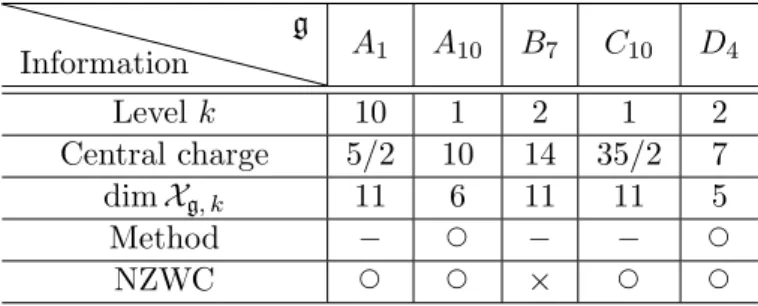
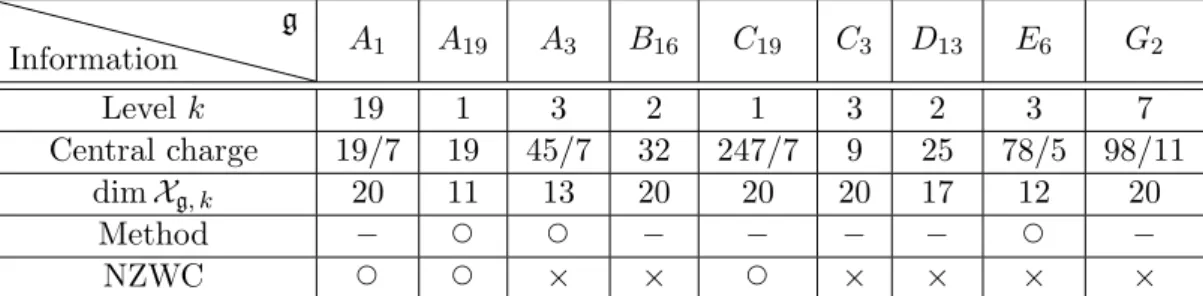
We give tables of dimensions of Xg, k and explain methods which we used to determine dimXg, k as well as non-zero Wronskian condition. Each table consists of data of types of Lie algebras, levels, central charges, dimensions of the spaces of characters and non-zero Wronskian condition (we write eifLg, k satisfies non-zero Wronskian condition and ×oth- erwise). Furthermore, we indicate a method by which we determine dimXg, k in the 5th row.
Each of symbols–, e,♢means that we have determined dimXg, k by using the the factLg, k