2001年情報論的学習理論ワークショップ
2001 Workshop on Information-Based Induction Sciences (IBIS2001)
Tokyo, Japan, July 30 - August 1, 2001.
局所錐型モデルの漸近理論とそのニューラルネットへの応用 Asymptotic Theory of Locally Conic Models and its Applications to
Neural Networks
福水健次∗
Kenji Fukumizu
Abstract: Multilayer neural networks have a problem of unidentiÞability in its parameter- ization. If a network has surplus hidden units to realize a target function, the parameters to give the function consist of a high dimensional subset. Many of usual statistical views fail in such cases. This paper discusses the likelihood ratio of the maximum likelihood es- timation in unidentiÞable cases, using the framework of locally conic models. We derive a sufficient condition that the likelihood ratio has a larger order than usual O
p(1). The exact order of the likelihood ratio of multilayer perceptrons is derived, and a new regularization scheme is proposed to overcome the strong overÞtting.
Keywords: Neural network, Maximum likelihood estimation, UnidentiÞability, Locally conic model, Regularization
1 Introduction
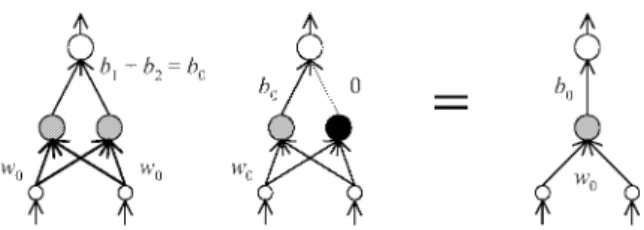
In a multilayer neural network model with H hidden units, if a function can be realized by a network with H − 1 hidden units, the parameter to give the function is not unique, but a high-dimensional continuous sub- set ([10], [3], [7]). This problem is known as unidentiÞ- ability of parameters, which is seen in many important statistical models such as mixture models and ARMA ([4]). For example, consider the following three-layer network with two hidden units:
ϕ(x; θ) = P
2j=1
b
js(x; w
j) + d, (1) where s(x; w) is a nonlinear function with a parameter vector w. This includes multilayer perceptrons and RBF. Suppose the true input-output relation ϕ
0(x) can be given by a network with 1 hidden unit, that is, ϕ
0(x) = b
0s(x; w
0) + d
0. We can easily see that the set of true parameters to give ϕ
0(x) includes high- dimensional submanifolds { b
2= 0, b
1= b
0, w
1= w
0, d = d
0, w
2: free } and { b
1+ b
2= b
0, w
1= w
2= w
0, d = d
0} in the parameter space (Fig.1). This is quit dif- ferent from a model with linear parameterization like polynomial regression, in which the parameter is al- ways determined uniquely even if the size of the model is surplus to give a target function.
UnidentiÞability inßuences strongly on the statisti- cal behaviors and learning dynamics of multilayer neu- ral networks. Many statistical techniques, including
∗統計数理研究所,〒106-8569 港区南麻布4-6-7 tel. 03-5421- 8730, e-mail [email protected],
The Institute of Statistical Mathematics, 4-6-7 Minami-Azabu, Minato-ku, Tokyo 106-8569, Japan
Figure 1: UnidentiÞability in multilayer networks.
model selection criteria (AIC and MDL), which assume the uniqueness of the optimum parameter, are not di- rectly applicable, if the true parameter is unidentiÞ- able.
This paper discusses the likelihood ratio of the max-
imum likelihood estimator (MLE) in unidentiÞable cases,
using the framework of a locally conic model ([4]), and
applied the results to multilayer neural networks. In
particular, we focus on the asymptotic order of the like-
lihood ratio in unidentiÞable cases of multilayer neu-
ral networks, and show that the order is larger than
the usual constant order, which means strong overÞt-
ting with given data. Based on the locally conic pa-
rameterization, we will introduce a new regularization
scheme for multilayer perceptrons to overcome such
strong overÞtting.
2 UnidentiÞability and Locally Conic Models
The general theory of a locally conic model is explained in this section. Let { p(z; θ) | θ ∈ Θ } be a family of probability densities. A parameter θ
0∈ Θ is called unidentiÞable if there exists a submanifold Θ
0⊂ Θ such that θ
0is included in Θ
0, dimΘ
0≥ 1 , and p(z; θ) = p(z; θ
0) for all θ ∈ Θ
0.
In the case of a function ϕ(x; θ) from x to y, by introducing a noise model r(y | s) and an input density q(x), we can regard it as a family of densities:
p(x, y; θ) = r(y | ϕ(x; θ))q(x). (2) The Gaussian distribution
√12πσ
exp {−
2σ12(y − s)
2} and cross-entropy
1+eeyssfor y ∈ { 0, 1 } are popular choice for a noise model. As the example in Section 1 illustrates, in three-layer neural networks, if a parameter deÞnes a function which can be realized by a network with H − 1 hidden units, the parameter is unidentiÞable.
If the true probability p
0, which generates i.i.d.
training data, is given by an unidentiÞable parame- ter in a model, the statistical analysis of estimation is difficult. We cannot use the asymptotic theory or Gaussian approximation for the distribution of the es- timator. Different approaches are needed in such cases ([8],[11]).
Locally conic models have been introduced by Dacunha-Castelle and Gassiat ([4]) to discuss the uniden- tiÞability. We use their formulation with some mod- iÞcations. Let S = { p(z; θ) | θ ∈ Θ } be a family of probability density functions. We assume that the pa- rameter space Θ is an open subset of A
0× R , where A
0is a (d − 1) dimensional space, and write θ = (α, β) according to this decomposition. The model S is called locally conic at p
0∈ S if the following four conditions are satisÞed;
1. p(z; (α, β)) is differentiable with respect to β for p
0-almost every z.
2. The parameter space Θ contains Θ
0:= A
0× { 0 } . 3. The set of parameters to give p
0is Θ
0, that is
p(z; (α, β)) = p
0(z) ⇐⇒ β = 0.
4. For all α ∈ A
0, the Fisher information of the one- dimensional submodel S
α= { p(z; α, β) | (α, β ) ∈ Θ } at β = 0 is one; that is, ° °
∂logp(z;α,0)∂β
° °
L2(p0)
= 1.
If dimA
0≥ 1, the parameter to give p
0is uniden- tiÞable. In the set of true parameter Θ
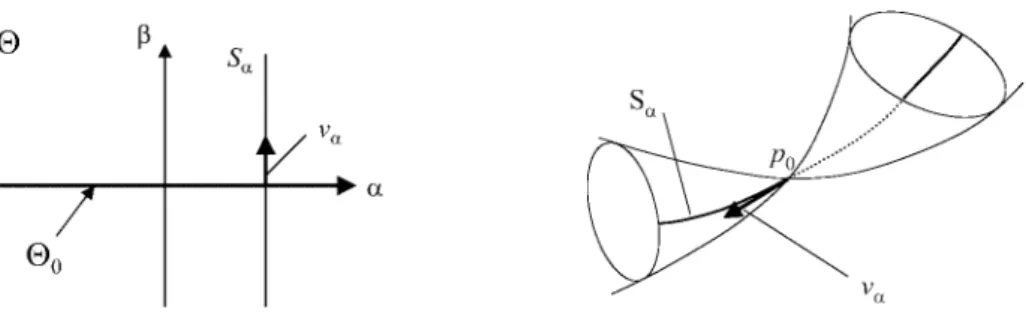
0, α can not be identiÞed. Intuitively, the locally conic model is a d-dimensional subset in the space of all the proba- bility density functions, while the point corresponding to p
0is a conic singularity in the model (Fig.2). For
each α ∈ A
0, the one-dimensional submodel S
αis an identiÞable model, which gives p
0only by β = 0. A locally conic model is a union of such one-dimensional submodels. The derivative of the log likelihood
v
α(z) = ∂
∂β log p(z; (α, 0)) (3) can be regarded as a tangent vector along S
αwith unit L
2(p
0)-norm. We call the set of such unit tangent vec- tors C = { v
α| α ∈ A
0} the basis of the tangent cone, because C deÞnes the tangent cone at the singularity.
3 Likelihood Ratio of a Locally Conic Model
Given an i.i.d. sample Z
1, . . . , Z
nfollowing p
0, the likelihood ratio is deÞned by
L
n(θ) = X
ni=1
log p(Z
i; θ)
p
0(Z
i) . (4) The MLE ˆ θ is the maximizer of L
n(θ). We focus on the likelihood ratio of MLE,
sup
θ∈Θ
L
n(θ), (5)
which essentially expresses the negative training error of a learning machine. In fact, for neural networks with the Gaussian noise model, the likelihood ratio is L
n(θ) = − 1
2σ
2X
ni=1
(y
i− ϕ(x
i; θ))
2+ 1
2σ
2(y
i− ϕ
0(x
i))
2. (6) This measures overÞtting of a learning machine. The more a machine Þts with given data, the larger the likelihood ratio is. The likelihood ratio is also used in a statistical test, since, under the regularity conditions of asymptotic theory, we have
2L
n(ˆ θ) −→ χ
2d(n → ∞ ) in law, (7) where χ
2dis the chi-square distribution with freedom d. However, if the true parameter is unidentiÞable, the asymptotic distribution of likelihood ratio is not chi-square, or may not be even O
p(1) as we see later.
Locally conic parameterization is useful for the anal- ysis of the likelihood ratio in unidentiÞable cases. Let β ˆ
αbe MLE in the submodel S
α. As S
αis identiÞable, a standard argument using Taylor expansion leads
L
n(α, β ˆ
α) = 1
2 U
n(α)
2+ o
p(1) (8) for each Þxed α, where U
n(α) is deÞned by
U
n(α) = 1
√ n X
ni=1
∂ log p(Z
i; α, 0)
∂β = 1
√ n X
ni=1
v
α(Z
i).
(9)
Figure 2: Locally conic model: parameter space (left) and the model in the space of density functions (right).
Note that the Fisher information of S
αat β = 0 is equal to one by the deÞnition. The likelihood ratio of a locally conic model is, then, given by
sup
θ∈Θ
L
n(θ) = sup
α∈A0
L
n(α, β ˆ
α) = sup
α∈A0
¡1
2 U
n(α)
2+ o
p(1) ¢ . (10) The MLE ˆ α, the maximizer of eq.(10), does not nec- essarily converge to a point in A
0, but it distributes along Θ
0.
The random variable U
n(α) converges in law to the standard normal distribution N (0, 1) for each α. Con- sidering all α, the random element U
nis a random process over α or the basis of the tangent cone. While the process marginally converges to N(0, 1) for each α, it does not necessarily converge as a random pro- cess. Indeed, the process may not converge uniformly, and the likelihood ratio can diverge to inÞnity. Har- tigan ([9]) shows such divergence in a special case of the normal mixture model with two components. His argument is as follows. The marginal distribution of U
nover Þnite points v
α1, . . . , v
αmin the basis of the tangent cone C converges to an m dimensional normal distribution with the covariance E
p0[v
αiv
αj]. If we can Þnd m ”almost uncorrelated” elements in C for arbi- trary m ∈ N , the maximum of the U
n(α
j) (1 ≤ j ≤ m) is very close to the maximum of m i.i.d. samples from N (0, 1), which is √
2 log m for large m. As m is arbi- trary, this maximum is not bounded. As an general- ization of this fact we have the following theorem.
Theorem 1. Let S = { p(z; (α, β)) } be locally conic at p
0∈ S, and C be its basis of the tangent cone. Assume for each α ∈ A
0the submodel S
α= { p(z; α, β) | β } sat- isÞes the regularity conditions of asymptotic normality.
If there is a sequence in C, which converges to zero in p
0-probability, then, for arbitrary M > 0 we have
n
lim
→∞Prob ¡ sup
(α,β)
L
n(α, β) ≤ M ¢
= 0. (11) Proof. See [6].
Eq.(11) shows that L
n(ˆ θ) is larger than the constant order O
p(1). The above theorem gives a simple suffi- cient condition of divergence of the likelihood ratio.
4 Strong OverÞtting of Multilayer Neural Networks
We consider the three-layer perceptron model with H hidden units:
ϕ(x; θ) = X
Hj=1
b
js(a
Tjx + c
j) + d, (12) where s(t) = tanh t, and the parameter space is de- noted by Θ
H. We assume the output is one-dimensional for simplicity. Suppose that the true function is real- ized by a network with K hidden units
ϕ
0(x) = X
Kk=1
b
0ks(a
0kx + c
0k) + d
0, (13) for 0 ≤ K ≤ H. If K ≤ H − 1, the true parameter is unidentiÞable, as we see in Section 1.
We can introduce a locally conic parameterization to formulate this unidentiÞability. A slightly restricted parameter space Θ
∗His deÞned by Θ
∗H= { θ ∈ Θ
H| a
j6 = 0, b
j6 = 0 (1 ≤ j ≤ H ), (a
j, c
j) 6 = ± (a
h, c
h) (1 ≤ j < h ≤ H), (a
j, c
j) 6 = ± (a
0k, c
0k) (1 ≤ k ≤ K, K + 1 ≤ j ≤ H ) } . Note that Θ
∗Heliminates the parameters of functions realizable by a smaller-sized network (see [10]). This reduction does not matter in discussing MLE, since it lies in Θ
∗Hwith probability one. We introduce a new parameterization by
β = sgn(b
K+1) q
b
2K+1+ · · · + b
2H, δ = d − d
0β , ξ
k= a
k− a
0kβ , η
k= b
k− b
0kβ , ζ
k= c
k− c
0kβ , ξ
j= a
j, η
j= b
jβ , ζ
j= c
j, (14) for 1 ≤ k ≤ K and K + 1 ≤ j ≤ H. The three-layer perceptron is rewritten using this parameterization:
ψ(x; ω) = X
Kk=1
(b
0k+ βη
k) s ¡
(a
0k+ βξ
k)x + (c
0k+ βζ
k) ¢
+ X
Hj=K+1
βη
js(ξ
jx + ζ
j) + βδ. (15)
The new parameter spaces Π
Hand Π
∗Hare deÞned by Π
H= { ω = (ξ
`, η
`, ζ
`, ζ
`, δ, β) | a
0k+ βξ
k6 = 0, b
0k+ βη
k6 = 0, (a
0k+ βξ
k, c
0k+ βζ
k) 6 = ± (a
0h+ βξ
h, c
0h+ βζ
h), (a
0k+ βξ
k, c
0k+ βζ
k) 6 = ± (ξ
j, ζ
j), (ξ
j, ζ
j) 6 =
± (a
0k, c
0k), η
j6 = 0, ξ
j6 = 0, (ξ
j, ζ
j) 6 = ± (ξ
i, ζ
i), (1 ≤ k < h ≤ K, K + 1 ≤ j < i ≤ H ), P
Hj=K+1
η
j2= 1, η
K+1> 0, β ∈ R} and Π
∗H= { ω ∈ Π
H| β 6 = 0 } , respectively. It is easy to see that ϕ(x; θ) = ψ(x; ω) for corresponding θ ∈ Θ
∗Hand ω ∈ Π
∗H, and that ψ(x; ω) = ϕ
0(x) if and only if β = 0. Thus, it suffices to consider { ψ(x; ω) | ω ∈ Π
H} , when MLE is dis- cussed. We deÞne the statistical model of three-layer perceptron S
H= { p(x, y; ω) | ω ∈ Π
H} by
p(x, y; ω) = r(y | ψ(x; ω))q(x), (16) for some noise model r(y | s) and input density q(x).
The model S
Hconsists of a probability density p
0(x, y) corresponding to ϕ
0(x) and densities given by ϕ(x; θ) for θ ∈ Θ
∗H. If we summarize (ξ
1, . . . , ζ
H, δ) by α, p(x, y; α, β) gives a locally conic parameterization;
Theorem 2. Under some regularity conditions on r(y | s) and q(x), the multilayer perceptron model S
His locally conic at p
0.
Proof. It is easy to see that the conditions 1—3 are sat- isÞed. For the condition 4, taking N (α) =
k
∂β∂log p(x, y; (α, 0)) k
L2(p0), the parameter ˜ β =
Nβ(α)instead of β makes the Fisher information one.
This locally conic model satisÞes the assumptions of Theorem 1, and we have
Theorem 3. Suppose that the model is given by eq.(12) and the true function by eq.(13). If K ≤ H − 1, then, under some regularity conditions on r(y | s) and q(x), we have for arbitrary M > 0
n
lim
→∞Prob ¡ sup
θ
L
n(θ) ≤ M ¢
= 0. (17)
Remark. This theorem means that the likelihood ratio has a larger order than the usual constant order O
p(1), if a network has redundant hidden unit to realize the target. It indicates very strong overÞtting.
Outline of the proof. We will prove the theorem only for K ≤ H − 2, while it can be proved also for K = H − 1 (see [6]). We have only to consider a submodel g(x, y; ξ, h, t) = r(y | ϕ
0(x) + βw(x; ξ, h, t))q(x), where w(x; ξ, h, t) is in a function class W = { w(x; ξ, h, t) =
√
1 A(ξ,h,t)1
2
{ tanh(ξ(x − t+h)) − tanh(ξ(x − t − h)) } . The constant A(ξ, h, t) is a normalization of L
2norm of the tangent vector v(z; ξ, h, t) deÞned below. Note that the shape of the function w is bell-shaped (Fig.3). For this submodel, the basis of the tangent cone consists of the functions of the form:
v(z; ξ, h, t) = ∂ log r(y | ϕ
0(x))
∂s w(x; ξ, h, t). (18)
Figure 3: A function in the subclass W (ξ = 10, t = 3, h = 0.5).
We can easily take a sequence (ξ
n, h
n, t
n) such that ξ
n→ ∞ , h
n→ 0, and v(z; ξ
n, h
n, t
n) converges to zero.
Using the subclass W in the above proof, we can derive also a lower bound of the likelihood ratio, if K ≤ H − 2;
Theorem 4. Suppose that the model is given by eq.(12), and the true function by eq.(13). If K ≤ H − 2, under some regularity conditions on r(y | s) and q(x), there exists δ > 0 such that
lim inf
n→∞
Prob ¡ sup
θ
L
n(θ) ≥ δ log n ¢
> 0. (19) Outline of the proof. We will show that we can Þnd m = n
γ(γ > 0) almost uncorrelated elements in the basis of the tangent cone C for the sample size n. For a closed interval I ⊂ R , we deÞne M (I) =
E
p0£¡
∂logr(y|ϕ0(x))∂s
¢
2χ
I(x) ¤
, where χ
I(x) is the indica- tor function of I. For m disjoint intervals I
k(1 ≤ k ≤ m) in R , we deÞne one-dimensional models r(y | ϕ
0(x)+
β √
1M(Ik)
χ
Ik(x))q(x). The unit tangent vectors at the origin are u
k(z) = √
1M(Ik)
∂logr(y|ϕ0(x))
∂u
χ
Ik(x), which are uncorrelated. Then, under some regularity con- ditions, we can show that the distribution of the m- dimensional random vector V
n= (
√1n
P
ni=1
u
1(Z
i), . . . ,
√1n
P
ni=1
u
m(Z
i) ¢
can be approximated by the m- dimensional standard normal distribution for an appro- priate choice of { I
k} and a sufficiently small γ. The maximum of | V
n| is arbitrarily close to √
2 log m =
√ 2γ log n. On the other hand, √
1M(I)
χ
I(x) can be arbitrarily approximated by a function in W , which means there exist n
γfunctions in W such that eq.(10) has the order of log n. The rigorous proof needs deli- cate discussion. See Fukumizu ([6]) for the details.
The above theorem shows the order of the likeli- hood ratio is at least log n, if the model has two re- dundant hidden units. This order is formerly obtained by Hagiwara et al. ([8]) under stronger assumptions of Gaussian noise and ϕ
0(x) ≡ 0.
We can derive an upper bound of the likelihood ra-
tio for wider class of learning machines and the Gaus-
sian noise model.
Theorem 5. Let F = { ϕ(x; θ) } be a family of func- tions, and ϕ
0(x) be a bounded function in F . If the VC dimension of F is Þnite, and the noise model is the Gaussian distribution r(y | s) =
√12πσ
exp {−
2σ12(y − s)
2} , then, we have
sup
θ
L
n(θ) = O
p(log n). (20) Outline of the proof. Since the probability of the event { max
1≤i≤nY
i> 2 √
log n } converges to 0, we can con- sider the case in which | Y
i− ϕ
0(X
i) | ≤ 2 √
log n and
| ϕ(x
i; θ) | ≤ 2 √
log n hold. For a given X = (X
1, . . . , X
n), the conditional probability of L
n(θ) − E
Y[L
n(θ) | X ] =
1 σ2
P
ni=1
(Y
i− ϕ
0(X
i))(ϕ(X
i; θ) − ϕ
0(X
i)) is the nor- mal distribution with mean zero and variance V
θ,X= P
ni=1
(ϕ(X
i; θ) − ϕ
0(X
i))
2. By the exponential inequal- ity for the tail probability of a normal distribution, for arbitrary λ > 0 we have Prob ¡
L
n(θ) ≥ λ −
2σ12V
θ,X| X ¢
≤
√
Vθ,X√2πλ
e
−λ2
2Vθ,X
. Setting λ = M log n +
2σ12V
θ,Xfor M > 0, we obtain
Prob ¡
L
n(θ) ≥ M log n ¢
≤
√σ2π√2M1lognn
−M/σ2. (21) Since the VC dimension of F is Þnite, we can Þnd n
γ(γ > 0) parameters { θ
k} such that for arbitrary θ there exists θ
ksatisfying
| L
n(θ
k) − L
n(θ) | ≤ p
2 log n. (22) From eqs.(21) and (22), we obtain the theorem.
From theorems 4 and 5, we see that under the assumptions of Theorem 4 and of additive Gaussian noise, the order of sup
θL
n(θ) is exactly log n. In con- trast to the order O
p(1) in regular cases, a redundant neural network strongly overÞts with the training data.
5 Regularization in Learning of Multilayer Perceptrons
The very strong overÞtting shown in the previous sec- tion explains the heuristics that regularization is par- ticularly important in neural networks. The proof of the previous theorems suggests that large parameter values in making a delta function can be a cause of the strong overÞtting, which agrees with the Bartlett’s statement ([2]) that large weight values worsen the gen- eralization.
The conventional regularization terms like weight decay are not necessarily reasonable in multilayer neu- ral networks. The weight decay, which adds the term
λ
n12k θ k
2(23) to the loss function, assumes that the `
2norm of θ represents the local distance of learning machines. This is not true about a locallcy conic model.
We propose the following regularization method in a locally conic model:
L ˜
n(α, β) = L(α, β ) − λ
nΦ(α), Φ(α) = 1
2 k α − α
0k
2, (24) where α
0is a point in A
0, and the regularization coef- Þcient λ
nsatisÞes sup
θL
n(θ) << λ
n<< √
n. We can see that the maximizer ˜ α of ˜ L
nconverges to α
0in prob- ability. In fact, if k α − α
0k ≥ δ for some δ > 0, the term λ
nΦ(α) is asymptotically larger than L
n(α, β), and ˜ L
n(α, β) becomes negative. Such α cannot be the maximizer, because sup
βL ˜
n(α
0, β) is asymptotically positive. When we concentrate on a small compact neighborhood K of α
0in maximizing ˜ L
n(α, β ), we have
sup
α,β
L ˜
n(α, β) = sup
α∈K
1 2
× n ¡
1√n
P
ni=1
v
α(X
i, Y
i) −
√λnn(α − α
0) ¢
2−
n1P
n i=1∂2logp0(Yi|Xi;α,0)
∂β2
+
λnn+ o
p(1) o
.
(25) As the o
p(1) term is uniform on the compact set K, from the fact λ
n<< √
n, the leading term of the right hand side is sup
α∈K12¡
1√n
P
ni=1
v
α(X
i, Y
i))
2, which is of the order O
p(1). Therefore, the extent of overÞtting is very improved so that the likelihood ratio does not diverge to inÞnity.
In three-layer perceptrons, the locally conic param- eterization depends on the unknown true function. We utilize the parameterization for the constant-zero tar- get ϕ
0(x) ≡ 0 to construct a regularization term. Tak- ing (η
01, . . . , η
H0) = (
√1H
, . . . ,
√1H
), ξ
0j= 1, ζ
j0= 0, and δ
0= 0 for α
0, the regularization term of the three-layer perceptron is given by
Φ(α)
= 1 2 n
− 1 H (
X
Hj=1
η
j)
2+ X
Hj=1
(ξ
j− 1)
2+ X
Hj=1
ζ
j2+ δ
2o
= 1 2 n
− ( P
H j=1b
j)
2P
Hj=1
b
2j+ X
Hj=1
(a
j− 1)
2+ X
Hj=1
c
2j+ d
2P
j