Hyundai Motor Company’s “Selective Focused Local Adaptation Strategy” from the Perspective of Global Marketing*
Eiko Tomiyama†
Hiromi Shioji‡
Abstract
The number of vehicles produced and sold worldwide by Hyundai Motor Company is rapidly increasing. This paper aims to comprehensively clarify the methods it uses to gather information in emerging economies to create customer value. In addition, it examines the systematic product planning and development process through which designs from within and outside the company are reflected in specific products. Furthermore, it looks at how these designs are embodied as customer value in Hyundai Motor Company’s integrated process through to marketing and sales. More specifically, it analyzes (1) the status of the selective focused local adaptation strategy; (2) the product development process; and (3) systems that facilitate product development aimed at local adaptation.
Keywords: Hyundai Motor Company, marketing, R & D, product planning, product development process, TFT
Introduction
Hyundai Motor Group (Hyundai) has adopted a “selective focused local adaptation strategy” in which local adaptation is focused on priority areas in selected key markets, namely the BRICs (Brazil, Russia, India, China) economies and other emerging markets. By researching designs that target the main market segment and appeal to local consumers in those countries, it has succeeded in developing and launching vehicles tailored to the local market
1. In addition, it has swiftly introduced cars tailored to the needs of local consumers in the main market segment.
Hyundai’s recent competitive advantage in emerging economies has been attributed to its outstanding new design strategy and concept planning and development that prioritizes customer value above all else, as well as qualitative growth leveraged by partnerships with Hyundai Mobis and other global suppliers (Shioji (editor & author) 2012).
This paper examines the establishment of and changes in Hyundai’s competitive advantage, comprehensively clarifying the methods it uses to gather information in emerging economies to create customer value, and the systematic concept planning and development process through which designs from within and outside the company are reflected in specific products and embodied as customer value in its integrated process through to marketing and sales. More specifically, it analyzes (1) the status of the selective focused local adaptation strategy; (2) the product development process; and (3) the systems that facilitate product development aimed at local adaptation.
1. Hyundai’s Local Adaptation Strategy
1.1 The Selective Focused Local Adaptation Strategy
Hyundai is said to be more advanced than Japanese manufacturers in the area of locally adapted and “locally modified” (with minor adjustments to suit local needs) vehicles. However, it has few fully local models produced from entirely new body dies. Among its main models are the Santro in India and the Elantra Yuedong in China, which underwent thorough localization or local modification. Hyundai does not develop strategic models for emerging economies, like Honda’s Brio, Toyota’s IMV and Dacia’s Logan. Consequently, from a global perspective, Japanese manufacturers can respond more systematically with vehicles adapted to the local market.
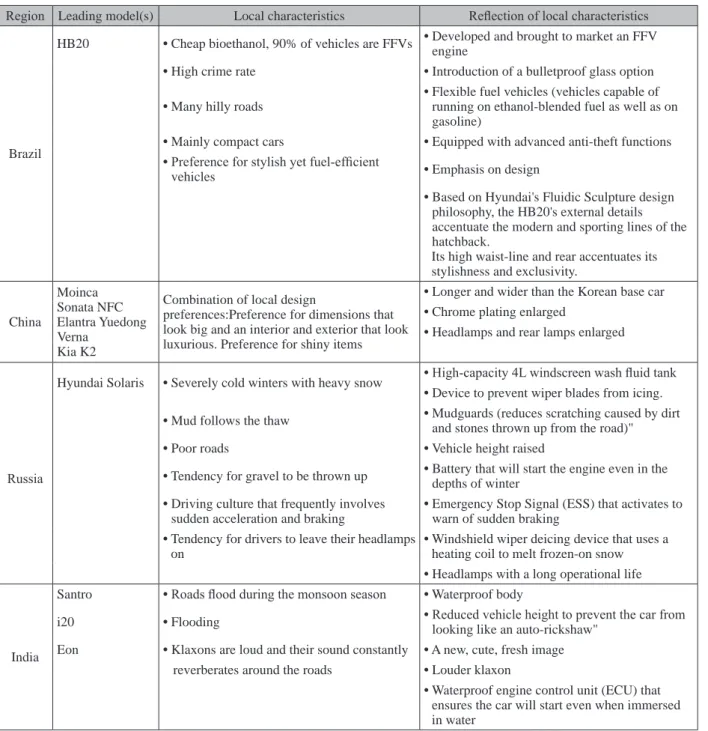
On the other hand, Hyundai is utilizing a “selective focused production model,” focusing selectively on producing a limited product range for specific markets. In particular, it adapts many of its Korean models to meet local needs in the BRICs economies. As well as the Santro, i10, and Eon in India and the Elantra Yuedong in China, examples include the Moinca, Sonata NFC (Lingxiang), and Verna in China, the Solaris in Russia, and the HB20 in Brazil. These are all models adapted following detailed research into the characteristics of each market and local needs (Table1).
Japanese manufacturers have a strong tendency to deploy models based on the perception of emerging markets as a monolithic entity. In contrast, manufacturers in the ROK divide up the BRICs markets by country, developing dedicated models for each country, and are keen to undertake local adaptation. This is because the ROK adopts a top-down approach and unless a company implements thorough local adaptation, it will find it difficult to sell all of its products in a particular country after establishing a mass production plant there in response to orders from above.
1.2 Platform Integration and Consolidation
Hyundai uses its products as platforms to develop multiple diverse products for different markets with differing needs. By equipping this base with the functions sought by consumers in a particular region, it can quickly provide the optimal product for their needs.
More specifically, Hyundai has enhanced its market response through consolidation into six platforms and swift, low-cost product development. In addition, it has increased the number of local models and enhanced its product range to meet the diverse needs of each region. Through platform integration and consolidation, it has reduced development costs by 60% and the development period to two years, facilitating a faster response.
In particular, Hyundai is expanding its range of derivative vehicles developed from its core platforms. It is expanding the range of local models in each region based on its B (Accent) and C (Avante) platforms. In other words, Hyundai’s strategy is to standardize its platforms, technologies, and components, while developing products tailored to local needs.
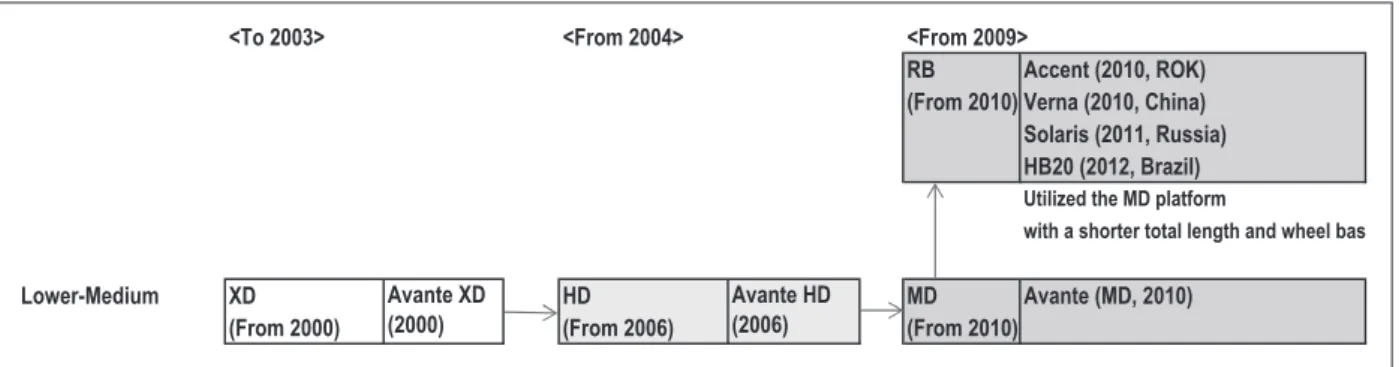
For example, Hyundai’s Accent/Verna (small sedan) revamp project used the Kia Pride as
the common platform to develop a range of locally adapted vehicles, namely the Accent (the
ROK), the Verna (China), the Solaris (Russia), and the HB20 (Brazil). These were developed
at Hyundai’s Namyang Research and Development Center (Namyang R&D Center) over five
years, at a cost of 200 billion won
2. Hyundai Motors has developed models for BRICs markets
concurrently as part of its new model development process. It develops shared platforms from
the outset, based on the premise that it will develop models specifically for China, Russia, and
Brazil.The Verna was launched in China in July 2010, the Accent in the ROK in November 2010,
the Solaris in Russia in January 2011, and the HB20 in Brazil in September 2012 (Figure 1).
Table 1: Development of Local Strategic Models Tailored to the Attributes of Emerging Markets (Examples of the development of local strategic models tailored to the attributes of emerging markets)
Region Leading model(s) Local characteristics Reflection of local characteristics
Brazil
HB20 • Cheap bioethanol, 90% of vehicles are FFVs • Developed and brought to market an FFV engine
• High crime rate • Introduction of a bulletproof glass option
• Many hilly roads
• Flexible fuel vehicles (vehicles capable of running on ethanol-blended fuel as well as on gasoline)
• Mainly compact cars • Equipped with advanced anti-theft functions
• Preference for stylish yet fuel-efficient
vehicles • Emphasis on design
• Based on Hyundai's Fluidic Sculpture design philosophy, the HB20's external details accentuate the modern and sporting lines of the hatchback.
Its high waist-line and rear accentuates its stylishness and exclusivity.
China
Moinca Sonata NFC Elantra Yuedong Verna
Kia K2
Combination of local design
preferences:Preference for dimensions that look big and an interior and exterior that look luxurious. Preference for shiny items
• Longer and wider than the Korean base car
• Chrome plating enlarged
• Headlamps and rear lamps enlarged
Hyundai Solaris • Severely cold winters with heavy snow • High-capacity 4L windscreen wash fluid tank
• Device to prevent wiper blades from icing.
Russia
• Mud follows the thaw • Mudguards (reduces scratching caused by dirt and stones thrown up from the road)"
• Poor roads • Vehicle height raised
• Tendency for gravel to be thrown up • Battery that will start the engine even in the depths of winter
• Driving culture that frequently involves sudden acceleration and braking
• Emergency Stop Signal (ESS) that activates to warn of sudden braking
• Tendency for drivers to leave their headlamps on
• Windshield wiper deicing device that uses a heating coil to melt frozen-on snow
• Headlamps with a long operational life
India
Santro • Roads flood during the monsoon season • Waterproof body
i20 • Flooding • Reduced vehicle height to prevent the car from
looking like an auto-rickshaw"
Eon • Klaxons are loud and their sound constantly • A new, cute, fresh image reverberates around the roads • Louder klaxon
• Waterproof engine control unit (ECU) that ensures the car will start even when immersed in water
Source: Compiled from studies conducted in Brazil, China, Russia, and India.
Figure 1: Global Platform Deployment of Hyundai Motor Group’s Lower-Medium Cars
1.3 Level of Quality Demanded Locally
The level of quality required in each country differs. Hyundai is skilled at reducing specifications in response to the level in each country. This ensures that specifications acceptable to each market can be purchased by customers at a reasonable price. Put simply, Hyundai’s quality standards are determined by customers (markets), who judge vehicles by price.
Hyundai’s quality standards differ in each country. Elements such as the powertrain are handled by the Namyang R&D Center, but competent local manufacturers are utilized to provide interior and exterior components. The Namyang R&D Center has the final say in such decisions.
For example, in China, the standard level is basically the same level of specifications as in the ROK, but with slightly lower interior specifications. Useful functions on the original Elantra, such as automatic door locking when driving, side-mirror-mounted turn signal indicators, and heated side mirrors, have been dropped from the Elantra Yuedong, along with interior elements such as the seat height adjuster and trunk light, thereby ensuring price competitiveness. The specifications adopted in India differ substantially from those in the ROK. Hyundai’s Indian plants produce vehicles with two different sets of specifications: those for sale in India and those to be exported to Europe. To reduce the specification level, Hyundai varies the quality of the materials used. It also alters the processing, taking into account changes in customer needs in that market. Its Russian cars are about the same standard as those sold in the ROK. Hyundai can reduce its specifications precisely because of its policy of permitting lower specifications.
In this way, Hyundai is addressing needs in each country by standardizing its platforms and altering specifications according to the level of quality demanded in that country.
2. Hyundai’s Product Development Process for Locally Adapted Vehicles
Thus, Hyundai is developing and bringing to market locally adapted vehicles tailored to the attributes of emerging markets, thereby increasing the number of vehicles sold. What is the secret of its product development process for locally adapted vehicles and how is this implemented?
2.1 Rapid Gathering of Detailed Information
Identification of Local Needs in the Native Language and Large Expatriate Staff
Source: Compiled on the basis of FOURIN (2010), p. 15.
<To 2003> <From 2004> <From 2009>
RB Accent (2010, ROK) (From 2010) Verna (2010, China) Solaris (2011, Russia) HB20 (2012, Brazil) Utilized the MD platform
with a shorter total length and wheel bas
Lower-Medium XD HD MD Avante (MD, 2010)
(From 2000) (From 2006) (From 2010)
Avante XD
(2000) Avante HD
(2006)
In the Chinese market, Hyundai has adopted a regional headquarters system, with local information reaching Hyundai head office directly. Moreover, it employs many local ethnic Korean staff, who can speak both Chinese and Korean. This not only enables the company to ensure thorough local adherence to the wishes of head office, but also ensures that its staff from the ROK (expatriate staff) can quickly identify local needs expressed in the local language.
Furthermore, to ensure that local needs in the native/local language are quickly picked up, Hyundai stations far more expatriate staff overseas than Japanese companies do. For example, in China, whereas just 4 out of the 100 staff at Tianjin FAW Toyota Motor Company’s Chinese development base are Japanese nationals, 7 of the 120 staff at Beijing Hyundai’s Chinese development base are citizens of the ROK. Similarly, in Russia, there are 4 Japanese nationals stationed at Toyota’s Russian subsidiary, but 7–8 Korean citizens at Hyundai’s Russian base.
Strength through Inter-Group Partnerships
Hyundai uses other affiliate companies in Hyundai chaebol
3in its marketing. The biggest weakness of those working in the automotive industry is that they tend to focus only on motor vehicles. In the case of Hyundai, when an order is given for a TFT (Task Force Team) to investigate local needs, this goes to all affiliate companies, like Innocean
4, not just Hyundai. This ensures that a variety of information from a range of divisions is fed back and cross-checked. It also helps to reveal needs. This strength achieved through inter-group partnerships enables the company to gather information rapidly from all directions.
2.2 Pre-Concept Planning and Concept planning
While the methods used for this are diverse, varying from one motor vehicle manufacturer to another, the product development process basically starts with pre-concept planning to determine whether or not to commercialize a product – in other words, whether or not to move on to the concept planning stage. If the company decides to embark upon concept planning, the next stage involves thorough customer research and consideration of product concepts suited to customer needs to put together a product plan. Finally, it will move on to product development planning, which involves considering whether the company can turn those concepts into a product and manufacture that item. After the concept planning process, a product development planning meeting is held to determine whether or not to undertake product development.
The pre-concept planning and concept planning processes take less time at Hyundai than
among Japanese manufacturers, which lag behind in launching new models onto emerging
markets because it takes them so long to go through the pre-concept planning and concept
planning processes (before the PM is determined). On the other hand, product development
planning takes about the same length of time.
Figure 2: Concept planning and Product Development Planning Times at Hyundai and Japanese Motor Vehicle Manufacturers
Hyundai’s pre-concept planning period is short because it uses TFTs, in which around 30 people basically find solutions for the concept planning process in the space of around three months. Hyundai’s short pre-concept planning period enables it to quickly launch vehicles that meet certain needs in BRICs economies and other key emerging markets.
This is because Hyundai is a follower, so all it had to do was follow the concept planning strategy of the most advanced manufacturers. In other words, it only needed a strategy of copying the companies that set the benchmark. For example, when VW launched its products in China, Hyundai was able to launch similar products positioned at a slightly cheaper price point. This is possible precisely because it adopts a selective, focused response in specific countries, rather than a systematic worldwide response.
2.3 Rapid Decision-Making by TFTs
Hyundai’s TFTs are cross-sectional project teams that engage in coordination to facilitate speedy decision-making across different departments. TFTs can react swiftly to requests emerging from the market. More specifically, TFTs are formed as needed, e.g. a TFT for launching a new vehicle overseas, a TFT that operates until production of the new vehicle begins, and a sales TFT.
The project leader in each TFT is a vice president. This makes it easy for the head office to grant permission. These TFTs originated from the teams introduced in 1997 to identify solutions to problems. If a major problem occurs, the TFT (consisting of around 30 people) makes a decision within three months.
For example, in a concept planning TFT, 30 people from each department decide within three months whether or not to embark upon concept planning. However, not every project for which a TFT is formed progresses. Then the matter is referred to a meeting of the vice presidents.
Once approval from the top (chairman) has been secured, things move at a rapid pace, come what may.
For example, a TFT was formed when the Elantra Yuedong for China was being developed.
Firstly, the Elantra Yuedong concept planning TFT was established. The personnel department selected a few people from each department for this TFT, which thoroughly analyzed the target demographic among Chinese consumers and the specifications that they desired, thereby enhancing marketability. In addition, it conducted surveys to identify the functions and value demanded by the local market and immediately relayed this information to the head office. Headed by a vice president, the TFT considered the issue for about three months. A conclusion was then reached at a meeting of Beijing Hyundai and the vice president for product
Source: Shioji (ed.) (2012), p. 35.
1 3 1 3
1–10 1–2 3
development, and approval was ultimately granted by company chairman Chung Mong-koo.
Concept planning and development were subsequently conducted via a concurrent process (Figure 3).
Figure 3: Hyundai’s TFTs for Development of Locally Adapted Vehicles for the Chinese Market
2.4 Sales and Marketing Predominates Over Manufacturing
The core role in decisions as part of the concept planning process for motor vehicles requiring adaptation to the local market is played by the general manager for sales in that region;
in the case of the Chinese market, this is the vice president of Beijing Hyundai Motor. Hyundai head office listens to what the general manager for sales in China says about local needs and how many vehicles could be sold if a car tailored to those needs were brought to market, and then decides on the product strategy, determining which elements are to be supported by the company’s plants in the ROK and the Namyang R&D Center and which are to be entrusted to the local operation. If the general manager for regional sales specifically indicates how many vehicles could be sold locally if a locally adapted vehicle were developed and brought to market, that manager’s judgment is prioritized. However, in return, the local sales department must then take responsibility for selling the number of vehicles proposed. Thus, the judgment of the overseas sales team strongly influences decision-making at Hyundai. In addition, considerable emphasis is placed on creating the value required by the local market in terms of design, quality,
Source: Compiled from interviews conducted in China in August 2012, and the ROK in October 2011 and June and August 2012.
Figure 3 Hyundai's TFTs for Development of Locally Adapted Vehicles for the Chinese Market
Marketing Division
Vice President Chinese Sales Domestic Sales
Marketing Division Overseas
Marketing Office European Division
Vice President Sales Overseas Sales
Asia-Pacific Division Vice Chairman Product Development
Chairman 7 Vice Chairmen 9 Presidents Asia & Middle East Division
Vice President Concept Planning
Vice President (Leader) U.S. Division Vice President Production Management TFT (30 people)
Vice President Global Purchasing Deliberations for 3 months Vice President Quality Control
Decided with Beijing Hyundai at a meeting of vice presidents concerning product development
Vice President Technology Chairman's approval
Product planning & development Vice President Financial Affairs (concurrent process)
Source: Compiled from interviews conducted in China in August 2012, and the ROK in October 2011 and June and August 2012.
Bu s ni es s Pl an ni ng
an d Co or di n at oi n Of fi ce
and price, among other elements. This is why greater importance is attached to the opinion of the overseas sales team than to that of the quality control and technical departments. Thus, Hyundai attaches greater importance to the local sales department and the sales and marketing department than to the manufacturing department, delegating authority to them.
2.5 Product Development Planning
Figure 4 illustrates Hyundai’s product development planning process. Seven or eight months after the decision is taken to develop a vehicle, a secondary model evaluation meeting is held, to which foreign experts are invited, and one of the several models is chosen. The model is approved two months after that, and the dimensions are determined and the model finalized another three months later. Production of the very first vehicle begins about 24 months after the model is finalized. In other words, it takes about three years from the start of product development planning until production of the first car begins (line-off) (Figure 4). This takes the same time as it does among Japanese manufacturers; what differs is the actual process.
Figure 4: Example of Hyundai’s Product Development Planning Process
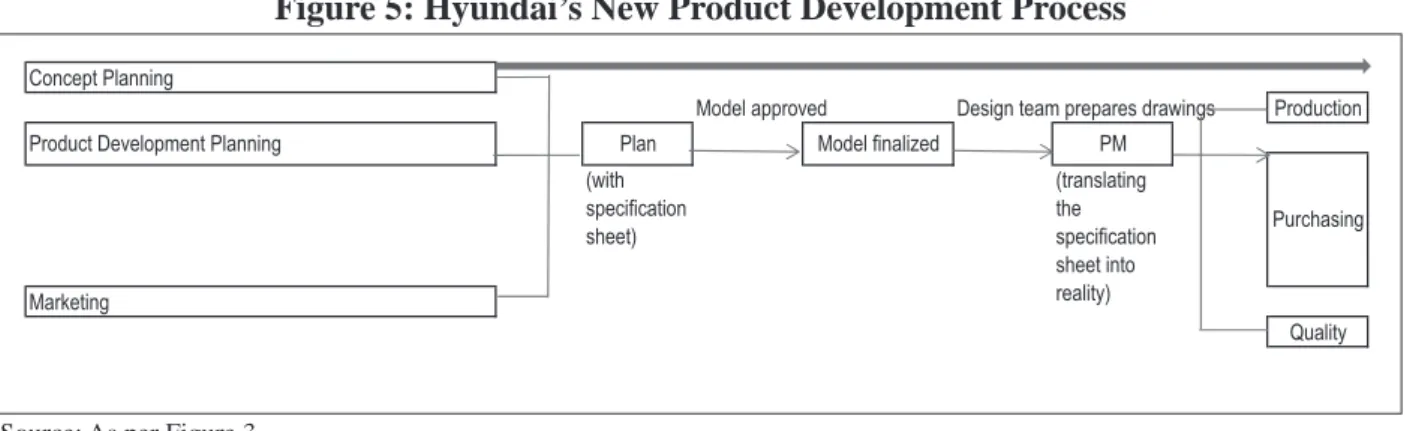
At Hyundai, once it embarks on development, a plan is drawn up by the product planning team (which strategically determines the approach to the vehicle while looking at moves by competitors), the product development planning team (which works out what the company can do and how using its own resources, while taking into account the requirements in the marketing plan), and the marketing team (which incorporates information about defects and consumer needs), working in partnership. These three teams work together, with the product planning team playing the central role in compiling the plan (Figure 5). The product planning team is affiliated to the Product Strategy Department, the product development planning team to the R&D Department, and the marketing team to the Sales Department. The product planning team is involved in (1) collating information concerning product planning, development, and marketing;
and (2) drafting and circulating the plan. The plan contains the specification sheet. Approval of the plan constitutes finalization of the model and the design team then prepares the drawings.
The development of components based on these then begins and equipment is ordered, with the PM (Product Manager) serving as overall coordinator. After finalization of the model, the PM’s task is to coordinate overall development of the product into a car, manage the schedule, and manage the budget. The PM is in charge of product development, tasked with turning the content of the specification sheet into an actual product. The PM’s development work also includes
Source: As per Figure 3.
Figure 4: Example of Hyundai's Product Development Planning Process
Source: As per Figure 3.
Model finalized Secondary
model evaluation meeting Development
begins
Approval of
Model Draft Production of the
first car begins
M+24months 3 months
2 months 7-8 months
giving the manufacturers of so-called “approved drawings” and “provided drawings” instructions concerning the development, manufacture, and delivery of components. The supervisor in the product development planning process after the product plan has been put together is the PM, but the concept planning team continues to monitor the product development planning process undertaken by the PM.
Figure 5: Hyundai’s New Product Development Process
2.6 Emphasis on Concept planning
In Hyundai’s product development process, the concept planning team continues to monitor the PM-led product development planning process, to ensure that the concept settled upon at the concept planning stage is carried through into the end product. The task in concept planning is to combine marketing with technology and needs to create a commercial product. It involves surveying customers and planning a product tailored to those customers. Product development planning involves creating an end product that embodies this. In emerging economies, marketing tailored to the needs of the market is more important than a high level of technical strength.
Accordingly, where technical factors dictate a change in the concept part of the way through the process, there is a risk of losing touch with market needs. Hyundai endeavors to avoid that risk by ensuring that the concept planning team continues to monitor product development through to the end.
The Product Strategy Department, which is in charge of concept planning, supervises not only the concept planning process, but also the product development process. In addition, the director of the Product Strategy Department holds ultimate responsibility in product development, through to the end of the product development planning process. The director of the Product Strategy Department supervises all models under development by Hyundai, providing guidance to the PMs for each model and coordinating all of the departments, such as the Sales Department and the R&D Department.
Source: As per Figure 3.
Figure Hyundai's e Product Development Process Concept Planning
Model approved Design team prepares drawings Production (with
specification sheet) Marketing
Quality
Product Development Planning Plan Model finalized PM
Purchasing (translating
thespecification sheet into reality)
Figure 6: Hyundai Motor Group Organizational Chart
2.7 Characteristics of Hyundai’s New Product Development Process
To sum up, as part of the product development process, the company establishes the aforementioned cross-sectional project teams (TFTs), which engage in coordination to facilitate speedy decision-making that transcends the boundaries between different departments. For example, in the case of the Chinese market, the project leader in the TFT is a vice president from the head office in the ROK. The vice presidents at the head office make decisions as senior management, so it is easy for the head office in the ROK to approve TFT proposals. These TFTs originated from the teams introduced in 1997 to identify solutions to problems. The mechanism enables any problems that arise to be addressed without delay, e.g. by a TFT covering the process through to the introduction of a new car overseas, a TFT covering the process through to the start of production of a new car, or a sales TFT. If a major problem occurs, the TFT (consisting of around 30 people) makes a decision within three months. This is convenient from the perspective of engineering.
2.8 Reduction of the Development Period via Pilot Lines at the Namyang R&D Center
Furthermore, the pilot lines at the Namyang R&D Center enable quality verification testing and mass production trials to be conducted efficiently.
Before these pilot lines were introduced, front-loading was poor and problems occurred once the company shifted to mass production at the Ulsan Plant or the Asan Plant. Moreover, lines at mass production plants (domestic or overseas) had to be stopped to conduct trials, causing availability and efficiency to fall at such plants. Accordingly, Hyundai decided to follow
Source: As per Figure 3.
Hyundai Motor Company Sales
Department Domestic Sales
Department Domestic
Marketing Office
Vice President Sales Department Overseas Sales
Department Overseas
Marketing Office
Kia Motors Corporation Sales
Department Domestic Sales
Department Domestic
Marketing Office Overseas Sales
Department Overseas
Marketing Office
Design Center Hyundai Motor Company
Kia Motors Corporation
Body and Basic Technology Center Light
Small Body and Technical Center Compact PM Center Compact
PM Center Mid-size & Large PM Center Compact
Vice President R&D Department Mid-size
(Namyang R&D Center) Powertrain Center
RV
Chairman 7 Vice Chairmen 9 Presidents Product Development Planning Office Small Commercial
Commercialization
Vice President Production Department TFT Product Enhancement
Vice President Global Purchasing ?
Vice President Quality Control
Market Analysis Vice President Financial Affairs
Hyundai Motor Company Vice President Product Strategy Department
・ Kia Motors Corporation
Vice President Planning Department
・ Product Strategy
As of June 4, 2012 ・ (20 departments in Total)
Bu si ne ss
Pl an ni ng an d Co or di na ti on Of
fi ce
Small/Commercial PM Center
Mercedes-Benz in introducing dedicated pilot lines, opening assembly lines for test evaluation, quality verification testing, and mass production trials at the Namyang R&D Center in 2004.
Its objectives in doing so were (1) to evaluate design quality during the development period; (2) to reduce the development period; (3) to conduct trials to check design quality and manufacturing quality; and (4) to reduce the set-up time for overseas plants via checks by the assembly workability group. It also conducted time and motion studies to speed up assembly work.
Conclusion
This paper has examined Hyundai’s product development process aimed at achieving a selective focused local adaptation strategy, looking at why Hyundai can identify each country’s needs so quickly and undertake product development based on this strategy. The analysis in this paper has revealed the following.
Firstly, cross-sectional project teams called TFTs swiftly coordinate departments and undertake cross-departmental decision-making. Moreover, the TFTs are headed by a vice president, making it easier for the head office in the ROK to give the go-ahead.
Secondly, as well as these cross-sectional project teams, the company utilizes the strength of inter-group partnerships and stations a comparatively large number of expatriate staff overseas, as well as employing local staff who speak both the local language and their mother tongue. This facilitates rapid information gathering and identification of needs from all directions.
Thirdly, Hyundai attaches greater importance to the overseas sales team than to the manufacturing department, delegating authority to them. The company is thoroughly marketing- oriented, understanding that it cannot achieve sales without developing products tailored to local needs.
Fourthly, Hyundai’s product development process is customer-oriented and the Concept Planning Department, which combines marketing with technology and needs to create a commercial product, retains responsibility right through to the end of the product development process. Rather than being technology-led, the whole company attaches great importance to this focus on marketing, ensuring that the needs of the market are met through to the very end.
Finally, the establishment of pilot lines at the Namyang R&D Center has enabled the company to conduct trial manufacture and quality verification of vehicles in development on an assembly line, as well as reducing the development period and facilitating assembly workability checks. This has reduced the startup time at overseas plants and enabled development to proceed smoothly.
* This paper is based on the following overseas surveys: Moscow and St. Petersburg, Russia (March 22–27, 2010); the ROK (March 28–April 2, 2011); the ROK (March 28–April 1, 2011); St. Petersburg, Russia (December 23–25, 2010); India (September 24 – October 2, 2011); the ROK (October 18–20, 2011); the ROK (March 28 –April 1, 2011); China (August 22–31, 2011); China (August 25–31, 2010); the ROK (November 17–20, 2009), the ROK (June 3–6, 2012); Russia (March 25 –April 6, 2013); Russia (September 7–9, 2014); and Brazil (March 23–28, 2015). The authors wish to express appreciation for the Grants-in-Aid for Scientific Research (Topic Nos. 21530446, 25380581, and 25380550) that supported the writing of this
paper. This paper is a revised version of Tomiyama (2012d)
† Regional & International Vice President, Professor, Graduate Institute for Entrepreneurial Studies
‡ Professor, Kyoto University
1 In Brazil, Hyundai won the 2013 Car of the Year award. In terms of the number of new vehicles registered in 2014, whereas Fiat, GM, VW, and Ford all experienced falls of 10% or more, Hyundai recorded a rise of 14.0% on the previous year to 179,724. http://www.marklines.com/ja/statistics/flash_sales/salesfig_
brazil_2014
Russian Car of the Year 2012: Hyundai Solaris (called the Accent in the ROK).
2 FOURIN (2010).
3 Chaebol is a South Korean form of business conglomerate (Heitor Almeida, Sang- Yong Park, Marti G.
Subrahmanyam, Daniel Wolfenzon (2011), Sangjin Yoo, Sang M.Lee(1987), Seung-Rok Park, Ky-Hyang Yuhn, (2012).
4 Innocean is one of Hyundai chaebol. (Lee, Kee (2013)).
References
Almeida, Heitor, Sang-Yong Park, Marti G. Subrahmanyam & Daniel Wolfenzon (2011): “The structure and formation of business groups: Evidence from Korean chaebols”, in Journal of Financial Economics, Vol.99, Issue 2, pp. 447–475.
FOURIN (2010): Monthly Report on the Asian Automotive Industry, No. 47, November 2010 [in Japanese].
Jo, Hyung-Je & Jong-Sung You (2011): “Dialectic Development of the Korean Automobile Industry: Focusing on the Hyundai Productive Model”, paper presented at the 19th GERPISA International Colloquium, Paris.
Lee, Kee (2013): “Practicing globalization: mediation of the creative in South Korean advertising”. PhD thesis, The London School of Economics and Political Science (LSE), London.
Park, Seung-Rok & Ky-Hyang Yuhn (2012): “Has the Korean chaebol model succeeded?”, Journal of Economic Studies, Vol. 39 Iss: 2, pp.260 –274.
Shioji, Hiromi & Eiko Tomiyama (2011): “Exploring the International Competitiveness of Hyundai Motor Company”, Journal of Graduate Institute for Entrepreneurial Studies, Graduate Institute for Entrepreneurial Studies [in Japanese].
Shioji, Hiromi (editor & author) (2012): “Hyundai Jidosha no Seicho Senryaku [Hyundai Motor Company’s Growth Strategy]”, Nikkan Jidosha Shimbun [in Japanese].
Tomiyama, Eiko & Hiromi Shioji (2011): “Hyundai Motor Company’s Marketing Strategies in Russia”, in ERINA Report, Vol. 98, March 2011, pp. 34–44, ERINA.
Tomiyama, Eiko & Hiromi Shioji (2012b): “Chapter 2: Hyundai Motor Company’s Emerging Countries Strategy – Focus on its marketing strategy in India and Russia” in Senryakuteki globalism no kigyo keiei [Corporate Management of Strategic Globalism], Koji Nakatsu. (editor & author), Soseisha, pp. 65–94 [in Japanese].
Tomiyama, Eiko & Hiromi Shioji (2012c): “Hyundai Jidosha no Senryaku to Russia shijo deno tenkai: Sentakuteki juutenteki genchi tekigouka senryaku wo kensho suru [Hyundai Motor Company’s Strategy and Expansion in the Russian Market: Examining its ‘Selective Focused Local Adaptation Strategy’]” in Russia & NIS Business Monthly, July 2012, pp. 10–23 [in Japanese].
Tomiyama, Eiko (2012d): “Chapter 2: Product Development Process Aimed at Local Adaptation” in Hyundai Jidosha no Seicho Senryaku [Hyndai Motor Company’s Growth Strategy], Hiromi Shioji. (editor & author), Nikkan Jidosha Shimbun, pp. 73–90 [in Japanese].
Yoo, Sang-Jin & Sang M. Lee (1987): “Management style and practice of Korean chaebols” in California Management Review, No.4, Summer 1987, pp.95–110.