PAPER
Special Section on Foundations of Computer Science — Algorithm, Theory of Computation, and their Applications —Quantum Query Complexity of Unitary Operator Discrimination
Akinori KAWACHI†a),Member, Kenichi KAWANO††,Nonmember, Franc¸ois LE GALL†††,Member, andSuguru TAMAKI†††,Nonmember
SUMMARY Unitary operator discrimination is a fundamental problem in quantum information theory. The basic version of this problem can be described as follows: Given a black box implementing a unitary opera- torU∈S:={U1,U2}under some probability distribution overS, the goal is to decide whetherU =U1orU=U2. In this paper, we consider the query complexity of this problem. We show that there exists a quantum algorithm that solves this problem with bounded error probability using
√6θ−cover1
queries to the black box in the worst case, i.e., under any proba- bility distribution overS, where the parameterθcover, which is determined by the eigenvalues ofU†1U2, represents the “closeness” betweenU1andU2. We also show that this upper bound is essentially tight: we prove that for everyθcover >0 there exist operatorsU1andU2such that any quantum algorithm solving this problem with bounded error probability requires at least 2
3θcover
queries under uniform distribution overS.
key words: quantum algorithms, quantum information theory, query com- plexity
1. Introduction (1) Background
Quantum state discrimination is one of the most fundamen- tal problems in quantum information theory[1]–[4]. In a typical setting, the goal of this problem is to discriminate two quantum states. The success probability of this prob- lem is known to be characterized by the orthogonality of the two states. In particular, non-orthogonal states cannot be discriminated with probability 1, no matter how many inde- pendent copies of the input state are given.
A problem closely related to quantum state discrimi- nation is the quantum operator discrimination problem[5]–
[15]. Similarly to quantum state discrimination, in a typi- cal setting the goal of quantum operator discrimination is to discriminate two operators: given a black box implementing a quantum operatorO ∈ {O1,O2}under some distribution over {O1,O2}, the goal is to decide whether O = O1 or O = O2. A specificity of the quantum operator discrimi- nation problem, which is not present in the quantum state discrimination problem, is that we can choose an arbitrary
Manuscript received March 30, 2018.
Manuscript revised July 27, 2018.
Manuscript publicized November 8, 2018.
†The author is with Osaka University, Suita-shi, 565–0871 Japan.
††The author is with Tokushima University, Tokushima-shi, 770–8506 Japan.
†††The authors are with Kyoto University, Kyoto-shi, 606–8501 Japan.
a) E-mail: [email protected] DOI: 10.1587/transinf.2018FCP0012
input state on which the operatorOis applied. Additionally, the operator O can be applied more than once in various combinations (parallel, sequential, or in any other scheme physically allowed). In contrast to quantum state discrimi- nation, it is known that for several classes of operators dis- crimination is possible without error[5],[7]–[10],[13]. For example, any two unitary operators can be discriminated without error by applying the operator in parallel on some well-chosen entangled quantum state[5],[8], or by apply- ing the operator sequentially on a non-entangled state[9].
In addition to unitary operators, it is also known that projec- tive measurements can be discriminated without error[13].
Necessary and sufficient conditions for discriminating trace preserving completely positive (TPCP) maps without errors are given in[10]as well.
Many computational problems solved by quantum al- gorithms can be recasted as discrimination problems. Here the quantum operator given as input typically implements a classical operation on the basis of the corresponding Hilbert space and the goal is to (possibly partially) identify which classical operation it implements. Such problems gener- alize Grover’s original quantum search problem[16] and have been studied under the name of the oracle identifica- tion problem[17],[18]. For instance, Grover’s algorithm for search solves the following problem: given an oracleUxcor- responding to an unknown stringx∈ {0,1}nthat maps any quantum basis state|i |b, withi∈ {1, . . . ,n}andb∈ {0,1}, to the quantum state |i |b⊕xi, determine if xcontains at least one non-zero coordinate. These problems have been mainly considered in the query complexity setting, where the complexity is defined as the number of calls of the oper- atorUxused by the algorithm. Upper and lower bounds on the query complexity of several oracle identification prob- lems have been obtained[17],[18].
Quantum operator discrimination problems relevant to quantum information theory, on the other hand, have not yet been the subject of much study in the framework of quantum query complexity.
(2) Our results
In this paper, we investigate the query complexity of the quantum operator discrimination problem for general quantum unitary operators (i.e., quantum unitary opera- tors not necessarily corresponding to classical operations) in bounded-error settings. More precisely, we consider the following problem: given an unknown unitary operator Copyright c2019 The Institute of Electronics, Information and Communication Engineers
U∈S :={U1,U2}under some probability distribution over a candidate setS, whereU is given as a (quantum) black- box and bothU1andU2are known unitary operators, deter- mine whetherU = U1 orU = U2 correctly with bounded error probability.
Our main contribution is a characterization of the query complexity of this problem (i.e., the number of times the black-boxUhas to be applied to solve the problem) in terms of a parameterθcover, which is defined formally later (Def- inition 12 in Sect. 3), representing the “closeness” between U1 andU2. By showing a tradeoffbetween the number of queries and success probability, we show the following up- per and lower bounds:
• There exists a quantum algorithm that makes√ 6θ−1cover non-adaptive queries and can correctly discriminateU1
fromU2in the worst case (i.e., under any probability distribution over a candidate setS), for any unitary op- eratorsU1andU2, with probability 2/3 (Theorem 14).
• For every distinct unitary operatorsU1 andU2, every quantum algorithm requires at least 2
3θcover
queries to discriminateU1 fromU2 with probability 2/3 (Theo- rem 17) under uniform distribution overS.
We thus obtain a tight (up to possible constant factors) char- acterization of the query complexity of unitary operator dis- crimination. Our upper bound is actually achieved by a quantum algorithm that makes only non-adaptive queries, i.e., a quantum algorithm in which all queries to the black- box can be made in parallel. On the other hand, our lower bound holds even for adaptive quantum algorithms. Our re- sults thus show that for the quantum unitary operator dis- crimination problem making adaptive query cannot (signif- icantly) reduce the query complexity of the algorithm. A similar consequence was derived in [19] for unitary dis- crimination of some continuous candidates. This contrasts with oracle identification problems[20] such as quantum search, where adaptive queries are necessary for achieving the speed-up exhibited by Grover’s algorithm[16], and with quantum channel discrimination, where adaptivity is essen- tially required to discriminate some quantum channels as shown by[21].
(3) Relation with other works
Note that Ac´ın actually showed upper bounds on the query complexity of the problem by using an entangled input state with non-adaptive queries[5]. Ac´ın provided a geometric interpretation for the statistical distinguishability of unitary operators based on sophisticated metrics of Fubini-Study and Bures. D’Ariano et al. briefly noted a simpler geomet- ric interpretation based on the Euclidean metric on the com- plex plane for the same result[8]. Duan et al. also showed the same upper bounds with adaptive queries and a non- entangled input state using the parameterθcover[9]. Our al- gorithm for the upper bounds uses an entangled input state with non-adaptive queries similarly to Ac´ın’s and D’Ariano et al.’s. In addition, we prove a tradeoffbetween the num- ber of queries and success probability with rigorous analy-
sis. Duan et al. also showed the optimality of their lower bounds to perfectly discriminate two unitary operators[9].
Our proof of the lower bound additionally analyzes the nec- essary number of queries for imperfect discrimination in de- tails by showing a tradeoffbetween the number of queries and success probability.
Harrow et al. showed the existence of a quantum state discriminatorM∗which solves the quantum state discrim- ination problem in the worst case, i.e., independently of a probability distribution over a set of candidate quantum states[22]. Using M∗, we construct the unitary operator discriminatorA∗. As withM∗,A∗solves the unitary oper- ator discrimination problem independently of a probability distribution over a set of candidate unitary operators, which provides the worst-case upper bound of query complexity for unitary operator discrimination problem.
In a more general setting, Aharonov et al. introduced the diamond norm, which can be utilized for quantum chan- nel discrimination[23]. In addition, they pointed out a char- acterization of success probability for unitary discrimination from eigenvalues of candidate unitary operators, which is similar to the parameterθcover.
(4) Organization of the paper
The organization of this paper is as follows. In Sect. 2, we define formally the quantum state discrimination prob- lem, the unitary operator discrimination problem, the error probability of a discriminator, and the query complexity. In Sect. 3, we show average-case upper bounds on the query complexity when arbitrary candidate operatorsU1 andU2 are given with probability 1/2 respectively by constructing a discriminator forU1andU2and analyzing the error prob- ability. In Sect. 4, we show the worst-case upper bounds on the query complexity by combining the discriminator in Sect. 3 with Harrow et al.’s result[22]. In Sect. 5, we show the lower bound on the query complexity of any quantum algorithm solving the quantum unitary operator discrimina- tion problem. Finally, we provide an improved analysis for lower bounds of the query complexity, which is attributed to Mori[27], in Sect. 6.
2. Preliminaries
First, we define the quantum state discrimination problem since the unitary operator discrimination problem can be re- duced to the quantum state discrimination problem.
Definition 1(Quantum state discrimination problem): The quantum state discrimination problem is defined as the problem of determining whether an unknown state |φ is
|φ1 or |φ2, where|φ is given from a candidate setS = {|φ1,|φ2} of arbitrary two quantum states. Below, we denote the quantum state discrimination problem of S = {|φ1,|φ2}by QSDP{|φ1,|φ2}
.
Definition 2(Error probability of QSDP{|φ1,|φ2} ):
For a quantum state discriminatorA, when|φ1and|φ2are given with probability p1andp2:=1−p1respectively, the
error probabilityPerrorofAis defined as follows:
Perror=p1Pr
A
A(|φ1)=“2”+p2Pr
A
A(|φ2)=“1”. Namely, the error probabilityPerroris the sum of the proba- bility thatAmistakes|φ1for|φ2and|φ2for|φ1, where the probability is taken over randomness of{|φ1,|φ2}and A.
The error probability is characterized by the closeness between two quantum states such as the trace distance and the fidelity.
Definition 3(Trace distance): Let ρandσ be pure quan- tum states. The trace distance d (ρ, σ) is defined as d (ρ, σ) := 12 ρ−σtr, where Xtr := Tr (|X|) = Tr√
X†X .
Definition 4(Fidelity): Letρ = |ψ ψ|andσ =|φ φ|be pure quantum states. The fidelity F(ρ, σ) is defined as F(ρ, σ) = | ψ|φ|.Since it is an absolute value of inner product, it holds that 0 ≤ F(ρ, σ) ≤ 1, F(ρ, σ) = 1 ⇔
|ψ=|φ, andF(ρ, σ)=0⇔ |ψ ⊥ |φ.
Also, the trace distance and the fidelity satisfy the fol- lowing relation.
Lemma 5([24]): Letρandσbe pure quantum states. We then haved(ρ, σ) := 12 ρ−σtr=
1−F(ρ, σ)2. A result of Barnum and Knill[25]shows that, assum- ing a probability distribution{pi} on a candidate set{ρi} of quantum states, the error probability of a quantum state discriminatorAis bounded as
Perror≤
ij
√pipj
F
ρi, ρj .
In this paper, we consider the case of two quantum states.
Additionally, from p1 ≥ 0, p2 ≥ 0, and p1 + p2 = 1,
√p1p2 ≤ 12 holds. Therefore, we obtain the following the- orem of upper bounds of error probability for quantum state discrimination in the worst case.
Theorem 6: Suppose the quantum statesρandσare given from the candidate setS = {ρ, σ} of pure quantum states with any probabilityp1andp2 respectively. Then there ex- ists a discriminatorAsuch that its error probabilityPerroris given as follows:
Perror≤ √ p1p2
F(ρ, σ)≤ 1 2
F(ρ, σ).
On the other hand, if we choose a uniform probability distribution over two candidate states, the error probability is completely characterized by their fidelity as shown in the following theorem, which is used to prove the lower bounds of query complexity.
Theorem 7([15]): Suppose quantum statesρ=|ψ ψ|and σ = |φ φ| are given from S = {ρ, σ} of pure quantum states with probability 1/2 respectively. Then there exists a
discriminatorAsuch that its error probabilityPerroris given as follows:
Perror= 1 2
1− 1
2 ρ− 1 2 σtr
= 1
2 ( 1−d(ρ, σ) )
= 1 2
1−
1−F(ρ, σ)2
.
Next, we define the unitary operator discrimination problem.
Definition 8(Unitary operator discrimination problem):
The unitary operator discrimination problemis defined as the problem of determining whether an unknown opera- torU isU1 or U2, whereU is given from a candidate set S = {U1,U2} of arbitrary two unitary operators Below, we denote the unitary operator discrimination problem of S ={U1,U2}by UODP{U1,U2}
. Definition 9(Error probability of UODP
{U1,U2} ): For a unitary operator discriminator A, when U1 andU2 are given with any probabilityp1andp2 respectively, the error probabilityPUerrorofAis defined as follows:
PUerror=p1Pr
A
AU1=“2”
+p2Pr
A
AU2 =“1”
. Namely, the error probabilityPUerroris the sum of the proba- bility thatAmistakesU1 forU2andU2forU1, where the probability is taken over randomness of{U1,U2}andA.
Except for Sect. 4, we assume that the given probability dis- tribution is uniform in this paper, i.e.,U1andU2 are given with probability 1/2, respectively.
Generally, the unitary operator discrimination problem can be reduced to the quantum state discrimination problem by applying the unknown unitary operatorUto an arbitrary
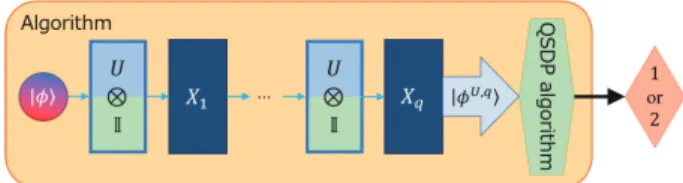
|φ. An application ofUto|φis called aquery. Then, we denote byφU,q
the quantum state generated byqqueries to U and unitary operators{Xi}qi=1, which are independent of U(however, possibly depend on{U1,U2}), specified byA.
It is given as follows:
φU,q
=Xq(U⊗I)Xq−1(U⊗I)· · ·X1(U⊗I)|φ. Here,|φ andφU,q
are quantum states ofm+nqubits, Xi
is a unitary operator overm+nqubits for eachi, andUand Iare unitary operators overn qubits andmqubits, respec- tively. Note that this formulation can represent non-adaptive discrimination. Let ˆU be a sequence of unitary operators of A. Then we haveφU,q
= Uˆ|φ. Also, we define ˆU1 and ˆU2as unitary operators satisfyingφU1,q
=Uˆ1|φand φU2,q
=Uˆ2|φ, respectively.
The unitary operator discriminator that makes all the queries at once (regardless of the answers to other queries) is called anon-adaptiveunitary operator discriminator. Oth- erwise it is called an adaptive unitary operator discrimi- nator. When unitary operators U1 andU2 are given from
S = {U1,U2} with probability p1and p2respectively, the error probability of any discriminator is bounded for every p1,p2as follows:
PUerror≤ 1 2
min|φ φ|Uˆ†1Uˆ2|φ
= 1 2
min
|φ | φ|U|φ|. (1) For ˆU1and ˆU2, letU=V†Uˆ1†Uˆ2V, whereUis a diagonal matrix, and let|φ = V†|φ. This inequality is shown immediately from Theorem 6.
Definition 10: We say a discriminatorAmakesqqueries ifAapplies a unitary operatorU qtimes to the initial state
|φ in total. We say A solves UODP{U1,U2} with q queries if A correctly discriminates unitary operators U1 andU2 with probability at least 2/3 withq queries when U1andU2are given with probability 1/2 repectively. In ad- dition, we sayAsolves UODP{U1,U2}
withqqueriesin the worst caseifAsolves UODP
{U1,U2}
with at mostq queries under every probability distribution over{U1,U2}.
The query complexity of UODP{U1,U2}
is the minimum number of queries whereAsolves UODP{U1,U2}
. 3. Upper Bounds
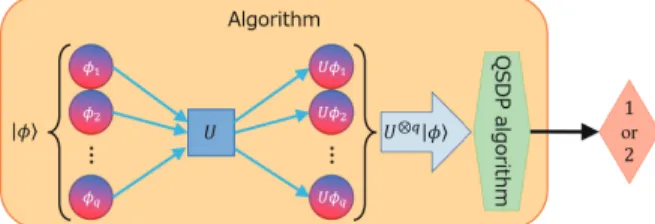
LetU1 andU2 be unitary operators acting onnqubits. In this section, we suppose that eitherU1 orU2 is given with equal probability, i.e., 1/2, respectively. Below we give a construction of a non-adaptiveq-query discriminator for UODP{U1,U2}
. See Fig. 1 for its schematic description.
Construction 11: (Non-adaptiveq-query discriminatorA for UODP{U1,U2}
)
1. Generate an initial qn-qubit quantum state |φ that is determined by U1,U2 and q as in the proof of Lemma 13.
2. ApplyU⊗qto|φ, whereU∈ {U1,U2}is the unknown unitary operator.
3. Apply the quantum state discriminator for
QSDP
U1⊗q|φ,U2⊗q|φ
, from Theorem 6, to the quantum stateU⊗q|φ.
4. Output the result of the quantum state discriminator.
To analyze the error probability of the non-adaptiveq-query discriminatorA, let us introduce a notion of the covering angle.
Fig. 1 Non-adaptive unitary operator discriminatorA
Definition 12(Covering angleθcover): Let arg(eiθ,eiθ) de- note the smaller angle between eiθ andeiθ in the complex plane, and let arc(eiθ,eiθ) denote its arc on the complex unit circle. Then, covering angle of the set
eiθ1, . . . ,eiθn , de- noted by θcover, is defined as θcover := min{θ : ∃θk,∃θl ∈ {θ1, . . . , θn} s.t. θ = arg(eiθk,eiθl) ∧
eiθ1, . . . ,eiθn
⊆ arc(eiθk,eiθl)}.
The covering angle θcover is formed byeiθk andeiθl if θcover=arg(eiθk,eiθl). As mentioned in Introduction, the cov- ering angle ofU1†U2represents the “closeness” betweenU1 andU2. This notion is also used for characterization of per- fect unitary discrimination[9] See Fig. 2 for an illustrated example of a covering angle. Aharonov et al.[23]pointed out that the success probability of unitary discrimination is characterized by the distance from the origin to the polygon whose vertices are the eigenvalues ofU1†U2in the complex plane. (Its proof was given, e.g., by Johnston et al.[26].) The parameterθcoveris similar to their characterization, but θcoveris more convenient to characterize the query complex- ity of the unitary discrimination simply.
Let
eiθ1, . . . ,eiθn
be the set of eigenvalues of U1†U2 and let θcover be its covering angle. The following is the main technical lemma of this section.
Lemma 13: The error probability PUerror of the non- adaptiveq-query discriminatorAis given as follows:
PUerror⎧⎪⎪⎪⎨
⎪⎪⎪⎩ ≤ 1 2
cos qθcover
2 ( 0≤qθcover< π),
=0 (π≤qθcover).
This lemma immediately implies the following:
Theorem 14: The non-adaptive q-query discriminator A solves UODP{U1,U2}
if q ≥ √ 6θcover−1
. Furthermore, the error probability ofAis zero ifq≥ π
θcover
. Proof of Theorem 14. Ifq ≥ π
θcover
, thenπ ≤ qθcover
holds and the error probability ofAis zero by Lemma 13.
For 0≤qθcover< π, again by Lemma 13, it suffices to findq such that
PUerror≤ 1 2
cos qθcover
2
≤ 1 2
1− 1
2!
qθcover
2 2
+ 1 4!
qθcover
2 4
Fig. 2 Covering angleθcover
≤ 1 2
1− 1
2
qθcover
2 2
1− π2 48
≤ 1 3 . (2) holds according to Definition 10. From (2), it is easy to see thatPUerror ≤1/3 holds ifq≥√
6θ−cover1
.
It remains to prove Lemma 13. It is instructive to first an- alyze a special case ofq = 1 as it captures the essence of general cases.
Lemma 15: The error probability of the non-adaptive 1- query discriminatorAis given as follows:
PUerror⎧⎪⎪⎪⎨
⎪⎪⎪⎩ ≤ 1 2
cos θcover
2 ( 0≤θcover< π),
=0 (π≤θcover≤2π).
Proof of Lemma 15. We consider two cases according to the value ofθcover.
Case (i)0≤θcover< π.
LetU=diag
eiθ1, . . . ,eiθn and|φ=(α1, . . . , αn). By (1) in Sect. 2, the minimum value of the fidelity ofU1|φand U2|φis represented as follows:
min|φ φ|U1†U2|φ=min
|φ φUφ
= min
nj=1|αj|2=1
n j=1
αj2eiθj .
The last term above is equal to the square of the short- est distance from the origin of the complex plane to the convex set C := ! n
j=1αj2eiθj : nj=1αj2=1
"
. The shortest distance from the origin of the complex plane to C is equal to the shortest distance from the ori- gin of the complex plane to the line segment C :=
|αk|2eiθk+|αl|2eiθl :|αk|2+|αl|2=1
, whereeiθk andeiθl form the covering angle θcover. See Fig. 3 for illustration.
Thus, we have min
n j=1|αj|2=1
n j=1
αj2eiθj
= min
|αk|2+|αl|2=1|αk|2eiθk+|αl|2eiθl.
The minimum of the right hand side above is achieved by setting|αk|2= 12,|αl|2= 12. Hence
|αk|2min+|αl|2=1|αk|2eiθk +|αl|2eiθl
Fig. 3 The shortest distance to the convex setC
= 1
2 eiθk+eiθl=cos θcover
2 . Thus,PUerrorofAis represented as follows:
PUerror≤ 1 2
cos θcover
2 ( 0≤θcover≤π). Case (ii)π≤θcover≤2π.
The error probability can be calculated in the same way as Case (i). In this case, the convex setCcontains the origin of the complex plane, i.e., the shortest distance from the origin toCis zero, hence we havePUerror=0.
We are prepared to prove Lemma 13.
Proof of Lemma 13.
Case (i)0≤qθcover≤π.
LetU=diag
eiθ1, . . . ,eiθn . Then the set of eigenvalues of U⊗qis
Λ =⎧⎪⎪⎪⎨
⎪⎪⎪⎩
#q j=1
eiθk j : 1≤k1, . . . ,kq≤n⎫⎪⎪⎪⎬
⎪⎪⎪⎭.
Note that if the covering angle θcover of {eiθ1, . . . ,eiθn} is formed byeiθkandeiθl, then the covering angle ofΛisqθcover
and formed byeiqθkandeiqθl, as long asqis not too large.
As the proof of Lemma 15, the minimum value of the square of the fidelity ofU⊗1q|φandU2⊗q|φis
min|φ φ|U1⊗q†U⊗2q|φ=min
|φ φU⊗qφ
= min
qn
j=1|αj|2=1|α1|2eiqθ1+|α2|2ei( (q−1 )θ1+θ2) +· · ·+αqn2eiqθn. This is the square of the shortest distance from the origin of the complex plane to the convex set
Cq:=
|α1|2eiqθ1+|α2|2ei( (q−1 )θ1+θ2) +· · ·+αqn2eiqθn :
qn j=1
αj=1⎫⎪⎪⎪⎬
⎪⎪⎪⎭. The shortest distance from the origin of the complex plane toCqis equal to the line segment
Cq:=!
|αx|2eiqθk+αy2eiqθl :|αx|2+αy2=1
"
. See Fig. 4 for illustration. Hence, in the same way as the
Fig. 4 The shortest distance to the convex setCq
proof of Lemma 15, we have PUerror≤ 1
2
cos qθcover
2 ( 0≤qθcover≤π). Case (ii)π≤qθcover.
Since the convex setCqcontains the origin of the complex plane, the error probability ofAcan be made zero as the
case ofq=1.
4. Worst-Case Upper Bounds
A quantum state discriminator is generally designed to op- timize the success probability under a given probability dis- tribution over a set of candidate states. In contrast, Harrow et al. showed the existence of a quantum state discrimina- torM∗which solves quantum state discrimination problem independently of the probability distribution over a candi- date set by using the min-max theorem[22]. Namely, they showed that someM∗can solve the quantum state discrim- ination problem in the worst case.
By applying the argument of Harrow et al. to our set- ting, we can show the existence of the unitary operator dis- criminatorA∗in the worst case as in quantum state discrim- ination problem.
Theorem 16: Let θcover be the covering angle of U1†U2. There exists a non-adaptive√
6θ−cover1
-query discriminator A∗that solves UODP
{U1,U2}
in the worst case.
Proof. A∗is constructed by replacing “QSDP algorithm”
in Fig. 1 withM∗. UsingA∗, we can show the worst-case upper bound given in the statement by the same analysis
with Theorem 14.
5. Lower Bounds
Every unitary operator discriminator can be represented as an adaptive discriminator given in Fig. 5. We now analyze the necessary number q of queries to solve UODP
{U1,U2}
for every distinctU1andU2. In this sec- tion, we suppose that one ofU1andU2is given from a can- didate set with probability 1/2.
The unitary operators in Fig. 5 can be described as fol- lows:
Uˆ :=Xq(U⊗I)Xq−1(U⊗I)· · ·X1(U⊗I)
from a givenU∈ {U1,U2}and any fixed unitary operators Xi(i=1,2, . . . ,q).
Fig. 5 The arbitrary adaptive discriminator
The following theorem shows the necessary number of queries for every distinctU1andU2.
Theorem 17: Letθcoverbe the covering angle ofU1†U2. If A solves UODP{U1,U2}
with q adaptive queries,q ≥ 2
3θcover
holds.
Proof. Let|φbe any initial state and letφU,q
be the state after applying ˆUto the initial state|φ. Then, we obtain the following states forU1andU2respectively:
Uˆ1|φ:=φU1,q
=Xq(U1⊗I)Xq−1(U1⊗I)· · ·X1(U1⊗I)|φ, Uˆ2|φ:=φU2,q
=Xq(U2⊗I)Xq−1(U2⊗I)· · ·X1(U2⊗I)|φ. We represent their states as ρq := φU1,q'
φU1,q and σq := φU2,q'
φU2,q respectively. Then, the trace norm is ρq−σqtr, and we obtain the equation as follows:
ρq−σqtr =Xq(U1⊗I)ρq−1(U1⊗I)†X†q
−Xq(U2⊗I)σq−1(U2⊗I)†Xq†tr. Since unitary operators do not change the trace distance, we have
Xq(U1⊗I)ρq−1(U1⊗I)†Xq†
−Xq(U2⊗I)σq−1(U2⊗I)†X†qtr
=(U1⊗I)ρq−1(U1⊗I)†
−(U2⊗I)σq−1(U2⊗I)†tr. By the triangle inequality,
(U1⊗I)ρq−1(U1⊗I)†−(U2⊗I)σq−1(U2⊗I)†tr
=(U1⊗I)ρq−1(U1⊗I)†−(U1⊗I)σq−1(U1⊗I)† +(U1⊗I)σq−1(U1⊗I)†−(U2⊗I)σq−1(U2⊗I)†tr
≤ρq−1−σq−1tr
+(U1⊗I)σq−1(U1⊗I)†−(U2⊗I)σq−1(U2⊗I)†tr. By Definition 3, 4 and Lemma 5,(U1⊗I)σq−1(U1⊗I)†−
(U2⊗I)σq−1(U2⊗I)†tris:
(U1⊗I)σq−1(U1⊗I)†−(U2⊗I)σq−1(U2⊗I)†tr
=2d
(U1⊗I)σq−1(U1⊗I)†,(U2⊗I)σq−1(U2⊗I)†
=2
1−F
(U1⊗I)σq−1(U1⊗I)†,(U2⊗I)σq−1(U2⊗I)†2
=2
1−φU2,q−1(U1⊗I)†(U2⊗I)φU2,q−12
=2
1−φU2,q−1U1†U2⊗I φU2,q−12
≤2
1−min
|ψ ψ|
U†1U2⊗I |ψ2.
SinceU1†U2is diagonalizable, there is always the unitary op- eratorV for generating the diagonal operatorD from the U†1U2. Therefore, we obtainU1†U2=V DV†. By using it,
min|ψ ψ|
U†1U2⊗I |ψ2
=min
|ψ ψ|
V DV†⊗I |ψ2
=min
|ψ ψ|(V⊗I) (D⊗I)
V†⊗I |ψ2. Here, using the state|ψsatisfying|ψ=
V†⊗I |ψ, we obtain:
min|ψ ψ|(V⊗I) (D⊗I)
V†⊗I |ψ2
=min
|ψψ(D⊗I)ψ2. Let D = diag
eiθ1, . . . ,eiθn and let
eiθk,eiθl be the pair making the covering angle θcover. Then min|ψ| ψ|(D⊗I)|ψ|2becomes as follows:
min|ψ ψ(D⊗I)ψ2= 1
2 eiθk + 1 2 eiθl2
= 1
2 ( 1+cos (θk−θl) )= 1
2 ( 1+cosθcover)
=cos2 θcover
2 . Therefore, we obtain the following equation:
2
1−min
|ψ ψ|
U1†U2⊗I |ψ2
=2
1−cos2 θcover
2 =2 sin θcover
2 .
Since sinθ ≤ θ, we obtain 2 sin θcover2 ≤ θcover. Therefore, we obtain:
ρq−σqtr≤ρq−1−σq−1tr +2
1−min
|ψ ψ|
U1†U2⊗I |ψ2
≤ρq−1−σq−1tr+θcover.
This means that the trace distance only increases at most θcover per once query. Therefore, we obtainρq−σqtr ≤ qθcover. Since the discrimination error probabilityPUerrorafter qqueries is represented with 12
1− 12 ρq−σqtr from Theorem 7,PUerrorbecomes as follows:
PUerror≥ 1 2
1− 1
2 qθcover
.
Thus, from 12
1− 12qθcover ≤ 13, we haveq ≥ 3θcover2 . Since the number of queriesq is integer, using the ceiling function,q≥
3θcover2
holds.
6. Improved Analysis for Lower Bounds of Fidelity The observation and analysis in this section are attributed to Mori[27].
In Sects. 3 and 5, we proved upper and lower bounds of the query complexity from the fidelity of quan- tum states. Actually, the upper bound of the fidelity FφU1,q'
φU1,q,φU2,q'
φU2,q ≤ cos qθcover2 obtained in Sect. 3 is exactly optimal, since we can show the following tight lower bound:
Lemma 18: [Mori[27]] Letθcoverbe the covering angle of U1†U2. For everyX1, . . . ,Xq−1and every|φ, we have
FφU1,q'
φU1,q,φU2,q'
φU2,q ≥cos qθcover
2 if 0≤qθcover< π.
Proof. The idea for improving the lower bound is the same as Zalka’s proof of the exact optimality of Grover’s quantum search[28]. Let
φi,q
=Xq(U2⊗I)Xq−1(U2⊗I)· · ·Xi+1(U2⊗I) Xi(U1⊗I)Xi−1· · ·X1(U1⊗I)|φ for i ∈ {0,1, . . . ,q −1}. Note that φ0,q
= φU2,q and
|φq,q=φU1,q . Let cosθ0,1 ='
φ0,qφ1,qand cosθ1,q ='
φ1,qφq,q for 0≤θ0,1, θ1,q≤π/2. We now show that
'
ψ0,qψq,q≥cos(θ0,1+θ1,q). (3) Definex = '
φ0,qφq,q
,y0,1 ='
φ0,qφ1,q
, andy1,q = 'φ1,qφq,q
. The Gram matrix
G=
⎡⎢⎢⎢⎢⎢
⎢⎢⎢⎢⎢
⎣ 'φ0,q 'φ1,q φq,q|
⎤⎥⎥⎥⎥⎥
⎥⎥⎥⎥⎥
⎦ φ0,q φ1,q
|φq,q
=
⎡⎢⎢⎢⎢⎢
⎢⎢⎢⎣ 1 y0,1 x y∗0,1 1 y1,q
x∗ y∗1,q 1
⎤⎥⎥⎥⎥⎥
⎥⎥⎥⎦
is positive semidefinite, and thus, its determinant det(G)=1+2Re(y0,1y1,qx∗)−y0,12−y0,12− |x|2 is non-negative. Since y0,1y1,q|x| ≥ Re(y0,1y1,qx∗) and y0,1=cosθ0,1,y1,q=cosθ1,q, we obtain
1+2 cosθ0,1cosθ1,q|x| −cosθ20,1−cosθ21,q− |x|2≥0. Therefore, we obtain|x| ≥cos(θ0,1+θ1,q),which implies (3).
In addition, we have '
φ0,qφ1,q=cosθ0,1≥cos θcover
2 ,
as done in the proof of Lemma 15. By induction, we can obtain
'
φ0,qφq,q≥cos qθcover
2
for 0≤qθcover< π.
By Theorem 7, the error probability is completely char- acterized by the fidelity if the distribution on{U1,U2} is uniform. Therefore, we obtain the optimal lower bound of the error probability
PUerror≥ 1 2
1−sin
qθcover
2
from Lemma 18 for 0≤q< π/θcover. Then, we can reprove the lower bound π/θcoverof query complexity for perfect unitary discrimination, which was shown in[9].
Acknowledgments
The preliminary version of this paper was published in COCOON 2017. AK was partially supported by MEXT KAKENHI (24106009) and JSPS KAKENHI (16H01705, 17K12640). ST was supported in part by MEXT KAKENHI (24106003) and JSPS KAKENHI (26330011, 16H02782). FLG was partially supported by MEXT KAKENHI (24106009) and JSPS KAKENHI (16H01705, 16H05853). The authors are grateful to Akihito Soeda for helpful discussions and to Ryuhei Mori for his observation and analysis described in Sect. 6 for improvements of the lower bounds. The authors also appreciate the editor and reviewers for valuable comments to earlier versions of this paper.
References
[1] K.M.R. Audenaert, J. Calsamiglia, L. Masanes, R. Mu˜noz-Tapia, A.
Ac´ın, E. Bagan, and F. Verstraete, “The quantum Chernoff2 bound,”
Physical Review Letters, vol.98, no.160501, 2007.
[2] A. Chefles, “Unambiguous discrimination between linearly indepen- dent quantum states,” Physics Letters A, vol.239, no.6, pp.339–347, March 1998.
[3] Y. Feng, R. Duan, and M. Ying, “Unambiguous discrimina- tion between quantum mixed states,” Physical Review A, vol.70, no.012308, July 2004.
[4] C. Mochon, “Family of generalized “pretty good” measurements and the minimal-error pure-state discrimination problems for which they are optimal,” Physical Review A, vol.73, no.012308, March 2006.
[5] A. Ac´ın, “Statistical distinguishability between unitary operations,”
Physical Review Letters, vol.87, no.177901, 2001.
[6] A. Chefles, A. Kitagawa, M. Takeoka, M. Sasaki, and J. Twamley,
“Unambiguous discrimination among oracle operators,” Journal of Physics A: Mathematical and Theoretical, vol.40, no.10183, 2007.
[7] A.M. Childs, J. Preskill, and J. Renes, “Quantum information and precision measurement,” Journal of Modern Optics, vol.47, no.2-3, pp.155–176, 2000.
[8] G.M. D’Ariano, P.L. Presti, and M.G.A. Paris, “Using entanglement improves the precision of quantum measurements,” Physical Review Letters, vol.87, no.270404, 2001.
[9] R. Duan, Y. Feng, and M. Ying, “Entanglement is not necessary for perfect discrimination between unitary operations,” Physical Review Letters, vol.98, no.100503, 2007.
[10] R. Duan, Y. Feng, and M. Ying, “The perfect distinguishability of quantum operations,” Physical Review Letters, vol.103, no.210501, 2009.
[11] M. Piani and J. Watrous, “All entangled states are useful for channel discrimination,” Physical Review Letters, vol.102, no.250501, 2009.
[12] G. Wang and M. Ying, “Unambiguous discrimination among quan- tum operations,” Physical Review A, vol.73, no.042301, 2006.
[13] Z. Ji, Y. Feng, R. Duan, and M. Ying, “Identification and dis- tance measures of measurement apparatus,” Physical Review Let- ters, vol.96, no.200401, 2006.
[14] M.F. Sacchi, “Optimal discrimination of quantum operations,” Phys- ical Review A, vol.71, no.062340, 2005.
[15] M. Ziman and M. Sedl´ak, “Single-shot discrimination of quan- tum unitary processes,” Journal of Modern Optics, vol.57, no.3, pp.253–259, 2010.
[16] L.K. Grover, “Quantum mechanics helps in searching for a needle in a haystack,” Physical Review Letters, vol.79, no.325, July 1997.
[17] A. Ambainis, K. Iwama, A. Kawachi, R. Raymond, and S.
Yamashita, “Improved algorithms for quantum identification of boolean oracles,” Theoretical Computer Science, vol.378, no.1, pp.41–53, 2007.
[18] R. Kothari, “An optimal quantum algorithm for the oracle identifica- tion problem,” Proceedings of the 31st International Symposium on Theoretical Aspects of Computer Science (STACS 2014), Leibniz International Proceedings in Informatics, vol.25, pp.482–493, 2014.
[19] G. Chiribella, G.M. D’Ariano, and P. Perinotti, “Memory effects in quantum channel discrimination,” Physical Review Letters, vol.101, no.180501, 2008.
[20] A. Ambainis, K. Iwama, A. Kawachi, H. Masuda, R.H. Putra, and S. Yamashita, “Quantum identification of boolean oracles,” Proceed- ings of the 21st Annual Symposium on Theoretical Aspects of Com- puter Science, LNCS 2996, pp.105–116, 2004.
[21] A.W. Harrow, A. Hassidim, D.W. Leung, and J. Watrous, “Adaptive versus non-adaptive strategies for quantum channel discrimination,”
Physical Review A, vol.81, no.032339, 2010.
[22] A.W. Harrow and A. Winter, “How many copies are needed for state discrimination?,” IEEE Trans. Inf. Theory, vol.58, no.1, pp.1–2, Jan.
2012.
[23] D. Aharanov, A. Kitaev, and N. Nisan, “Quantum circuits with mixed states,” Proceedings of the 30th annual ACM Symposium on Theory of Computing, pp.20–30, 1998.
[24] M.A. Nielsen and I.L. Chuang, Quantum Computation and Quantum Information, Cambridge University Press, 2000.
[25] H. Barnum and E. Knill, “Reversing quantum dynamics with near-optimal quantum and classical fidelity,” Journal of Mathemati- cal Physics, vol.43, no.5, pp.2097–2106, 2002.
[26] N. Johnston, D.W. Kribs, and V.I. Paulsen, “Computing stabilized norms for quantum operations via the theory of completely bounded maps,” Quantum Information and Computation, vol.9, no.1, pp.16–
35, 2009.
[27] R. Mori, personal communication, 2018.
[28] C. Zalka, “Grover’s quantum searching algorithm is optimal,” Phys- ical Review A, vol.60, no.4, pp.2746–2751, 1999.
Akinori Kawachi is an associate professor of Department of Information and Communica- tions Technology, Osaka University. Received B.E., M.Info., and Ph.D. degrees from Kyoto University in 2000, 2002, and 2004, respec- tively. His research interests are computational complexity, quantum computing, and founda- tions of cryptography.
Kenichi Kawano has received B.E. and M.E. from Tokushima University in 2016, and 2018. He currently works at Sun-M System.
Franc¸ois Le Gall is an associate profes- sor at the Graduate School of Informatics, Kyoto University. He received his Ph.D. from the Uni- versity of Tokyo in 2006 under the supervision of Hiroshi Imai. His research interests include quantum computation and algorithms.
Suguru Tamaki is an assistant professor of Informatics at Kyoto University. He received his Ph.D. from Kyoto University in 2006 under the supervision of Kazuo Iwama. His research interests include algorithms and theory of com- putation.