INVITED PAPER
Special Section on Leading-Edge Applications and Fundamentals of Superconducting Sensors and DetectorsApplication of Superconducting Hot-Electron Bolometer Mixers for Terahertz-Band Astronomy
Hiroyuki MAEZAWA†a),Nonmember
SUMMARY Recently, a next-generation heterodyne mixer detector—
a hot electron bolometer (HEB) mixer employing a superconducting microbridge—has gradually opened up terahertz-band astronomy. The sur- rounding state-of-the-art technologies including fabrication processes, 4 K cryostats, cryogenic low-noise amplifiers, local oscillator sources, mi- cromachining techniques, and spectrometers, as well as the HEB mixers, have played a valuable role in the development of super-low-noise hetero- dyne spectroscopy systems for the terahertz band. The current develop- mental status of terahertz-band HEB mixer receivers and their applications for spectroscopy and astronomy with ground-based, airborne, and satellite telescopes are presented.
key words: superconducting hot-electron bolometer mixer receiver, astro- physics, heterodyne spectroscopy, terahertz
1. Introduction
Many spectral lines for rotational, rotation-vibration, and fine-structure transitions of gas species in the interstel- lar medium lie in the millimeter to submillimeter wave band. In this frequency band heterodyne spectroscopy with high-frequency resolution is a powerful tool for identifying the line-of-sight velocity components of interstellar media such as dense molecular clouds, the warm and cold neu- tral medium, and the warm ionized medium, as shown in Fig. 1. Such identifications promote an accurate understand- ing of their basic physical conditions (dynamics, densities, and temperatures), chemical conditions, and formation and evolutionary processes of star-forming regions, their parent interstellar clouds, and galaxies. The 2.45- and 1.47-THz band fine-structure transition (3P2–3P1 and3P1–3P0) lines of [NII] are important tracers of the extended warm and low density ionized layer and localized HIIregions in the galaxy.
The 4.7- and 2.06-THz (3P1–3P2 and3P0–3P1) transition lines of [OI] act as important coolants of neutral clouds un- der high UV fields and/or high densities (>103.5 cm−3) in our galaxy, whereas the 1.9-THz2P3/2–2P1/2transition line of [CII] is important for cooling neutral clouds under lower densities and weak UV fields [1], [2]. These cooling pro- cesses play a critical role in the gravitational collapse of dense cores resulting in star formation. [CII] and [NII] also play a key role in producing the basic molecules such as ion- ized molecules, hydrocarbons, nitrogen hydrides, and oxide
Manuscript received June 30, 2014.
Manuscript revised October 22, 2014.
†The author is with the Department of Physical Science, Osaka Prefecture University, 1-1 Gakuen-cho, Naka-ku, Sakai, Osaka 599-8531, Japan.
a) E-mail: [email protected] DOI: 10.1587/transele.E98.C.196
Fig. 1 Schematic illustration of heterodyne spectroscopy in astronomy.
species, which subsequently form various complex species including organic molecules in dark clouds. The highly ex- cited dense gaseous species heated in star-forming regions have many lines in the terahertz frequency bands.
Molecular species in earth’s atmosphere and other planetary atmospheres emit spectral lines efficiently in the radio to infrared bands. The profiles of these lines are shaped by superimpositions of emission from molecules at each altitude. In case of the earth, molecules excited thermally in the upper atmosphere have Gaussian-type line profiles with a Doppler width prevailing, whereas those in the lower atmosphere exhibit Lorentzian profiles be- cause of pressure broadening. High spectrally resolved and wideband heterodyne sensing make it possible to re- trieve the spectral lines of atmospheric minor constituents related to global warming and ozone-recovering/destruction processes (e.g., H2O, O3, NOx, hydro radicals, and sulfur- and chlorine-containing species). Various key spectral lines from such gaseous species also lie in the THz band.
Despite its scientific and observational importance, 1–
10 THz band radio astronomy has been long unexplored because of a lack of good observing sites and the unavail- ability of highly sensitive heterodyne receivers in this fre- quency range. Niobium-based superconductor–insulator–
superconductor (SIS) mixers have allowed remarkable de- velopment of millimeter to submillimeter wave band astron- omy. In a niobium-based SIS junction, a thin layer of alu- minum oxide is a very good match with the niobium (Nb) electrode, which gives an excellent insulator with high crit- ical density and very low leakage current. Because of the Copyright c⃝2015 The Institute of Electronics, Information and Communication Engineers
resultant strong nonlinearity, the SIS junction works as a super-low-noise mixer detector. Above the gap frequency of Nb, fgap = ∆/h =∼670 GHz, where∆andhare the super- conducting energy gap and Planck’s constant, respectively, the electrodes and integrated tuning circuit become lossy owing to the breaking of Cooper pairs [3]. To avoid the loss, a low-loss normal conductor such as aluminum and a su- perconductor film such as niobium titanium nitride (NbTiN) with a high fgap are widely utilized. Recently, the band 10 receiver of Atacama Large Millimeter/Submillimeter Ar- ray (ALMA) project for 780–950 GHz frequency band has achieved a quantum-noise-level equivalent noise tempera- ture of 250 K (double side band (DSB)), corresponding to 5hν/kB [4], where kB is the Boltzmann constant. Above twice the energy gap frequency of Nb (∼1.3 THz) Nb-based SIS junctions cannot function as a detector, at least in prin- ciple. Against this background, the superconducting hot- electron bolometer (HEB) mixer is being developed as the next-generation of heterodyne mixer for operation above 1 THz.
2. Heterodyne Receiver
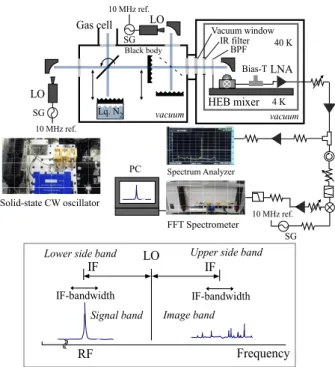
Radio-frequency (RF) signals above 0.1 THz are difficult to amplify directly with high frequency response and high sen- sitivity. Therefore, the input RF signal is first mixed with a local oscillator (LO) signal using a super-low-noise mixer detector cooled with a 4 K cryocooler, and subsequently the down-converted intermediate frequency (IF) signal is ampli- fied by cooled low-noise amplifiers for L (0.5–1.5 GHz), S (2–4 GHz), C (4–8 GHz), or X (4–12 GHz) band as shown in Fig. 2. The RF signal is led to the mixer via a low-loss vacuum window (e.g., of high-density polyethylene) and an infrared filter (e.g., Zitex 106) for suppression of thermal radiation. Additionally, for an HEB mixer a cooled band eliminator such as a mesh filter is inserted for suppression of the direct detection effect [5]–[7]. In several terahertz band, at present the most well-used LO sources are IR- pumped gas lasers and continuous-wave (CW) solid-state oscillators consisting of amplifier-multiplier chains coupled with a commercial high-quality microwave signal genera- tor (SG). At 2.7 THz the latter output power has achieved
∼3µW [8], which is sufficient to fully pump an HEB mixer.
The frequency and/or phase of the primary microwave sig- nal output from the SG is precisely locked with the highly- stabilized reference signal from a GPS or hydrogen maser atomic clock.
Finally, via adequate amplifications the IF signal is spectrally resolved with spectrometers. Recently, high- resolution, wideband digital fast Fourier transfer spectrome- ters (FFTSs) employing gigahertz analog-to-digital convert- ers and field programmable gate array chips have become commercially available. For example, the RPG extended bandwidth XFTTS has an instantaneous bandwidth of 2.5 GHz and 32768 frequency channels [9]. The Agilent Ac- qiris AC240 has a 1-GHz bandwidth and 16384 channels.
These heterodyne spectroscopy units provide us with a fre-
Fig. 2 Schematic drawings of heterodyne detection and a receiver sys- tem for heterodyne spectroscopy.
quency resolution of<100 kHz, making them powerful tools for precisely resolving the narrow spectral lines of gaseous species exited thermally at low pressure.
The observable spectral coverage of the velocities of astronomical target,∆V, is determined by the IF bandwidth of the heterodyne system as explained by∆V=c×∆B/fRF, where∆Bis the bandwidth of the spectrometer, fRF is the frequency of the RF signal, and c is the velocity of light.
Generally spectral lines come from a number of interstellar clouds with different velocity components lying along the line of sight. The typical total width of the spectral lines ob- served toward the galactic disk is less that 100 kms−1, while the line width of some kind of interstellar gaseous species in the galactic center reaches∼600 km s−1which corresponds to the instantaneous IF bandwidth of∼4 GHz, for example, for 2 THz band observations.
Largely, the RF bandwidth of THz-band HEB mixer re- ceivers is limited by impedance matching of the input radia- tion and of the quasi-optical antenna or waveguide-type feed or by the output frequency range of local sources, while the instantaneous IF bandwidth is limited by the 3-dB roll-off IF bandwidth (of several gigahertz) of the HEB mixer. For SIS mixer receivers the IF bandwidth is usually restricted by that of the spectrometer or of the low-noise cryogenic am- plifier and isolator. By using parallel-connected spectrom- eters instantaneous spectroscopic bandwidth can be practi- cally broadened.
In heterodyne detection, the system noise temperature is expressed as
TS YS = TRX×eτ+TS KY(eτ−1), (1) TRX = TRF+TMIX
GRF
+ TIF GRFGMIX
, (2)
Fig. 3 Atmospheric transmission as a function of frequency calculated with a radiative transfer model for the four different precipitable water va- por (PWV) conditions of 0.01, 0.1, 0.4, and 1 mm.
whereτis the optical depth of the sky,TS KYis the temper- ature of the atmosphere,TRX is the receiver noise temper- ature,TMIX andTIF are the equivalent noise temperatures of the mixer detector and the IF chain system, respectively, TRFandGRFare the equivalent noise temperature and trans- parency brought by the beam-correcting devices in the re- ceiver, optics, and antenna systems, andGMIX is the gain of the mixer. The equivalent noise temperature and band characteristics of the cooled amplifiers as well as those of the mixer detector play essential roles in achieving the high sensitivity and wide bandwidth of heterodyne receiver sys- tems. The receiver noise temperature is generally evaluated according to the Callen–Welton formula with hot (∼300 K) and cold (∼temperature of liquid nitrogen) blackbody radi- ation [10]. The optical depthτeven at a desert highland of 4 km in altitude is basically greater than unity above 1 THz because of atmospheric loss from the absorption by water vapor as shown in Fig. 3, which had been the main bottle- neck for ground-based THz-band observations in astronomy and earth and planetary atmospheric researches.
3. Superconducting HEB Mixer
3.1 Basic Principles
The first observation employing an InSb-semiconductor- based HEB mixer of an interstellar cloud was demonstrated in 1973 [11]. The thermal time constant of the InSb HEB mixer was∼10−7s, corresponding to an IF bandwidth of 1
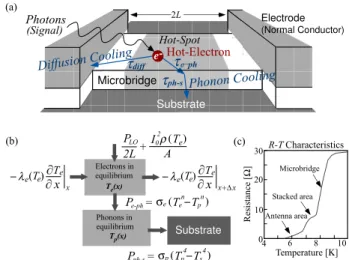
Fig. 4 Schematic drawings of the microbridge (a), the heat balance dia- gram (b), and theR–Tcharacteristics (c).
MHz. At present, superconducting HEB mixers employing thin and short-length microbridges made of low-temperature superconductors such as NbN and NbTiN hold the best prospect as heterodyne detectors in the THz frequency band.
These kinds of superconducting mixers offer a high-speed bolometric response of several gigahertz through phonon cooling between the microbridge and the substrate and/or diffusion of hot electrons from the microbridge to the nor- mal conductor electrodes [12], [13], as shown in Fig. 4.
Nearly a decade of improvements in the microbridge size, fabrication processes, and theoretical and design mod- els have led to HEB mixers with sensitivities achieving quantum-noise level (5–10hν/kB) at the several terahertz band. The upper limit of operational frequency for super- conducting HEB mixers is not determined by the energy gap, unlike SIS mixers, because the HEB mixers work as transition-edge sensors by absorbing the photon at the su- perconductor microbridge.
The heat balance equations for a small segment along the microbridge (xaxis), where the temperature distribu- tions in the directions of the width and height of the mi- crobridge are assumed to be uniform, can be expressed by
PLO
2L +I02ρ(Te) A + d
dx (
λe
dTe
dx )
= σe(Ten−Tnp), (3) σe(Ten−Tpn)=σp(T4p−Ts4), (4) where λe and D are the thermal conductance and diffu- sion coefficient of electrons, respectively,σeandσpare the electron–phonon and phonon–substrate coupling efficiency, respectively, 2L and A are the length and cross-sectional area of the microbridge, respectively, Te, Tp, and Ts are the electron, phonon, and substrate temperatures, respec- tively, andPLOis the LO power absorbed in the microbridge.
For NbNnis estimated to be∼3.6 experimentally. ρis the temperature-dependent local resistivity at thex-axis position along the microbridge.
The nonlinear resistance versus temperature (R–T) characteristics have decisive influences on the sensitivity
and gain bandwidth of the HEB mixers. The device’s overall R–T is determined by the superposition of severalR–T pat- terns of differentTc’s of the superconducting microbridge and stack layers consisting of the superconducting film and normal conductors at the contact electrode and the antenna.
The proximity between the thin superconductor film and the normal conductor and the heating effects caused by the DC and photon-induced currents reduce the transition tempera- ture and broaden the transition width of theR–T curve, re- sulting in degradation of nonlinearity of theI–Vcurve of the HEB mixer.
By numerically calculating the balance Eqs. (3) and (4) based on theR–T curve, we can derive theTedistributions along the microbridge for a bias currentI=I0, and then the I–Vcurve and the conversion gainGMIXof a pumped HEB mixer at a bias point ofV=V0can be calculated as follows [14], [15]:
GMIX = PIF
PS = 2I02RLC2RFPLO (R0+RL)2
(
1−CDCI20RL−R0
RL+R0 )2
× 1
1+(2πfIF×τMIX)2
1−
Zemb−Zbridge
Zemb+Zbridge 2
, (5) whereR0=V0/I0denotes the device resistance caused by dc bias and the time-averaged RF irradiation,RLis the IF load resistance, andPIF,PS, andPLOare the output IF, absorbed RF, and LO signal powers, respectively. The first term in- cludes the electrothermal feedback effect where the current flow induced by a part of the IF signal reflected through the IF load further heats the microbridge. The final term is the coupling efficiency between the impedance of the micro- bridge,Zbridge(∼R0), and the embedding impedance of the mixer at the feed point,Zemb.CDC andCRFare the respon- sivities ofR0with respect to the absorbed DC and RF power, respectively.
The small change in the resistance of the microbridge follows the relation ∆R = CDC∆PDC +CRF∆PRF, so that CDCandCRF are derived by
CRF = ∂R0
∂PLO
∆P
DC=0
= R0 PDC
(dV dI )
dc
−R0
(dV dI )
dc
+R0
, (6)
CDC = ∂R0
∂PDC ∆P
LO=0
= 1
χCRF. (7)
χis the power exchange function with typical values of 1.0–
3.0.τMIXis the relaxation time of the mixer, given by τMIX = τe×
(
1−CDCI02RL−R0
RL+R0 )−1
, (8)
τe =
( 1
τe−ph+(Ce/Cp)τph−s
+ 1 τdi f f
)−1
, (9)
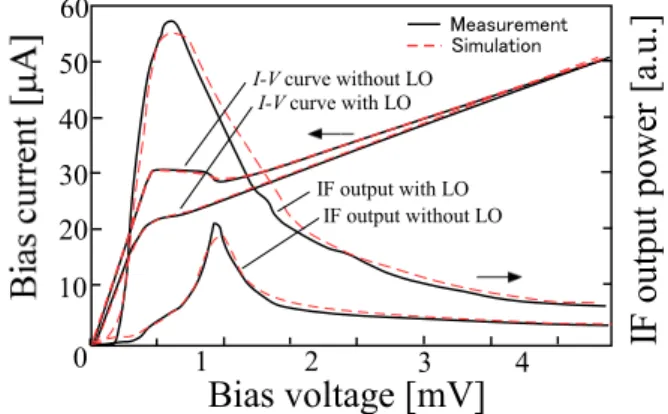
Fig. 5 Calculated and measuredI–Vcharacteristics and IF output pow- ers of an HEB mixer.
whereCeandCp are the specific heats of the electrons and phonons, respectively.τeis the relaxation time of electrons, τe−ph is the time constant for electron–phonon interaction in the superconducting microbridge, and τph−s is the time constant for the phonons to escape to the substrate. The dif- fusion time constant for hot electrons to escape to the elec- trodes on both sides of the microbridge,τdi f f, is defined by L2/π2D[16]. Examples of the calculated and measuredI–V curves and IF output powers are shown in Fig. 5.
For the DSB detection mode, the equivalent noise tem- perature of the HEB mixer,TMIX,DS B, can be calculated by using [14]
TMIX,DS B = (TJnout,DS B+TT Fnout ,DS B)/2GMIX (10)
= TJnin,DS B+TT Fnin ,DS B. (11) ToutJn,DS Bis the Johnson noise, andTinJn,DS Bis expressed by
TJnin,DS B(I0,PLO)=
∫ L
−L
ρ(Te,I0,x)Te
I02C2RFPLOAdx. (12) TT Fnout ,DS Bis the temperature fluctuation noise, andTT Fnin ,DS B is expressed by
TT Fnin ,DS B(I0,PLO) =
∫ L
−L
1 CRF2 PLO
(∂ρ(Te,I0,x)
∂Te
)2
×Te2τe
CeA3dx. (13) Note that the electron temperatureTederived by solving the heat balance equations [Eqs. (3) and (4)] is a function ofI0 andx.
The HEB mixer is operated under the resistive transi- tion state between superconducting and normal conducting states of the microbridge by optimizing the bias voltage and the LO power precisely. One of the keys to improving the sensitivity and bandwidth of an HEB mixer is the optimiza- tion ofτdi f f andτph−s. τdi f f can be improved by selecting the material of the microbridge, shortening its lengthL, in- creasing its thickness, and depositing high-quality contact electrode pads onto the microbridge throughin situfabrica- tion processes and/orτph−scan be improved by acoustically
matching the interface between the superconducting micro- bridge and the substrate with a buffer layer and by reducing the thickness of the microbridge.
The minimal length of the microbridge is restricted by the technical limitations of the electron-beam (EB) lithog- raphy and etching technologies. The thickness of the mi- crobridge cannot be extremely reduced to avoid decreasing the critical temperature (Tc) and broadening the width of the R–Ttransition as this would degrade the nonlinearI–Vchar- acteristics of the superconducting HEB mixer. However, if the microbridge is too thick, matching betweenZemband the lowZbridgebecomes difficult, degrading the phonon cooling effects. Owing to the small volume of the superconduct- ing microbridge, the LO power required for RF/LO mixing and suppression of the superconducting hysteresis current of a typical HEB mixer is about several tens of nanowatts, which is orders of magnitude lower than those required for SIS and Schottkey barrier diode (SBD) mixers. This is one of the crucial advantage of HEB mixers. The dimensions and material of the HEB mixer are empirically determined by considering these design trade-offbetween diffusion and phonon cooling effects. The most widely used supercon- ducting mircobrides are of NbN and NbTiN at present. The typical dimensions of the microbridge are 100–300 nm long, 30–100 Å thick, and∼1µm wide.
The gain bandwidth of most phonon-cooled NbN HEB mixers is limited by the escape time of nonequilibrium phonons from the superconducting microbridge to the sub- strate. The typical gain bandwidth reaches∼5 GHz by us- ing a 3.5-nm-thick NbN microbridge grown on a crystalline substrate such as MgO and highly resistive Si preheated to
∼800◦C. Recently, the Moscow State Pedagogical Univer- sity (MPSU) group improved both phonon and diffusion cooling devices by shortening the length of the NbN mi- crobridge to 0.12µm and introducing anin situprocess for better connection between the microbridge and the contact electrodes [17], [18]. They achieved a 7-GHz noise band- width and a simultaneously equivalent noise temperature (DSB) of 600 K at 2.5 THz experimentally, whereτdi f f and τph−sare estimated to be comparable to 40 ps. The Univer- sity of Tokyo group developed waveguide-type low-noise 0.8- and 1.5-THz-band HEB mixers by employing a rela- tively thick NbTiN microbridge fabricated in anin situpro- cess, for which the corrected receiver noise temperatures are 220 and 250 K with the IF 3dB-rolloffbandwidths of 1.5 and 2.5 GHz, respectively [19]. The performances of recent HEB mixers are shown in Fig. 6 with comparisons to the sensitivity of SIS mixers and semiconductor SBD mixers.
3.2 Fabrication Process
Currently, NbN and NbTiN films are the most com- monly used for the superconducting microbridges men- tioned above. The Harvard-Smithonian Center for Astro- physics and Jet Propulsion Laboratory (JPL), California Institute of Technology, group succeeded in fabricating a NbTiN microbridge on a crystalline quartz substrate pre-
Fig. 6 Equivalent noise temperatures in DSB mode of the superconduct- ing HEB, SIS, and semiconductor SBD mixers (e.g. [19]–[21]).
heated to 375◦C over a 20-nm-thick AlN buffer layer and demonstrated for the first time the scientific significance of the low-noise NbTiN HEB mixer for observation of the CO J =7 → 6 line from an astronomical source, IRC+10216, with the Submillimeter Telescope in Arizona [22]. Here we present one of ourin situfabrication processes for HEB mixers employing a NbTiN microbridge at the University of Tokyo [19], [23]–[25].
We developed a multideposition system exclusively for in situfabrication of HEB mixers. In this system, to control the thickness of the microbridge precisely, a slow deposi- tion rate of 1 Å/s is achieved under high vacuum condition by using a helicon plasma sputtering technique. The sputter- ing chamber is connected to the electron-beam evaporation chamber via a load lock chamber, which allows us to de- posit a 2-nm-thick Ti interface layer and a 100-nm-thick Au electrode layer on the sputtered NbTiN layer without break- ing the vacuum. Thisin situtechnique is essential for ob- taining a good contact at the NbTiN/Ti/Au interface as it prevents natural oxidation. The 4- to 12-nm-thick NbTiN films are deposited on a Z-cut crystalline SiO2 substrate for a waveguide-type mixer chip or on a nondoped high- resistivity floating zone Si substrate for a twin-slot-antenna- type mixer chip, in which the NbTi target is sputtered with an mixture of N2 and Ar inlet gases at room temperature.
Before this process an AlN buffer layer is sputtered on the substrate in the multideposition system as necessary [26].
The stress, resistivity, andTcof NbTiN are crucial pa- rameters for determining the properties of the HEB mixer.
The stress and resistivity depend strongly on the crystalline structures of the sputtered film, which are very sensitive to the total process pressure. To keep the pressure constant, the inlet mass flow velocity of N2and Ar gas, the exhaust velocity from a molecular turbo evacuation system, and the discharge current are precisely tuned according to a process simulation [27]. In this simulation model fine changes of the sputtering condition caused by the erosion of the NbTi tar- get are also considered. The dimensions of the microbridge
Fig. 7 SEM photograph of the quasi-optical twin-slot antenna and the microbridge part of an HEB mixer (left), an optical micrograph of an HEB mixer chip mounted in a chip channel (center), and an HFSS simulation at the waveguide-to-microstrip transition structure of the HEB mixer (right).
are defined by using EB lithography and subsequently by dry-etching of the Au layer on the NbTiN/Ti layer with an inductively coupling plasma (ICP) system. The Ti layer works as an etching stopper. In this procedure, the spa- tial resolution of the EB lithography and the accuracy of the etching rate and the redeposition of the etched byprod- ucts on the sidewall of the Au electrodes in the ICP etch- ing processes determine the effective length of the micro- bridge of the HEB mixer. For twin-slot-antenna-type mix- ers, coplanar-type choke filters and slot antenna patterns are defined by photolithography as shown in Fig. 7 and then a low-loss normal conductor at the THz band (e.g., Au or Al) is deposited. After the subsequent lift-offprocess, for waveguide-type mixers, the back side of the substrate is pol- ished, and then the substrate is chipped with a dicing ma- chine.
Finally, the chips are mounted on a mixer block and the IF port on the chip is linked via bonding wires to an IF mi- crostrip line on a Duroid substrate integrated into a mixer block as shown in Fig. 7. The quasi-optical mixer chip is attached to the bottom surface of a hyper- or extended- hemisphere lens made of nondoped high-resistivity Si with an antireflection (AR) coating. The waveguide probe that couples the input signal can be designed with the aid of 3D EM field simulator such as HFSS(TM) as shown in Fig. 7.
The probe feed is optimized so that it matches the micro- bridge impedance. For example, twin-slot antenna type mix- ers can be redesigned with a boundary element method and method of moments numerical technologies on the basis of the conventional model [28], [29]. The frequency responses and co- to cross-polarization of the HEB mixers are checked by using an FTS system.
3.3 Mixer Mount Design
The beam pattern of a mixer detector, including its beam size, the side-lobe level, and the polarization, is one of the essential factors for astronomical observations. In the millimeter to submillimeter wave band, corrugated horn antennas are widely utilized because of their well-defined beam pattern. Above 1 THz, the usual diagonal horns are often adopted because of their ease of fabrication.
Above the 2-THz band, for which micromachining of the
waveguide structures becomes very difficult, quasi-optical log-spiral and double-slot planar antennas on hyper- and extended- hemispherical lenses are comparatively well used.
In waveguide-type HEB mixers, the electromagnetic field of the fundamental TE10waveguide mode is coupled to the mi- crobridge at the feed point of the waveguide-to-microstrip transition area, and the dimension of the substrate of the HEB mixer chip and the chip channel slot are designed so as to suppress RF leakage through surface wave modes in the substrate. For the design of optical components, vari- ous commercial simulators such as GRASP are widely uti- lized [30].
The University of Cologne has developed a high- sensitive 2.5-THz-band NbTiN HEB mixer integrated onto a conventional waveguide block machined for the German REceiver for Astronomy at Terahertz frequencies (GREAT) on the Stratospheric Observatory For Infrared Astronomy (SOFIA) [31]. To obtain the good lattice matching at the interface between the microbridge and substrate, the NbTiN microbridge is fabricated onto a 2-µm-thick low-stress sili- con nitrite (SiN) membrane deposited on a 500-µm-thick sil- icon wafer for easier processing. Finally, this silicon wafer is back-etched. The DSB equivalent receiver noise temper- atures for 1.9- and 2.53-THz bands achieved∼1500 K.
To produce waveguide circuits with fine accuracy and high reproducibility, JPL of NASA tackled the novel de- velopment of a 2.7-THz waveguide-based NbN HEB mixer [32]. They deposited a thin MgO buffer layer onto silicon on an insulator wafer (SOI) consisting of a 2.5-µm high- resistive Si layer/2-µm oxide layer/400-µm handling wafer.
The NbN film is sputtered onto the MgO layer. The channel slot structure for the mixer chip with 22µm width and 3µm thickness is perpendicular to a half-height waveguide transi- tion (of dimensions of 78×19µm) to a metal Pickett Potter horn manufactured commercially by electroforming. The slot channel is composed of the stack of three gold layers of 5, 4, and 5µm thickness, which are fabricated by means of deep UV photolithography with the thick GKR4400 resist and a microplating technique. The noise temperature of this waveguide NbN mixer achieved 965 K at 2.74 THz.
The group of advanced receiver development of Chalmers University of Technology developed a balance waveguide HEB mixer for the 1.25–1.39 THz band [33].
The mixer mount block consists of two NbN HEB mixer chips and a waveguide 3-dB 90◦ RF hybrid fabricated by using an advanced photolithographic microfabrication tech- nology of thick SU-8 photoresist combined with copper electroplating. This process gives fabrication reproducibil- ity with an accuracy of better than 2µm and a surface ac- curacy of the waveguide wall of <100 nm rms. The mixer is cooled to 4 K with an assembly bracket in the closed- cycle cryocooler of the Swedish heterodyne Facility Instru- ment (SHeFI). The receiver noise temperature and spectro- scopic Allan time achieved were <1200 K and >200 s, re- spectively. In 2008, they succeeded in observing the CO J =11 → 10 line toward the AGB star CW Leo with this SHeFI receiver installed in the Atacama Pathfinder Exper-
iment (APEX) telescope located at Liano de Chajnantor in Northern Chile (at an altitude of 5105 m). They also de- veloped a balance waveguide HEB mixer for the 1.6–2.0 THz band [34]. The mixer block is composed of corrugated horns for RF and LO signals, a waveguide 3-dB 90◦RF hy- brid with a minimum slot dimension of 21µm, two HEB mixers employing NbN microbridges grown on a preheated (700◦C) 14×14 mm2 double-bonded SOI substrate, and a 3-dB 90◦IF hybrid circuit. The novel mixer chip supported by the SOI frame facilitates handling of the chip and electri- cal access. Such a technical approach may break ground for multipixel waveguide receivers in the several THz band.
3.4 Operations with 4 K Refrigerators
NbN and NbTiN HEB mixers are usually cooled with a com- mercially available 4 K cryocooler (e.g., an infrared dewar cooled with liquid helium or a mechanical closed-cycle 4 K cryocooler). Mechanical closed-cycle Gifford MacMahorn (GM) and pulse-tube (PT) 4 K cryocoolers are very useful for long-term field observations with superconducting de- tectors. However, temperature fluctuations of the PT cryo- stat and mechanical vibrations of the GM cryostat induce periodic changes in the gain of the HEB mixer, which de- grades the Allan variance time of the receiver system. For example, the PT 4 K cryocooler (SPR-062B) from Sumit- omo Heavy Industries, Ltd., has a cooling capacity of 0.5 W and an amplitude of mechanical vibration of<3 µm. The peak-to-peak temperature fluctuation of the PT cryostat in- duced by the inner He gas circulation is 320 mK, which is greater than that of the GM 4 K cryocooler. This temper- ature fluctuation is not negligible compared to the width of the transition temperature between the superconducting state and normal conducting state of the microbridge of the HEB mixer. Inserting buffer materials with very high heat capacity at low temperature between the HEB mixer and cold head of the cryocooler can reduce the temperature vi- brations [25]. Another interesting method is to stabilize the bias current of the HEB mixer directly by injecting mi- crowave radiation from the IF port [35].
4. Observations with HEB Mixers
In 1998, the Harvard-Smithsonian Center for Astrophysics group succeeded in observing a spectral line of the J = 7 → 6 transition of CO at 806.651 GHz toward the Orion Kleinmann–Low (Orion-KL) nebula with massive star-forming regions using a waveguide-type NbN HEB mixer detector with the 10-m Heinrich Herz Telescope (HHT) on Mt. Graham, Arizona [36]. In addition, the same group observed aJ=11→10 transition line at 1.267 THz toward M17 and aJ=13→12 transition line at 1.497 THz of 12CO toward Orion-KL nebula with the 0.8-m receiver lab telescope located at an elevation of 5525 m in Chile in 2004 [37] and successfully obtained a two-dimensional im- age of12COJ =9→ 8 (1.037 THz) toward the Orion-KL nebula with a spatial resolution of 84′′in 2006 [38]. In these
observations the mixers were cooled to 4.2 K with a liquid- helium-cooled dewar.
The Herschel-Heterodyne Instrument for the Far- Infrared (HIFI) is the receiver system onboard the Herschel Space Observatory launched in 2009; it employs 1.4–1.7 and 1.7–1.9 THz band NbN HEB mixers [39], [40]. The HIFI spectral surveys presented the widest spectral coverage ever observed in these frequency ranges, covering the tran- sition lines of SO, H2S, HCN, H2O, CH3OH, and so on to- ward the Orion-KL nebula [41]. The HIFI GOT C+Galactic plane [CII] spectral survey revealed the bright emission of [CII] at 1900.5469 GHz in the Scutum-Crux spiral arm tan- gencies as shock compression of the warm ionized medium induced by spiral density waves [42].
SOFIA is an airborne observatory that comprises a modified Boeing 747SP with a 2.7-m telescope. SOFIA employs a photometer, near-, mid-, and far-infrared cam- eras, infrared spectrometers, and the GREAT heterodyne spectrometer, covering wavelengths from 0.3µm to 1.6 mm [43], [44]. GREAT uses waveguide HEB mixer detectors cooled at 4 K with cryogenic amplifiers in a liquid-helium- cooled cryostat, giving a hold time of>15 h [45]. The LO source system consists of solid-state cascading multiplier chains from Virginia Diodes, Inc. Utilized as backends are an acousto-optical spectrometer covering two 4-GHz-wide bands, a chirp transform spectrometer with 220-MHz band- width and 56-kHz resolution [46], and a XFFTS.
In 2011, observations of many interstellar gaseous species such as carbon monoxide (CO), mercapto radicals (SH), hydroxyl radicals (OH), deuterated hydroxyl radicals (OD), ammonia (NH3), ionized carbon [CII], and so on were made toward various astronomical targets with the SOFIA GREAT instrument. The OH radical plays a crucial role in the chemical balance in the interstellar medium (ISM) and planetary atmospheres. For understanding the chemi- cal reaction network of the ISM, observations at 2.514 THz for 2Π3/2J = 5/2 ← 3/2 and 1.837 THz for 2Π3/2J = 3/2 ← 1/2 transition lines of OH hyperfine structure and 2.494 THz for 2Π3/2J = 5/2 ← 3/2 transitions lines of
18OH were performed toward the diffuse clouds W49N, W51, and G34.26+015 in the Carina-Sagittarius spiral arm [47]. The 32+ → 22− transition lines at 1810.379971 GHz of NH3, which is comparatively free from freezing out onto dust grains in the initial cold phase of molecu- lar cloud cores, was observed toward the high-mass-star- forming clumps as a tracer of dynamical infall motion in the early stage of star formation [48]. To understand the formation mechanism of water in the interstellar medium, the 2Π3/2J = 5/2 → 3/2, l = −1 → +1 multiplet line of OD was observed at the 1.3915-THz band toward a low- mass protostar. The inferred high OD/HDO ratio, which is higher than predicted by standard chemical models includ- ing gas-phase and dust chemistries, implies that exothermic OH+D exchange promotes the fractionation of OH relative to water in the gas phase via dissociative recombination re- processing of H2DO+ [49]. The existing form of sulfur is considered to be extremely varied through complex chemi-
cal reactions in the gas phase and on the dust grain surface in the ISM. Thus an accurate abundance value for sulfur in the ISM is a missing piece of the puzzle. To understand the abundance of sulfur-bearing hydrides in the ISM, the
2Π3/2J = 5/2 ← 3/2 lambda doublet of SH was observed at the 1.383-THz band along the line of sight toward the submillimeter continuum source W49N with the GREAT in- strument. The derived SH/H2S abundance ratio was lower than the value predicted by standard models including the effects of the photodissociation region, turbulent dissipation region, or continuous- or jump-type shocks, which may sug- gest enhancement of the endothermic neutral-neutral reac- tion SH+H2→H2S+H in the ISM [50]. [CII] lines were observed also toward planetary nebula such as the Ring Neb- ula in Lyra (NGC6720), suggesting that the [CII] is a better tracer of circumstellar material and other evolved planetary nebulae than CO because the bulk of the element carbon is divided roughly equally between [CII] and [CI] [51].
The CO N+Deuterium Observations Receiver (CON- DOR) with a waveguide NbTiN HEB mixer was installed on the 10-m APEX telescope. CONDOR employs a closed- cycle PT cryocooler and solid-state LO sources manufac- tured by Radiometer Physics GmbH and Virginia Diode, Inc. With CONDOR, observations of high-JCO lines, the transition line of [NII], and the ground transition of para- H2D+, which are good tracers of hot dense gas, ionized diffuse gas, and cold dense gas, respectively, were demon- strated toward Orion FIR4 in 2006 [52]. The University of Tokyo group started astronomical observation by installing their own 0.9- and 1.3-THz-band waveguide-type NbTiN HEB mixers onto the 10-m Atacama Submillimeter Tele- scope Experiment (ASTE) located at Pampa La Bola in northern Chile (at an altitude of 4860 m) in 2011 [19].
The Terahertz and submillimeter Limb Sounder (TELIS), being developed by the Space Research Organiza- tion of the Netherlands, the Rutherford Appleton Aerospace Center in the United Kingdom, and the German Aerospace Center, is preparing 0.5-, 0.6-, and 1.8-THz-band hetero- dyne receivers including NbN HEB mixer coolers with an IRlabs HDL-5 dewar [53]. Observation during the flight du- ration of about 24 h will provide important information on the diurnal variation of key atmospheric short-lived radicals such as OH, HO2, ClO, and BrO together with stable con- stituents such as O3, HCl, and HOCl.
5. Outlook
In this decade and beyond, further development of highly sensitive superconducting HEB mixers will drive THz-band astronomy and its widespread application. Future chal- lenges for HEB mixers include improving the sensitivity and bandwidth by optimizing the size of the microbridge, along with refining the fabrication yield, simplifying the handling of the mixer chips and mounts and of the align- ment of the optical components, and stabilizing the HEB mixer receivers.
We are currently developing a waveguide-type HEB
mixer employing a diagonal horn for the 1.8–2.0 THz band, where the dimensions of a NbTiN microbridge fabricated by ourin situtechnique are optimized on the basis of the model mentioned in Section 3.1. The observational targets for this frequency band are OH radicals, which are the central pro- oxidant in the chemical reaction network in the earth’s atmo- sphere and planetary atmospheres; lines from [OI] and [C II], which are the basic coolants of the interstellar medium;
and other complex and high-Jmolecules. The designed chip width and thickness of the mixer are 44µm and 19µm, re- spectively. The establishment of such microfabrication pro- cesses will also support the mass production of the THz- band heterodyne receivers studied in the ALMA project col- lectively referred to as Band 11. The observational targets of Band 11, which covers 1.0–1.6 THz, are [CII] lines from in- termediate redshift galaxies (0.3<z<1); [NII] lines; deuter- ated nitrogen-bearing molecules such as N2D+and NH2D, which are good tracers of dense core regions; high-J lines emitted from UV and shock-heated gases in star-forming re- gions; para-H2D (1370 GHz) and ortho-D2H+(1476 GHz);
and so on. The ortho/para ratio of H2D+provides us with crucial information about the physical conditions of dense clouds where deuterium fractionation and the ortho/para ra- tio of H2molecules proceed through the exothermic proton- deuteron exchange reaction H++HD→H2D++H2.
In DSB heterodyne detection, spectral lines in the im- age band often interfere with spectral lines in the signal band of interest. In addition, the noise performance of DSB receivers is often degraded by the atmospheric equivalent noise from the image band. To overcome these problems, sideband separation (2SB) and balanced waveguide mixers are also worth considering in the THz band by following up on the surface roughness of the waveguide wall and fabri- cation processing of mount block components. These un- relenting approaches will enable developments of multip- ixel receiver systems, as are being planned for upGREAT instruments including 2×7 pixels for 1.9–2.5 THz and 1×7 pixels for 4.7 THz [45] covering the fine structure line of atomic oxygen [OI], which will allow for highly efficient two-dimensional imaging observations.
For THz-band imaging based on heterodyne spec- troscopy in astronomy, the quantum cascade laser (QCL) is one of the most promising compact, high-power CW LO sources (e.g. [54], [55]). Recently, 1–5 THz band submilliwatt-class CW emissions have been demonstrated using metal–metal (MM) and semi-insulation-surface–
plasmon (SI-SP) waveguide type QCLs based on chirped su- perlattice (CSL), bound-to-continuum (BTC), and resonant phonon (RP) active regions [55]–[58]. A phase-locking sys- tem with an HEB mixer can be a useful tool for precisely stabilizing the frequency of emission of the QCLs [59]–
[62]. Recently, spectroscopic observations of methanol (CH3OH) have been successfully demonstrated with NbN HEB mixer receivers at 2.918, 3.5, and 4.7 THz by using a single-mode third-order distributed feedback (DFB) grat- ing and MM waveguide type RP-QCLs, in which pressure- broadened Lorenzian line profiles were reproducibly re-
solved with an FFTS with a bandwidth of 1.5 GHz and 8192 frequency channels developed by MPIfR in Bonn [63]–[65].
The DFB QCL has a low divergent field beam that couples efficiently with the beam of the HEB mixer detector [66].
These combined heterodyne receiver systems with super- conducting HEB mixers and QCLs will open up laboratory spectroscopies of molecular, atomic, and plasma gaseous species as well as THz-band astronomy with multipixel het- erodyne receivers and remote sensing of earth’s atmosphere and other planetary atmospheres.
The strengthening of the strategic aircraft- and satellite- based observatories also plays a key part in further devel- opment of highly efficient THz-band spectroscopic sensing.
Such flight missions require tough sensors that are resis- tant to the harsh operating conditions, where the sensors are exposed to repeated cooling/heating cycles in prior re- liability verification tests. The heavy-duty superconducting HEB mixer employing a thick NbTiN microbridge is one of the most promising THz-band heterodyne sensors for use in such field missions.
References
[1] C. L. Bennett, D. J. Fixsen, G. Hinshaw, J. C. Mather, S. H. Moseley, E. L. Wright, R. E. Eplee, Jr., J. Gales, T. Hewagama, R. B. Isaac- man, R. A. Shafer, and K. Turpie, “Morphology of the interstel- lar cooling lines detected by COBE,” Astrophys. J., vol.434, no.2, pp.587–598, Oct. 1994.
[2] D. J. Hollenbach and A. G. G. M. Tielens, “Dense photodissocia- tion regions (PDRs),” Annu. Rev. Astron. Astrophys., vol.35, no.1, pp.179–215, Sept. 1997.
[3] D. C. Mattis and J. Bardeen, “Theory of the anomalous skin effect in normal and superconducting metals,” Phys. Rev., vol.111, no.2, pp.412–417, July 1958.
[4] Y. Uzawa, M. Kroug, T. Kojima, M. Takeda, M. Candotti, Y. Fujii, K. Kaneko, W. Shan, T. Noguchi, and Z. Wang, “A sensitive ALMA Band 10 SIS receiver engineering model,” Supercond. Sci. Technol., vol.22, no.11, pp.114002, Nov. 2009.
[5] J. J. A. Baselmans, A. Baryshev, S. F. Reker, M. Hajenius, J. R. Gao, T. M. Klapwijk, B. Voronov, and G. Gol’tsman, “Influence of the di- rect response on the heterodyne sensitivity of hot electron bolometer mixers,” J. Appl. Phys., vol.100, no.8, pp.084510, Oct. 2006.
[6] J. J. A. Baselmans, A. Baryshev, S. F. Reker, M. Hajenius, J. R.
Gao, T. M. Klapwijk, Y. Vachtomin, S. Maslennikov, S. Antipov, B.
Voronov, and G. Gol’tsman, “Direct detection effect in small volume hot electron bolometer mixers,” Appl. Phys. Lett., vol.86, no.16, pp.163503, Apr. 2005.
[7] M. Hajenius, J. J. A. Baselmans, A. Baryshev, J. R. Gao, T. M. Klap- wijk, J. W. Kooi, W. Jellema, and Z. Q. Yang, “Full characterization and analysis of a terahertz heterodyne receiver based on a NbN hot electron bolometer,” J. Appl. Phys., vol.100, no.7, pp.074507, Oct.
2006.
[8] T. W. Crowe, J. L. Hesler, S. A. Retzloff, C. Pouzou, and G. S.
Schoenthal, “Solid-state LO sources for greater than 2THz,” 22nd Int. Symp. Space Terahertz Technol., pp.209–212, 2011.
[9] B. Klein, S. Hochgürtel, I. Krämer, A. Bell, K. Meyer, and R.
Güsten, “High-resolution wide-band fast Fourier transform spec- trometers,” Astron. Astrophys., vol.542, pp.L3, June 2012.
[10] A. K. Kerr, “Suggestions for revised definitions of noise quanti- ties, including quantum effects,” IEEE Trans. Microw. Theory Tech., vol.47, no.3, pp.325–329, Mar. 1999.
[11] T. G. Phillips and K. B. Jefferts, “A low temperature bolometer het- erodyne receiver for millimeter wave astronomy,” Rev. Sci. Instrum.,
vol.44, no.8, pp.1009–1014, Aug. 1973.
[12] E. M. Gershenzon, G. N. Gol’tsman. I. G. Gogidze. Y. P. Gusev.
A. I. Elant’ev. B. S. Karasik, and A. D. Semenov, “Millimeter and submillimeter range mixer based on electronic heating of supercon- ducting films in the resistive state,” Sov. Phys. Superconductivity, vol.3, pp.1582–1597, Oct. 1990.
[13] D. E. Prober, “Superconducting terahertz mixer using a transition- edge microbolometer,” Appl. Phys. Lett., vol.62, no.17, pp.2119–
2121, Apr. 1993.
[14] P. Khosropanah, H. Merkel, S. Yngvesson, A. Adam, S. Chered- nichenko, and E. Kollberg, “A distributed device model for phonon- cooled HEB mixers predicting IV characteristics, gain, noise and IF bandwidth,” 11th Int. Symp. Space Terahertz Technol., pp.465–479, 2000.
[15] H. Merkel, P. Khosropanah, D. Wilms-Floet, P. Yagoubov, and E.
Kollberg, “Conversion gain and fluctuation noise of phonon-cooled HEB in hot spot regime,” IEEE Trans. Terahertz Sci. Technol., vol.48, no.4, pp.690–699, Apr. 2000.
[16] P. J. Burke, R. J. Schoelkopf, D. E. Prober, A. Skalare, B. S. Karasik, M. C. Gaidis, W. R. McGrath, B. Bumble, and H. G. LeDuc, “Mix- ing and noise in diffusion and phonon cooled superconducting hot- electron bolometers,” J. Appl. Phys., vol.85, no.3, pp.1644–1653, Feb. 1999.
[17] S. Ryabchun, M. Finkel, I. Tretyakov, A. Maslennikova, N. Kaurova, B. Voronov, and G. Gol’tsman, “Next generation of hot-electron bolometer mixers for future heterodyne missions,” 22st Int. Symp.
Space Terahertz Technol., pp.187, 2011.
[18] I. V. Tretyakov, M. I. Finkel, S. A. Ryabchun, A. I. Kardakova, S. V. Seliverstov, D. V. Petrenko, and G. N. Goltsman, “Hot-electron bolometer mixers with in situ contacts,” Radiophys Quantum El., vol.56, no.8–9, pp.591–598, Jan. 2014.
[19] T. Shiino, R. Furuya, T. Soma, T. Sakai, Y. Watanabe, N. Sakai, L. Jiang, O. Ohguchi, H. Maezawa, T. Yamakura, Y. Irimajiri, and S. Yamamoto, “The 0.9 and 1.3 THz superconducting HEB mixer receiver for the ASTE 10 m telescope,” 23rd Int. Symp. Space Tera- hertz Technol., pp.76, 2012.
[20] H.-W. Huber, IEEE J. Sel. Top. Quantum Electron., vol.14, no.2, pp.378–391, Mar.–Apr. 2008.
[21] R. G. Ladret, A. F. Degardin, and A. J. Kreisler, “Nanopatterning and hot spot modeling of YBCO ultrathin film constrictions for THz mixers,” IEEE Trans. Appl. Supercond., vol.23, no.3, pp.2300305, June 2013.
[22] C. E. Tong, J. Stern, K. Megerian, H. LeDuc, T. K. Sridharan, H.
Gibson, and R. Blundell, “A low-noise NbTiN hot electron bolome- ter mixer,” 12th Int. Symp. Space Terahertz Technol., pp.253–261, 2001.
[23] L. Jiang, S. Shiba, K. Shimbo, N. Sakai, T. Yamakura, M. Sug- imura, P. G. Ananthasubramanian, H. Maezawa, Y. Irimajiri, and S. Yamamoto, “Development of THz waveguide NbTiN HEB mix- ers,” IEEE Trans. Appl. Supercond., vol.19, no.3, pp.301–304, June 2009.
[24] L. Jiang, S. Shiba, T. Shiino, K. Shimbo, N. Sakai, T. Yamakura, Y. Irimajiri, P. G. Ananthasubramanian, H. Maezawa, and S. Ya- mamoto, “Development of 1.5 THz waveguide NbTiN supercon- ducting hot electron bolometer mixers,” Supercon. Sci. Technol., vol.23, no.4, pp.045025, Apr. 2010.
[25] H. Maezawa, T. Yamakura, T. Shiino, S. Yamamoto, S. Shiba, N.
Sakai, Y. Irimajiri, L. Jiang, N. Nakai, M. Seta, A. Mizuno, T. Na- gahama, and Y. Fukui, “Stability of a quasi-optical superconducting NbTiN hot-electron bolometer mixer at 1.5 THz frequency band,”
IEEE Trans. Appl. Supercond., vol.21, no.3, pp.640–644, June 2011.
[26] T. Shiino, S. Shiba, N. Sakai, T. Yamakura, L. Jiang, Y. Uzawa, H.
Maezawa, and S. Yamamoto, “Improvement of the critical temper- ature of superconducting NbTiN and NbN thin films using the AlN buffer layer,” Supercon. Sci. Technol., vol.23, no.4, pp.045004, Apr.
2010.
[27] H. Maezawa, T. Sato, and T. Noguchi, “Process simulation of reac-
tive DC magnetron sputtering for thin film deposition of niobium- titanium nitride,” IEEE Trans. Appl. Supercond., vol.15, no.2, pp.3520–3523, June 2005.
[28] J. Zmuidzinas and H. G. LeDuc, “Quasi-optical slot antenna SIS mixers,” IEEE Trans. Microw. Theory Tech., vol.40, no.9, pp.1797–
1804, Sept. 1992.
[29] P. Focardi, W. R. McGrath, and A. Neto, “Design guidelines for terahertz mixers and detectors,” IEEE Trans. Microw. Theory Tech., vol.53, no.5, pp.1653–1661, May 2005.
[30] http://www.ticra.com/products/software/grasp
[31] P. Pütz, C. E. Honingh, K. Jacobs, M. Justen, M. Schultz, and J.
Stutzki, “Terahertz hot electron bolometer waveguide mixers for GREAT,” Astron. Astrophys., vol.542, pp.L2, June 2012.
[32] F. M. Boussaha, J. H. Kawamura, J. A. Stern, A. Skalare, and V.
White, “A low noise 2.7 THz waveguide-based superconducting mixer,” IEEE Trans. Terahertz Sci. Technol., vol.2, no.3, pp.284–
289, May 2012.
[33] D. Meledin, A. Pavolotsky, V. Desmaris, I. Lapkin, C. Risacher, V.
Perez, D. Henke, O. Nystrom, E. Sundin, D. Dochev, M. Pantaleev, M. Fredrixon, M. Strandberg, B. Voronov, G. Goltsman, and V. Be- litsky, “A 1.3-THz balanced waveguide HEB mixer for the APEX telescope,” IEEE Trans. Microw. Theory Tech., vol.57, no.1, pp.89–
98, Dec. 2009.
[34] D. Dochev, V. Desmaris, D. Meledin, A. Pavolotsky, V. Belitsky,
“A technology demonstrator for 1.6–2.0 THz waveguide HEB re- ceiver with a novel mixer layout,” J. Infrared., Milli. Terahz. Waves., vol.32, pp.451–465, Apr. 2011.
[35] A. Shurakov, C. E. Tong, R. Blundell, N. Kaurova, B. Voronov, and G. Gol’tsman, “Microwave stabilization of a HEB mixer in a pulse-tube cryocooler,” IEEE Trans. Appl. Supercond., vol.23, no.3, pp.1501504, Jan. 2013.
[36] J. Kawamura, T. R. Hunter, C.-Y. E. Tong, R. Blundell, D. C. Papa, F.
Patt, W. Peters, T. L. Wilson, C. Henkel, G. Gol’tsman, and E. Ger- shenzon, “Ground-based terahertz CO spectroscopy towards Orion,”
Astron. Astrophys., vol.394, no.1, pp.271–274, Oct. 2002.
[37] D. P. Marrone, R. Blundell, E. Tong, S. N. Paine, D. Loudkov, and J. H. Kawamura, “Observations in the 1.3 and 1.5 THz atmospheric windows with the receiver lab telescope,” 16th Int, Symp. Space Terahertz Technol., pp.64–67, 2005.
[38] D. P. Marrone, J. Battat, F. Bensch, R. Blundell, M. Diaz, H. Gibson, T. Hunter, D. Meledin, S. Paine, D. C. Papa, S. Radford, M. Smith, and E. Tong, “A Map of OMC-1 in COJ=9→8, ” Astrophys. J., vol.612, no.2, pp.940–945, Sept. 2004.
[39] Th. de Graauw, et al. “TheHerschel-Heterodyne Instrument for the Far-Infrared (HIFI),” Astron. Astrophys., vol.518, pp.L6, July–Aug.
2010.
[40] G. L. Pilbratt, J. R. Riedinger, T. Passvogel, G. Crone, D. Doyle, U.
Gageur, A. M. Heras, C. Jewell, L. Metcalfe, S. Ott, and M. Schmidt,
“Herschelspace observatory,” Astron. Astrophys., vol.518, pp.L1, July–Aug. 2010.
[41] N. R. Crockett, E. A. Bergin, J. L. Neill, C. Favre, P. Schilke, D. C.
Lis, T. A. Bell, G. Blake, J. Cernicharo, M. Emprechtinger, G. B.
Esplugues, H. Gupta, M. Kleshcheva, S. Lord, N. Marcelino, B. A.
McGuire, J. Pearson, T. G. Phillips, R. Plume, F. van der Tak, B.
Tercero, and S. Yu, “Herschelobservations of extraordinary sources:
Analysis of the HIFI 1.2 THz wide spectral survey toward Orion KL. I. methods, ” Astrophys. J., vol.787, no.2, pp.112, June 2014.
[42] T. Velusamy, W. D. Langer, J. L. Pineda, and P. F. Goldsmith, “[C II]
158µm line detection of the warm ionized medium in the Scutum- Crux spiral arm tangency,” Astron. Astrophys., vol.541, pp.L10, May 2012.
[43] P. Temi, P. M. Marcum, E. Young, J. D. Adams, S. Adams, B.- G. Andersson, E. E. Becklin, A. Boogert, R. Brewster, E. Burgh, B. R. Cobleigh, S. Culp, J. De Buizer, E. W. Dunham, C. Engfer, G. Ediss, M. Füjieh, R. Grashuis, M. Gross, E. Harmon, A. Hel- ton, D. Hoffman, J. Homan, M. Hutwohl, H. Jakob, S. C. Jensen, C. Kaminski, D. Kozarsky, A. Krabbe, R. Klein, Y. Lammen, U.
Lampater, W. B. Latter, J. Le, N. McKown, R. Melchiorri, A. W.
Meyer, J. Miles, W. E. Miller, S. Miller, E. Moore, D. J. Nickison, K. Opshaug, E. Pfüeller, J. Radomski, J. Rasmussen, W. Reach, A.
Reinacher, T. L. Roellig, G. Sandell, R. Sankrit, M. L. Savage, S.
Shenoy, J. E. Schonfeld, R. Y. Shuping, E. C. Smith, E. Talebi, S.
Teufel, T. C. Tseng, W. D. Vacca, J. Vaillancourt, J. E. Van Cleve, M. Wiedemann, J. Wolf, E. Zavala, O. Zeile, P. T. Zell, and H. Zin- necker, “The SOFIA observatory at the start of routine science oper- ations: Mission capabilities and performance,” Astrophys. J. Suppl., vol.212, no.2, pp.24, June 2014.
[44] H. Zinnecker, “SOFIA: First science highlights and future science potential,” Astron. Nachr., vol.334, no.6, pp.558–575, July 2013.
[45] S. Heyminck, U. U. Graf, R. Güsten, J. Stutzki, H. W. Hübers, and P. Hartogh, “GREAT: The SOFIA high-frequency heterodyne instru- ment,” Astron. Astrophys., vol.542, pp.L1, June 2012.
[46] G. Villanueva and P. Hartogh, “The high resolution chirp transform spectrometer for the Sofia-great instrument,” Exp. Astron., vol.18, no.1–3, pp.77–91, Dec. 2004.
[47] H. Wiesemeyer, R. Güsten, S. Heyminck, K. Jacobs, K. M. Menten, D. A. Neufeld, M. A. Requena-Torres, and J. Stutzki, “High- resolution absorption spectroscopy of the OH2Π3/2 ground state line,” Astron. Astrophys., vol.542, pp.L7, June 2012.
[48] F. Wyrowski, R. Güsten, K. M. Menten, H. Wiesemeyer, and B.
Klein, “Terahertz ammonia absorption as a probe of infall in high- mass star forming clumps,” Astron. Astrophys., vol.542, pp.L15, June 2012.
[49] B. Parise, F. Du, F.-C. Liu, A. Belloche, H. Wiesemeyer, R. Güsten, K. M. Menten, H.-W. Hübers, and B. Klein, “Detection of OD to- wards the low-mass protostar IRAS 16293–2422,” Astron. Astro- phys., vol.542, pp.L5, June 2012.
[50] D. A. Neufeld, E. Falgarone, M. Gerin, B. Godard, E. Herbst, G.
Pineau des Forêts, A. I. Vasyunin, R. Güsten, H. Wiesemeyer, and O.
Ricken, “Discovery of interstellar mercapto radicals (SH) with the GREAT instrument on SOFIA,” Astron. Astrophys., vol.542, pp.L6, June 2012.
[51] R. Sahai, M. R. Morris, M. W. Werner, R. Gusten, H. Wiesemeyer, and G. Sandell, “Probing the mass and structure of the Ring Nebula in Lyra with SOFIA/GREAT observations of the [CII] 158 micron line,” Astron. Astrophys., vol.542, pp.L20, 2012.
[52] M. C. Wiedner, G. Wieching, F. Bielau, K. Rettenbacher, N. H.
Volgenau, M. Emprechtinger, U. U. Graf, C. E. Honingh, K. Ja- cobs, B. Vowinkel, K. M. Menten, L.-Å. Nyman, R. Güsten, S.
Philipp, D. Rabanus, J. Stutzki, and F. Wyrowski, “First observations with CONDOR, a 1.5 THz heterodyne receiver,” Astron. Astrophys., vol.454, no.2, pp.L33–L36, Aug. 2006.
[53] A. D. Semenov, H. Richter, H.-W. Hübers, P. Khosropanah, M. Ha- jenius, J.-R. Gao, and T. M. Klapwijk, “Development of a 1.8-THz hot-electron-bolometer mixer for TELIS,” 19th Int. Symp. Space Terahertz Technol., pp.417–420, 2008.
[54] H.-W. Hübers, R. Eichholz, S. G. Pavlov, and H. Richter, “High resolution terahertz spectroscopy with quantum cascade lasers,” J.
Infrared, Millimeter, Terahertz Waves, vol.34, no.5–6, pp.325–341, June 2013.
[55] B. S. Williams, “Terahertz quantum-cascade lasers,” Nat. Photonics, vol.1, no.9, pp.517–525, Sept. 2007.
[56] S. Kumar, B. S. Williams, S. Kohen, Q. Hu, and J. L. Reno,
“Continuous-wave operation of terahertz quantum-cascade lasers above liquid-nitrogen temperature,” Appl. Phys. Lett., vol.84, no.14, pp.2494–2496, Apr. 2004.
[57] J. R. Gao, J. N. Hovenier, Z. Q. Yang, J. J. A. Baselmans, A. Bary- shev, M. Hajenius, T. M. Klapwijk, A. J. L. Adam, T. O. Klaassen, B. S. Williams, S. Kumar, Q. Hu, and J. L. Reno, “Terahertz hetero- dyne receiver based on a quantum cascade laser and a superconduct- ing bolometer,” Appl. Phys. Lett., vol.86, no.24, pp.244104, June 2005.
[58] S. Shiba, Y. Irimajiri, T. Yamakura, H. Maezawa, N. Sekine, I.
Hosako, and S. Yamamoto, “3.1-THz heterodyne receiver using an