PAPER
Special Section on Information Theory and Its ApplicationsPerformance Analysis of the Interval Algorithm for Random Number Generation in the Case of Markov Coin Tossing ∗
Yasutada OOHAMA†a),Senior Member
SUMMARY In this paper we analyze the interval algorithm for random number generation proposed by Han and Hoshi in the case of Markov coin tossing. Using the expression of real numbers on the interval [0,1), we first establish an explicit representation of the interval algorithm with the repre- sentation of real numbers on the interval [0,1) based one number systems.
Next, using the expression of the interval algorithm, we give a rigorous analysis of the interval algorithm. We discuss the difference between the expected number of the coin tosses in the interval algorithm and their up- per bound derived by Han and Hoshi and show that it can be characterized explicitly with the established expression of the interval algorithm.
key words: random number generation, interval algorithm, Markov coin tossing, number systems, performance analysis
1. Introduction
Simulation problems of generating random sequences from a prescribed information source by using a random sequence from a given information source are called the random num- ber generation. In the random number generation random sequences from a prescribed information sources are called thetargetrandom sequences which we wish toproduceand the random sequence from given information sources are called thecoinrandom sequences that the target random se- quences aremade from.
There have been several works on the random number generation in the field of computer science and information theory. Some interesting relations between random number generation and information theory have been found in the papers of Elias[1]and Knuth and Yao[2].
Han and Hoshi[3]studied a variable-to-fixed random number generation problem. They studied the method of generating target random sequences of fixed length from a prescribed information source by using coin random se- quences ofvariable lengthfrom a given information source.
They proposed a simple algorithm called the interval algo- rithm and obtained results for its performance analysis.
When coin random sequences are from a stationary memoryless source, Han and Hoshi[3] established an up- per bound of the average length of coin random sequences necessary to create target random sequences. The derived
Manuscript received January 25, 2020.
Manuscript revised June 1, 2020.
†The author is with The University of Electro-Communications, Chofu-shi, 182-8585 Japan.
∗This work was presented in part at the Symposium on Nonlin- ear Theory and Its Applications (NOLTA2016), Yugawara, Japan, Nov. 27–30, 2016.
a) E-mail: [email protected]
DOI: 10.1587/transfun.2020TAP0008
bound is characterized with a fraction of two entropies of given and prescribed sources and is shown to be asymptot- ically optimal for large length of output sequences. They further studied an extended case, where coin random se- quences are from a stationary Markov information source.
We hereafter call the stationary Markov information sources which outputs coin random sequences the Markov coin toss- ing. Han and Hoshi[3]also investigated a random number generation problem of generating a prescribed target random process using a given coin random process. Watanabe and Han[4]investigated this random generation problem by the information spectrum approach[5].
In [6], the author studied the performance analysis of the interval algorithm for random number generation pro- posed by Han and Hoshi[3]. Using representation of real numbers, the author refined Han and Hoshi’s performance analysis of the interval algorithm. In the above work the au- thor treated the problem that we wish to generate a target random variable by using a coin random sequence from a stationary memoryless source.
In this paper we analyze the interval algorithm for ran- dom number generation proposed by Han and Hoshi[3]in the case of Markov coin tossing. We extend the method developded by the author[6] to this case, deriving several explicit results.
As a theoretical extension we have an importance on the study of the random number generation problem in the case of Markov coin tossing. We also have a practical im- portance on this study. From a practical point of view infor- mation resources which output coin random sequence must be easily accessible and available. On the other hand, in- formation resources in the real world that we can easily ac- cess to utilize include several data such as text data, digi- tally processed audio, image or video data. Most of them have memory and are mathematically modeled by Markov information sources. Hence, considering applications of the random number generation in practical situations such that we only have a few choices of information resources avail- able as generators of coin random sequences, we inevitably face to the study of the random number generation in the case of Markov coin tossing.
In this paper we derive explicit results on the perfor- mance analysis of the interval algorithm for random number generation using an expression of real numbers in the unit interval [0,1). On the expression of real numbers in the unit interval, we establish a kind of generalized number system based on the stochastic structure of the coin random pro- Copyright c2020 The Institute of Electronics, Information and Communication Engineers
1326
cess. Using the above representation of real numbers on the interval, we find an explicit expression of the interval algo- rithm. We further present a rigorous analysis of the interval algorithm using the expression of the algorithm.
We discuss the difference between the expected num- ber of the coin tosses in the interval algorithm and their up- per bound derived by Han and Hoshi and show that it can be characterized explicitly with the established expression of the interval algorithm.
An explicit representation of the interval algorithm de- veloped by the author [6] can be extended to the case of Markov coin tossing. However, this case yields some spe- cific difficulty in the performance analysis of the interval algorithm. To state this difficulty we define a mapϕrepre- senting the interval algorithm. We further define a random variableS which generates the target random variableXby ϕ, that is,ϕ(S)=X. Precise definitions of those quantities will be stated in Sects. 2 and 4. Performance of the inter- val algorithm is measured by an expected number of coin tossing denoted by ¯L. In the case where coin random se- quences are from a stationary memoryless source we have H(S) = LH, where¯ H is the entropy rate of the descrete memoryless source. In this case the performance analy- sis for the interval algorithm is reduced to an evaluation of H(S). However, as stated in[3], this equality does not hold in general in the case of Markov coin tossing. In this paper we present a class of stationary Markov information sources having asymmetrical propertyon their stochastic matrices.
We prove that for Markov information sources belonging to this class the above equality holds. For Markov informa- tion sources not belonging to this class, another method of evaluating ¯Lwill be necessary.
The results of this paper were presented in part at[7], where several arguments are omitted because of page con- straint. Furthermore, it contains a mistake. In this paper we provide those arguments and give a complete proof of our main result on the performance analysis of interval al- gorithm. We also fix the above mistake in[7].
2. Interval Algorithm for Random Number Genera- tion
LetXbe random variables taking values in a finite setX:= {0,1,· · ·,N −1}. Let pX := {pX(x)}x∈X be a probability distribution ofX. Let{Yt}∞t=1be a stationary Markov source.
For eacht = 1,2,· · ·,Yt takes values in a finite setY := {0,1,· · · ,M−1}. The stationary Markov source{Yt}∞t=1is specified with theM×Mstochastic matrix denoted byP= [Pi j], where
Pi j=Pr{Yt+1= j|Yt=i},fort=1,2,· · ·.
We also writePi j,(i,j)× Y2asPi j=pY(j|i). LetY∗denote the set of all finite sequence emitted from the above infor- mation source. We write a string from information source asyml :=ylyl+1· · ·ym ∈ Y∗. Ifl >m, the stringyml means nullstring denoted byλ. Whenl =1, we frequently omit the suffix 1 ofym1 and writeym = y1y2· · ·ym. Let pY(yml)
denote the probability ofyml . Since the information source is a stationary Markov source, we have
pY(yml )=pY(yl)Pylyl+1· · ·Pym−1ym.
Here{pY(a)}a∈Yis a stationary distribution computed from P. The probability of the null stringλassumes to be one.
In this paper we deal with the variable to fixed ran- dom number generation problem of generating target ran- dom variable X by using the coin random sequence Y1
Y2· · ·Yi· · · from a stationary Markov information sources {Yt}∞t=1. A formal definition of the variable to fixed ran- dom number generation problem is the following. Repeated tosses of the coin random variable Y produces random se- quenceY1,Y2,· · · from a Markov source. The coin toss ter- minates at some finite timeLto generate a random variable X with a prescribed distribution pX. L is a random vari- able specified in terms of a deterministic two valued func- tion such that f(Yi) =‘Continue’ for 1 ≤ i ≤ L−1 and f(YL) =‘Stop’. The output X is expressed as X = ψ(YL) with some deterministic functionψ.
For the given generating algorithm (f, ψ) of random number generation letSx,x∈ Xbe a set of all input strings yl ∈ Y∗ that generate x. It is obvious thatSx,x ∈ X are disjoint. Set
S:=X
x∈X
Sx,
where we have used the notation ‘P’ for the sum of disjoint sets instead of ‘∪’. Hereafter, to distinguish the sum of dis- joint sets from the union of sets, we use the notation ‘+’ or
‘P’ for the sum ofdisjointsets.
In the above random number generation problem Han and Hoshi [3] proposed a simple algorithm called interval algorithm and evaluated its performance. Let I = [0,1).
Define the cumulative probabilities forpYby cY(0) :=0,
cY(y) :=X
i<y
pY(i),1≤y≤M−1.
Using these probabilities, define the decomposition ofIby IY(y) :=[cY(y),cY(y)+pY(y)).
For pX, we use the same notations and definitions as those forpY. For giveny1∈ Y, define the cumulative probabilities for pY(·|y1)={pY(y2|y1)}y2∈Yby
cY(0|y1) :=0, cY(y2|y1) :=X
i<y2
pY(i|y1),1≤y2 ≤M−1.
Fork=1,2,· · ·, and any stringyk =y1y2· · ·yk ∈ Yk, de- fine the semi-open intervalIY(yk) :=[LY(yk),UY(yk)) by the following recursions:
LY(y1)=cY(y1),
UY(y1)=cY(y1)+pY(y1)
LY(yi)=LY(yi−1)+pY(yi−1)cY(yi|yi−1), UY(yi)=LY(yi)+pY(yi), for 2≤i≤k.
(1)
The procedure of computing upper and lower end points of the interval corresponding to a given sequence is equivalent to the encoding algorithm in the arithmetic coding. On inter- vals generated by the above recursion we have the following property.
Property 1: For anyn ≥2, anyan ∈ Yn, we have that for any 1≤m≤n−1,
[LY(am),LY(an))=
n
X
k=m+1
X
y<ak
IY(ak−1y), (2)
[UY(an),UY(am))=
n
X
k=m+1
X
y>ak
IY(ak−1y). (3) Proof of Property 1 is given in Appendix. This property will be a basis of a key important result, which yields an explicit representation of the interval algorithm. We derive this key result in the next section.
Interval algorithm by Han and Hoshi[3]can be stated in the following.
Interval Algorithm (Han and Hoshi[3]):
1) Seti=k=1,y0=λ.
2) Givenyi−1, generate a letteryi ∈ Yaccording to the transition probability pY(yi|yi−1) of the coin random variable. Here for i = 1, the quantity pY(y1|y0) = pY(y1|λ) = pY(y1) is the stationary probability of the coin random variable.
3) ComputeIY(yi)=[LY(yi),UY(yi)) according to the re- cursion (1).
4) IfIY(yi)⊆IX(x) for somex∈ X, then outputxas the value of target random variableX and stop the algo- rithm.
5) Seti=k+1 and go to 2).
In the above interval algorithm the target random vari- ableXcan exactly be produced.
3. An Explicit Representation of the Interval Algo- rithm
In this section we give two expressions of real numbers in the intervalI=[0,1) on the number system. There is some complementary relation between the above two expressions.
Using those expressions we give an explicit form of the in- terval algorithm.
3.1 Representation of Real Numbers Forz∈[0,1), define the sequence{ai}∞i
=1∈ Y∗such that z∈IY(ai),i=1,2,· · ·.
It can easily be verified that usinga1,a2,· · ·,zcan be ex- pressed in the following manner:
z=X
k≥1
pY(ak−1)X
a<ak
pY(a|ak−1)
=X
k≥1
pY(ak−1)cY(ak|ak−1).
Here we assume thata0 = λfork = 1. The same rule of notation will be used in the subsequent arguments. We call the above expression the pY-ary representation of the real number zand write as
z=0.a1a2a3· · ·. (4)
In the above expression, if we wish to expresszwith the sum of the number having the expression
0.a1a2a3· · ·at00· · ·
and the other remaining term, we write
z=0.a1a2· · ·at + 0.0a10a2· · ·0atat+1· · · , (5) where the second term is defined by
0.0a10a2· · ·0atat+1· · ·:=X
k≥t+1
pY(ak−1)cY(ak|ak−1).
Next, forz∈[0,1), set ¯z=1−z. Using the sequence{ai}i≥1 appearing in thepY-ary representation of the real numberz,
¯
zhas an expression
¯ z=X
k≥1
pY(ak−1)X
a>ak
pY(a|ak−1).
Then, adopting the notation cY(¯a|ak−1) :=X
i>a
pY(i|ak−1), we obtain the following expression
¯ z=X
k≥1
pY(ak−1)cY(¯ak|ak−1).
We call the above expressionthe pY-ary co- representation of the real number z and write as
¯
z=0.¯a1a¯2a¯3· · ·. (6)
Letz(n)denote the real number which is obtained by round- ing offzton-digits in thepY-ary representation, that is,
z(n):=0.a1a2· · ·an.
Similarly, let ¯z(n) denote the real number which is obtained by rounding offz¯ton-digits in thepY-ary co-representation, that is,
¯
z(n):=0.¯a1a¯2· · ·a¯n.
It can easily be verified that the pY-ary representation and the pY-ary co-representation of the real number zsatisfy the following.
Property 2:
a) For anyi,z∈IY(ai).
b) cY(ai|ai−1)+cY(¯ai|ai−1)=1−pY(ai|ai−1).
1328
c) Forz=0.a1a2· · ·an· · · ∈[0,1),we have z(n)+z¯(n)=1−pY(an).
From Properties 1 and 2, we have the following lemma.
Lemma 1: We assume thatzhas the followingpY-ary ex- pression:
z=0.a1a2· · ·an· · · ∈[0,1).
Then for anym≥1, we have the following:
[LY(am),z)= X
k≥m+1
X
y<ak
IY(ak−1y), (7) [z,UY(am))= X
k≥m+1
X
y>ak
IY(ak−1y). (8) Proof:By Property 1, we have
[LY(am),z(n))=[LY(am),LY(an))
=
n
X
k=m+1
X
y<ak
IY(ak−1y), (9)
[z(n)+pY(an),UY(am))=[UY(an),UY(am))
=
n
X
k=m+1
X
y>ak
IY(ak−1y). (10)
Note that
n→∞limz(n)= lim
n→∞(z(n)+pY(an))=z.
Hence by lettingn→ ∞in (9) and (10), we have [LY(am),z)= X
k≥m+1
X
y<ak
IY(ak−1y), [z,UY(am))= X
k≥m+1
X
y>ak
IY(ak−1y),
completing the proof.
Lemma 1 plays an important role in deriving an ex- plicit representation of the interval algorithm. The detail of derivation is stated in Sect. 5.
Kanaya[8], Oohama et al.[9] point out that the pY- ary representation has a close connection with the arithmetic coding and the Markov shift. In the following we explain this connection. LetAbe a set ofy2∈ Y2such thatpY(y2)>
0.Note that X
y2∈A
IY(y2)=I,X
y∈Y
IY(y)=I.
DefineτY:I→IandφY:I→ Yby τY(z)=(pY(y1|y2))−1
z−LY(y2)
+LY(y1), fory2∈ Aandz∈IY(y2),
φY(z)=y, fory∈ Yandz∈IY(y).
The mapτY is called the Markov shift in the terminology
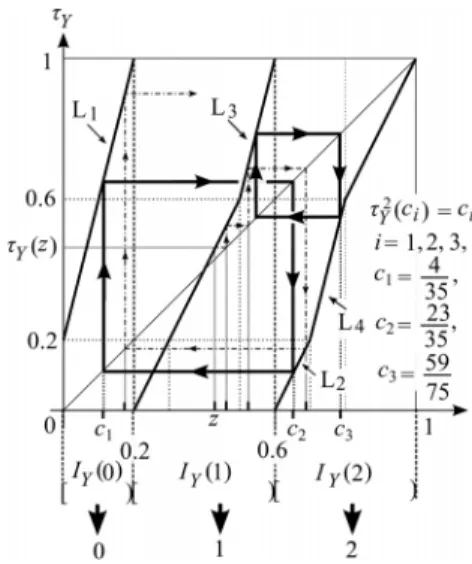
Fig. 1 The mapsτY andφYforPgiven by (11). The quantitiesc1 = 4/35,c2=23/35, andc3=59/75 satisfiesτ2Y(ci)=ci,i=1,2,3.
of ergodic theory since it can be regarded as a shift on the Markov process specified withP. As an example of (τY, φY), we consider the case whereM =|Y|=3 and
P=
0 0.5 0.5 0.25 0.5 0.25 0.25 0.25 0.5
. (11)
In this example A = Y2− {(0,0)}. The stationary distri- bution is (pY(0),pY(1),pY(2)) = (0.2,0.4,0.4).The maps τY and φY for P given by (11) are shown in Fig. 1. Let z ∈ [0,1) be an initial value. We consider the sequence φY(z)φY(τY(z))· · ·φY(τk−1Y (z)) generated by the initial value z, the mapτY and the quantizerφY. Then, we have the fol- lowing property.
Property 3(Kanaya[8], Oohama et al.[9]):
a) IY(a1a2· · ·ak) is equal to the set of initial valueszgen- eratingφY(z)φY(τY(z))· · ·φY(τk−1Y (z))=a1a2· · ·ak. b) The sequence{φY(τk−1Y (z))}∞k=0 coincides with the pY-
ary representation ofz.
c) The procedure of producing sequence using iteration of τYand quantization byφYis equivalent to the decoding process in the arithmetic coding.
The followings are two examples ofpY-ary representa- tions ofz∈I.
Example 1: We consider the example wherePis given by (11). The mapτYis shown in Fig. 1. In this figure the quan- tities c1 = 4/35, c2 = 23/35, and c3 = 59/75 satisfies τ2Y(ci) = ci,i = 1,2,3. The line segments Li,i = 1,2 are related to the computation ofci,i=1,2. Those are explic- itly given by
L1:τY(z)=4z+0.2 forz∈[0,0.2), L2:τY(z)=2z−1.2 forz∈[0.6,0.7).
The line segments Li,i=3,4 are related to the computation
ofc3. Those are explicitly given by L3:τY(z)=4z−1.4 forz∈[0.5,0.6), L4:τY(z)=4z−2.6 forz∈[0.7,0.8).
It can be seen from Fig. 1 that we have φY(c1)=0, φY(τY(c1))=2, φY(c2)=2, φY(τY(c2))=0, φY(c3)=2, φY(τY(c3))=1.
(12) Then by (12) and Property 3 parts a) and b), thepY-ary rep- resentations ofci,i=1,2,3 are
c1=0.02020202· · ·,c2=0.20202020· · ·, c3=0.21212121· · ·.
Example 2: We consider the case whereM=|Y|=3 and P=
0.25 0.25 0.5 0.25 0.5 0.25 0.25 0.25 0.5
. (13)
In this example A = Y2. The stationary distribution is (pY(0),pY(1),pY(2)) = (1/4,1/3,5/12).The mapsτY and φYforPgiven by (13) are shown in Fig. 2. In this figure the quantitiesc01 =1/7,c02 =7/9 satisfiesτY2(c0i)=c0i,i =1,2.
In Fig. 2, the line segments Li,i = 1,2 are related to the computation ofc01. Those are explicitly given by
L1:τY(z)=(10/3)z+1/6 forz∈[1/8,1/4), L2:τY(z)=(12/5)z−7/5 forz∈[7/12,11/16).
The line segments Li,i=3,4 are related to the computation ofc02. Those are explicitly given by
L3:τY(z)=5z−23/12 forz∈[1/2,7/12),
Fig. 2 The mapsτYandφYforPgiven by (13). The quantitiesc01=1/7, c0
2=7/9 satisfyτ2Y(c0i)=c0i,i=1,2.
L4:τY(z)=(16/5)z−39/20 forz∈[11/16,19/24), It can be seen from Fig. 2 that we have
φY(c01)=0, φY(τY(c01))=2, φY(c02)=2, φY(τY(c02))=1.
)
(14) Then by (14) and Property 3 parts a) and b), thepY-ary rep- resentations ofc0i,i=1,2 are
c01=0.02020202· · ·, c02=0.21212121· · · .
3.2 An Explicit Representation of the Interval Algorithm In this subsection, we give an explicit form of the interval algorithm by using thepY-ary representation andpY-ary co- representation of the real number in the intervalI =[0,1).
It can easily be seen from the definition of the interval al- gorithm the interval IX(x) = [LX(x),UX(x)) corresponding to the target random numberx∈ Xhas a form of a disjoint sum of the intervalsIY(·). In our previous work we obtained an explicit form of the disjoint sum in the case where the source{Yt}∞t=1 representing coin tossings is a discrete mem- oryless source. In the present case where{Yt}∞t=1is a station- ary Markov source the same result holds. This result is as follows.
Theorem 1: Forx ∈ X, letIX(x) = [LX(x),UX(x)) be an interval corresponding to the target random variable Xtak- ing values in X. Suppose that lower and upper endpoints LX(x) andUX(x) have the following pY-ary representation andpY-ary co-representations:
LX(x)=0.a1a2· · ·, LX(x)=0.¯a1a¯2· · ·, UX(x)=0.b1b2· · ·.
For eachx∈ X, there exists an integert=t(x) such that rep- resentations ofLX(x) andUX(x) have first different values at thet-th place at theirpY-ary representations. Then, we have
pX(x)=pY(at−1)
"
X
at<a<bt
pY(a|at−1) + X
k≥t+1
npY(ak−1t |at−1)cY(¯ak|ak−1) +pY(bk−1t |at−1)cY(bk|bk−1)o#
, (15)
where X
at<a<bt
pY(a|at−1)=0
whenbt =at+1. Furthermore, we have the following de- scription of IX(x) with the disjoint sum of intervals corre- sponding to the target random sequences in the interval al- gorithm:
IX(x)= X
at<y<bt
IY(at−1y)
1330
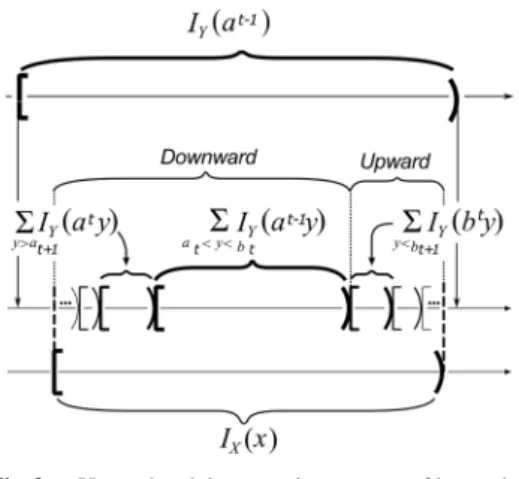
Fig. 3 Upward and downward sequences of intervals.
+ X
k≥t+1
X
y>ak
IY(ak−1y)+X
y<bk
IY(bk−1y)
. (16)
Proof of the equality (15) in Theorem 1 is quite parallel with that of the similar equality with respect topX(x),x∈ X in[6]. For the equality (16) in Theorem 1, we give a simple and rigorous proof of this equality without depending on the equality (15). Lemma 1 is a key result for the proof. This lemma together with some simple observations on the pY- representations of two endpointsLX(x) andUX(x) ofIX(x), x∈ Xyields (16). The detail of the proof of Theorem 1 is given in Sect. 5.
It can be seen from the above presentation that the in- tervalP
at<y<btIY(at−1y) is in the middle of the intervalIX(x)
and that the sequence of intervals{P
y>ak+1 IY(aky)}k≥t en-
tirely covers the lower part of the intervalIX(x). Those in- tervals are called downward sequencesin Han and Hoshi [3]. We also know that the sequence of intervals {P
y<bk
IY(bk−1y)}k≥t+1in the third term in the right member of the above equation entirely covers the upper part ofIX(x). This sequence of the intervals are calledupward sequencein Han and Hoshi[3]. The result of Theorem 1 can be regarded as giving an explicit form of upward/downward sequences of intervals in the interval algorithm. Those sequences of intervals is shown in Fig. 3.
Based on the expression ofpX(x),x∈ Xin Theorem 1, set
Dt,x:=n
yt:yt−1=at−1,at< yt<bt
o. (17) Furthermore, forl≥t+1, set
Dl,x:=n
yl:yl−1=al−1,al< ylo
, (18)
Ul,x:=n
yl:yt−1=at−1, ytl−1=bl−1t , yl<blo
. (19)
Then, we have the following.
S =X
x∈X
Dt,x+X
l≥t+1
Dl,x+X
l≥t+1
Ul,x
. (20)
Forx∈ X, define
Dx:=Dt,x+X
l≥t+1
Dl,x, Ux:= X
l≥t+1
Ul,x.
It is obvious thatSx=Dx+Ux,x∈ X. In the remaining part of this section we present two examples of random number generation. For each example, we computeSx,Dx, andUx forx∈ X.
Example 3: We consider the case where M = 3, N = 4.
The target random variableXhas the following distribution:
pX =(pX(0),pX(1),pX(2),pX(3))
=(4/35,19/35,68/525, /16/75).
We assume that the stationary Markov process{Yt}t=1 spec- ified with (11) in Example 1 generates coin random se- quences. The pY-array representation for this example is discussed in Example 1. In the random number generation problem treated here the choice of pX is closely related to the periodic point of the mapτY defining the Markov shift.
In fact, we have LX(1) =4/35 =c1,LX(2) =23/35 =c2, LX(3)=59/75=c3, whereci,i=1,2,3 are the same quan- tity as those in Example 1. Those are the periodic points ofτY satisfyingτ2Y(ci)=ci,i=1,2,3. Using the pY-array representations ofci,i=1,2,3 in Example 1, we have
LX(1)=0.02020202· · · , LX(2)=0.20202020· · · , LX(3)=0.21212121· · · .
Applying the formula (16) onIX(x),x∈ Xin Theorem 1 to the present example, we have the following:
IX(0)=X
k≥0
X
y<2
IY(0[20]ky), IX(1)=IY(1)+X
k≥1
X
y>0
IY([02]ky) +X
k≥1
X
y<2
IY([20]ky), IX(2)=X
k≥0
X
y>0
IY(2[02]ky)
+X
k≥1
X
y<2
IY(2[12]k1y)+IY(2[12]k+10)
, IX(3)=X
k≥0
IY(2[12]k2).
Hence the setsSx,Dx, andUxforx=0,1,2,3 are S0 =U0=n
0[20]k0,0[20]k1o
k≥0, S1 =D1+U1,
D1 ={1}+n
[02]k1,[02]k2o
k≥1, U1 =n
[20]k0,[20]k1o
k≥1, S2 =D2+U2,
D2 =n
2[02]k1,2[02]k2o
k≥1, U2 =n
2[12]k10,2[12]k11,2[12]k+10o
k≥0,
S3=D3 =n
2[12]k2o
k≥0.
Example 4: We consider the case where M = 3, N = 3.
The target random variableXhas the following distribution:
pX =(pX(0),pX(1),pX(2))=(1/7,40/63,2/9).
We assume that the stationary Markov process{Yt}t=1spec- ified with (13) in Example 2 generates coin random se- quences. The pY-array representation for this example is discussed in Example 2. In the random number generation problem treated here the choice of pX is closely related to the periodic point of the mapτY defining the Markov shift.
In fact, we have LX(1) = 1/7 = c01, LX(2) = 7/9 = c02, wherec0i,i=1,2 are the same quantity as those in Example 2. Those are the periodic points ofτYsatisfyingτ2Y(c0i)=c0i, i=1,2. Using thepY-array representations ofc0i,i=1,2 in Example 2, we have
LX(1)=0.02020202· · ·, LX(2)=0.21212121· · ·. Applying the formula (16) onIX(x),x∈ Xin Theorem 1 to the present example, we have the following:
IX(0)=X
k≥0
X
y<2
IY(0[20]ky), IX(1)=IY(1)+X
k≥1
X
y>0
IY([02]ky)
+X
k≥0
IY(2[12]k0)+X
y<2
IY([21]k+1y)
, IX(2)=X
k≥0
IY(2[12]k2).
Hence the setsSx,Dx, andUxforx=0,1,2 are S0=U0=n
0[20]k0,0[20]k1o
k≥0, S1=D1+U1,
D1={1}+n
[02]k1,[02]k2o
k≥1, U1=n
2[12]k0,[21]k+10,[21]k+11o
k≥0, S2=D2 =n
2[12]k2o
k≥0.
4. Performance Analysis of the Interval Algorithm In this section we present a rigorous performance analysis of the interval algorithm using the expression of the interval algorithm we gave in the previous section.
4.1 Some Preliminaries
We define several quantities necessary for describing our re- sult on the performance analysis of the interval algorithm.
LetS ∈S be a random variable with the distribution Prn
S =yl∈ So
=pY(y1)pY(y2|y1)· · ·pY(yl|yl−1).
Foryl∈S define the mapϕ:S → Xsuch that
ϕ(yl) :=xifyl∈ Dl,xoryl∈ Ul,x. (21) Defineϕ1:S → {0,1}by
ϕ1(yl) :=(
0 ifyl∈ Dl,x
1 ifyl∈ Ul,x. (22)
SetV :=ϕ1(S). Furthermore, define the mapϕ2 :S → Y2 by ϕ2(yl) = (yl−1, yl). Set W := ϕ2(S). For each (a0,a)
∈ Y ×(Y − {0}), consider the set of integersl that satisfy yl+1 ∈ Dl+1,xand (yl, yl+1) =(a0,a).Letl1,a0,a,l2,a0,a,· · · be its elements arranged in the increasing order. By definition it is obvious that
t−1≤l1,a0,a<l2,a0,a<· · ·<lk,a0,a<lk+1,a0,a<· · ·. Similarly, for each (b0,b)∈ Y ×(Y − {M −1}), consider the set of integerslsatisfyingyl+1 ∈ Ul+1,xand (yl, yl+1) = (b0,b).Let ˜l1,b0,b,l˜2,b0,b,· · · be its elements arranged in the increasing order. By definition it is obvious that
t≤l˜1,b0,b<l˜2,b0,b<· · ·<l˜k,b0,b<l˜k+1,b0,b<· · · . Let
pS|VW X(ylk,a0,a+1|0,a0,a,x),k=1,2,· · ·,
denote conditional probabilities of S =ylk,a0,a+1 for given V = 0,W = (a0,a), andX = x. Let pS|VW X(·|0,a0,a,x) denote the probability distribution which consists of those probabilities. Similarly, let
pS|VW X(yl˜k,b0,b+1|1,b0,b,x),k=1,2,· · ·,
denote conditional probabilities of S =yl˜k,b0,b+1 for given V = 1,W = (b0,b), andX = x. Let pS|VW X(·|1,b0,b,x) denote the probability distribution which consists of those probabilities. In the remaining part of this subsection we compute the above two probability distributions, which will be useful for later arguments on the performance analysis of the interval algorithm. By the expression ofpX(x) using the coin random sequences we obtain
Prn
S =ylk,a0,a+1,V=0,W=(a0,a),X=xo
=Prn
Yt−1=at−1,Ytlk,a0,a+1=altk,a0,aao
=pY(altk,a0,aa|at−1)pY(at−1)
(a)= pY(altk,a0,aa|at−1)pY(at−1), (23) where ifl1,a0,a =t−1, we definealt1,a0,a =λ. Step (a) fol- lows from the Markov property of coin random sequences.
Similarly, we obtain Prn
S =yl˜k,b0,b+1,V=1,W=(b0,b),X=xo
=pY(btl˜k,b0,bb|at−1)pY(at−1). (24) Set
1332
η0(a0,a,x|at−1) :=X
k≥1
pY(altk,a0,aa|at−1), (25) η1(b0,b,x|at−1) :=X
k≥1
pY(blt˜k,b0,bb|at−1). (26) From (23) and (25), we have
PrV=0,W=(a0,a),X=x =X
k≥1
1
×Prn
S =ylk,a0,a+1,V=0,W=(a0,a),X=xo
=X
k≥1
pY(altk,a0,aa|at−1)pY(at−1)
=η0(a0,a,x|at−1)pY(at−1). (27) Similarly, from (24), and (26), we have
Pr
V=1,W=(b0,b),X=x
=η1(b0,b,x|at−1)pY(at−1). (28) From (23) and (24), we have
pS|VW X(ylk,a0,a+1|0,a0,a,x)
=Prn
S =ylk,a0,a+1
V =0,W =(a0,a),X=xo
= pY(altk,a0,aa|at−1)
η0(a0,a,x|at−1). (29)
Similarly, from (24) and (28), we have pS|VW X(y˜lk,b0,b+1|1,b0,b,x)
= pY(b˜ltk,b0,bb|at−1)
η1(b0,b,x|at−1). (30)
Define two probability distributions on positive integers by p(0)Y (·|a0,a,x,at−1)
:=
pY(altk,a0,aa|at−1)/η0(a0,a,x|at−1)
k=1,2,···, p(1)Y (·|b0,b,x,at−1)
:=
pY(b˜ltk,b0,bb|at−1)/η1(b0,b,x|at−1)
k=1,2,···. Then we have
pS|VW X(·|0,a0,a,x)=p(0)Y (·|a0,a,x,at−1), (31) pS|VW X(·|1,b0,b,x)=p(1)Y (·|b0,b,x,at−1). (32) 4.2 Performance Evaluation of the Interval Algorithm In this subsection we state our main result on the perfor- mance analysis of the interval algorithm. In the follow- ing arguments,H(·) designates the entropy of a probability distribution or a random variable andD(·||·) designates the Kullback-Leibler divergence between two probability distri- butions.
For eachi∈ Y, letY2(i) be a random variable with the
distribution{Pi j}M−1j=0 . Entropy rate of{Yt}∞t=1 is the follow- ing:
H(Y2|Y1)=
M−1
X
i=0
pY(i)
M−1
X
j=0
Pi j[−logPi j]
=
M−1
X
i=0
pY(i)H(Y2(i)).
Define
Hmin(Y2(·)) := min
0≤i≤M−1H(Y2(i)), (33)
Hmax(Y2(·)) := max
0≤i≤M−1H(Y2(i)). (34)
Then we have
Hmin(Y2(·))≤H(Y2|Y1)≤Hmax(Y2(·)).
Here we have a certain nontrivial class of information sources where the above two bounds Hmin(Y2(·)) and Hmax(Y2(·)) match. For givenY1 = y1 ∈ Y, we define a probability distributionQy1by
Qy1 :=pY(·|y1)={Py1y2}y2∈Y
LetS(Y) denote the representation of the symmetric group of permutations ofYby the|Y| × |Y|permutation matrix.
We consider the following condition.
Condition:We call that the stochastic matrixPsatisfies a symmetrical property if for any y1, y01 ∈ Y, there exists Π∈S(Y) such thatQy01=Qy1Π.
Then we have the following.
Lemma 2: If the stochastic matrix P of the stationary Markov information source{Yt}t=1,2,···satisfies a symmetri- cal property, we have
Hmin(Y2(·))=H(Y2|Y1)=Hmax(Y2(·)).
Proof: Letimin ∈ Y be the symbol i such that it at- tainsHmin(Y2(·)) defined by (33). Similarly, letimax ∈ Ybe the symbolisuch that it attainsHmax(Y2(·)) defined by (34).
SincePsatisfies a symmetrical property, we have that Qimin =QimaxΠ for someΠ∈S(Y). (35) Then we have the following chain of equalities:
Hmin(Y2(·))=H(Qimin)(a)=H(QimaxΠ)(b)=H(Qimax)
=Hmax(Y2(·)).
Step (a) follows from (35). Step (b) follows from that the en- tropy is invariant under the permutation on the components
of the probability vectorQimax.
In the following we show three examples ofPwith a symmetrical property.
Example 5: We consider the case where M = 3. Set θi := P0i,i = 0,1,2. The following three stochastic ma- tricesPi,i=1,2,3 are examples ofPhaving a symmetrical
property.
P1=
θ0θ1θ2 θ0θ1θ2
θ0θ1θ2
,P2=
θ0θ1θ2 θ1θ2θ0
θ2θ0θ1
,P3=
θ0 θ1θ2 θ0 θ2θ1
θ0 θ1θ2
. The above three examples have some specific properties.
WhenP = P1, the source becomes the stationary memo- ryless source specified with pY = (pY(0),pY(1),pY(2)) = (θ0, θ1, θ2). P2 is a doubly stochastic matrix. When we chooseθ0 =θ1 =0.25,θ2 =0.50 inP3,P =P3coincides with the stochastic matrix in Example 2.
The efficiency of the interval algorithm is measured by the average number of coin tosses necessary to obtain the target random variable. We denote it by ¯L. According to Han and Hoshi[3], we have the following:
Lemma 3(Han and Hoshi[3]):
LH¯ min(Y2(·))≤H(S)≤LH¯ max(Y2(·)).
Specifically, if the stochastic matrix P of the stationary Markov information source{Yt}t=1,2,···satisfies a symmetri- cal property, we have ¯LH(Y2|Y1)=H(S).
From this lemma we can see that an evaluation of ¯Lis reduced to an estimation of upper bound of H(S). On the upper bound of this quantity, we have the following lemma.
Lemma 4:
H(S)≤H(X)+log{2M(M−1)}+ζ, (36) whereζ:=H(S|VW X). For the quantityζ, we have
ζ=
N−1
X
x=0
pY(at(x)−1)
M−1
X
a0=0 M−2
X
a=0
η0(a0,a,x|at−1)
×H
p(0)Y (·|a0,a,x,at−1) +
M−1
X
b0=0 M−1
X
b=1
η1(b0,b,x|at−1)
×H
p(1)Y (·|b0,b,x,at−1)
. (37)
Proof:We first prove (36). We have the following:
H(S)=H(ϕ(S)ϕ1(S)ϕ2(S)S)=H(XVWS)
=H(X)+H(VW|X)+H(S|VW X)
≤H(X)+log{2M(M−1)}+H(S|VW X),
where the last inequality follows from thatVis a binary ran- dom variable and thatW takes values inY ×(Y − {M−1}) ifV =1 and takes values inY ×(Y − {0}) ifV =0. From (27), (28), (31), and (32), we have (37).
Han and Hoshi[3]used several complicated arguments to derive the upper bound ofH(S|VW X). Their result is the following.
Theorem A(Han and Hoshi[3]):
H(X)
Hmax(Y2(·)) ≤L¯ ≤ H(X)
Hmin(Y2(·))+log{2M(M−1)}
Hmin(Y2(·)) + h(pmax)
(1−pmax)Hmin(Y2(·)), (38) where
pmax:= max
(y1,y2)∈Y2
Py1y2
andh(·) is the binary entropy function.
Define the geometrical distribution p∗ with parameter pmaxby
p∗:=
pmaxk−1(1−pmax)
k=1,2,···
Our main result on the performance analysis of the interval algorithm is the following.
Theorem 2:
H(X)
Hmax(Y2(·)) ≤L¯ ≤ H(X)
Hmin(Y2(·))+log{2M(M−1)}
Hmin(Y2(·)) + h(pmax)
(1−pmax)Hmin(Y2(·))− ∆
Hmin(Y2(·)), (39) where∆is a nonnegative number defined by
∆ =
N−1
X
x=0
pY(at(x)−1)
M−1
X
a0=0 M−1
X
a=1
η0(a0,a,x|at−1)
×D
p(0)Y (·|a0,a,x,at−1) p∗ +
M−1
X
b0=0 M−2
X
b=0
η1(b0,b,x|at−1)
×D
p(1)Y (·|b0,b,x,at−1) p∗
. (40)
Specifically, if the stochastic matrix P of the stationary Markov information source{Yt}t=1,2,···satisfies a symmetri- cal property, we have
H(X)
H(Y2|Y1) ≤L¯≤ H(X)
H(Y2|Y1)+log{2M(M−1)}
H(Y2|Y1) + h(pmax)
(1−pmax)H(Y2|Y1)− ∆
H(Y2|Y1). (41) Proof of Theorem 2 is given in the next section. Let the upper bound of ¯Lby Han and Hoshi[3]in (38) be denoted by ¯LHH. Then our upper bound of ¯Lin Theorem 2 is
L¯≤L¯HH− ∆
Hmin(Y2(·)). (42)
Note that∆is nonnegative and may almost always be pos- itive. Hence our upper bound improves ¯LHH. The bound (42) is equivalent to ¯LHH−L¯ ≥∆/Hmin(Y2(·)), implying that the quantity ∆/Hmin(Y2(·)) serves as a lower bound on the deviation of ¯LHHfrom the true value of ¯L.
Remark:In[7], the author made a mistake in the derivation of the upper bound of ¯L. Hence the upper bound of ¯Lgiven