PAPER
Parameter Estimation of Fractional Bandlimited LFM Signals Based on Orthogonal Matching Pursuit
Xiaomin LI†,††a),Nonmember, Huali WANG†††b),Member,andZhangkai LUO††††c),Student Member
SUMMARY Parameter estimation theorems for LFM signals have been developed due to the advantages of fractional Fourier transform (FrFT).
The traditional estimation methods in the fractional Fourier domain (FrFD) are almost based on two-dimensional search which have the contradiction between estimation performance and complexity. In order to solve this problem, we introduce the orthogonal matching pursuit (OMP) into the FrFD, propose a modified optimization method to estimate initial frequency and final frequency of fractional bandlimited LFM signals. In this algo- rithm, the differentiation fractional spectrum which is used to form obser- vation matrix in OMP is derived from the spectrum analytical formulations of the LFM signal, and then, based on that the LFM signal has approx- imate rectangular spectrum in the FrFD and the correlation between the LFM signal and observation matrix yields a maximal value at the edge of the spectrum (see Sect. 3.3 for details), the edge spectrum information can be extracted by OMP. Finally, the estimations of initial frequency and fi- nal frequency are obtained through multiplying the edge information by the sampling frequency resolution. The proposed method avoids recon- struction and the traditional peak-searching procedure, and the iterations are needed only twice. Thus, the computational complexity is much lower than that of the existing methods. Meanwhile, Since the vectors at the initial frequency and final frequency points both have larger modulus, so that the estimations are closer to the actual values, better normalized root mean squared error (NRMSE) performance can be achieved. Both theoreti- cal analysis and simulation results demonstrate that the proposed algorithm bears a relatively low complexity and its estimation precision is higher than search-based and reconstruction-based algorithms.
key words: linear frequency modulation signal, parameter estimation, or- thogonal matching pursuit, fractional Fourier transform
1. Introduction
Fractional Fourier transform (FrFT) is a powerful tool for analyzing LFM signals which are also known as chirp sig- nals[1]. FrFT uses a transform kernel which essentially al- lows the signal in the time-frequency domain to be projected onto a line of arbitrary angle. The definition of FrFT is de- noted by[2]:
Manuscript received May 15, 2019.
†The author is with School of Electronic and Optical Engi- neering, Nanjing University of Science and Technology, Nanjing 210094, China.
††The author is with School of Mechanical and Electrical En- gineering, Henan Institute of Science and Technology, Xinxiang 453003, China.
†††The author is with College of Communication Engineer- ing, The Army Engineering University of PLA, Nanjing 210007, China.
††††The author is with Science and Technology on Complex Elec- tronic System Simulation Laboratory, Space Engineering Univer- sity, Beijing 101416, China.
a) E-mail: [email protected]
b) E-mail: [email protected] (Corresponding author) c) E-mail: luo [email protected]
DOI: 10.1587/transfun.E102.A.1448
Xp(u)=n
Fp[x(t)]o
(u)=R∞
−∞x(t)Kp(t,u)dt (1) WhereFpdenotes the FrFT operator. The kernel function is denoted by:
Kp(t,u)=
Aαexpjπh t2+u2
cotα−2utcscαi
, α,nπ
δ(t−u), α=nπ
δ(t+u), α=(2n+1)π
(2)
Where Aα = p
1−jcotα, and α = pπ2 is the trans- form angle. FrFT can be interpreted as a signal decompo- sition in terms of a chirp basis as its kernel is constituted by chirp functions, so FrFT has a notable potential for ana- lyzing chirp signals[1],[3]. For the LFM signal detection and parameter estimation, FrFT is densely used by making use of the change of the concentration, or equivalently the support. In the fractional Fourier domain (FrFD), support of LFM signals change associated with the transform an- gle and there exists an optimum transform angle in which the energy of chirp signals are most concentrated[4],[5].
when an LFM signal is transformed by FrFT at its optimum angle, transform kernel acts as a matched filter. Therefore, an optimum LFM detection and estimation can be done by sweeping all of the angles and finding the correct angle that maximizes the absolute amplitude. Almost all successful methods employing FrFT use the maximum peak of sweep in the FrFD[4],[6]–[11], which is an easy method to realize.
And obviously, the search-based algorithms above require numerous extra calculations and have the contradiction be- tween estimation performance and complexity.
In recent years, numerous researchers have explored the parameter estimation problem of chirp signals from dif- ferent aspects[1],[9],[12]–[22]. Inspired by the recently- developed sparse reconstruction method[23]–[28], we pro- pose a fast and high accuracy parameter estimation method for LFM signals in the FrFD based on orthogonal matching pursuit (OMP). In this algorithm, We construct the observa- tion matrix through the differentiation spectrum, and prove that the LFM signal and observation matrix are most rele- vant at the edge of the fractional spectrum, so the fractional spectrum edge information can be extracted by OMP. And the estimations of initial frequency and final frequency can be gotten through multiplying the sampling frequency reso- lution by the edge information.
Neither reconstruction nor peak-searching are needed in the proposed method, which can reduce the computa- Copyright c2019 The Institute of Electronics, Information and Communication Engineers
tional complexity greatly. And the estimation precision is higher than existing algorithms because of the larger modu- lus the vectors at the initial frequency and final frequency points have (see Sect. 3.3 for details). Simulation results demonstrate that the proposed algorithm has better normal- ized root mean squared error (NRMSE) performance.
The remainder of this paper is organized as follows: In Sect. 2, the basic preliminaries is presented. The new algo- rithm is proposed in Sect. 3. In Sect. 4, the parameters esti- mation performance is simulated and analyzed. Section 5 is the conclusion.
2. Preliminaries
2.1 Simplified Fractional Fourier Transform (SFrFT) FrFT is an extension of the ordinary Fourier transform (FT), which essentially allows the signal in the time-frequency domain to be projected onto a line of arbitrary angle[29].
Simplified fractional Fourier transform (SFrFT)[30]has the same effect as FrFT of orderαfor filter design, but it is sim- pler to implement digitally than the original FrFT. And the first type ofαth-order SFRFT is defined as[30]:
Yα(u)=(j2π)−12
×R∞
−∞exp
−jut+jt2cotα/2 y(t)dt
(3) whereαis the SFrFT order. The inverse SFrFT is denoted as follows:
y(t)=(j/2π)12exp
−ju2cotα/2
×R∞
−∞exp (jut)Yα(u)dt
(4) The digital implementation of SFrFT (DSFrFT) is given by [30]
Fα[m]=(j2π)−12∆t
N
X
n=−N
exp −j 2πmn 2N+1+ j
2n2cotα(∆t)2
!
·y[n]
(5)
Wherey[n] = y[n∆t], Fα[m] = Fα[m∆u],m, n = −N,
−N+1,N,∆tand∆u are the sample spacing in temporal domain and simplified fractional Fourier domain (SFrFD) respectively. And∆t∆u =2π/(2N+1). We can also write (5) in matrix form, expressed as
Fα=c1OαFy
Wherec1 = (j2π)−12∆t, OαF−1
= OαF∗
, ∗ denotes the transposed conjugate operator, andOαF is a (2N+1)× (2N+1) unitary matrix whose elementh
OαFi
mnat themrow, ncolumn has the following form:
OαF
mn =expl
−j2π(m−N−1)(n−N−1) 2N+1
m
·expl
j(n−N−1)2cotα(∆t)2/2m
whered·ereturns the nearest integer towards positive infin- ity. With the change ofα, the frequency axis of the SFrFT is located in different positions, and more abundant informa- tion about the frequency characteristics of the signal can be obtained compared to the FT.
2.2 Fractional Bandlimited LFM Signal and Its Spectral Features in SFrFD
A fractional bandlimited LFM signal f(t) has finite en- ergy. The SFrFT of f(t) is zero outside the region (−u0−uα,−u0+uα)∪(u0−uα,u0+uα).
i.e.
Fα(u)=
Fα(u),u0−uα≤ |u| ≤u0+uα
0, otherwise (6)
Where 2uαis the fractional bandwidth of f(t). Accord- ing to Parseval’s theorem, the bandlimited LFM signal can also be expressed as:
R∞
−∞|f(t)|2dt=R−ul
−uh |Fα(u)|2du+Ruh
ul |Fα(u)|2du whereuh=u0+uα, andul=u0−uα.
The LFM signal model is given by x(t)=A·exp
j2πf0t+ jπKl f mt2
(7) Where f0is the initial frequency,Ais the amplitude ofx(t) which could be random or fixed.Kl f mis the modulation rate.
And using the results in Appendix, for the LFM signal whose duration time ish
−T2d,T2di , when
Kl f m+cotα/2π Td2 1, its amplitude spectrum in SFrFD is
|Xα(u)|
≈ 1
pKl f m+cotα/2π·rect u−2πu0cscα B0
! (8)
and its phase spectrum in SFrFD is θ(u)≈ −π(u−2πu0cscα)2
Kl f m+cotα/2π +π
4 (9)
Where B0 is the width of the spectrum in SFrFD, Kl f m0 = Kl f m+cotα/2π, andαis the fractional orders. And accord- ing to (6) and (8), the LFM signalx(t) whose duration time ish
−T2d,T2di
is a fractional bandlimited signal.
3. Proposed Parameter Estimation Method for Frac- tional Bandlimited LFM Signals
3.1 Method Description
In this part, we propose an optimization method to estimate initial frequency and final frequency of fractional bandlim- ited LFM signals by introducing the OMP. The proposed method is based on two principles. First, the LFM signal has a rectangular spectrum in the SFrFD ofα-th order when
Td·p
|Kl f m+cotα| 1 (see Appendix for details), and the correlation between the LFM signal and observation matrix yields a maximal value at the edge of the fractional spectrum (see Sect. 3.3 for details). Second, OMP algorithm have the ability to search the maximum correlation information.
In the proposed method, the differentiation spectrum which is used to form the observation matrix is derived from the spectrum analytical formulations of the LFM signal in the FrFD, and then the correlation between the LFM signal and observation matrix is proved to be the largest at the edge of the fractional spectrum, as a result, the spectrum edge information can be extracted by OMP. Finally, multiply the sampling frequency resolution by the edge information to get the estimations of initial frequency and final frequency.
There are only two iterations in the method, neither re- construction nor the traditional peak-searching procedures are needed, thus, the computational complexity is much lower than the existing methods. Meanwhile, since the vec- tors at the initial frequency and final frequency points both have larger amplitude, so that better NRMSE performance can be achieved as well.
3.2 The Differential Procedure for the Fractional Spec- trum of the LFM Signal
The fractional bandlimited LFM signals can be depicted as ym=A·ej[2π(nln/K+Kl f mn2/2K2)]|n=0,1,···,K−1
=A·ej
2π
nl K
n−n2K2
+nhKn2 2K
|n=0,1,···,K−1
=ym(0) ym(1) · · · ym(K−1)T
(10)
wherenl is the initial frequency point, nh is the final fre- quency point. Kl f m is the modulation rate. Kis the number of sampling data.
The DSFrFT ofymis[30]
Fα=c1OαFym
the differentiating process forFαcan be expressed as y= Γ0·Fα= Γ0·c1OαFym (11)
whereΓ0=
1 −1 · · · 0
0 1 ... 0
0 ... ... −1
0 · · · 0 1
K×K
is the differentiating matrix.c1=(j2π)−1/2∆t,
OαF =
OαF(1,1) OαF(1,2) · · · OαF(1,K) OαF(2,1) OαF(2,2) · · · OαF(2,K)
... ... ... ...
OαF(K,1) OαF(K,2) · · · OαF(K,K)
K×K
is the DSFrFT matrix, andOαF is unitary matrix. The ele- ments of matrixOαF are:
OαF(m,n)=expl
−j2π(m−N2N0−1)(n−N0+1 0−1)
m
·expl
j n−N0−12
cotα(∆t)2/2m m,n=1,· · ·,N0,· · ·,K,N0=lK−1
2
m,∆t= 1fs From Eq. (11),
ym= Γ0·c1OαF−1·y=G0·y (12) Where
G0= Γ0·c1OαF−1=(j/2π)1/2/(K∆t)·
1
P
n=1
OαF(1,n)
2
P
n=1
OαF(1,n) · · ·
k
P
n=1
OαF(1,n)
1
P
n=1
OαF(2,n)
2
P
n=1
OαF(2,n) · · ·
k
P
n=1
OαF(2,n)
... ... ... ...
1
P
n=1
OαF(K,n)
2
P
n=1
OαF(K,n) · · ·
k
P
n=1
OαF(K,n)
∗
K×K
3.3 The Correlation betweenG0andym
Assume the initial residual res0 = ym, observation matrix G0 =
Γ0·c1OαF−1
, so the correlation betweenres0 andG0 can be computed according to their inner product as follows:
|res0,G0|=(j/2π)1/2/(K∆t)·
|
1
P
n=1
OαF(n,1)ym(1)+· · ·+P1
n=1
OαF(n,k)ym(k)|
|
2
P
n=1
OαF(n,1)ym(1)+· · ·+P2
n=1
OαF(n,k)ym(k)| ...
|
K
P
n=1
OαF(n,1)ym(1)+· · ·+PK
n=1
OαF(n,k)ym(k)|
K×1
(13) Whereh·idenotes the inner product operator. Since the DS- FrFT ofym(n) is
Fα(m)=c1 K
P
n=1
OαF(m,n)·ym(n) Equation (13) can be reduced to:
|res0,G0|
=|res0, g01||res0, g02| · · · |res0, g0K|T
=(j/2π)1/2/(K∆t)·
|Fα(1)|
|Fα(1)+Fα(2)| ...
|Fα(1)+Fα(2)+· · ·+Fα(k−1)|
|Fα(1)+Fα(2)+· · ·+Fα(k−1)+Fα(k)|
K×1
=(j/2π)1/2/(K∆t)·
|
1
X
m=1
Fα(m)||
2
X
m=1
Fα(m)| · · · |
K
X
m=1
Fα(m)|
T
(14)
According to (14), |D
res0, g0kE
|, the kth element of
| hres0,G0i |, denotes the summation of the firstkterms from Fα(m), which is the DSFrFT ofym(n). And for the LFM signalym, whenTd·p
|Kl f m+cotα| 1, its amplitude spec- trum and phase spectrum inα-th order discrete time simpli- fied fractional Fourier domain (DTSFrFD) are respectively:
|Xα(u)|
≈ A
pKl f m+cotα·rect u−2πu0cscα B0
! (15)
θ(u)≈π(u−2πu0cscα)2 Kl f m+cotα +π
4 (16)
Substitute (15) and (16) into(14),
|D res0, g0kE
|=
0, k<nl
|(j/2π)
1 2
K∆t · √ A
Kl f m+cotα·
k−nl
P
m=1
ejφ(m)|, nl≤k≤nh
|(j/2π)
12
K∆t · √ A
Kl f m+cotα·
k−nl
P
m=1
ejφ(m)|, k>nh
(17)
Whereφ(m)=−Kπ(m∆)2
l f m+cotα+π4, 0≤m≤nh−nl, and
∆φ(m)=φ(m)−φ(m+1)=π(2m+1)∆2
Kl f m+cotα (18) whennl≤k≤nh,|D
res0, g0kE
|can be expressed as the sum of (j/2π)
1 2
K∆t · √ A
Kl f m+cotα ·ejφ(m), whose phase changes nonlin-
early in Eq. (18) as Fig. 1.
Let vectorB = (j/2π)K∆t12 · √ A
Kl f m+cotα ·ejφ(m). And Fig. 1
also shows that vector B with constant magnitude, moves clockwise on a circle. Meanwhile, φ(m), the phase of B, increases with an interval of∆φ(m), therefore|D
res0, g0kE
| will increase at first and then decrease. According to (18),
∆φ(m) increases asBmoves along the circle clockwise, the
Fig. 1 The vector B with constant magnitude.
accumulated phase energy of|D
res0, g0kE
|reaches its maxi- mum value within the first cycle. And this maximum value is corresponding to the estimation of initial frequency. Sim- ilarly, when differentiating matrix is
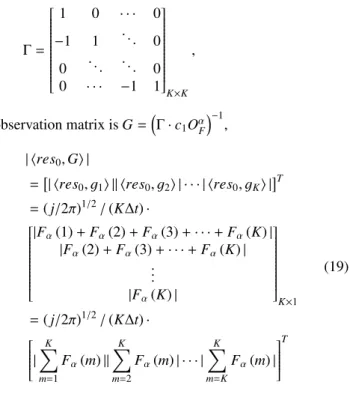
Γ =
1 0 · · · 0
−1 1 ... 0
0 ... ... 0
0 · · · −1 1
K×K
,
observation matrix isG=
Γ·c1OαF−1
,
| hres0,Gi |
=| hres0, g1i || hres0, g2i | · · · | hres0, gKi |T
=(j/2π)1/2/(K∆t)·
|Fα(1)+Fα(2)+Fα(3)+· · ·+Fα(K)|
|Fα(2)+Fα(3)+· · ·+Fα(K)| ...
|Fα(K)|
K×1
=(j/2π)1/2/(K∆t)·
|
K
X
m=1
Fα(m)||
K
X
m=2
Fα(m)| · · · |
K
X
m=K
Fα(m)|
T
(19)
And a similar analysis can be perform for| hres0, gki |, as a result, the maximum value of| hres0, gki |is correspond- ing to the estimation of final frequency.
3.4 The Parameter Estimation Procedures Using OMP Assume res0 is the residual, i is the iteration count, Λ0
is a set of indices of the nonzero channel coefficients.
g0k(k=1,2,· · ·,K) is the columns of observation matrixG0. Andym=G0·y. Accordingly, the initial frequency estima- tion procedures of the proposed method is summarized in Algorithm 1.
Algorithm 1: the initial frequency estimation (1) Initializeres0=ym,i=1 andΛ0=∅.
(2) Determine the new indexλ0iby selecting the maximum absolute value of the correlation betweenG0and previous residualres0. That is,λ0i=arg max
k=1,2,···,N/2|D resi−1, g0kE
|.
(3)combine the newly selected indexλ0iwith the indexΛi−1, i.e., Λi= Λi−1∪n
λ0io . Compute theyi=arg miny
ym−G0Λ
iy 2. Compute the new residualresi=ym−G0Λ
iyi. (4) Seti=i+1 ifi<3 go to step 2.
The stopping criterion in Algorithm 1 isi =3, which means that two iterations forym =G0·yis required. As a result,λ01andλ02, the index which are corresponding to the maximum values of the correlation betweenG0and residual
Fig. 2 The relationship between |D resi−1, g0kE
|and the fractional “fre- quency”.
within each iterations, are obtained. And the estimated ini- tial frequency of LFM signal in DTSFrFD is min
λ01, λ02
∆, where∆ =1/KTs,Tsis the sampling interval.
Similarly, when observation matrix isG=
Γ·c1OαF−1
, conduct two iterations onym=G·yto generate two indexs λ1,λ2. Then the estimated final frequency in DTSFrFD is max (λ1, λ2)∆, where∆ =1/KTs. Figure 2 illustrates the re- lationship between|D
resi−1, g0kE
|,i=1,2 and the fractional
“frequency”. Figure 2(a) shows that there are two maximum values atnlandnhrespectively after the first iteration. Thus the indexλ01 corresponds to eithernlornh. Compared with Fig. 2(a),|D
res1, g0kE
|has a smaller value atnh as shown in Fig. 2(b), because the update process in OMP removes the influence ofgλ01 from|D
res0, g0kE
|. Accordingly, the maxi- mum value obtained by the second iteration is the second largest value of|D
res0, g0kE
|, i.e., the value corresponding to nl. Since the LFM signal has approximate rectangular spec- trum in DTSFrFD, so whenk>nh,Fα(m) is approximately zero, which leads to an almost constant value of|D
res0, g0kE
|, as shown in Fig. 2(a). Therefore, after two iterations, the in- dex min
λ01, λ02
corresponds tonl, which is the initial fre- quency.
Similarly, Fig. 3 illustrates the relationship between
| hresi−1, gki |i = 1,2 and the fractional “frequency”. And after two iterations, the index max (λ1, λ2) is corresponding tonhwhich is the final frequency.
Thus, the estimated initial frequency is
f0=u0·cscα=min λ01, λ02∆·cscα (20) the final frequency estimated is
f1=u1·cscα=[max (λ1, λ2)∆]·cscα (21) 3.5 Influence of the Fractional Order
According to the analysis above, algorithm 1 can effectively
Fig. 3 The relationship between| hresi−1, gki |, and the fractional “fre- quency”.
extract the edge information of the spectrum in DTSFrFD.
Since theαth-order SFrFT can be regarded as the projection on the rotated frequency axisu, so the spectrum distribution of the signal directly depends on the order of the SFrFT. Ac- cording to the analysis in Appendix, for a discrete-time LFM signal with the duration ofh
−Td
2,T2di
, its amplitude spectrum in DTSFrFD is
|Xα(u)| ≈ A
pKl f m+cotα·rect u−2πu0cscα B0
! ,
when
Kl f m+cotα/2π
Td21. WhereB0is the bandwidth of the spectrum,αis the fractional orders.
whenTdandKl f mare constant, the fluctuation of Fresnel in- tegral decreases as cotαincreases. So the shape of|Xα(u)| is closer to rectangle and the edge feature of the spectrum is more distinct as shown in Fig. 4, which improves the effi- ciency of Algorithm 1.
4. Simulation and Analysis
4.1 Simulation Configurations
To evaluate the performance of the proposed method, a uni- formly sampled chirp signal is tested. The original chirp sig- nal in discrete-time domain is denoted by x(n). The noisy signal is x(n)+w(n), wherew(n) is the zero-mean Gaus- sian noise. The SNR is defined by 10 log
kxk2/kwk . x(n) is given by x(n) = EejπKl f mn2/fNY Q2 cos 2πfln/fNY Q, where Eis the amplitude of the signal which could be random or fixed. Kl f m=0.200×10⁹Hz/sis the signal modulation rate.
The Nyquist sampling rate is fNY Q=uNY Qcscα=2.2GHz, whereuNY Qis the sampling rate in FrFD.αis the bandlim- ited order which varies from−0.50×10⁻⁸to−0.36×10⁻⁸ with a step of −0.01×10⁻⁸. The signal duration time is T =1s. So the bandwidth ofx(n) isB=Kl f m·T =10MHz,
Fig. 4 The amplitude spectrums of the LFM signal in DTSFrFD with different orders(S NR=15dB).
fl = 1GHz is the initial frequency. The signal is both frequency bandlimited and fractional bandlimited with dif- ferent bandwidths in the observation interval. Simulations were conducted to valid ate parameter estimation accuracy.
Each simulation has 300 trials to ensure statistically stable results.
4.2 Parameter Estimation Accuracy
In this experiment, we test the parameter estimation ac- curacy of our proposed method, compared with the tradi-
Fig. 5 The performance in the noise-free case.
tional search-based method [11] and reconstruction tech- nique[28]. The parameter estimation accuracy is evaluated by the NRMSE in the noise-free and noisy cases. And the NRMSE is defined as:
fNRMS E=
s
1 N
PN n=1
_
fn−fn 2
max _
fn
−min _
fn
WhereNis the number of Monte Carlo trials,
_
fnis the estimation signal frequency from then-th Monte Carlo ex- periment, fn is the original signal frequency. Figure 5 de- picts the tradeoff between NRMSE and the fractional or- der α in the noise-free case. The orders α varies from
−0.50×10⁻⁸to−0.36×10⁻⁸with a step of−0.01×10⁻⁸. Ac- cording to the previous analysis, fractional orderαmay lead to changes in the spectral width. The wider the spectrum, the better estimation performance can be achieved. And it is observed that a smaller NRMSE correspond to largerαand vice versa.
In the noisy case, the simulations demonstrated two aspects:
the tradeoff between NRMSE and the fractional order α, and the balance between NRMSE and signal-to-noise ratio (SNR).
Fig. 6 The relationship between the NRMSE and ordersαin the noise case.
Figure 6 shows the relationship between the NRMSE and orders α. In Fig. 6, the SNR is {5,25}dB, the orders αvaries from−0.50×10⁻⁸ to−0.36×10⁻⁸with a step of
−0.01×10⁻⁸. The increase ofαleads to the wider bandwidth and the NRMSE decreases.
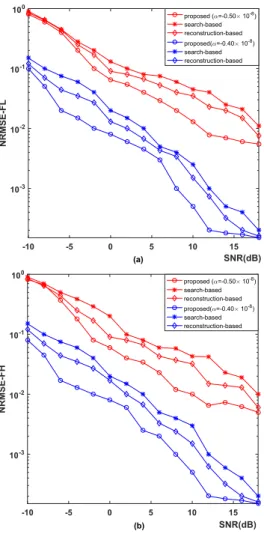
In Fig. 7, the SNR varies from−10dBto 18dBwith a step of 2 dB. The fractional orderαisn
−0.50×10⁻⁸,−0.40
×10−8o
. It is common that the NRMSE decreases with in- creasing SNR in both the proposed method and compared methods. And it is clear that the proposed method has better accuracy.
Figure 8 depicts the performance in terms of NRMSE with different SNRs and fractional orderαfor the proposed method. The SNR varies from−105dBto 18dBwith a step of 2dB. The fractional orderαvaries fromn
−0.50×10⁻⁸o ton
−0.36×10⁻⁸o
with a step ofn
−0.02×10⁻⁸o
. It is ob- served that the NRMSE has the opposite trend as the SNR.
5. Conclusion
This paper introduces a parameter estimation method to de- termine the initial frequency and final frequency of the frac- tional bandlimited LFM signals by using OMP. The edge
Fig. 7 The relationship between the NRMSE and SNR.
Fig. 8 The relationship between the NRMSE and SNR.
information of the spectrum can be extracted effectively in DTSFrFD, and the corresponding frequencies are obtained.
The proposed method avoids reconstruction and the tradi- tional peak-searching procedure, and it only needs two iter- ations. The theoretical analysis and the simulations results
demonstrate better performance of the proposed method in comparison with existing methods.
Acknowledgments
This work is supported by National Natural Science Founda- tion of China (No. 61271354) and Henan Province Science and Technology Key Project (No. 142102210431).
References
[1] A. Serbes, “On the estimation of LFM signal parameters: Analyti- cal formulation,” IEEE Trans. Aerosp. Electron. Syst., vol.54, no.2, pp.848–860, 2018.
[2] H.M. Ozaktas, Z. Zalevsky, and M.A. Kutay, The Fractional Fourier Transform: With Applications in Optics and Signal Processing, Wi- ley, 2001.
[3] R. Tao, B. Deng, and Y. Wang, “Research progress of the fractional Fourier transform in signal processing,” Sci. China, vol.49, no.1, pp.1–25, 2006.
[4] L. Qi, R. Tao, S. Zhou, and Y. Wang, “Detection and parameter estimation of multicomponent LFM signal based on the fractional Fourier transform,” Sci. China Ser. F: Inf. Sci., vol.47, no.2, pp.184–
198, 2004.
[5] C. Capus and K. Brown, “Fractional Fourier transform of the Gaus- sian and fractional domain signal support,” IEE Proceedings - Vi- sion, Image and Signal Processing, vol.150, no.2, pp.99–106, 2003.
[6] Y. Zhao, Y. Hua, W. Gang, J.I. Fei, and F. Chen, “Parameter estima- tion of wideband underwater acoustic multipath channels based on fractional fourier transform,” IEEE Trans. Signal Process., vol.64, no.20, pp.5396–5408, 2016.
[7] X. Liu and C. Wang, “A novel parameter estimation of chirp signal inα-stable noise,” IEICE Electron. Express, vol.14, no.8, pp.1–11, 2017.
[8] Y. Liu, Y. Zhao, J. Zhu, Y. Xiong, and B. Tang, “Iterative high- accuracy parameter estimation of uncooperative OFDM-LFM radar signals based on FrFT and fractional autocorrelation interpolation,”
Sensors, vol.18, no.10, pp.3550–3559, 2018.
[9] L. Tao, Z. Qian, X. Fan, and P. Chen, “Parameter estimation of LFM signal intercepted by improved dual-channel Nyquist folding receiver,” Electron. Lett., vol.54, no.10, pp.659–661, 2018.
[10] J. Song, Y. Liu, and Y. Wang, “Iterative interpolation for parameter estimation of LFM signal based on fractional Fourier transform,”
Circuits Syst. Signal Process., vol.32, no.3, pp.1489–1499, 2013.
[11] Y. Chen, L. Guo, and Z. Gong, “The concise fractional Fourier trans- form and its application in detection and parameter estimation of the linear frequency-modulated signal,” Chinese J. Acoust., no.1, pp.70–86, 2017.
[12] Y.X. Zhang, R.J. Hong, C.F. Yang, Y.J. Zhang, Z.M. Deng, and S. Jin, “A fast motion parameters estimation method based on cross- correlation of adjacent echoes for wideband LFM radars,” Applied Sciences, vol.7, no.5, p.500, 2017.
[13] Y. Jin and D. GAO, “Parameter estimation of LFM signals based on synchrosqueezing chirplet transform in complicated noise,” J. Elec- tron. Inf. Technol., vol.39, no.8, pp.1906–1912, 2017.
[14] S. Barbarossa, “Analysis of multicomponent LFM signals by a combined Wigner-Hough transform,” IEEE Trans. Signal Process., vol.43, no.6, pp.1511–1515, 1995.
[15] G. Bai, Y. Cheng, W. Tang, and S. Li, “Chirp rate estimation for LFM signal by multiple DPT and weighted combination,” IEEE Sig- nal Process. Lett., vol.26, no.1, pp.149–153, 2019.
[16] F.G. Geroleo and M. Brandt-Pearce, “Detection and estimation of LFMCW radar signals,” IEEE Trans. Aerosp. Electron. Syst., vol.48, no.1, pp.405–418, 2012.
[17] T. Jensen, J.K. Nielsen, J.R. Jensen, M.G. Christensen, and S.H.
Jensen, “A fast algorithm for maximum likelihood estimation of harmonic chirp parameters,” IEEE Trans. Signal Process., vol.65, no.19, pp.5137–5152, 2017.
[18] D. Fourer, F. Auger, K. Czarnecki, S. Meignen, and P. Flandrin,
“Chirp rate and instantaneous frequency estimation: Application to recursive vertical synchrosqueezing,” IEEE Signal Process. Lett., vol.24, no.11, pp.1724–1728, 2017.
[19] X. Meng, A. Jakobsson, X. Li, and Y. Lei, “Estimation of chirp sig- nals with time-varying amplitudes,” Signal Process., vol.147, pp.1–
10, 2018.
[20] Y. Doweck, A. Amar, and I. Cohen, “Fundamental initial fre- quency and frequency rate estimation of random amplitude har- monic chirps,” IEEE Trans. Signal Process., vol.63, no.23, pp.6213–
6228, 2015.
[21] W. Yi, Z. Chen, R. Hoseinnezhad, and R.S. Blum, “Joint estima- tion of location and signal parameters for an LFM emitter,” Signal Process., vol.134, pp.100–112, 2017.
[22] D. Ding, N. Cheng, and Y. Liao, “LFM signal parameters estima- tion using optimization approach initialized by Lipschitz constant assisted DIRECT algorithm,” Circuits, Syst. Signal. Process., vol.34, no.6, pp.2037–2051, 2015.
[23] L. Applebaum, S.D. Howard, S. Searle, and R. Calderbank, “Chirp sensing codes: Deterministic compressed sensing measurements for fast recovery,” Appl. Comput. Harmon. Anal., vol.26, no.2, pp.283–
290, 2009.
[24] S.I. Adalbj¨ornsson, A. Jakobsson, and M.G. Christensen, “Multi- pitch estimation exploiting block sparsity,” Signal. Process., vol.109, pp.236–247, 2015.
[25] L. Gao, S.-Y. Su, and Z.-P. Chen, “Orthogonal sparse represen- tation for chirp echoes in broadband radar and its application to compressed sensing,” J. Electron. Inform. Technol., vol.33, no.11, pp.2720–2726, 2011.
[26] B. Fang, G.M. Huang, and J. Gao, “A multichannel blind com- pressed sensing framework for linear frequency modulated wide- band radar signals,” Zidonghua Xuebao/acta Automatica Sinica, vol.41, no.3, pp.591–600, 2015.
[27] L. Hu, J. Xiong, Z.Z. Guang, and S.Q. Fu, “Compressed sensing of superimposed chirps with adaptive dictionary refinement,” Sci.
China Inf. Sci., vol.56, no.12, pp.1–15, 2013.
[28] B. Fang, G. Huang, J. Gao, and W. Zuo, “Compressive sensing of linear frequency modulated echo signalsin fractional Fourier do- mains,” J. Xidian University, vol.42, no.1, pp.200–206, 2015.
[29] L.B. Almeida, “The fractional fourier transform and time-frequency representations,” IEEE Trans. Signal Process., vol.42, no.11, pp.3084–3091, 1994.
[30] S.C. Pei and J.J. Ding, “Simplified fractional fourier transforms,” J.
Opt. Soc. Am. A, vol.17, no.12, pp.2355–2367, 2000.
Appendix:
Spectrum distribution characteristics of LFM signal in SFrFD
A monocomponent LFM signal is defined by:
x(t)=A·expx
j2πf0t+jπKl f mt2
(A·1) Where f0is the initial frequency.Ais the amplitude ofx(t) which could berandom or fixed.Kl f mis the modulation rate.
And the duration time ofx(t) ish
−Td
2,T2di . The SFrFT ofx(t) can be calculated by
Xα(u)=A(j2π)−1/2Z ∞
−∞
exp
−jut+jt2cotα/2
· exp
j2πf0t+jπKl f mt2 dt
=A(j2π)−1/2 Z ∞
−∞
exp jπ
Kl f m+cotα/2π
t2+ j2πf0t
·
exp (−jut)dt (A·2)
According to (A·2), Xα(u), the SFrFT of x(u), denotes the FT of another LFM signal whose modulation rate is Kl f m0 =Kl f m+cotα/2π, initial frequency is f0, and the fre- quency interval ish
f0−Kl f m0 T2d,f0+Kl f m0 T2di
. So the band- width isB0=Kl f m0 ·Td. It can be interpreted that the SFrFT rotates the time-frequency distribution curve ofx(t) in the clockwise direction with angleα, so that the modulation rate and bandwidth changes.
Thus,
Xα(u) = √A
2K0l f mexp
−j(u−2πu4πK00cscα)2 l f m
· {[c(u2)+c(u1)]+ j[s(u2)+s(u1)]} Where
c(u)=Ru 0 cosπ
2x2 dx and
s(u)=Ru 0 sinπ
2x2 dx is the Fresnel integral. And
u1= q
2Kl f m0 Td
2 −u−2πu0cscα
Kl f m0
u2= q 2Kl f m0
Td
2 +u−2πuK00cscα
l f m
(A·3)
whereu0= f0sinα.
So the amplitude spectrum ofXα(u) is
|Xα(u)|= A q2Kl f m0
·
n[c(u2)+c(u1)]2+[s(u2)+s(u1)]2o1/2
(A·4) and the phase spectrum is
θ(u) = θ1(u)+θ2(u)
= −(u−2πu0cscα)2
4πKl f m0 +arctan
"
s(u2)+s(u1) c(u2)+c(u1)
#
(A·5) SubstitutingKl f m0 = BT0 into Eq. (A·5):
u1= √
2B0Td1
2 −u−2πu0cscα
B0
u2= √ 2B0Td
1
2 +u−2πuB00cscα (A·6)
According to the property associated with Fresnel inte- gral, whenB0Td 1, i.e.Kl f m0 Td2 1,c(u2)≈s(u2)≈ 12, so
|Xα(u)| ≈ √A
Kl f m0 ·rectu−2πu
0cscα B0
= √ A
Kl f m+cotα/2π ·rectu−2πu0cscα
B0
, θ(u)≈ −π(u−2πu0cscα)2
Kl f m0 +π4
=−π(u−2πuK 0cscα)2
l f m+cotα/2π +π4. Therefore, when
Kl f m+cotα/2π
Td2 1,|Xα(u)|is approximately a rectangular spectrum.
Xiaomin Li received the B.Eng. degree in electronic engineering from Nanjing Univer- sity of Science and Technology, China, in 2011.
Currently she is a research student working to- wards the Ph.D. degree in Nanjing University of Science and Technology, China. Her re- search interests include information processing and time-frequency analysis for communication signals.
Huali Wang received the Ph.D. degree in electronic engineering from the Nanjing Univer- sity of Science and Technology, China, in 1997.
He is currently a Professor with the College of Communication Engineering, The Army Engi- neering University of PLA, Nanjing, China. His research interests include satellite communica- tion and signal processing.
Zhangkai Luo received the B.Eng. degree in measurement, control and instruments from Hebei University of Technology, Tianjin, China, in 2011. Currently he is a research student work- ing towards the Ph.D. degree in PLA Univer- sity of Science and Technology, China. His re- search interests include information processing and confrontation.