PAPER Special Section on Intelligent Transport Systems
Attribute-Aware Loss Function for Accurate Semantic Segmentation Considering the Pedestrian Orientations
Mahmud Dwi SULISTIYO†,††a),Nonmember, Yasutomo KAWANISHI†b), Daisuke DEGUCHI†††c),Members, Ichiro IDE†d),Senior Member, Takatsugu HIRAYAMA††††e),Member, Jiang-Yu ZHENG†††††f),Nonmember, andHiroshi MURASE†g),Fellow
SUMMARY Numerous applications such as autonomous driving, satel- lite imagery sensing, and biomedical imaging use computer vision as an important tool for perception tasks. For Intelligent Transportation Systems (ITS), it is required to precisely recognize and locate scenes in sensor data.
Semantic segmentation is one of computer vision methods intended to per- form such tasks. However, the existing semantic segmentation tasks label each pixel with a single object’s class. Recognizing object attributes, e.g., pedestrian orientation, will be more informative and help for a better scene understanding. Thus, we propose a method to perform semantic segmenta- tion with pedestrian attribute recognition simultaneously. We introduce an attribute-aware loss function that can be applied to an arbitrary base model.
Furthermore, a re-annotation to the existing Cityscapes dataset enriches the ground-truth labels by annotating the attributes of pedestrian orientation.
We implement the proposed method and compare the experimental results with others. The attribute-aware semantic segmentation shows the ability to outperform baseline methods both in the traditional object segmentation task and the expanded attribute detection task.
key words: semantic segmentation, attribute-aware, pedestrian orienta- tion, deep neural network
1. Introduction
Computer vision plays an important role in perception tasks and has been widely utilized for various purposes such as au- tonomous driving[1], satellite imagery sensing[2], biomed- ical imaging[3],[4], face recognition[5], and robotics nav- igation[6]. For Intelligent Vehicle (IV) applications, it is very important to have a comprehensive understanding of surrounding scenes captured by in-vehicle cameras. For ex- ample, weather conditions can be predicted by recognizing
Manuscript received March 7, 2019.
Manuscript revised July 3, 2019.
†The authors are with the Graduate School of Informatics, Na- goya University, Nagoya-shi, 464-8601 Japan.
††The author is also with the School of Computing, Telkom University, Indonesia.
†††The author is with the Information Strategy Office, Nagoya University, Nagoya-shi, 464-8601 Japan.
††††The author is with the Institutes of Innovation for Future So- ciety, Nagoya University, Nagoya-shi, 464-8601 Japan.
†††††The author is with the Department of Computer Science, In- diana University-Purdue University Indianapolis, USA.
a) E-mail: [email protected] b) E-mail: [email protected]
c) E-mail: [email protected] d) E-mail: [email protected]
e) E-mail: [email protected] f) E-mail: [email protected]
g) E-mail: [email protected] DOI: 10.1587/transfun.2019TSP0001
road and sky[7]for vehicle safety. Ground marking detec- tion is useful for vehicle localization purposes[8],[9]and it is also necessary to mark drivable roads for lane instructions in a smart car[10]. Moreover, recognizing the behavior of pedestrians is also important to plan the vehicle actions[11].
Obstacle detection is important for an autonomous ve- hicle to avoid collisions by breaking, lowering or keeping the speed. However, understanding the situation around the obstructing objects instead of only focusing on the obstacles will allow us to handle even more complicated situations.
Semantic segmentation, as one of computer vision tasks, classifies all desired things in an input image and locates their areas, ultimately in pixel-level precision. This provides more decisive information than just detection to help an au- tonomous vehicle in achieving a better scene understanding;
Semantic segmentation provides more environmental infor- mation to instruct the vehicle with an immediate breaking or further to recommend an optimal path for collision avoid- ance.
Only in a few years, semantic segmentation has at- tracted many studies in building deep neural network mod- els. They include Fully Convolutional Network[12], SegNet [1], Bayesian SegNet[13], PSPNet[14], Mask R-CNN[15], ICNet[16], and the DeepLab from versions v1 to v3+[17]–
[19]. Several datasets consisting of input images and the ground-truth annotations such as CamVid[20], KITTI[21], and Cityscapes [22]are also publicly available for bench- marking purpose. The latter is very popular in the semantic segmentation task for autonomous driving, pushing many researchers and practitioners in such competition to reach higher ranks.
However, most of the existing semantic segmentation methods only learn to recognize object types such as road, building, car, and person. For autonomous vehicles, addi- tional information describing an object in details such as its attributes could help the better understanding of scenes[11].
Figure 1 illustrates the ultimate goal of this newly proposed task should we apply it to some moving objects. In addition, breaking down a class into several sub-classes can reduce the variation of class instances to help the classification process.
Therefore, as our objective, we aim at improving the segmen- tation accuracy in pixel-level by considering attribute infor- mation attached to particular objects. This paper exploits the attribute-aware semantic segmentation, with the simul- taneous combination of attribute recognition and semantic Copyright © 2020 The Institute of Electronics, Information and Communication Engineers
Fig. 1 A general view illustrating the purpose of the newly proposed attribute-aware semantic segmentation for a better scene understanding.
segmentation. It is implemented as a multi-task learning paradigm and is expected to be able to enhance environ- ment perception tasks for ITS purposes. In a preliminary work[23], this task was designed in three successive stages, i.e., semantic segmentation, object detection, and attribute recognition, but our current work proposes an approach to train the model in an end-to-end process. The concept was initially introduced in our previous paper [24], while this paper reveals additional aspects along with a newly extended dataset and base models.
This paper focuses on pedestrian detection and selects body orientation as its attribute. Simply detecting the exis- tence of a pedestrian is necessary for an autonomous vehicle to take immediate actions before collision. However, we con- sider that the pedestrian’s body orientation is an important sign of walking direction to anticipate possible risks from a distance. The information of body orientation becomes a clue to the pedestrian movement and hence helps potential collision avoidance. They are useful for a motion planning module to plan a vehicle’s future actions. Although pedestri- ans might suddenly change their direction or movement state, an accurate segmentation system will recognize the changes in pedestrian attribute and make the decision again. This ex- plains why simply knowing the existence of a pedestrian is sometimes inadequate for a smart vehicle. Predicting the op- timal path is difficult without gaining pedestrian attributes;
Thus, the attribute-aware semantic segmentation task is more beneficial to ITS applications.
Here, we also show the re-annotation process on an ex- isting dataset, documenting our effort to provide the ground- truth required in this task. Althoughonlypedestrian orien- tation is added as a new semantic information, it gives hint and insight to other object attributes when the method is extended. In summary, our contributions are as follows:
1. We introduce a new concept of attribute-aware seman- tic segmentation that enables an end-to-end training process.
2. The proposed attribute-aware loss function is able to treat both object classes and attribute classes in the same manner and hence is applicable to all base models.
3. We construct the CityWalks dataset with an attribute
annotation of pedestrian orientations as an extension to the Cityscapes dataset.
4. We show experimental results proving that the proposed approach achieves a better performance over the base- line methods and is capable of providing attribute in- formation in the segmented results.
The rest of this paper explores related works in Sect. 2, describes details of the proposed method and its implemen- tation in Sect. 3, and explains the dataset construction in Sect. 4. Experimental results and analyses are discussed in Sect. 5 and Sect. 6 respectively, followed with a conclusion in Sect. 7.
2. Related Work
In recent years, many studies have been conducted to develop deep neural network models for the semantic segmentation task. Liu et al. provides a comprehensive review to summa- rize the recent progress of semantic segmentation approaches and datasets[25]. For the attribute-aware semantic segmen- tation task, which can basically be regarded as a multi-task learning goal, we have been conducting a study despite some limitations. A part of work regarding this initial concept has been published in paper[24].
2.1 Semantic Segmentation Datasets
One of publicly available semantic segmentation datasets, namely Cityscapes[22],[26], is constructed mainly for au- tonomous driving research and development purpose. It ad- equately depicts the complexity of real-world urban scenes and therefore exceeds previous efforts in terms of dataset size, annotation richness, and scene diversity. The vehicle- mounted cameras, while moving, recorded videos of traffic scenes during the daytime from 50 cities in Germany and some neighboring countries. The data collection covers sea- son changes during several months-span including spring, summer, and fall. The captured road scenes include cloudy and sunny weathers, but do not include adverse weather con- ditions such as heavy rain or snow[22]. The first row of Fig. 6 shows examples of the Cityscapes images. A number of frames are then extracted from the recorded videos, which results in 5,000 images with high quality pixel-level annota- tions and 20,000 additional images with coarse annotations.
The fine-annotated images are divided into 2,975 images for training and 500 images for validation, while the remain- ing 1,525 images are for testing that is available to the public without annotations as they are designated for benchmarking purpose through the Cityscapes Web site†. Each of the three split sets is carefully organized to have equal distributions in some properties such as the city crowd levels and geo- graphical locations. However, there is no information about the distribution of the data for each weather condition. The dataset challenges researchers to classify 19 different classes in the pixel-level semantic labeling task.
†https://www.cityscapes-dataset.com/benchmarks/
2.2 Semantic Segmentation Models
A Fully Convolutional Network (FCN) was introduced by Long et al. as a model of semantic segmentation trained in an end-to-end process[12]. FCN extends the existing mod- els containing fully-connected layers for classification to the semantic segmentation task. This model takes an arbitrary size of input image and produces a pixel-wise segmentation map. To reduce the computational cost, Badrinarayanan et al.
presented SegNet[1]with two deep convolutional streams, namely encoder and decoder. It adapts the VGG16 network [27] without employing fully-connected layers. Each en- coder layer in the model has a corresponding decoder layer and is ended with a final pixel-wise classification layer. It was then enhanced by Kendall et al. as Bayesian SegNet[13]
to obtain better performance by considering a probabilistic element.
The Pyramid Scene Parsing network (PSPNet) architec- ture by Zhao et al.[14]uses ResNet[28]as its backbone, fol- lowed by a pyramid module pooling. It extracts features from four different scales, and then merge them after up-sampling each feature to the same resolution. This pipeline effec- tively produces combined multi-scale feature maps without performing multiple convolutions. It showed its remark- able performance on PASCAL VOC [29] and Cityscapes datasets [22]. Meanwhile, the Mask R-CNN by He et al.
[15]arose with a new conceptual framework. It performs objects detection in parallel with segmentation mask cre- ation for each object instance. It modifies the Faster R- CNN[30]model by adding a segmentation branch to work together with the existing bounding-box detection branch.
Very recently, DeepLab-v3+ [19]was developed by Chen et al. from the previous DeepLab-v3 [18] version by em- ploying an encoder-decoder structure. The encoder module utilizes multi-scale atrous convolution to encode contextual information at multiple scales, while the decoder effectively improves the segmentation results.
2.3 Multi-Task Learning
Multi-Task Learning (MTL) is a machine learning paradigm that leverages useful information by solving multiple related tasks simultaneously. Zhang and Yang made an extensive survey[31]on numerous MTL algorithms, classified them into some categories, and summarized the results including applications in the area of computer vision. Meanwhile, Ruder described that for the deep learning context, MTL would typically be performed with either two concepts:hard orsoft parameter sharing[32].
Mask R-CNN[15]is one of deep learning models that applies the MTL paradigm by adding the functionality of in- stance segmentation. The idea is simple but powerful enough to place top ranks in three challenges including instance seg- mentation, object detection, and person key-point detection.
Recently, the MTL paradigm is widely implemented for var- ious purposes. An MTL-based CNN was presented by Lu et
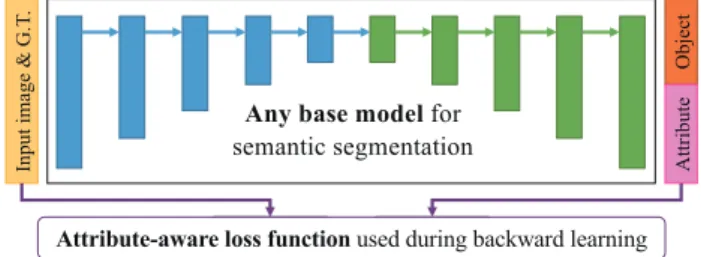
Fig. 2 Our general approach of multi-task learning for attribute-aware semantic segmentation; Unlike other existing works, an attribute-aware loss function is proposed to deal with the attributes (either exists or not), and applicable to any arbitrary base model.
al.[33]to address food segmentation, recognition, and vol- ume estimation, which successfully outperforms the baseline methods. Another MTL architecture with heavy sharing of weights and features was introduced in[34]to perform four tasks: 2D pose estimation, 3D pose estimation, 2D action recognition, and 3D action recognition.
In some references related to MTL, each task is treated in a different manner and solved by modifying the classifier model. Commonly, the loss function can handle multi-task conditions of the input image, yet is not considered for non- multi-task conditions simultaneously. The concept proposed in this paper will overcome this limitation. Concretely, we design a loss function that is general as in Fig. 2 to be applied to all input images through the same calculation flow without any change of network architecture.
3. Attribute-Aware Semantic Segmentation
We propose a new task named “attribute-aware semantic segmentation” to yield a richer output than a conventional pixel-wise labeling task, which can be implemented as an MTL framework. Through this task, in addition to recog- nizing the object class of each pixel, we can also obtain the attribute information associated with the object. Addition- ally, this newly proposed task is also aimed at improving the segmentation performance. Typically, the instances of a particular class, for example, person, have a high variance in shape and appearance. This makes an algorithm difficult to classify heterogeneous instances into a correct class. Our idea is to divide such a class into several sub-classes accord- ing to its attribute values. This will reduce the diversity in each sub-class and thereby simplify the classification task.
Instead of reconstructing the model architecture, the proposed approach basically deals with the training process.
Since the original class, i.e. person, might be necessary if the attribute value looks unknown, we simply add the sub-class set corresponding to the attribute values at the same level of object classes in the base model’s output layer, yet maintain each attribute as astill-derivedclass using a loss function.
Thus, any base semantic segmentation model can be made use of in the proposed method.
3.1 Designing an Attribute-Aware Loss Function
In the semantic segmentation task, a pixel-wise cross- entropy loss has been the most commonly used loss function so far. The final layer of a segmentation model produces out- put tensor channels as many as the number of object classes.
Each output channel representing a class contains the prob- abilities of all pixels to be classified into that class. The loss function (L) examines every pixel individually according to its class predictions (ρk) by comparing a depth-wise pixel vector to the encoded target vector (yk) as follows.
L= 1 N
N
X
i
`i (1)
`i =−
|C|
X
k
yklog(ρk) (2)
The log loss for thei-th pixel is calculated on thek-th class and then summed over all possible classes (C). This scoring is repeated over all N pixels and averaged to obtain the overall image loss. To improve the object segmentation result, attribute information is considered to be important.
By dividing a particular class into sub-classes according to its distinct attribute values, a more appropriate pixel-wise labeling can be obtained. Therefore, we need to consider attribute loss in addition to object class loss when evaluating the prediction of pixels containing attribute information.
`i =
`oi +`ai if thei-th pixel has an attribute
`oi otherwise (3)
For example, suppose that three objects form the target classesC ={X,Y,Z}, and classX has two attribute classes AX = {X1,X2}. Pixel area or instances labeled as the at- tributed object X will be valued additionally to either of those attributes,X1orX2. However, in some conditions due to visual limitation, we cannot always assign every instance of an attributed class with an attribute value. To allow this, there will be some pixels annotated as classXbut with an un- known attribute. LabelXremains as a target class and the set of targets is obtained by combiningCandAX(or justA) to be C∪A={X,Y,Z,X1,X2}. This clarifies Eq. (3) that`ioand
`ai are distinguished based on which the class set is used such that`oi =−Σ|C|
k yklog(ρok)and`ia=−Σ|C∪A|
k yklog(ρak).
With the general class setting described above, we can calculate two independent losses: Lo penalizes every pixel across all object classes and La does so to all combined object and attribute classes. These loss functions allow us to evaluate object and attribute classes simultaneously while maintaining the dependency of attributes to an object. To solve the problem in one calculation flow, we combine the two losses via key parameters of weights, namely ˆβoand ˆβa, to construct the attribute-aware loss function:
L= βˆo
βˆo+βˆaLo+ βˆa
βˆo+βˆaLa, (4)
where the values for ˆβo and ˆβacan be arbitrarily assigned any real number to represent the amount of contributions from LoandLatoward the final loss calculation. We then simplify βˆβˆo
o+βˆa and βˆβˆa
o+βˆa with βo andβa, respectively, to equally re-form the formula as follows:
L= βoLo+βaLa. (5) According to Eq. (4), βoandβain Eq. (5) should satisfy the condition of βo+βa =1. SinceL is proportional to` as defined in Eq. (1), the loss for each pixel is
`i =βo`oi +βa`ai. (6) By replacingyklog(ρk)in Eq. (2) withEkfor simplification, we then break down Eq. (6) with object and attribute classes mentioned in the above case as follows:
`i = βoΣ|C|
k Eo
k +βaΣ|C∪A|
k Ea
k,
= βo(EXo +EYo+EoZ)+ βa(EaX+EYa+EZa+EXa
1+EaX
2).
The proposed framework puts object and attribute classes together in the output layer so it is easy to calculate La. Meanwhile, to calculateLo, the likelihoodρokfor each object class can be copied from ρa
k, since X, Y, and Z in the calculation forLa are designated to the same classes in the calculation forLo. This makesρoX =ρaXthat impliesEoX = Ea
X, and the same also applies toEo
YandEo
Zto continue and simplify the derivation as
`i = βo(Ea
X+Ea
Y+Ea
Z)+ βa(Ea
X+Ea
Y+Ea
Z+Ea
X1+Ea
X2),
= βoEa
X+βoEa
Y+βoEa
Z+ βaEaX+βaEYa+βaEZa+βaEXa
1+βaEXa
2,
= (βo+βa)EaX+(βo+βa)EYa+(βo+βa)EaZ+ βaEaX
1+βaEXa
2,
`i =EXa +EYa+EZa+βaEaX
1+βaEXa
2,
=
|C|
X
k
Ea
k +βa
|A|
X
k
Ea
k. (7)
The formula derivation along with the aforementioned scheme and class setting ensures that the proposed loss func- tion with two entire-image losses in Eq. (4) will penalize each pixel with object and attribute losses as defined in Eq. (6).
Hence, it should be able to treat both attributed and non- attributed objects simultaneously in one calculation flow.
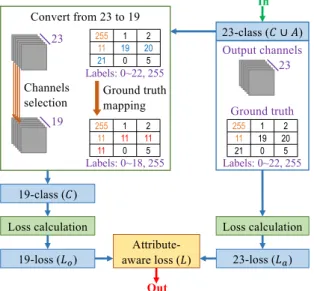
Figure 3 illustrates the proposed loss function and com- pares it to the basic semantic segmentation, while the re- maining part of this section will explain the implementation especially in the study discussed in this paper.
3.2 Implementation of the Semantic Segmentation The difference between baseline methods and the proposed method lies inside the loss calculation process in the train- ing phase, while other processes remain basically the same.
Fig. 3 Illustration of the proposed method in Sect. 3, and comparison of conventional semantic seg- mentation and the proposed attribute-aware semantic segmentation via a simple case, where objects and attributes areC={X,Y,Z}andAX={X1,X2}, respectively.
Fig. 4 Block diagram of the proposed loss calculation in the semantic segmentation network; pixels with class “person” are annotated as 11, while ignored pixels are annotated as 255.
Figure 4 depicts the block diagram explaining the modifica- tion applied to the standard loss function. In the Cityscapes challenge, images are annotated with 19 object classes. We add four attribute values correspondingly to pedestrian body orientations (back, right, front, and left), resulting in the ground-truth labels re-annotated in 23 classes. Before count- ingLoandLaseparately, we convert the ground-truth maps and output channels from 23-class to 19-class mode. In the ground-truth conversion, the proposed algorithm maps all four orientation labels to one-person label, while in the outputs conversion, it selects channels corresponding to 19 object classes and omits any attribute channel.
Algorithm 1 shows this process. We can see that the input parameters (i.e. output channels and target map) be- tween the standard and the proposed loss functions are the same. Therefore, in terms of algorithm complexity, the pro- posed method is not very different compared to the standard one. The actual codes for training and testing were based on Deng’s implementation[35]obtained from a GitHub repos- itory†, of which some modules were modified to implement the proposed algorithm properly.
†https://github.com/zijundeng/pytorch-semantic-segmentation/
Algorithm 1:The attribute-aware loss function
FunctionGtMapping(gt):
gt[(gt=attribute_id)]←person_id returngt
FunctionChannelSelection(out):
num←num_all_class−num_attribute out←out[0:num]
returnout
FunctionStandardLoss(gt,out):
returnCrossEntropyLoss(gt,out)
FunctionAttributeAwareLoss(gt,out,βˆo,βˆa):
gto←GtMapping(gt)
outo←ChannelsSelection(out) Lo←StandardLoss(gto,outo) La←StandardLoss(gt,out)
return( ˆβo/ ( ˆβo+ ˆβa))Lo+ ( ˆβa/ ( ˆβo+ ˆβa))La
4. Construction of the CityWalks Dataset
There are numerous datasets publicly available for the se- mantic segmentation challenge, but none of them includes attribute information together with the object class in the given labels. Therefore, for the proposed attribute-aware semantic segmentation task, a modification on top of an ex- isting dataset is required. Here, we use the Cityscapes dataset as the base and re-annotate the labels as needed by dividing a certain object into a number of attribute labels.
4.1 Pedestrian Orientation as Attributes
As mentioned in Sect. 1, we choose the class person as a target because a driver must pay attention to moving objects, especially a pedestrian, while driving. Since the walking direction is also important for the driver to determine his/her actions, body orientation is designated as an attribute to en- rich the class ofperson. We introduced the initial concept of our work in[24], but it was not effective enough to achieve good accuracy in classifying the orientations. In this paper, we consider four orientation classes as considered in devel- oping an autonomous vehicle[36], includingback(0◦),right (90◦),front(180◦), andleft (270◦). Information regarding
Fig. 5 Guidance for four orientations annotation.
Table 1 Statistics of the CityWalks dataset.
Training set Validation set
#image 2,975 500
#image withperson 2,345 402
#image with 4 orientation attributes 2,083 371
%image withpersonin the dataset 78.82 % 80.40 %
%image with attributes in the dataset 70.02 % 74.20 %
%personpixels in the dataset 1.08 % 1.15 %
%attribute pixels in the dataset 1.03 % 1.09 %
these directions of a pedestrian is meaningful and especially important for ITS purposes, because it can provide informa- tion on whether a pedestrian is intending to walk across the street, is aware of the vehicle, or walks on a sidewalk along the street, and so on. We use the guidance as shown in Fig. 5 to re-annotatepersoninstances in the Cityscapes dataset.
4.2 Extending Dataset Annotation to the CityWalks Dataset
Unlike the preliminary work[23]that utilizes the CityPer- sons [37] bounding box, we completely re-annotate the Cityscapes dataset’s ground-truth labels manually. We achieved this re-annotation in a much better quality by com- pleting missing pedestrians as well as small body parts such as toe, hand, and head. In addition, through this, the number of pixels annotated with attribute values drastically increased for training and evaluation purposes.
We performed the re-annotation using a conventional image editor. It took around 1.5 minutes per image for ‘easy’
or ‘moderate’ cases including those that covered quite a few persons in one image. However, for ‘difficult’ images which contains a crowd of pedestrians with various orientations, it took approximately ten minutes per image.
Statistics on this new annotation is summarized in Table 1, while some visual results before-and-after re- annotation are shown in Fig. 6. The annotated colors cor- responding to all classes are visualized in Fig. 7. We name the dataset CityWalks, a modified Cityscapes dataset with additional labels corresponding to pedestrian orientations, and will make it available to the public.
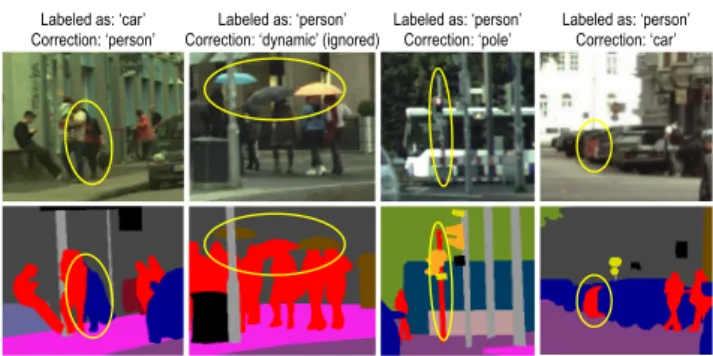
In addition to new annotations, this process also pro- vides some corrections to the original ground-truth labels given in the Cityscapes dataset. The mistakes we found in- clude several labels swapped between objects, missed or ig- nored pedestrians, and inconsistent labels for items attached to a pedestrian such as umbrella, bag, etc. Figure 8 shows some samples of incorrect ground-truth labels found in the Cityscapes dataset.
Fig. 6 Comparing ground-truth annotations of scenes in the original Cityscapes and the extended CityWalks datasets.
Fig. 7 Color annotations for Cityscapes and CityWalks datasets.
Fig. 8 Samples of incorrect annotations in the original Cityscapes dataset.
5. Experimental Results
5.1 Methods Comparison
We evaluated the following methods in our experiments:
(1) FCN8s[12]andPSPNet[14]are the baseline methods with the same base semantic segmentation models built in[12]and[14]. We re-train each of them using the standard loss function and the Cityscapes dataset to output 19 object classes.
(2) FCN8s.23clsandPSPNet.23clsare same as the base- line methods (1) but trained with CityWalks dataset to
Fig. 9 Baseline (PSPNet), proposed, and comparative methods.
output 23 classes.
(3) PSPNet.comp is a comparative method representing the MTL-based architecture; It modifies PSPNet.23cls by splitting convolution layers to separately output be- tween object and attribute segmentation tasks. With the same training set as used in (2), each object and at- tribute branch uses the standard loss function to output (19+4) classes.
(4) FCN8s.propandPSPNet.propare our proposed meth- ods which utilize the same models as in (2), but apply the proposed attribute-aware loss function during the training process. The training set and the number of output classes are the same as (2). The default values for ˆβoand ˆβa in FCN8s.prop are 0.7 and 0.3, respec- tively, while for PSPNet.prop, they are equally set as 0.5.
Figure 9 depicts the four methods used in our experi- ments with PSPNet as the base model. In the training stage, we used a batch size of 4 and the maximum iteration of 50,000 or equivalent with 66 epochs. All images and cor- responding ground-truth labels were resized from 2,048× 1,024 pixels to 1,024×512 pixels. We set 512×512 pixels as the window cropping size.
5.2 Segmentation Performance
The segmentation performance of each method for local eval- uation is calculated based on metrics including global Ac- curacy (gAcc), per-class Accuracy (cAcc), Intersection over Union (IoU), and mean IoU (mIoU). Moreover, we consider IoU for thepersonclass (IoUp) to particularly see how the attribute of pedestrian orientation affects the segmentation model in classifying the object class from which those at- tributes are derived. Detailed definitions on these metrics are provided in our previous paper[24]. In short, gAcc is obtained by the number of correctly-predicted pixels across all classes compared to the number of all pixels, and cAcc is similar to gAcc but calculated for each class, then averaged for all classes. Meanwhile, IoU of each class is the number of true positives divided by the sum of true positives, false positives, and false negatives.
The performances are measured in two ways: object segmentationthat consists of 19 classes corresponding to all objects, andattribute segmentationthat only focuses on four orientation classes. The output of the model trained with the Cityscapes dataset contains 19 labels and thus we only assess it with the object segmentation performance. Mean- while, for all models trained with the CityWalks dataset, we can measure them with both object and attribute segmen- tation performances. Their segmentation outputs, however, contain 23 labels including all objects and attributes. There- fore, to calculate the object segmentation performance, we need to convert the output and ground-truth labels from 23- class mode to 19-class mode by substituting all attribute labels (19∼22) with thepersonlabel (11). For attribute seg- mentation performance, we convert the labels into four-class mode by ignoring all object labels (0∼18) before calculating each IoU. Especially for PSPNet.comp, the four attribute la- bels are not merged into theperson label since object and attribute classes are already divided into two output maps.
5.3 Comparison of Validation Performances
We train each model using the training set containing 2,975 images and calculate the performance using 500 images in the validation set. Table 2 shows the performance compar- ison between object segmentation models. Performances in terms of attribute segmentation are compared in Table 3 where all models are trained with the CityWalks dataset.
Note that we are not focusing between different base models here since it is already proven in the previous study[14]that PSPNet works much better than FCN8s in the pixel-wise la- beling task. Therefore, we compare the performances locally for each base model.
As we can see in Table 2, FCN8s.prop only loses versus FCN8s in terms of IoUp. Probably, this is due to the lim- itation of the FCN8s itself which is unstable in classifying a certain object. In more general measurements, i.e. gAcc, cAcc, and mIoU, the proposed FCN8s is better than the base- line. However, with PSPNet baseline, the proposed method outperforms both the baseline and the comparative methods in all metrics. Moreover, Table 4 shows the performance for each object class. In the table, the proposed method shows its ability to yield better IoU in more objects than the base- lines. Therefore, we can infer that the best result for each base model is obtained from the proposed method.
In terms of attribute segmentation shown in Table 3, the proposed loss function applied to both base models gen- erally works better than those using the standard function.
For instance, for the FCN8s base model, FCN8s.prop is bet- ter than FCN8s.23cls in overall score despite the loss in a particular IoU, i.e. IoU20. Meanwhile, for the PSPNet base model, PSPNet.prop is defeated by PSPNet.comp according to the average of all orientations’ IoU. Nevertheless, if we take a detailed look at each IoU, the performances between those two methods can be said to be competitive between each other. For example, in IoU19and IoU21, the proposed method loses, but on the other hand, in IoU20and IoU22, it
Table 2 Comparing performances on the object segmentation.
Method Loss Training
gAcc cAcc mIoU IoUp function data
FCN8s[12] standard Cityscapes 88.44 57.12 46.33 48.01 FCN8s.23cls standard CityWalks 88.72 57.05 47.08 44.80 FCN8s.prop proposed CityWalks 88.84 57.73 47.64 47.45 PSPNet[14] standard Cityscapes 94.94 78.02 70.25 74.08 PSPNet.23cls standard CityWalks 94.86 79.48 70.85 71.69 PSPNet.comp standard CityWalks 92.54 71.45 59.02 63.72 PSPNet.prop proposed CityWalks 94.98 79.90 72.15 74.35
Table 3 Comparing performances on the attribute segmentation;
IoU19, IoU20, IoU21, and IoU22are the IoU scores for orientations back,right,front, andleft, respectively.
Method Average IoU19 IoU20 IoU21 IoU22
FCN8s.23cls 19.53 27.64 6.98 18.78 24.70
FCN8s.prop 21.34 28.52 5.58 25.51 25.75 PSPNet.23cls 38.52 54.63 23.26 49.56 26.63 PSPNet.comp 42.02 59.12 24.98 57.74 26.24 PSPNet.prop 41.17 56.83 26.85 50.54 30.48
Table 4 Performances of semantic segmentation on the validation set for all object classes measured in each class’s IoU and the Mean IoU.
Method
MeanIoU road sidewalk building wall fence pole trafficlight trafficsign vegetation terrain sky person rider car truck bus train motorcycle bicycle
FCN8s[12] 46.33 93.56 60.57 80.45 27.31 33.28 12.26 16.93 28.89 81.42 40.53 75.47 48.01 28.23 80.70 32.11 41.95 34.51 17.03 47.10 FCN8s.23cls 47.08 93.57 60.67 80.94 29.10 34.30 12.43 18.93 29.10 81.80 41.91 76.89 44.80 27.86 80.29 33.30 39.04 44.09 18.28 47.12
FCN8s.prop 47.64 93.59 60.34 81.20 28.80 34.42 12.63 19.07 29.26 81.81 42.44 77.60 47.45 27.93 80.57 36.69 39.90 42.08 22.02 47.36
PSPNet[14] 70.25 97.59 80.89 90.50 49.25 50.22 51.24 59.83 71.02 90.89 60.85 93.82 74.08 53.18 93.15 67.01 79.55 46.25 55.26 70.14 PSPNet.23cls 70.85 97.41 79.99 90.37 48.52 50.06 51.98 59.86 70.45 91.01 63.29 93.74 71.69 53.89 93.07 67.54 81.46 58.58 53.35 69.89 PSPNet.comp 59.02 95.93 71.27 87.10 31.03 37.57 38.65 41.80 53.35 88.19 53.94 91.25 63.72 38.30 88.66 48.59 63.03 44.09 25.22 59.73
PSPNet.prop 72.15 97.50 80.34 90.67 52.98 52.23 50.58 58.86 70.10 90.83 62.63 93.47 74.35 54.53 93.18 71.08 83.73 69.67 54.29 69.91
Table 5 Comparing performances of FCN8s and PSPNet models using the proposed attribute-aware loss function with various ˆβoand ˆβavalues.
βˆo, ˆβa FCN8s PSPNet
gAcc mIoU IoUp gAcc mIoU IoUp
0.0, 1.0 88.72 47.08 44.80 94.86 70.85 71.69 0.1, 0.9 88.63 47.16 46.57 94.91 70.60 73.69 0.2, 0.8 88.77 46.91 46.70 94.91 70.84 73.45 0.3, 0.7 88.72 46.79 47.02 94.92 70.61 73.87 0.4, 0.6 88.73 47.00 47.52 94.84 70.10 73.65 0.5, 0.5 88.64 47.08 47.11 94.98 72.15 74.35 0.6, 0.4 88.69 46.85 47.36 94.93 69.51 74.32 0.7, 0.3 88.84 47.64 47.45 94.95 71.00 74.26 0.8, 0.2 88.64 46.56 47.51 94.94 71.21 74.34 0.9, 0.1 88.40 46.71 47.41 94.97 71.21 73.89 1.0, 0.0 88.44 46.33 48.01 94.94 70.25 74.08
is the best among all methods.
5.4 Performances with Various ˆβoand ˆβa
The weights ˆβo and ˆβa are the key parameters of the pro- posed attribute-aware loss function. Therefore, we trained the PSPNet and FCN8s models using the proposed loss func- tion with various combinations of ˆβo and ˆβa. Each weight value ranges from 0.0 to 1.0. In this case, assigning ˆβoand βˆawith 0.0 and 1.0, respectively, means that the base model is trained with 23 classes but using the standard loss function, which corresponds to our previous work[24]. On the other way, assigning those weights with 1.0 and 0.0, respectively, is equivalent to the base model trained with 19 classes using the standard loss function, since the loss only considers the object loss in the learning process.
Table 5 shows the results of this experiment, comparing object segmentation performances based on gAcc, mIoU, and IoUp. Numbers in bold indicate the best three in each column. For the FCN8s model, we can see that the pattern is not so clear on which pair of ˆβoand ˆβaresults in the best
performance among all settings. However, for the PSPNet model, we can see better and best performances commonly yield from ˆβo larger or equal to ˆβa. Compared to the first and last rows, which do not handle both object and attribute classes simultaneously, the proposed method with various
βˆoand ˆβahas better results in general.
6. Discussion
According to Table 2, we can see that for both base models, the proposed method that uses the attribute-aware loss func- tion outperforms other methods in the object segmentation task. This is also reinforced by what is shown in Table 4 where the proposed methods for both base models dominate the higher scores over all objects classes. The experimen- tal results also show that the comparative method performs well particularly in the attribute segmentation task but loses much in the object segmentation task. This winning case is reasonable since the comparative method splits the attribute segmentation task away from the object segmentation. The classification task to learn by the comparative method’s at- tribute branch has only four classes, which is much easier than the proposed method has. Nevertheless, looking at the results in Table 3, the proposed method is still able to compete with it. On the other hand, the performance of PSPNet.comp in classifying 19 object classes is worse than the other methods; It might require more epochs to fit the weights during training process due to additional trainable parameters introduced by the attribute branch. Thus, we can infer that by adding attributes to enrich the information of a particular type of object and treating it with a suitable loss function provided by our proposed method, the seg- mentation performance improves. This not only provides more information in the segmentation using pedestrian ori- entation, but also increases the ability to perform pixel-wise
classification, and furthermore, improves the global segmen- tation accuracy. The proposed method can also be applied to other base models not included in this experiment to see the improvement of segmentation performance. For more ITS applications, this technique can be extended to the training with other datasets enriched with more variability in envi- ronment and weather in order to better understand various conditions of traffic scenes.
Based on the experimental results, we consider that the gAcc of around 85∼90% is sufficient to detect and locate some objects, but insufficient for the pixel-wise segmenta- tion task. This means that with level of gAcc, we can use it to predict whether pedestrians exist or not, but still inad- equate to help plan future actions. Therefore, we expect a higher accuracy of about 95% for a better environmental un- derstanding. With a higher pixel-level accuracy, it will allow us to precisely locate the objects including their surrounding areas and will be helpful in predicting vehicle’s future path to avoid collision. Thus, a more accurate segmentation result is needed for complex ITS applications. Additionally, we con- sider that accuracy improvement in semantic segmentation is necessary to better classify two or more similar objects but destined to have different labels. To see the improved results, we may refer to Fig. 10 showing thatpersonandrider are actually the same object but classified into two different classes. In this case, a more accurate segmentation helps the autonomous driving system to distinguish those two classes and make a correct decision. Any small improvement is also important to make clearer boundaries betweenperson and surrounding pixels that can help predict an alternative path to avoid obstacles or other further actions. Besides, for the attribute-aware semantic segmentation task, the pixel- level accuracy is important to avoid multiple attribute values labeled on the same object instance.
6.1 Qualitative Result
Figure 10 shows some results that indicate how the proposed method enhances the segmentation outputs. Some parts of personpixels are often misclassified as rider since they are quite similar. In input (1) and (2), the proposed method performs better while the baseline method labels incorrectly in some parts of the person pushing a cart. Sometimes, the baseline method is also confused to label arider who stands and looks like apersonas seen in input (3), while the proposed method can handle it correctly. In another case, the segmentation might fail to form a complete person. For example, at the leg part of input (4), the proposed method can form complete legs better than the baseline method.
This figure demonstrates that the proposed method is capable of improving the segmentation accuracy by considering the pedestrian’s attribute.
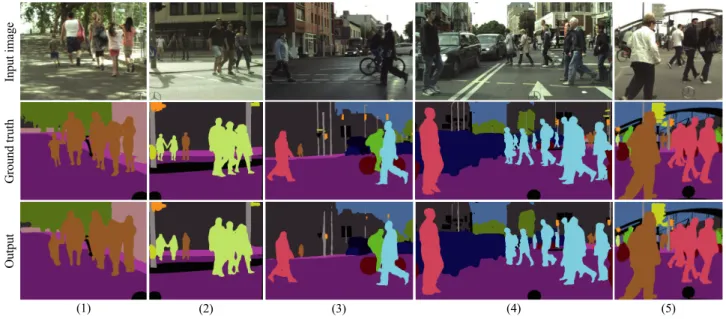
In terms of objects combined with attributes segmen- tation, let us inspect Fig. 11 to see sample results of the proposed method. A pedestrian group with the same ori- entation is shown in column (1), while a pedestrian with a different orientation from a group is shown in column (2).
Fig. 10 Qualitative results in the object segmentation task, comparing the baseline (PSPNet[14]) and the proposed methods (PSPNet.prop); the difference is seen inside the yellow-dashed box.
Columns (3) and (4) represent cases of crossing pedestrians.
The proposed method shows its capability to correctly dis- tinguish pedestrians with body orientation attributesleft or right. Column (5) also shows the superiority of the proposed method in segmenting a crowd of people with various orien- tation attributes. Overall, these figures verify that the results yielded by the proposed method are in good quality thanks to the multi-tasking segmentation by combining object and attribute recognitions.
6.2 Computational Cost
We point out the load of computation to execute the training process with several settings according to GPU usage and the number of epochs completed per day. We used the NVIDIA GeForce GTX 1080 Ti GPU to train each model. Table 6 shows the summary results of computational costs recorded during each training. The first three rows indicate the costs to run the baseline, comparative, and the proposed methods, respectively. We can see that there is no significant difference among the three methods as long as the image and window cropping sizes are the same. For the comparative method, although it splits the layers, the cost of computation is not affected much since the additional branch is placed in the final layer. We can infer that the proposed method using the attribute-aware loss function is capable of performing an MTL-based task but takes no risk on the computational cost.
This is in accordance with the explanation in Sect. 3.
The computational cost in the training process is, how- ever, mostly influenced by the image size and the window cropping size. In the fourth row of Table 6, when the image size is doubled, the training speed is much slower, but the
Fig. 11 Some results of the proposed method (PSPNet.prop) in the attribute-aware semantic segmen- tation task, from (1) easy (uniform) to (5) complex (heterogeneous) cases.
Table 6 Computational costs of PSPNet training with several settings.
Method Image size Crop size GPU usage Train speed PSPNet[14] 1,024×512 512×512 ∼10 GB ∼33 epochs/day PSPNet.comp 1,024×512 512×512 ∼10 GB ∼33 epochs/day PSPNet.prop 1,024×512 512×512 ∼10 GB ∼33 epochs/day PSPNet.prop 2,048×1,024 512×512 ∼11 GB ∼7.2 epochs/day PSPNet.prop 2,048×1,024 713×713 ∼20 GB ∼8.4 epochs/day PSPNet.prop 2,048×1,024 916×916 ∼30 GB ∼6.7 epochs/day
GPU usage only increases slightly as the cropping size is still the same. Meanwhile, the cropping size has more influence on the GPU size. As the cropping size increases, the space required on the GPU increases sharply. It also affects on the training speed, but not too significant when the image size remains the same.
For real ITS applications, here we also consider the processing speed on the testing data. Since the proposed method practically just modifies the training process, the computational cost of testing will not be influenced by the attribute-aware loss function. For the proposed methods using FCN8s and PSPNet base models, they gave around 5.00 and 2.57 frames per second (fps), respectively. These costs were calculated for images sized 1,024×512 pixels in the NVIDIA’s GPU as previously mentioned. That FCN8s runs faster than PSPNet is presumably noticed since the PSPNet model by[14]is much complex as compared to the FCN8s by[12]. The processing speed here is apparently very slow if we compare it to a video that commonly moves with 20∼30 fps, and hence insufficient for common vehicle based vision in real-time. Since a real self-driving car requires high accuracy, as well as fast processing on a limited hardware, it is recommended to implement the semantic segmentation models on FPGA, which is extensively used in embedded applications. The FPGA implementation that is faster and more efficient but still maintains its performance[38]can be a solution to the problem of the real-time processing speed.
7. Conclusion
We introduced a new concept of attribute-aware semantic segmentation to enrich the scene understanding as well as an approach which allows a deep neural network model trained in an end-to-end process. Our main contribution is the pro- posal of an attribute-aware loss function capable of handling segmentation loss for both object and attribute classes in one calculation flow which can be applied to an arbitrary base model. We also enriched the most popular pixel-wise labeled dataset Cityscapes by adding body orientations of pedestrian as an attribute to thepersonclass to extend the ground-truth labels, which is named the CityWalks dataset and will be publicly available on the Web. Experiments with various settings were conducted and the results showed that the pro- posed method successfully outperforms the baseline meth- ods covered in this study. It shows that the proposed method is able to work well in recognizing pedestrian attributes and improving the performance of semantic segmentation for ob- ject classes as challenged in various competitions. A further extension in terms of attribute types will be our future plan as well as applying the method to other moving objects.
Acknowledgments
The first author would like to thank Indonesia’s BUDI-LN scholarship for the generous supports to his doctoral study.
Parts of this research were also supported by MEXT, KAKENHI Grant Number JP 17H00745.
References
[1] V. Badrinarayanan, A. Kendall, and R. Cipolla, “SegNet: A deep convolutional encoder-decoder architecture for image segmentation,”