Relationship Between Intrinsic Values and the Use of Cognitive Strategies Among Japanese College Learners of English
Shien SAKAI
1.Background
In English language learning, some students are good performers and some are not.
At first, most students are positively effort-oriented toward learning, which means that they believe that if they work at studying English, it will not take them long to become fluent English speakers. Learning a foreign language, however, is challenging. Even though a person studies hard, s/he may fail tests and find it difficult to get good marks.
Eventually, the student may feel that s/he does not have the ability to learn English.
This way of thinking is called negative talent-orientation. Once individuals have such negative perceptions about English language learning, the perception often remains even after the student passes college entrance examinations (Kiyota, 2011).
These two perceptions, positive effort-orientation and negative talent-orientation, are located at both ends of one imaginary continuum, with each student’s perception falling somewhere in between. The author wonders, then, how perceptions between poor performers and good performers differ and how these differences are generated. These two groups of students probably have dissimilar perceptions about English language learning. Sakai and Takagi ( 2009 ) studied 721 subjects to examine the disparities between the perceptions of good performers and those of poor performers, claiming that the key factor is the effective use of meta-cognitive strategies.
2.The Survey
1n 2009, in order to verify the results of Sakai and Takagi (2009), the author of the current study decided to conduct a large-scale investigation. The research questions include:
● What differentiates good performers from poor ones?
● How do perceptions about English language learning differ between good performers and poor performers?
● What influences students’ use of cognitive strategies?
In the present study, 3 , 587 subjects were recruited from 13 universities in Japan.
〔論 説〕
Tests were used to measure vocabulary size; however, a tool for measuring an individual’s use of meta-cognitive strategy has not been invented. Therefore, considering that a subject’s use of meta-cognition in English language learning should have something to do with his or her perceptions about it, based on existing literature, the author’s team decided to formulate seven scales: ‘Self-efficacy’, ‘Cognitive Strategy Use’,
‘Intrinsic Value’, ‘Learner Autonomy’, ‘Test Anxiety’, ‘Self-regulated Study’ and
‘Language Learning Belief’.
Mori (2004) states that a sense of self-efficacy influences English language learning.
Therefore, some of the items from Pintrich et al.’s study (1990) were included in the questionnaire in the present study. The breakdown of the current questionnaire is as follows: from Pintrich et al. (1990), eight items for ‘Scale/Self-Efficacy (S/SE)’, fourteen items for ‘Scale/Cognitive Strategy Use (S/CSU)’, eight items for ‘Scale/Intrinsic Value (S/IV)’, four items for ‘Scale/Test Anxiety (S/TA)’ and eight items for ‘Scale/Self- Regulated Study (S/SRS)’. In addition, considering that awareness of taking control of one’s own study leads to a student’s activeness or passiveness toward English language learning, eight questionnaire items about control of one’s own studies are including in the questionnaire— ‘Scale/Learner Autonomy (S/TA)’ — drawn from Sakai, Takagi, and Chu (2008), who conducted research among East Asian students. Finally, considering the differences in language learning beliefs between good performers and poor performers, questionnaire items about ‘Scale/Language Learning Belief (S/LLB)’ are drawn from Sakui and Gaies (1999), who surveyed Japanese college students. The seven scales are fixed. Most of the questionnaire items were written in English; therefore, the author translated them into Japanese and adjusted phrases from the original questionnaires to fit the Japanese educational setting and added other items that seemed to be necessary to suit the purposes of the survey. There are 62 questionnaire items in total. (Appendix2) In terms of English language learning, it seems impossible that both good and poor performers would share the same or similar perceptions. The examinees were divided according to their English proficiencies, which were measured using a test to determine vocabulary size, chosen due to budget limitations and to eliminate possible variances in marking. Some vocabulary tests can be used free of charge. As for reliability, some vocabulary tests adopt a multiple-choice method, which provides high reliability with regard to marking. Tohno et al. (1995, p. 14) claims, ‘There is no objection to using a person’s vocabulary size as a scale for measuring his or her English proficiency’.
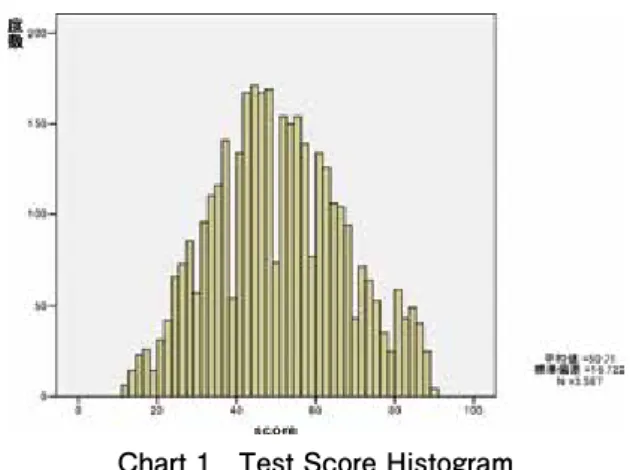
Schmitt et al. (2001 , p. 60) explains, ‘vocabulary tests are often correlated with proficiency tests, particularly the TOEFL’. Therefore, the author of this study decided to use the Mochizuki test (Mochizuki, 1998), which is a popular vocabulary level test in Japan. Chart 1 is a histogram of the test result showing a bell shape, indicating normal distribution. In addition, 1,013 student subjects took an EIKEN placement test, a popular standardized test; the correlation of both tests was calculated to be r (1013)=0.714.
The First Stage
Three steps were employed to uncover the students’ perceptions about English language learning: first, factor-analysis was conducted with all of the subjects using Promax Rotation; next, the subjects were divided into three groups according to their test scores; finally, factor-analyses were conducted for each group.
First, five factors were extracted and labelled Factor/Cognitive Strategy Use (F/
CSU), Factor/Self-Efficacy (F/SE), Factor/Desire for Lessons (F/DL), Factor/Intrinsic Value (F/IV) and Factor/Test Anxiety (F/TA). Then, the relationships between each factor and the test scores were calculated; only F/CSU correlated with the test scores (r(3587)=0.208**).
Table 1 Extracted Factors Conducted against Whole Subjects
F Name Mean α Item numbers
I F/CSU 45.65 0.887 57, 41, 38, 48, 39, 45, 5, 56, 14, 30, 20, 11, 1, 61 II F/SE 32.08 0.868 37, 25, 31, 19, 47, 21, 50, 55, 35, 7, 26, 8 III F/DL 24.57 0.842 13, 6, 27, 4, 54, 10, 15, 42
IV F/IV 25.96 0.870 60, 34, 22, 2, 33, 12, 59, 24
V F/TA 12.76 0.783 40, 18, 51, 32
This means that the subjects were ranked according to F/CSU as well as the test scores. Factors related to S/SR and S/LLB were not extracted.
In the next stage, all the subjects were divided into three levels according to their test scores: the top level (n=816), the middle level (n=1942) and the bottom level (n=829).
Then the authors investigated the relationship between the subjects’ use of cognitive strategies and their intrinsic values. Table 2 shows the relationships between the factors and test scores: blue colored cells mean that the correlation is strong; green colored cells indicate moderate correlation; relationships in yellow colored cells have a weak correlation; and white colored cells have no correlation. F/CSU has a correlation
Chart 1 Test Score Histogram
with F/DL, F/IV and F/TA. In particular, the correlation with F/IV is exceedingly high. Only F/CSU has a correlation with test scores.
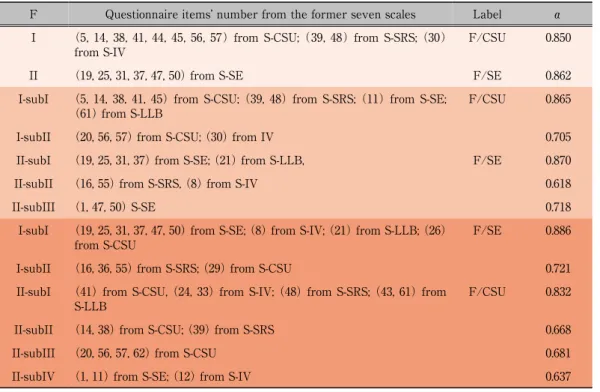
The first factor in the top level consists of items mostly from S/CSU. The second factor consists of all the items from S/SE. Eleven items constitute F/CSU and six items constitute F/SE. Both of these factors are so strongly connected that they cannot be factor-analysed any further. With regard to the middle level, Factor One is labelled F/
CSU and Factor Two is labelled F/SE. However, Factor One is loosely tied so it can be factor-analysed again and extracted into two sub-factors. Factor Two cannot be factor- analysed any further. Thirteen items constitute F/CSU and eleven items constitute F/
SE. Although the composing items are slightly different in the best performers and the
Table 3 Factor Contents of the Three Levels
F Questionnaire items’ number from the former seven scales Label α
I (5, 14, 38, 41, 44, 45, 56, 57) from S-CSU; (39, 48) from S-SRS; (30)
from S-IV F/CSU 0.850
II (19, 25, 31, 37, 47, 50) from S-SE F/SE 0.862
I-subI (5, 14, 38, 41, 45) from S-CSU; (39, 48) from S-SRS; (11) from S-SE;
(61) from S-LLB F/CSU 0.865
I-subII (20, 56, 57) from S-CSU; (30) from IV 0.705
II-subI (19, 25, 31, 37) from S-SE; (21) from S-LLB, F/SE 0.870
II-subII (16, 55) from S-SRS, (8) from S-IV 0.618
II-subIII (1, 47, 50) S-SE 0.718
I-subI (19, 25, 31, 37, 47, 50) from S-SE; (8) from S-IV; (21) from S-LLB; (26)
from S-CSU F/SE 0.886
I-subII (16, 36, 55) from S-SRS; (29) from S-CSU 0.721
II-subI (41) from S-CSU, (24, 33) from S-IV; (48) from S-SRS; (43, 61) from
S-LLB F/CSU 0.832
II-subII (14, 38) from S-CSU; (39) from S-SRS 0.668
II-subIII (20, 56, 57, 62) from S-CSU 0.681
II-subIV (1, 11) from S-SE; (12) from S-IV 0.637
Table 2 Relationships among Factors
F/SE F/DL F/IV FTA T-Score
F/CSU 0.050** 0.359** 0.701** 0.250** 0.208**
F/SE - 0.082* 0.150** -0.417** 0.078**
F/DL - 0.285** 0.193** 0.070**
F/IV - 0.159** 0.179**
F/TA - -0.067**
middle group of students, F/CSU is the first factor and F/SE is the second in both groups, while in the lower performing group, F/CSU is the second factor. Factor One is F/SE. In addition, both of these factors can be factor-analysed further, which means that both of the factors are more loosely tied than those of best performers. Fifteen items constitute F/CSU and thirteen items constitute F/SE in the bottom level.
As for cognitive strategy uses, based on the facts stated above, good performers knew what to do to complete their tasks; the effective strategies were a few in number but best performers used them skilfully. The same strategies were used among almost all of the students, however, poor performers did not use effective strategies skilfully.
Their meta-cognition, which controls cognitive strategies, is not well developed.
Therefore, various other strategies were employed among poor performers. The lower the English proficiency, the more fragmentary the learners’ factors related to cognitive strategy use. It can be said that good performers face English learning tasks with cognitive strategies while poor performers handle them with self-efficacy.
Then, what influences the use of meta-cognition? F/CSU had a strong correlation with F/IV (r (3587)=0.701). The F/IV items can be divided into two groups: Items for Practical Orientation (PO: #12, #24, #33, #59) and Items for Fulfilment Orientation (FO:
#2, #22, #34, #60).
The seven items in the left column of Table 4-6 are from F/CSU. Next, items #12,
#24, #33 and #59 in the top row are for practical orientation while items #2, #22, #34,
#60 are for fulfilment orientation. The relationships between the PO items and those of F/CSU result in 28 cells. Only two cells are not correlated. The other cells are correlated and 13 of the cells are moderately correlated. The relationships between the PO items and those of CSU also have 28 cells. Only three cells have no correlation.
In relationships between orientation toward practicality and F/CSU, two cells have no correlation. Nine cells are moderately correlated. However, in relationships between FO and F/CSU, eight cells have no correlations.
In relationships between PO and F/CSU, only one cell has no correlation. However, in relationships between FO and F/CSU, 12 cells have no correlation.
Comparing Tables 4 - 6 as to the relationship between PO and F/CSU, the best performers are well aware. Middle group students and low performers can also be said to be well aware. However, the differences among those groups regarding FO are significant; the best performers enjoy English learning, but poor performers seldom enjoy English learning.
In conclusion, poor performers are weak at using meta-cognitive strategies. The lower the English proficiency learners have, the more fragmentary their factors related to cognitive strategy use becomes. Students at all levels are practically-oriented. Good performers are also fulfilment-oriented, while poor performers are not.
The Second Stage
1.F/IV questionnaire items that are causes of F/CSU
As stated above, questionnaire items composing F/IV affect F/CSU at all levels. The author decided to discover what questionnaire items composing F/IV affect F/CSU at each respective level. Using covariance structure analysis, the best-fit model considering
Table 5 F–IV (PO vs FO) of Subjects at the Middle Level
Middle 12 24 33 59 2 22 34 59 60
14 0.348** 0.425** 0.392** 0.329** 0.335** 0.307** 0.252** 0.329** 0.248**
38 0.320** 0.505** 0.530** 0.443** 0.317** 0.439** 0.281** 0.443** 0.286**
39 0.195** 0.355** 0.351** 0.311** 0.146** 0.275** 0.156** 0.311** 0.161**
41 0.264** 0.559** 0.541** 0.446** 0.230** 0.352** 0.167** 0.446** 0.186**
48 0.197** 0.472** 0.424** 0.389** 0.149** 0.298** 0.087** 0.389** 0.141**
56 0.275** 0.223** 0.245** 0.271** 0.278** 0.270** 0.279** 0.271** 0.303**
57 0.246** 0.361** 0.383** 0.388** 0.277** 0.371** 0.262** 0.388** 0.282**
Table 6 F–IV (PO vs FO) of Subjects at the Bottom Level
Poor 12 24 33 59 2 22 34 59 60
14 .391** .375** .443** 0.373** 0.243** 0.253** 0.202** 0.373** 0.215**
38 .350** .403** .461** 0.445** 0.289** 0.307** 0.213** 0.445** 0.249**
39 .194** .313** .353** 0.265** 0.192** 0.162** 0.092** 0.265** 0.141**
41 .233** .519** .494** 0.400** 0.182** 0.193** 0.036 0.400** 0.068
48 .238** .372** .397** 0.326** 0.123** 0.109** -0.009 0.326** 0.062
56 .269** .205** .221** 0.246** 0.291** 0.308** 0.309** 0.246** 0.379**
57 .278** .314** .335** 0.388** 0.251** 0.238** 0.242** 0.388** 0.282**
*=p<0.05, **=p<0.01
Table 4 F–IV (PO vs FO) of Subjects at the Top Level
Best 12 24 33 59 2 22 34 59 60
14 0.405** 0.451** 0.440** 0.246** 0.393** 0.339** 0.294** 0.246** 0.327**
38 0.388** 0.505** 0.524** 0.475** 0.347** 0.451** 0.366** 0.475** 0.391**
39 0.189** 0.299** 0.322** 0.311** 0.165** 0.269** 0.159** 0.311** 0.185**
41 0.359** 0.557** 0.552** 0.466** 0.319** 0.418** 0.298** 0.466** 0.318**
48 0.189** 0.378** 0.385** 0.350** 0.229** 0.350** 0.228** 0.350** 0.237**
56 0.406** 0.400** 0.443** 0.275** 0.345** 0.357** 0.354** 0.275** 0.382**
57 0.258** 0.414** 0.424** 0.428** 0.256** 0.449** 0.347** 0.428** 0.388**
F/CSU and F/IV at each level was calculated to determine the causes and effects.
At the top level, four F/IV items are defined as causes of F/SCU: # 22 ‘Learning English interests me’ (standardized estimate=0.291, p<0.001); #24 ‘I think that what I am learning in this English class is useful’ (standardized estimate=0.391, p<0.001); #33 ‘It is important for me to learn what is being taught in this English class’ (standardized estimate=0.430, p<0.001); and #59 ‘I study English because it is useful for communication with English-speaking people’ (standardized estimate=0.463, p<0.001).
At the middle level, two items of F/IV items were identified as causes of F/SCU: #22 (standardized estimate=0.254, p<0.001) and #33 (standardized estimate=0.498, p<0.001).
Both of these items are also the cause of F/SCU at the top level.
At the bottom level, only one F/IV item was defined: # 59 (standardized estimate=0.611, p<0.001). This item was also identified as the cause of F/SCU at the top level.
2.F/CSU questionnaire items that are causes of F/IV
At the top level, three F/CSU items are defined as causes of F/IV: #30 ‘Even when I do poorly on a test, I try to learn from my mistakes’ (standardized estimate= 0 . 220 , p<0.001); #38 ‘I always try to understand what the teacher is saying even if it doesn’t make sense’ (standardized estimate=0.230, p<0.001); and #41 ‘When I study for a test, I try to remember as many facts as I can’ (standardized estimate=0.293, p<0.001).
At the middle level, two F/CSU items are defined as causes of F/IV: #11 ‘I’m certain I can understand the ideas taught in this course’ (standardized estimate=0.271, p<0.001) and #30 ‘Even when I do poorly on a test, I try to learn from my mistakes’ (standardized estimate=0.227, p<0.001).
3 ) At the bottom level, two F/CSU items were defined: # 57 ‘When I am studying a topic, I try to make everything fit together’ (standardized estimate=0.216, p<0.001) and
#61 ‘Listening to tapes and watching English programs on television are very important in learning English’ (standardized estimate=0.325, p<0.001). Most of the best performers rated this item so highly that a ceiling effect is shown at the top level. Therefore, this item is the subjects’ strong belief but not a component of any factor.
Discussion
The field where questionnaire items consisting of F/IV affect F/CSU
There are four questionnaire items consisting of F/IV that are causes of F/CSU: #22,
#24, #33 and #59. They represent the subject’s interest as well as the importance and usefulness of English language learning. The top level students’ F/CSU is affected by all four items. That of the middle level students is affected by two: # 22 and # 33 . The middle level students’ F/CSU is less affected by #24 and #59. The word ‘use’ is common
to items #24 and #59. Therefore, the middle level students’ cognitive strategy use is less affected by usefulness. What does the usefulness of English language learning mean in Japan? Considering that the subjects of this study are college students, good English language scores gave them the opportunity to be admitted to good schools. In that respect, middle level students less often benefit from the usefulness of English language learning. In addition, these students are less interested in communicating with foreign people than students in the other levels.
Students at the bottom level are encouraged to study English through their belief that it will be useful for communicating with foreigners. However, the cognitive strategies of these students are less affected by their interest in learning English than students at the other levels. They have a will to communicate with foreigners, but they have not been encouraged to learn the language. This is why these students are at the bottom level in educational setting in Japan where test scores are exceedingly important.
The questionnaire items composed of F/CSU that are the causes of F/IV.
There are three questionnaire items composed of F/CSU that are causes of F/IV at the top, two at the middle, and two at the bottom levels. At the top level, #41 ‘When I study for a test, I try to remember as many facts as I can’ is a cause of F/IV. At the middle level, # 41 is not a cause of F/IV. However, it is the cause of Factor/Test Anxiety, which is one of the extracted factors but is not mentioned in this study.
Students at the top level have the will to challenge, but middle level students experience test anxiety. This is the difference between these two groups. In addition, at the bottom level, #41 is not a cause of any factor. Poor performers do not mind taking tests. Furthermore, # 30 ‘Even when I do poorly on a test, I try to learn from my mistakes’, affects F/IV at the top and middle levels, but not at the bottom level. At the bottom level, F/Desire for Lessons, such as #04 ‘I would like to reflect on the topics and activities we learn in class’, is affected by the questionnaire items composed of F/CSU.
This means that poor performers should be the most probable candidates for using cognitive strategies to cope with their lessons. Students at the top and middle levels are able to use cognitive strategies to obtain high test scores and to reflect on their efforts.
However, poorly performing students lack these two abilities.
As for the difference between the top and middle levels, top students more strongly think that what they learn is useful. This perception makes their cognition stronger.
Students in the middle level have a less strong perception that learning the English language is useful than those in the top level. As previously mentioned, this is probably because they have not benefitted as much from the usefulness of learning English compared to top levelled students.
Bottom level students do feel that learning English is interesting, however, they fail to make their perception affect cognition. Teachers should offer students stimulating
environments where they can use what they have learned.
F/CSU → F/IV Relationships
Concerning reflection, #30 asks an individual whether s/he tries to learn from his or her own mistakes. Let us discuss what it means when an individual’s reflection affects his or her intrinsic values. It can definitely be said that students are aware that reflection can improve his or her cognition. Both the top and middle level students indicated such awareness. In contrast, the poor performers did not have awareness of proper reflection skills probably as they become used to receiving bad scores and do not mind being considered poor performers. This causes them to avoid reflecting on what they have done. Therefore, bottom level students do not develop cognitive strategies for coping with tests. These phenomena show that students’ success in language tests in Japan are mostly related to their learning autonomy.
Regarding attitude toward class lessons, there are three cognitive strategies that trigger students’ internal values. The top level students’ attitudes toward lectures are indicated by # 38 ‘I always try to understand what the teacher is saying even if it doesn’t make sense’. The item means that the subjects increase their efforts so that can perfectly, or near perfectly, understand the content of a given lecture. The data shows that both middle and bottom level students seldom try to understand the lecture perfectly if they find it difficult to follow. Middle level students believe they are certain that they can understand the concepts taught in their course. The bottom level students’ attitudes are shown by # 57 ‘When I am studying a topic, I try to make everything fit together’. That is, the top students try to understand the lecture perfectly, the middle group believes that they can understand the idea of the lecture and the bottom students try to make everything fit together by themselves.
As for test strategies, only the top-level students have intrinsic values activated by
#41 ‘When I study for a test, I try to remember as many facts as I can’.
Pedagogical Implications
Throughout this study, it has been shown that intrinsic values concerning studying the English language are activated through the use of cognitive strategies. The strategies used vary from the top students to poor performers. As students become better performers, they also become more stringent in their study habits. This is because, most of the time, students’ English proficiency is rated according to their paper test performance in Japanese English educational settings. In an English as a foreign language (EFL) environment in East Asian countries, including Japan, obtaining high scores in English proficiency tests, such as EIKEN (seven bands of popular English proficiency tests in Japan), TOEIC or TOEFL, is an indicator of high achievement.
English learners are very keen to obtain high scores in high-stakes exams that often determine their futures as ‘the examination is the soul of ethos about education in East
Asian societies’ (Cheng, 1996, p. 9). Therefore, only students who are accurate can be good performers in English language learning. This is not fair because an individual may be weak at taking tests but able to communicate, read or write well.
Thus, test-oriented education has produced a few good performers and many weaker performers. The desirable proficiency target established by the Ministry of Education, Culture, Sports, Science and Technology (MEXT) at the end of upper-secondary school is equivalent to either A 2 or B 1 on the Common European Framework of Reference (CEFR). Table 1 shows 12th graders’ English proficiencies as surveyed by MEXT in 2013, 2014 and 2017. About 70% of 12th graders’ English reading skills remained at A1 on the CEFR, which is the level that 9th graders are supposed to achieve. As for listening, writing and speaking, more than three-quarters of the students investigated remained at the A1 level. It easy to see that test-oriented education has not had a good effect on English language education in Japan.
Table 7 12th Graders’ English Proficiency Levels (%)
Reading Listening Writing Speaking
2014 2015 2017 2014 2015 2017 2014 2015 2017 2014 2015 2017
B2 0.0 0.1 0.4 0.2 0.2 0.3 0.0 0.0 0.0 NM NM NM
B1 2.0 2.2 3.7 2.1 2.3 3.1 0.7 0.7 0.4 1.2 1.5 1.2
A2 29.9 32.4 29.4 24.2 26.2 30.2 17.2 18.8 19.3 9.8 11.3 11.7
A1 68.0 65.3 66.5 73.6 71.4 66.4 82.1 80.4 80.4 89.0 87.1 87.2
N=Reading, Listening and Writing: about 70,000 in 2014; 90,000 in 2015; and 60,000 in 2017. Speaking: 17,000 in 2014; 22,600 in 2015; and 10,000 in 2017. (Adapted from MEXT, 2014, 2015, and 2017)
Considering these results, students who attain a level of B 1 or more level on the CEFR can learn to be proficient in English through test-oriented education. In this style of teaching/learning, teachers use tests to let the students know how well they are doing. Teachers often show the results to motivate them to perfection. Students who get perfect or near perfect are evaluated highly. Consequently, a hierarchy is created among the students. However, this practice might be counterintuitive as students who cannot achieve perfection may become reluctant to study and receiving low evaluations might reduce self-efficacy. It is possible that the same schools that help some students thrive may cause other students to dislike studying.
Then, for what should the Japanese people strive? It is the opinion of this author that the educational system should focus on cooperative learning, whose importance in the Japanese educational settings is currently being declared. However, cooperate learning is not popular in a test-oriented educational system, particularly at the junior and senior high school levels. During a sabbatical year, April 2015 – March 2016, the author visited many high school and elementary schools classes in European countries, the UK and the USA. Many of these classes were taught using cooperative learning. There, learners
assumed the attitude that one can be inadequate in oneself but that students can help one another during the processes of communicating and learning. Students can create a cooperative group culture while performing tasks assigned by their teacher or completing those that they themselves developed. The learners share their group members’ ideas, raising self-efficacy and respect for other classroom members. They learn about citizenship and how to cooperate with various individuals. The author of this study believes that cooperative learning is a good way to teach students to be communicative in language classrooms in Japan.
This sabbatical year motivated the author to study cooperative learning. It is understood that an effective learning environment is one of the factors necessary for success. For learning English in Japan, it would be easy for students to create their own test-centred learning environments as materials and a range of mechanisms, such as dictionaries, vocabulary books, study reference books and collections of questions from previous English language examinations, are available. In contrast, the learning environments in Japan do not currently lend themselves to cooperative learning.
In the beginning, to be motivated implies ones desires to be in the classroom and to study with a teacher and classmates. When one’s intention to learn is set, learning starts.
Unless a student’s mind is ready to learn, s/he will not make good progress. How can this mindset be created? Maslow’s hierarchy of needs (1943) is useful for explaining this phenomenon. Maslow successfully established a hierarchy of human needs, showing that one human need typically follows the satisfaction of a need located lower in the hierarchy.
From the bottom—Physiological needs → Safety needs → Love and belonging → Esteem
→ Self-actualization. Let us use this theory to examine an individual’s psychological state.
First, unless physiological requirements are satisfied, an individual is not ready to learn. For example, if an individual is hungry or sleepy, s/he will not have the desire to study. When these needs are fulfilled, safety needs will appear. If an individual’s sense of safety is threatened through bulling, his or her readiness to study will be undermined. Therefore, this need should be satisfied. Once these fundamental needs are met, the learner will seek the needs of love and belonging.
From this level on, the process of learning can begin, as it is human nature to seek the company of those who like us. Therefore, if the teacher and classmates like a certain student, he or she will have the motivation to study with them. A learner at this level is strongly affected by the attitude of the people around him or her. If their needs of love and belonging are satisfied, they move up to the next level—esteem. Those with experience in a sports club will understand this concept. Once an individual is accepted in a certain group, s/he has the desire to be recognized, make great achievements and be respected by the others. The individual comes to understand the necessity of training to excel in the sport or target subject. The individual’s mind is set. At this time, teachers can help students develop meta-cognitive abilities: set a goal, make a plan to achieve the goal, study, check the progress and revise the plan. When students
understand this process and continue to work, they will advance to the next level.
Therefore, beginners and/or poor performers need a good environment in which to work. Reflecting on the present study, the author did not at first consider the importance of cooperative learning. Therefore, the sets of questionnaire items do not include any questions about group learning. Future research will incorporate questionnaire items that will investigate how cooperative learning affects students’
intrinsic values and cognitive strategy use in English learning.
謝辞
本研究は,平成 27 年度千葉商科大学在外研究の成果の一部である。大学からの多大な 研究支援に対して,この場を借りて,感謝を申し上げます。
References
Cheng, K. M. (1996). Excellence in education: Is it culture-free? Keynote paper presented at the Annual Conference of the Educational Research Association, Singapore.
Kiyota, Y. (2009). Motivation of remedial EFL learners (a case study of Japanese college EFL learners), Journal of the Japan Association for Developmental Education, 4(2), 173- 179.
MEXT. (2014): Heisei 26 Nendo Eigoryoku Chosa no Kekka (Koukou 3 Nensei) no Gaiyo (School year 26 of Heisei’s A Report of Survey of English Ability for Reform of English Education), http://www.mext.go.jp/a_menu/kokusai/gaikokugo/1358258.htm, (30th April 2017).
MEXT. (2015): Heisei 27 Nendo Eigoryoku Chosa no Kekka (Koukou 3 Nensei) no Gaiyo) School year 27 of Heisei’s A Report of Survey Results of 12th graders’ English Ability (Summary)http://www.mext.go.jp/b_menu/shingi/chousa/shotou / 117 /shiryo/
icsFiles/afieldfile/ 2016/05/24/1368985_7_1.pdf, (30th April 2017).
MEXT. (2017): Heisei 29 Nendo Eigoryoku Chosa no Kekka(Koukou 3 Nensei) no Gaiyo) School year 29 of Heisei’s A Report of Survey Results of 12th graders’ English Ability(Summary)http://www.mext.go.jp/a_menu/kokusai/gaikokugo/_icsFiles/
afieldfile/2018/ 04/06/1403470_03_1.pdf, (7th April 2018).
Mori, Y. ( 2004 ). Daigakusei no Jikokouryokukan to Eigo Gakushu Houryaku no Kankei (Relationship between self-efficacy and college students’ learning strategies of the English language), The Journal of Japan Society for Educational Technology, 28, 45-48.
Maslow, A. (1943). A theory of human motivation. Psychological Review, 50(4), 370-396.
Pintrich, P. R., & De Groot, E. V. (1990). Motivational and self-regulated learning components of classroom academic performance. Journal of Educational Psychology, 82(1), 33-40.
Sakui, K., & Gaies, S. J. (1999). Investigating Japanese learners’ beliefs about language learning. System, 27, 473-492.
Sakai, S., & Takagi, A. ( 2009 ). Relationship between learner autonomy and English language proficiency of Japanese learners. The Journal of ASIA TEFL, 6(3), 297-325.
Sakai, S. (2012). A study on the factors which influence use of cognitive strategy among Japanese college students. Journal of Japan Association of Developmental Education, 7(1), 141-154.
Schmitt, N., Schmitt, D., & Clapham, C. (2001). Developing and exploring the behaviour of two new versions of the Vocabulary Levels Test. Language Testing, 18, 55-88.
Tohno, Y. (1995). Eigo Goi Shutoku Ron (The theory of English vocabulary acquisition).
Tokyo, Japan: Kagensha Press.
Appendix 1
Set of questionnaire items (divided into scales) used in the present study Scale/Self-Efficacy (S/SE)
01. I know that I will be able to learn the material for an English class.
11. I’m certain I can understand the ideas taught in this course.
19. Compared with others in this English class, I think I’m a good student.
25. I think I will receive a good grade in this English class.
31. My study skills are excellent compared with others in this English class.
37. Compared with other students in this English class, I think I know a great deal about the subject.
47. I expect to do very well in this English class.
50. I am sure I can do an excellent job solving the problems and completing the tasks assigned in this English class.
Scale/Cognitive Strategy Use (S/CSU)
05. When I study for a test, I try to put together the information from class and from the book.
14. When I do homework, I try to remember what the teacher said in class so I can answer the questions correctly.
20. I outline the chapters in my book to help me study.
26. It is hard for me to decide what the main ideas are in what I read. (*R) 28. When studying, I copy my notes over to help me remember material.
29. I put English text from the textbook into Japanese when I prepare for the class.
38. I always try to understand what the teacher is saying even if it doesn’t make sense.
41. When I study for a test, I try to remember as many facts as I can.
44. When I study, I put important ideas into my own words.
45. When reading, I try to connect the things I am reading about with what I already know.
52. When I study for a test, I practice saying the important facts over and over to myself.
56. I use what I have learned from old homework assignments and the textbook to do new assignments.
57. When I am studying a topic, I try to make everything fit together.
62. When I study for a test, I say the words over and over to myself to help me remember.
Scale/Intrinsic Value (S/IV)
02. I think that what we are learning in English class is interesting.
08. I prefer class work that is challenging so I can learn new things.
12. I think I will be able to use what I learn in this English class in other classes.
22. Learning English interests me.
24. I think that what I am learning in this English class is useful for me to know.
30. Even when I do poorly on a test, I try to learn from my mistakes.
33. It is important for me to learn what is being taught in this English class.
59. I study English because it is useful for communicating with English-speaking people.
60. I like what I am learning in this English class.
Scale/Test Anxiety (S/TA)
18. I am so nervous during a test that I cannot remember facts I have learned.
32. I have an uneasy, upset feeling when I take a test.
40. I worry a great deal about tests.
51. When I take a test, I think about how poorly I am doing.
Scale/Self-Regulated Study (S/SRS)
07. I often find that I read for class but I don’t know what it is all about. (*R) 16. I ask myself questions to make sure I know the material I have been studying.
36. When I’m reading a textbook, I stop once in a while and go over what I have read.
39. I work hard to get a good grade even when I don’t like the class.
46. I find that when the teacher is talking, I think of other things and don’t really listen to what is being said. (*R)
48. Even when study materials are dull and uninteresting, I keep working until I finish.
49. When work is hard, I either give up or study only the easy parts. (*R)
55. I work on practice exercises and answer end of chapter questions even when I don’t have to.
Scale/Desire for Lessons (S/DL)
04. I would like to reflect on opinions about the topics and activities we learn in class.
06. I would like to reflect on opinions about our class’s study goals for the semester.
10. I would like to reflect on opinions about the type of classroom activities, such as individual, pairs and group work.
13. I would like to reflect on opinions about how to carry out lessons.
15. I would like to reflect on opinions about the textbooks and materials we use in class.
27. I would like to reflect on opinions about the amount and type of homework.
42. I would like to reflect on opinions about methods of assessment, such as attendance, essays and self-evaluation.
54. I would like to reflect on opinions about classroom management, such as seating and class rules.
Scale/Language Learning Belief (S/LLB)
03. Some people are born with special abilities that allow them to learn English more easily than others.
09. I am satisfied with the English education I have received.
17. Girls are better than boys at learning English.
21. Considering the amount of time I have studied English, I am satisfied with my progress.
23. To say something in English, I think of how I would say it in Japanese and then translate it into English.
34. The more I study English, the more enjoyable I find it.
35. In order to speak and understand English very well, English education at school is enough.
43. To understand English, it must be translated into Japanese.
53. People who are good at math and science are not good at learning foreign languages.
58. Learning a word means learning the Japanese translation.
61. Listening to tapes and watching English programs on television are very important in learning English.
Appendix 2
Sets of Questionnaire items (for the subjects of the present study)
Please choose one of the choices which reflect your perception of English language learning.
5 Totally, 4 Sometimes, 3 Neutral, 2 Rarely, 1 Not at all
01. I know that I will be able to learn the material for an English class.
02. I think that what we are learning in an English class is interesting.
03. Some people are born with a special ability which is useful for learning English.
04. I would like to reflect on our opinion in topics and activities we learn in class.
05. When I study for a test, I try to put together the information from class and from the book.
06. I would like to reflect on our opinion in deciding our class’s goal of study in one semester.
07. I often find that I have been reading for class but don’t know what it is all about. (*R) 08. I prefer class work that is challenging so I can learn new things.
09. I am satisfied with the English education I received.
10. I would like to reflect on our opinion in deciding the type of classroom activities, such as individual, pair and group work.
11. I’m certain I can understand the idea taught in this course.
12. I think I will be able to use what I learn in this English class in other classes.
13. I would like to reflect on our opinion in how to carry out lessons.
14. When I do homework, I try to remember what the teacher said in class so I can answer the questions correctly.
15. I would like to reflect on our opinion in deciding the textbook and materials we use in class.
16. I ask myself questions to make sure I know the material I have been studying.
17. Girls are better than boys at learning English.
18. I am so nervous during a test that I cannot remember facts I have learned.
19. Compared with others in this English class, I think I’m a good student.
20. I outline the chapters in my book to help me study.
21. Considering the amount of time I have studied English, I am satisfied with my progress.
22. Learning English interests me.
23. To say something in English, I think of how I would say it in Japanese and then translate it into English.
24. I think that what I am learning in this English class is useful for me to know.
25. I think I will receive a good grade in this English class.
26. It is hard for me to decide what the main ideas are in what I read. (*R)
27. I would like to reflect on our opinion in deciding the amount and type of homework.
28. When studying, I copy my notes over to help me remember material.
29. I put English text in the textbook into Japanese when I prepare for the class.
30. Even when I do poorly on a test I try to learn from my mistakes.
31. My study skills are excellent compared with others in this English class.
32. I have an uneasy, upset feeling when I take a test.
33. It is important for me to learn what is being taught in this English class.
34. The more I study English the more enjoyable I find it.
35. In order to speak and understand English very well, English education at school is enough.
36. When I’m reading a textbook, I stop once in a while and go over what I have read.
37. Compared with other students in this English class, I think I know a great deal about the subject.
38. I always try to understand what the teacher is saying even if it doesn’t make sense.
39. I work hard to get a good grade even when I don’t like the class.
40. I worry a great deal about tests.
41. When I study for a test, I try to remember as many facts as I can.
42. I would like to reflect on our opinion in deciding ways of assessment, such as attendance, essay and self-evaluation.
43. To understand English, it must be translated into Japanese.
44. When I study, I put important ideas into my own words.
45. When reading, I try to connect the things I am reading about with what I already know.
46. I find that when the teacher is talking, I think of other things and don’t really listen to what is being said. (*R)
47. I expect to do very well in this English class.
48. Even when study materials are dull and uninteresting, I keep working until I finish.
49. When work is hard, I either give up or study only the easy parts. (*R)
50. I am sure I can do an excellent job on the problems and tasks assigned for this English class.
51. When I take a test I think about how poorly I am doing.
52. When I study for a test, I practice saying the important facts over and over to myself.
53. People who are good at math and science are not good at learning foreign languages.
54. I would like to reflect on our opinion in deciding classroom management, such as seating and class rules.
55. I work on practice exercises and answer end of chapter questions even when I don’t have to.
56. I use what I have learned from old homework assignments and the textbook to do new assignments.
57. When I am studying a topic, I try to make everything fit together.
58. Learning a word means learning the Japanese translation.
59. I study English because it is useful to communicate with English-speaking people.
60. I like what I am learning in this English class.
61. Listening to tapes and watching English programs on television are very important in learning English.
62. When I study for a test, I say the words over and over to myself to help me remember.
Items with (*R) mean reverse ones.
(2018.5.16 受稿,2018.6.12 受理)
Abstract
This study explores the perceptions that separate good performing from poor performing English language learners in Japan. In 2009, the author conducted a large- scale survey of 3 , 587 students from 13 universities in Japan. The measurement tools included a vocabulary size test and a set of questionnaires developed from existing literature. The analyses consisted of a factor analysis and a covariance structure analysis. The results of the factor analysis showed that poor performers were weak in the use of meta-cognitive strategies. Students at all levels were practically-oriented.
Good performers were also fulfilment-oriented, while poor performers were not. The covariance structure analysis showed that top level students felt that what they learn is useful, while the middle level students had a weak perception that learning English is useful. In addition, both the top level and middle level students reflected on their work, but the poor performers were not aware of practicing proper reflection. Through this study, intrinsic values concerning the study of the English language were activated through the use of cognitive strategies, which varied from the top students to poor performers. The better performing students tended to be more disciplined in their studies than were the poorer performers.