S
pinal metastasis occurs in 30-60 of patients with a malignant tumor [1-3]. Metastatic epi- dural spinal cord compression (MESCC) is a common complication in patients with malignant tumors occur- ring in 5-14 of all cases [4-7]. There are a variety of options for the treatment of MESCC. Some patients are treated nonsurgically by radiotherapy or chemotherapy, while others undergo surgical treat- ments such as posterior decompression with or without instrumentation or total en bloc spondylectomy [8-11].Several authors have reported that radiotherapy is as effective as decompressive surgery in preserving neu- rological function and pain control [4,12-14].
However, decompressive surgery was shown to be superior to radiotherapy in preserving neurological function [15,16]. Although the goals of surgery for MESCC are to improve the patientʼs prognosis and quality of life, it is difficult to decide the proper time to perform the surgery. In this study, we analyzed MESCC patients who underwent surgery, and we determined the prognostic factors for postoperative
CopyrightⒸ 2016 by Okayama University Medical School.
http ://escholarship.lib.okayama-u.ac.jp/amo/
Original Article
Neurological Recovery after Posterior Spinal Surgery in Patients with Metastatic Epidural Spinal Cord Compression
Noriyuki Watanabea, Yoshihisa Sugimotoa*, Masato Tanakaa, Tetsuro Mazakia, Shinya Aratakia, Tomoyuki Takigawaa, Masaki Kataokaa, Toshiyuki Kunisadab, and Toshifumi Ozakia
Departments of aOrthopaedic Surgery, bMedical Materials for Musculoskeletal Reconstruction, Okayama University Graduate School of Medicine, Dentistry and Pharmaceutical Sciences, Okayama 700-8558, Japan
Metastatic epidural spinal cord compression (MESCC) is a common complication in patients with a malignant tumor, but it is difficult to decide the proper time to perform the necessary surgery. Here we analyzed the prognostic factors for postoperative walking ability. We retrospectively reviewed the cases of 112 MESCC patients treated surgically at our institute and divided them into ambulatory (n= 88) and non-ambulatory (n=24) groups based on their American Spinal Injury Association (ASIA) Impairment Scale grades at the final follow-up. We also classified the patients preoperatively using the revised Tokuhashi score. We assessed the correlation between preoperative or intraoperative factors and postoperative walking ability in both groups. Of the 10 patients classified preoperatively as grade A or B, 2 (20 ) were ambulatory at the final follow-up. Of the 102 patients classified preoperatively as grade C, D or E, 86 (84 ) were ambulatory at the final follow-up (p<0.001). There were no signifi- cant differences between the groups in the average total Tokuhashi score. Our analysis revealed that the severity of paralysis significantly affects neurological recovery in patients with MESCC. Patients with MESCC should receive surgery before the preoperative ASIA Impairment Scale grade falls below grade C.
Key words: metastatic epidural spinal cord compression, American Spinal Injury Association Impairment Scale, Tokuhashi score, walking ability, prognostic factor
Received November 27, 2015 ; accepted June 24, 2016.
*Corresponding author. Phone : +81-86-235-7273; Fax : +81-86-223-9727
E-mail : [email protected] (Y. Sugimoto) Conflict of Interest Disclosures: No potential conflict of interest relevant to this article was reported.
walking ability.
Patients and Methods
This study was approved by the ethical review board of our hospital (ID 1604-503). From 1987 to 2014, 112 consecutive patients with MESCC (73 men and 39 women) underwent surgery at our hospital.
The average age was 61.5 years (range 14-83 years).
The average period from the onset of symptoms (local back pain, radicular pain and neurological deficit) to surgery was 99.4 days (range 1-1100 days). The aver- age follow-up time after surgery was 17.0 months (range 0.5-84 months) (Table 1).
Using the American Spinal Injury Association (ASIA) Impairment Scale [17], we classified these 112 patients preoperatively as grade A in 2 patients, B in 8, C in 59, D in 36 and E in 7 patients. The ASIA Impairment Scale grades are defined as fol- lows: grade A, no sensory or motor function is pre- served in the sacral segments; grade B, sensory but not motor function is preserved below the neurological level and includes the sacral segments; grade C, motor function is preserved below the neurological level, and more than half of key muscles below the neurological level have a muscle grade<3; grade D, motor function is preserved below the neurological level, and at least half of key muscles below the neu- rological level have a muscle grade 3; grade E, sensory and motor function is normal.
The surgical indications are neurological deficit, severe pain and possibility of spinal vertebrae col- lapse. We chose a posterior procedure to achieve decompression of the spinal cord. We performed instrumentation surgery if the patient had spinal insta- bility. Seven patients underwent decompression sur- gery alone, and 87 patients underwent decompression surgery with posterior fusion. Five patients under- went both anterior and posterior approaches, and 11 underwent total en bloc spondylectomies.
We classified the 112 patients preoperatively using the revised Tokuhashi score [18]. There were 57 patients whose total Tokuhashi scores were 0-8, 52 whose total scores were 9-11, and 13 whose total scores were 12-15. The revised Tokuhashi score con- sists of 6 items thought to affect the outcome (general condition, number of bone metastases other than spi- nal metastases, number of spinal metastases, type of primary lesion, presence or absence of metastases to major organs, and state of paralysis). The survival period is predicted to be 6 months when the total score is 0-8, 6 months when the total score is 9-11, and 1 year when the total score is 12.
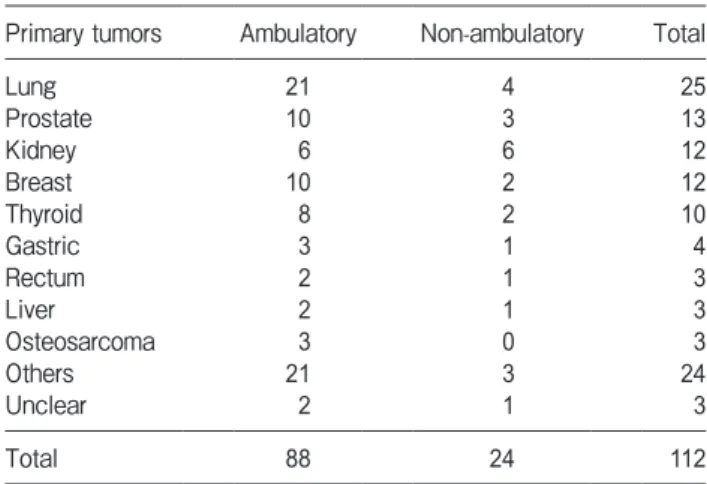
The primary tumors in these patients included lung (n=25), prostate (n=13), kidney (n=12), breast (n=12) and thyroid (n=10) (Table 2). Sixteen responsible lesions were located in cervical vertebrae, 76 in thoracic vertebrae and 20 in lumbar vertebrae.
Of the 112 patients, 16 (14 ) had multiple spinal compression lesions.
We performed a retrospective review and divided the patients into 2 groups based on their ASIA Impairment Scale grades at the final follow-up. There were 88 patients (58 men and 30 women) in the ambu- latory group and 24 patients (15 men and 9 women) in the non-ambulatory group. The average age was 60.6 years (14-83 years) in the ambulatory group and 64.6 years (40-78 years) in the non-ambulatory group. The types of primary tumors found in the ambulatory group were lung (n=21), breast (n=10), prostate (n=10), thyroid (n=8) and kidney (n=6). The patients in the non-ambulatory group had kidney (n=6), lung (n=4), prostate (n=3), thyroid (n=2)
Table 1 Patients characteristics (n=112)
Age* 61.5 (14-83) years
Sex (male/female) 73/39 patients
The time from the onset until
operation* 99.4 (1-1,100) days
Follow-up time after surgery* 17.0 (0.5-84) months
*average (range)
Table 2 Sites of primary tumors
Primary tumors Ambulatory Non-ambulatory Total
Lung 21 4 25
Prostate 10 3 13
Kidney 6 6 12
Breast 10 2 12
Thyroid 8 2 10
Gastric 3 1 4
Rectum 2 1 3
Liver 2 1 3
Osteosarcoma 3 0 3
Others 21 3 24
Unclear 2 1 3
Total 88 24 112
and breast (n=2) tumors (Table 2).
The ambulatory group had 15 lesions located in cervical vertebrae, 55 in thoracic vertebrae and 18 in lumbar vertebrae, whereas one lesion was located in cervical vertebrae, 21 in thoracic vertebrae and 2 in lumbar vertebrae in the non-ambulatory group. As for the preoperative impairment scale grades, there were 2 patients with grade B impairment, 44 with grade C, 35 with grade D and 7 with grade E in the ambulatory group. In the non-ambulatory group, there were 2 patients with grade A impairment, 6 with grade B, 15 with grade C and one with grade D. Grade C was most prevalent in both groups. As for the revised Tokuhashi score, there were 44 patients whose total scores were 0-8, 33 whose total scores were 9-11 and 11 whose total scores were 12-15 in the ambulatory group. In the non-ambulatory group there were 13 patients whose total scores were 0-8, 9 whose total scores were 9-11, and 2 whose total scores were 12-15.
We assessed the correlations between preoperative or intraoperative factors and the patientsʼ postopera- tive walking ability in both groups, using the Mann- Whitney U-test and Fisherʼs exact probability test. We regarded a value of p<0.05 as significant.
Results
Of the 10 patients classified preoperatively as grade A or B, 2 (20 ) were ambulatory at the final follow-up (Table 3). In contrast, of the 102 patients classified preoperatively as grade C, D or E, 86 (84 ) were ambulatory at the final follow-up (p< 0.001). The probability of a patient being able to walk after surgery was 0 for those with a preoperative impairment scale grade of A, 25 for grade B, 75 for grade C, 97 for grade D and 100 for grade E (Fig. 1).
The average amount of intraoperative bleeding was 960 ml (range 20-3,420 ml) in the ambulatory group and 1,230 ml (range 230-3,090 ml) in the non-ambula- tory group. The average length of surgery was 199 min (range 60-975 min) in the ambulatory group and 259 min (range 100-685 min) in the non-ambulatory group.
There was no significant difference between the groups in bleeding (p=0.35) or duration of surgery (p= 0.78).
The rates of improving by one grade at the final follow-up on the ASIA Impairment Scale were 63
(55 of 88 patients) in the ambulatory group and 25 (6 of 24 patients) in the non-ambulatory group (Table 4).
The average total Tokuhashi scores were 8.4 points in the ambulatory group and 7.8 in the non-ambulatory group. There were no significant differences between the 2 groups in the average total Tokuhashi score (p=0.35) or the average score for each of the 5 mea- sured Tokuhashi parameters, except for the state of paralysis. The average survival period was 12 months in both groups.
Table 3 ASIA impairment scale grade at final follow-up based on preoperative ASIA impairment scale grade
Preoperative Final follow-up Total
ASIA impairment
score Ambulatory
(grade D,E) Non-Ambulatory (grade A,B,C)
grade (A,B) 2pts 8pts *p<0.001 10
A 0 2 2
B 2 6 8
grade (C,D,E) 86 16 102
C 44 15 59
D 35 1 36
E 7 0 7
Total 88 24 112
ASIA, American Spinal Injury Association; Ambulatory group, ASIA impairment score grade D and E at the final follow-up; Non-Ambu- latory group, ASIA impairment score grade A, B and C at the final follow-up. pts: patients
0 20 40 60 80 100
A B C D E
Preoperative ASIA impairment score
%
grade Probability of being ambulatory
Fig. 1 Probability of being ambulatory after surgery depending on the preoperative ASIA impairment score. A severe preoperative ASIA impairment score was observed to reduce the probability of being ambulatory. ASIA, American Spinal Injury Association.
Discussion
Our findings revealed that the severity of the pre- operative paralysis greatly affected the final walking ability in MESCC patients. Patients with MESCC should receive spinal surgery before their ASIA Impairment Scale grade falls below grade C. In our study, 10 patients had preoperative impairment scale grades of A or B, and 2 of these patients (20 ) were ambulatory by the final follow-up.
We graded 102 patients as C, D or E, and 86 (84 ) recovered their ability to walk. Several authors reported that the level of preoperative paral- ysis was associated with postoperative ambulation [4-7,14,16,19-25]. Helweg-Larsen et al. reported that ambulatory function before surgery was the main determinant for postoperative gait function [16].
Chaichana et al. also showed that the preoperative ability to walk was associated with ambulatory status at the time of the last follow-up [6].
In the present study, the rates of improving by at least one grade on the ASIA Impairment Scale at the final follow-up were 25 in the non-ambulatory group, 63 in the ambulatory group, and 54 for all patients. Several groups showed that the improve- ment rate was worse for patients who were non-ambu- latory before surgery compared to those who were ambulatory [25-27]. Hirabayashi et al. reported a 39 (9 of 23 patients) improvement rate of at least one grade on the Frankel scale for patients in their non-ambulatory group, 89 (31 of 35 patients) in the
ambulatory group and 69 (40 of 58 patients) overall [26]. Chong et al. reported improvement rates of at least one Frankel grade in 11 (2 of 19) of preopera- tive non-ambulatory patients, 43 (19 of 44) of ambu- latory patients with a Frankel grade less than E, and 33 (21 of 63) of all patients with a Frankel grade less than E [25].
Other than the paralysis parameter, our results showed no association between postoperative ambula- tory status and Tokuhashi score or type of primary tumor. Several research groups have reported rela- tionships between the preoperative Tokuhashi score and postoperative ambulatory function or survival [7,22]. Park et al. showed that the preoperative Tokuhashi score was significantly associated with lon- ger overall survival, but it was not prognostic of post- operative ambulation [7]. Moon et al. demonstrated that the Tokuhashi scoring system was not a signifi- cant prognostic predictor for postoperative ambulatory function or survival [22].
Our present findings suggest that the average intraoperative blood loss and operation time are not associated with postoperative ambulatory function.
Few studies have demonstrated any correlation between average intraoperative blood loss or operation time and postoperative ambulatory ability, but several authors described other prognostic factors for postoperative ambulatory function in patients with spinal metastasis [6,7,22,25].
The limitations of this study include the short fol- low-up period after surgery and the exclusion of a discussion on whether radiotherapy or chemotherapy was performed in the patients.
In conclusion, our analysis of 112 consecutive patients with MESCC showed that the severity of their paralysis significantly affected their neurological recovery. Patients with MESCC should undergo sur- gery before the preoperative ASIA Impairment Scale grade falls below grade C.
References
1. Barron KD, Hirano A, Araki S and Terry RD: Experiences with metastatic neoplasms involving the spinal cord. Neurology (1959) 9:91-106.
2. Yamaguchi T, Tamai K, Yamato M, Honma K, Ueda Y and Koichi S: Intertrabecular pattern of tumors metastatic to bone. Cancer (1996) 78: 1388-1394.
3. Walsh GL, Gokaslan ZL, McCutcheon IE, Mineo MT, Yasko AW, Table 4 Change of ASIA impairment scale grade before and
after surgery
Postoperative ASIA impairment score
A B C D E
A 1 1
B 1 5 1 1
Preoperative ASIA impairment score
C 1 2 12 41 3
D 1 30 5
E 7
No change
Improved Worse
ASIA:American Spinal Injury Association
Swisher SG, Schrump DS, Nesbitt JC, Putnam JB Jr and Roth JA: Anterior approaches to the thoracic spine in patients with can- cer: indications and results. Ann Thorac Surg (1997) 64: 1611- 1618.
4. Gilbert RW, Kim JH and Posner JB: Epidural spinal cord compres- sion from metastatic tumor: diagnosis and treatment. Ann Neurol (1978) 3: 40-51.
5. Patchell RA, Tibbs PA, Refine WF, Payne R, Saris S, Kryscio RJ, Mohiuddin M and Young B: Direct decompressive surgical resection in the treatment of spinal cord compression caused by metastatic cancer. Lancet (2005) 366:643-648.
6. Chaichana KL, Woodworth GF, Sciubba DM, McGirt MJ, Witham TJ, Bydon A, Wolinsky JP and Gokaslan Z: Predictors of ambula- tory function after decompressive surgery for metastatic epidural spinal cord compression. Neurosurgery (2008) 62: 683-692.
7. Park JH, Rhim SC and Jeon SR: Efficacy of decompression and fixation for metastatic spinal cord compression: analysis of factors prognostic for survival and postoperative ambulation. J Korean Neurosurg (2011) 50:434-440.
8. Rades D, Fehlauer F, Schulte R, Veninga T, Stalpers LJ, Basic H, Bajrovic A, Hoskin PJ, Tribius S, Wildfang I, Rudat V, Engenhart Cabilic R, Karstens JH, Alberti W, Dunst J and Schild SE:
Prognostic factors for local control and survival after radiotherapy of metastatic spinal cord compression. J Clin Oncol (2006) 24:
3388-3393.
9. Tokuhashi Y, Matsuzaki H, Toriyama S, Kawano H and Ohsaka S:
Scoring system for the preoperative evaluation of metastatic spine tumor prognosis. Spine (Phila Pa 1976) (1990) 15:1110-1113.
10. Tomita K, Kawahara N, Kobayashi T, Yoshida A, Murakami H and Akamaru T: Surgical strategy for spinal metastases. Spine (Phila Pa 1976) (2001) 26:298-306.
11. Tomita K Kawahara N, Baba H, Tsuchiya H, Nagata S and Toribatake Y: Total en bloc spondylectomy for solitary spinal metastasis. Int Orthop (1994) 18: 291-298.
12. Black P: Spinal metastasis: current status and recommended guidelines for management. Neurosurgery (1979) 5: 726-746.
13. Findlay GF: Adverse effects of the management of malignant spi- nal cord compression. J Neurol Neurosurg Psychiatry (1984) 47:
761-768.
14. Sorensen S, Borgesen SE, Rohde K, Rasmusson B, Bach F, Boge-Rasmussen T, Stjernholm P, Laesen BH, Agerlin N and Gjerris F: Metastatic epidural spinal cord compression. Results of treatment and survival. Cancer (1990) 65:1502-1508.
15. Klimo P Jr, Thompson CJ, Kestle JR and Schmidt MH: A meta-analysis of surgery versus conventional radiotherapy for the treatment of metastatic spinal epidural disease. Neuro Oncol
(2005) 7: 64-76.
16. Helweg-Larsen S, Sorensen S and Kreiner S: Prognostic factors in metastatic spinal cord compression: a prospective study using multivariate analysis of variables influencing survival and gait func- tion in 153 patients. Int J Radiat Oncol Biol Phys (2000) 46: 1163- 1169.
17. Maynard FM Jr, Bracken MB, Creasey G, Ditunno JF Jr, Donovan WH, Ducker TB, Garber SL, Marino RJ, Stover SL, Tator CH, Waters RL, Wilberger JE and Young W: International standards for neurological and functional classification of spinal cord injury.
Spinal Cord (1997) 35: 266-274.
18. Tokuhashi Y, Uei H, Oshima M and Ajiro Y: Scoring system for prediction of metastatic spine tumor prognosis. World J Orthop (2014) 5: 262-271.
19. Maranzano E and Latini P: Effectiveness of radiation therapy with- out surgery in metastatic spinal cord compression: final results from a prospective traial. Int J Radiat Oncol Biol Phys (1995) 32:
959-967.
20. Fourney DR, Abi-Said D, Lang FF, McCutcheon IE and Gokaslan ZL: Experience in 100 consecutive procedures. J Neurosurg (2001) 94: 25-37.
21. Ogihara S, Seichi A, Hozumi T, Oka H, Ieki R, Nakamura K and Kondoh T: Prognostic factors for patients with spinal metastases from lung cancer. Spine (2006) 31:1585-1590.
22. Moon K, Chung C, Jahng TA, Kim H and Kim C: Postoperative survival and ambulatory outcome in metastatic spinal tumors: prog- nostic factor analysis. J Korean Neurosurg (2011) 50: 216-223.
23. Dunnning E, Butler J and Morris S: Complications in the manage- ment of metastatic spinal disease. World J Orthp (2012) 3: 114- 24. Bilsky MH, Lis E, Raizer J, Lee SH and Boland P: The diagnosis 121.
and treatment of metastatic spinal tumor. Oncologist (1999) 4:
459-469.
25. Chong S, Shin SH, Yoo H, Lee SH, Kim KJ, Jahng TA and Gwak HS: Single-stage posterior decompression and stabilization for metastasis of the thoracic spine: prognostic factors for func- tional outcome and patientsʼ survival. Spine (2012) 12: 1083- 1092.
26. Hirabayashi H, Ebara S, Kinoshita T, Yuzawa Y, Nakamura I, Takahashi J, Kamimura M, Ohtsuka K and Takaoka K: Clinical outcome and survival after palliative surgery for spinal metastases.
Cancer (2003) 97: 476-484.
27. Kato S, Hozumi T, Takeshita K, Kondo T, Goto T and Yamakawa K: Neurological recovery after posterior decompression surgery for anterior dural compression in paralytic spinal metastasis. Arch Ortho Trauma Surg (2012) 132: 765-771.