Occurrence of Young Milkfish Chanos chanos
(FORSSKAL) in Indonesia
著者
KAWAMURA Gunzo, MONINTJA Daniel R.,
MANGUNSKARTO Kusman
journal or
publication title
南海研紀要
volume
3
number
2
page range
23-32
URL
http://hdl.handle.net/10232/15616
Mem. Kagoshima Univ. Res. Center S. Pac, Vol. 3, No. 2, 1983 23
Occurrence of Young Milkfish Chanos chanos
(Forsskal) in Indonesia*1
Gunzo KAWAMURA*2, Daniel R. MONINTJA*3, and Kusman MANGUNSKARTO*3
Abstract
A field survey was conducted to verify the occurrence of young milkfish in coastal waters. Results include information obtained from interviews with small-scale or subsis
tence fishermen, supported by successful capture of the fish in shore waters and rivers in 25 locations in Madura, Bali, and Java, Indonesia.
INTRODUCTION
The natural history of the milkfish has been studied since only very recently, starting with work at the Aquaculture Department of SEAFDEC in Uoilo, Philippines (SENTAet
ah, 1976, 1980; Kumagai, 1981). The seasonal occurrence of the larvae in tremendous numbers in shore waters in tropical and subtropical Indo-Pacific, however, was "discov
ered" centuries ago and has been the basis of the pond culture industry. Recently, it was
speculated that milkfish fry actively migrate to inshore nursery grounds, aided by
wind-and tide-generated onshore currents, when drift card experiments showed "negative re sults" (Kumagai and Bagarinao, 1979). Thereafter, Buri and Kawamura (1982) dem
onstrated the active process governing the occurrence and movement of the larvae in
coastal waters, in field and laboratory experiments. There are several reports on young milkfish in shore waters, lakes, and rivers (see Schuster, 1960). Buri (1980) studied
the feeding of young milkfish found in coral reefs, lagoons, mangrove and nipa swamps
as well as estuarine systems and concluded that depositional environments are important nursery grounds for this species. The milkfish is euryhaline, and the histology and
spectral sensitivity of the retina show the typical characteristics of the teleosts which inhabit coastal waters or fresh waters (Kawamura and Hara, 1980; Kawamura and
Nishimura, 1980).
Saanin (1954) reported capture of young milkfish in coastal swamps along the
north coast of Central Java. In this paper, further information on the occurrence of young milkfish after metamorphosis, about 2 to 50 cm in size, is provided.
* 1 This study was supported by the Overseas Scientific Survey No. 5641062 from the Ministry of Ebucation,
Japan.
*2 Lab. Fish. Technol., Fac. Fish., Kagoshima Univ., 4-50-20, Shimoarata Kagoshima, 890 Japan. * 3 Fac. Fish., Bogor Agr. Univ., Raya Pajajaran, Bogor, Indonesia.
METHOD
A field survey to collect information on the occurrence of young milkfish in coastal
waters was made in Madura, Bali, and Java, Indonesia in July-August, 1981. We visited
the government fisheries office in each province, interviewed subsistence fishermen and
observed fishing operations.
RESULTS AND DISCUSSION
The survey was made in 26 locations in Java, 9 locations in Madura, and 8 locations in Bali. The Brackishwater Aquaculture Development Center at Jepara has carried out intensive surveys on milkfish spawners and has useful information about the occurrence
of preadult and adult milkfish in Karimun Java waters (MARTOSUDARMO et al, 1976).
There was no information about the young milkfish in the goverment fisheries office. We were able to verify the capture of young milkfish of various sizes by small-scale and commercial fishermen in 27 of the 43 locations visited (Fig. 1). The fishing gear includes fish fence, gill net, cast net, beach seine, fish corral, and lift net in shore waters,
and lift net, cast net, and filter bagnet in rivers and creeks. The gill net is the most com
mon ; we saw specimens about 25 cm total length captured with a 5 cm mesh gill net at Prenduan, south coast of Madura (Fig. 2). The size of the fish, according to the gill netters, is commonly around 25 cm in length. The size distribution of a gill net catch does not usually show the population because of the sharp mesh selectivity. If the
girth-length relationship in herring (Kawamura, 1972) is applied to milkfish, the size distri
bution of milkfish captured with 5 cm mesh gill net will have a peak at 25 cm total
length. At Tejakula in Bali, there is a gill net specially designed and operated for 1-2 kg
milkfish from coral reefs.
A fish fence seems to be the most efficient gear for milkfish. Around Gending, East Java, fish fences 300 m long and 1.5 m high set along the sandy or muddy beach at high
tide trap various speicies during following low tide (Figs. 3 and 4). The fishermen here
believe that there are two types of milkfish, i. e., long slender ones and thicker ones : Bandeng Beru and Bandeng Biasa, respectively.
1- 2 kg milkfish are occasionally caught in fish corral in Jakarta Bay, in boat seine in northern waters off Bali, and in lift net in the waters off Jepara, Central Java.
They are not limited to the sea. Young milkfish are captured quite often with fil
ter bagnet across the Segaramadu River, some kilometers upstream. We saw milkfish about 30 cm in total length captured with cast net in the river at Tembaru, Madura
(Fig. 5). Young milkfish are captured with lift nets from small streams in Sedayu, East Java (Fig. 6). According to the keepers of fish ponds in Panarukan, East Java, small young milkfish come into the ponds from the river through the pond gates at high tide, just as larvae do, and the trapped fish are cultured to market size. The pond keepers
burn dried coconut husk to lure more milkfish into the ponds (Figs. 7 and 8). A re
searcher at the Aquaculture Develoment Station at Serang reported that he had ob served young milkfish swimming in the waterway of a new experimental tilapia pond in Panjang Island, Banten Bay, West Java (Fig. 9). There is no milkfish pond on the
Banten JaJ<arta Bay BaV "9Vi> .oa"9 -crsr-—» 1—* ,o93 Bangkalan MADURA Camplong_ote^x»^ Fig. 1. The area covered by the survey, with key locations shown. Young milkfish occur in locations shown with closed circles. Tejakula re 5
West
Java
Location
Market in Cilegon Panjang Is. Banten .
Pontan Jakarta Bay Central Batang Java Tegal Bondo Sarang Off Jepa ra Cilacap East Java Bali Tuban Sedayu Segaramadu River Lekok Gending Besuki Panarukan Kalibuntu Banyuwangi Pengastulan Lovina Beach Tejakula Madura Ketapang Ternberu Pasongsongan Camplong Prenduan Tlanakah
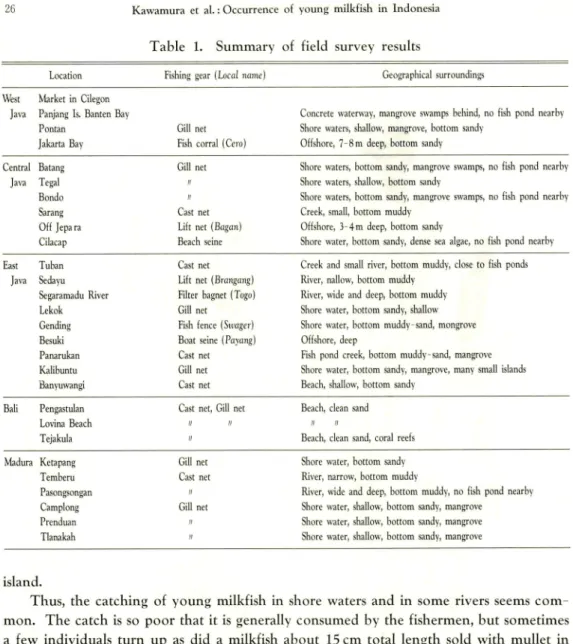
Table 1. Summary of field survey results
Fishing gear (Local name Geographical surroundings
Concrete waterway, mangrove swamps behind, no fish pond nearby
Gill net Shore waters, shallow, mangrove, bottom sandy Fish corral (Cero) Offshore, 7-8 m deep, bottom sandy
Gill net Shore waters, bottom sandy, mangrove swamps, no fish pond nearby
ii Shore waters, shallow, bottom sandy
H Shore waters, bottom sandy, mangrove swamps, no fish pond nearby Cast net Creek, small, bottom muddy
Lift net (Bagan) Offshore, 3-4m deep, bottom sandy
Beach seine Shore water, bottom sandy, dense sea algae, no fish pond nearby Cast net Creek and small river, bottom muddy, close to fish ponds
Lift net (Brangang) River, nallow, bottom muddy Filter bagnet (Togo) River, wide and deep, bottom muddy
Gill net Shore water, bottom sandy, shallow7
Fish fence (Siirager) Shore water, bottom muddy-sand, mongrove
Boat seine {Payang) Offshore, deep
Cast net Fish pond creek, bottom muddy-sand, mangrove Gill net Shore water, bottom sandy, mangrove, many small islands Cast net Beach, shallow, bottom sandy
Cast net, Gill net
Gill net Cast net
Gill net
Beach, clean sand
Beach, clean sand, coral reefs Shore water, bottom sandy River, narrow, bottom muddy
River, wide and deep, bottom muddy, no fish pond nearby Shore water, shallow, bottom sandy, mangrove
Shore water, shallow, bottom sandy, mangrove Shore water, shallow, bottom sandy, mangrove
island.
Thus, the catching of young milkfish in shore waters and in some rivers seems com mon. The catch is so poor that it is generally consumed by the fishermen, but sometimes a few individuals turn up as did a milkfish about 15 cm total length sold with mullet in a market in Cilegon, West Java (Fig. 10).
The shore waters where young milkfish are caught have common geographical
conditions : shallow waters, sandy beach, mangrove swamps behind, and a river nearby
(Table 1). Nervertheless, we have to consider the fishing methods. In coastal waters in Indonesia, fishing activity is on a small scale and efforts are concentrated on flat sandy beaches or muddy backwaters where fishing gears such as gill nets and cast net can be
easily operated. We cannot estimate the distribution of young milkfish from maldis-tributed fishing efforts. The occurrence of the young milkfish is not always related to
that of larvae. This may be because in some locations the collection of the larvae is not made efficiently. Beach seiners in Cilacap, Central Java, have captured young milkfish
(Fig. 11), although milkfish larvae have not been reported on the southern coast of Java. It is possible that some of the young milkfish come from broken-down fish ponds, especially at times of swell and flood ; some fishermen claimed that their milkfish catch
Mem. Kagoshima Univ. Res. Center S. Pac, Vol. 3, No. 2, 1983 27
improved a great deal and according to pond caretakers, it is almost impossible for fish to escape even at such bad times. They do not flood every year, but young milkfish
were caught every year in locations with no milkfish pond nearby. Therefore, it can
be concluded that young milkfish occur naturally where they have been caught and
that these locations are natural nursery grounds.
REFERENCES
Buri, P., 1980. Ecology on the feeding of milkfish fry and juveniles, Chanos shanos (Forsskal) in the Philippines. Mem. Kagoshima Univ. Res. Center S. Pac., 1(1)
25-42.
and Kawamura, G., 1983. The mechanics of mass occurrence and recruitment
strategy of milkfish Chanos chanos (Forsskal) fry in the Philippines. Ibid., 3(2),
33-55.
Kawamura, G., 1972. Gill net mesh selectivity curve developed from length-girth re
lationship. Bull Japan. Soc. Sci. Fish., 38(10), 1119- 1127.
and HARA, S., 1980. On the visual feeding of milkfish larvae and juveniles in captivity. Ibid, 46(11), 1297-1300.
and Nishimura, W., 1981. S-potential from the retina of milkfish, Chanos
chanos (Forsskal). Ibid., 46(11), 1421.
Kumagai, S., 1980. Ecology of milkfish with emphasis on reproductive periodicity. Re search report to the Aquaculture Department of SEAFDEC, Iloilo, Philippines. and BAGARINAO, T. U., 1979. Results of drift card experiments, with con siderations on the movement of milkfish eggs and larvae in the northern Sulu Sea. Fish. Res. J. Phil, 4(2), 64-81.
MARTOSUDARMO.B., Noor-Hamid, S. and Sabaruddin, S., 1976. Occurrence of milk
fish, Chanos chanos, spawners in Karimun Jawa waters. Bull Shrimp. Cult. Res.
Cent., 2(1/2), 169-176.
Saanin, H., 1954. On occurrence of Chanos fry in Indonesian waters. Tech. Pap.
Indo-Pacif. Fish., 54/41.
Senta, T., Kumagai, S. and Castillo, N., 1980. Occurrence of milkfish, Chanos
chanos (Forsskal), egge around Panay Island, Philippines. Bud Fac. Fish.,
Nagasaki Univ., 48, 1-11.
, and Ver, L., 1976. Occurrence of milkfish egges in the waters around Panay Island, Philippines, in April and May, 1976. Proc. Inti. Milikfish
Workshop-Con/., Tigbauan, Iloilo, Philippines, May 19-22, 1976, 167-180. Schuster, W. H., 1960. Synopsis of biological data on milkfish Chanos chanos (Forskal),
Explanation of Plates
Fig. 2. A fisherman with milkfish (arrow) captured with a gill net (Prenduan, Madura).
Figs. 3. and 4- A fish fence in operation (Gending, East Java).
Fig. 5. Cast netters in operation. A milkfish was found in their canoe (arrow)
(Pasongsongan, Madura).
Fig. 6. A lift net set in a small stream (Sedayu, East Java).
Figs. 7 and 8. Fish ponds that young milkfish come into from the river. Dried coconut
(arrow) is burnt to lure more milkfish (Panarukan, East Java).
Fig. 9. A concrete waterway which opens to the sandy beach from an experimental
tilapia pond (Panjang Island, Banten Bay, West Java).
Fig. 10. A milkfish sold with mullet in a market (Cilegon, West Java). Fig. 11. A beach seine in operation (Cilacap, Central Java).
• .
Mem. Kagoshima Univ. Res. Center S. Pac, Vol. 3, No. 2, 1983 Plate I
Siiiiliii^^^Mtt^^^^i
mi
mm illt
'
•.
y
• -•
*
•
"',;
' '-'*• :*" 'v&&\**iy^~^.t&$&.
Mem. Kagoshima Univ. Res. Center S. Pac, Vol. 3, No. 2, 1983 Plate III