Essential Fatty Acids of Tilapia nilotica
著者
TESHIMA Shin-ichi, KANAZAWA Akio, SAKAMOTO
Mineshi
journal or
publication title
鹿児島大学水産学部紀要=Memoirs of Faculty of
Fisheries Kagoshima University
volume
31
page range
201-204
別言語のタイトル
Tilapia niloticaの必須脂肪酸
Vol. 31 pp. 201-204 (1982)
Essential Fatty Acids of Tilapia nilotica
Shin-ichi Teshima, Akio Kanazawa, and Mineshi Sakamoto*1
Abstract
The essential fatty acid requirements of Tilapia nilotica were examined by the 4-week feeding trials using the defined, artificial diets at water temperatures of 20°C and 28°C. The test diets contained 1.0% levelsof 18:1 w9, 18: 2^6, 18: 3w3, 20: 4^6, or o;3-HUFA (60% 20: 5a>3 and 40% 22: 6w3) in addition to 4.0% 18: 1<o9 as dietary lipids. The highest weight gains were observed on the diets supplemented with 1.0% levels of 18: 2a>6 or 20: 4a>6. These indicated that T. nilotica requires
a>6-fatty acids such as 18: 2^6 and 20:4a>6 rather than a>3-fatty acids in contrast to other fishes. However, the effects of water temperatures on the EFA requirementsof T.nilotica were not clarifiedin the present study due to the poor growth of this fish at 20°C.
Many papers have shown that fishes require a>3-fatty acids such as linolenic (18: 3<a3),
eicosapentaenoic (20: 5a>3), and docosahexaenoic (22: 6a>3) acids for growth as essential fatty acids (EFA),,2). These findings have indicated that EFA requirements of fishes are different with those of mammals which require a>6~fatty acids such as linoleic (18: 2o>6) and arachidonic (20: 4
o)3) acids as EFA. Previously, we have revealed that Tilapia zillii requires 18: 2 co6 and 20: 4<w6 as EFA rather than a>3-fatty acids such as 18: 3a>3 and a>3-HUFA (highly unsaturated fatty acids such as 20: 5o>3 and 22: 6a>3), indicating that the EFA requirements of T. zillii are quite unique among the fishes3). We imagine that EFA requirements of fish may be variable with environmental factors such as water temperatures and salinities besides the genetic differences of fish. In the present study, the feeding experiments using Tilapia nilotica were conducted in order to confirm the unique aspect of EFA requirements in Tilapia species and also to examine the effect of water temperatures on the EFA requirements of this fish.
Materials and Methods
Specimens of T. nilotica, approximately 3.7-4.0 g in body weight, were obtained from the Ibusuki Branch of Fisheries Experimental Station of Kagoshima Prefecture. The Tilapia were fed the lipid-free diet for 10 days before the feeding trials, divided into 10 experimental groups of 10 fishes in an aquarium (30 liter-capacity), and reared with the test diets for 4 weeks. The composition of the basal ration was essentially the same as that used for T. zillii in the previous
*' Laboratory of Fisheries Chemistry, Faculty of Fisheries, University of Kagoshima, 4-50-20 Shimoarata,
202 Mem. Fac. Fish., Kagoshima Univ. Vol. 31 (1982)
study3) and contained the following ingredients (%); casein 40, dextrin 31, lipids 5, vitamins 3, minerals 4, cellulose powder 13, and agar 4. The test diets 1,2,3, 4, and 5 contained 1.0% levels of oleic acid (18: 1cv9), 18: 2co6, 18: 3^3, 20: 4<u6, and a>3"HUFA (a mixture of 60% 20: 5a>3
and 40% 22: 6co3), respectively, in addition to 4.0% 18: 1a>9 as dietary lipids (Table 1). The
Tilapia were fed the test diets at the 4.0% level of their body weightdaily (feeding time; 9:00a.m.
and 6:00 p.m.). The feeding trials of experimental groups 1 to 5 and 6 to 10 were carried out at
the water temperatures of 28°C, and 20°C, respectively.
Results and Disussion
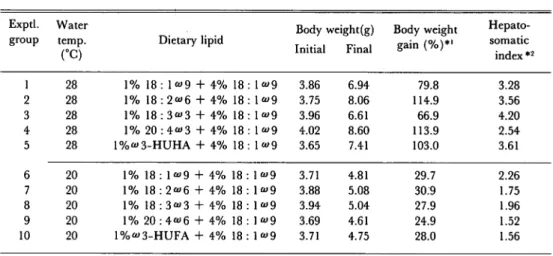
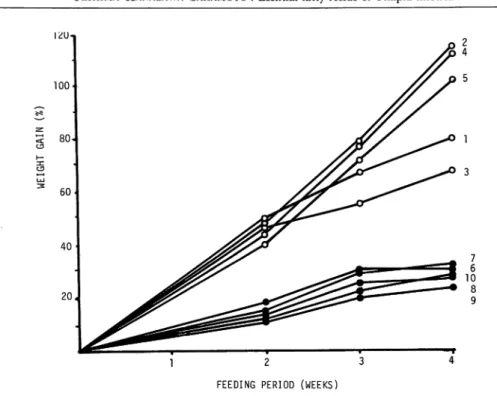
Table 1 and Fig. 1 show the results of the feedingtrials. When the Tilapia were reared at 28°C, the highest weight gain was attained on the diets 2 and 4 which were supplemented with 1.0% levels of 18: 2co6 and 20: 4w6, respectively. The Tilapia fed the diet containing 1.0% a>3-HUFA also showed a relatively high weight gain, but the weight gain on 1.0% a>3-HUFA was slightly inferior to those on 1.0% 18: 2<o6 and 1.0% 20: 4<w6. Whereas, growth of the
Tilapia was markedly poor on the diets supplemented with 18: 3 w3 or 18: 1co9. These results
Table 1. Effects of dietary fatty acids on the weight gain and hepatosomatic index of T. nilotica reared at water temperatures of 20°C and 28°C.
Body weight(g)
Body weight
Hepato-Dietary lipid
gain (%)„
somatic
index *2 1% 18: 1*>9 + 4% 18: 1*>9 1% 18:2^6 + 4% 18: 1 " 9 1% 18:3«>3 + 4% 18: 1 "9 1% 20:4^3 + 4% 18: 1^9 28 1%<»3-HUHA + 4% 18: 1">9 3.65 7.41 103.0 3.61 20 1% 18: 1 <»9 + 4% 18: 1 "9 3.71 4.81 29.7 2.26 1% 18:2^6 + 4% 18: 1^9 1% 18:3^3 + 4% 18: 1^9 1% 20:4^6 + 4% 18: 1^9 l%a>3-HUFA + 4% 18 : 1^9
*' (Final body wt. —Initial body wt.) x 100/Initial body wt.
*2 Liver wt. x 100/Body wt.
indicated that T. nilotica requires o>6~fatty acids such as 18: 2 <u6 and 20: 4<u6 as EFA rather than a>3-fatty acids as also observed on T. zilliiin the preceding study. Recently, Takeuchi et al4).
have also presented that T. nilotica showed better growth when fed the diets suppelemented with
18:2 oj6 rather than 18: 3 a>3 or <w3"HUFA. Furthermore, they have demonstrated that corn oil and soybean oil containing large amounts of 18: 2<w6 had a higher dietary value for T. nilotica than several lipids such as middle carbon triglycerides, beef tallow, pollack liver oil, etc5).
Exptl. Water group temp. (°C) 1 2 3 4 28 28 28 28 7 20 8 20 9 20 10 20 3.86 6.94 79.8 3.28 3.75 8.06 114.9 3.56 3.96 6.61 66.9 4.20 4.02 8.60 113.9 2.54 3.88 5.08 30.9 1.75 3.94 5.04 27.9 1.96 3.69 4.61 24.9 1.52 3.71 4.75 28.0 1.56
100-FEEDIN6 PERIOD (WEEKS)
Fig. 1. Growth of T. nilotica fed the test diets. Letters indicate the exprimental groups. O, reared at
28°C; #, reared at 20°C.
Differing from the present study (water temp., 28°C), Takeuchi et fl/4,5).
have conducted the
feeding trialsof T. nilotica at 25°C, however theirresults ofthe EFA requirements4* were essentially
similar to those obtained in the present study, except for the growth-promoting effect of 20: 4
co6.
They have pointed out that 20: 4a>6 did not improve the weight gain as effectively as 18: 3
a;3 in contrast to the present study. We assume that T. nilotica is possibly able to convert 18: 2
<v6 to 20: 4<w6 as found in mammals and several fishes6"81, because the growth-promoting effect of
18: 2oo6 was almost equal to that of 20: 4^6.
However, the above assumption should be
confirmed by further studies using radioactive tracer experiments.
When T. nilotica were reared at 20°C, the weight gains and hepatosomatic indices were low as
compared with the Tilapia reared at 28°C. The weight gains of Tilapia were not significantly
different amongthe groupsfed the dietssupplemented with 1.0% levels of 18: 1co9, 18: 2cv6, 18: 3
a>3, and o>3-HUFA, although the Tilapia gave a slightly low weight gain on the diet with 1J0% 20: 4a>6. Therefore, we could not withdraw any conclusion on the effects of water temperature on the EFA requirements of T. nilotica. The rearing of T. nilotica at low water temperature such as 20°C may result in a marked depression of metabolism of lipids and other nutrients.
Consideringthe above data and information, T. nilotica was concluded to require <w6"fatty acid as 18: 2co6 and 20: 4o>6 for growth in contrast to other fishes such as the rainbow trout9,,0), carp1U2), turbot,3), red sea bream14), Ayu (Plecoglossus altivelisyb~xl), eel,8), and chum salmon,9).
204 Mem. Fac. Fish., Kagoshima Univ. Vol. 31 (1982)
Finally, we assume that the EFA requirements of some fishes habiting in tropical environments
may differ from those of fishes living in temperate and cold water zones.
References
T. TAKEUCHI: in "Fish Culture and Dietary Lipids (in Japanese)" (ed. by Japan. Soc. Sci. Fish.,), Suisangaku Series No. 22, Koseisha-Koseikaku, Tokyo, 1978, pp. 60-77.
Y. YONE: in"Fish Culture and DietaryLipids (inJapanese)"(ed. byJapan. Soc. Sci.Fish.),Suisangaku Series No. 22, Koseisha-Koseikaku, Tokyo, 1978, pp. 43-59.
A. Kanazawa, S. Teshima, M.Sakamoto, and Md. A. Awal: Bull.Japan. Soc. Sci.Fish., 46,
1353-1356 (1980).
T. Takeuchi, H. Sato, and T. Watanabe: On the essential fatty acid requirements of Tilapia nilotica. The Autumn Meeting of Japan. Soc. Sci. Fish. p. 93 (1981).
T. Takeuchi, H. Sato, and T. Watanabe: Nutritional values of several lipids for Tilapia nilotica. The Spring Meeting of Japan. Soc. Sci. Fish. p. 95 (1982).
M. Kayama, Y. Tsuchiya, J.C. Nevenzel, A. Fulco, and J.F. Mead: J. Am. Oil Chem. Soc,
40, 477-502 (1963).
7) J.M. Owen, J.M. Adron, C. Middleton, and C.B. Cowey: Lipids, 10, 528-531 (1975). 8) A. Kanazawa, S. Teshima, and K. Ono: Comp. Biochem. Physiol., 63B, 295-298 (1979). 9) J.D. Castell, R.O. Sinnhuber, D.R. Lee, and J.H. Wales: J. Nutr., 102, 87-92 (1972). 10) T. Watanabe, C. Ogino, Y. Koshiishi, and T. Matsunaga: Bull.Japan. Soc Sci. Fish., 40, 493-499
(1974).
11) T. Watanabe, T. Takeuchi, and C. Ogino: Bull Japaan. Soc Sci. Fish., 41, 263-269 (1975). 12) T. Watanabe, O. Utsue, I. Ogino: Bull. Japan. Soc. Sci. Fish., 41, 257-262 (1975).
13) C.B. Cowey, J.M. Owen, J.W. Adron, and C. Middleton: Brit. J. Nutr., 36, 479-486 (1976). 14) M. FUJH and Y. YONE: Bull. Japan. Soc. Sci. Fish., 42, 583-588 (1976).
15) A. Oka: The Aquiculture, 27, 202-208 (1980).
16) C. Kitajima, M. Yoshida, and T. Watanabe: Bull. Japan. Soc. Sci. Fish., 46, 47-50 (1980). 17) A. Oka, N. Suzuki, and T. Watanabe: Bull. Japan. Soc. Sci. Fish.,45, 1413-1418 (1980). 18) T. Takeuchi, S. Arai, T. Watanabe, and Y. Simma: Bull.Japan. Soc. Sci. Fish., 46, 345-353 (1980).