5: 217-235 (2016)
Lessoned Learnt from Japan for Indonesia in the Area of Urban and Regional Planning:
Achievements from the Staff Enhancement Program under the Professional Human
Resource Development Project, Phase III IV (PHRD-IV)
Yusuke Toyoda1, Mingji Cui2, Mia Amalia3, Arinal Huda4, Diny Sukmaningsih5, Ludiyanta6, Ningsih7 *
Abstract: This summarizes achievements that Indonesian trainees learnt in Japan during the Staff Enhancement Program under the Professional Human Resource Development Project, Phase III IV (PHRD-IV). In II. Incentive Based Policies for Urban and Regional Plan Implementation the author introduces incentives in industrial and techno parks as well as in public transportation sector to foster economic growth and forest management to increase sustainable forest production in Kyoto and Shiga. III. Revitalization of Public Transportation ANGKUDES in Bitar Regency, East Java Province Indonesia: An Inspiration from Japan explains public financial support systems that are important for promoting public transportation in Kyoto and tries to adopt some of them to his own regency. IV. The Implementation of Aging Population Management Concept: A Comparison between Japan and Indonesia, based on the background that author s city is going to be faced with aging challenges, demonstrates public transportation in the city and compares the one between Indonesia and Japan. V. Compact City: A Panacea for Preventing Urban Sprawl in Japan analyses compact city in Japan from the viewpoints of financial, cultural aspects and insists the importance of Compact City while introducing some of its fallacies. And the last section VI. Integrating Strategic Environmental Assessment (SEA) to the Spatial Plan Document of Serdang Bedagai Regency states that government of Indonesia has transposed the SEA requirements into national legislation but the spatial plans still has not yet considered the sustainable development concept in her regency, therefore exploring some hints in Japan especially Kyoto though it does not arrange a specific document of SEA for their city planning yet. These efforts are our first trials to find out how to adopt lessons learnt in Japan to Indonesia for further studies.
Keywords: Lessons learnt, Urban and Regional Planning, PHRD-IV
1 Associate Professor, College of Policy Science, Ritsumeikan University 2 Senior Researcher, Kinugasa Research Organization, Ritsumeikan University
3-7Visiting Researchers, Research Organization of Open Innovation & Collaboration, Ritsumeikan University *The order of the authors are determined according to the rule: the first two authors managed this program to accept Indonesian trainers and are in charge of section I, while from the third authors are the trainees (the third author is a leader of the delegation and others are ordered alphabetically) and wrote sections from II to VI, one section owed by one author according to the authors order.
Introduction
Yusuke Toyoda and Mingji Cui
In the Staff Enhancement Program under the Professional Human Resource Development Project, Phase III IV (PHRD-IV), Ritsumeikan University had accepted five trainees who work for national government and local governments in Indonesia. During their stay at Japan for almost 1 months in October 12th, 2015 to November 6th, 2015, the trainees brought a variety of their own policy challenges in Indonesia and were involved in study in Japan from literature reviews at Ritsumeikan libraries to field visit to related agencies: alphabetically Kameoka City (Community Development and Safety Section and Policy Promotion Section), Kyoto City (Environmental Management Section, New Industry Promotion Section, Urban Planning Section and Walking Kyoto Promotion Section), (Public Interest Incorporated Foundation) Kyoto SKY Center, and Shiga Prefecture (City and Town Tax System Section, Forest Policy Section). This is the report summarizing their outputs through the program. As each trainee had her/his own task, each trainee wrote each section hereafter. These efforts are our first trials to find out how to adopt lessons learnt in Japan to Indonesia for further studies.
. Incentive Based Policies for Urban and Regional Plan Implementation
Mia Amalia
.1 Introduction
This paper aims to: (1) detail the implementation of incentive based policies for spatial planning; (2) propose how the incentive based policies in spatial planning fit into current implementation of spatial plans. Issues addressed in this paper are incentive for: (1) industrial and techno parks development as well as for the transportation and agricultural sector to foster economic growth in targeted areas; and (2) forest management to increase sustainable forest production and promote environmental services.
.2 Results from Fieldwork in Kansai Area, Japan
This section is written based on interviews with officers from Kameoka City, Kyoto City and Shiga Prefecture. Figures and numbers were taken from documents obtained from internet as well as from the presentation given by the officers. The main theme is gaining information of incentive based policies implemented in Japan, especially in Kansai Area for spatial planning implementation.
.2.a Kameoka City
Kameoka City area comprise of 70 per cent forest area. Thirty per cent of the total areas are used for housing, farming, service and public space. The forest areas are managed by government (public) and individuals (private). The Kameoka City provides subsidies to maintain forest cover
managed by individuals (private). All forest pathways are maintained by the Kameoka Government. This type of payment to forest owner ensure maintenance of forest cover. Monitoring is performed using aerial photos. Payment for maintaining forest cover is important for Indonesia since Indonesia, as Japan, consist of group of island with higher vulnerability compare to countries located in continents.
Kameoka City is also famous for its farmland. There are no direct incentives from Kameoka City to the farmers, as well as from other local governments to Kameoka City. Government provides information of agricultural market where produce can be sold at the highest possible price. Reliable information system is a type of important subsidy for farmers, fishermen and smallholders as well as other creative micro businesses. This type of subsidy is adaptable for Indonesia s condition where there are no information available for farmers and fishermen to gain highest profit from their labor.
As in other Japan region, population in Kameoka is decreasing, creating aged society. In 2007 Kameoka City apply for safe community concept developed by the World Health Organization. In March 2008, this city received a Safe Community certification, first in Japan. One of the features of a safe community is Community Buses. The bus is mainly used by elderly people who cannot drive or ride anymore. This service provides ways to transport within the city to places they need to be such as train station, city hall, hospitals. Yearly, the government provides JPY14.43M subsidy from the total of JPY23.75M of its yearly operational cost. In return, the benefit of providing community bus, to the Kameoka Society, exceeds the cost bear by the local government. This type of subsidy can be implemented in Indonesia s big cities/metropolitan areas where air quality is decreasing because of high volume of private vehicle operation. Subsidy and increasing quality of public transportation will provide citizens with more choices to sustainable use of roads as well as increasing air quality. Other possibility is to provide subsidized public transportation system where highest risk of transportation is bear by children or elderly. For instance, where they have no option other than use private motorize vehicle, or when the footpaths are not wide enough for them to walk safely.
.2.b Kyoto City
Kyoto City is located in the central part of Honsu Island in Japan with 1.5 million inhabitants. In the past, Kyoto City was the Imperial Capital of Japan, known as the thousand-year capital. It is located in a valley, part of the Yamashiro Basin, and sits on top of a large natural water table providing continues freshwater supply for its citizens. Incentives are used to support people protecting conservation areas as well as upland areas for watershed protection.
Kyoto City move toward a walking city. It proposed dis-incentive road design for private motorized vehicles in busy urban areas. For instance, bus stops are not pitted so that private vehicle cannot move pass the bus, they have to wait until all bus passenger board the bus. In busy areas, vehicle lanes are reduced from four lanes to only two lanes. Walking paths are widened since for the same areas, promotion of walking paths in busy areas, provide space for 8,000 people while vehicle lanes can only provide 2,000 cars, some are single riders.
Higher incentives are given for public transportation users, non-motorized vehicles and pedestrian in the form of safe walking paths, special lanes and parking stations for bicycles, park and ride facilities. At the same time, the Kyoto City Government promotes time saving transport, convenient and punctual public transportation facilities, and (Aruku machi town to walk) Kyoto application for mobile users. On top of that, to promote a walking society, early education for future public transportation users are compulsory in all public and private schools.
The Kyoto City Transportation Department provide effective dis-incentive examples for people who use private vehicle. It assigns roads to transport as many people possible, not to transport vehicles. Dis-incentive is followed by incentives for public transport users in the form of convenient and punctual public transports as well as highly accessible walking path, bicycle lanes and parking stations for bicycles. This type of incentives and dis-incentive can be applied in Indonesia s big cities, where people prefer to use private vehicles as the main means of transport.
In urban plan implementation, Kyoto City tends to use command and control policies. It issues building permit in accordance with zoning regulation. The city regularly controls for non-compliance. The city has designated areas for industries. The key industry of Kyoto is information technology and electronics and a home for Nintendo, Intelligent systems, Dainippon Screen, TOSE, OMRON, Kyocera, Shimadzu Corp, Rohm, Horiba, Nidec Corporation, Nichicon, Nissin Electric and GS Yuasa. Traditional Japanese craft are also major industry in Kyoto including ancient textile industries in the south of Kyoto.
Command and control policies are in place to make sure the industrial sector comply with the regulation. There are special areas designated for industrial areas. These areas are equipped with infrastructure to tackle pollution problems. Incentive are given in the form of matching research with corporation, especially high tech related research. The city acts as intermediaries between universities and industries. For ancient textile and ceramic technology, subsidies are given in the form of scholarship for students studying ancient arts and for creating business using ancient technology.
.2.c Shiga Prefecture
Shiga Prefecture is the place where Biwa Lake resides, the largest freshwater lake in Japan. The lake occupies one-sixth of Shiga Prefecture Area. It has been the main source of freshwater for its surrounding areas. This prefecture has place greater value on the close relationship between Shiga Forest and Lake Biwa. To maintain its forest cover, prefectural tax is implemented especially for promoting forest regeneration. This tax is additional to prefectural resident taxes of JPY800 per person and additional tax for corporation from JPY2,200 to JPY88,000 per corporation, resulting in JPY400M per year additional revenue. From our communication with the Prefecture, there was no environmental valuation process in place before the policy implementation. Currently there is no direct subsidy from the central government to the Prefecture for providing service to other Prefectures. This is the form of subsidy from downstream to upstream communities. The revenue from forest tax is designed to encourage forest uses, promote citizens involvement and forest management. For instance: (1) conversion of untended artificial forests into mixed forests; (2)
forest regeneration and management involving Shiga residents (JPY130M/year); (3) research and development (R&D) using forest resources and spaces efficiently; and (4) conserving and maintaining woodlands through citizen involvement.
There is no subsidy for people living in the forest area since there is none, very much different from Indonesia s condition, where local people live within forest areas. Ideally, revenue from this forest tax is used to improve condition of forest so that quality of environmental service is higher in the future. Payment from other local governments benefiting from forest conservation, especially for continues water supply to its lowland areas, is important for the prefecture to maintain its forest cover. According to Kyoto City, there is payment from Kyoto City to Shiga Prefecture for watershed protection. This type of intergovernmental payment is needed to be implemented in Indonesia, where more than one administrative areas located in a watershed.
.3 Conclusion
Fieldworks, discussions and interviews in Japan provide examples on how incentive based policies can be implemented in an administrative areas as well as inter-administrative areas. Important lessons are as follow:
1. Industrial and techno parks development. Incentive can be given in the form of matching research done by university with corporation, especially high tech related research. For the industrial park, government should provide special areas equip with pollution management system so that there is no negative impact imposed from such areas to the community. 2. Transportation. Dis-incentive policies for people who use private vehicle are very important
to be implemented in Indonesia s big cities. Dis-incentive should be follow by incentives for public transport users in the form of subsidized, convenient and punctual public transports as well as highly accessible walking path, bicycle lanes and parking stations for bicycles. Subsidy should also be given to primary schools to promote public transport use. 3. Agricultural sector. Incentive for this sector should be given in the form of reliable
information system. It should contain information of profitable crops as well as when and where to sell the produce. This type of subsidy is needed by farmers, fishermen and smallholders as well as other creative micro businesses.
4. Forest management. Direct incentive should be given to people protecting the forest.
Incentive in the form of payment can also be in the form of transfer from a local government to other government for maintaining forest cover and for providing continues water supply. Forest tax to people benefited from the forest areas is one of the choice as the source of forest incentive fund.
. Revitalization of Public Transportation ANGKUDES in Bitar Regency, East Java Province Indonesia: An Inspiration from Japan
Arinal Huda
.1 Introduction
Blitar Regency is one of thirty eight of local governments in the Province of East Java-Indonesia. The total area of Blitar regency is approximately 1,588.79 kilometer square and the population is 1,126,151. Most of population are farmer and they live in villages. Public transportation service which usually carries out people and things from rural area to urban area is called ANGKUDES. The capacity of ANGKUDES is about twelve passengers, and it is mostly owned by individual businessmen. The usage of ANGKUDES for transportation services is actually important for rural people because the average distance from rural area to urban area is more than 30 kilometer. Initially, ANGKUDES provides services for 24 routes within the region. In the early of 2000, the total number of ANGKUDES was more than 250 units and people from rural area prefer using ANGKUDES to using their own motorbikes when they go to urban districts.
Along with the improvement of income per capita and the easiness to buy motorbikes, many people prefer using their own motorbikes to ANGKUDES. At the same time, unfair competition among ANGKUDES businessmen also often occur. The services of ANGKUDES become unsatisfying. ANGKUDES usually leave terminal after getting full passengers, so there is no certain time table. Getting on ANGKUDES sometimes feel uncomfortable because some of ANGKUDES are not clean enough. These conditions discourage passengers to get on ANGKUDES for their mobility.
The number of ANGKUDES dramatically decreases in the last few years. There were 76 units in 2012, 56 units in 2013, and 37 units in 2014. In contrary, the number of motorbikes and cars increases about 10 percent annually. In 2003, for instance, the number of motorbikes was about 407,161 units but in 2014, it increases to 452,401 units. The same figure also occurs on car ownership in which the total number is also increases about 10 percent in the last few years.
The above data shows that the number of motorbikes and cars in Blitar regency annually increases in the last few years. This condition is assured to have correlation with the decline of ANGKUDES. People prefer using their own motorbikes to get on ANGKUDES. The increase of motorbikes and cars in the region is unfortunately not followed by the number of roads. The development of transportation infrastructure tend to increase the quality of the road rather than to build the new ones. Therefore, this condition sometimes attracts traffic jam in urban districts particularly during busy hours. Besides, the number of traffic accidents in Blitar Regency remains high. The data from the local police department shows that during 2014, there were 539 traffic accidents, in which were 177 died, 146 victims were heavy injured, and 615 victims were light injured. Meanwhile, the total financial loss was approximately IDR 1,004,250,000.
In line with the relocation of the city of Blitar Regency to Kanigoro Sub District by the end of 2015, the development of structure and infrastructure of public transportation such as bus terminal, bus stops, sidewalks, and representative roads should be well prepared. It is intended not only to
provide better access from rural to the new city of Blitar Regency but also to attract economic growth in the region. Moreover, it is strongly to reduce traffic accidents, traffic jam, and even pollution in the city.
So far however, we have not had enough capacity to make strategic and comprehensive concept of public transportation development. As we know that Japan is one of country in the world whose world class transportation management systems and public transportation services. Therefore, through the Staff Enhancement Program sponsored by Indonesian National Development Planning Board (BAPPENAS) in cooperation with Ritsumeikan University, Kyoto-Japan, I would love to learn from Japan on how to provide safe and convenient public transportation and what kind of strategies or policies are implemented by Local Government. I strongly believe that this short research will be very useful for my reference to develop public transportation in Blitar Regency.
.2 Lesson learnt from Japan
Due to limited time (only 3 weeks) provided, the locus of my field study were only two cities, Kyoto city and Kameoka city. Both are in Kyoto Prefecture. The main activities were observing public transportation services and infrastructure of public transportation, and doing interview with the staff from transportation division of the local governments. Based on those main activities, the following are some important points that I learnt from Japan concerning public transportation services.
.2.a Integrated transportation infrastructure.
Generally, transportation infrastructure such as railway station and bus station are built inter connectedly. Bus station is always available in front of railway station, so it is very convenient for passengers to transfer their trip from train to bus or vice versa. Buses become feeder of trains. I think this policy is very good to reduce traffic mobility within the city. It is different from what many of cities in Indonesia have. Bus station is commonly built far away from railway station. For some reasons, it is intended to spread economic growth, but it can trigger traffic mobility and traffic jam.
In case of Blitar regency, the implementation of integrated transportation infrastructure is not as easy as what Japan does. This is because there is no railway across the new city, Kanigoro. The distance of the new city to the nearest railway station is about 10 kilometres and there is no public transportation services which connect the new city, Kanigoro to the nearest railway station, Garum sub district. However, we will provide a new route for public transportation access from the central city of Kanigoro to the railway station, Garum. I strongly believe that this policy will attract people to use public transportation rather than to use their own cars or motorbikes.
.2.b Provision of public transportation services by the local government
Provision of public transportation services by the local government of Kyoto city and Kameoka city indicates that the local governments are very concern on public services. The Kyoto city buses
which serve strategic routes and dominate the services within the city have been able to finance its own operation, so the city government does not need to provide subsidy anymore to run these Kyoto city buses. Different from the city of Kyoto, Kameoka city still needs to provide subsidy annually to run Furusato buses and Kameoka Community bus. This kind of policy is still hardly found in Indonesia since many of cities in Indonesia have not prioritized the provision of public transportation.
Based on the experience that I obtained from Kyoto city and Kameoka city, I think the provision of public transportation services by local government of Blitar regency need to be done. This policy is relevance to article 139 point (3) and (4) of Law of Republic of Indonesia Number 22 Year 2009 concerning Road Transport and Transportation which states that:
(3) Municipal/city government shall ensure the availability of the public transportation for people and/or goods transportation services in the territory of municipality/town.
(4) The providing of public transportation services shall be conducted by state-owned enterprises, regional owned enterprises, and/or other legal entity in accordance with the legislation.
The Law of the Republic of Indonesia number 23 year 2014 concerning local government also gives mandatory to the local government to develop their own respective region for the sake of citizen s prosperity, and therefore, providing public transportation service is also in line with the national law on local government.
.2.c Roads and its utilities
Generally, roads and its utilities in Japan are very convenient. All of roads in the city are equipped with sidewalk. Smooth roads, clear road signs, and traffic announcer systems are easily found in Japan. Sidewalk is very convenient everywhere. Even in Kyoto s downtown, a number of sidewalks are revitalized to promote (Aruku machi town to walk) program. Sidewalk is designed conveniently for all people in any ages. Children, teenager, elderly people, and even disabled person are easy to walk along sidewalk in the city. A number of traffic light is also equipped by traffic announcer systems which makes easy for deaf people to cross the road. This concept does not only attract people to walk but also to reduce traffic accident on the road. I am sure this concept can also be applied in Blitar Regency in the near future.
.2.d Bus stops and bus time schedule
In Japan, bus stops are placed near education centre, business centre, public offices, and some other strategic places. Generally, no chairs are available in the bus stops and people are mostly in line to wait the bus arrival. Bus stops are always equipped with bus time schedule, so passengers will know when the bus arrives. The bus tends to be punctual, so it is very good as people will easily know how much time they need to reach destination. This concept is very good to apply, and therefore, we will apply it in Blitar regency in the near future.
Those are four main points of the portrayal of public transportation services in Japan, and I strongly believe that they are the keys to revitalize public transportation services in Blitar regency, and I also believe if we can implement them in our transportation development program, surely
public transportation services in Blitar regency will be better than before.
.3 Conclusion
Providing public transportation in Japan is not merely to ease people to mobile from one place to another, but more of that, the concept of safety first is always implemented in any kind of situation, including people mobility. Human safety in transportation field is not only gained by providing the tools of public transportation services, but also influenced by the provision of transportation infrastructure. Adopting lesson learnt from Japan, I will try hard to make public transportation services in Blitar regency, east java-Indonesia, better than before, so the number of traffic accident can be reduced and the citizen s prosperity will be gained.
. The Implementation of Aging Population Management Concept: A Comparison between Japan and Indonesia
Diny Sukmaningsih
.1 Introduction
The need to manage the aging population is becoming one of main characters and main problems that is faced by developed countries. Since they have sufficient health management quality and the high number of life expectancy, it brings to the consequences of the high number of aged people or elderly including in Japan.
Japan as a developed country and a nation facing the aged population for over decades could be the best example and reference to examine and explore more regarding aging population management. Despite a Japan s problem struggling with the shortage of productive age population, the authority still afford to perform an adequate policies in order to maintain their aging population. Public pension schemes, aging population regulation in form of a law for stabilizing and promoting elderly employment opportunities, carrying out the consumption taxes expected to be doubled from 5% to 8% and also to 10% (planned in 2017) in order to fund the increasing pension costs, are some of its policies that show the government alignment for the elderly. Besides that, Japan is also known as a friendly country for the elderly since the authority has provided them with sufficient public facilities along with adequate community based programs.
Since the concept of aging population management is quite extensive so that to make it narrower and easier to describe and to implement in Indonesia especially in Sukabumi City, it decided to examine and explore the concept just in terms of public facilities provision and community based programs for the elderly.
. 2 Issues/problems
Inadequate existing policies particularly related to the provision of public facilities for the elderly by local government of Sukabumi City
Partial programs and activities for the elderly that run by some of local government institution
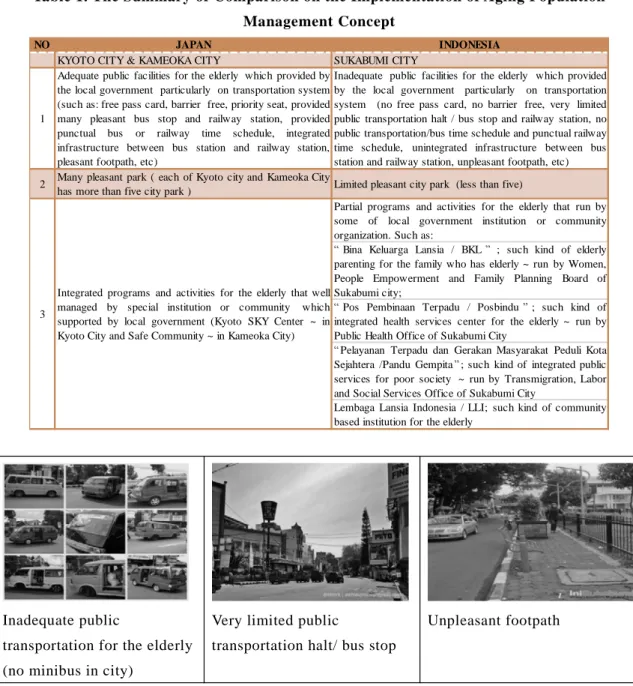
Table 1. The Summary of Comparison on the Implementation of Aging Population Management Concept
Inadequate public
transportation for the elderly (no minibus in city)
Very limited public
transportation halt/ bus stop
Unpleasant footpath
Figure 1. Some of inadequate transportation system in Sukabumi City
NO JAPAN INDONESIA
KYOTO CITY & KAMEOKA CITY SUKABUMI CITY
1
Adequate public facilities for the elderly which provided by the local government particularly on transportation system (such as: free pass card, barrier free, priority seat, provided many pleasant bus stop and railway station, provided punctual bus or railway time schedule, integrated infrastructure between bus station and railway station, pleasant footpath, etc)
Inadequate public facilities for the elderly which provided by the local government particularly on transportation system (no free pass card, no barrier free, very limited public transportation halt / bus stop and railway station, no public transportation/bus time schedule and punctual railway time schedule, unintegrated infrastructure between bus station and railway station, unpleasant footpath, etc) 2 Many pleasant park ( each of Kyoto city and Kameoka City
has more than five city park ) Limited pleasant city park (less than five)
Partial programs and activities for the elderly that run by some of local government institution or community organization. Such as:
Bina Keluarga Lansia / BKL ; such kind of elderly parenting for the family who has elderly ~ run by Women, People Empowerment and Family Planning Board of Sukabumi city;
Pos Pembinaan Terpadu / Posbindu ; such kind of integrated health services center for the elderly ~ run by Public Health Office of Sukabumi City
Pelayanan Terpadu dan Gerakan Masyarakat Peduli Kota Sejahtera /Pandu Gempita ; such kind of integrated public services for poor society ~ run by Transmigration, Labor and Social Services Office of Sukabumi City
Lembaga Lansia Indonesia / LLI; such kind of community based institution for the elderly
3
Integrated programs and activities for the elderly that well managed by special institution or community which supported by local government (Kyoto SKY Center ~ in Kyoto City and Safe Community ~ in Kameoka City)
Lapang Merdeka Park Urang Park Aspirasi Park Figure 2. Some figures of limited pleasant park in Sukabumi City
Unpleasant bus station
The distance between bus station and railway station is quite far (different location or area)
Unpleasant railway station Figure 3. Unintegrated infrastructure between bus station and railway station
in Sukabumi City
.3 Conclusion
Japan, particularly in Kyoto City and Kameoka City have comprehensive systems and policies regarding the provision of public facilities especially for their elderly. The convenience and the needs of the elderly are the main consideration when it comes to compile their urban planning and strategy;
Japan, particularly in Kyoto City and Kameoka City have integrated programs and activities for the elderly which is vitalize cooperation and collaboration spirit among local communities and the government.
.4 Recommendations
The local government of Sukabumi City should create comprehensive system and policies regarding the provision of public facilities for their citizen especially for their elderly. Public hearing and public involvement as well as basic survey on the demand of the citizen and mainly the elderly for a convenient public facilities is really needed to conduct;
Concerning the gradually increasing aging population in Sukabumi City over the years, the local government of Sukabumi City should start to compose integrated programs and activities for the elderly which is vitalize cooperation and collaboration spirit among local communities and the government. In a short term, re-organizing or re-formeing the existing partial programs and activities for the elderly in Sukabumi City into one special integrated program or activity could be the necessary solution to be implemented.
. Compact City: A Panacea for Preventing Urban Sprawl in Japan
Ludiyanta
. 1 Introduction
Population growth in a region will increase the demand of spaces for housing and activities. For a city that has a dense building, continuity of growing population and its activities will result in the city no longer can accommodate space for its population and its activities. Because of limited land in the city, the development of city tends to shift from urban area to suburbs. Therefore, urban functions will also shift to suburbs area. This condition is familiar called urban sprawl. Urban sprawl describes the expansion of human populations away fro m central urban areas into previously remote and rural areas in which sometimes is development uncontrolled.
Urban sprawl has both positive and negative impacts to the develop ment of the cities. The positive impacts are increasing productive business opportunities and increasing people s lives. Moreover, the settlers in the suburbs tend to have a better education level due to better economic conditions. On the other hand, urban sprawl has some negative impacts such as environ mentally sensitive land damage including loss of fertile wetlands, global warming due to overutilization of carbon based energy, transportation congestion, agriculture and open space land conversion, and infrastructure deficiencies.
It is well known that urban sprawl phenomenon has emerged in the United States. However, Japan has experience of urban sprawl, a pattern of low density growth a few decades ago. According to Pernice (2007) the most evident and massive changes in the Japanese urban system and townscape occurred in the period between 1955, which saw the official end of the postwar phase of reconstruction of the social and economic fabrics, and the early 1960s. This was the period which has been generally known as the "Japanese Economic Miracle" or "Great Economic Growth," with an average national GDP of 9% per year for the entire decade until the early 1970s. Housing land has sprawled extensively into the outskirts of the metropolis. The area of land covered by new urban development in the 30 years since the Second World War is equivalent to the total urban area built in Japan since the beginning of history (Kurasawa, in Sazanami, 1982). The uncontrollable and widespread urban sprawl of the early 1960s became a matter of serious concern to the Japanese government giving attention to issues related to environmental quality improvement in the urban
life of the citizens.
In 1968, City Planning Law was significantly revised and a kind of growth boundary systems that controls expansion of urban area, more precise zoning system that may protect good residential environment, and the development permission system that ensures a certain level of infrastructure of development were introduced. From the act, compact city concepts have been adopted in Japan to control the urbanization of the countryside. Dense, compact city was seen as a panacea for preventing urban sprawl in Japan. Japan has success experience in implementing compact city and the success much depends on technical, financial and cultural aspects.
. 2 Compact City Concept
Gordon and Richardson (1997) stated that the term compact city can take on different meanings, each with different planning implications. There are at least three possibilities: (1) a macro approach, based on high average densities at the city-wide or even metropolitan level, but more likely to be applied to a freestanding small town: (2) a micro approach, reflecting high densities at the neighborhood or community level; and (3) a spatial structure approach, emphasizing a pattern oriented to downtown or the central city versus a polycentric (or dispersed) spatial pattern, with obviously density consequences.
Many experts argue that the compact city will give many advantages. The compact city concept was seen as an approach that could end the evil of urban sprawl (Beatley in Linden and Voogd, 2004). Thomas and Cousins have summarized the most cited advantages: less car dependency, low emissions, reduce energy consumption, better public transport services, increased overall accessibility, the-reuse of infrastructure and previously developed land, the rejuvenation of existing urban areas and urban vitality, a high quality of life, the preservation of green space and a milieu for enhanced business and trading. The intensification of the use of space would also strengthen the self-containment, diversity, and multifunctionality of the city (Linden and Voogd, 2004)
On the other hand, some experts also pick up an argument the negative impacts of the compact city called the compact city fallacy or the compact city paradox. The relationship between the compact city and the environment is controversial more than one reason. Not only did the compact city prove to be less sustainable than some people believe it to be, but compact urban development will most likely have a negative effect on the quality of the grey environment as well. The grey environment is the environment that can be affected by intrusive emissions such as noise, odor, dust, toxic pollutant, calamities and so on (Hoeflaak and Zinger in Linden and Voogd, 2004).
The compact city paradox describes that the advantages of compact city are reducing transportation and space requirement but environmental problems are concentrated in the urban area, which can lead to conflict between living and work functions (Neuman, 2005). However, I still believe that compact city is better than urban sprawl in term of efficiency of public services and the impacts to environment since there are some advance alternative technologies to solve the paradoxes of compact city. In my opinion, Japan has a success story in implementing compact city.
. 3 Key Success of Compact City in Japan
The key success of compact city in Japan much depends on technical, financial and cultural aspects.
Technically, the City Planning Act of 1968 forms the basis for city planning in Japan. Based
on this act, the land use planning in Japan Cities can be an effective tool for managing urban growth and urban sprawl. Land use in Urban Area (and only in Urban Area) is controlled by the regulations of the City Planning Law .Areas within a city were designated as 'urbanization promotion areas (UPA)' and 'urbanization control areas (UCA)' depending on the degree of urbanization. Urbanization in UCA and UPA has been controlled mainly by Agricultural Land designation in agricultural area where agricultural land is protected to promote productive agriculture. Development permission system was also introduced to provide sufficient level of infrastructure in development of building land. Furthermore, the city planning areas were designated integrating multiple municipalities into single planning units. Financially, the compact city policies in Japan are supported by the government budget in term of compensation and direct payment. Compensation is given to the farmland owner in order to preserve their land. The other mechanism is direct payment. Direct payment is designated to compensate 80% of the difference in production cost between each less favored area and the average flat area. By this mechanism, the farmers are motivated to prevent their land for agricultural production. Compensation now becomes crucial issues for government expenditure and free trade era. Furthermore, the government restrictions on the marketability of agricultural land supports the saving in prime agricultural land (Miyao in Gordon and Richardson, 1997). Culturally, compact city enjoys support from cooperation and collaboration among multi stakeholders including farmers, residents, local institutions, private sectors, nongovernmental organizations and municipal administration so that land use can be well implemented. It is also part of Japan tradition to preserve scenic beauty and cultural properties as in the case of Kyoto City. Since 1969, the landscape policies of Kyoto City is keeping a balance between conservation and development in which the basic policy was decided as Conserving the north and developing the south which meant to conserve the historical townscape and mountain views of three sides in the north, and develop the south (Kyoto City, n.d.) .
. 4 Conclusion
Based on the discussion above, this study concludes that the compact city can be as a panacea for preventing urban sprawl in Japan. The success much depends on technical, financial and cultural aspects. Technically, the urban planning or land use planning in Japan Cities can be an effective tool for managing urban growth and urban sprawl. Financially, the prevention of urban sprawl in Japan is supported by the government budget in term of compensation and subsidy. Furthermore, the government restrictions on the marketability of agricultural land supports the saving in prime agricultural land. Culturally, it enjoys support from cooperation and collaboration among multi stakeholders so that land use can be well implemented. Furthermore, preserving the scenic beauty
and cultural properties is part of Japan tradition.
. Integrating Strategic Environmental Assessment (SEA) to the Spatial Plan Document of Serdang Bedagai Regency
Ningsih
.1 Introduction
Government of Indonesia has transposed the Strategic Environmental Assessment (SEA) requirements into national legislation through Law No. 32/2009 on Environmental Protection which requires mandatory SEA for spatial and development plans at the national, provincial and local levels as well as optional SEA for policies, plans and programs (PPPs) with potentially significant environmental impacts. Serdang Bedagai Regency as one of 514 regencies or cities in Indonesia has also tried to implement the SEA through integrating the SEA into Spatial Plans. In 2013, Government of Serdang Bedagai Regency has published the Spatial Plans document for 2013-2033 through Local Regulation No. 12/2013 which will become a guidance in developing the region of Serdang Bedagai Regency in 20 years ahead but the Spatial Plans still has not yet considered the sustainable development concept. Therefore, considering the Law No. 32/2009 on Environmental Protection, Government of Serdang Bedagai Regency through the Regional Development Planning Board has been arranging the SEA document to review policies, plans and programs (PPPs) that have been specified in the Spatial Plans document.
At present, there is no yet Government Regulation that manages the process of integrating the SEA into the Spatial Plans therefore the application of the SEA integration into PPPs becomes different among the local governments, provincial governments and even the national government. Up to now, Indonesian Government only has a Regulation of Environmental Ministry No. 9/2011 on General Guidelines for Strategic Environmental Assessment (SEA). Given this background, the objective of this research is to explore how SEA, as a tool, could be integrated into the spatial planning process in Serdang Bedagai Regency based on best practices that has been held by the Government of Kyoto City, Japan.
Methods applied in arranging this paper is by analyzing the policies, plans and programs (PPPs) in the Spatial Plans document of Serdang Bedagai Regency, collecting literature reviews of best practices and previous studies related with this subject and discussing with local governments in Japan and experts on environmental subject.
.2 Results Description .2.a Literature Review
Japan has not transposed its SEA requirements into national legislation though it is currently establishing the groundwork for a SEA system through research projects commissioned by the Ministry of Environment (MOE) including SEA guidelines formulated for waste management plans and SEA for programs of projects subject to EIA (Victor and Agamuthu, 2013). Lack of the
legislative framework for SEA has also become a primary problem identified in SEA implementation for Japan. Although SEA implementation may indicate the trend that Japan does not perceive the need for SEA as part of its national policy planning process, the existing environmental systems may be deemed adequate for addressing environmental issues at a strategic level.
Meanwhile, some cities in Japan shows a notable progress of SEA implementation through the introduction of SEA in local planning in areas such as Saitama prefecture, Tokyo Metropolitan Area, Hiroshima and Kyoto (Victor and Agamuthu, 2013). The development of a SEA legislative framework seems to be in the context of updating the existing EIA legislation. Other notable progress has been the initiation of the public involvement (PI) system which considers environmental, social and environmental aspects including alternatives for sectoral planning of infrastructure projects such as roads, airports, harbours and river basins. It is perceived that the PI system in Japan may mimic the form and function of SEA.
In Japan, integrating the SEA through the PI system is conducting at the early stage of the planning formulation which requires tremendous amount of energy. Focusing particularly on procedural and methodological aspects of planning formulation, measures that have already been adopted include consultation and coordination adjustment by the use of the conference system within the administration, involvement of interested parties, and the introduction of outside specialist knowledge through the council system, taking such forms as advisory panels, and democratic control by such means as local assembly resolutions (Ohsugi, 2010).
In addition to these measures, with the particular aim of encouraging a wider range of citizen participation in the process of planning formulation, many different methods of participation by local residents have now been put into practice, demonstrating the development of a form of planning administration that puts emphasis on the autonomy of residents. The participation of residents has thus become a key focal point in the government planning formulation process, and it has been pointed out that the increased awareness of participation by residents has played a part in reconfirming the importance and significance of local government planning (Ohsugi, 2010).
Considering several of the environmental issues being addressed in Agenda 21 Plan (UN,1992), the Government of Kyoto City engages stakeholders, citizens, local-, civic-, community-, business- and industrial organizations in formulating optimal strategies. Opening up local governments to citizen participation and promoting open decision-making processes (allowing for pluralistic inputs) is not only important from a democratization standpoint, but also of additional importance for the implementation of effective policies within the environmental field (Harnesk, 2011). As a result of citizen participation and the empowerment of citizens in planning and decision making-processes becoming acknowledged as a valuable tool when working with sustainability elements, collaborative-environmental management has become an increasingly popular approach for governments. The consultation processes with and the engagement of citizens were also assumed to result in an increase of the household awareness of sustainable development issues.
.2.b Lesson learnt From Kyoto City
The Government of Kyoto City does not arrange a specific document of strategic environmental assessment (SEA) for their city planning to show that they consider the environmental aspect into the policies, plans and programs (PPPs). The environmental concept has been integrated directly into their grand vision which finally will be implemented in all PPPs they make. Kyoto City grand vision is developing the city based on the categories Conservation, Revitalization and Creation which has been designed since 1999 to the coming 50 and 100 years and also becomes the foundation of urban structure of Kyoto. Based on these categories, the city provides guidelines for appropriate land use according to the characteristics of each zone.
Conservation zone is the area where natural environment and historical landscape should be conserved; favourable housing environment should be protected and improved; and cultural, artistic and academic facilities should be centralized.
Revitalization zone is a place where the rich historical area should be revitalized by keeping harmony between economy, housing, culture and entertainment.
Creation zone is the area where creative projects should be implemented to produce energy for the 21st century.
Implementation of this concept could be seen in land use ratio in relation to city area. From 82,790 Ha of city area; about 74% is forestry, 3.4% is agriculture and 17% is urban area.
Regarding the grand vision, the Government of Kyoto City has proposed some plans such as Kyoto City Master Plan, Ward Master Plans, Landscape Plans, District Plans, Field Specific Plans, etc. All these plans will create the City Planning of the City of Kyoto. The purpose of city planning is to regulate the use of land in the city area so that streets, parks and green areas are properly laid out and healthy and cultural urban life and efficient urban activities can be attained.
The integrating of the environmental concept could also be found in two of six future visions of Kyoto mentioned in the Kyoto City Master Plan; Kyoto is an environmental symbiosis and a low-carbon city and Kyoto is a city that cultivates industry that increasingly contributes to the environment and society. The Government of Kyoto City is also committing itself to materialize the ideal image of Kyoto while taking into account of the balance between environment , economy , livelihood , culture and safety .
Due to the beautiful landscape, Kyoto City is an asset that belongs not only to its citizens but also to the entire Japan and is even considered as a treasure of the world. This landscape has been protected and nurtured by the tireless efforts of their ancestors. Therefore, the Government of Kyoto City has proposed five basic guidelines in planning and improving the landscape formation of Kyoto City. The environmental concept also becomes the consideration of the guidelines of improving the landscape of Kyoto City such as landscape of Kyoto shall be in harmony with the nature based on the Basin Landscape .
The most important things of the implementation of all planning formulations in Kyoto City based on the discussion conducted with staff in Urban Planning Board of Kyoto City are:
As mentioned in the previous part of this paper, all planning documents are formulated based on the cooperation between various bodies such as residents, enterprises and city government through a Public Involvement (PI) System. All government plans could be seen in the website of the Government of Kyoto City therefore all citizens in Kyoto know what the government will do in their area, what the land use of the their area is, what citizens should or not do in regarding the grand vision of the city. The citizens have already had a high sense of belongings to the development of their city.
The new major of the Kyoto city could not change all planning documents have been formulated through the Public Involvement (PI) process. The renewal of Kyoto City Plan is only conducted due to some considerations through a PI system. Since the establishment of Grand Vision of Kyoto City in 1999, the Kyoto City already has 2 master plans; the first one is Master Plan in period 2001-2010 with theme life of peace, city of prosperity built on mutual trust Kyoto, in the 21st century and the second one is Master Plan in period 2011-2020 with theme flying into the future .
Concept of urban or city development planning in Indonesia is different with the one conducted in Kyoto City or maybe in some other cities in Japan. Although the planning formulation process also involves the societies and the stakeholders through a forum called Musyawarah Perencanaan Pembangunan (Musrenbang) , the role of the mayor or regent of the city or regency is very big. This view is getting bigger since the implementing of regional autonomy. The mayor who has been elected by the societies will also determine the development of the city in the future.
Regarding the integration of environmental concept in development planning, similar with other developing cities in other developing countries in the world, cities in Indonesia still only consider the economy aspect in their development planning. As long as the investors want to conduct their business in their area, the government may change their plans which sometimes do not consider the environmental impact anymore. Therefore, the integrating of the strategic environmental assessment into the regional or spatial planning document is only about conducting a SEA Document as a requirement in getting the legalization of the Regional or Spatial Planning Document. The SEA concept does not inherent in the planning document does not become a guideline in formulating the development document.
Acknowledgement:
We would like to express our deepest thanks to those who cooperate to this program:
Staff of Kameoka City (Community Development and Safety Section and Policy Promotion Section), Kyoto City (Environmental Management Section, New Industry Promotion Section, Urban Planning Section and Walking Kyoto Promotion Section), (Public Interest Incorporated Foundation) Kyoto SKY Center, and Shiga Prefecture (City and Town Tax System Section,
Forest Policy Section) for their kind cooperation to interviews and providing materials, and Dr. Tetsuo Mizuta ([Public Benefit Foundation Corporation ]The Consortium of Universities in Kyoto) for his comments in the final presentation;
Asia Seed for coordinating this program between Indonesia side and Ritsumeikan University; and
Japan International Cooperation Agency (JICA) and National Development Planning Agency (BAPPENAS), Republic of Indonesia for their fund and opportunities to hold this program.
[References]
Gordon, P. and Richardson, H. W., Are Compact Cities a Desirable Planning Goal Journal of the
American Planning Association, 63 (1), 1997, pp. 95-106.
Harnesk, D., Local Environmental Stakeholder Collaborations in the Kyoto Local Agenda 21-forum
(Bachelor Thesis), Japan: Lund University, 2011.
Katsumata, Y., The Impact of Population Decline and Population Aging in Japan from The Perspectives of Social and Labor Policy, Expert Group Meeting in Policy Responses to
Population Ageing and Population Decline, Population Division, Department of Economic and
Social Affairs, United Nations Secretariat, New York, 16-18 October 2000. Kyoto City, Kyoto City Official, n.d., Accessed on October 30th, 2015, from:
http://www.city.kyoto.lg.jp/
Linden and Voogd., Environmental and Infrastructure Planning, The Netherlands: Geo Press, 2004 Menon, J. And Melendez, A.C., Ageing in Asia: Trends, Impacts and Responses, ASEAN
Economic Bulletin, 26(3), 2009, pp. 293-305.
Neuman, M., The Compact City Fallacy Journal of Planning Education and Research, 25(1), 2005, pp. 11-26.
Ohsugi, S. Local Government Planning in Japan (in Papers on the Local Governance System and its Implementation in Selected Fields in Japan No.15), Japan: Council of Local Authorities for International Relations (CLAIR), 2010.
Okamoto, A., Optimal Tax Combination in Aging Japan, International Economic Journal, 21(1), 2007, pp. 91-114.
Pernice, Raffaele, Urban Sprawl in Postwar Japan and the Vision of the City based on the Urban Theories of the Metabolist Projects Jurnal of Asian Architecture and Building Engineering, 6(2), 2007, pp. 237-244.
Sazanami, H., Metropolitan Planning and Management, Japan: Japan Society for the Promotion of Science, 1982.
Victor, D., Agamuthu, P. Policy trends of strategic environmental assessment in Asia
Forest Policy Section) for their kind cooperation to interviews and providing materials, and Dr. Tetsuo Mizuta ([Public Benefit Foundation Corporation ]The Consortium of Universities in Kyoto) for his comments in the final presentation;
Asia Seed for coordinating this program between Indonesia side and Ritsumeikan University; and
Japan International Cooperation Agency (JICA) and National Development Planning Agency (BAPPENAS), Republic of Indonesia for their fund and opportunities to hold this program.
[References]
Gordon, P. and Richardson, H. W., Are Compact Cities a Desirable Planning Goal Journal of the
American Planning Association, 63 (1), 1997, pp. 95-106.
Harnesk, D., Local Environmental Stakeholder Collaborations in the Kyoto Local Agenda 21-forum
(Bachelor Thesis), Japan: Lund University, 2011.
Katsumata, Y., The Impact of Population Decline and Population Aging in Japan from The Perspectives of Social and Labor Policy, Expert Group Meeting in Policy Responses to
Population Ageing and Population Decline, Population Division, Department of Economic and
Social Affairs, United Nations Secretariat, New York, 16-18 October 2000. Kyoto City, Kyoto City Official, n.d., Accessed on October 30th, 2015, from:
http://www.city.kyoto.lg.jp/
Linden and Voogd., Environmental and Infrastructure Planning, The Netherlands: Geo Press, 2004 Menon, J. And Melendez, A.C., Ageing in Asia: Trends, Impacts and Responses, ASEAN
Economic Bulletin, 26(3), 2009, pp. 293-305.
Neuman, M., The Compact City Fallacy Journal of Planning Education and Research, 25(1), 2005, pp. 11-26.
Ohsugi, S. Local Government Planning in Japan (in Papers on the Local Governance System and its Implementation in Selected Fields in Japan No.15), Japan: Council of Local Authorities for International Relations (CLAIR), 2010.
Okamoto, A., Optimal Tax Combination in Aging Japan, International Economic Journal, 21(1), 2007, pp. 91-114.
Pernice, Raffaele, Urban Sprawl in Postwar Japan and the Vision of the City based on the Urban Theories of the Metabolist Projects Jurnal of Asian Architecture and Building Engineering, 6(2), 2007, pp. 237-244.
Sazanami, H., Metropolitan Planning and Management, Japan: Japan Society for the Promotion of Science, 1982.
Victor, D., Agamuthu, P. Policy trends of strategic environmental assessment in Asia