
トップ - アジア経済研究所学術研究リポジトリ ARRIDE
24
0
0
全文
(2) July 2004. Discussion Paper. The First Universal Suffrage Election, at County (Gewog) Level, in Bhutan Karma Ura. The Institute of Developing Economies (IDE) is a semigovernmental, nonpartisan, nonprofit research institute, founded in 1958. The Institute merged with the Japan External Trade Organization (JETRO) on July 1, 1998. The Institute conducts basic and comprehensive studies on economic and related affairs in all developing countries and regions, including Asia, Middle East, Africa, Latin America, Oceania, and East Europe.. The views expressed in this publication are those of the author(s). Publication does not imply endorsement by the Institute of Developing Economies of any of the views expressed.. INSTITUTE OF DEVELOPING ECONOMIES (IDE), JETRO 3-2-2, WAKABA, MIHAMA-KU, CHIBA-SHI CHIBA 261-8545, JAPAN. ©2004 by Institute of Developing Economies, JETRO.
(3) July 2004. Discussion Paper. The First Universal Suffrage Election, at County (Gewog) Level, in Bhutan Karma Ura. JULY 2004 DISCUSSION PAPER. The First Universal Suffrage Election, at County (Gewog) Level, in Bhutan, Karma Ura, Visiting Research Fellow, IDE-JETRO. CONTENTS. SIGNIFICANCE OF 2002 GUP ELECTION ............................................................................................................ 2 GUP, GEWOG AND GYT – LOCAL GOVERNMENT INSTITUTIONS ...................................................................... 4 POLLING BOOTHS AS MAZES FOR FIRST TIME, TREMBLING SIMPLE VOTERS ................................................... 8 LOW TURNOUT OF VOTERS AND CANDIDATES ................................................................................................. 9 EFFECTS OF TWO VOTE COUNTING METHODS ............................................................................................... 12 FINGERPRINT MOBILIZATION FOR NOMINATION ............................................................................................ 14 ELIGIBILITY CRITERION AND DESIRABLE ATTRIBUTES OF CANDIDATES ........................................................ 15 POST-ELECTION ALLEGATIONS, AND INAUGURAL CELEBRATIONS ................................................................. 18 RECOMMENDATIONS ...................................................................................................................................... 20. 1.
(4) July 2004. Discussion Paper. The First Universal Suffrage Election, at County (Gewog) Level, in Bhutan Karma Ura. DISCUSSION PAPER The First Universal Suffrage Election, at County (Gewogs)1 Level, in Bhutan. An Assessment of Gups’ Election of 2002 Karma Ura2. Significance of 2002 Gup Election A Royal Edict issued in 2002 profoundly altered the way the chief executive of a Gewog Yargay Tshogchung (abbreviated to its acronym GYT in the national language Dzongkha), a gup, was appointed. GYT is a County3 Development Committee. The chief executive of a GYT is titled in dzongkha as gup, who by tradition and history has been also the head of a county or gewog. A gup was earlier elected by the representatives of each household in a gewog through open discussion. There was no secret ballot. A Royal Edict of 2002 made it necessary for the position of gup to be subjected to secret ballots of eligible voters, defined as those 21 years old or above, in a gewog. Universal suffrage was included as a provision in the new GYT act, which was redrawn in 1999 at the command of the King to devolve decision making further to local government institutions. As the new GYT act, or chatrim as it is called in Dzongkha, came into force in July 2002, passed by the National Assembly that year, fresh elections were called for all gups in 199 gewogs (counties) out of 201 for a three-year term. 4Competitive remunerations were announced in the new GYT chatrim for the gups to attract persons of better qualification and experience for this post. There was a nationwide re-election of the gups by universal suffrage in September 2002, following this Royal Edict. Most of the elections were held in November 2002.5 It was the first time when positions of all gups were subjected to secret ballots by each adult voter, in contrast to the position of gups being selected by the representatives of each household until that time. The significance of gup election in 2002 is not limited to the novelty of each voter exercising his or her choice for a gup, ushering in one major form of democracy. The gup election of 2002 generated first-time lessons for electoral organization by the twenty district administrations,. I would like to acknowledge my gratitude for valuable suggestions and information to various people. These include Mayumi Murayama, Lyonpo Khandu Wangchuk, Dasho Kunzang Wangdi, and Dedri Boyd. I am particularly thankful to Karma Gayleg, Tashi Choden, Sonam Kinga, Dorji Penjore and Lham Dorji, all researchers of the Centre for Bhutan Studies. However, responsibility for any error found in the paper is mine. This article draws heavily on the comprehensive and extensive raw data collection and report prepared mostly by Tashi Choden, Sonam Kinga, Dorji Penjore and Lham Dorji for each of the 199 gewogs where election was held. Their work was compiled and bound in a few copies for archiving by the Centre for Bhutan Studies under the title ‘Secret Ballots in Rural Heartland’ (pp. 797) in 2003. However, this is the first attempt to analyse and synthesize the data to make it accessible to general readers. I would like to thank Institute of Developing Economies – JETRO, Chiba, Japan for enabling me to carry out research into a number of topics during a research fellowship. Responsibility for any errors found in the paper is completely mine.. 1. Karma Ura is Director of the Centre for Bhutan Studies, Langjophakha, PO 1111, Thimphu, Bhutan and visiting research fellow (April-December 2004), IDE-JETRO, Chiba, Japan. Email address at [email protected] or [email protected] 2. 3 Gewog is usually translated as ‘block’. Literally, a gewog means the area ‘under a gup’, given that a gup is abbreviated to ged in writing. I prefer to use the term county which sounds more exact in meaning as well as slightly more elegant. A county has semantic and functional equivalence across many countries that a block does not. 4. Elections could not be held in two counties in southern Bhutan due to poor security situation.. One of the unintended consequences of this will be that the election for most gups will be synchronized in November at an interval of three years throughout the country.. 5. 2.
(5) July 2004. Discussion Paper. The First Universal Suffrage Election, at County (Gewog) Level, in Bhutan Karma Ura. though it appears that this can not go on for long without consolidating the authority of dzongdags6, and if it does that it could go against the grain of coherent decentralization by investing new roles in dzongdags that widen their scope of power and functions. But the supervision of election by district administration is a temporary measure that the current move to set up an election authority will replace, and the administrative chief will not be part of coordination and supervision of election to rule out further conflict of interest for dzongdags. In a considerable number of gewogs elections were smooth and uncontroversial, with former gups returning easily to their post from which they had a large role in distributing nomination forms. However, when the information available through extensive interviews, supplemented by a modest gewog level quantitative data are examined in a nuanced way, a variety of phenomenon such as rivalries and conflicts, influences and pressures, campaigning and fingerprint mobilization, promises and incentives become more visible. This paper probes also into these aspects of election primarily to envision future political scenarios where safety measures need to be put in place. Being the first such franchise, the participation rates for the candidates and voters was generally low in the country as a whole. But the data reveals strikingly different levels of voters turn out across the country. There were gewogs where the voter turn out level plunged below 15 percent of voters and others where it soared above 75 percent of voters coming eagerly to cast their votes, suggesting huge variations in the interest to votes. As part of the exploration of the future political scenarios, the gup election of 2002 also provides some indication of the kind of values that the mass-voters will use to judge candidates in the foreseeable future which may partly determine the types of people going into elected public positions. The same kind of desirable values can be associated with those who rise to political power to the central legislative organs like the National Assembly and the Royal Advisory Council if the candidates mirror closely the values and attributes of the voters they represent. Though the candidates to the National Assembly and the Royal Advisory will be different from the gups, the voters will be the same and it is unlikely that they will use vastly different yardsticks to assess competence and values of candidates for local and central bodies. However, perhaps, one of the more important lessons of the gup election of 2002 can be that it is a rudimentary model for a nonpartisan election for local government institutions such as GYT and district development committees. If future elections of the members of two sub-national decision making bodies, district development committee (hence abbreviated to its Dzongkha acronym DYT) and county development committee are to remain free from party system, the gup election 2002 provides some experience in that direction. A question of vital importance facing Bhutan is whether sub-national bodies like GYT and DYT can be left out of political party system that will come to dominate central politics. A natural question is whether political party system will not make its division and alignments felt right across the land through GYTs and DYTs and turn these bodies effectively into structures of centralized party control and communication which can reduce the scope of locally relevant diversity and locally relevant choices? 7 From this perspective, a critical point of discussion and practical task is to search for a democratic framework for election for the local government institution such as GYT that does not carry the likelihood of small communities being divided.. The chief administrator of a district is known as dzongdag in Dzongkha. It literally means the holder of the fortress. The current practice of eliding dzongdags as governors by the dzongdags is illuminating in so far as dzongdags perceive themselves as both bureaucrats and politicians. Actually, they are bureaucrats and hence not governors as conventionally understood in other countries.. 6. 7 The advantages for not politicising the election of the members of local government institutions are presented in my forthcoming paper on electoral issues.. 3.
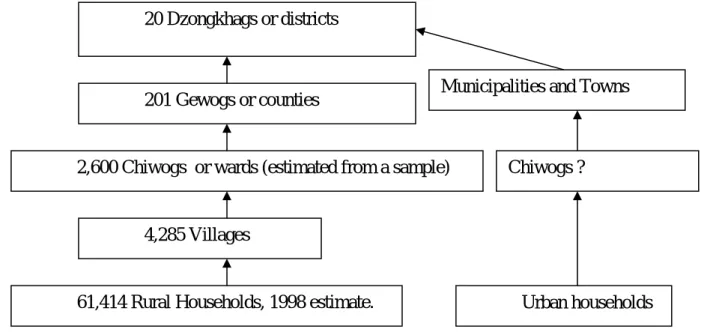
(6) July 2004. Discussion Paper. The First Universal Suffrage Election, at County (Gewog) Level, in Bhutan Karma Ura. Gup, Gewog and GYT – Local Government Institutions A wider significance of the gup election of 2002 can not be understood unless the place of GYT in the structure of the state and the role of gup in a gewog is briefly explained. However, this is not the place to go into details about it, and only cursory outline is presented here.. 20 Dzongkhags or districts. Municipalities and Towns. 201 Gewogs or counties. 2,600 Chiwogs or wards (estimated from a sample). Chiwogs ?. 4,285 Villages. 61,414 Rural Households, 1998 estimate.. Urban households. Figure above presents vertical organizational structure of the country. The country is divided into 20 districts of varying sizes, both demographically and territorially. A district is further divided into municipalities and gewogs. There are 201 gewogs and several municipalities. The distinction between municipalities and gewogs follows the distinction between traditional settlements and modern towns. A gewog is further subdivided into chiwogs, and chiwogs are in turn divided into villages. However, it must be noted that the division into chiwogs is not uniform throughout the country. In a few districts there are different organization formations of a gewog which does not correlate to chiwog, sociological and historical reasons for these differences have not yet been studied. In general, a group of villages makes up a chiwog. A chiwog, which may be compared to wards, or a group of chiwogs is overseen by a tshogpa8 who is a member of GYT. Chiwog. According to summary data that has come my way, there are approximately 4,285 villages in the country.9 The population (not in demographic sense but in sampling sense) mean and population distribution of villages are not known. Neither can we estimate these statistics because of the lack of a sample data on the size of villages. However, data on the number of households was available for 56 of the 201 gewogs. Data was also available for the number of villages in each of those chiwogs. In all, the sample represented 16,920 households in 1,302 villages in 547 chiwogs in 56 gewogs. Although all the districts were represented in the chiwog sample, the data was dominated by four districts: Thimphu, Trashigang, Sarpang, Wangdue, and Pema Gatshel. The sample was not chosen deliberately by any criteria; it was selected from a publication by the Centre for Bhutan Studies, where interviewers happened to collect this set of information randomly during data collection for the evaluation of the gup election of 2002.The data set is sufficiently large and can be used to generalize for the whole country.. 8. Tshogpa literally means representative.. The definition of a village is not given while drawing up this list by the Ministry of Home Affairs. It is likely to be villagers’ categorization and construct that has been merely translated into an official list.. 9. 4.
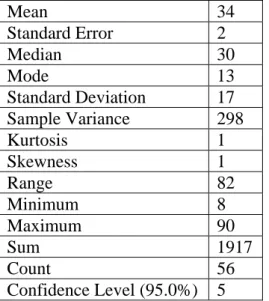
(7) July 2004. Discussion Paper. The First Universal Suffrage Election, at County (Gewog) Level, in Bhutan Karma Ura. Table 1 Summary statistics for distribution of households in chiwogs or wards.. Mean Standard Error Median Mode Standard Deviation Sample Variance Kurtosis Skewness Range Minimum Maximum Sum Count Confidence Level (95.0%). 34 2 30 13 17 298 1 1 82 8 90 1917 56 5. An idea of household numbers under each chiwog was obtained by dividing the number of households by the number of chiwogs from a sample of 56 gewogs. This is an indirect way of approximating the distribution of households under each chiwog by averaging. Within the sample generated by this means, the number of households under a chiwog ranged from 8 to 90. The distribution is left-skewed. Following this method, one can find that a typical chiwog is made up of 34 households with a standard deviation of +-17 households. Summary statistics for distribution of 1917 household over 547 chiwogs in a sample of 56 gewogs are presented in the table below.. Table 2 Correlation (R-square) between households and chiwogs, and between villages and chiwogs. Correlation between households and chiwogs Correlation between villages and chiwogs. 0.7476 0.2429. As expected, the number of chiwogs within a gewog is correlated positively to the number of household. That is, the greater number of households, the greater the number of chiwogs. However, there is negligible correlation between the number of villages and the number of chiwogs. This demonstrates that the entities called villages do not follow any norms according to the number of households to be called villages. The number of villages and formation of chiwogs are not linked in any clear pattern. Most gewogs consist of less than 10 chiwogs, with each chiwog having about 34 households. Table 3 Frequency distribution of a sample of 56 gewogs according to chiwogs range.. Interval of chiwogs 0 to 5 chiwogs 6 to 10 chiwogs 11 to 15 chiwogs 16 to 20 chiwogs 21 to 25 chiwogs 26 to 30 chiwogs more than 30 chiwogs. Frequency of gewogs 12 32 4 4 1 1 2 56. Frequency % 21 57 7 7 2 2 4 100. Gewog and GYT. A number of chiwogs, as mentioned earlier, make up a gewog. The distribution of households in 200 gewogs, for which data collected in 1998 was available, shows that a typical gewog has 307 households with a standard deviation of +-153 households. Mean is a greater than median: so the distribution of households is right-skewed. Household numbers under gewogs vary greatly from 47 in Soe in Thimphu to 878 in Gomdar in Samdrup Jongkhar.. 5.
(8) July 2004. Discussion Paper. The First Universal Suffrage Election, at County (Gewog) Level, in Bhutan Karma Ura. Table 4 Frequency distribution and cumulative percentage of gewogs by households. Interval of households Frequency of Gewogs 1 to 50 households 2 51 to 100 households 10 101 to 150 households 15 151 to 200 households 24 201 to 250 households 27 251 to 300 households 38 301 to 350 households 24 351 to 400 households 9 401 to 450 households 12 451 to 500 households 14 501 to 550 households 10 551 to 600 households 7 601 to 650 households 4 651 to 700 households 1 701 to 750 households 0 751 to 800 households 2 801 and more households 1 Total 200. % 1.0 5.0 7.5 12.0 13.5 19.0 12.0 4.5 6.0 7.0 5.0 3.5 2.0 0.5 0.0 1.0 0.5 100. Cum % 1.0 6.0 13.5 25.5 39.0 58.0 70.0 74.5 80.5 87.5 92.5 96.0 98.0 98.5 98.5 99.5 100.0. It can be concluded from the frequency distribution table of the number of households across the gewogs that 70% of the gewogs have less than 350 household in them. About 14% of the gewogs have lower than 150 households and only about 10% of the gewogs have over 500 households.10 Figure 1 Distribution of household over 200 gewogs. Households number is shown on X axis. Gewog numbers are shown on Y axis.. Frequency dis. Of households 40. 35. 30 38. frequency. 25 27 20. 24. F Poly. (F). 25. 15 16 10. 12 9. 14. 9. 5. 10 7. 2 0 1 to 49. 4. 2 1 1 0 0 50 to 100 to 150 to 200 to 250 to 300 to 350 to 400 to 450 to 500 to 550 to 600 to 650 to 700 to 750 to 800 to 850 to 99 149 199 249 299 349 399 449 499 549 599 649 699 749 799 849 899 No of households. The first quartile, Q1, is 198 households and the third quartile, Q3, is 401 households. Therefore the interquartile range is 203 households. Inter quartile range is particularly useful for measuring non-central location such as in skewed distributions of households numbers across gewogs. It uses the spread in the middle 50% of the data, effectively excluding both small observations and large observations unlike in variance. An interquartile range of 203 households therefore means that within the 50% of midspread data, average is 203. 10. 6.
(9) July 2004. Discussion Paper. The First Universal Suffrage Election, at County (Gewog) Level, in Bhutan Karma Ura. Table 5 Summary statistics for distribution of household in 200 gewogs. Mean Standard Error Median Mode Standard Deviation Sample Variance Kurtosis Skewness Range Minimum Maximum Sum Count Confidence Level(95.0%). 307 11 281 344 153 23470 1 1 831 47 878 61414 200 21. GYT functions and its chief executive, gup. Corresponding to the division of a district into gewogs and municipalities / towns, there is GYT (Dzongkha acronym for the gewog development committee) for gewogs and Thromkhag Yargye Tshogchung (municipal committee) for municipalities / towns. The GYTs and municipal commitees form the first layer of emerging local government institutions. These two bodies are linked at a higher, second level in a DYT (Dzongkha acronym for district development council) representing the whole district. Both the members of Thromkhag Yargay Tshogchung and GYTs are represented in the DYT. District Development Committee (DYT). Gewog or County Development Committee (GYT). Municipal Committee. or. Town. A DYT cannot be understood on its own, separate from the functions of GYTs: DYTs are derived bodies composed by the ensemble of top GYT members - the gups and mangmis11 of the gewogs - and representatives of the thromkhags 12 . A DYT acts as a counterpart to a district administration. Although DYTs have a set of broader powers and responsibilities, they are of a coordinating, reviewing and clearing house nature when issues of intra-gewog or overall nature crops up. GYTs have a variety of functions according to its act passed in 2002. Some of these are: to settle disputes about corporate properties; to arbitrate civil disputes toward reconciliation; to maintain corporate properties; to propose motions to the National Assembly; to prepare comprehensive annual report to district administrators e.g dzongda and beyond; to promote artisan production and cooperatives; to control architecture designs; to control access to edible forest products; to control environmental pollution; to promote conservation of ecological and historical sites, to award tender works; to manage community educational and communal religious. 11. Mangmi and mang gap are used inter-changeably for deputy gup.. 12. Municipality.. 7.
(10) July 2004. Discussion Paper. The First Universal Suffrage Election, at County (Gewog) Level, in Bhutan Karma Ura. establishments; to control and manage GYT budgets; including the retained rural taxes to organise minor village defence activities. These are then the field of influences of the GYT, in particular, the gup as its chief executive. As mentioned earlier, a GYT is headed by its chief elected executive, the gup. The membership of a GYT ranges from five to 20 depending on the size of the gewog.. Polling Booths as Mazes for First Time, Trembling Simple Voters Being the first time, the gup election of 2002 was not without humorous incidents which conjure up challenging moments for peasants rallied to vote by various means such as district administrations’ official scripts, and appeals of gups and candidates. In many gewogs, voting was made, at least for one person per household, obligatory reminiscent of electoral practice in a few countries, like Belgium, where voting is compulsory. On average, most of the voters had to walk fast three hours to polling booths carrying pack lunches and another three hours to walk back homes: it was gruelling for average farmers, arduous for elderly people and difficult for women with babies. But there were also polling booths where voters had to walk hard for two days each way. To be motivated to participate in voting in the light of such distance must be considered highly giving on the part of peasants during post harvest season in November. Public facilities saw new uses as polling stations. Polling booths were transformations of GYT halls, gup’s offices, gewog centres, natural renewable resource centres, schools, basic health units, temples, and offices. Booths were usually guarded by police, volunteers or election committee members. They not only had to guard booths but assist bewildered peasants to select the box into which they wanted to insert their votes. The motion of dropping pieces of paper into a box to choose a gup was without parallel in their life so far. It can only be hoped that the unverifiable direction they pointed in the privacy of booth was correct one. Election officials, in consultation with community functionaries, usually looked for a room with an exit and entrance to serve as a ballot booth. Separate entrance and exit facilitated segregation of voters into those who cast their votes and those who did not. It was considered important in many polling stations not to allow the two groups to mix. In some parts of the country election committee members and their assistants resorted to branding people, who finished voting with ink marks on their thumb nails or stamping official seals on their arms to prevent any voter, who might try to come to vote for the second time. Enthusiasm to cast votes place was over estimated; none seems to have approached a poll twice to do so. In many gewogs, election committees issued serially numbered ballots while noting the name of the voter who received it. Thus in principle it would have been possible for an election committee to match the exact identity of each voter with his or her chosen candidate, although this was neither the intention and also was not done. Nevertheless, such a practice is fraught with potential for abuse in future and it should be considered improper and prohibited. No clear standards seem to have been laid for dimension of ballot boxes, and for photographic and textual information on the candidates to be displayed on ballot boxes. Or, it seems not to have been followed if such standards were issued. This situation led to some improvisational variations across gewogs. To begin with, it was understood that in the case of multiple candidates, there should be only one ballot box representing each candidate. But in one gewog, a ballot box was installed also for abstention votes – which appeared necessary for those who walked all the way under some kind of persuasion but who did not want to approve any candidate at the end, as proven by 20 abstention votes out of 144 cast. This gewog gave an additional space to the choices of its voters that would otherwise be limited to a clear dichotomy of yes or no for the current candidates. A sizeable abstention vote could indicate that the voters are politically active and willing to make the effort to vote but none of the current candidates come close to the ideal candidate against which they measure the current candidates. From this point of view, it seems important to introduce the ballot boxes for abstention votes in future elections. The sizes of photographs on ballot boxes were not uniform, even within a booth. Ballot boxes of some candidates did not display photographs but their addresses. While modest variations could make no significant difference to the decision of the voters, the difference between a post 8.
(11) July 2004. Discussion Paper. The First Universal Suffrage Election, at County (Gewog) Level, in Bhutan Karma Ura. card photograph and a passport size photograph were found perceptible to old peasants with dodgy eyesight. In one gewog, polling went on well in to dusk when photographs were blurred squares until tube lights were installed. In such cases, guards had to assist the voters once again in identifying correct ballot boxes. The gup election of 2002 was also noteworthy in generating many amusing and touching conduct of first-time voters. Numerous voters exited booths without casting their ballots, after having a drawn out look at the inside of a booth. Others caused ques to stop moving as they did not come out, and booth guards had to go inside to check why such voters took so long inside. Many voters stood still for a long time in booths, at a loss not sure what to do next. It is perhaps in this context that an unusual complaint some candidates made can be understood. They contended that the order of ballot boxes in terms of nearness to the entrance made a difference to a candidate’s success. It was said that the first ballot box from the entrance usually received the maximum votes, reinforcing speculation that many voters baffled by the experience of first-time voting simply dropped their ballots into the first ballot box placed near the entrance. Voters were noticed shivering and trembling from fear and anxiety of an unknown experience, and it is plausible that they dropped their ballots into the first ballot box they found to get over a stressful situation. In a typical fashion to turn any public atmosphere into a celebratory one, the arenas of voting were turned in many cases to open air dancing after the voting results were counted and declared. This may have pleased a section of crowd and candidates who won, and made the losers feel less stung by loss.. Low Turnout of Voters and Candidates Low voter turnout was a major characteristic of the gup election of 2002. Out of 201 gewogs, gup elections were held in all 199 gewogs except Samrang in Samdrup Jongkhar and Taklai in Gaylegphug. Out of a total of 2,13,550 eligible voters in 199 gewogs, 73,607 voters, or 34.4 percent of the eligible voters, cast their votes. The list of eligible voters was prepared by the 20 dzongkhag administrations that acted as election coordinating bodies within their respective jurisdictions. Eligible voters were defined simply as people 21 years old and above whose census information was registered in a particular gewog. Such voters should be defined as potential voters instead of eligible voters, because eligibility was defined with a further criterion at most of the polling stations. This additional criterion was whether a person of voting age with census registration in a particular gewog could produce his or her national identity card. This criterion had dramatic effect at some poll stations. In one gewog, out of 260 people who turned up to vote, 100 did not have national identity cards and they were denied the opportunity to cast their votes. From this account, it is apparent that issuing identity cards rapidly to all who are of voting age is clearly needed if future voting pattern is not to be biased towards those who could obtain national identity cards because of their capacity to reach Thimphu to do so. The technical criterion of being able to produce national identity card was however not uniformly followed; there were many gewogs where commonsense prevailed over technical requirements. Voters were allowed to vote, as long as the members of the community knew each other to be Bhutanese residing in that area. Although people maintained their census registration in a certain gewog, they do not physically live there. The result is that a person’s home address written on national identity card derived solely from census registration can diverge from the true address of a person which actually indicates where he or she lives. For those who have nothing more than census registration in a certain gewog linking their parental origin to that gewog, they have very little experiential content of that gewog. They have been away for over a decade, or even longer, working elsewhere as civil servants, soldiers, monks, wage workers, contractors, traders and other business persons. Nonetheless, a person is eligible to vote only at the gewog where he or she is registered for census, which is usually at his or her ancestral place. Given this fact, the voter turnout was generally low in the gup election. Even after taking into consideration the fact that a significant proportion of eligible voters have migrated and live elsewhere, there were gewogs where the voter turnout was extremely low. 9.
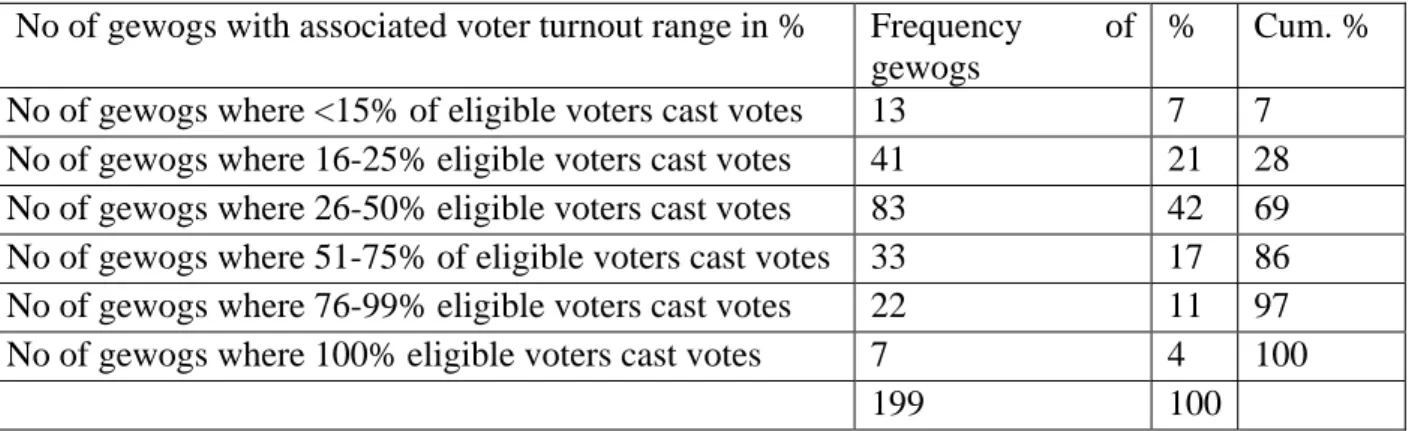
(12) July 2004. Discussion Paper. The First Universal Suffrage Election, at County (Gewog) Level, in Bhutan Karma Ura. There is no great value in introducing free election if voter turnout will continue to remain poor due to long term structural causes. Obviously, where voter turnout is abnormally low, it implies that the gups have been elected by an extreme minority of people. Efforts to increase participation rate for voting will be an important task. On the other hand, as the election in 2002 was the first such occasion, voter turnout might have been depressed by sheer lack of knowledge about the importance of participation in election. As such events are repeated, the participation rate could increase. Table 6 Summary statistics for voter turnout in percentage in 199 gewogs. Mean Standard Error Median Standard Deviation Sample Variance Skewness Range Minimum Maximum Count Confidence Level(95.0%). 43 2 36 24 595 1 90 10 100 199 3. The main descriptive statistics of voter participation rate or voter turnout in 199 gewogs are summarized. The units of data in the table are in percentage of vote cast divided by eligible voters which gives measure of participation or voter turnout. The distribution of data show that data is distributed asymmetrically and it is positively skewed as indicated by mean voter turnout (43%) being greater than median voter turnout (36%) per gewog. The lowest turnout was 10% and the highest turnout 100%. As the distribution of votes cast per gewog is skewed, mean voter turnout is not a good measure of data fluctuation around the mean; standard deviation gives a better idea about the clusters of data around it. The standard deviation is 24, which means that voter turnout data in the population lie within 24% around the mean of 43%. (i.e. clustering between 43%+24%=67% and 43%-24%=19% In 137 gewogs, less than 50% of the eligible voters actually cast votes. In 54 gewogs, less than 25% of eligible voters cast votes, and in 13 gewogs less than 15% of the eligible voters cast votes. Where low voter turnouts dipped below 25% of eligible voters, further research will be necessary to establish whether the reasons were structural and long term in nature or whether the reason was merely apathy. Table 7 Frequency distribution of gewogs by range of voter turnout. No of gewogs with associated voter turnout range in % No of gewogs where <15% of eligible voters cast votes No of gewogs where 16-25% eligible voters cast votes No of gewogs where 26-50% eligible voters cast votes No of gewogs where 51-75% of eligible voters cast votes No of gewogs where 76-99% eligible voters cast votes No of gewogs where 100% eligible voters cast votes. Frequency gewogs 13 41 83 33 22 7 199. of % 7 21 42 17 11 4 100. Cum. % 7 28 69 86 97 100. Gewogs with less than 25% of voter turnout as well as gewogs with more than 75% of voter turnout represent extreme situations of electoral participation in 2002 gup election. 29 gewogs where people were electorally, exceptionally active and turnout exceeded 75% were: Merak, Sakten, Naro, Lingshi, Mewang, Naja, Sarpangtar, Dekiling, Singye, Hilley, Dovan, Goenshari, Kabji, Talo, Rangthangling, Betine, Tsholaingkhar, Barshong, Kithorthang, Dunglagang, Gosaling, Semjong, Trong, Phangkhar, Nangkor, Nganglha, Goshing, Depung, Yurung. From the list of these gewogs, it. 10.
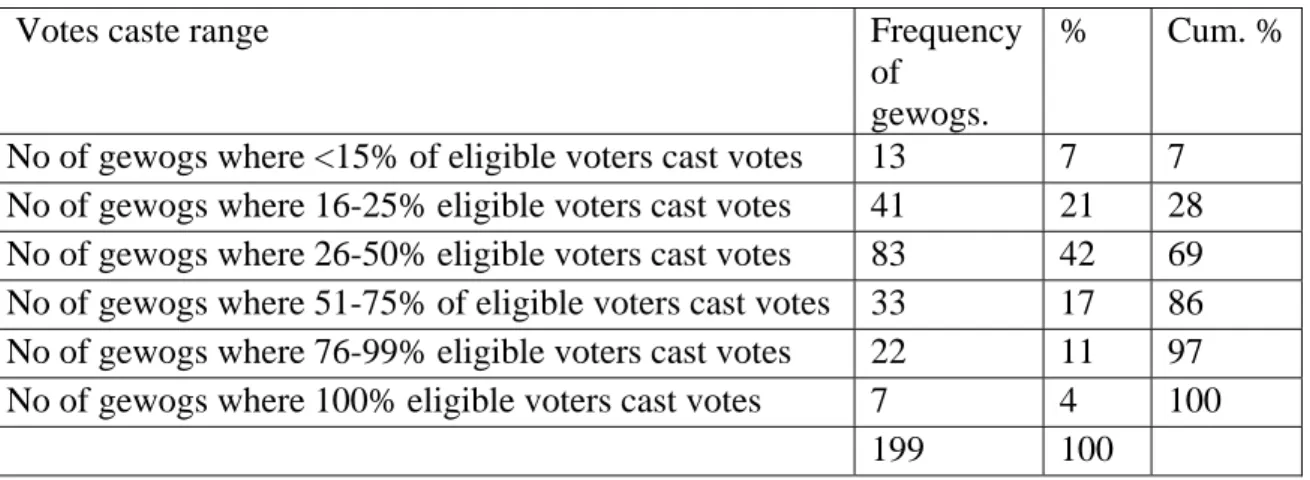
(13) July 2004. Discussion Paper. The First Universal Suffrage Election, at County (Gewog) Level, in Bhutan Karma Ura. is apparent that three districts where voter turn out was above 75% were Sarpang, Zhemgang and Tsirang. 18 out of 29 gewogs where turnout was very high belonged to these three districts. On the other extreme, 54 gewogs where less than 25% voter turnout was seen were: Kanglung, Bartsham, Khaling, Uzorong, Bidung, Lumang, Samkhar, Shongphu, Nanong, Toepisa, Chang, Babisa, Lunana, Shari, Wangchang, Hungrel, Tsento, Bji, Sombay Kha, Kana, Goshi, Drujegang, Tshangkha, Lajab, Tsendagang, khibesa, Gesarling, Tashiding, Dorona, Nubi, Dragteng, Getena, Dala, Bhur, Lhamoy Zinkha, Deorali, Nichula, Yangtse, Yallang, Ramjar, Shengana, Zomi, Toewang, Kurtoe Gangzur, Khoma, Minjay, Metsho, Menbi, Silambi, Mongar, Martshalla, Adang and Rubesa. It is highly likely that longer distance from the villages to polling booths was a disincentive to come to vote, but this could only be one of the explanations. A test of this hypothesis could not be carried due to lack of systematic data. Where there is roads access, motor transportation to polling booths may become an important factor in mobilization of voters in future. The election in 2002 already pointed toward this. Some candidates and their supporters who had financial or transportation means provided motor transportation to ferry back and forth their supporters while other candidates who lacked such economic means were comparatively disadvantaged. Table 8 Frequency distribution of gewogs by levels of percentages of votes cast. Votes caste range. No of gewogs where <15% of eligible voters cast votes No of gewogs where 16-25% eligible voters cast votes No of gewogs where 26-50% eligible voters cast votes No of gewogs where 51-75% of eligible voters cast votes No of gewogs where 76-99% eligible voters cast votes No of gewogs where 100% eligible voters cast votes. Frequency of gewogs. 13 41 83 33 22 7 199. %. Cum. %. 7 21 42 17 11 4 100. 7 28 69 86 97 100. Coefficient of variation (CV) was calculated by grouping gewogs in four categories by voter turnout range. Low voter turnout range consist of 54 gewogs where voter turnout was less than 25%; lower medium turnout consist of 83 gewogs where voter turnout was between 25.1% to 50%; average voter turnout consists of 33 gewogs where voter turnout was between 50.1% and 75%. High voter turnout consists of 29 gewogs where voter turnout was more than 75.1%. Table 9 shows that the variability of voter turnout is very high in lower turnout gewogs. In general for the country as a whole, there is no credible explanation from available data for the extreme variations in voter turnout. It may be speculated that the turnout was low in a gewog where the number of eligible voters was large. The underlying reason for this line of thinking is that people in a more populous gewog have relatively more people who are indifferent to the outcome of the election, given that a larger population means less intensive diffusion information about election. This can be tested simply by checking on the degree of correlation between the size of the population of a gewog as indicated by the size of the eligible voters and actual turnout as indicated by total votes cast in the election in a gewog. Their correlation turned out to be positive. That is, more populous a gewog, the greater the percentage of turnout. But the degree of positive correlation was rather low as indicated by R-square = 0.57. To probe further into connection between different variables, correlation was estimated between the number of candidates and the voter turnout as represented by the number of votes cast in a gewog as a whole. It would be thought that lesser the number of candidates, lesser the voter turnout because people expect less competition. As there were a large number of single candidate gewogs, it may be assumed that there would have been less voter turnout in such gewogs as voters 11.
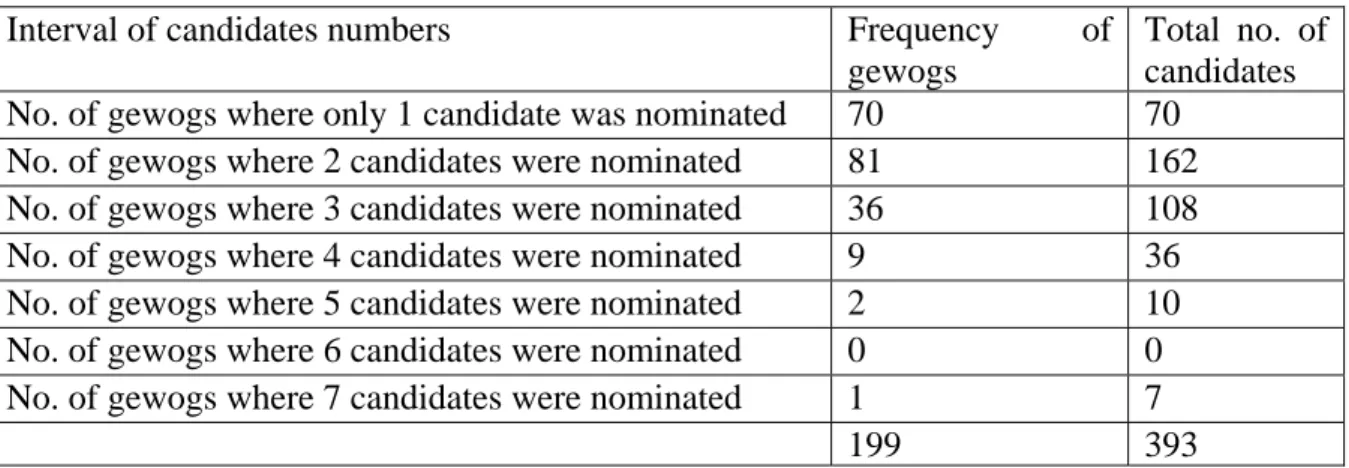
(14) July 2004. Discussion Paper. The First Universal Suffrage Election, at County (Gewog) Level, in Bhutan Karma Ura. might have expected single candidates to win anyway. Once again, very poor correlation between the number of candidates and voter turnout was found. Not a single woman candidate stood in the gup election. This was in keeping with the nature of the job which requires traveling and being away from home which are usually associated with men. Gender disaggregated data exist for eligible voters only for a handful of gewogs. The sample shows that that the proportion of women who voted compared to the eligible women voters was much lower than men voters. Once again, there is no good explanation within available information for the difference in turnout between men and women. Table 9 Frequency distribution of gewogs by number of candidates standing for elections. Interval of candidates numbers No. of gewogs where only 1 candidate was nominated No. of gewogs where 2 candidates were nominated No. of gewogs where 3 candidates were nominated No. of gewogs where 4 candidates were nominated No. of gewogs where 5 candidates were nominated No. of gewogs where 6 candidates were nominated No. of gewogs where 7 candidates were nominated. Frequency gewogs 70 81 36 9 2 0 1 199. of Total no. of candidates 70 162 108 36 10 0 7 393. Overall, 393 candidates stood for election in 199 seats, giving an average of two candidates per seat. In 70 gewogs, the number of candidates was limited to one. In 81 gewogs, there were two candidates each while in 36 gewogs there were three candidates each. Only 12 gewogs had more than four candidates each. Out of 199 gups elected, 86 of them were incumbent gups. In 36 gewogs, the incumbent gups were the sole candidates. In 56 gewogs incumbent gups were candidates but they faced competition from new candidates. Table 10 Proportion of incumbent and fresh candidates elected as gups.. No. of incumbent gups re-elected No. of fresh candidates elected Total gups elected. Total 86 113 199. % 43 57 100. Effects of Two Vote Counting Methods In the system of voting that has spread from a practice introduced in the National Assembly, when there is only one candidate voters are required to vote either for or against the sole candidate by casting votes into either ‘Yes Box’ (positive votes) or ‘No Box’ (negative votes). The sole candidate has to get an absolute majority of positive votes. Thus, in 70 gewogs voting principle was slightly different from the rest where there were multiple candidates. Where there were multiple candidates, voters had to cast only positive votes into the box of a particular candidate whom they preferred, it being automatically deemed that he had cast negative votes against other candidates. In the case of multiple candidates, the election rule required the candidate with maximum votes (plurality vote) to be the winner; he or she did not have to score an absolute majority to win. Results would have been different if only one counting method was used instead of two. A consistent method would have altered the results especially where there were multiple candidates. To trace the effect of existing methods of voting and counting, examine the case of a single candidate in a gewog. There were 70 gewogs with single candidate consisting either of an 12.
(15) July 2004. Discussion Paper. The First Universal Suffrage Election, at County (Gewog) Level, in Bhutan Karma Ura. incumbent gup or a fresh candidate. As expected, in all cases of single candidate gewogs, the candidates had to secure a majority of ‘yes vote’ over ‘no vote’ to be declared winner. This was invariably the case. In the case of multiple candidates in a gewog, a candidate was not required to get a majority. A candidate who got the maximum number of votes was declared winner ie, as in plurality vote. If the principle of majority was applied also in the case of multiple candidates in a gewog, naturally, many candidates who were declared winners would not have done so. The number of gups who would not have made it if absolute majority had to be fulfilled is as many as 22. Table 11 No. of gups who would not have been elected if absolute majority were required.. % No. of gups elected with less than 50.1 % of vote No. of gups elected with greater than 50.1 % of vote Total no. gups elected. 22 177 199. 11 89 100. There were nine gups who got hundred percent vote, out of which four were incumbent gups. In eight cases, candidates got hundred percent vote without facing any contestant. There was only one candidate who got hundred percent vote despite having a rival candidate. It might be added that a third method of voting and election emerged in 2003 in the National Assembly while it voted for ministers for a five-year term. Three new ministries – Works and Human Settlements, Labour and Employment, Communications - were created by segregating functions that were grouped under certain agencies in the past. The total number of ministries increased from seven to 10 in 2003. The six incumbent ministers were re-nominated as single candidate for each of the seven posts by His Majesty the King by subjecting them to ‘yes vote’ and ‘no vote’ by the National Assembly members. For them to continue in their posts as ministers, each candidate had to score a majority of ‘yes votes’ compared to ‘no votes’. In contrast, for the four new ministerial posts seven candidates were nominated by His Majesty the King for election by the National Assembly by casting ‘yes vote’ and ‘No vote’ against each of the five candidates. Four candidates scoring the highest number of ‘yes vote’ were declared as three additional new ministers for a five-year term. Table 12 Votes obtained by single candidates for 6 ministerial posts in 1998 and 2003 elections 1998. 2003. Ministerial Candidate Jigmi Y. Thinley Sangay Ngedup Yeshey Zimba Khandu Wangchuk Kinzang Dorji Thinley Gyamtsho. Yes 136 133 132 127 126 120. No 4 7 8 13 14 20. Total 140 140 140 140 140 140. Yes 127 124 125 111 103 79. No 18 21 20 34 42 66. Total 145 145 145 145 145 145. Table 13 Multiple candidates for 4 additional ministerial posts in 2003 elections Ministerial candidates Leki Dorji Jigme Singye Wangdi Norbu Ugyen Tshering Kunzang Wangdi Bap Kezang Karma Dorji. Yes 125 109 107 96 86 80 67. No 23 39 41 52 62 68 81. Total 148 148 148 148 148 148 148. 13.
(16) July 2004. Discussion Paper. The First Universal Suffrage Election, at County (Gewog) Level, in Bhutan Karma Ura. Fingerprint Mobilization for Nomination Any group of people could in principle sponsor a nomination, but, eventually nomination forms had to be certified by the functionaries of a gewog. The chatrim lacks a provision on the minimum number of people necessary to endorse a nomination. Existing nomination form requires the signatures or fingerprints of ‘tshogpa/ chupon/ tshongdey tshogpa’ 13on the one hand, and ‘gup/ mangmi’ on the other. Strictly interpreted, a candidate can be nominated by just two functionaries: one from each category. As the nomination form stands at present, technically speaking, nominations for candidates could be largely dependent on tshogpa, chupon, tshongdey tshogpa (business community representative), gup and mangmi for they could refuse to endorse a candidate on his nomination form, although this did not happen in the election in 2002. If the functionaries of a gewog like gup, mangmi or tshogpa were running for the post of gup, which is quite likely in many gewogs in future, the nomination of such candidates would be logically impossible to fill as the very people who are candidates would be required by the structure of the form to endorse themselves. In any case, the concept of authorizing existing functionaries of a gewog to certify nomination seems inconsistent with impartiality of nomination, especially when one or more of them are contestants, unless the definition of certifying nomination is made more elaborate and clear. One candidate was normally fielded, if at all, by a chiwog. This was also because, in most cases, each tshogpa was given only one nomination form. In many cases, the number of nomination forms distributed was less than the number of tshogpa or chiwogs. At the same time, it was rare for a chiwog to sponsor two or more nominations especially if a chiwog had a relatively small population, based on the realisation that this could only act against the likely success of a candidate due to vote split. A candidate from a small chiwog is already at a disadvantage due to a smaller numbers of potential voters for him or her. So even if a candidate from a small chiwog has higher merit for getting elected, a less ideal candidate from a bigger chiwog with a higher population could get an upper hand. Nomination process leading to filling a nomination form was a much more eventful than voting. With tacit proscription of open campaigning amongst the candidates, tension, and opinion mobilisation, if any, surfaced more at the time of nomination stage. The term 'tacit proscription' is used deliberately here to describe the feeling that open campaigning ought not be carried out, whereas the chatrim explicitly proscribes only unscrupulous means of campaign such as threat and bribery. A group of people from a chiwog or gewog identifying and sponsoring a candidate for gup became the crucial starting point in the election process. The same group of people went around collecting signatures or fingerprints on the petition sponsoring a candidate. It might be a group led by tshogpa, chipon, or goshey nyenshey (those able to listen and able to comprehend). The concept of people who are able to listen and able to comprehend (goshey nyenshey) is widely prevalent throughout the Dzongkha speaking part of the country. The power of articulation is often stressed as a desirable characteristic of a candidate but this has to be balanced by the concept of leadership and counsel based on ability to listen and ability to understand. It is only when a figure has these abilities that he or she can see all sides, while the power of articulation on its own is said to degenerate into ‘mouth only’ (meaning sweet articulation without substance). A nomination to be supported by signatures ostensibly committed the signatories to vote for the nominee. Given that literacy rate is low, it was more usual to obtain fingerprints (lagthi or lagje) Tshogpa means representative, chupon means the head of a village, tshongdey tshogpa means the representative of the business community. But the term chupon is not used uniformly throughout the country to refer to head of a village. A head of a village is known by various names depending on the dialect of an area, and the term chupon or chipon may be reserved for a post intermediate between tshogpa and head of a village.. 13. 14.
(17) July 2004. Discussion Paper. The First Universal Suffrage Election, at County (Gewog) Level, in Bhutan Karma Ura. than signatures. The phenomenon of soliciting fingerprints was a widespread means of campaign. Indeed, the people who went around on behalf of a nominee to mobilize signatures or fingerprints were synonymous with campaigners. In some sense, the mobilization of signatures to demonstrate the widespread popularity of a nominee was, and will be, a stronger method of campaign than any urging based on oral persuasion or leaflet distributions. Thus, although there was tacit proscription of campaign, mobilization of signatures or fingerprints for a candidate was tantamount to active campaign. Potential voters were construed by fingerprint ‘mobilizers’ to have expressed tangibly commitment towards their nominee by the mere act of giving their fingerprints. However, such potential voters had the tactical choice to give their fingerprints to a candidate while they voted eventually secretly if they wished for another candidate. Potential voters caught under social pressure gave their fingerprints to campaigners only to say behind their back that they would ‘see’ discretely on the day of secret voting to whom they would give their votes. Voters were often pushed to give their fingerprints to multiple candidates when campaigners of different candidate approached them. Dedicating their fingerprints to one candidate did not necessarily lead to voting for him. Secret ballot was thus one means for the voters to exercise their real choice that open nominations did not necessarily provide. Being an open process where dominant individuals play local king maker’s role, nominations were sometimes restrictive. But the tendency of campaigners to collect fingerprints from semi-literate or illiterate people who tend to give it liberally to avoid embarrassment of offending the campaigners and being named unsupportive towards a candidate does bristle with hazard for social disruption in small communities. People who did not oblige with their fingerprints can be differentiated or singled out by a successful candidate later on. It was a stock approach of such campaigners to induce an unwilling person to give his or her fingerprint by pointing out that many others already had done so, so the weight of conformity as a group was brought to bear on him or her. Fingerprints were collected not only to endorse nominees, in some gewogs representatives of each household signed agreements (genja), sealed with fingerprints, that they had nominated only one candidate from their gewog because of a candidate’s unrivalled suitability and they pledged to vote for him. Thus, the actual secret voting later on would have become only a ritual that implemented the essence of an agreement already drawn up. If there were cases of a nomination hoisted in a subtle manner on voters by campaigners, there were equally nominations forced on candidates. People compelled a candidate whom they perceived as able to stand in the election in spite of the lack of interest and motivation on the part of the candidates. A sheer lack of candidates, who could fulfill criterion, forced the people to persuade people to stand in the election although candidates found it difficult to fulfill the demanding task of gup, mainly on account of the lack of manpower to substitute for them in their domestic front. The duties of a gup can be effectively performed only if he is also not burdened by day-to-day affairs of his own household due to lack of a ‘person in charge’ in his house. He has to have sufficient flexible time to respond to the unexpected demands on his time required for both formal and informal duties he has to perform. On the other hand, a gup can significantly strengthen his domestic labour constraints for major tasks such as rice planting or construction of his house. By virtue of his role as a gup, he can also exempt his own house from supplying a worker on behalf of his house to activities where communal labour is mobilized.. Eligibility Criterion and Desirable Attributes of Candidates No legislation can cover every eventuality. Thus a piece of legislation becomes subject to interpretation when it is faced with an unforeseen circumstance. For peasants, making meaning out of statements of eligibility criteria which required professional understandings of certain precisely defined terms proved interesting. For example the criterion that a candidate or a voter to be eligible in the election process should not only be registered in the gewog but should have lived there for a year prior to the election provoked a variety of interpretations, each choosing the one favourable to his point of view. The choice for a candidate was restricted to one-year residents. But what could be quantified as one-year full residency was subject to a range of definitions. A month long travel 15.
(18) July 2004. Discussion Paper. The First Universal Suffrage Election, at County (Gewog) Level, in Bhutan Karma Ura. outside of the gewog, for example, was considered by some to be long enough to violate the oneyear residency rule. On the whole, this criterion is said to have seriously deprived many gewogs the choice of capable candidates. Capable candidates not only did not live full one-year in the area, they often migrated on long term basis to towns. The provision related to one-year residency reduced the incentive for them to come back to their own villages, with their skills, as gups. Setting up a year's residency for both candidates and voters within a gewog as an eligibility criterion was prompted primarily by the belief that those who had no contextual knowledge of that gewog due to a prolonged absence might become candidates in the election. In the case of candidates for gups the installation of such relative strangers to the gewog might, it was assumed, prove detrimental to the interest of the electorate at the end. In hindsight, it seems that this is a judgement that should be left entirely to the voters. One-year residency requirement for candidates could be dropped. One-year residency requirement for voters could also be dropped so that whosoever of voting age is registered in a gewog is allowed to vote if they come back just to vote. This will resolve the problem of dis-enfranchising a large proportion of potential voters living away from their gewogs. Reading and Writing Abilities: Abilities to read and write were considered by the voters as necessary, as prescribed by official qualification criteria of functional literacy for candidature of gups. Writing applications (zhutshig zhengni), drawing up agreements (genja), reading letters sent by district administrations and conveying contents of official correspondences to the people were seen as the main reasons for literacy requirement for gups. The ability to read and write is not a general ability to read and comprehend newspaper, or write any composition. Rather, a candidate for gup needs narrower and specialized reading, writing and comprehending abilities with regard to two very prominent functions of a gup: the ability to read and write officials communications and the ability to draw up agreements settling disputes. An ability to read and write pertains to petitions and correspondence mostly to officials within a district administration. Vocabulary and mode of expression in such official protocols of correspondences reflect both strengths and limitations of repetitive official writing and idiom. It is therefore a basic reading and writing ability that has to be enhanced in the direction of official language of development projects and programmes. This ability is acquired and deepened by holding similar jobs such as tshogpa, chimi,14 mangmi15 or clerk of the gup prior to becoming a candidate. With the intensification of written communication about planning, budgeting, and reporting progress of projects and programmes in a variety of sectors, candidates have to be literate, although the creation of a new position, a clerk of a gup, compensates for the lack of textual abilities in a gup. Considering the scarcity of English literate persons in villages, the eligibility criterion of gup did not specify literacy competency standards in any language, Dzongkha, English or Nepali, and left it to the electors themselves to adjudge functional literacy contents which are not extraneous to their local linguistic context. Some district administrations conducted literacy test amongst the candidates to assess them. Candidates were made to read officials directives and fill up bio-data forms. In some cases, such improvised test included basic arithmetic. From the point of view of voters, a candidate who had a primary school education, or who had some degree of monastic education, or who was self-taught was considered adequate. Many young men who had primary education certificate were propelled to the position of gup primarily because of the functional literacy eligibility criteria. The likelihood of their becoming gup would have been very slim without this condition for a candidate's eligibility in the election. Mediation Abilities: One of the most rated abilities in a candidate is related to drawing up agreements although this was not foreseen as part of a formal eligibility criterion. However, it turns out that it is not so much the ability to prepare agreements as negotiation settlement in keeping with popular Buddhist value of peace making and pacifying internal feuds (khonpa dum, nangthrug zhiwa). Reading and writing an agreement is a short final outcome of a much longer process where 14. A member of the National Assembly.. 15. Deputy gup.. 16.
(19) July 2004. Discussion Paper. The First Universal Suffrage Election, at County (Gewog) Level, in Bhutan Karma Ura. functional literacy has very little role. Indeed, a very successful negotiator in Bhutanese rural settings may not necessarily be even a literate person. Negotiation skills may spring from attributes of a person different from literacy. Priority attached to agreement making and arbitrating skill among candidates is a surprising finding of this research. Although the function of mediation by a gup has been known, the degree of importance attached to mediation ability, which underlie the ability to draw up agreements, amongst candidates is relatively unforeseen or underestimated in most official perspective. A leading importance of arbitrating abilities in a gup is clear also from interviews. A dispute takes many sessions of mediation talks before terms acceptable to both the disputants can be committed to written agreements. The brevity of agreements, usually limited to two to three pages, do not indicate accurately either the time that has gone into the long process or the non textual based thinking and communication abilities. Moreover, such mediation works by a gup are not charged; the cost of these services being limited to meals during arbitration sessions provided by the parties of disputants. The fact that that the voters saw agreement writing and arbitration was one of the key desirable attributes of a gup show how much people depend on less costly methods of conciliation or settlement compared to options of going to courts. At the same time it shows how much speedy and creative (non legal rather than illegal, non divisive rather than win-lose decision) are sought by the people from gups and community elders who may understand the necessity of arbitrating towards compromises and maintaining peace in smaller, interconnected communities. Bridge between Government and People: The ability to foster good relations and cooperation between the people and government is another desirable quality that the voters assessed in a candidate. One of the usual metaphors to be evoked for the general role of a gup or chimi is that of a bridge. The voters as well as the candidates’ expressed aspirations towards being bridge between the masses and government (zhung dang miser gi barna gi zam or zhung dang miser gi barna gi thuenlam). There is no distinction in Dzongkha between the state and the government: both of these concepts have to be construed from the word ‘zhung’. But the metaphorical statement, whatsoever way we take the meaning of zhung to be, suggests the ever important tasks of fostering productive interdependence between the masses and the government officials. At the same time, if the metaphorical statement is deconstructed, it suggests that the vulnerable link between government and the masses can be crucially affected by community leaders such as gups. Seeing themselves as bridges implies that GYTs and gewogs which the gup manage are civil or community organizations distinct from government organizations, a distinction that is of crucial importance and can be jeopardized or erased in the popular imagination even by symbolic acts of gups being appointed ceremonially by dzongdags. In being a constructive bridge, the voters wanted ideally candidates who were familiar with policies of the government. Such knowledge of government policies would enable a candidate to evaluate them in a local context and suggest remedies, if needed, to existing policies. Or the same knowledge of government policies could be viewed as a given framework by the candidates who see themselves as only agents of implementing policies. How they view themselves is important to the roles they assume. Past Experience, and Experience of Dealing with Officials: In the gup election of 2002, a large number of incumbent gups and fresh candidates who held certain community posts like tshogpa, chimi and mangmi were elected. Such candidates’ past interactions with the voters had provided the voters with knowledge of their performance and attitudes. If an incumbent gup had not completed his term of three years by the time 2002 election was held, there was an additional element of consideration to re-elect him so that he would complete the original term. A candidate who had contributed to infrastructure development such as basic health unit, school, outreach clinic, suspension bridge, temple, water supply for the voters were more easily nominated. On the other hand, people's experience of trouble and hardships associated with a former gup, tshogpa or chimi led to rejections of their candidatures right at nomination phase. Misuse of. 17.
(20) July 2004. Discussion Paper. The First Universal Suffrage Election, at County (Gewog) Level, in Bhutan Karma Ura. community labour for personal purposes and non accountability of resources collected from the people were cited as some of other reasons for rejecting candidates. Voters assessed the candidates also on criterion such as possession of prior experiences of dealing with government officials, whether civil or military. Their notion of what constituted the core experience of dealing with officials was very general. Voters implicitly assumed that retired soldiers, for example, were acquainted with ways of working together with government officials. Anyone who has had a stint of working in the government as government employee (zhung yokpa) was viewed as being advantageous. Nevertheless, inherent differences of occupations that exist within the military or civil service means that the experiences cannot be homogeneous. What typical skills were seen by voters among former soldiers and civil servants as attractive is still far from clear. Perhaps the demand for experience with dealing with officials is actually a commentary on the labyrinth of the bureaucracy that is rising steeply with new processes and legislations which require forms and papers to be filled at multiple stages in multiple places. Viewed in this light, one can appreciate voters’ preference for a candidate having procedural knowledge of dealing with officialdom. A further question concerns the values such candidates bring from their past occupations to the communities. A great deal of the post of community functionary such as tshogpa has fallen on retired soldiers. The effects of a large number of positions of gewog functionaries including gup being held by retirees of a certain occupation could be distinctive through the subtle transfer of values, for example of military service, just as young literate western educated men might bring an altogether different complexion to the management of a gewog. Confidence and Articulation: Confidence is another feature that the people sought in a candidate for gup. A decisive gup, while drawing and building on the consensus of the people, who can speak with some degree of weight to both people and officials, was considered desirable. Many candidates were judged capable by voters because it was expected that they would not be unduly submissive to visiting government officials, or to cow down in front of influential households. Articulation was another important attribute of a candidate for gup. Usually referred to as ‘having mouth’ in Dzongkha, communication skills is vital for a gup. It is a supportive skill for all functions mentioned earlier, but also for the sake of evenhandedness in his dealings with others. For example, a gup who can convince people about something except those who are wealthy and powerful can be characterized as nothing more than mouth, since such a gup does not use his articulation power fairly; the gift of felicity of expression is thus seen as a negative tool or power. It would then be viewed as furthering the influence of those households who are already influential.. Post-election Allegations, and Inaugural Celebrations Voting was preceded by the introduction of candidates based on personal data each of them had filed with the district administration during nomination. This was a redundant exercise for most people given that the people have nominated the candidates. Yet again, this follows the style of election for ministers within the National Assembly, where the bio-data of ministerial candidates are read comprehensively before casting votes. A provision of the chatrim on the election of gups permit any voter or defeated candidate to send a written complaint concerning the alleged irregularity in the election of gup to district administration within a period of ten days. If an allegation was found true, the district administration called for a re-election, by disqualifying the earlier winner from standing in all future elections. The value of this rule was attested by the fact that there were at least seven gewogs where re-election had to be conducted. There were re-elections in Bji and Sangbay in Haa, Tshenkar in Kurtoe, Phuntenchu and Chargarey in Tsirang, Tashiding and Gesarling (?) in Dagana and Yangtse (?) in Trashi Yangtse. If this safety rule were absent, candidates who violated rules of election would have been on the job. However, this provision has also paved the way for a plethora of allegations to be brought against successful candidates and their supporters, as well as the district administrations for unfair practices in the election. There is no well-defined procedure for appealing against unfair practices of a district administration which itself acts as the election agency in a district. It must be qualified 18.
(21) July 2004. Discussion Paper. The First Universal Suffrage Election, at County (Gewog) Level, in Bhutan Karma Ura. here that there was no sizeable number of allegations of unfair practices made against district administrations. Those that were expressed related to accepting nominations that did not fully comply with eligibility criterion or accepting certain documents like No Objection Certificates or Police Clearance accompanying nomination forms too late. Most of the allegations levelled against candidates after the election pertained to fraud when a candidate was holding a post such as that of chimi, mangmi, tshogpa, gup or clerk of a gup. The second major category of allegations levelled against candidates was campaigning either personally or through a set of supporters and relations. Third major category of allegations consisted of biased nominations, claiming that the successful candidate was nominated by a narrow group. Allegations of fraud or abuse of authority when a candidate was holding certain community posts should have been technically inadmissible as far as the election committees were concerned because the rule for complaining against irregularity of election by a candidate confines the nature of contravention by a candidate to the election process period, ie, from the date of announcing the election to the date of voting. Allegations of fraud and abuse of authority before this period should have been received by a court if it was deposited with it. But this should not have any bearing on the election that took place, until its ruling in course of time effects a gup just it effects any public officeholder if an offence has been committed. The nature of allegations based on possible malpractices against a candidate in general consisted of false offers of jobs and infrastructure development (which turned out to be non-existent jobs and infrastructure even in plans), withholding house insurance payment and life insurance payment, embezzlement of money collected from the community for various purposes, falsification of official documents, false enumeration of a person in the census, transfer of census from another place to the gewog just before the election, exchange of photos of the candidate pasted on the ballot box after voting, coercion of the people to give them fingerprints, sale of public land, undue influenced exercised to withdraw nominations, promise of money to support campaign, caste based grouping and scheming to prevent fair nomination. Once again, to put the allegations into perspective, the magnitude of alleged offences involving money was extremely small as the total financial dealings by gups and GYT office bearers until the adoption of new acts (GYT and DYT Chatrims) were very limited. If an allegation is proven in administrative proceeding conducted by a district administration, the law bars a candidate from participation in future elections. Alternatively if an allegation is deemed serious, the administrative inquisition can refer the case to a court. It is not known how many allegations were referred further by administrative inquisitions to their respective district courts. One of the most serious and legitimate complaints against this particular provision that allowed people to level charges against a successful candidate was that it did not provide for penalties on people who brought charges of the charges were proven baseless or unfounded. After the 10 day precautionary period was over, a winning candidate was ceremonially confirmed as gup by a dzongdag. Taking up an office by a candidate is usually a public show of people coming to facilitate him with dar (long white ribbons) symbolising their ‘pure-white’ good wishes. A body of opinion has criticized such celebrations as lacking humility about electoral successes. However, it was not only the long white ribbons that were offered. Ribbons were supplemented by gifts of cash in envelopes or gifts of goods. Many gups has had to hold celebrations in two places: once near the dzongkhag head quarters soon after the dzongdag handed over the letter of appointment and a dar, and the second time in their own village or gewog centre where well-wishers from throughout the gewog were expected to turn up. The cost of sumptuous meals hosted for the visitors on those occasions was staggering compared to the annual salary of a gup. A gup of a remote gewog spent Nu. 92,000 just for food commodities while the estimated value in-kind gifts and cash came to Nu 90,000. An expenditure of Nu 60,000 for hosting meals for the visitors appears to be the minimum. It is very unlikely that such heavy expenditure will be incurred by successful candidates unless there is a pay off in some way or the other. It is also an occasion that half well-wishers cannot easily dodge given the very public nature of such celebration in small communities where those missing are conspicuously noticed. The complexity of the 19.
図

+4

関連したドキュメント
URL http://doi.org/10.20561/00041066.. も,並行市場プレミアムの高さが目立つ (注3) 。
1880 年代から 1970 年代にかけて、アメリカの
1880 年代から 1970 年代にかけて、アメリカの
中国の農地賃貸市場の形成とその課題 (特集 中国 の都市と産業集積 ‑‑ 長江デルタで何が起きている か).
ティモール戦士協会‑ティモール人民党 Kota/PPT 1974 保守・伝統主義 2 ティモール抵抗民主民族統一党 Undertim 2005 中道右派 2.
⑧ Ministry of Statistics and Programme Implementation National Sample Survey Office Government of India, Report No.554 Employment and Unemployment Situation in India NSS 68th ROUND,
Ⅲ期はいずれも従来の政治体制や経済政策を大きく転
2016.④ Daily News & Analysis "#dnaEdit: Tamil Nadu students' suicide exposes rot in higher
