Finite
element methods for nearly incompressible
media
Fumio
Kikuchi*
Professor
Emeritus,
The
University of Tokyo
Abstract
Wewillsummarizeandanalyzesomefinite element methods for analysis of nearly
orcompletely incompressible mediaincludinglinearly elastic solids andviscous
New-tonianfluids. Numerical analysis of such problemsisdifficultespeciallyinselecting
ap-propriate finite elementmodels, and the mixedFEM anddiscontinuous Galerkin FEM
(DG FEM) areofteneffectivetoobtain reliable numerical solutions.
1
Introduction
We will present
some
finite element methods for analysis of nearly (or completely)incom-pressible media including elastic solids andviscousfluids. Numerical analysis of such
prob-lems is difficult especially in selecting appropriate finite element models. Especially, the
genuine methods based
on
displacementsor
velocities only usually suffer fromvolumet-ric locking in the nearly incompressible range,
so
that various attempts have been made.Among them, the mixed and the stabilization methods
are
known to be effective in thisre-spect. Nowadays, the discontinuous Galerkin methods combined with the mixed methods
become to be realized to be
more
effective to obtain reliable numerical solutions. In thisnote,
we
will summarizesome
knownresultsas
wellas our
own ones.
Acknowledgment: The present authorexpresses his sincere thanks toDr. Daisuke Koyama
ofUniversity ofElectro-Communications
as
ajoint workerofthis report for the section onplain strain problems.
2
Nearly incompressible
media
We will mainly discuss the solid
cases
below. Let $x=\{x_{1}, x_{N}\}(N=2,3)$ denote theCartesiancoordinates, and$\Omega\subset \mathbb{R}^{N}$
be
a
bounded domain occupied by the solid. We willuse
the notation of small displacements of solids
as
$u=\{u_{i}\}_{1\leq i\leq N}$, and the associated smallor
linearized strains
as
$e_{ij}(u)=(\partial_{j}u_{i}+\partial_{i}u_{j})/2 (\partial_{i}=\partial/\partial x_{i};1\leq i, j\leq N)$, (1) $*E$-mail address: [email protected]
which
can
be regardedas a
second-order symmetric tensor. The diagonal components $e_{ii}$are
normal stretching strains, while the off-diagonalones
$e_{ij}(i\neq])$are
shearing strains.Moreover, the volumetric strain is given by$divu=\sum_{i=1}^{N}e_{ii}(u)$,whichplays importantroles
innearlyincompressible
cases.
Remark 1 For$N=2$,we assume that the
functions
donotdependon
$x_{3}$and also that$u_{3}=0$(inthe$3D$notations), so that$e_{33}=e_{i3}=e_{i3}=0(i=1,2)$
.
The stresses $s_{ij}(1\leq i, j\leq 3)$
are
also treatedas a
second-order symmetrictensor, andwe
assume
the followinggeneralizedHooke’s law forisotropic solids:$s_{ij}(u)=\lambda(divu)\delta_{ij}+2\mu e_{ij}(u)$ $(\lambda>0, \mu>0 : Lam\’{e}$’sparameters)
.
(2)Noticethat $s_{33}$ maynotvanishunder the above relation. We will
assume
in additionthatthesolidishomogeneous, thatis, $\lambda$ and
$\mu$donotdependon $x.$
The static
pressure
isdefined by theminus ofmean
normal stress, thatis,$p:=- \frac{1}{3}\sum_{i=1}^{3}s_{ii}=-(\lambda+\frac{2\mu}{3})divu\Rightarrow$ $s_{ij}=- \frac{\lambda}{\lambda_{B}}p+2\mu e_{ij}(u)(\lambda_{B}:=\lambda+2\mu/3)$, (3)
where$\lambda_{B}$ iscalled the bulkmodulus, and,
as
was
noted,theterm $s_{33}$ isnecessary.
The abovesuggests that$divuarrow 0$
as
$\lambdaarrow+\infty$.
(Underappropriate
settings,we
can
also show$parrow p_{\infty}$for
some
$p_{\infty}.$) Insome
mathematicalliteratures, $p$is simply defined by $p=-\lambda divu$.
Suchanonphysical definition maybe
more
convenientforpuremathematical analysis.The staticequilibrium ofstresses isexpressed by the following Cauchy equations:
$- \sum_{j=1}^{N}\partial s_{ij}/\partial x_{j}=f_{i} (1\leq i\leq N)$, (4)
where $f=\{f\}_{1\leq i\leq N}$ isthe distributed body forcevector. Substituting (1) and (2) into(4),
we
have Navier’s equations forisotropic homogeneous solids:
$- \lambda\partial_{i}divu-\mu\sum_{j=1}^{N}\partial_{j}(\partial_{j}u_{i}+\partial_{i}u_{j})=f(1\leq i\leq N)$, (5)
(by (3)) $\Rightarrow$ $\frac{\lambda}{\lambda_{B}}\partial_{i}p-\mu\sum_{j=1}^{N}\partial_{j}(\partial_{j}u_{i}+\partial_{i}u_{j})=f_{i}(1\leq i\leq N)$
.
(6)3
Weak
formulations
For simplicity,
we
will consider thepure
homogeneous Dirichlet boundary conditions, anduse
the usual Hilbertian Sobolev spaces $H^{1}(\Omega)$ and $H_{0}^{1}(\Omega)$.
We will also denote the innerproducts of$L^{2}(\Omega)$
or
$L^{2}(\Omega)^{N}$by $)_{\Omega}$ and their associatednorms
by $||\cdot||_{\Omega}$.
Belowwe
will3.1
Displacement
formulation in
$u$only
The most fundamental weak formulation for finite $\lambda>0$ is the following
one
using thedisplacementonly.
[DF] Given$f\in L^{2}(\Omega)$, find$u\in H_{0}^{1}(\Omega)^{N}$ thatsatisfies
$\lambda(divu, divv)_{\Omega}+2\mu\sum_{i,j=1}^{N}(e_{ij}(u), e_{ij}(v))_{\Omega}=(f, v)_{\Omega}(\forall v\in H_{0}^{1}(\Omega)^{N})$
.
(7)For mathematical analysis ofthe above formulation, Korn’s inequalities
are
essential,and
a
typical example of them is: There existsa
domain constant$C>0$suchthat$\sum_{i,j=1}^{N}||e_{ij}(v)||_{\Omega}^{2}+\Vert v\Vert_{\Omega}^{2}\geq C||v\Vert_{H^{1}(\Omega)^{N}}^{2}(\forall v\in H^{1}(\Omega)^{N})$
.
(8)The presentresult is generalized to the Sobolev
space
$W^{1,p}(\Omega)$ with $1<p<\infty$ for$N=2$[17]. For$v\in H_{0}^{1}(\Omega)^{N}$,the above becomes$\sum_{i,j=1}^{N}||e_{ij}(v)||_{\Omega}^{2}\geq C||v||_{H^{1}(\Omega)^{N}}^{2}$ withpossible change
of$C>0$, from which
we
can
conclude theexistence anduniqueness of the weak solution $u$of[DF]. Moreover, keeping$\mu$ constant,
we
have$\lambda||divu||_{\Omega}^{2}\leq C||f\Vert_{\Omega}^{2}$,so
that$divuarrow 0$ in$L^{2}(\Omega)$
as
$\lambda$tends to$+\infty.$
3.2
Mixed
formulation in
$u$and
$p$To deal with the nearly and completely incompressible cases, it is natural to add $p$
as
an
independent unknown function.
[MF] Given$f\in L^{2}(\Omega)$,find $\{u, p\}\in H_{0}^{1}(\Omega)^{N}\cross L^{2}(\Omega)$ thatsatisfies
$\{\begin{array}{ll}2\mu\sum_{i,j=1}^{N}(e_{ij}(u), e_{ij}(v))_{\Omega}-\frac{\lambda}{\lambda_{B}}(p,divv)_{\Omega}=(f, v)_{\Omega} (\forall v\in H_{0}^{1}(\Omega)^{N}) ,- \frac{\lambda}{\lambda_{B}}[(divu, q)_{\Omega}+\lambda_{B}^{-1}(p, q)_{\Omega}]=0 (\forall q\in L^{2}(\Omega)) .\end{array}$ (9)
We
can see
formally that$p$is the Lagrange multiplier for the linear constraint$p+\lambda_{B}divu=0.$Also, bythe Gaussformula,
we
find that$p\in L_{0}^{2}(\Omega)$ for$L_{0}^{2}(\Omega)=\{q\in L^{2}(\Omega);(q, 1)_{\Omega}=0\}.$To deal with [MF], it is essential to
use
the following inf-sup condition: There exists $a$constant$K>0$ such that
$inf\sup \underline{(divv,q)_{\Omega}}\geq K$
.
(10)
$v\in H_{0}^{1}(\Omega)^{N}\backslash \{0\}_{q\in L_{0}^{2}(\Omega)\backslash \{0\}}||v||_{H^{1}(\Omega)^{N}}\cdot||q||_{\Omega}$
Thiscondition isrelated to the solvabilityof$divv=g\in L_{0}^{2}(\Omega)$for$v\in H_{0}^{1}(\Omega)^{N}.$
Usingthe above,
we
can
conclude the existence anduniqueness of$\{u,p\}$with$||u\Vert_{H^{1}(\Omega)^{N}}+||p||_{\Omega}\leq C||f||_{\Omega}$ uniformly in $\lambda\geq\lambda_{0}=$ positiveconstant. (11)
Moreover,
as
$\lambda$ tends to$\infty,$ $\{u,p\}$
converges
strongly in $H_{0}^{1}(\Omega)^{N}\cross L^{2}(\Omega)$ toa
$\{u_{\infty}, p_{\infty}\}\in$ $H_{0}^{1}(\Omega)^{N}\cross L_{0}^{2}(\Omega)$,which satisfies [MF]formally with $\lambda/\lambda_{B}=1$ and$\lambda_{B}^{-1}=0$:
$\{\begin{array}{l}2\mu\sum_{i,j=1}^{N}(e_{ij}(u_{\infty}), e_{ij}(v))_{\Omega}-(p_{\infty},divv)_{\Omega}=(f, v)_{\Omega}(\forall v\in H^{1}(\Omega)^{N}) ,-(divu_{\infty}, q)_{\Omega}=0(\forall q\in L^{2}(\Omega)) \cdots\cdots incompressibility condition.\end{array}$ (12)
ForFrierdrichs-Kellermeshes,
kernel
of
$div|_{(V_{0}^{h})^{2}}$for
$k=1$ is$\{0\}.$Figure 1: Triangular meshes of Frierdrichs-Keller type for
a square
domain4
FEM based
on
[DF]
Themoststandard FEM
are
basedon
the$N$-simplexes and thepiecewisepolynomialspaces
$P^{k}(k\in \mathbb{N})$
.
More specifically,we
consider$a$ (regular) family oftriangulations $\{\mathcal{T}^{h}\}_{h>0}$ of$\Omega$by $N$-simplexes $(K’ s)$, andintroduce the finite element
spaces
$V^{h}=\{v\in H^{1}(\Omega);v|K\in P^{k}(\forall K\in \mathcal{T}^{h} V_{0}^{h}=V^{h}\cap H_{0}^{1}(\Omega)$
.
(13)Then
our
discreteproblembasedon
[DF] for each $\mathcal{T}^{h}$isto find$u_{h}\in(V_{0}^{h})^{N}$ thatsatisfies
$[DF]_{h}$ $\lambda(divu_{h},divv_{h})_{\Omega}+2\mu\sum_{i,j=1}^{N}(e_{ij}(u_{h}), e_{ij}(v_{h}))_{\Omega}=(f, v_{h})_{\Omega}(\forall v_{h}\in(V_{0}^{h})^{N})$
.
(14)Unfortunately, suchfinite element models usually behave
very
poorly when $\lambda$ becomeslarger (Locking). In fact, for
some
meshes suchas
the Friedrichs-Kellerones
(Fig. 1), $u_{h}$obtained by thepiecewiselinear$(P^{1})$triangular elements tendsto
zero
tokeep thedivergenceterm small, since we have the estimation$\lambda||divu_{h}||_{\Omega}^{2}\leq C||f||_{\Omega}^{2}$ and the condition $divu_{h}=0$
implies$u_{h}=0$under thepurehomogeneous Dirichlet condition.
5
FEM based
on
[MF]
This approach
uses
$p$ besides $u$as
independent unknown functions,so
thatwe
must alsoprepare a
finite element elementspace
$W^{h}\subset L_{0}^{2}(\Omega)$ foreach$\mathcal{T}^{h}.$$[MF]_{h}$ Given $f\in L^{2}(\Omega)$, find$\{u_{h}, p_{h}\}\in(V_{0}^{h})^{N}\cross W^{h}$ thatsatisfies
$\{\begin{array}{ll}2\mu\sum_{i,j=1}^{N}(e_{ij}(u_{h}), e_{ij}(v_{h}))_{\Omega}-\frac{\lambda}{\lambda_{B}}(p_{h},divv_{h})_{\Omega}=(f, v_{h})_{\Omega} (\forall v_{h}\in(V_{0}^{h})^{N}) ,-\frac{\lambda}{\lambda_{B}}[(divu_{h}, q_{h})_{\Omega}+\lambda_{B}^{-1}(p_{h}, q_{h})_{\Omega}]=0 (\forall q_{h}\in W^{h}) .\end{array}$ (15)
But for this approach to behave nicely,
we
should take fullcare
ofthe combination of$u_{h}$ and$p_{h}$ to satisfy thediscrete inf-sup condition. A typical approach isto use $(V_{0}^{h})^{N}$based
on
$P^{k}$for $u_{h}$ and also $W^{h}$ based
on
continuousor
discontinuous$P^{k_{p}}$
for $p_{h}$
.
Usually,we
choose$k_{p}$ tobe smaller than$k$, but thevalidity of such approximations depends strongly
on
the arrangement of nodes
as
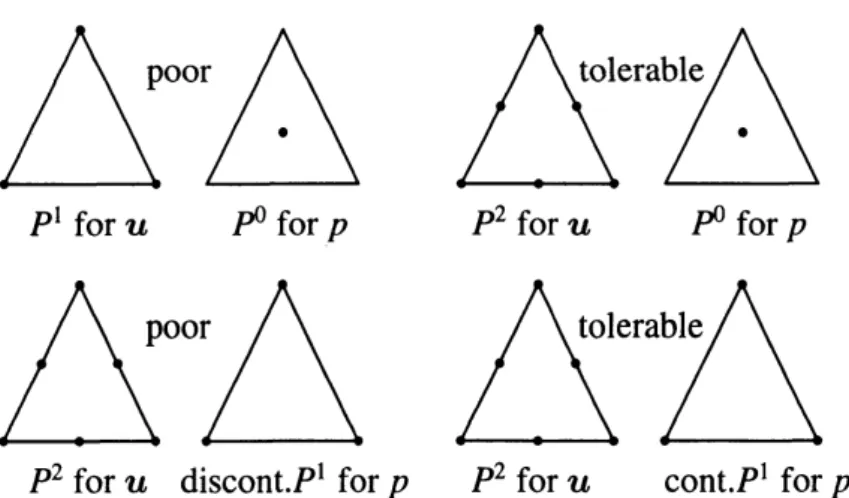
well. For example, the $P^{1}-P^{0}$ triangle (continuous $P^{1}$for $u_{h}$
and discontinuous $P^{0}$ for
$p_{h}$) is not appropriate, while $P^{2}-P^{0}$ triangle works. Moreover, $P^{2}$
-cont.$P^{1}$ works,
while$P^{2}$
-discont.$P^{1}$ behavesbadly. SeeFig.2for
a
fewtypical$P^{1}$ for
$u$ $P^{0}$ for
$p$ $P^{2}$ for$u$ $\mu$ for$p$
$P^{2}$
for$u$
discont.Pl
for$p$ $P^{2}$for $u$
cont.Pl
for$p$Figure2: Some combinations of$u$ and$p$for triangles
To analyze $[MF]_{h}$, it is essentialto show the followingdiscrete inf-sup condition: There
existsa constant$K>0$suchthat, $\forall h>0,$
$inf\sup \underline{(divv_{h},q_{h})_{\Omega}}\geq K$
.
(16)
$v_{h}\in(V_{0}^{h})^{N}\backslash \{0I_{q_{h}\in W_{0}^{h}\backslash \{0\}}\Vert v_{h}\Vert_{H_{0}^{1}(\Omega)^{N}}\cdot\Vert q_{h}\Vert_{\Omega}$
A typical approach to show the above is to construct
a
Fortin operator $\Pi_{h}^{F}$:
$H_{0}^{1}(\Omega)^{N}arrow$ $(V_{0}^{h})^{N};\forall v\in H_{0}^{1}(\Omega)^{N},$$||\Pi_{h}^{F}v||_{H^{1}(\Omega)^{N}}\leq C||v||_{H^{1}(\Omega)^{N}}, (div(\Pi_{h}^{F}v-v), q_{h})_{\Omega}=0;\forall q_{h}\in W^{h}$
.
(17)A number of trials have been madeto find such $\Pi_{h}^{F}[6]$,though it isnot
so easy a
task.6
Hybrid
discontinuous Galerkin FEM
We
can
alsouse
discontinuous,more
flexibleapproximate
displacementsbasedon
thehybriddiscontinuous GalerkinFEM (HDGFEM). In thiscase,
we use
discontinuous element-wisepolynomial functions for $u$ (and p) and also the so-called fluxes$\hat{u}$ (inter-element
displace-ments)
as
independent unknown functions[8, 13]. Onthe otherhand,intheoriginaldiscon-tinuous Galerkin (DG)FEM, fluxes
are
calculated from $v[2].$We willconsider only the 2-D
cases
$(N=2)$,andassume
that$\Omega$is aboundedpolygonaldomain withboundary $\partial\Omega$
.
Moreover,we
will also
use
(possiblyfractional) Sobolevspaces
$W^{s,p}(\Omega)$and $W_{0}^{s,p}(\Omega)$for $1\leq p\leq\infty,$ $s\geq 0$,whose
norm
andstandardsemi-normare
denotedby $||\cdot||_{s,p,\Omega}$ and $|\cdot|_{s,p,\Omega}$,respectively. Moreover, $s$is omitted when $s=0$
.
When$p=2$ , theyare
alsowrittenby $H^{s}(\Omega)$and$H_{0}^{s}(\Omega)$,and the thesubscript$p$in thenorms
andsemi-norms isomitted. We willessentially dealwith theHilbertian
cases
$(p=2)$ , but sometimes considermore
generalcases.
To take theconsistency between thecase
$p=2$ andothers $(p\neq 2)$ for(semi-)norms,
we
for example define $\Vert\nabla u||_{p,\Omega}$ by $|| \nabla u||_{p,\Omega}^{p}=\sum_{i=1}^{2}||\partial u\int\partial x_{i}\Vert_{p,\Omega}^{p}$ for $1\leq p<\infty$6.1
Triangulations
by
finite elements
We will
use
$\{\mathcal{T}^{h}\}_{h>0}$as
a
“regular family of triangulations of $\Omega$.
The precise meaning of“regular” is omitted here (see e.g.[3, 12 roughly speaking, it
means
that the shapes offinite elements (see below)
are
not too much distorted and their sizesare
comparable. Inthe presentsettings, each triangulation$\mathcal{T}^{h}$
consists offinite number ofbounded$m$-polygonal
finite elements $K’ s$, where $m$ is
an
integersuch that $3\leq m\leq M$ ($M\geq 3$ isa
constant) andcan
differ with$K$.
Theboundary of$K\in \mathcal{T}^{h}$ isa
closed simple polygonal lineand denotedby$\partial K$
.
Notice here that each finiteelement (orelement, in short) $K$ is not necessarily
convex
and vertexes with the flat angle
are
allowed. The number$h_{K}$ stands for the diameter of$K,$and themesh parameter$h$ofthe triangulation is defined by$h= \max_{K\in \mathcal{T}^{h}}h_{K}$
.
An(open) edgeof$K$is designated by$e$, andits lengthby $|e|$
.
Wedefine$S^{K}$ and$S^{h}$as
the sets of alledges in $K\in \mathcal{T}^{h}$and $\mathcal{T}^{h}$
, respectively. Moreover, $\Gamma^{h}=\bigcup_{e\in S^{h}}\overline{e}$ is called the skeleton of$\mathcal{T}^{h}$
.
Almosteverywhere
on
$\partial\Omega$and$\partial K$
,
we can
define theunitoutwardnormal vector$n=\{n_{1},n_{2}\}.$As duality pairings
or
innerproducts relatedtoeach element $K\in \mathcal{T}^{h}$,we
willuse:
$)_{K}$:
dualitypairingbetween$L^{p}(K)^{\ell}$and$L^{q}(K)^{\ell}(\ell=1, 2, 1/p+1/q=1)$as
theextensionof theinnerproduct of$L^{2}(K)^{\ell}$,i.e., forexamplefor$\ell=1,$ $(u, v)_{K}= \int_{K}$uvdx $(u\in L^{p}(K)$,
$v\in L^{q}(K))$,
$]_{\partial K},$ $]_{e}$,resp.)
:
dualitypairingbetween$L^{p}(\partial K)^{\ell}$($L^{p}(e)^{\ell}$foredge$e\in S^{K}$,resp.) and$L^{q}(\partial K)^{\ell}$ ($L^{q}(e)^{f}$,resp.) $(\ell=1,2,1/p+1/q=1)$
as
theextensionof theinnerproductof$L^{2}(\partial K)^{\ell}$ ($L^{2}(e)^{\ell}$,resp.).
Moreover,$L^{p}$ type
norms
related to$K$are
denotedby: $||\cdot||_{p,K}$:
norm
of$L^{p}(K)^{\ell}(\ell=1,2)$,$|\cdot|_{p,\partial K}$ $(|\cdot|_{p,e},$
resp.
$)$: norm
of$L^{p}(\partial K)^{f}$($L^{p}(e)^{\ell}$,resp.) $(\ell=1,2)$.
We will oftenomitthe suffix$p$of
norms
andinner productsfor$p=2.$Figure3: $K,$ $K’,$$e,$ $u$and $\hat{u}$
6.2
Function
spaces
dependent
on
$\mathcal{T}^{h}$For
our
purposes,
itis essentialtouse
the broken(orpiecewise)Sobolevspace$\Pi_{K\in \mathcal{T}^{h}}W^{s,p}(K)$$(1\leq p\leq\infty, s>0)$
on
$\mathcal{T}^{h}$,which is identified with
Iistobe notedthat,for$v\in W^{1/p+\gamma,p}(\mathcal{T}^{h})(\gamma>0)$,thetrace
v
$|_{\partial K}$of$v|_{K}(K\in \mathcal{T}^{h})$to$\partial K$belongsto$L^{p}(\partial K)$, and
may
be double-valuedon an
inter-element edge$e$ sharedby two elements $K$and$K’:(v|_{K})|_{e}$ may notcoincide with $(v|_{K’})|_{e}.$
In HDG FEM,
we
alsouse
$U$ functionson
the skeleton $\Gamma^{h}$, which
are
called numericalfluxes.
It is important that each $\hat{v}\in L^{p}(\Gamma^{h})$ is single-valuedon
$\Gamma^{h}$, unlike the traces of
$v\in Hz^{\iota_{+\gamma}}(\mathcal{T}^{h})(\gamma>0)$ to $\Gamma^{h}$
.
To account for the homogeneous Dirichletcondition,we
alsointroduce thefollowing
space on
$\Gamma^{h}$:
$L_{D}^{p}(\Gamma^{h})=\{\hat{v}\in L^{p}(\Gamma^{h});\hat{v}=0 on \partial\Omega\}$ (19)
In the HDG methods, the numerical flux $\hat{v}$ is independent of the function
$v$ taken for
example from $W^{1,p}(\mathcal{T}^{h})$
.
On the otherhand, in the original DGmethods, the flux is rathera
subsidiaryfunction, and, whennecessary,
it is derived from $v$.
We will only consider themosttypicalderivation of$\hat{v}$
:
if$e\in S^{h}$is sharedby two elements$K$and$K’,$ $\hat{v}|e$is given by$\hat{v}|_{e}=\frac{1}{2}((v|_{K})|_{e}+(v|_{K’})|_{e})$ , (20)
while if$e\subset\partial\Omega,$ $\hat{v}|_{e}$ istaken
as
either$0$or
$v|_{e}$ in accordance with the homogeneous Dirichletcondition is considered
or
not[2]. Thespaces
thus inducedare
also denotedby $0^{h}$ and $O_{D}^{h}.$Over $W^{1,p}(\mathcal{T}^{h})\cross L^{p}(\Gamma^{h})$, define $W^{1,p}$-type semi-norm and
norm
for $\{v, \hat{v}\}\in W^{1,p}(\mathcal{T}^{h})\cross$ $L^{p}(\Gamma^{h})$respectively by$| \{v, \hat{v}\}|_{1,p,h}^{p}=||\nabla_{h}v||_{p,\Omega}^{p}+\sum_{K\in \mathcal{T}^{h}}\sum_{e\in S^{K}}\frac{1}{|e|^{p-1}}|v-\hat{v}|_{p,e}^{p},$ $||\{v, \hat{v}\}||_{1,p,h}^{p}=\{v, \hat{v}\}|_{1,p,h}^{p}+||v||_{p,\Omega}^{p}$, (21)
where $\nabla_{h}v\in W^{1,p}(\mathcal{T}^{h})^{2}$ is characterized by $(\nabla_{h}v)|K=\nabla(v|K)\in L^{p}(K)(\forall K\in \mathcal{T}^{h})$
.
Thelast term in $|\{v, \hat{v}\}|_{1,p,h}^{p}$ is used
as a
measure
of discontinuity of $v$ along the inter-elementboundaries together with thediscrepancy of$v$ fromthe Dirichlet condition
on
$\partial\Omega$.
A similartermwith
some
coefficients will be used lateras
the interior penaltyterm.6.3
Finite
element
spaces
for
HDG
FEM
For$k\in N$, let
us prepare
the following finite dimensionalspaces:
$U^{h}=\Pi_{K\in \mathcal{T}^{h}}P^{k}(K)\subset W^{2,\infty}(\mathcal{T}^{h})$, (22) $\hat{U}^{h}=\Pi_{e\in\epsilon}hP^{k}(e) (or \Pi_{e\in\epsilon^{h}}P^{k}(e)\cap C(\Gamma^{h}))\subset L^{\infty}(\Gamma^{h}) , \hat{[Ucirc]}_{D}^{h}=\hat{U}^{h}\cap L_{D}^{\infty}(\Gamma^{h})$, (23)
where $P^{k}(K)$ and $P^{k}(e)$
are
polynomialspaces on
$K$ and $e$ of degree $\leq k$, respectively. For$\hat{U}^{h}$
, the
case
$0_{h}\subset C(\Gamma^{h})$ (space of continuous numericalfluxes) is ina sense
naturalas
thespaceoftracesfrom $W^{1,p}(\Omega)$to$\Gamma^{h}$
atleast when$p\geq 2$
.
However, $0^{h}$ whoseelementscan
bediscontinuousat vertexesis also used and
may
besometimes superiortothecontinuousone.
Now typical examples offinite element
spaces
used forapproximating scalar functionsin $W^{1,p}(\Omega)$ and $W_{0}^{1,p}(\Omega)$ are, respectively,
$V^{h}=U^{h}\cross 0^{h}\subset W^{2,\infty}(\mathcal{T}^{h})\cross L^{\infty}(\Gamma^{h})$, $V_{D}^{h}=U^{h}\cross O_{D}^{h}\subset W^{2,\infty}(\mathcal{T}^{h})\cross L_{D}^{\infty}(\Gamma^{h})$
.
(24)As
was
already noted, the approximate flux $\hat{v}$is derived from $v\in U^{h}$ in the original DG
6.4
Lifting
operators
InDGFEM,variousfunctions
on
edges and$\Gamma^{h}$appear
andplay essential roles. To associatethem with
some
functionson
$K’ s$,we
oftenuse
the so-calledliftingoperators,whose typicalexamples
are
introduced below.For$K\in \mathcal{T}^{h}$ and the former$k\in \mathbb{N}$,let
us
introduce $Q^{K}\subset L^{\infty}(K)$as
$Q^{K}=P^{k}(K)$
or
$P^{k-1}(K)$. (25)Then thelocal liftingoperators$R_{Ki}(i=1,2)$
:
$g\in L^{p}(\partial K)\mapsto\xi_{j}\in Q^{K}$are
defined by$(\xi_{i}, \eta)_{K}=[g, \eta n_{i}]_{\partial K}(\forall\eta\in Q^{K})$, (26)
where $n=\{n_{1}, n_{2}\}$ isthe outwardunitnormal
on
$\partial K$.
Clearly,$\xi_{i}=R_{Ki}g$ exists uniquely for
each $i(=1,2)$
.
The global liftingoperators$R_{hi}(i=1,2)$
are
given, roughly speaking,by assemblingthelocal
ones
element by element. Moreprecisely, with $Q^{h}:=\Pi_{K\in \mathcal{T}^{h}}Q^{K}\subset L^{\infty}(\Omega)$,$R_{hi}$ foreach $i\in\{1$,2$\}$ is defined by$R_{hi}:\tilde{g}=\{g_{\partial K}\}_{K\in \mathcal{T}^{h}}\in\Pi_{K\in \mathcal{T}^{h}}L^{p}(\partial K)\mapsto\{R_{Ki}g_{\partial K}\}_{K\in \mathcal{T}^{h}}\in Q^{h}$ (27)
Theliftingoperators of the present form
are
usedtoapproximatesucha
boundary integral$[g, n_{i}\partial u/\partial x_{i}]_{\partial K}(i\in\{1,2\})$ by
an
integralover
$K$.
If $u$is approximated bya
$P^{k}$ function $u_{h}$ in$K,$ $\partial u_{h}/\partial x_{j}|_{K}$is a$P^{k-1}$ function, sothat $(\xi_{i}, \eta)=[g, n_{i}\eta]_{\partial K}(\xi_{i}=R_{Ki}g, \eta\in P^{k} or P^{k-1})$gives
$(R_{Ki}g, \partial u_{h}/\partial x_{i})_{K}=[g, n_{j}\partial u_{h}/\partial x_{j}]_{\partial K}(i=1,2)$
.
(28)Moreover, when $k=1$ and $Q^{K}=P^{0}(K)$, any $P^{1}$ function
$v_{h}$ in $K$ satisfies $(\partial v_{h}/\partial x_{j}, \eta)_{K}=$
$[v_{h}, n_{i}\eta]_{\partial K}$by the Gaussformula,
so
thatthe relation$(R_{Ki}v_{h}, \eta)_{K}=[v_{h}, n_{i}\eta]_{\partial K}$recovers
$\partial v_{h}/\partial x_{i},$i.e.,
$R_{Ki}(v_{h}|_{\partial K})=\partial v_{h}/\partial x_{i}(k=1, Q^{K}=P^{0}(K))$
.
(29)It is to be noted that the present flux $\hat{v}\in L^{p}(\Gamma^{h})$ is single-valued
on
$e\in S^{h}$, and isconsidered an element of$\Pi_{K\in \mathcal{T}^{h}}L^{p}(\partial K)$
.
On the other hand, the trace of$v\in W^{1,p}(\mathcal{T}^{h})$ to$e$can
bedouble-valued. Touse
$R_{hi}$ to such$v$,letus
introduce theoperator:$S_{h}:v\in W^{1,p}(\mathcal{T}^{h})\mapsto\{v|_{\partial K}\}_{K\in \mathcal{T}^{h}}\in\Pi_{K\in \mathcal{T}^{h}}L^{p}(\partial K)$
.
(30)By using $S_{h}$,
we
can
apply $R_{hi}(i=1,2)$ to an element suchas
$S_{h}v-\hat{v}$, which belongs to$\Pi_{K\in \mathcal{T}^{h}}L^{p}(\partial K)$ (alsoto$\Pi_{K\in \mathcal{T}^{h}}L^{\infty}(\partial K)$in thepresent choice of$V^{h}$ in (24)and $Q^{K}$ in (25)), the
domain of definition of$R_{hi}.$
7
Some theoretical
results
for
DG
FEM
In thissection,
we
will presentsome
theoretical results for DG FEM. In the former parts,thefunctions
are
essentially scalar ones,whilevectorfunctions willbe also considered later. Wewill essentially considerthe
cases
for $1<p<\infty$, althoughsome
results may also hold for7.1
Regularization
of
discontinuous
functions
7.1.1 Assumptions
on
thefamilyof triangulationsTo derive various theoretical results for HDGFEM,
we
must imposesome
assumptionson
$\{\mathcal{T}^{h}\}_{h>0}$
.
We havealready stated that thenumber of elements in $\mathcal{T}^{h}$is finite, and the number
of edges of each bounded polygonal finite element $K\in \mathcal{T}^{h}$ is bounded from above by
a
positive integer$M$independently of$h$and $K[3$, 12$].$
Weadd
a
geometricalassumptioncalled thechunkiness condition duetoDeny-Lions andBrenner-Scott[3]. Thatis,forany $h>0$ and$K\in \mathcal{T}^{h}$,there exists
an open
disk$D_{K}$ of radius$\rho_{K}>0$ inscribedto$K$such that$K$is star-shapedwith respectto any points in$D_{K}$ and $\rho_{K}/h_{k}\geq\eta$, (31)
where$\eta$ is
a
positiveconstantcommon
toallthe elements in the family$\{\mathcal{T}^{h}\}_{h>0}.$
For the above$D_{K}$ of$K$, let
us
denote its center by $C^{K}$.
Foreach edge $e\in S^{K}$, define by$\theta_{e}$ theinterior angle at $C^{K}$ of the trianglecomposedof$C^{K}$ and $e$
.
Then,we
furtherassume,for
a
positiveconstant $\theta_{0},$$\theta_{e}\geq\theta_{0}(\forall h>0, \forall K\in \mathcal{T}^{h}, \forall e\in S^{K})$
.
(32)From this assumption,
we can
conclude the finiteness of number of edges of$K$but alsothatthe edgelength$|e|$ is bounded from below by
a
constanttimes$h_{K}.$7.1.2 Evaluation of liftingoperatorsby interiorpenaltyterms
Foranalyzing the DG methodusinglifting operators,
we
must evaluatethem intermsof theinterior penalty terms. To do this,
we can use
the duality operators from $L^{p}(K)$ to $L^{q}(K)$$(1<p<\infty, q=p/(p-1))[5$, 7$]$,and then
we
have thefollowing results.Lemma 1 For$h>0,$ $K\in \mathcal{T}^{h}$ and$i=1$,2, it holds
for
$g\in L^{p}(\partial K)$that$||R_{Ki}g||_{p,K} \leq C_{p}[\sum_{e\in\epsilon^{\kappa}}\frac{1}{|e|p-1}|g|_{p,e}^{p}]^{\iota/p}$ (33)
where $C_{p}>0$is dependenton$p$but independent
of
$g,$ $h,$ $K$and$i.$7.1.3 Vertex averaging operator
Letus first considerthe vertex averaging operator forthe numerical fluxes. Essentially the
same
ideawas
introduced by Brenner[4] for the original DG FEM, and has been used inmany
literatures. In the HDG FEM, such averagingprocess
isunnecessary
if $\hat{[Ucirc]}^{h}\subset C(\Gamma^{h})$,while itis effective in general HDG and original DG FEM where numerical fluxes
may
bediscontinuousatvertexes.
Let
us
consider the numerical flux $\hat{v}_{h}\in 0^{h}$, where $O^{h}$ is either independent of$U^{h}$ in thepresentHDG FEM
or
derived from $U^{h}$ in the original (non-hybrid) DG FEM. Inany
cases,they
are
piecewisepolynomialson
$\Gamma^{h}$.
Then foreachvertex$p\in\Gamma^{h}$,define$(\ovalbox{\tt\small REJECT}_{h}v_{h})(p)$ bywhere$T_{p}$is the setof edges thathave$p$
as an
endpoint, i.e., $T_{p}=\{e\in S^{h};p\in\overline{e}\}$, and $|Y_{p}|$is the numberof edges in$T_{p}$,which is finite andboundedfromabove by
a
positiveconstantunder appropriate regularity conditions
on
$\{\mathcal{T}^{h}\}_{h>0}$.
Fora
continuous flux, it clearly holdsthat$(\ovalbox{\tt\small REJECT}_{h}\hat{v}_{h})(p)=\hat{v}_{h}(p)$ foranyvertex$p\in\Gamma^{h}.$
As Lemma2.1 of [4],thefollowinglemmaholds.
Lemma 2 There exists apositive constant common to $\{\mathcal{T}^{h}\}_{h>0}$ such that,
for
any $\{v_{h}, \hat{v}_{h}\}\in$ $U^{h}\cross O^{h}$, anyvertex$p\in\Gamma^{h}$ and any$e\in Y_{p},$$| \lim_{q\in earrow p}\hat{v}_{h}(q)-(\ovalbox{\tt\small REJECT}_{h}\hat{v}_{h})(p)|\leq C\sum_{e\in T_{p}}\sum_{K\in \mathcal{T}^{e}}|\lim_{q\in Karrow p}v_{h}(q)-\lim_{q\in earrow p}\hat{v}_{h}(q^{*})|$, (35)
where$\mathcal{T}^{e}$ is theset
of
elements that have$e\in S^{h}$ as their edge, i.e., $\mathcal{T}^{e}=\{K\in \mathcal{T}^{h};e\subset\partial K\}.$7.1.4
Discreteinverse tracetheoremsWe will introduce
a
$2D$discreteinversetrace,or
trace lifting, operator, whichmapscontinu-ous
numericalfluxesin $\hat{U}^{h}\subset C(\partial K)$to functions in $W^{1,p}(K)$.
Let
us
state the trivial ID discrete trace theorem, which is shown by using the linearinterpolationfunctions withtwoend-points used
as
the samplingpoints.Lemma3 Let$I=[0, L]$
for
$L>0$, and$a,$ $b\in \mathbb{R}$.
Then thereexistsa
unique linearpolyno-mial
function
$\hat{v}\in C(I)$such that$\hat{v}(O)=a,$ $\hat{v}(L)=b$, and$| \hat{v}|_{pJ}\leq(\frac{2^{p-1}L}{p+1})^{1/p}(|a|^{p}+|b|^{p})^{1/p}(1\leq p<\infty)$, $| \hat{v}|_{\infty J}\leq\max\{|a|, |b|\}(p=\infty)$, (36)
$where|\cdot|_{pJ}$ denotes the
norm over
$L^{p}(I)$.
The following lemma is
a
discrete analog oftheinverse
trace theorem, but in theorig-inal inverse trace theorem, functions
on
$\partial K$are
taken from $W^{1-1/p,p}(\partial K)$, the tracespace
of $W^{1,p}(K)$
.
The assumption $\hat{v}\in C(\partial K)$ below is essential for $\hat{v}$ tobelong to $W^{1-1/p,p}(\partial K)$
especiallywhen$p\geq 2.$
Lemma4 Let$h>0,$ $K\in \mathcal{T}^{h},$ $k\in \mathbb{N},$ $1<p<\infty$ and$\hat{v}\in\Pi_{e\in S^{K}}P^{k}(e)\cap C(\partial K)$
.
Then thereexistsa
function
$v\in W^{1,p}(K)$ such that$v|_{\partial K}=\hat{v}$and$|v|_{1,p,K}+h_{K}^{-1}||v||_{p,K}\leq C_{p}h_{K}^{1/p-1}|\hat{v}|_{p,\partial K}$, (37)
where $h_{K}$ is the diameter
of
$K$, and$C_{p}$ isa
positive constantdepending onlyon $p$under thepresentregularity conditions
on
$\{\mathcal{T}^{h}\}_{h>0}.$7.1.5 Regularization of discontinuous functionsin $U^{h}$
By Lemmas 2 and 3,
we can
construct a continuous flux from the original one, and thedifference between themis bounded by the interior penalty. Then using Lemma4 and the
above continuous flux,
we
obtaina
$W^{1,p}(\Omega)$ function, whose difference from the original$W^{1,p}(\mathcal{T}^{h})$ functionis againevaluated by the interior penaltyterm.
Thepresentprocess is essentiallythe
same
as
theuse
of thereconstruction presented byLemma5 Let
us
consider $\{\mathcal{T}^{h}\}_{h>0}$and $\{v_{h}, \hat{v}_{h}\}\in U^{h}\cross\hat{U}^{h}$ associatedwitha
$\mathcal{T}^{h}$.
Then thereexists a
function
$v^{h}\in W^{1,p}(\Omega)$suchthat$|| \nabla v^{h}-\nabla_{h}v_{h}||_{p,\Omega}+h^{-1}||v^{h}-v_{h}\Vert_{p,\Omega}\leq C_{p}(\sum_{K\in \mathcal{T}^{h}}\sum_{e\in S^{K}}\frac{1}{|e|^{p-1}}|v_{h}-\hat{v}_{h}|_{p,e}^{p})^{1/p}(h=\max_{K\in \mathcal{T}^{h}}h_{K})$, (38)
where $C_{p}>0$depends only
on
$p$under thepresentregularity conditionson
$\{\mathcal{T}^{h}\}_{h>0}.$Using the above results,
we
can
derive the discrete versions of the Poincar\’e-Friedrichsinequalities, the Rellich-Kondrashov theorem, the Kom inequalities etc., which
are
allim-portant tools in numericalfunctional analysis.
7.2
$2D$discrete
Rellich-Kondrashov theorem
Since $W^{1,p}(\mathcal{T}^{h})$ ismuch wider than $W^{1,p}(\Omega)$,
we
mustprove
variousdiscrete versionsofthe-orems
relatedto the Sobolev spaces suchas
the Rellich-Kondrashov compactness theorem.The author derived the Rellich-type theorem $(p=2)[12$, 14$]$, and here give its extension
to
more
generalcases, i.e., discrete Rellich-Kondrashovtheorem by using the discretetracelifting theorem and Lemma 1. Itis to be noted that the strong
convergence
in $L^{p}(\Omega)$ belowis generalizedto
more
generalvalues otherthan $p$dependingon
the valueof$p$,althoughwe
omitthe detail here.
Theorem 1 Under the regularity conditions[3, 12]
of
$\{\mathcal{T}^{h}\}_{h>0}$, consider anyfamily$\{\{u_{h}, \hat{u}_{h}\}\in$$V^{h}\}_{h>0}$ $(\{\{u_{h},\hat{u}_{h}\}\in V_{D}^{h}\}_{h>0},$ respectively)associatedto $\{\mathcal{T}^{h}\}_{h>0}$such
$that|\{u_{h}, \hat{u}_{h}\}|_{1,p,h}^{p}+||u_{h}||_{p,\Omega}^{p}\leq$
$1$
.
Thenthereexist$u_{0}\in W^{1,p}(\Omega)$($u_{0}\in W_{0}^{1,p}(\Omega)$, respectively)anda
sub-family, again denotedby $\{\{u_{h}, \hat{u}_{h}\}\}_{h>0}$, such that
as
$h\downarrow 0$$u_{h}arrow u_{0}$ stronglyin$L^{p}(\Omega)$, $u_{h}|_{\partial\Omega}arrow 0$ stronglyin$L^{p}(\partial\Omega)$
if
$\{u_{h}, \hat{u}_{h}\}\in V_{D}^{h}$, (39) $\nabla_{h}u_{h}+R_{h}(\hat{u}_{h}-S_{h}u_{h})arrow\nabla u_{0}$ weaklyin $L^{p}(\Omega)^{2}$ with $R_{h}=\{R_{h1},R_{h2}\}$.
(40)7.3
Approximate derivatives
in DG
FEM
In view of the former theorem, the lifting term in $\nabla_{h}u_{h}+R_{h}(\hat{u}_{h}-S_{h}u_{h})$ is essential, and
is related to thejumps
on
the inter-element boundaries:even
when this term is not used,something
more
orless alike is necessary as an alternative.As
an
approximation ofusualderivative$\partial v/\partial x_{j}(i=1,2)$ for $v\in H^{1}(\Omega)$,we
willuse
thefollowing$\partial_{h,i}\{v, \hat{v}\}$ for $\{v, \hat{v}\}\in H^{1}(\mathcal{T}^{h})\cross L^{2}(\Gamma^{h})$based
on
thelifting operator$R_{Ki}$:
$(\partial_{h,i}\{v,\hat{v}\})|_{K}=\partial(v|_{K})/\partial x_{i}+R_{Ki}(\hat{v}|_{\partial K}-(v|_{K})|_{\partial K})(i=1,2)$
.
Inthe present HDGFEM,
we
willuse
suchapproximatederivatives instead of the usualones
8
$2D$plain
strain
problem
8.1
Preparations for
HDG FEM
As the $2D$ displacementin
our
approach,we
willuse
$\tilde{u}=\{u, \hat{u}\}\in H^{1}(\mathcal{T}^{h})^{2}\cross L^{2}(\Gamma^{h})^{2}$ with $u=\{u_{1}, u_{2}\}$ and \^u $=$ $\{\hat{u}_{1}, \hat{u}_{2}\}$.
Then,as
approximate derivatives tobe used for approximatestrains,
we
adopt $\partial_{h,i}\{v, \hat{v}\}(i=1,2)$ for $\{v, \hat{v}\}\in H^{1}(\mathcal{T}^{h})^{2}\cross L^{2}(\Gamma^{h})^{2}$as
proposed in thepreceding subsection. Thusthe approximatestrains $e_{h,ij}(\tilde{u})(1\leq i, j\leq 2)$ and divergence
are
expressed by
$e_{h,ij}( \tilde{u})|_{K}=\frac{1}{2}(\partial_{h,j}\{u_{j},\hat{u}_{i}\}+\partial_{h,i}\{u_{j},\hat{u}_{j}\}) , div_{h}\tilde{u}=\sum_{i=1}^{2}e_{h,ii}(\tilde{u})$, (41)
whilethe stresses
are
derived from the strainsby thegeneralized Hooke law:$s_{h,ij}(\tilde{u})=\lambda\delta_{ij}div_{h}\tilde{u}+2\mu e_{h,ij}(\tilde{u})$ $(1\leq i, j\leq 2)$ with $p_{h}(\tilde{u})=-\lambda_{B}div_{h}\tilde{u}$
.
(42)We will essentially
use
thefollowing bilinear form for$\tilde{u},$ $\tilde{v}\in H^{\frac{3}{2}+\gamma}(\mathcal{T}^{h})^{2}\cross L^{2}(\Gamma^{h})^{2}$ with$\gamma>0$
:
$a_{h,\sigma}( \tilde{u},\tilde{v})=\sum_{i,j=1}^{2}\{[\sum_{K\in \mathcal{T}^{h}}(e_{ij}(u), e_{ij}(v))_{K}+[\hat{u}_{i}-u_{i}, e_{ij}(v)n_{j}]_{\partial K}+[\hat{v}_{j}-v_{i}, e_{ij}(u)n_{j}]_{\partial K}]$
$+ \frac{1}{4}(R_{hj}(\hat{u}_{i}-S_{h}u_{j})+R_{hi}(\hat{u}_{j}-S_{h}u_{j}),R_{hj}(\hat{v}_{i}-S_{h}v_{i})+R_{hi}(\hat{v}_{j}-S_{h}v_{j}))_{\Omega}\}$
$+ \sigma\sum_{K\in \mathcal{T}^{h}}\sum_{e\in S^{K}}\sum_{i=1}^{2}\frac{1}{|e|}[u_{i}-\hat{u}_{i}, v_{i}-\hat{v}_{i}]_{e}$, (43)
$d_{h}( \tilde{u},\tilde{v})=\sum_{K\in \mathcal{T}^{h}}[(divu, divv)_{K}+\sum_{i=1}^{2}([\hat{u}_{j}-u_{i}, (divv)n_{i}]_{\partial K}+[\hat{v}_{i}-v_{i},(divu)n_{i}]_{\partial K})]$
$+ \sum_{i,j=1}^{2}(R_{hi}(\hat{u}_{i}-S_{h}u_{i}),R_{hi}(\hat{v}_{i}-S_{h}v_{i}))_{\Omega}$, (44)
where the assumption$\gamma>0$is required to
assure
theexistence ofsome
traces, the lasttermin $a_{h,\sigma}(\cdot, \cdot)$ is the interior penalty one, and $\sigma\geq 0$ is the penalty parameter which is usually
chosen to be 0(1). Moreover, the terms involving $R_{hi}$’s
are
omitted insome
primitive DGandHDGFEM[13], but then$\sigma$ mustbe chosen sufficiently largeto
assure
the positivity ofthe above bilinear forms.
8.2
Basic
HDG FEM
in
$\tilde{u}$only
Wewill
use
the$P^{k}$finiteelement
spaces
(22) and(23)for$\tilde{u}=\{u,$$u$Then
a
typical FEformulation
is, fora
given
$f\in L^{2}(\Omega)^{2}$,tofind $\tilde{u}_{h}=\{u_{h},\hat{u}_{h}\}\in\tilde{V}_{D}^{h}s.t.$$2\mu a_{h,\sigma}(\tilde{u}_{h},\tilde{v}_{h})+\lambda d_{h}(\tilde{u}_{h},\tilde{v}_{h})_{\Omega}=(f, v_{h})_{\Omega}(\forall\tilde{v}_{h}=\{v_{h},\hat{v}_{h}\}\in\tilde{V}_{D}^{h})$, (46)
where
we can
rewritethe approximatebilinear forms by$a_{h,\sigma}( \tilde{u}_{h},\tilde{v}_{h})=\sum_{i.j=1}^{2}(e_{h,ij}(\tilde{u}_{h}), e_{h,ij}(\tilde{v}_{h}))_{\Omega}+\sigma\sum_{K\in \mathcal{T}^{h_{e}}}\sum_{\epsilon^{K}}\sum_{i=1}^{2}\frac{1}{|e|}[u_{i}-\hat{u}_{i}, v_{i}-\hat{v}_{i}]_{e}$, (47)
$d_{h}(\tilde{u}_{h},\tilde{v}_{h})=(div_{h}\tilde{u}_{h}, div_{h}\tilde{v}_{h})_{\Omega}$
.
(48)The unique solvability of the above problem is straightforward provided that the Kom-typeinequalities(seethesubsequentsubsection)
are
establishedtogetherwithsome
standard requirements in DGFEM[2]. However,its
behaviorsas
$\lambdaarrow\infty$isnotclear at present.More-over, under appropriate regularity conditions
on
the exact solution,we can
derive variouserror
estimatesas
routineworks.8.3
A discrete
$2D$Korn’s inequality
Forthe validity of the present approximation, it is again essential to show discrete versions
of Kom’s inequalities. We have shown, for $\mu/\mu$ approximation $(P^{k}(K)$ for $u_{i},$ $P^{k}(e)$ for
$\hat{u}_{j})[15]$ for$p=2$,which
can
begeneralizedfor $1<p<\infty$:
Lemma6 There existsa constant$C_{p.\Omega}>0$ (dependenton $p(1<p<\infty)$ and$\Omega$), $s.t.$,
for
any small$h(0<h\leq h)$andany$\tilde{v}_{h}=\{v_{h}, \theta_{h}\}=\{\{v_{h1}, v_{h2}\}, \{\hat{v}_{h1}, \hat{v}_{h2}\}\}\in\tilde{V}^{h},$
$\sum_{K\in \mathcal{T}^{h}}\sum_{i,j=1}^{2}\Vert\frac{1}{2}(\partial_{j}v_{hi}+\partial_{i}v_{hj})\Vert_{p,K}^{p}+\sum_{i=1}^{2}\sum_{\kappa er^{h}}\sum_{e\in8^{K}}\frac{1}{|e|^{p-1}}|v_{hi}-\hat{v}_{hi}|_{p,e}^{p}+||v_{h}||_{p,\Omega}^{p}\geq C_{p}||\tilde{v}_{h}||_{1,p,h}^{p}(49)$
where the $tenn||v||_{p,\Omega}^{p}$
can
beomittedfor
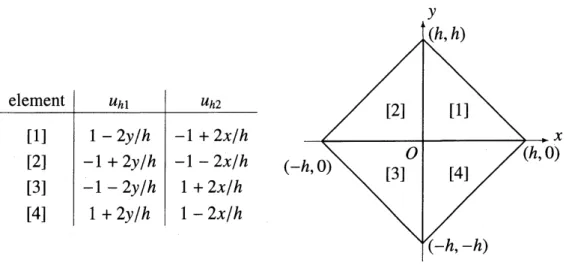
$\tilde{v}\in\tilde{V}_{D}^{h}.$Remark2 For the non-conforming$P^{1}$ triangle
of
Crouzeix-Raviart, $Kom$-type inequalitiesdo not hold.
If
the mesh contains the patch in Fig.4 and $u_{h}=\{u_{h1}, u_{h2}\}$ iszero
outside$it$, this non-confonning displacementcannot satisfy Korn-type inequalities[11], although it
certainlydoes
for
the completely incompressiblecase
where the divergence-free condition isimposedelement-wise, see [1]. Notice that this triangularfinite elementmethod is themost
elementaryDGFEM.
8.4
Mixed
type HDG FEM
in
$\tilde{u}$and
$p$
Itis alsopossibleto add$p$
as
an independent unknown function, andsuchan
approach isan
mixed type HDG FEM. We introduce
a
space
$W^{h}$for$p$such
as
$\Pi_{K\not\in\Gamma^{h}}P^{k_{p}}(K)$with$0\leq k_{p}\leq k,$and also
use
$W_{0}^{h}=W^{h}\cap L_{0}^{2}(\Omega)$.
Thena
mixed HDG FEMisto find$\{\tilde{u}_{h},p_{h}\}\in\tilde{V}_{D}^{h}\cross W^{h}s.t.$Figure 4: Exampleofpatchoftriangularelements
Remark3 Since $\hat{u}_{h}\in O_{D}^{h}$,
we can
show that $(div_{h}\tilde{u}_{h}, 1)_{\Omega}=0$by the Greenformula.
Thusthe present $p_{h}$ necessarily belongs to $W_{0}^{h}$
. If
$div_{h}\tilde{V}_{D}^{h}\subset W^{h}$ and $\lambda$ is finite, we have $p_{h}=$ $-\lambda_{B}div_{h}\tilde{u}_{h}$, sothat the presentformulation coincides with theone
in$u$only. Suchasituationis realized
if
wechoose$k_{p}=k-1(k\geq 1)$.
8.5
An
inf-sup condition for mixed
HDG
FEM
Forthe validity of the presentmixed HDG FEM,it is again essential to show
some
inf-supconditions such
as:
There existsa
constant$K>0s.$ $t.$,for all$h(0<h\leq h_{0})$,$inf\sup \underline{(div_{h}\tilde{v},q)_{\Omega}}\geq K$
.
(51)$\tilde{v}\in v_{D^{\backslash \{\tilde{0}\}_{q\in W_{0}^{h}\backslash \{0\}}}}h||\tilde{v}||_{1,h}\cdot\Vert q||_{\Omega}$
To show the above, it is again effective to construct
a
Fortin operator$\Pi_{h}^{F}^{\sim}$ : $H_{0}^{1}(\Omega)^{2}arrow\tilde{V}_{D}^{h},$which is characterized
as
follows: There exists apositive constant $C$ such that,for
all $v\in$$H_{0}^{1}(\Omega)^{2},$
$||\Pi_{h}^{F}v\Vert_{1,h}\leq C||v||_{H^{1}(\Omega)^{2}}\sim,$ $((div_{h}II_{h}^{F}-div)v, q_{h})_{\Omega}=0$ ;$\forall q_{h}\in W^{h}$ (52)
Although it is in general difficult to find
a
nice Fortin operator, it isnow
knownthat itsexistence isassured in the arbitrary choice of$0\leq k_{p}\leq k$for thepolygona12Delements with
discontinuous numerical fluxes $(0^{h}=\Pi_{e\in S^{h}}P^{k_{p}}(e))[9]$
.
This is ina
sense an
amazing resultcomparedwith the classical mixed FEMusing $u$ and$p.$
For
some
finite elementspaces
with (discontinuous) $P^{k-1}$ approximation for $W^{h}$, thepresent mixed HDG FEM give identical results to the displacement HDG FEM for finite
$\lambda$byeliminating
$p$usingthe relation$p=-\lambda_{B}div_{h}\tilde{u}$,cf. Remark 3.
On the otherhand, if
we
add thecontinuityconditionon
thenumerical fluxes$at$ vertexes$(\hat{U}^{h}\subset C(\Gamma^{h}))$, we can atpresent concludethe existenceof theFortin operators for$0\leq k_{p}\leq$
8.6
Reduced-order numerical fluxes
In [16], Oikawa proposed the
use
of$P^{k-1}$ discontinuous numerical fluxes together with the$P^{k}$ interior functions. As
for the interiorpenalty term, the trace ($v|_{K})|_{e}$ of$v\in P^{k}(K)(K\in$ $\mathcal{T}^{h},$ $e\in S^{K})$ is
replaced with its $L^{2}(e)$ projectionto$P^{k-1}(e)$
.
He also pointed outitsrelationwith the Crouzeix-Raviart $P^{1}$ nonconforming triangular element when
$k=1$ and $K$’s
are
triangles. Except for$k=1$ where Kom typeinequalities
may
nothold, suchapproximationswork well for the finite element analysis of nearly incompressible media.
8.7
Initial
stress
problems
We haveconsideredthe
case
where the linearelastic mediaare
free from the initial stressesor
strains. However,ifthe mediaare
pre-stressedbefore further forcesare
applied, theremay
remain initial stresses. In modeling such phenomena,
we
often addsome
linear forms totheweakform (7). Anexample ofsuchmodified weakforms isgiven
as
follows:$[DF]_{IS}$ Given$f\in L^{2}(\Omega)$ and$\{s_{ij}^{0}\}\in L^{2}(\Omega)^{4}(1\leq i, j\leq 2;s_{12}^{0}=s_{21}^{0})$,
find
$u\in H_{0}^{1}(\Omega)^{2}s.t.$$\lambda(divu,divv)_{\Omega}+2\mu\sum_{i,j=1}^{N}(e_{ij}(u), e_{ij}(v))_{\Omega}=(f, v)_{\Omega}-\sum_{i,j=1}^{2}(s_{ij}^{0}, e_{ij}(v))_{\Omega}(\forall v\in H_{0}^{1}(\Omega)^{N})$
.
(53)Itisclear that the solution$u$exists uniquely in$H_{0}^{1}(\Omega)^{2}$,butit
may
notbesufficiently smooth,so
that the usualerror
estimation interms of$h$may
bedifficulttoderive.In DG FEM for the present problem, it is
a
serious problem toexpress
the right-handside that is valid for $\tilde{V}^{h}$
or
$\tilde{V}_{D}^{h}$.
One possible remedy is to replace the strain terms$e_{ij}$’s in
the right-hand side with their approximations $e_{h,ij}’ s$
.
Then (46) should modified as, for all$\tilde{v}_{h}=\{v_{h}, \hat{v}_{h}\}\in\tilde{V}_{D}^{h},$
$2 \mu a_{\sigma,h}(\tilde{u}_{h},\tilde{v}_{h})+\lambda(div_{h}\tilde{u}_{h}, div_{h}\tilde{v}_{h})_{\Omega}=(f, v_{h})_{\Omega}-\sum_{i,j=1}^{2}(s_{ij}^{0}, e_{h,ij}(\tilde{v}_{h}))_{\Omega}$ (54)
We
can
show thestrong$L^{2}$convergence
of$u_{h}$ and$\partial_{hi}\tilde{u}_{h}$respectively
totheexact$u$ and$\partial_{i}u$
byusingthediscreteRellichtheorem,thediscrete Kom-type inequalities
as
wellas
the lower semi-continuity ofthe $L^{2}$norm,cf.[12].9
Numerical Examples
We show
some
numerical results fora
test problem, where the domain $\Omega$ isa
unitsquare
defined by $\{x=\{x_{1}, x_{2}\};0<x_{1}<1, 0<x_{2}<1\}$ and theexact solutionisgivenby
$\phi(s):=s^{2}(s-1)^{2},$ $\Phi(x)=-\frac{1}{2}\phi(x_{1})\phi(x_{2})$, $u=rot\Phi+t\lambda^{-1}$grad$\Phi$, (55)
where $t\geq 0$ is
a
parameter. In the present calculations,we
take $\lambda,$$\mu$ and $t$
as
5000, 1 andDirichlet one, and $f$ is specified by applying the operator of the Navier equations to the
above$u.$
In the numerical calculations,
we
choose $\sigma$unity and consider four triangulationsnum-bered
as
$j=1$, 2, 3, 4,whichare
obtained by usingGmsh [10] and by dividing each side ofthesquare domaininto $10\cross 2^{j-1}$ segments withequal length.
Asfiniteelementmethods,
we
consideredthree types of$P^{1}$-basedones:
1. CG: Classical conforming $P^{1}$ triangular element.
2. DG-D: HybridDG triangular element based
on
discontinuous$P^{1}$-u
and discontinuous$P^{1}-\hat{u}$
,where the
pressure can
becalculated element-wise by the relation$p=-\lambda_{B}divu.$3. DG-C: Hybrid DG triangular element based
on
discontinuous $P^{1}-u$ and continuous$P^{1}-\hat{u}.$
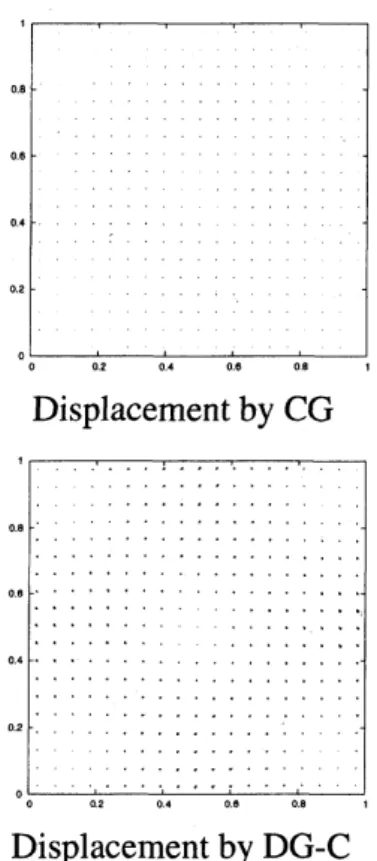
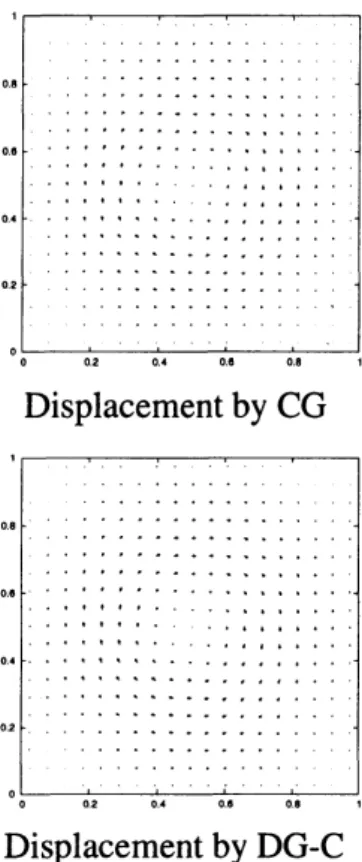
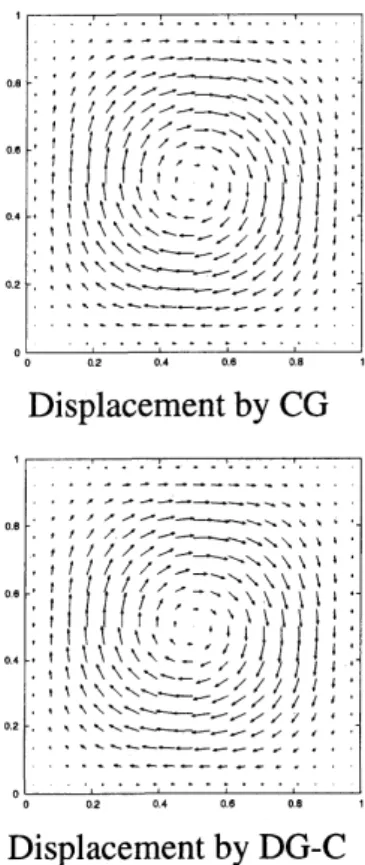
The results
are
shown in Fig.5 through 8, andwe
can
observe that the resultsmay
stronglydepend
on
element types. Thatis,whentriangulationsare
coarser,the results basedon
CG and DG-Care very poor:
the displacementsare
much smaller than the exact one,whichis very close tothe
ones
basedonDG-D in graphicallevel. The resultsare
improvedas
the triangulations become finer, butwe
need muchmore
computational costs than usingthe DG-D method. Onthe contrary, theresultsbased
on
DG-Dare
robust to the finenessoftriangulations
as
is expected theoretically. It is to be noted that, for smaller $\lambda$ (not shownhere), the differenceisnot
so
severe
and sometimes$CG$ may givebetterresults.Triangulation 1 Displacementby CG
Displacementby DG-D DisplacementbyDG-C
Triangulation 2 Displacement by CG
Displacementby DG-D Displacement by DG-C
Figure
6:
Triangulation 2andcomputed displacementsTriangulation 3 Displacement by CG
Displacement by DG-D Displacement by DG-C
Triangulation4 Displacement by CG
Displacement by DG-D Displacement by DG-C
Figure 8: Triangulation4 andcomputeddisplacements
10
Concluding remarks
We have surveyed fundamental finite elementmethods for nearly incompressible media. As
a
whole, the mixed methods using thepressure
$p$as
wellare
superior to the methods indisplacements(or velocities)only,butitisnotso easyto find nice finiteelement models.
As alternatives, the hybrid DGFEM and theirmixed variants may be promising to
de-rive
more
flexible finite element models that behave nicely in nearly incompressible cases,although their practical feasibility (cost, size of discretized problems,etc.) mustbecarefully
tested. Finally,
we
have essentially omit the proofs of theoretical results, which must becompleted
as soon
as
possible.References
[1] Arnold, D.N., On nonconforming linear-constant element for
some
variants of theStokesequations. Istit.Lombardo Accad. Sci. Lett. Rend. A01/1993127,
83-93
(1994)[2] Arnold, D.N., Brezzi, F., Cockburn, B., Marini, L.D.,Unified analysis of discontinuous
Galerkin methods forellipticproblems. SIAM J. Numer. Anal. 39, 1749-1779 (2002)
[3] Brenner, S.C., Scott, L.R., The Mathematical Theory ofFinite Element Methods. 3rd ed.Springer (2008)
[4] Brenner, S.C.,Kom’s inequalities for
piecewise
$H^{1}$vectorfields. Mathematics of
Com-putation 73, 1067-1087 (2003)
[5] Brezis, H., Functional Analysis, Sobolve Spaces and Partial Differential Equations.
Springer(2011)
[6] Boffi, D., Brezzi, F., Fortin, M., Mixed Finite Element Methods and Applications.
Springer(2013)
[7] Buffa, A., Ortner, C.,Compact embeddings of broken Sobolevspacesandapplications.
IMA J. Numer. Anal. 29,
827-855
$(2\alpha)9$)[8] Cockbum, B., Gopalakrishnan, J., Lazarov, R., Unifiedhybridizationofdiscontinuous
Galerkin,mixed, andcontinuousGalerkin methodsfor second orderellipticproblems.
SIAM J. Numer. Anal. 47,
1319-1365
(2009)[9] Egger,H.,Waluga,C.,hp analysis of
a
hybrid DG method for Stokes flow. IMAJoumalof Numerical Analysis33, 687-721 (2013)
[10] Geuzaine, G. and G. Remacle, J.-F., Gmsh: A3-D finite element mesh generator
with built-in pre-and
post-processing
facilities. Internat. J. Numer. Methods Engrg.79,
1309-13331
(2009)[11] Hughes,T.J.R.,TheFiniteElementMethod: Linear Static andDynamicFiniteElement
Analysis.Prentice-Hall (1987)
[12] Kikuchi, F., Rellich-type discrete compactness for
some
discontinuous GalerkinFEM,JapanJ. Indust. Appl. Math. 29,
269-288
(2012)[13] Kikuchi, F., Ishii, K., Oikawa, I.,Discontinuous Galerkin FEMofhybrid displacement
type–development ofpolygonalelements–.Theor. Appl. Mech.Japan.57, 395-404
(2009)
[14] Kikuchi, F., Koyama,D., Strong$L^{p}$
convergence
associated with Rellich-type discretecompactness for discontinuous Galerkin FEM, JSIAMLetters 6,
25-28
(2014)[15] Koyama,D., Kikuchi, F., A hybridized discontinuous Galerkin FEM with lifting
oper-ator for plane elasticity problems, Discussionpapers/GraduateSchool
of
Economics,Hitotsubashi University, No. 2014-04,2014.
[16] Oikawa, I., A hybridizeddiscontinuous Galerkin method with reduced stabilization. J.
Sci. Comput. toappear.