A
discussion
of
nonnegative
solutions
of
elliptic
equations
on
symmetric
domains*
P. Pol\’a\v{c}ik\dagger
School of Mathematics, University ofMinnesota
Minneapolis, MN 55455
Abstract. In this note we summarize our recent results on
nonnega-tive solutions of nonlinearelliptic equations onreflectionallysymmetric
domains. We discuss symmetry properties ofsuchsolutions, the
struc-ture oftheir noda$I$ set, and the existence and multiplicity of solutions
with a nontrivial nodal set.
Contents
1 Introduction 2
2 Notation and hypotheses 4
3 Symmetry properties of nonnegative solutions 6
4 Existence and nonexistence results 7
4.1 Examples 8
4.2 Nonexistence of nonnegative solutions with a nontrivial nodal
set 10
5 Uniqueness and multiplicity results 12
*Prepared for the Proceedings of the International Conference on Partial Differential Equations-in honor of Hiroshi Matano
1
Introduction
Consider a nonlinear elliptic problem ofthe form
$F(x, u, Du, D^{2}u)=0, x\in\Omega$, (1.1)
$u=0, x\in\partial\Omega$. (1.2)
Here $\Omega$ is a bounded domain in $\mathbb{R}^{N}$
, which is reflectionally symmetric about
the hyperplane
$H_{0}=\{x=(x_{1}, x’)\in \mathbb{R}\cross \mathbb{R}^{N-1}:x_{1}=0\}$
andconvexin thedirection$e_{1}$ $:=(1,0, \ldots, 0)$
.
The nonlinearity $F$is assumedto be sufficiently regular, elliptic, and symmetric, so that in particular the
equation is invariant under the reflection in $H_{0}$ (see Section 2 for the precise
hypotheses). For example, the semilinear problem
$\triangle u+f(x’, u)=0, x=(x_{1}, x’)\in\Omega$, (1.3)
$u=0, x\in\partial\Omega$, (1.4)
where $f$ : $\mathbb{R}^{N-1}\cross \mathbb{R}arrow \mathbb{R}$is continuous in all variables and Lipschitz in
$u$, is
admissible for our results without any additional assumption on $f.$
By a celebrated theorem of Gidas, Ni, and Nirenberg [13], and its
gener-alization to nonsmooth domains given by Berestycki and Nirenberg [3] (see
also Dancer’s result in [8]$)$, each positive (classical) solution $u$ of (1.1), (1.2) is even in $x_{1}$:
$u(-x_{1}, x’)=u(x_{1}, x’) ((x_{1}, x’)\in\Omega)$, (1.5)
and decreasing with increasing $|x_{1}|$:
$u_{x_{1}}(x_{1}, x’)<0 ((x_{1}, x’)\in\Omega, x_{1}>0)$. (1.6)
This result was proved using the method of moving hyperplanes introduced
by Alexandrov [1] and further developed and applied in a symmetry
prob-lem by Serrin [25]. We refer the reader to the surveys [2, 16, 17, 18], the
monographs [9, 12, 24], or the more recent paper [6], for perspectiveson this
theorem, related results, and many other references.
The above symmetry and monotonicity theorem is not valid in general
ifthe solution $u$ is assumed to be nonnegative, rather than strictly positive:
consider, for example, the function $u(x)=1+\cos x$ as a solution of $u”+$
$u-1=0$
on
$\Omega=(-3\pi, 3\pi)$.
Note, however, that in this example $u$ still hasabout the center of the
interval
between any two successivezeros.
It is nothard to prove that a similar symmetry result is valid for the nonnegative
solutions of any problem (1.3), (1.4) in
one
space dimension (in theone-dimensional case, $\Omega=(-\ell, \ell)$ for
some
$\ell>0$, and there isno
variable $x’$).It is natural to ask whether in higher dimension, nonnegative solutions
also have some symmetry properties. One would also like to know how the
nodal set of such solutions
can
look like and whether it hassome
symmetryitself. We address these problems in Section 3. The theorem
we
give therestates, roughly speaking, that each nonnegativesolutions$u$of (1.1), (1.2) has
a similar symmetry structure
as
solutions in one dimension: it is symmetricabout $H_{0}$ and, if $u\not\equiv 0$ and $u$ is not strictly positive in $\Omega$, the nodal set
of $u$ divides $\Omega$ into a finite number of reflectionally symmetric subdomains
(nodal domains) inwhich $u$ has the usual Gidas-Ni-Nirenberg symmetry and
monotonicity properties.
Discussing nonnegative solutions with a nontrivial nodal set,
we
havean
obligation to address the problem of existence of such solutions. Using the
one-dimensional example mentioned above, it is not difficult to find such
solutions for
some
problemson a
rectangle. However, it is not at alla
trivialmatter to determine whether such solutions
can
be foundon
other domainsand whether they
can
be found formore
specffic problems, like the spatiallyhomogeneous semilinear equations. These issues are discussed in Section 4,
where we summarize known examples of solutions with a nontrivial nodal
set and mention several results on the nonexistence of such solutions under
various additional conditions
on
the nonlinearity and/or the domain.Our next
concern
is the multiplicity of nonnegative solutions with anontrivial nodal set, in case such solutions do exist. For one-dimensional
problems (1.3), (1.4), a phase-plane analysis reveals that if a solution has
interior zeros, then it’s derivative has to vanish at the boundary points,
that is, such
a
solution satisfies simultaneously the Dirichlet and Neumannboundary conditions. The uniqueness for the Cauchy problem for the
sec-ond order $ODE$ therefore implies that the solution is uniquely determined.
Surprisingly perhaps, a similar uniqueness result holds for a large class of
domains, not necessarily smooth, in any dimension. For general domains,
the number of solutions with interior zeros is finite. See Section 5, for a
2
Notation
and
hypotheses
In this section we state the hypotheses used throughout the paper. First
recall that the standing hypothesis on $\Omega\subset \mathbb{R}^{N}$ is that
it is a bounded
domain, which is $x_{1}$
-convex
$(or$ convex $in the$ direction $e_{1}=(1,0, \ldots, 0)$)and symmetric about the hyperplane $H_{0}=\{(x_{1}, x’)\in \mathbb{R}^{N} : x_{1}=0\}.$
To formulate our hypotheses on the nonlinearity $F$, let $S$ denote the
space of$N\cross N$ symmetric (real) matrices and $\mathcal{B}$ $:=\mathbb{R}\cross \mathbb{R}^{N}\cross S$
.
Let $Q$ bethe transformation on $\mathcal{B}$ defined
by
$Q(u,p, q)=(u, -p_{1},p_{2}, \ldots,p_{N},\overline{q})$, (2.1)
$\overline{q}_{ij}=\{\begin{array}{ll}-q_{ij} if exactly one of i, j equals 1,q_{ij} otherwise.\end{array}$
We
assume
that $F$ : $(x, u,p, q)\mapsto F(x, u,p, q)$ : $\overline{\Omega}\cross \mathcal{B}arrow \mathbb{R}$, satisfies thefollowing conditions.
(Fl) (Regularity) $F$ is continuous on $\overline{\Omega}\cross \mathcal{B}$
and Lipschitz in $(u,p, q)$: there
is $\beta_{0}>0$ such that
$|F(x, u,p, q)-F(x,\tilde{u},\tilde{p},\tilde{q})|\leq\beta_{0}|(u,p, q)-(\tilde{u},\tilde{p},\tilde{q})|$
$((x, u,p, q), (x,\tilde{u},\tilde{p},\tilde{q})\in\overline{\Omega}\cross \mathcal{B})$
.
(2.2)Moreover, $F$ is differentiable with respect to
$q$ on $\Omega\cross \mathcal{B}$ and its
deriva-tives $F_{q_{ij}},$ $i,j=1,$
$\ldots,$$N$, are Lipschitz (in all variables) on $\Omega\cross \mathcal{B}.$
(F2) (Ellipticity) There is a constant $\alpha_{0}>0$ such that
$F_{q_{ij}}(x, u,p, q)\xi_{i}\xi_{j}\geq\alpha_{0}|\xi|^{2} ((x, u,p, q)\in\Omega\cross \mathcal{B}, \xi\in \mathbb{R}^{N})$
.
(2.3)Here and below we use the summation convention (summation over
repeated indices). For example, in the above formula the left hand
side represents the sum over $i,j=1,$ $\ldots,$ $N.$
(F3) (Symmetry) $F$ is independent of
$x_{1}$ and for any $(x, u,p, q)\in\Omega\cross \mathcal{B}$
one has
$F(x, Q(u,p, q))=F(x, u,p, q) (=F((0, x’), u,p, q))$
.
We consider classical solutions $u$ of (1.1), (1.2). By this
we mean
func-tions $u\in C^{2}(\Omega)\cap C(\overline{\Omega})$ such that (1.1), (1.2) are satisfied everywhere.
When considering fully nonlinear equations, we shall require the
(U) For $i,j=1,$ $\ldots,$$N$, the derivatives $u_{x_{i}x_{j}}$
are
locally Lipschitzcontinu-ous on
$\Omega.$We remark that one can often establish the validity of (U) for each
classical solution if additional assumptions are made on $F.$ $A$ sufficient
condition is that $F$ is differentiable (in all variables) on $\Omega\cross \mathcal{B}$ and all its
first order derivatives
are
locally H\"older continuous (see [14, Lemma 17.16]).The main
reason
for thecondition (U) isthatsome
theoremsstatedbelowdepend on the unique continuation and related results for linear equations
related to (1.1), such
as
the linear equation for the difference of two solutionsof (1.1). For the unique continuation to apply, the leading coefficients in the
linear equation must be (locally) Lipschitz continuous. This is guaranteed
by the Lipschitz continuity of the derivatives $F_{q_{ij}}$, as assumed in (Fl), and
condition (U). For morespecific equations, condition (Fl) alone is sufficient.
This is the case, for example, if (1.1) is quasilinear, that is,
$F(x, u,p, q)=A_{ij}(x, u,p)q_{ij}+f(x, u,p)$ $((x, u,p)\in(\overline{\Omega}\cross \mathcal{B}))$ (2.4)
for
some
functions $A_{ij}$ and $f$.
Note that in this case, the last requirementin (Fl) translates to the Lipschitz continuity of the functions $A_{ij},$ $i,j=$
$1,$
$\ldots,$$N$, in
$(x, u,p)\in\Omega\cross \mathbb{R}^{N+1}$
Condition (Fl) implies that $F$ differentiable with respect to $u,$ $p,$ $q$
al-most everywhere. In Section 5,
we
shall need the stronger differentiabilityproperty:
(Fla) $F$ is everywhere differentiable with respect to $u,$ $p,$ $q.$
The
reason
for this condition isan
application of the chain rule, which doesnot always hold for Lipschitz functions. However, for semilinear equations
(1.3), condition (Fla) is not needed (see the remark at the end of Section
5$)$
.
The following notation is used throughout the paper (here $\lambda\in \mathbb{R}$ and
$U\subset\Omega)$:
$H_{\lambda}:=\{x\in \mathbb{R}^{N}:x_{1}=\lambda\},$
$\Gamma_{\lambda}:=H_{\lambda}\cap\Omega,$
$\ell$ $:= \sup\{x_{1}\in \mathbb{R}$ : $(x_{1}, x’)\in\Omega$ for some $x’\in \mathbb{R}^{N-1}\}.$
$\Sigma_{\lambda}^{U}:=\{x\in U:x_{1}>\lambda\}.$
When $U=\Omega$, we omit the superscript $U=\Omega$, thus
Let $P_{\lambda}$ stand for the reflection in the hyperplane $H_{\lambda}$
.
Note that since $\Omega$ isconvex in $x_{1}$ and symmetric in the hyperplane $H_{0},$ $P_{\lambda}(\Sigma_{\lambda})\subset\Omega$ for each
$\lambda\in[0, \ell)$ and $\Sigma_{0}$ is connected $(for \lambda>0, \Sigma_{\lambda} may not be$ connected)
.
For any function $z$
on
$\overline{\Omega}$
, we define $V_{\lambda}z$ by
$V_{\lambda}z(x)=z(P_{\lambda}x)-z(x) (x\in\overline{\Sigma}_{\lambda})$. (2.5)
3
Symmetry properties
of
nonnegative
solutions
The following theorem describes the symmetry structure of nonnegative
so-lutions of (1.1), (1.2).
Theorem 3.1 ([20]). Assume that $(F1)-(F3)$ hold and let$u$ be
a
nonnegativesolution
of
(1.1), (1.2). Further assume that (U) holds or $F$ isof
theform
(2.4). Then either $u\equiv 0$ $($hence, necessarily, $F(\cdot, 0,0,0)\equiv 0$) or else there
exist $m\in \mathbb{N}$ and constants $\lambda_{1},$
$\ldots,$$\lambda_{m}$ with the following properties:
(i) $0=\lambda_{m}<\lambda_{m-1}<\cdots<\lambda_{1}<\ell.$
(ii) For $i=1,$ $\ldots,$$m,$ $V_{\lambda_{i}}u\equiv 0$ on a connected component
of
$\Sigma_{\lambda_{i}}$.
Inparticular, $a\mathcal{S}\Sigma_{0}$ is connected, $V_{0}u\equiv 0$ in $\Sigma_{0}$, that is, $u$ is even in
$x_{1}.$
(iii) There are mutually disjoint open $set_{\mathcal{S}}G_{i}\subset\Omega,$ $i=1,$
$\ldots,$$m$, with $G_{m}$
$po\mathcal{S}$sibly empty, such that the following $\mathcal{S}tatement\mathcal{S}$ are true;
$(a)\emptyset\neq G_{i}\subset\Sigma_{0} (i=1, \ldots, m-1)$
.
$(b) \overline{\Omega}=\overline{G}_{m}\cup\bigcup_{i=1}^{m-1}(\overline{G}_{i}\cup P_{0}(\overline{G}_{i}))$.
$(c)$ For $i=1,$
$\ldots,$ $m$, the set
$G_{i}$ is $x_{1}$-convex and $P_{\lambda_{i}}(G_{i})=G_{i}.$
$(d)$ $Fori=1,$
$\ldots,$$m$, one $ha\mathcal{S}u>0$ in $G_{i},$ $u=0on\partial G_{i},$ $V_{\lambda_{i}}u\equiv 0$
in $Gb$, and $u_{x_{1}}<0$ in $\Sigma_{\lambda_{i}}^{G_{i}}$
If $m=1$ $($and $\lambda_{1}=0)$, statements (ii) and (iii) give the usual symmetry
and monotonicity properties of a positive solution $u$
.
In the general case,(ii), (iii) show that the nodal set of$u,$ $u^{-1}(0)$, divides $\Omega$ into a finite number
of open reflectionally symmetric subsets $G_{m},$ $G_{i},$ $P_{0}(G_{i}),$ $i=1,$
$\ldots,$ $m-1$, in
each ofwhich $u$ is positive, and has the usual Gidas-Ni-Nirenberg symmetry
and monotonicity properties. In is also proved in [20] that each of thesets $G_{i}$
has finitely many connected components. We remark that, although in [20]
the formulation of condition (U) is stronger in that the Lipschitz continuity
of the functions $u_{x_{i}x_{j}}$ on
$\Omega$ is required, just the local Lipschitz continuity is
A related symmetry result for nonnegative solutions ofvariational
prob-lems is proved in [4]. It says that for each subdomain $U$ of $\Omega$ in which $u>0$
and $u_{x_{1}}>0$, the graph of $u$ contains a part reflectionally symmetric to
$\{(x, u(x)) : x\in U\}$
.
The basic method of [4] is the continuous Steinersym-metrization. In [20],
a
modification of the method of moving hyperplanesis used. The latter applies to more general equations, but requires stronger
regularity assumptions.
4
Existence
and
nonexistence
results
As we will see shortly, there
are
domains $\Omega$ and nonlinearities $f=f(x’,u)$,such that the semilinear problem (1.3), (1.4) admits a solution with a
non-trivial nodal set in $\Omega$ (here “nontrivial”
means
different from $\Omega$ and $\emptyset$). Onthe other hand, there
are
domainson
which thereare no
such solutions,no
matter how the nonlinearity is chosen. An example is any $C^{1}$
convex
domainin $\mathbb{R}^{2}$ whose boundary contains a line segment parallel to the $x_{2}$ axis. This
was shown in [20, Proposition 2.7] for semilinear problems (1.3), (1.4). By
similar arguments, one can prove that on such a domain there
can
be nosolutions with a nontrivial nodal set for any fully nonlinear problem (1.1),
(1.2) (assuming that conditions (Fl)$-(F3)$, (Fla), and (U) are in effect). We
refer the reader to [20] for some explanations as to why the existence of
solutions with a nontrivial nodal set imposes restriction on the domain and
how this is related to
some
results concerning overdetermined problems.We do not have
a
good understanding of domains which supportso-lutions with a nontrivial nodal set, let alone any general classffication of
such domains. $A$ classification problem of this sort can be formulated in
the context of general fully nonlinear problems (1.1), (1.2) or more specific
problems, such
as
(1.3), (1.4). We cannot say much about either.How-ever,
we
do havesome
general nonexistence results concerning the spatiallyhomogeneous problem
$\Delta u+f(u)=0, x\in\Omega$, (4.1)
$u=0, x\in\partial\Omega$, (4.2)
see Section 4.2 below. In Section 4.1, we summarize known examples of
semilinear problems (1.3), (1.4) admitting solutions with a nontrivial nodal
set. As of today, there seem to be no known examples of such solutions for
the homogeneous multidimensional problem (4.1), (4.2). Results in Section
4.2 completely rule out such examples with smooth domains,
or
in the case4.1
ExamplesIn all examples given in this section, $\Omega$ is a planar domain, hence we
use
thesimplified notation $(x, y)=(x_{1}, x’)$
.
We consider problems of the form$\triangle u+\mu u+h(y)=0, (x, y)\in\Omega$, (4.3)
$u=0, (x, y)\in\partial\Omega$, (4.4)
where $\Omega\subset \mathbb{R}^{2}$
satisfies the standing hypothesis, $\mu$ is a positive constant, and
$h$ a continuous function of
$y$ only. Thus this is a problem of the form (1.3),
(1.4). For suitable $\Omega,$
$\mu$, and $h$, as specified below, there is a nonnegative
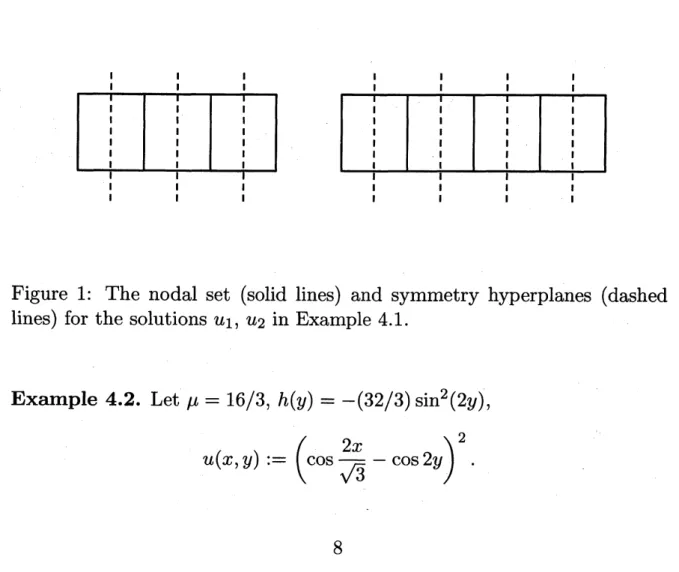
solution $u$ with interior nodal curves. In Figures 1-4, the solid lines indicate
the nodalcurves ofthe solution$u$ and thedashed lines indicate the symmetry
hyperplanes (lines) for the nodal domains of $u$ (cp. Theorem 3.1).
We start with two explicit examples.
Example 4.1. Let $\mu=2,$ $h(y)=-\sin y,$ $u_{1}(x, y)$ $:=(1+\cos x)\sin y$, and
$u_{2}(x, y)$ $:=(1-\cos x)\sin y$
.
Then, for any $k\in \mathbb{N}$, the functions$u_{1}$ and $u_{2}$ arenonnegative solutions of (4.3), (4.4) on $\Omega=(-(2k+1)\pi, (2k+1)\pi)\cross(0, \pi)$
and $\Omega=(-2k\pi, 2k\pi)\cross(0, \pi)$, respectively.
1 1 1 1 1 1 1 $1$ 1 1 1 1 1 1 I I I I 1 I I I I I I I I I I I I I
Figure 1: The nodal set (solid lines) and symmetry hyperplanes (dashed
lines) for the solutions $u_{1},$ $u_{2}$ in Example 4.1.
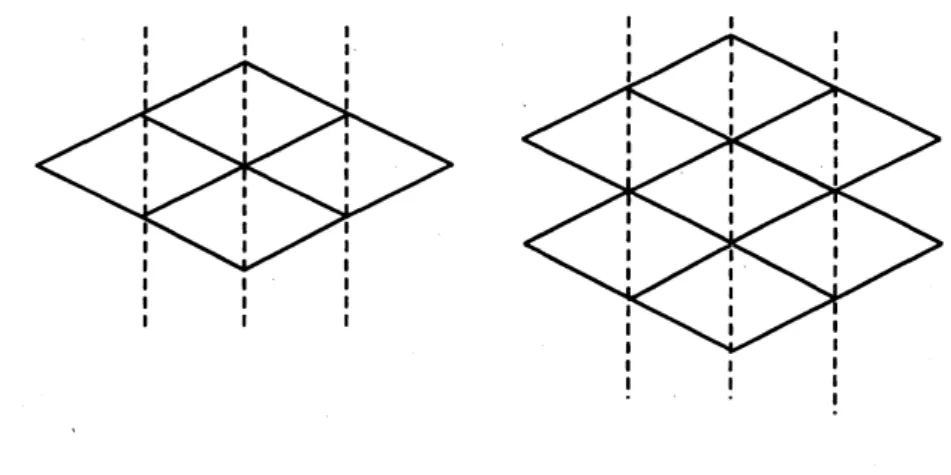
Example 4.2. Let $\mu=16/3,$ $h(y)=-(32/3)\sin^{2}(2y)$,
The nodal lines of $u$
are
given by $y=\pm x/\sqrt{3}+k\pi,$ $k\in \mathbb{Z}$,and the
func-tion $u$ is a nonnegative solution of (4.3), (4.4)
on
any symmetric domainwhose boundary consists of segments from these lines. Figure 2 shows two
possibilities.
111
1 1
111
1!
Figure 2: The nodal set and symmetry lines for solutions in Example 4.2.
In the previous two examples, the interior nodal set of $u$ consists of line
segments. This is different in the next example, where the nodal set consists
of non-flat analytic
curves.
Example 4.3. The domain $\Omega$ and the nodal
curves
of$u$
are
as
in Figure 3.The definition of $\Omega,$
$\mu$, and $h$ is not so simple and explicit here;
we
refer thereader to [20, Section 5] for the detailed construction.
Figure 3: The domain and nonflat nodal lines of a solution.
The domains in the previous examples have corners. The next theorem
shows that even on smooth domains one can find solutions with a nontrivial
Theorem 4.4 ([23]). There exist a constant $\mu>0$, a continuous
function
$h:\mathbb{R}arrow \mathbb{R}$, and a bounded analytic domain $\Omega\subset \mathbb{R}^{2}$ satisfying the standing
hypothesis such thatproblem (4.3), (4.4) has a nonnegative solution $u$ whose
nodal set in $\Omega$ consists
of
two analytic curves (see Figure 4).Figure 4: The domain $\Omega$, and the nodal set and symmetry lines of the solution
$u$
from Theorem 4.4.
A few words about how the above examples have been found. The
constructions link the solutions of (4.3) to eigenfunction of the Laplacian.
Specifically, if $u$ is
a
solution of (4.3), then $v=u_{x}$ satisfies $\triangle v+\mu v=0$ in$\Omega$
.
Moreover, if $u\geq 0$ in $\Omega$, then $v=0$ on all nodalcurves
of$u$ in $\Omega$
.
Also,one has $v=0$ on $H_{0}$ and all the other symmetry lines of $u$ parallel to $H_{0}.$
Thus a key prerequisite for our construction is an eigenvalue-eigenfunction
pair $(\mu, v)$ of the Laplacian, such that $v$ has a suitable nodal structure.
The solution $u$ of (4.3), $(4\backslash 4)$, for some function $h$, is then found as an
antiderivative of $v$ with respect to $x.$
4.2
Nonexistence of nonnegative solutions
witha
nontrivialnodal
set
Some resultsonthenonexistence of solutions with anontrivialnodalset have
been available for a long time, in particular for the homogeneous problem
(4.1), (4.2). In [5], such a result is proved if $\Omega$ is a ball in $\mathbb{R}^{N}(N\geq 2)$
(see also the monographs [9, 12] for the proofand a discussion ofthis result;
an extension to quasilinear radial problems can be found in [24]$)$
.
Moregenerally, nonexistence results for (4.1), (4.2)
can
be found in [15] or [7],where $\Omega$ is a $C^{2}$ domain satisfying, in addition to the standing hypothesis,
a geometric condition: a sort of strict $x_{1}$-convexity in [15] and convexity
the strict positivity of nonnegative
nonzero
solutionswas
given in [10]. Itrequires, roughly speaking, that for any $\delta>0$ there be
a
two-dimensionalwedge $W$, such that if the tip of $W$ is translated to any point of $\partial\Omega$ with
$x_{1}\geq\delta$, then $W$ is contained in $\overline{\Omega}$
.
Note that a rectangle, or a rectangle with
smoothed out corners, does not satisfy the geometric condition of [10]. The
results of [10] apply to equations (1.3) (and to a class of of fully nonlinear
equations), if they satisfy additional symmetry assumptions.
We
now
give two rather general nonexistence results for (4.1), (4.2). Inthe first one, we deal with general smooth domains in $\mathbb{R}^{N},$ $N\geq 2.$
Theorem 4.5 ([19]). Let $\Omega$ be a $C^{2}$ bounded domain in $\mathbb{R}^{N},$ $N\geq 2$,
sat-isfying the standing hypothesis.
If
$u\in C^{2}(\overline{\Omega})$ is a nonnegative solutionof
(4.1), (4.2)
for
some
locally Lipschitzfunction
$f$ : $\mathbb{R}arrow \mathbb{R}$, then either $u\equiv 0$or else $u>0$, hence $u$ has the symmetry and monotonicity properties (1.5)
and (1.6).
We remark that, by the Schauder theory, any classical solution of (1.1),
(1.2) belongs to $C^{2}(\overline{\Omega})$ (even to $C^{2+\alpha}(\overline{\Omega})$) if $\Omega$ is
a
$C^{2+\alpha}$ domain forsome
$\alpha\in(0,1)$
.
The next theorem gives the nonexistence for a large class of planar
do-malns.
Theorem 4.6 ([21]). Assume that $\Omega$ is a bounded domain in $\mathbb{R}^{2}$ satisfying
the standing hypothesis such that one
of
the following conditions issatisfied:
(i) $\Omega$ is convex (not necessarily symmetric) in the direction $e_{2}=(0,1)$
(the direction
of
the $x_{2}$ axis),(ii) $\Omega$ is strictly
convex
in the direction$e_{1},$
(iii) $\Omega$ is piecewise $C^{1,1}$
Let $f$ : $[0, \infty)arrow \mathbb{R}$ be a locally Lipschitz
function
such thatfor
somecon-stants $\delta>0,$ $\alpha\in$ $(0,1] one has f|_{[0,\delta)}\in C^{1,\alpha}[0, \delta)$.
If
$u\in C^{2}(\Omega)\cap C(\overline{\Omega})$ isa nonnegative solution
of
(1.1), (1.2), then either $u\equiv 0$ or else $u>0.$Note that $\Omega$ is strictly convex in the direction
$e_{1}$ if
$\partial\Omega$ contains no
horizontal line segments $(that is,$ segments parallel $e_{1})$. Condition (iii) can
be weakened; we only need the boundary of $\Omega$ to be piecewise $C^{1,1}$
ne.ar
theend points of the horizontal line segments contained in $\partial\Omega$
.
If there are no5Uniqueness and multiplicity results
We mentioned in the introduction that in one-dimensional problems, the
uniqueness of the Cauchy problem implies the uniqueness of solutions with
a nontrivial nodal set. The
same can
be said of multidimensional problemsunder some geometric conditions on $\Omega$, for example, if $\Omega$ is convex (in all
directions). This may be surprising at the first glance, as we are making no
smoothness assumptions on $\Omega$
.
To explain, recall that the symmetries of$u$
(see Theorem 3.1) imply that a portion of $\partial\Omega$ is the reflection of a nodal
set of $u$
.
Now, the nodal set of $u$ is at the same time the nodal set of $u_{x_{1}}$$(as u\geq 0)$, and the latter has some partial regularity properties, thanks to
well-known theorems for linear equations. One eventually shows that any
two solutions with a nontrivial nodal set in $\Omega$ vanish on a smooth portion of
$\partial\Omega$ together with their gradients. The uniqueness for the Cauchy problem
for elliptic equations then implies that any two such solutions coincide on
a
nonempty open subset. Consequently, by unique continuation, they coincide
everywhere in $\Omega$, which gives the uniqueness.
The above arguments give the uniqueness if $\Omega$ is convex or if other
geo-metric conditions are imposed. Without any additional conditions on $\Omega$, we
can prove that the number ofsolutions with a nontrivial nodal set is finite.
To give a precise statement, let $E_{nod}$ be the set of all nonnegative solutions
$u$ of (1.1), (1.2), which satisfy (U) and for which $u^{-1}(0)\cap\Omega\neq\emptyset.$
Theorem 5.1 ([22]). Assume that $(F1)-(F3)$, (Fla) hold. Then the set
$E_{nod}$ is
finite. If
the set $\Sigma^{\lambda}$is connected
for
each $\lambda>0$, then $E_{nod}$ has atmost one element.
Note that $\Sigma^{\lambda}$
is connected for each $\lambda>0$ if$\Omega$ is
convex
(in alldirections)or, more generally, if it is convex in all directions perpendicular to $e_{1}.$
See [22] for the proof of
this
theorem and a more precise multiplicityresult giving an estimate on $|E_{nod}|$ in terms of $N=\dim\Omega$, the constants $\beta_{0},$
$\alpha_{0}$ from (Fl), (F2), and some geometric characteristics of $\Omega.$
The finite multiplicity result is of some importance in studies of the
parabolic problem associated with (1.1), (1.2). The solutions of (1.1), (1.2)
are equilibria for the parabolic problem, and the equilibria with \‘a nontrivial
nodal set play a distinguished role in the global dynamics (more details
on
this will appear in [11]$)$.
The multiplicity result have also some symmetry consequences for the
solutions of (1.1), (1.2) themselves. For example, if both $\Omega$ and $F$ are
nontrivial nodal set must be symmetric withrespect
to
thatgroup
(otherwiseits group orbit yields infinitely many such solutions).
We conclude with a remark concerning assumption (Fla). The
argu-ments in [22] depend on the fact that the function $u_{x_{1}}$, which is of class
$C^{1,1}$
by (U), satisfies almost everywhere
a
linear equation with boundedcoeffi-cients. To
see
this just differentiate (1.1) with respect to $x_{1}$ using the chainrule and the fact that $F$ is independent of $x_{1}$ (see condition (F3)). The
chain rule does not apply in general to Lipschitz functions, and this is the
only
reason
why we need condition (Fla). However,one can use
differentarguments if the equation is semilinear,
as
in (1.3). Even without (Fla),one can
show that $v=u_{x_{1}}$ isa
solution of the equation$\Delta v+a(x)v=0, x\in\Omega$, (5.1)
where $a(x)$ is a bounded measurable function. More specffically, $a(x)$ is
any bounded measurable which coincides with $f_{u}(x, u(x))$, except at the
points $x$ such that either $v(x)=u_{x_{1}}(x)=0$ (in which
case
the value of$a(x)$ is irrelevant in (5.1)$)$ or $u_{x_{1}}\neq 0$ and the derivative $f_{u}$ does not exist at $(x’, u(x))$
.
It is not dfficult to show, using the Lipschitz continuity of$f$withrespect to $u$, that the set of all points $x\in\Omega$ with the latter property has
measure zero.
One then proves that $u_{x_{1}}$ satisfies (5.1) almost everywhere byconsidering the equation satisfied by $(u(x_{1}+\epsilon, x’)-u(x_{1}, x’))/\epsilon$ and taking
the limit
as
$\epsilon\searrow 0.$References
[1] A. D. Alexandrov, A characteristic property
of
spheres, Ann. Math.Pura Appl. 58 (1962), 303-354.
[2] H. Berestycki, Qualitative properties
of
positive solutionsof
ellipticequations, Partial differential equations (Praha, 1998), Chapman
&
Hall/CRC Res. Notes Math., vol. 406, Chapman
&
Hall/CRC, BocaRaton, FL, 2000, pp. 34-44.
[3] H. Berestycki and L. Nirenberg, On the method
of
moving planes andthe sliding method, Bol. Soc. Brasil. Mat. (N.S.) 22 (1991), 1-37.
[4] F. Brock, Continuous rearrangement and symmetry
of
$\mathcal{S}$olutionsof
[5] A. Castro and R. Shivaji, Nonnegative solutions to a semilinear
Dirich-letproblem in a ball are positive and radially symmetric, Comm. Partial
Differential Equations 14 (1989), 1091-1100.
[6] F. Da Lio and B. Sirakov, Symmetry results
for
viscosity solutionsof
fully nonlinear uniformly elliptic equations, J. European Math. Soc. 9
(2007),
317-330.
[7] L. Damascelli, F. Pacella, and M. Ramaswamy, A $\mathcal{S}$trong maximum
principle
for
a $clas\mathcal{S}$of
non-positone singular elliptic problems, NoDEANonlinear Differential Equations Appl. 10 (2003), no. 2, 187-196.
[8] E. N. Dancer, Some notes on the method
of
moving planes, Bull.Aus-tral. Math. Soc. 46 (1992), 425-434.
[9] Y. Du, Order structure and topological methods in nonlinear partial
differential
equations. Vol. 1, Series in Partial Differential Equationsand Applications, vol. 2, World Scientffic Publishing Co. Pte. Ltd.,
Hackensack, NJ, 2006.
[10] J. F\"oldes, On symmetry $propertie\mathcal{S}$
of
parabolic equations in boundeddomains, J. Differential Equations 250 (2011), 4236-4261.
[11] J. F\"oldes and P. Pol\’a\v{c}ik, (in preparation).
[12] L. E. $\mathbb{R}$aenkel,
An introduction to maximum principles and
symme-try in elliptic problems, Cambridge Tracts in Mathematics, vol. 128,
Cambridge University Press, Cambridge, 2000.
[13] B. Gidas, W.-M. Ni, and L. Nirenberg, Symmetry and relatedproperties
via the maximum principle, Comm. Math. Phys. 68 (1979), 209-243.
[14] D. Gilbarg and N. S. Tirudinger, Ellipticpartial
differential
equationsof
$\mathcal{S}$econd order, Classics in Mathematics, Springer-Verlag, Berlin, 2001,
Reprint of the 1998 edition.
[15] P. Hess and P. Pol\’a\v{c}ik, Symmetry and convergence properties
for
non-negative solutions
of
nonautonomous $reaction-diffu\mathcal{S}ion$ problems, Proc.Roy. Soc. Edinburgh Sect. A 124 (1994), 573-587.
[16] B. Kawohl, Symmetrization - or how to prove symmetry
of
solutionsto
a
PDE, Partial differential equations (Praha, 1998), Chapman&
Hall/CRC Res. Notes Math., vol. 406, Chapman
&
Hall/CRC, Boca[17] W.-M. Ni, Qualitat ive properties
of
solutions to elliptic problems,Hand-book of Differential Equations: Stationary Partial Differential
Equa-tions, vol. 1 (M. Chipot and P. Quittner, eds.), Elsevier, 2004, pp.
157-233.
[18] P. Pol\’a\v{c}ik, Symmetry properties
of
positive $\mathcal{S}$olutionsof
parabolicequa-tions: a survey, Recent progress
on
reaction-diffusion systems andvis-cositysolutions (W.-Y. Lin Y. Du, H. Ishii, ed.), World Scientffic, 2009,
pp. 170-208.
[19] –, Symmetry
of
nonnegative solutionsof
elliptic equations via aresult
of
Serrin, Comm. Partial Differential Equations 36 (2011),657-669.
[20] –, On symmetry
of
nonnegative solutionsof
elliptic equations,Ann. Inst. H. Poincar\’e Anal. Non Lineaire 29 (2012), 1-19.
[21] –, Positivity and symmetry
of
nonnegative solutionsof
semilinearelliptic equations onplanar domains, J. Funct. Anal. 262 (2012),
4458-4474.
[22] –, On the multiplicity
of
nonnegative solutions with a nontrivialnodal set
for
elliptic equations on symmetric domains, (preprint).[23] P. Pol\’a\v{c}ik and S. Terracini, Nonnegative solutions with a nontrivial
nodal set
for
elliptic equations on smooth symmetric domains, Proc.AMS (to appear).
[24] P. Pucci and J. Serrin, The maximum principle, Progress in Nonlinear
Differential Equations and their Applications, 73, Birkh\"auser Verlag,
Basel, 2007.
[25] J. Serrin, A symmetry problem in potential theory, Arch. Rational Mech.