Lee’s homology and
Rasmussen
invariant
Tetsuya AbeDepartment of Mathematics, Osaka City University Sugimoto, Sumiyoshi-ku Osaka 558-8585, Japan
Email: [email protected]
July 3,
2010
Abstract
In thisnote, weconsidersome cycles for Lee’s complex which represent canonical classes of
Lee$s$ homology of a knot. We also consider the Rasmussen invariant of ahomogeneous knot
and its application.
1
Introduction
In [19], Rasmussen introduced a smooth concordance invariant ofa knot $K$, now called the
Ras-mussen invariant $s(K)$, whichis defined by cycles of Lee’s complex. There aremany resultson the
Rasmussen invariant However little is known on cycles of Lee$s$ complex. In this note, we consider
some cycles for Lee’s complex which represent canonical classes of Lee$s$ homology ofa knot. We
also consider the Rasmussen invariant of a homogeneous knot and its application.
Acknowledgments
The author would like to express his sincere gratitudes to the organizers of ILDT for giving the
authorthe chance to talk at ILDT. This work was supported by Grant-in-Aid for JSPS Fellows.
2
Lee’s homology of
a
knot
Lee [13] constructed ahomology theorywhich is closely related to Khovanovhomology theory. We
review the results in [13].
2.1 The construction of Lee’s homology of
a
knotIn this subsection, werecall the construction of Lee$s$ homology ofaknot.
Let $K$ be a knot, $D$ a diagram of $K,$ $c_{1},$$\cdots,$$c_{n}$ the crossings of $D$ and $n_{-}(D)$ the number of
negative crossings of$D$
.
A state $s=(s_{1}, \cdots, s_{n})$ for$D$ is a vertex of then-dimensional cube $[0,1]^{n}$,that is, an element of $\{0,1\}^{n}$
.
The grading of $s$ is the sum $\sum_{i=1}^{n}s_{i}-n_{-}(D)$ and denote it by $|s|$.
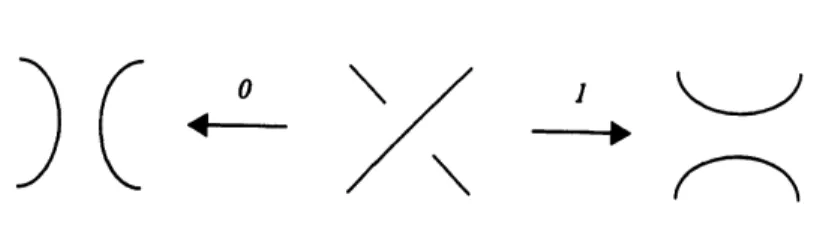
A 0-smoothing and a l-smoothing are local moves on a link diagram
as
in Figure 1. We denote by$D_{s}$ the loops which are obtained from$D$ by applying $s_{i}$-smoothingat $c_{i}(i=1, \cdots, n)$ and by $|D_{s}|$
$rightarrow$
Figure 1: 0- and l-smoothings
and $x$
.
The object ofLee’s complex is definedas
follows,$\sigma_{Lee}(D)=\bigoplus_{s\in\{0,1\}^{n}}|s|=\iota^{V^{\otimes|D_{s}|}}$ and $C_{Lee}^{*}(D)= \bigoplus_{i\in Z}C_{Lee}^{i}(D)$
.
The multiplication $m:V\otimes Varrow V$ and the comultiplication $\Delta$ : $Varrow V\otimes V$
are
defined by$m(1\otimes 1)=m(x\otimes x)=1$, $\Delta(1)=1\otimes x+x\otimes 1$,
$m(1\otimes x)=m(x\otimes 1)=x$
,
$\Delta(x)=x\otimes x+1\otimes 1$.
Let $\xi=$ $(\xi_{1}, --, \xi_{i}, \cdots, \xi_{n})$ be an edge of the
n-dimensional
cube $[0,1]^{n}$, that is,an
element of$\{0, *, 1\}^{n}$ with just
one
$*$.
Suppose that $\xi_{i}=*$.
Thenwe
define to be $|\xi|=\xi_{1}+\cdots+\xi_{i-1},$ $\xi(0)=$
$(\xi_{1}, \cdots, \xi_{i-1},0, \xi_{i+1}, \cdots,\xi_{n}),$ $\xi(1)=(\xi_{1},$
$\cdots$ $\xi_{i-1},1,$$\xi_{i+1},$
$\cdots,$$\xi_{n})$ and $\xi(*)=i$
.
For example,suppose that $n=5$ and$\xi=(1,1, *, 0,1)$
.
Then $|\xi|=2,$ $\xi(0)=(1,1,0,0,1),$ $\xi(1)=(1,1,1,0,1)$and
$\xi(*)=3$
.
For
an
edge $\xi$,we
associate thecobordism
$S_{\xi}$ from $D$ to $D$as
folloneighborhood of the $\xi(*)-$th crossing, assign
a
productcobordism, and fill the saddle cobordi
$\xi(0)$ $\xi(1)$
as
$o$ows: we
remove
abetween
the 0- and l-smoothings around the $\xi(*)-$th crossing. The cobordism is either of thco or
lsmfollowing twotypes: (i) two circles of$D_{\xi(0)}$ merge into
one
circle of$D$ or (ii)one
circle of$D$$1Se$ler $0$ te
$\zeta(1)$, or
splits into two circles of$D_{\xi(1)}.$ Rrthermore,
we
associate the ma $d\cdot V^{\otimes|D_{\zeta(0)}|}$$\xi(0)$
$p$ $\xi$
.
$arrow V$ $\xi(1)$as
$\otimes|D$ $|$
follows: the
homeomorphism
$d_{\xi}$ is induced by the map$m$ if the cobordism $S$ is of$t$
the map $\Delta$ ifthe
cobordism
$S_{\xi}$ is of type (ii).
Note
thatwe
set $d$ to be the $\xi identit^{yp}n$
the ten
$y$ $e(i)$ and $b$
factors
corresponding to the loopsthat do not participate. For $an\xi$element $x\in V^{\otimes|D,|}\subset yonC_{Lee}^{i}(D)$
, $e$
ensor
we define $\theta$
as
follows,$d^{t}(x)= \sum_{\xi\in\{0,*,1\}^{n}:\xi(0)=s}(-1)^{|\xi|}d_{\xi}(x)$,
where $s$is
a
statefor$D$.
Let$d$be$\oplus_{i\in Z}\theta$
.
We obtain$d^{2}=0$.
Thecomplex$C^{*}$$(D)-(C^{*}$ $(D$ $d$
is called Lee’s complex. The Lee’s homology of$KH^{*}$ $(K)$, is defined to $betheh^{-}mo1LeeLee$
$)$, $)$
of$C_{Lee}^{*}(D).$ By the following lemma,
$H_{Lee}^{*}(K)$ does $notdependLee$ on the choice of diagrams of
$K$
.
$e$ omo ogy group
Lemma 2.1 ([13]). Let$D$ and$D’$ be diagrams
of
a knotK. Then$C_{Lee}^{*}(D)$ and$C_{Lee}^{*}(D’)$ are chain
homotopic.
2.2
The
basis
ofLee’s
homology
of
a
knot
It is known that Lee’s homology of a knotisverysimple
as
avector space. Indeed, Lee [13] showedthat $\dim H_{Lee}^{*}(K)=2$and
described
a basis ofLee’s homologyofa
knot$K$
.
In thissubsectionwe
ee [13] showe
explain these results. We also recall the notion ofan enhanced state.
It is useful to
use
the basis $a=1+x,$ $b=1-x$ of $V$.
Then$m(a\otimes a)=2a,$$m(b\otimes b)=2b$, $\triangle(a)=2a\otimes a$,
For astate $s$ for $D$, wedefine col$(D_{s})$ to be the set of coloring maps from the components of$D_{s}$ to
V. Note that an element of col$(D_{s})$ is naturally identified with an element of $V^{\otimes|D_{S}|}\subset C_{Lee}^{|s|}(D)$
.
Hereafterwe always identify an element ofcol$(D_{s})$ withthe element of $V^{\otimes|D_{S}|}\subset C_{Lee}^{|s|}(D)$
.
We callan
element of col$(D_{s})$an
enhanced state.Let$0$ be theorientationof$D$ and $s_{o}$ thestatefor $D$ correspondingto$0$, that is, the state whose
i-th element is $0$ ifthe sign of
$c_{i}$ is positive and 1 if the sign of$c_{i}$ is negative. Then, by definition,
$D_{s_{O}}$ arethe Seifert circles and $|s_{o}|=0$
.
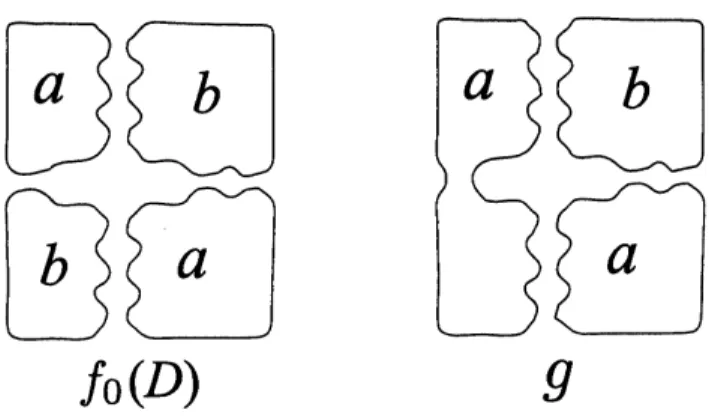
Let$f_{0}(D)\in$ col$(D_{s_{o}})$be theenhanced state whose values ofany adjacent Seifert circlesare$a$ and$b$respectively and the outer most right-handed Seifert circle is
$a$ andthe outer most left-handed Seifert circle is $b$ (seeFigure 3). Let5be thereversed orientation
of $D$
.
Then $f_{0}(D)$ and $f_{\overline{o}}(D)$are
cycles of$C_{Lee}^{0}(D)$ and weobtain the following.Theorem 2.2 ([13]). Let $K$ be a knot and $D$ a diagram
of
K. Then$H_{Lee}^{i}(K)=\{\begin{array}{ll}\mathbb{Q}\oplus \mathbb{Q} i=0,0 i\neq 0.\end{array}$
Here, $[f_{0}(D)]$ and $[f_{\overline{o}}(D)]fom$ a basis
of
$H_{Lee}^{0}(K)$.
Remark 2.3. The two cycles $f_{0}(D)$ and $f_{\overline{o}}(D)$ are determined up to multiplication of$2^{c}$, where $c$
isan integer (see [13]). Therefore we call $[f_{0}(D)]$ and $[f_{\overline{o}}(D)]$ the canonical classes of$H_{Lee}^{*}(K)$
.
3
State
cycles which represent canonical classes
In this section, we recall the notion of a state cycle, which is a cycle of $C_{Lee}^{0}(D)$ and a result on
state cycles (Theorem 3.2).
We recallsome terms. A Seifert circle of adiagram is strongly negative if signs of the adjacent
crossings to it are all negative. Let $D$ be a diagram ofa knot. An enhanced state $g\in$ col$(D_{s_{o}})$ is
state cycle if$f_{0}(l)=g(l)$ for any Seifert circle $l$which is not strongly negative. We define $col_{o}(D_{s_{o}})$
to be the subset of col$(D_{s_{o}})$ which consists of state cycles. Note that the cycle $f_{0}(D)$ is a state
cycle. Any state cycles are, indeed, cycles of$C_{Lee}^{0}(D)$ as follows:
Lemma 3.1 ([1]). Let $D$ be a diagram
of
a knot and$g$ astate cycle. Then$g$ is a cycleof
$C_{Lee}^{0}(D)$$i.e$
.
$d^{0}(g)=0$.
In general, the homology class of a cycle of $C_{Lee}^{0}(D)$ has many representatives. Let $f_{2}(D)$ be
the state cycle such that $f_{2}(D)(l)=2$ for any strongly negativeSeifert circle $l$
.
Then weobtain thefollowing:
Theorem 3.2 ([1]). Let $D$ be
a
non-negative diagramof
a knot K. Then $[f_{0}(D)]=[f_{2}(D)]$.
We give anexample which illustrates Theorem 3.2.
Example 3.3. Let $D$ be the standard pretzel diagram of $P(3, -3, -3)$
.
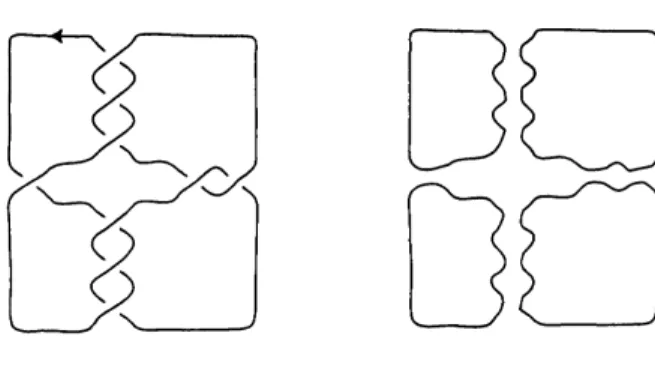
Figure 2 illustrates $D$,its Seifert circles and strongly negative Seifert circles. Let $g\in C_{Lee}^{-1}(D)$ be the enhanced state as
in Figure 3. Then $f_{0}(D)-d^{-1}(g)$ is also a state cycle as in Figure 3. Let $h\in C_{Lee}^{-1}(D)$ be the
enhanced state
as
in Figure 4. Then $f_{2}(D)=f_{0}(D)-d^{-1}(g)-d^{-1}(h)$as
in Figure 4. Therefore$|\backslash \backslash \sim’;\backslash \text{ノ^{}\sim}\backslash ,\gamma_{/^{\wedge}}^{\prime\sim\sim_{\backslash }}.\}$ $O$ $’$ $’\backslash _{-\supset}$
$/^{\text{へ}}\backslash ^{×_{\vee}/^{-}\backslash \text{ノ^{}i}}\vee;)$
Figure 2: The standard pretzel diagram of $P(3, -3, -3)$, its Seifert circles and strongly negative
Seifert circles
$f_{0}(D)$ $g$ $-d^{-1}(g)$ $f_{0}(D)-d^{-1}(g)$
Figure 3: Some enhanced states
$f_{0}(D)-d^{-1}(g)$ $h$
$-d^{-1}(h)$ $f_{0}(D)-d^{-1}(g)-d^{-1}(h)$
Figure 4: Someenhanced states
4
The
Rasmussen
invariant
of
a
knot and the sharper slice-Bennequin
inequality
In this section, we recall the definition of the Rasmussen invariant of a knot and the sharper
slice-Bennequin inequality for the Rasmusseninvariant of aknot.
We define a grading $p$ on $V$ by setting $p(1)=1$ and $p(x)=-1$ and extend it to $V^{\otimes n}$ by
$p(v_{1}\otimes v_{2}\otimes, \cdots, v_{n})=p(v_{1})+p(v_{2})+\cdots+p(v_{n})$
.
Nextwe define afiltration grading $q$ on $C_{Lee}^{i}(D)$ by $q(v)=p(v)+i+\omega(D)$, where $v$ is a monomial of $C_{Lee}^{i}(D)$ and $\omega(D)$ is the writhe of $D$, andextend it to $C_{Lee}^{i}(D)$ by$\min\{q(v_{j})\}$ where $v= \sum v_{j}\in C_{Lee}^{*}(D)$ and $v_{j}$ is
a
monomial. Let$PC_{Lee}^{*}(D)=\{v\in C_{Lee}^{*}(D)\backslash \{0\}|q(v)\geq i\}\cup\{0\}$
.
Then $\{PC_{Lee}^{*}(D)\}$ is a filtration of$C_{Lee}^{*}(D)$
.
Rasmussen showed the following.Lemma 4.1 ([19]). Let $D$ and$D’$ be diagmms
of
a knot. Then $C_{Lee}^{*}(D)$ and$C_{Lee}^{*}(D’)$ arefiltered
chain homotopic.
Wealso denote by$q$ thefiltration gradingon$H_{Lee}^{*}(K)$ whichis induced by the filtration grading
$q$ on $C_{Lee}^{*}(D)$
.
Let$q_{\max}(K)= \max\{q(x)|x\in H_{Lee}^{*}(K), x\neq 0\}$, $q_{\min}(K)= \min\{q(x)|x\in H_{Lee}^{*}(K), x\neq 0\}$
.
The Rasmussen invariant ofa knot $K,$ $s(K)$, is define to be $\frac{q_{\max}(K)-q_{\min}(K)}{2}$
.
By Lemma 4.1,$s(K)$ does not depend on the choice of diagrams of$K$
.
Lemma 4.2 ([19]). Let $K$ be a knot and $D$ a diagram
of
K. Then(1) $q_{\min}(K)=q([f_{0}(D)])=q([f_{\overline{o}}(D)])$
.
(2) $q_{\max}(K)-q_{\min}(K)=2$
.
Note that $s(K)$ is equalto $q([f_{0}(D)])+1$ by Lemma4.2. The following theorem is the sharper
slice-Bennequin inequalityfor the Rasmussen invariant, whichwas first proved by Kawamura [10].
Note that the state cycle in Theorem 3.2 implies the sharper slice-Bennequin inequality for the
Rasmussen invariant.
Theorem 4.3 ([1] and [10]). Let $D$ be a non-negative diagram
of
a K. Then$w(D)-O(D)+2O_{<}(D)+1\leq s(K)$,
where $O_{<}(D)$ is the number
of
strongly negative circlesof
$D$.5
Kawamura-Lobb
$s$inequality
for
the
Rasmussen
invariant
Inthis section,werecallKawamura-Lobb$s$inequalityfortheRasmusseninvariant, which isstronger
than the sharper slice-Bennequin inequality, and that the equality holds for homogeneous knots.
Let $O_{+}(D)^{1}$ and $O_{-}(D)$ be the numbers of connected components of the diagrams which is
obtained from $D$ by smoothing all negative and positive crossings of $D$, respectively. Kawamura
[11] and Lobb [17] independently obtained a stronger estimation for the Rasmussen invariant as
follows:
$D$ $G(D)$ $+0+$ $+$
$=$
$(ii=$
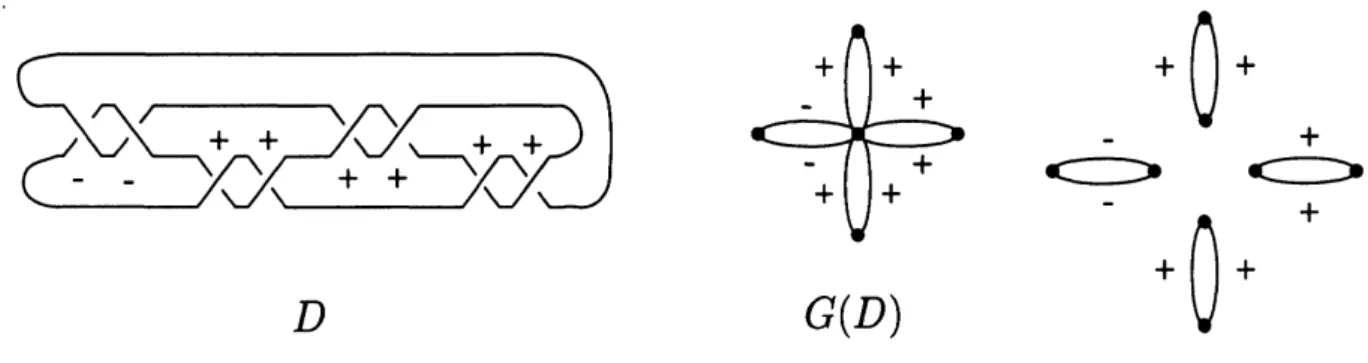
$+0+$ $+$Figure 6: A non-alternating and non-positive diagram $D$ and the graph $G(D)$
Theorem 5.1 ([11] and [17]). Let$D$ be
a
diagramof
a knot K. Then$w(D)-O(D)+2O_{+}(D)-1\leq s(K)$,
where $\omega(D)$ denotes the writhe
of
$D(i.e$.
the numberof
positive crossingsof
$D$ minus the numberof
negative cmssingsof
$D$) and$O(D)$ denotes the numberof
theSeifert
circlesof
$D$.
Cromwell [5] introduced the notionofhomogeneityfor knots to generalize results
on
alternatingknots. The notion ofhomogeneity is also defined forsigned graphs and diagrams: A signed graph
is homogeneous if each block has the
same
signs, and a diagram $D$ of a knot is homogeneousif its Seifert graph, denoted by $G(D)$, is homogeneous (for
more
details,see
[2]). A knot $K$ ishomogeneous if$K$ has ahomogeneous diagram. In [2], we determined the Rasmussen invariant of
ahomogeneous knot
as
follows:Theorem 5.2 ([2]). Let$D$ be a homogeneous diagmm
of
a knot K. Then$s(K)=w(D)-O(D)+2O_{+}(D)-1$
.
6
A
criteria
on
homogeneous
knots
Inthis section, weconsider
some
homogeneous knotsandgivea new criteriaon
homogeneousknots.Cromwell [5] showed thatalternating diagrams and positive diagrams
are
homogeneous. Therearemany homogeneous diagrams whichareneither alternatingnorpositive. The following isasuch
example.
Example 6.1. Let $D$ be the diagram
as
in Figure 6. Then $G(D)$ is homogeneous (see Figure 6).Therefore $D$ is a homogeneous diagram whichis neither alternating nor positive.
Theclass of homogeneous knots includes alternating knots and positive knots. Another example
of a homogeneous knot is the closure of
a
homogeneous braid, a notion whichwas
introduced byStallings [21]. Let $B_{n}$ be the braid group on $n$ strands with generators $\sigma_{1},$$\sigma_{2},$$\cdots,$$\sigma_{n-1}$
.
A braid$\beta=\sigma_{i_{1}}^{\epsilon_{1}}\sigma_{i_{2}}^{\epsilon 2}\cdots\sigma_{i_{k}}^{\epsilon_{k}},$$\epsilon_{j}=\pm 1(j=1, \cdots, k)$ is homogeneous if
(1) every $\sigma_{j}$ occurs at least once,
Table 1:
For example, the braid $\sigma_{1}\sigma_{2}^{-1}\sigma_{1}\sigma_{2}^{-1}$ is homogeneous, however, the braid $\sigma_{1}^{2}\sigma_{2}\sigma_{1}\sigma_{2}^{-1}$ is not
homo-geneous.
Lemma 6.2 ([5]). Let $\beta$ be a braid whose closure is a knot. Then $\beta$ is homogeneous
if
and onlyif
the knot diagmm
of
the closureof
$\beta$ is homogeneous.A homogeneous bmid knot is the closure of a homogeneous braid. By the above lemma, a
homogeneous braid knot is homogeneous. The knot $9_{43}$ is a homogeneous braid knot whichis not
neither alternating nor positive.
Stallings [21] proved thata homogeneousbraid knot is fibered. Notice that there exist
homoge-neous knotswhich arenot homogeneous braid knotssince somehomogeneous knots arenot fibered
(for example, $5_{2}$). The knot $9_{49}$ is a homogeneous knot which are neither homogeneous braid,
alternating, nor positive. We give tables of non-alternating homogeneous knots and homogeneous
braid knots up to 10 crossings, respectively. The table of non-alternating homogeneous knots up
to 10 crossings isdue to Cromwell [5].
Figure 7: A diagram of$8_{19}$ and its Seifert circles
Theorem 6.3 (Theorem 1.3 in [2]). A knot $K$ is positive
if
and onlyif
$K$ homogeneous and$s(K)/2=g_{*}(K)=g(K)$, where$g_{*}(K)$ is the
4-ball
genusof
$K$ and$g(K)$ is the genusof
$K$.
As
a
corollary, we obtain the following:Corollary 6.4.
If
$K$ is not positive and $s(K)=2g(K)$, then $K$ is not homogeneous.This corollary gives
us
a new
method to show thatsome
knotsare
not homogeneous. Thefollowing issuch
an
example.Example 6.5. Let $K$ bethe knot $10_{145}$
.
Then $K$ is not positive and $s(K)=2g(K)=4$ (see [4]).Therefore $K$ is not homogeneous.
7
Non
state
cycles which represent
canonical classes
In section 3, we described state cycles which give the sharper slice-Bennequin inequality for the
Rasmussen invariant. In this section,we considercycleswhichgive Kawamura-Lobb’ inequality for
the Rasmussen invariant, which is stronger thanthe sharper slice-Bennequininequality.
First we give some examples of knot diagrams such that Kawamura-Lobb’ inequality gives a
strongerestimation than the sharper slice-Bennequin inequality.
Example 7.1. Let$D$ be the diagram of$8_{19}$
as
in Figure 7. Then$\omega(D)=3,$$O(D)=4,$$O_{<}(D)=0$and$O_{+}(D)=2$
.
Therefore the sharper slice-Bennequin inequality implies that$0=3-4+0+1\leq$$s(8_{19})$ and Kawamura-Lobb’ inequalityimplies that $2=3-4+2+1\leq s(8_{19})$
.
Note that $s(8_{19})=2$(see [4]).
Example 7.2. Let$D$bethe alternating diagram asinFigure8and$K$the knot which isrepresented
by $D$
.
Then $\omega(D)=-3,$ $O(D)=6,$$O_{<}(D)=2$ and $O_{+}(D)=4$. Therefore the sharperslice-Bennequin inequality implies that $-4=-3-6+4+1\leq s(K)$ and Kawamura-Lobb’ inequality
implies that $-2=-3-6+6+1\leq s(K)$
.
Since $K$ is the connected sum of two figure-eight knotsand the trefoil knot, $s(K)=-2$ (see [19]).
Next wegivesome cycles which give Kawamura-Lobb’ inequality for theRasmussen invariant.
Example 7.3. Let $D$ be the diagram of $8_{19}$
as
in Figure 7. Let $g\in C_{Lee}^{-1}(D)$ be the enhancedstate
as
in Figure 9. Then $f_{0}(D)-d^{-1}(g)$ is nota
state cycleas
in Figure 10. Note that the cycleFigure
8:
An alternating diagram and its Seifert circles$f_{0}(D)$ $g$
Figure 9: The state cycle $f_{0}(D)$ and the enhanced state$g$
$b$
$+$
$2a$
$f_{0}(D)$
–$d^{-1}(g)$
$f_{0}(D)$ $g$
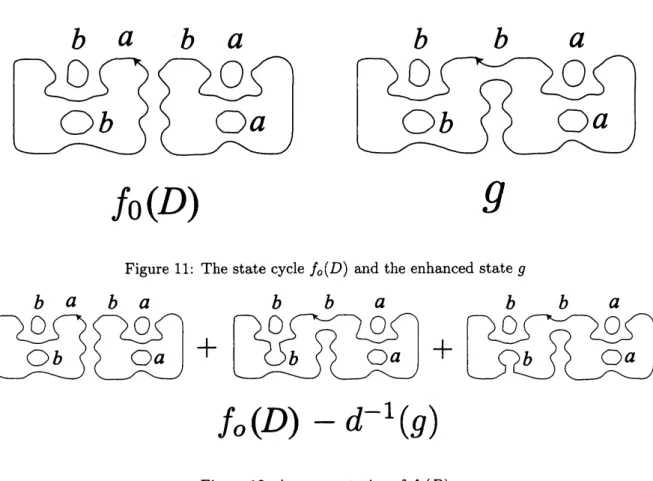
Figure 11: Thestate cycle $f_{0}(D)$ and the enhanced state $g$
$b$
a
$b$a
$f_{0}(D)$ – $d^{-1}(g)$
Figure 12: A representative of $f_{0}(D)$
Example 7.4. Let$D$bethe alternating diagram
as
inFigure8and$K$the knot which is representedby $D$. Let $g\in C_{Lee}^{-1}(D)$ be the enhanced state
as
in Figure 11. Then $f_{0}(D)-d^{-1}(g)$ is not a statecycle
as
inFigure 10. Notethat the cycle$f_{0}(D)-d^{-1}(g)$ impliesthat-2 $=-3-6+6+1\leq s(K)$,which is Kawamura-Lobb’ inequality.
Problem 7.5. Let$D$ be a knot diagram. Find an explicit presentation
of
a cycle $f(D)$ such that$[f_{0}(D)]=[f(D)]$ and $q(f(D))=w(D)-O(D)+2O_{+}(D)-2$ .
In general,
even
foran
alternating diagram $D$,we
do not knowan
explicit presentation of acycle $f(D)$ such that $[f_{0}(D)]=[f(D)]$ and $q(f(D))=w(D)-O(D)+2O_{+}(D)-2$
.
8
Non
homogeneous
knots
There are many non homogeneous knots. One of them is the pretzel knot of type $(p, -q, -r)$ for
odd integer $|p|\geq 3,$ $|q|\geq 3,$ $|r|\geq 3$ (see [5]). Another example is the untwisted Whitehead double
ofa knot (see [5]). For diagrams of these knots, it
seem
to bemore
hard to describe cycles whichdetermine the Rasmussen invariant.
References
[1] T. Abe, State cycles which represent canonical classes
of
Lee’s homologyof
a knot, preprint.Figure 13: $P(3,-5,-7)$ and the untwisted Whitehead double ofthetrefoil knot
[3] Cornelia A. Van Cott, Ozsvath-Szabo and Rasmussen invamants
of
cable knots,arXiv:0803.0500v2 [math. GT].
[4] J. C. Cha and C. Livingston,
KnotInfo:
Tableof
Knot Invariants,http:$//www$.indiana.edu/knotinfo, July 2, 2010.
[5] P. R. Cromwell, Homogeneous links, J. London Math. Soc. (2) 39 (1989), no. 3, 535-552.
[6] P. R. Cromwell, Knots and Links, Cambridge University Press, (2004).
[7] A. Elliott, State Cycles, Quasipositive Modification, and Constructing H-thick Knots in
Kho-vanovHomology, arXiv:0901.4039v2 [math.GT].
[8] M. Freedman, R. Gompf, S. Morrison, K. Walker, Man and machine thinking about the smooth
4-dimensional
Poincare conjecture,arXiv:0906.5177v2 [math.GT].[9] M. Hedden and P. Ording, The $Ozsv\acute{a}th-Szab\mathscr{E}$andRasmussen concordance invart,ants are not
equal, Amer. J. Math. 130 (2008), no. 2, 441-453.
[10] T. Kawamura, The Rasmusseninvareants and the sharperslice-Bennequininequality on knots,
Topology46 (2007), no. 1, 29-38.
[11] T. Kawamura, An estimate
of
the Rasmussen invariantfor
links, preprint (2009).[12] M. Khovanov, A categorification
of
the Jones polynomial, Duke Math. J. 101 (2000), no. 3,359-426.
[13] E. S. Lee, An endomorphism
of
the Khovanov invariant, Adv. Math. 197 (2005),no.
2,554-586.
[14] C. Livingston, Computations
of
the Ozsvath-Szabo knot concordance invariant, Geom. Topol.8 (2004) 735-742.
[15] C. Livingston and S. Naik, Ozsvath-Szabo andRasmussen invariants
of
doubledknots, Algebr.Geom. Topol. 6 (2006), 651-657.
[16] C. Livingston, Slice knots with distinct Ozsvath-Szab6 andRasmussen invariants, Proc. Amer.
Math. Soc. 136 (2008), no. 1, 347-349.
[17] A. Lobb, Computable bounds
for
Rasmussen’s concordance invanant, arXiv:0908.2745v2[19] J. Rasmussen, Khovanov homology and the slice genus, to appear in Invent. Math.
[20] A. Shumakovitch, Rasmussen invariant, slice-Bennequin inequality, and sliceness
of
knotsmath, J. Knot Theory Ramifications 16 (2007), no. 10, 1403-1412.
[21] J. Stallings, Constructions
of fibred
knots and links, Algebraic and geometric topology (Proc.Sympos. Pure Math., Stanford Univ., Stanford, Calif., 1976),Part 2, pp. 55-60, Proc. Sympos.
Pure Math., XXXII, Amer. Math. Soc., Providence, R. I., 1978.
[22] A. Stoimenow,
Some
examples related to knotsliceness,J.
Pure Appl. Algebra 210 (2007),no.
1,
161-175.
[23] S. Wehrli, Contributions to Khovanov Homology, arXiv:0810.0778.
[24] S. Wehrli, Catego
rification of
the colored Jones polynomial and Rasmussen invariantof
links,Canad. J. Math. 60 (2008), no. 6, 1240-1266.