HYPERELLIPTIC GOLDMAN LIE ALGEBRA AND ITS ABELIANIZATION
WATARUYUASA
DEPARTMENT OFMATHEMATICS,
TOKYOINSTITUTE OF TECHNOLOGY
ABSTRACT. In this article, we focuson thedefinition of the Goldman Lie algebra of
anorbifold andits properties without fear of going off what is written in the title. The Goldman Lie algebra isaLie algebrastructureonthefreevectorspacewhich spanned by thesetof all free homotopy classes of oriented loopson asurface. In otherwords, the
vectorspaceis spanned by thesetofall conjugacy classes of the fundamentalgroup. We
extendthe definition of the Goldman Liealgebra ofasurfacetoanorbifold. Weconsider
thesurface obtainedbyremoving allsingularpoints fromanorbifold and defineanideal of the Goldman Lie algebra of this surface. The Goldman Lie algebra of the orbifold is quotient Lie algebra modulo the ideal. The Goldman Lie algebra ofaorbifoldis naturally linear isomorphictothe freevectorspacespannedbythe set ofallconjugacyclasses ofthe orbifold fundamentalgroupofit.
1. INTRODUCTION
Goldman introduced a Lie algebra, the Goldman Lie algebra, in his paper [3]
on
thegeometry ofasymplectic structure
on
therepresentationspace
ofa
surface group. TheLie algebrais defined forany oriented surface and this Lie algebra structure only dependson
the homeomorphism type of the surface. The Goldman Lie algebra $\mathbb{Q}\hat{\pi}(S)$ is defined
as
thefollowing. Let$S$beaconnected oriented surface and$\hat{\pi}(S)$the setofall free homotopy classes of oriented loops
on
S. $\mathbb{Q}\hat{\pi}(S)$ is the $\mathbb{Q}$-vector spaceon
$\hat{\pi}(S)$.
Let $a$ and $b$be immersedloopson
$S$such that allintersection pointsof$a\cup b$are
transversedoublepoints(wecallsuch immersedloopsgeneric). Then
we
define theGoldman bracket ofthese loops by$[a, b]= \sum_{p\in a\cap b}\epsilon(p;a, b)|a_{p}b_{p}|\in \mathbb{Q}\hat{\pi}(S)$,
where$\epsilon(p;a, b)$ isthelocalintersectionnumber of$a$and$b$at
$p,$$a_{p}$ and$b_{p}$
are
closed pathsbased at $p$ obtained from $a$ and $b$ respectively. We consider these paths
as
elements in $\pi_{1}(S,p)$. $|a_{p}b_{p}|$ is thefree homotopy class ofan orientedloop obtainedbyforgettingthebasepoint of$a_{p}b_{p}.$
Theorem 1.1 (Goldman [3]). The Goldman bracket $[,$ $]$ is
well-defined
on
$\hat{\pi}(S)$ and the linearextensionof
thisbracketdefines
theLiealgebrastructureon
$\mathbb{Q}\hat{\pi}(S)$.Goldman also introduced
a
homological version of the Goldman Lie algebra. Let$\mathbb{Q}H(S)$ be the $\mathbb{Q}$-vector space spanned by $H(S)=H_{1}(S, \mathbb{Z})$. When
we
consider $X$in $H(S)$
as an
element of thebasis of$\mathbb{Q}H(S)$,we
denote itby $\langle X\rangle$.
Thenthebracket of$\mathbb{Q}H(S)$ isdefined by
$[\langle X\rangle, \langle Y\rangle]=\mu(X\cdot Y)\langle X+Y\rangle\in \mathbb{Q}H(S)$
forany$X$ and$Y$ in$H(S)$ where$\mu$istheintersectionform
on
$H(S)$. The linearextensionGoldman Lie algebra of
a
surface $S$.
Thereis \‘acanonical surjective homomorphismfromthe Goldman Lie algebra to the homological Goldman Lie algebra of the same surface.
This surjective Lie algebra homomorphism $Ab_{*}:\mathbb{Q}\hat{\pi}(S)arrow \mathbb{Q}H(S)$ is induced by the
abelianization Ab: $\pi_{1}(S)arrow H_{1}(S)$.
Inthisarticle,Wedefine theGoldman Lie algebraof
a
2-orbifold by thequotientoftheGoldman Lie algebra of the surface obtained from removingallsingularpoints inSeciton
2. Weremarkthat Chas and Gadgil [2]giveanotherdefinition oftheGoldman bracket’for
$2$-orbifoldsby the
use
oforbifoldhomotopies andshowtheJacobiidentity bya
method ofhyperbolicgeometry. We alsoreview its definition in this section. Wewillalso showthat
underlying vectorspaceof
our
Lie algebra ofanorbifold is linear isomorphictothevectorspace spanned by the all conjugacy classes ofits orbifold fundamental group. In section
3,
we
describea
relationship between Goldman Lie algebras of finite Galois coverings. Moreprecisely, the action of the coveringtransformation group $\Gamma$of
a
finite unbranched Galois covering $\tilde{S}arrow S$on
the totalspace
$\tilde{S}$induces
an
action of$\Gamma$on
$\mathbb{Q}\hat{\pi}(\tilde{S})$.
Then the $\Gamma$
-invariantpart $\mathbb{Q}\hat{\pi}(\tilde{S})^{\Gamma}$
is embedded in the Goldman Lie algebra$\mathbb{Q}\hat{\pi}(S)$ ofthe base
space. In Section4,
we
givesome
observation ofaproperty of Goldman Lie algebras offinitebranched Galoiscoverings.
2. GOLDMANLIE ALGEBRA OF ORBIFOLD
Aorbifold
was
defined by Satake[6] (underthename
of $V$-manifold”)andThurston[7].We briefly review the definition of
an
orbifold basedon
Bonahon-Siebenmann[l] andMatsumoto-Montesinos[5]. A $n$-dimensional orbifold is aparacompactHausdorffspace
$X$ withan orbifoldatlasof foldingcharts $\{(\tilde{U}_{i}, G_{i}, \varphi_{i}, U_{i})\}_{i\in I}.\tilde{U}_{i}$ isaconnected smooth
$n$-dimensional manifold, $G_{i}$
a
finite group acting smoothly and effectivelyon
$\tilde{U}_{i},$$U_{i}a$
connectedopen setof$X$ such that$X= \bigcup_{i\in I}U_{i}$,
a
foldingmap$\varphi_{i}:\tilde{U}_{i}arrow U_{i}$a
continuousmapwhich naturallyinduces
a
homeomorphism between $\tilde{U}_{i}/G_{i}$and$U_{i}$
.
Furthermore,thefolding charts satisfythefollowing compatibility condition.
$\bullet$ If $U_{i}\cap U_{j}\neq\emptyset$ and$\varphi_{i}(x)=\varphi_{j}(y)=p\in U_{i}\cap U_{j}$, then there exists a diffeo-morphism$\psi:\tilde{V}_{x}arrow\tilde{V}_{y}$ froman openneighborhood of$x\in\tilde{V}_{x}\subset\tilde{U}_{i}$ to
an
open neighborhood of$y\in\tilde{V}_{y}\subset\tilde{U}_{j}$ such that$\varphi_{j}\psi=\varphi_{i}$ and$\psi(x)=y.$Foranyfoldingchart $(\tilde{U}_{i}, G_{i}, \varphi_{i}, U_{i})$ and$x$in$\tilde{U}$
,thestabilizer subgroup $(G_{i})_{x}$ of$x$isthe
set of all elements in $G_{i}$ which fixing $x$
.
The isomorphism class of $(G_{i})_{x}$ depends onlyonthepoint$p=\varphi_{i}(x)$ in $X$. Wecall this isomorphism classthe isotropygroup of$p$
.
Wedefine the singularset$\Sigma X$of$X$
as
thesetofall points in$X$which have nontrivial isotropygroups. A singularpoint of$X$is anelementin$\Sigma X.$
In this article,
we
only consider a 2-dimensional orbifold with the underlyingspace
$S$ which has $0$-dimensional isolated singular points. We take an orbifold atlas of$S$
as
the following. $S-\Sigma S$ is
a
connected oriented smooth surface whichdenotedby $S_{*}.$ $A$singularpoint$p$in$\Sigma S$has
a
foldingchart$(\mathbb{D}, C_{p}, \varphi_{p}, U_{p})$. Thefoldingmap
$\varphi_{p}$ : $\mathbb{D}arrow U_{p}$is a continuous map with$\varphi_{p}(0)=p$ where$\mathbb{D}$ is theopen unit disk in $\mathbb{C}$ and
$U_{p}$ an open neighborhood of$p$
.
The cyclic group $C_{p}$ oforder$m_{p}$ acts on$\mathbb{D}$ by$2\pi/m_{p}$-rotation. We denotethe orbifold by $(S, \Sigma S)$ for the sake of simplicity. Ifallisotropygroups aretrivial,
thatis $\Sigma S=\emptyset$, then$S$is
an
2-dimensional manifold. Let$p_{0}$ be abase point in$S_{*}$.
Fixa reference path $u_{p}$ from$p_{0}$ to $\varphi_{p}(1)$ foreach$p$ in $P$.
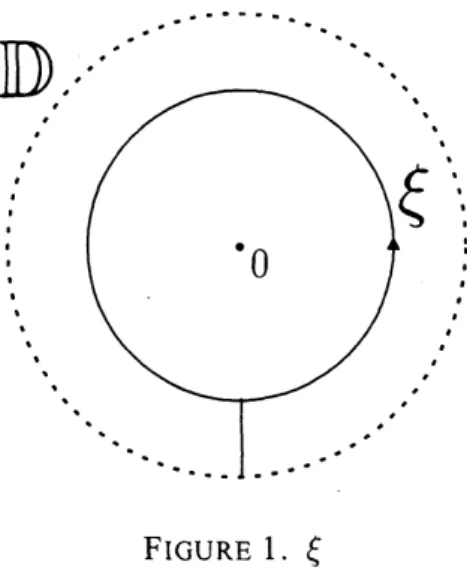
Let $\xi$ be aclosedpath in $\mathbb{D}$definedby Figurel. We define
a
closed path$\xi_{p}=u_{p}(\varphi_{p}0\xi)\overline{u}_{p}$ by connecting the abovepathswhere$\overline{u}_{p}$ is theinversepath of$u_{p}$
.
This pathis $m_{p}$-thpowerofa“meridian“ of$p$in $\Sigma S.$FIGURE 1. $\xi$
we
call it the characteristic subgroupof$\pi_{1}(S_{*},p_{0})$.
The orbifold fundamental group of$(S, \Sigma S)$
can
be defined by$\pi_{1}(S_{*},p_{0})/\langle\xi\rangle_{S}$ andwe
denote it by$\pi_{1^{1b}}^{o}(S,p_{0})$.
We define the Goldman Lie algebra of the above orbifold $(S, \Sigma S)$
as a
quotient Liealgebra of$\mathbb{Q}\hat{\pi}(S_{*})$. $I(S, \Sigma S)$ denotes thevectorsubspace of$\mathbb{Q}\hat{\pi}(S_{*})$generatedby the set $\{|\ell|-|\ell\xi_{p}||\ell\in\pi_{1}(S_{*},p_{0}),p\in\Sigma S\}$
as a
vectorspace.
Weremarkthat the definition of$I(S, \Sigma S)$ is independentof choice of reference paths. Because,Ifwe
takea new
reference path$v_{p}$,then$|l|-|\ell v_{p}(\varphi_{p}\circ\xi)\overline{v}_{p}|=|\ell|-|\ell(v_{p}\overline{u}_{p})u_{r}(\varphi_{p}\circ\xi)\overline{u}_{p}(u_{p}\overline{v}_{p})|$
$=|(u_{p}\overline{v}_{p})\ell(v_{p}\overline{u}_{p})|-|(u_{p}\overline{v}_{p})\ell(v_{p}\overline{u}_{p})u_{p}(\varphi_{p}\circ\xi)\overline{u}_{p}|$
$=|\ell’|-|\ell’u_{p}(\varphi_{p}\circ\xi)\overline{u}_{p}|$
where$\ell’$ is$(u_{p}\overline{v}_{p})\ell(v_{r}\overline{u}_{p})$ in$\pi_{1}(S_{*},p_{0})$
.
Lemma2.1. $I(S, \Sigma S)$ isanideal
of
$\mathbb{Q}\hat{\pi}(S_{*})$.
Proof
We show that $[|a|, |\ell|-|\ell\xi_{p}|]$ isan
elementin $I_{P}$ foranya
in$\pi_{1}(S_{*})$.
Wetakea
representative of$|a|$ which intersects $\ell\xi_{p}$ transversally. If the representative intersects at
points
on
$\xi_{p}$, thenwe
replaceitbya
homotopy tokeepingaway
froma
neighborhood of$U_{p}Uu_{p}$. We denote the representative by $a’$
.
We remark that the representative hasno
intersection pointswith $\xi_{p}$
.
Thereforewe
obtain the following equality.$[|a|, |\ell|-|\ell\xi_{p}|]=[|a’|, |l|-|\ell\xi_{p}|]$
$= \sum_{q\in a’\cap\ell}\epsilon(q;a’, \ell)|a_{q}’\ell_{q}|-\sum_{q\in a\cap\ell\xi_{p}}\epsilon(q;a’, \ell\xi_{p})|a_{q}’(\ell\xi_{p})_{q}|$
$= \sum_{q\in a’\cap\ell}\epsilon(q;a’, \ell)(|a_{q}’\ell_{q}|-|a_{q}’(\ell\xi_{p})_{q}|)$
$= \sum_{q\in a’\cap l}\epsilon(q;a’,\ell)(|\ell_{p0q}a_{q}’\ell_{q}\overline{\ell}_{p0q}|-|(\ell_{p0q}a_{q}’\ell_{q}\overline{\ell}_{p\mathfrak{o}q})\xi_{p}|)\in I_{P}$
where$\ell_{poq}$ is thepathfrom$p_{0}$ to$q$ obtainedby restricting
$\ell$to $[0, \ell^{-1}(q)]$
and$\overline{\ell}_{roq}$ is its
inversepath. $\square$
Definition2.2. TheGoldman Lie algebra
of
$(S, \Sigma S)$ isdefined
by$\mathbb{Q}\hat{\pi}(S_{*})/I(S, \Sigma S)$.
WeRemark2.3. Let$S$bea2-dimensional
manifold
withasetofspecifiedpoints$P\subset S$.
Wedefine
$\xi_{p}$ as a meridianof
$p$in $P$ andthecharacteristic subgroup $\langle\zeta\rangle_{S}$of
$\pi_{1}(S-P)$ byconsidering$p\in P$asa “order1singularpoint”. Then $\mathbb{Q}\hat{\pi}(S, P)=\mathbb{Q}\hat{\pi}(S-P)/\langle\zeta\rangle s$ is
isomorphicto theGoldmanLiealgebra
of
$S.$Let$G$bea groupand$\hat{G}$
the setofconjugacyclasses of
G.
$\hat{g}$denotetheconjugacyclassrepresentedby$g$in
G.
$\mathbb{Q}\hat{G}$
isthe$\mathbb{Q}$-vector
space
spannedby $\hat{G}$.
TheGoldman Liealgebraofasurface $S$ canbe considered
as
$\mathbb{Q}\hat{\pi_{1}}(S,p_{0})$ bya natural bijection between$\hat{\pi_{1}}(S,p_{0})$ and$\hat{\pi}(S)$.
Thenatural bijectionis obtained by regarding $|a|$as
\^aforany$a$ in$\pi_{1}(S)$.Proposition2.4. Thereisanatural isomorphism between$\mathbb{Q}\hat{\pi}(S, \Sigma S)$ and$\mathbb{Q}\hat{\pi_{1}^{orb}}(S,p_{0})$
.
Proof
Wedenote $\pi_{1}^{orb}(S,p_{0})$ by$\Gamma$.Thenatural quotient
map
$\Phi_{\#}:\pi_{1}(S_{*})arrow\Gamma$ induces a linearmap $\Phi_{*}:\mathbb{Q}\hat{\pi}(S_{*})arrow \mathbb{Q}\hat{\Gamma}$. The kemel of$\Phi_{*}$ is generated bya
subset $\{|a|-|b||$ $|\Phi_{\#}(a)|=|\Phi_{\#}(b)|$ and $a,$$b\in\pi_{1}(S_{*})$}
of$\mathbb{Q}\hat{\pi}(S_{*})$.
The condition $|\Phi_{\#}(a)|=|\Phi_{\#}(b)|$means
that$\Phi_{\#}(a)$ isconjugate to $\Phi_{\#}(b)$ in $\Gamma$. Therefore $a^{-1}gbg^{-1}$ is contained in $\langle\xi\rangle_{S}$
for
some
$g$in $\pi_{1}(S_{*})$.
Wecan
denote$a^{-1}gbg^{-1}$ by$\prod_{i=1}^{n}h_{i}\xi_{p_{i}}h_{i}^{-1}$ where$h_{i}$ is in$\pi_{1}(S_{*})$and$p_{i}$ in$\Sigma S$for each$i$
.
Then thegenerator $|a|-|b|=|a|-|a \prod_{i=1}^{n}h_{i}\xi_{p_{i}}h_{i}^{-1}|$$=|a|-|ah_{1} \xi_{p_{1}}h_{1}^{-1}|+\sum_{i=1}^{n-1}(|a\prod_{j=1}^{i}h_{j}\xi_{p_{j}}h_{j}^{-1}|-|a\prod_{j=1}^{i+1}h_{j}\xi_{p_{j}}h_{j}^{-1}|)$
$= \sum_{i=1}^{n}|a_{i}|-|a_{i}\xi_{p_{i}}|$
where$a_{1}=h_{1}^{-1}ah_{1}$ and$a_{i}$ isdefined inductivelyby $h_{i}^{-1}a_{i-1}h_{i}$. Consequently, Theideal $I(S, \Sigma S)$ includes the kemel of$\Phi_{*}$. Thereverse inclusion is clear. Therefore $\Phi_{*}$ induce
an
isomorphism$\Phi:\mathbb{Q}\hat{\pi}(S, \Sigma S)arrow \mathbb{Q}\hat{\Gamma}.$ $\square$Chas and Gadgi1[2] give
a
group-theoretic definition of the Goldman bracket foran
orbifoldbyusing hyperbolicgeometry. Wewill reviewthisdefinition. Let$\Gamma$be
a
discrete subgroup of theorientationpreserving isometric groupof theupperhalfplane$\mathbb{H}$with
the hyperbolicmetric and base point$\tilde{p}_{0}$. For any$x$and$y$in$\Gamma,$$I(x, y)$ denote theemptyset if
$x$
or
$y$arenon-hyperbolicelements, otherwise,$I(x, y)=\{XgY\in X\backslash \Gamma/Y|Ax(x)\cap gAx(y)\neq\emptyset, 9\in\Gamma\}$
where $X$ and$Y$
are
infinite cyclic subgroups generated by $x$ and$y$respectively, $X\backslash \Gamma/Y$isthesetofdouble coset of$X$ and$Y$in $\Gamma$
.
TheGoldmanbracket $[,$ $]_{\Gamma}$on
$\mathbb{Q}\hat{\Gamma}$is given by
$[ \hat{x}, \hat{y}]_{\Gamma}=\sum_{\}}\epsilon(x, 9yXgY\in I(xy)9^{-1})x\overline{gyg^{-1}}$
for any $x$ and $y$ in $\Gamma.$ $\epsilon(x, gyg^{-1})$ is the algebraic intersection number of$Ax(x)$ and
$g$Ax(y). If$x$ is
a
hyperbolic elementin $\Gamma$,we
can
uniquelydeterminethe geodesic line
$Ax(x)$ in $(\mathbb{H}_{0},\tilde{p}_{0})$which fixed by theactionofx. Wecall the geodesic line $Ax(x)$theaxis
of$x$
.
Theorientationofthe axis ofa
hyperbolic elementis defined by the direction fromthe repelling pointto theattractivepoint.
We will observe a relationship between
our
bracket and the above bracket. The$\mathbb{H}-\varpi^{-1}(\Sigma S_{\Gamma})$ by $\mathbb{H}_{0}$
.
We takea
base point $\tilde{p}_{0}$ in $\mathbb{H}_{0}$ and$p_{0}=\varpi(\tilde{p}_{0})$.
Theorb-ifold fundamental group $\pi_{1}^{oIb}(S_{\Gamma},p_{0})$ is isomorphicto $\Gamma$
. The characteristic subgroupof
$\pi_{1}((S_{\Gamma})_{*},p_{0})$isequalto$\varpi\#(\pi_{1}(\mathbb{H}_{0},\tilde{p}_{0}))$. (Referto[4], [5], [7] etc.) Proposition2.4gives
a linear isomorphism $\Phi:\mathbb{Q}\hat{\pi}(S_{\Gamma}, \Sigma S_{\Gamma})arrow \mathbb{Q}\hat{\Gamma}$
.
Therefore $\mathbb{Q}\hat{\Gamma}$
has another Lie algebra structure induced from$\mathbb{Q}\hat{\pi}(S_{\Gamma}, \Sigma S_{\Gamma})$
.
Question 2.5. Does $\Phi$ induce aLie algebra isomorphism
fiom
$(\mathbb{Q}\hat{\pi}(S_{\Gamma}, \Sigma S_{\Gamma}), [, ])$ to $(\mathbb{Q}\hat{\Gamma}, [, ]_{\Gamma})$?0bservation
of
Question2.5. Let $x$ bean
element in $\Gamma$and$\tilde{p}$ in $\mathbb{H}_{0}$
a
starting point. Wetake
a
path$\gamma_{x}^{\tilde{p}}$from$\tilde{p}$to$x\tilde{p}$in$\mathbb{H}_{0}.$ $|\varpi\gamma_{x}^{\overline{p}}|$ defines
a
uniqueelementindependent ofa choiceofstarting points in$\mathbb{H}_{0}$
.
Theinverseof$\Phi$sends$\hat{x}$to$|\varpi\gamma_{x}^{\tilde{p}}|$
.
If$x$bean
ellipticor
parabolicelement in $\Gamma$,
then $\varpi\gamma_{x}^{\tilde{p}}$ is freely homotopic to
a
neighborhood ofa
singular pointor
a
puncture of$S_{\Gamma}$
.
Theseelementsare
containedin the center of$\mathbb{Q}\hat{\pi}(S_{\Gamma}, \Sigma S_{\Gamma})$.
Let $x$ and $y$ be hyperbolic elements in$\Gamma$ and$\tilde{p}$a
pointon
$Ax(x)\cap \mathbb{H}_{0}$ outside of$\bigcup_{g\in\Gamma}g$Ax(y). Wedenote the geodesic half line from $\tilde{p}$ to $x\tilde{p}$ in $Ax(x)$ by$\gamma_{x}^{;\tilde{p}}$
.
($\gamma_{x}^{;\tilde{p}}$does not contain $xp$)
There is
a
bijection between the set ofall intersectionpoints (counting multiplicities)of$\varpi\gamma_{x}^{\prime\tilde{p}}$ and$\varpi\gamma_{y}^{\prime\tilde{p}’}$
and$\gamma_{x}^{\prime\overline{r}}\cap(\bigcup_{g\in\Gamma}(gAx(y)))$for
some
$\tilde{p}’$on
$Ax(y)$.
Furthermore,Thereis
a
bijectionbetween$\gamma_{x}^{\prime\tilde{p}}\cap(\bigcup_{g\in\Gamma}(gAx(y)))$ and $I(x, y)$.
(RefertoChasand Gadgi1[2])If$XgY$is in$I(x, y)$, then$\gamma_{x}^{\prime\overline{p}}$
and$g$Ax(y) have
a
unique intersection point$\tilde{q}$in$\mathbb{H}$.
Wecan
obtain
a
piecewisegeodesicpath$\gamma_{x}^{\prime\tilde{q}}\gamma_{xgyg^{-1}x^{-1}}^{\prime x\overline{q}}$ from$\tilde{q}$to$xgyg^{-1}\tilde{q}$.
Weremark that$x\tilde{q}$ison
$xg$Ax(y) whichistheaxisof$xgyg^{-1}x^{-1}.$ $\varpi\gamma_{x}^{\prime\overline{q}}$and$\varpi\gamma_{xgyg^{-1}x^{-1}}^{\prime x\tilde{q}}$ represent $\Phi^{-1}(x)$
and $\Phi^{-1}(y)$ respectively. These representatives intersect at $q=\varpi(\tilde{q})$
.
The projection$\varpi(\gamma_{x}^{\prime\overline{q}}\gamma_{xgygx}^{\prime x\tilde{q}}-1-1)$ is
a
productof basedloops $(\varpi\gamma_{x}^{\prime\tilde{q}})_{q}$and $(\varpi\gamma_{xgyg^{-1}x^{-1}}^{\prime x\tilde{q}})_{q}$ where $q=$ $\varpi(\tilde{q})$
.
Therefore,$\Phi^{-1}([\hat{x},\hat{y}]_{\Gamma})=\Phi^{-1}(\sum_{XgY\in I(x,y)}\epsilon(x, gyg^{-1})x\overline{gyg^{-1}})$
$= \sum_{\overline{p},\overline{q}\in\gamma_{x}’\cap(\bigcup_{9\in\Gamma(gAx(y)))}}\epsilon(q;\varpi\gamma_{x}^{\prime\tilde{q}}, \varpi\gamma_{xgyg^{-1}x^{-1}}^{\prime x\tilde{q}})|-1$
$= \sum_{\overline{p}’,q\in\varpi\gamma_{x}^{\tilde{p}}\cap\varpi\gamma_{y}’} \prime\tilde{q} \prime x\tilde{q}$
$\epsilon(q;\varpi\gamma_{x}, \varpi\gamma_{xgyg^{-1}x^{-1}})|(\varpi\gamma_{x}^{\prime\tilde{q}})_{q}(\varpi\gamma_{x}^{\prime x\tilde{q}_{yg^{-1}x^{-1}}}9)_{q}|$
$=[|\varpi\gamma_{x}^{\prime\overline{q}}|, |\varpi\gamma_{xgyg^{-1}x^{-1}}^{\prime x\tilde{q}}|]$
$=[\Phi^{-1}(\hat{x}) , \Phi^{-1}(xg\overline{yg^{-1}x}^{-1})]$
$=[\Phi^{-1}(\hat{x}), \Phi^{-1}(\hat{y})]$
ifallintersection points
are
notcontained in$\Sigma S_{\Gamma}$.
Icannotconfirmyetwhen$q$iscontained
in$\Sigma S_{\Gamma}.$ $\square$
Remark2.6. Our
definition of
thebracketisapplicable to $t$‘bad”
orbifolds.
(A badorb-ifold
cannotbe covered by amanifold
[71)We will define the homological Goldman Lie algebra of
an
orbifold. The firsthomol-ogygroupofanorbifold$(S, \Sigma S)$ withcoefficientin$\mathbb{Z}$ isthe
abelianization of the orbifold fundamentalgroup. Wedenote it by $H(S, \Sigma S)$. Weremark that thereexists aunique
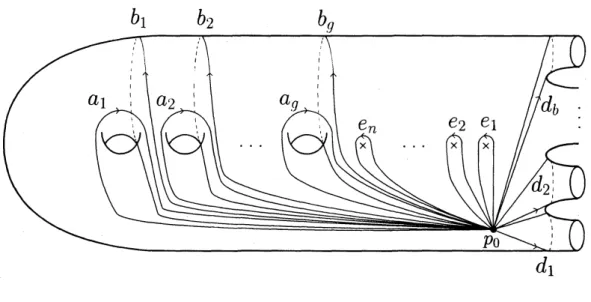
FIGURE 2. generatorsof$\pi_{1}((S_{g,b}))_{*}$
$(S_{g,b}, \Sigma S_{g,b})$be
an
orbifold where$S_{g_{\rangle}b}$ is acompactconnected oriented smooth surface ofgenus $g$with$b$boundarycomponents. Denote $\Sigma S_{g,b}$ by$Q=\{q_{1}, q_{2}, . . . , q_{n}\}$ and the
or-derof theisotropy
group
of$q_{k}$by$m_{k}$ for each$k=1$,2,. . . ,$n$.
Wetakea
generatingset of $\pi_{1}((S_{g_{)}b})_{*},p_{0})by\{a_{i}, b_{i}, d_{j}, e_{k}|i=1, 2, . . . , g, j=1, 2, . . . , b, k=1, 2, . . . , n\}$.
(Seefigure2)Wedenote generatorsof$H_{1}((S_{g,b})_{*}, \mathbb{Z})$ by$A_{i},$$B_{i},$ $D_{j}$and $E_{k}$whichcorrespond
to$a_{i},$ $b_{i},$$d_{j}$ and$e_{k}$respectively. Then the first homology
group
of$H(S, Q)$isdescribed by $H(S, Q) \cong\bigoplus_{i=1}^{g}(\mathbb{Z}A_{i}\oplus \mathbb{Z}B_{i})\bigoplus_{j=1}^{b}\mathbb{Z}D_{j}\bigoplus_{k=1}^{n}\mathbb{Z}_{rn_{k}}E_{k}/\langle\sum_{j=1}^{b}D_{j}+\sum_{k=1}^{n}E_{k}\rangle.$Theintersection form$\mu:H((S_{g,b})_{*})\cross H((S_{g,b})_{*})arrow \mathbb{Z}$ induces $\mu^{orb}:H((S_{g,b}), Q)\cross$
$H(S_{g,b}, Q)arrow \mathbb{Z}$because$\mu$istrivial
on
$D_{j}$and$E_{k}$.
Wecan
definea
bracketon
$\mathbb{Q}H(S_{g,b}, Q)$by
$[\langle X\rangle, \langle Y\rangle]=\mu^{orb}(X, Y)\langle X+Y\rangle$
forany$X$and$Y$ in$H(S_{g,b}, Q)$
.
Definition 2.7. Thehomological Goldman Lie algebra
of
anorbifold
$(S_{g_{\}}b}, Q)$ is the$\mathbb{Q}-$vectorspace$\mathbb{Q}H(S_{g,b}, Q)$ equipped with theabove bracket.
Consequently,
we
obtain the followingcommutativediagram of Liealgebras.$\mathbb{Q}\hat{\pi}((S_{9^{b}},)_{*})arrow^{Ab_{*}.}\mathbb{Q}H((S_{g,b})_{*})$
$\downarrow$ $\downarrow$
$\mathbb{Q}\hat{\pi}(S_{g,b}, Q)\underline{Ab}_{*arrow}\mathbb{Q}H(S_{9^{b}},, Q)$
.
3. GOLDMAN LIEALGEBRAOF FINITE GALOIS COVERING
Let $\tilde{S}$
and $S$be connected oriented smooth surfaces. An orientation preserving
self-diffeomorphism$\gamma$ of $\tilde{S}$
induces abijective mapfrom $a\cap b$to $\gamma a\cap\gamma b$where $a$ and$b$
are
generic immersed loopson
$\tilde{S}$.
The local intersectionnumber of$a$ and$b$ at$p$ agrees with thatof$\gamma a$and$\gamma b$at$\gamma(p)$ because$\gamma$preserves orientationof$\tilde{S}$
. Therefore
we can
obtainan
automorphism$\gamma_{*}$ ofthe Goldman Lie algebra
$\mathbb{Q}\hat{\pi}(\tilde{S})$ givenby$\gamma_{*}(|x|)=|\gamma x|$ for any
$x$in $\pi_{1}(\tilde{S})$
.
Let $f:\tilde{S}arrow S$be
a
finite Galois coveringwithno
branched points and$\Gamma$the coveringtransformation group ofit. Weknow that$\Gamma$ acts
on
$\mathbb{Q}\hat{\pi}(\tilde{S})$from the previousdiscussion.
Let$\mathbb{Q}\hat{\pi}(\tilde{S})^{\Gamma}$
denotethe$\Gamma$
-invariantpartof$\mathbb{Q}\hat{\pi}(\tilde{S})$
.
Lemma3.1. $\mathbb{Q}\hat{\pi}(\tilde{S})^{\Gamma}$
isaLiesubalgebra
of
$\mathbb{Q}\hat{\pi}(\tilde{S})$.Proof.
$\gamma_{*}[v, w]=[\gamma_{*}v, \gamma_{*}w]=[v, w]$ forany $v$and$w$ in
$\mathbb{Q}\hat{\pi}(\tilde{S})^{\Gamma}$
and 7in $\Gamma$
.
Therefore
$\mathbb{Q}\hat{\pi}(\tilde{S})^{\Gamma}$
is
a
Lie subalgebra of$\mathbb{Q}\hat{\pi}(\tilde{S})$.
$\square$Weremark that theLie subalgebra$\mathbb{Q}\hat{\pi}(\tilde{S})^{\Gamma}$
isgenerated by the set$\Gamma\hat{\pi}(\tilde{S})=\{\Gamma(a)|a\in\pi_{1}(\tilde{S})\}$
where $\Gamma(a)$ denotes $\sum_{\gamma\in\Gamma}|\gamma a|$. We denote the vector subspace by $\mathbb{Q}\Gamma\hat{\pi}(\tilde{S})$
.
If$u=$ $\sum_{a\in\pi_{1}(\overline{S})}r_{a}|a|$ isan
elementin$\mathbb{Q}\hat{\pi}(\tilde{S})^{\Gamma}$
, then $u= \sum_{a\in\pi_{1}(\overline{S})}(r_{a}/\#\Gamma)\Gamma(a)$ where $\#\Gamma$
is the number of elements in $\Gamma$
.
Therefore the vector subspace generatedby $\Gamma\hat{\pi}(\tilde{S})$
in-cludes$\mathbb{Q}\hat{\pi}(\tilde{S})^{\Gamma}$
.
Thereverse
inclusionisobvious. Consequently,$\mathbb{Q}\hat{\pi}(\tilde{S})^{\Gamma}$isisomorphicto
$\mathbb{Q}\Gamma\hat{\pi}(\tilde{S})$
.
Ifwetake thecoefficient ofthe GoldmanLie algebra in$\mathbb{Z}$,thenwe
cannotshow the isomorphism.
Wedefinealinear map$\hat{f}:\mathbb{Q}\hat{\pi}(\tilde{S})^{\Gamma}arrow \mathbb{Q}\hat{\pi}(S)$
by$\hat{f}(\Gamma(a))=|f_{\#}(a)|$where$f_{\#}:\pi_{1}(\tilde{S})arrow$
$\pi_{1}(S)$ is the injectivehomomorphism induced by$f.$
Lemma
3.2.
$\mathbb{Q}\hat{\pi}(\tilde{S})^{\Gamma}$isthe
ffee
vectorspace on
$\Gamma\hat{\pi}(\tilde{S})$.
Proof
If$\hat{f}(\Gamma(a))=j(\Gamma(b))$, that is $|f_{\#}(a)|=|f_{\#}(b)|$, hold forany $a$ and$b$ in $\pi_{1}(\tilde{S})$,thenthereexist$\gamma$ in $\Gamma$
whichsatisfies $|a|=|\gamma b|$. We obtain $\Gamma(a)=\Gamma(b)$. This implies
that $|f_{\#}(a)|$ isnotfreely homotopic to $|f_{\#}(b)|$ if$\Gamma(a)\neq\Gamma(b)$. Let$s_{1}\Gamma(a_{1})+s_{2}\Gamma(a_{2})+$
. . .
$+s_{k}\Gamma(a_{k})=0$ for all$\mathcal{S}_{1}$,. . .
,$s_{k}\in \mathbb{Q}$where $\Gamma(a_{1})$,. . .
,$\Gamma(a_{k})$are
distinct elementsin $\Gamma\hat{\pi}(\tilde{S})$.
Then$\mathcal{S}_{1}|f_{\#}(a_{1})|+\cdots+s_{k}|f_{\#}(a_{k})|=0$holdsin$\mathbb{Q}\hat{\pi}(S)$.
Therefore$s_{1}=\cdots=$
$s_{k}=0$ $\square$
Proposition3.3. $\hat{f}:\mathbb{Q}\hat{\pi}(\tilde{S})^{\Gamma}arrow \mathbb{Q}\hat{\pi}(S)$
isaninjectiveLiealgebrahomomorphism.
Proof
Wecan seethat$\hat{f}$ : $\Gamma\hat{\pi}(\tilde{S})arrow\hat{\pi}(S)$is injective because of the proof ofLemma3.2. We show that$\hat{f}$isa
Lie algebrahomomorphism. Forany$a$and$b$in$\pi_{1}(\tilde{S})$,
$[ \Gamma(a), \Gamma(b)]=\sum_{\gamma,\gamma’\in\Gamma}[|\gamma’a|, |\gamma b|]=\sum_{\gamma,\gamma’\in\Gamma}\gamma_{*}’[|a|,$ $| \gamma^{\prime-1}\gamma b|]=\sum_{\gamma_{\}}\gamma’\in\Gamma}\gamma_{*}’[|a|, |\gamma b|].$
Thereforeweobtain that
$\hat{f}([\Gamma(a), \Gamma(b)])=\sum_{\gamma\in\Gamma}f_{*}([|a|, |\gamma b|])$
where$f_{*}:\mathbb{Q}\hat{\pi}(\tilde{S})arrow \mathbb{Q}\hat{\pi}(S)$ is theinduced linear
map
obtainedfrom$f$.
We takegeneric immersedloops $|a|$ and$|b|$ asrepresentatives of$a$and$b$respectively. Let$H$ : $(S^{1}uS^{1})\cross$ $[0, 1]arrow S$beahomotopy such that$H(\cdot, 0)=f\circ|a|\sqcup f\circ|b|, H(\cdot, 1)=a’\sqcup b’$
where$a’ub’$is generic immersion. Weremark that $|a|\sqcup\gamma 0|b|$ is alift of$fo|a|\sqcup fo|b|$
for each$\gamma\in\Gamma$
.
Wecan
obtain aliftof$H$ suchthatbecauseofthe homotopy lifting property. $a’\sqcup b’$intersectstangentially if$\tilde{a}’\sqcup\tilde{b}_{\gamma}’$ intersects
tangentially. $a’\sqcup b’$has triple points if$\tilde{a}’\sqcup\tilde{b}_{\gamma}’$has triplepoints. Therefore$\tilde{a}’\sqcup\tilde{b}_{\gamma}’$ isgeneric
immersion. Next,
we
observea
correspondence betweenintersection pointsof$a’ub’$ and$\tilde{a}’u\tilde{b}_{\gamma}’$. We show that there uniquely exists a lift of intersection point$p$ of$a’$ and $b’$ on
$\tilde{a}’\cap\tilde{b}_{\gamma}’$. Wetakea lift$\tilde{p}$
on
$\tilde{a}’$ foreach intersectionpoint$p$ of$a’$ and$b’$. There is $\gamma$ in
$\Gamma$
such that$\tilde{p}$is
on
$\tilde{b}_{\gamma}’$because theactionof$\Gamma$ is transitive. Ifthereis another lift
on
$\tilde{a}’$,then
$p$ is
a
triple (ormore
multiple)point. Therefore the lift$\tilde{p}$ is uniquely determined. Thereis
no
another lift of$b’$ suchthat$\tilde{p}$ ison
itfor thesame reason.
Accordingly,we
obtaina
bijective map between $\bigcup_{\gamma\in\Gamma}\tilde{a}’\cap\tilde{b}_{\gamma}’$ and$a’\cap b’$ byrestricting$f$. The followingequality
holds because$f$is
an
orientationpreserving local diffeomorphism.$f\circ(\tilde{a}_{\tilde{p}}’\tilde{b}_{\gamma\tilde{p}}’)=a_{p}’b_{p}’, \epsilon(\tilde{p};\tilde{a}’,\tilde{b}_{\gamma}’)=\epsilon(p;a’, b$
Therefore
$\hat{f}[\Gamma(a), \Gamma(b)]=\sum_{\gamma\in\Gamma}f_{*}([|a|, |\gamma b|])$
$= \sum_{\gamma\in\Gamma}f_{*}([|\tilde{a}’|, |\tilde{b}_{\gamma}’|])$
$= \sum_{\gamma\in\Gamma}f_{*}(\sum_{\tilde{p}\in\tilde{a}’\cap\overline{b}_{\gamma}’}\epsilon(\tilde{p};\tilde{a}’,\tilde{b}_{\gamma}’)|\tilde{a}_{\overline{p}}’\tilde{b}_{\gamma\tilde{p}}’|)$
$= \sum_{\tilde{p}\in\bigcup_{\gamma\in\Gamma}\tilde{a}’\cap\tilde{b}_{\gamma}’},\epsilon(\tilde{p};\tilde{a}’,\tilde{b}_{\gamma}’)|f\circ(\tilde{a}_{\tilde{p}}’\tilde{b}_{\gamma\tilde{p}}’)|$
$= \sum_{p\in a’\cap b’}\epsilon(p;a’, b’)|a_{p}’b_{p}’|$
$=[a’, b’]=[|f_{\#}(a)|, |f_{\#}(b)|]=[\hat{f}(\Gamma(a)), \hat{f}(\Gamma(b))].$
Fromtheabove,$\hat{f}:\mathbb{Q}\hat{\pi}(\tilde{S})^{\Gamma}arrow \mathbb{Q}\hat{\pi}(S)$
is
a
homomorphism. $\square$4. GOLDMANLIEALGEBRA OF FINITE BRANCHED GALOIS COVERING
In this section, We consider a
case
that $f:\tilde{S}arrow S$ isa
finite Galois covering with branchedpoints. Let$(S, \Sigma S)$beanorbifold,$\tilde{S}$and$S_{*}$ comected oriented smoothsurfaces, $f:\tilde{S}arrow S$
a
continuous
surjective map such that the restriction $f_{0}:\tilde{S}_{0}arrow S_{*}$ isa
finiteGalois covering with the covering transformationgroup$\Gamma$
where$\tilde{S}_{0}=\tilde{S}-f^{-1}(\Sigma S)$
.
Wedenote$f^{-1}(\Sigma S)$ by$\tilde{P}.$
$f$gives
a
finite uniformization of$(S, \Sigma S)$,thatisan
orbifoldatlasis given by $\{(\tilde{U}_{p}, C_{p}, f|_{U_{p}}-, U_{p})\}_{p\in S}$ where $U_{p}$ is a open neighborhood of$p$ and $\tilde{U}_{p}$ is a
connectedcomponentof$f^{-1}(U_{p})$
.
Fix basepoints$\tilde{p}_{0}$ in $\tilde{S}_{0}$and$p_{0}=f(\tilde{p}_{0})$ in$S$
.
Takea
$m_{p}$-thpower of meridian$\xi_{p}$ of$p\in\Sigma S$by the
same
wayas
Sect.2 foreach$p$ in $\Sigma S$. Wealsodefine
a
meridian$\zeta_{\overline{p}}$ foreach$\tilde{p}\in\tilde{P}$.
(See Remark2.3)Theideal$I(\tilde{S},\tilde{P})$is$\Gamma$-invariant
subspace of$\mathbb{Q}\hat{\pi}(\tilde{S}_{0})$
.
Theorem4 There exists the injec$ive$homomorphism$\hat{f}:\mathbb{Q}\hat{\pi}(\tilde{S}_{0})^{\Gamma}/I(\tilde{S},\tilde{P})^{\Gamma}arrow \mathbb{Q}\hat{\pi}(S, P)$
satisfying thefollowing
commu
ativediagram.$0-I(\tilde{S},\tilde{P})^{\Gamma}-\mathbb{Q}\hat{\pi}(\tilde{S}_{0})^{\Gamma}-\mathbb{Q}\hat{\pi}(\tilde{S}_{0})^{\Gamma}/I(\tilde{S},\tilde{P})^{\Gamma}arrow0$
$\hat{f}_{0}|_{I(\overline{S},P^{-})^{\Gamma}}\downarrow \hat{f}0\downarrow \hat{f}\downarrow$
$0-I(S, \Sigma S)arrow \mathbb{Q}\hat{\pi}(S_{*})$ $arrow$ $\mathbb{Q}\hat{\pi}(S, \Sigma S)$ –0.
Sketch ofproof Thehorizontal
sequences
are
exactand$\hat{f}_{0}$an
injective Lie algebrahomo-morphismbyProposition3.3. We
can prove
theTheorem by carefullychase thecommuta-tivediagram. $\square$
Remark4.2. $\mathbb{Q}\hat{\pi}(\tilde{S}_{0})^{\Gamma}/I(\tilde{S},\tilde{P})^{\Gamma}$
is includedin$\mathbb{Q}\hat{\pi}(\tilde{S})^{\Gamma}$
Finally, We onlygive
a
definitionofthehyperellipticGoldmanLie algebraofa
surface. We denotea closedsurfaceof genus$g$ by $S_{g}$ and fixa
hyperelliptic involution $\iota$ of$S_{g}.$ $\iota$gives
a
degree 2 uniformization of$h:S_{g}arrow(S, \Sigma S^{2})$ where $S^{2}$ isthe2-sphere and all of these singular points have order2isotropygroups. Wecallthe $\iota$-invariantpartof$\mathbb{Q}\hat{\pi}(S_{9})$
as
thehyperellipticGoldmanLiealgebra of$S_{g}.$REFERENCES
1. F. Bonahon and L. Siebenmann, Theclassification of Seifertfibred3-orbifolds, Low-dimensional topology (ChelwoodGate, 1982), London Math. Soc. Lecture NoteSer.,vol. 95, CambridgeUniv.Press,Cambridge,
1985,pp. 19-85.MR827297(87k:570l2)
2. M.Chas and S. Gadgil, The Goldman bracket determines intersectionnumbersforsurfacesandorbifolds,
2012.
3. W.M. Goldman, InvariantfunctionsonLiegroupsandHamiltonianflows ofsurfacegrouprepresentations,
Invent.Math.85(1986),no.2,263-302.MR846929(87j:32069)
4. M.Kato,Onuniformizationsoforbifolds, Homotopy theory and related topics(Kyoto, 1984),Adv.Stud. Pure
Math.,vol. 9,North-Holland,Amsterdam, 1987,pp. 149-172.MR896951(89e:57035)
5. Y. Matsumoto and J. M.Montesinos,Aproofof Thurston$\acute{s}$
uniformizaiontheorem ofgeometric orbifolds,
Tokyo J. Math.14(1991),no. 1,181-196. MR1108165(92g:57005)
6. I. Satake,On ageneralizationofthenotionofmanifold,Proc. Nat.Acad. Sci.U.S.A. 42 (1956),359-363.
MR0079769(18,144a)