A PARABOLIC FREE BOUNDARY PROBLEM WITH
B.ERNOULLI
TYPE CONDITION ON THE FREE BOUNDARY
JOHN ANDERSSONAND GEORG S. WEISS
ABSTHACT. Inthe brilliant paper [1], H.W Alt aiidL.A. Caffarelli provedthatcloseto
flat points the hee boundary of ccrtain weriksolutious ofthc Bernoulli $\theta \mathrm{c}.\mathrm{e}$ boundary
problem
$\Delta u-Q_{t}u=0$in $\{u>0\},$ $|\nabla u|=1$ on$\partial\{u>0\}$
.
isanalytic.
The result is related to the theory of harmonic$\mathrm{m}\mathrm{e}u$urae (see [10], [11], [12]).
For arealistic class ofsolutions, containingforexample alllimitsofthesingular
pertur-bationproblem
$\Delta u_{e}-\partial_{t}u_{e}=\beta_{e}(u_{\iota})$ as$\epsilonarrow 0$,
weprove that one-sided flatnessofthe freeboundary implies regularity.
Inparticular, weshow thatthe topologicaifree boundary $\theta\{u>0\}_{\backslash }$canbedecomposed
intoan openregular set (relative to $\partial\{u>0\}$) which is locally asurface with
H\"older-continuous spacenormal, anda closed singularset.
Ourresult extends the main theorem in the paper byH.W. Alt-L.A. $C$affarelli (1981)
to more generalsolutions as well as thetime-dependent case. Our proofuses methods
developedinH.W. Alt-L.A. Caffarelli (1981),howeverwereplacethecoreof thatpaper,
whichrelies on non-positi.ve mean curvature at singular points, by an argument based
onscaling discrepancies,whichpromisesto beapplicable to moregeneralfreeboundary
orfreediscontinuity problems.
1. INTRODUCTION
This notecontains $\mathrm{t}$ announcement
as
well as heuristics for the paper with thesame
titleto appear, but norigorous proofs. The parabolic free boundary problem
(11) $\Delta u-\partial_{t}u=0$ in $\{u>0\},$ $|\nabla u|=1$
on
$\partial\{u>0\}$2000 $MaV\kappa matics$Subject Classtfication. Primary$35\mathrm{R}B5$, Secondary $35\mathrm{K}55$
.
Key words andphrases. Free boundary,BeaouUitype, parabolic,regularity, flatnessimprovement.
J. Andersson has been prtiaUysupported byafellowshipofthe${\rm Max}$Planck Society. G.S. Weiss has
been partially supported by theGrant-in-Aid 15740100/18740086of the Japanese MinistryofEducation,
Culture, Sports, Science and Ilechnology and partially supported by a fellowship of the ${\rm Max}$ Planck
Society. Bothauthors thank the$\mathrm{M}\alpha$Planck InstituteforMathematics in the Sciences for the hospitality
has $\mathrm{o}\mathrm{r}\mathrm{i}\mathrm{g}\mathrm{i}\mathrm{n}\mathrm{a}\mathrm{l}\mathrm{i}_{\mathrm{y}}$been derived as singular limit $\mathrm{h}\mathrm{o}\mathrm{m}$
a
model for the propagation ofequidif-fusional premixed flameswith high activation energy ([3]); here$u=\lambda(T_{c}-T),$ $T_{\mathrm{c}}$ is the
flame temperature, which is assumed to be constant, $T$ is the temperature outside the
flame and A is a normalization factor.
Let usshortly summarize the mathematical results directly relevantinthiscontext, begin-ningwiththe
limit
problem (1.1): inthe
brilliant paper [1], H.W. Alt and L.A. Caffarelliproved via minimization ofthe energy $\int(|\nabla u|^{2}+\chi\{\mathrm{u}>0\})$ -here $\chi\{u>0\}$ denotes the
char-acteristic hiction of the set $\{u>0\}$ –existence of
a
stationary solution of (1.1) in thesense.of
distributions. Theyako derived regularityof thehee boundary$\partial\{u>0\}$ up toa
set ofvanishing $n-1$-dimensionalHausdorffmeasure.
By [16] existence ofsingular min-imizers implies the existence of singular minimizingcones.
L.A. Caffalelli-D. Jerison-C.Kenigshowed thatsingular minimizing
cones
donot exist in dimension3 ([6]). Moreover itis known thatsingular minimizingcones
exist for$n\geq 7([9])$.
Non-minimizingsingularcones
appearakeadyfor$n=3$ (see [1, example 2.7]). Moreoverit isknown, that solutions of the Dirichlet problem intwo space dimensions are not unique (see [1, example 2.6]).C.E. Kenig-T. Toro ([10], [11], [12]) extended the
result
in
[1] to VMO-coefficients andapplied it to
abstract
harmonicmeasures.
For
the time-dependent (1.1), both “trivialnon-uniqueness” (the positive solution of the heat equation is always another solution of (1.1)$)$ and“non-triviaJ.
uniqueness” (see [14])occur. Even for flawlessinitial data, classical solutions of (1.1) develop singularitiesafter
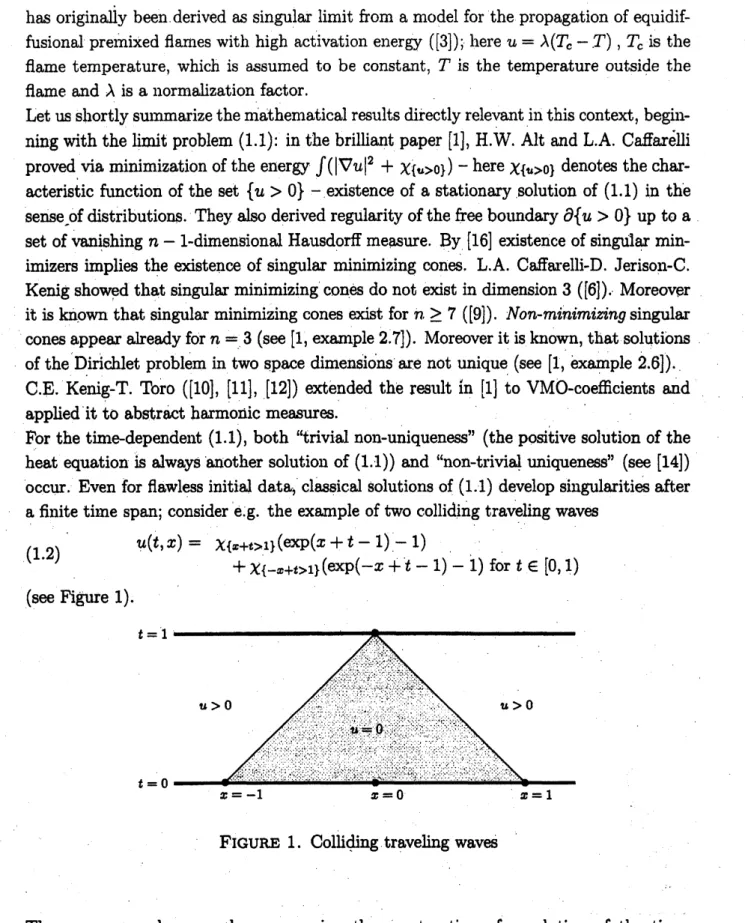
a finite time span; consider e.g. the example of two collidingtraveling
waves
$u(t,x)=\chi\{x+t>1\}(\exp(x+t-1)-1)$ (1.2)
$+\chi\{-x+t>1\}(\exp(-x+t-1)-1)$ for $t\in[0,1)$
(see Figure 1).
FIGURE 1. Colliding $\mathrm{t}\mathrm{r}\mathrm{a}\mathrm{v}\mathrm{e}1_{\dot{\mathrm{i}}}\mathrm{g}$
waves
There
are
several approaches concerning the construction ofa
solution of the time-dependentproblem, $\mathrm{a}\mathrm{U}$ of whichare
basedinsomeformon
theconvergenceofthe solution$u_{\epsilon}$ ofthe reaction-diffusion equation
(1.3) $\Delta u_{\epsilon}-\partial_{t}u_{\epsilon}=\beta_{\epsilon}(u_{\epsilon})$
to (1.1)
as
$\epsilonarrow 0$; here $\beta_{\epsilon}(z)=\frac{1}{\epsilon}\beta(\frac{z}{\epsilon})$ , $\beta$ $\in C_{0}^{1}([0,1])$,
$\beta>0$ in $(0,1)$ and$\int\beta=\frac{1}{2}$
.
L.A. Caffarelli and J.L. Vazquez proved in [7] uniform estimates for (1.3) and a
conver-gence result: for initial data $u^{0}$ that
are
strictlymean
concave
in theinterior
of their support,a
sequence of $\epsilon$-solutions$\mathrm{c}\mathrm{o}\mathrm{n}$
.verges
toa
solution of (1.1) in thesense
ofdistri-butions.
Let
us
also mention several results on the corresponding two-phase problem, whichare
relevant as solutions of the one-phase $\mathrm{p}\mathrm{r}\mathrm{o}\mathrm{b}\mathrm{l}\mathrm{e}\iota \mathrm{n}$ are automatically solutions of the
corre
sponding two-phase problem. In [5] and [4], L.A. Caffarelli, C. Lederman and N.
Wolan-ski prove
convergence
toa
barrier solution in thecase
that the limit function$\cdot$satisfies$\{u=0\}^{\mathrm{o}}=\emptyset$
.
Then, there is the convergence to a solution in the
sense
of domain variations [15] whichseems
to containmore
information than the barrier solutions in [5] and [4]. Formore
general two-phase probleins
see
[17]. Domain variation $\mathrm{s}\mathrm{o}\mathrm{l}\mathrm{u}\mathrm{t}\mathrm{i}\mathrm{o}\iota.\mathrm{l}\mathrm{s}$playan
important rulein this paper and will be discussed in
more
detail inSection 3.Here let it suffice to saythat domain variation solutions are pairs $(u, \chi)$ where the order
parameter $\chi$shares many properties with the characteristic function
$\chi_{\{u>0\}}$ but does not
necessarily coincide withit. By [15], all-limits ofthe singular perturbation problem (1.3)
are
domain variation solutions,so
all results in the present paper hold for all limits of(1.3).
Our main$\mathrm{r}\dot{\infty}\mathrm{u}\mathrm{l}\mathrm{t}$ Theorem 8.1
states-leaving out inessential assumptions-thatif$(0, \rho^{2})$
is
a
pointon
the topological&ee boundary and if the set $\{\chi>0\}$ is flat enough, i.e.$\chi(x,t)=0$ when $(x,t)\in Q_{\rho}$ and $x_{n}\geq\sigma\rho$,
for
some
$\sigma\leq\sigma_{0}$ (see Figure 2), then thefree boundary $Q_{\rho/4}\mathrm{n}\partial\{u>0\}$ is asurfacewithH\"older-continuous space normal.
As
a
consequence we obtain that the regular set is open relative to $\partial\{u>0\}$ (Corollary8.2, $\mathrm{c}\mathrm{f}_{:}$ Figure 3).
Note that
even
in the stationarycase
ourresultextendstheresult in [1]as our
assumptionsdo not exdude degenerate points
or
cusps close to the origin (excluded by the definitionof weak solutions [1, 5.1]$)$, ourresult $d.oes$ that.
In the proofof
our
result weuse
ingenious tools developed in [1]: We prove that flatnesson
the side of$\{\chi=0\}$ impliesflatnesson
the side of$\{\chi>0\}$ whichinturnyieldsuniformconvergence of
an
in$\mathrm{h}\mathrm{o}\mathrm{m}\mathrm{o}\mathrm{g}\mathrm{e}\mathrm{n}\infty \mathrm{u}\mathrm{s}\mathrm{l}\mathrm{y}$ scaled sequence offree boundaries.However
we
replacethe core
in the method of H.W. Alt-L.A. Caffarelli, relyingon
non-positive
mean
$\mathrm{c}\mathrm{u}\mathrm{r}\mathrm{v}\overline{\mathrm{a}}\mathrm{t}\mathrm{u}\mathrm{r}\mathrm{e}$of $\partial\{u>0\}$ at singularities, by
a
method basedon
scalingmay now be applicable to
more.
general free boundaryor
free discontinuity problems, in particular two-phase free boundary problems.Note that the time-dependent problem (1.1) is related to caloric
measures
(see [8] where the topic of the present paper has been mentionedas
open problem).2. NOTATION Throughout this article$\mathrm{R}^{n}$ will beequipped
$\mathrm{w}\dot{\mathrm{i}}\mathrm{t}\mathrm{h}$
theEuclidet innerproduct $x\cdot y\mathrm{t}\mathrm{d}$
theinduced
norm
$|x|,$ $B_{r}(x_{0})$ will denote the open$n$-dimensional ball ofcenter $x_{0},$ radius $r$ and volume $r^{n}\omega_{n},$ $B_{f}’(0)$ the open $n-1-\dim e\mathrm{n}\mathrm{s}\mathrm{i}\mathrm{o}\mathrm{n}\mathrm{a}\mathrm{l}$ball ofcenter$0\mathrm{t}\mathrm{d}$ radius $r$, and $e_{i}$ the i-th unit vector in$\mathrm{R}^{n}$
.
We define$Q_{f}(x_{0}, t_{0})j=B,(x_{0})\mathrm{x}(t_{0}-r^{2}, t_{0}+r^{2})$ to be thecylinder of radius$r\mathrm{t}\mathrm{d}$height$2r^{2},$ $Q_{r}^{-}(x_{0)}t_{0}):=B_{f}(x_{0})\cross(t_{0}-r^{2}, t_{0})$its “negative part”
and$T_{f}^{-}(t_{0}):=\mathrm{R}^{n}\cross(t_{0}-4r^{2}, t_{0}-r^{2})$ the horizontal layer $\mathrm{h}\mathrm{o}\mathrm{m}t_{0}-4r^{2}\mathrm{t}\mathrm{o}\cdot t_{0}-r^{2}$
.
Letus
alsointroduce the parabolicdistallce pardist$((t, x),$$A):= \inf_{()\in A}‘,\sqrt{|x-y|^{2}+|t-s|}y$.
Consideringa
fiiction $\phi\in H_{1\mathrm{o}\mathrm{c}}^{1,2}(\mathrm{R}^{n_{j}}\mathrm{R}^{n})$we
denote.
by $\mathrm{d}\mathrm{i}\mathrm{v}\phi:=\sum_{1=1}^{n}.\partial_{i}\phi_{i}$ the spacedivergence $\mathrm{t}\mathrm{d}$ by
$D\phi:=$
the matrix ofthe spatialpartial derivatives.
Given aset $A\subset \mathrm{R}^{n}$, we denote itsinteriorby$A^{\mathrm{o}}\mathrm{t}\mathrm{d}$its iaracteristic functionby
$\chi_{A}$
.
Inthetext
we
use
the$n$-dimensionalLebaegu-measure
$\mathcal{L}^{n}$ and the$m$-dimensional Hausdorff
measure
$\mathcal{H}^{m}.$ When considerimga
givenset $A\subset \mathrm{R}^{n}$, let$\partial_{M}A:=$
{
$x\in \mathrm{R}^{n}$ : $\lim_{farrow}\sup_{0}\frac{\mathcal{L}^{n}(B_{f}(x)\cap A)}{\mathcal{L}^{n}(B_{f})}>0$ and $\lim_{farrow}\sup_{0}\frac{\mathcal{L}^{n}(\wedge B_{f}(x)-A)}{\mathcal{L}^{n}(B_{f})}>0$}
$:\vee^{:}:::.:_{:}^{:::_{i}}-:_{\mathrm{i}^{\backslash }}’.:..:_{:}^{1.\cdot..\cdot.\backslash }:\cdot.\cdot:::\cdot:1!:::_{j}^{\wedge}\backslash _{\mathrm{t}}:\urcorner::\backslash :::^{4}:’.:_{1}:_{\backslash }:.:i.\cdot:_{\bigvee,\cdot\cdot::^{::^{i}\cdot::_{-}}}\backslash .:\overline{:.}::^{\vee:.:^{:}\bigwedge_{:}:_{\nu,::^{I}}}:,.:^{1}::.:^{:1_{:..:\cdot:^{1\backslash :::_{-:^{:}}^{\mathrm{b}^{\backslash }}}}’}\text{・^{}\backslash }|.\cdot.\cdot:.\cdot.:^{:}’|.\cdot\backslash \cdot\prime\prime:’::=’:..\backslash .\cdot.i\prime\prime\prime:.::::_{j}.\cdot$
$x_{n}>\sigma$
$’.\cdot..\cdot.:^{j}:^{\nu}’..\cdot‘,:’.\cdot.’.:^{\mathrm{t}}‘:^{::^{:}:}.:.:.:|.\cdot:_{\mathrm{J}_{}}..:^{:;^{:}}|::::_{\wedge^{:}:_{\backslash :_{:_{}^{1:^{\iota}}}’\cdot\cdot\cdot:}^{t}}*_{i}\cdot::_{u}\backslash :::j^{\backslash }.’..\cdot.|^{j}::\mathrm{x}:_{j_{\backslash }}:.:^{i^{*::.:^{i}:}},\cdot.,\cdot‘...:-\backslash \backslash .\backslash ;_{:}:\tau_{\mathrm{Y}}:.::::^{-:\cdot:}\backslash ::’::_{;.\cdot a}:.:!.:\sim\cdot::_{\chi’=0}\backslash \cdot.\cdot$
$\mathrm{F}\iota \mathrm{d}\mathrm{u}\mathrm{R}\mathrm{E}3$
.
Example of theset of regular free boundary points (stationaiy)be the measure-theoretic boundary of $A$, let $\partial^{*}A:=\{x\in \mathrm{R}^{n}$ : there is $\nu(x)\in$
$\partial B_{1}(0)$ such that $r^{-n} \int_{B_{f}(x)}|\chi_{A}-x_{\{y:(y-x)\cdot\nu(x)<0\}}|arrow 0$ as $rarrow \mathrm{O}$
}
(by [18, Corollary 5.6.8]$\partial^{*}A$ coincides $\mathcal{H}^{n-1}-\mathrm{a}.e$. with the
$\mathrm{r}e$ducedboundary ofaset of finite perimeter defined in
[18, Definition 5.5.1]$)$, and let $\nu$ : $\partial^{*}Aarrow\partial B_{1}(0)$ denote this
measure
theoretic outwardnormal to $\partial A$
.
We shall oftenuse
abbreviations for inverse images like $\{u>0\}:=\{x\in$$\Omega$ : $u(x)>0\}$, $\{x_{n}>0\}:=\{x\in \mathrm{R}^{n} : x_{n}>0\};\{s=t\}:=\{(s, y)\in \mathrm{R}^{n+1} : s=t\}$ etc.
as well as $A(t):=A\cap\{s=t\}$ for a set $A\subset \mathrm{R}^{n+1}$, and occasionally we employ the
de-composition $x=(x’, x_{n})$ ofavector $x\in \mathrm{R}^{n}$ as well as the corresponding decompositions
of the gradient and the Laplace operator,
Vu$=(\nabla’u, \partial_{n}u)$ and $\Delta u=\Delta’u+\partial_{nn}u$
.
Finally, $\mathrm{C}^{\beta,\mu}:=\mathrm{H}^{\mu,\beta}$ denotes the parabolic H\"older-space defined in [13].
3. NOTION OF SOLUTION AND PRELIMINARIES
In$\mathrm{t}\mathrm{l}\dot{\mathrm{u}}\mathrm{s}$sectionwegather
some
results from[15]. Asdegenerate pointsare
unavoidableintheparabolic problem (see the$\mathrm{i}\mathrm{n}\mathrm{t}\mathrm{r}\mathrm{o}\mathrm{d}\iota \mathrm{i}\mathrm{c}\mathrm{t}\mathrm{i}\mathrm{o}\mathrm{n}$ of[15] for examples),
an
extensionof the weaksolutionsin [1] doesnot
seem
to be the right choice. Insteadwe use
the solutions of [15,Definition 6.1], which are, roughly speaking, solutions in the
sense
of domain variations.the blow-up process. Moreover, all limits of the singular perturbation problem d\’iscussed
in [7]
are
domain variation solutions alld satisfy [15, Definition 6.1] (see [15, Section 6]). Letus
recall the definition of solutions and the monotonicity formula used therein: Theorem 3.1 (Monotonicity Formula, cf. [15, Theorem 5.2]). Let $(x_{0}, t_{0})\in \mathrm{R}^{n}\mathrm{x}$$(0, \infty),$ $T_{r}^{-}(t_{0})=\mathrm{R}^{n}\cross(t_{0}-4r^{2}, t_{0}-r^{2}),$ $0<p<\sigma<\mathit{4}\S 2$ and
$G_{(x_{0},t_{0})}(x, t)=4 \pi(t_{0}-t)|4\pi(t_{0}-t)|^{-_{\mathrm{I}}^{\mathfrak{n}}-1}\exp(-.\frac{|x-x_{0}|^{2}}{.4(t_{0}-t)})$
Then
$\Psi_{(x_{0},t_{0})}(r)=r^{-2}\int_{T^{-}(t_{0})},.(|\nabla u|^{2}+\chi)G_{(x_{0},t_{0})}-\frac{1}{2}r^{-2}\int_{T_{r}^{-}(\iota_{0})}\frac{1}{t_{0}-t}u^{2}G_{(x_{0},t_{0})}$
satisfies
the monotonicityformula
$\Psi_{(x_{0},t\mathrm{o})(\sigma)}-\Psi_{(x_{0},\mathrm{t}_{0})}(p)$
$\geq\int_{\rho}^{\sigma}r^{-1-2}\int_{T_{f}^{-}(t_{0})}\frac{1}{t_{0}-t}(\nabla u\cdot(x-x_{0})-2(t_{0}-t)\partial_{t}u-u)^{2}C_{\mathrm{v}(ae0,t_{0})}dr\geq 0$
Deflnition 3.2 (cf. [15, Definition 6.1]). We call $(u, \chi)$ a solution in $\Omega_{0}:=\mathrm{R}^{n}\mathrm{x}(0, \infty)$
(in which
case we
set $\tau:=0$) or $\Omega_{1}:=\mathrm{R}^{n}\cross(-\infty, \infty)$ (in which casewe
set $\tau:=1$), if:1) $u\in \mathrm{C}_{1\mathrm{o}\mathrm{c}}^{1,\}}(\Omega_{\tau})\cap C^{2}(\Omega_{\tau}\cap\{u>0\})\cap H_{1\mathrm{o}\mathrm{c}}^{1.2}(\Omega_{\tau})$ and $\chi\in L^{1}((-\tau R, R);BV(B_{R}(0)))$ for
each $R\in(0, \infty)$
.
For each $R\in(0, \infty)$ and $\mathit{6}\in(0,1)$ there exists $C_{1}<\infty$ such that for$Q_{f}(x_{0}, t_{0})\subset\Omega_{\tau}\cap Q_{R}(0)$
$\int_{Q_{f}(x_{0},t_{0})}|\nabla\chi|\leq C_{1}\prime r^{n+1}$,
$\int_{Q_{\mathrm{r}}(\varpi_{0},t_{0})}|\partial_{t}u|^{2}\leq C_{1}r^{n}$, aiid
$\int_{B_{r}(x\mathrm{o})\mathrm{x}(t_{0+s_{1}}}r^{2},t_{0}+S_{2^{r^{2}}})|\partial_{t}(|\nabla u|^{2}+\chi)*\phi_{\mathrm{r}\delta}|\leq C_{1}\sqrt{S_{2}-S_{1}}r^{n}$
for $0<S_{1}<S_{2}<\infty$; here the mollifier $(\phi_{\delta})_{\delta\epsilon(0,1)}$ should be non-negative and satisfy
$\phi_{\delta}(\cdot)=\frac{1}{\delta^{n}}\phi(_{\overline{\delta}}),$ $\phi\in C_{0}^{0,1}(\mathrm{R}^{n}),$ $\int\phi=1$ and $\mathrm{s}\mathrm{u}\mathrm{p}\mathrm{p}\emptyset\subset B_{1}(0)$.
Moreover, $\chi\in\{0,1\}\mathrm{a}.\mathrm{e}$. in $\Omega_{\tau}$ and
$\chi\{u>0\}\leq\chi \mathrm{a}.\mathrm{e}$. in $\mathrm{S}\mathrm{t}_{\tau}$
.
2) The solution $u$ satisfies the monotonicity formula Theorem 3,1 (in the case of $\tau=1$
for $(x_{0}, t_{0})\in \mathrm{R}^{n+1}$ and $\sigma\in(0, \infty))$
.
3) $0= \int_{-\infty}^{\infty}\int_{\mathrm{R}^{n}}[-2\partial_{t}u\nabla u\cdot\xi+(|\nabla u|^{2}+\chi)\mathrm{d}\mathrm{i}\mathrm{v}\xi-2\nabla uD\xi\nabla \mathrm{u}]$
for every $\xi\in C_{0}^{0.1}(\Omega_{\tau};\mathrm{R}^{n})$
.
4) The solution$u$ is non-negative.
5)Thesolution$u$attains the initial data$u^{0}\in C_{0}^{0,1}(\mathrm{R}^{n})$ in$L_{1\mathrm{o}\mathrm{c}}^{2}(\mathrm{R}^{n})$ inthecasethat$\tau=0$
.
6) For each $\kappa>0$ there is $\delta>0$ such that $Q_{f}(x_{0}, t_{0})\subset\Omega_{\tau}$ and $|| \frac{\mathrm{u}(x_{0}+\mathrm{r}x,t_{0+\mathrm{f}}t)}{f}$
,
-$\theta|x_{n}|||_{C^{0}(Q_{1}(0))}<\delta$ imply $\theta<1+\kappa$ .
7) For $\delta\in(0,1)$ , $\psi_{\delta}\in C_{0}^{0,1}(\{|y|^{2}+.\mathrm{s}^{2}<\delta^{2}\}),$ $r \iota_{f}(y, s):=\frac{v(t_{0}+r^{2}\epsilon,x\mathrm{o}+ry)}{r}$ and $\chi_{r}(y, .\mathrm{s})$ $:=$
$\chi(x_{0}+ry, t_{0}+r^{2}s)$ the following holds:
a) $\int_{Q_{\rho}(x_{1},t_{1})}|(\nabla\chi_{r}\cdot x+2t\partial_{t\chi f})*\psi_{\delta}|$
$\leq C(\mathit{6}, Z,T, S, \rho)(\Psi_{(x_{0},t_{0})}(r\sqrt{\frac{-t_{1}+\delta+\rho^{2}}{2}})-\Psi_{(x_{0},t_{0})}(r\sqrt{\frac{-t_{1}-\mathit{6}-\rho^{2}}{2}}))$
$\mathrm{f}\mathrm{o}\mathrm{r}-S\leq t_{1}\leq-T<0,\mathit{6}+\rho^{2}\leq\frac{T}{2}$ , $|x_{1}|\leq Z$ and, in the
case
of$\tau=0.,$ $t_{0}-2r^{2}(-t_{1}+$$\rho^{2}+\mathit{6})>.0$
.
b) $\int_{Q_{\rho}(t_{1x_{1}})},|(\nabla\chi_{r}\cdot\xi’)*\psi_{\delta}|\leq C(\delta)\int_{Q_{B+}(t_{1x_{1}})},|\nabla u_{r}\cdot.\xi|$
for $\xi\in\partial B_{1}(0),$ $t_{1}<0$ and, inthe case of$\tau=0,$ $t_{0}-$. $r^{2}(-t_{1}+(\rho+\sqrt{\delta})^{2})>0$
.
c) $\int_{\mathrm{C}_{1}}^{t_{2}}\partial_{t}((|\nabla u_{f}|^{2}+\chi_{f})*\phi_{\delta})(t, x_{0})\leq\int_{t_{1}}^{t_{2}}\int_{\mathrm{R}}2\partial_{\iota}u_{f}(t, z)\nabla u_{r}(t, z)\cdot\nabla\phi_{\delta}(x_{0}-z)dz$ $\mathrm{f}\mathrm{o}\mathrm{r}-\infty<t_{1}<t_{2}<\infty$ and, in the case of$\tau=0,$ $t_{0}+r^{2}t_{1}>0$
.
Remark 3.3. As the function $\chi$ is defined only almost everywhere, all pointwise equal-$\mathrm{i}\mathrm{t}\mathrm{i}\mathrm{a}\mathrm{e}/\mathrm{i}\mathrm{n}\mathrm{e}\mathrm{q}\mathrm{u}\mathrm{a}\mathrm{l}\mathrm{i}\mathrm{t}\mathrm{i}\mathrm{e}\mathrm{s}$ involving
$\chi$ should be understood as
$\mathrm{e}\mathrm{q}\mathrm{u}\mathrm{a}\mathrm{l}\mathrm{i}\mathrm{t}\mathrm{i}\mathrm{e}\mathrm{s}/\mathrm{i}\mathrm{n}\mathrm{e}\mathrm{q}\mathrm{u}\mathrm{a}\mathrm{l}\mathrm{i}\mathrm{t}\mathrm{i}\mathrm{a}\mathrm{e}$ that hold
almost everywhere with respect to the Lebesgue
measure.
Thereadermay wonder whetherasolution in the
sense
ofdistributions (possiblydefined by the identity in [15, Lemma 11.3]$)$ would not be good enough for the purposes ofthispaper. It turns however out $\mathrm{t}\mathrm{h}\mathrm{a}\mathrm{t}\mathrm{t}\mathrm{h}\mathrm{e}|$
information yielded by the order parameter $\chi$ in
Definition 3.2 carries informationthat is
essential.
inwhat follows. Incidentally, $\chi$maybedifferent $\mathrm{h}\mathrm{o}\mathrm{m}\chi_{\{u>0\}}$ (see [15, Reniark 4.1]).
4. FLATNESS CLASSES
Definition 4.1. Let $0<\sigma_{+},$$\sigma_{-}<1$ and $\tau\geq 0$
.
We say that $u\in F(\sigma_{+}, \sigma_{-}, \tau)$ in $Q_{\rho}$ in direction $e_{n}$if
(1) $(u, \chi)$ is a solutionin the
sense
ofDefinition 3.2 ina
domain containing $Q_{\rho}$.
(2)
$(0, \rho^{2})\in\partial\{u>0\}$,
$u(x,t)=\chi(x,t)=0$when $(x, t)\in Q_{\rho}$ and $x_{n}\geq\sigma_{+\beta}$,
(3)
$|\nabla_{\mathrm{t}l}|\leq 1+\tau$ in $Q_{\rho}$
.
Whenthe origin is replaced by $(x_{0}, t_{0})$ and the flatness direction $e_{n}$ is replaced by $\nu$then
we define $u$ to belong to the flatness class $F(\sigma_{+}, \sigma_{-\prime\backslash }\tau)$ in $Q_{\rho}(x_{0}, t_{0})$ in direction $\nu$
.
5. FLATNESS ON THE SIDE OF $\{\chi=0\}$ IMPLIES FLATNESS ON THE SIDE OF $\{\chi>0\}$
Theaim ofthis and the following sections isto draw information from properties of an
inhomogeneous blow-uplimit.
One
of the central problems when using blow-upargunientsis “not-strong convergence”
or
($‘ energy$ loss” in the limit. Here we avoid those problems
by working with
unifom
convergence (notsome
Sobolev norm). The approach is basedon
a $\mathrm{p}\mathrm{o}\mathrm{w}\mathrm{e},\mathrm{r}\mathrm{h}\iota 1$ideaby H.W. Alt-L.A.$\mathrm{C}\mathrm{a}\mathrm{f}\mathrm{f}_{C}\mathrm{u}\mathrm{e}\mathrm{l}\mathrm{l}\mathrm{i}$who used “flatne\S 6
on
the side of$\{u=0\}$ impliesflatnessonthe side of$\{u>0\}$” to proveuniformconvergenceto
an
inhomogeneousblow-up limit (cf [1, Section 7]). In this section
we
extend their result toa
weaker classofsolutions andto the paraboliccase, usingresults in [15]. The followingtheorem extends [1, Lemma 7.2].
Theorem 5.1. There enists
a
$con\mathit{8}tantC\in(\mathrm{O}, +\infty)$ depending onlyon
the spacedimen-sion$n$ suchthat
if
$u\in F(\sigma, 1, \sigma)$ in $Q_{\rho}$ then$u\in F(C\sigma, C’\sigma, \sigma)$ in $Q_{\rho/2}’(0, y_{n}, 0))$for
some
$|y_{n}|\leq C\sigma$
.
The idea is to touch the boundary $\partial\{\chi=0\}$ with the graph ofa$C^{2}$-function, and to
proceedthen with
a
Harnack inequality argument.6. INHOMOGENEOUS BLOW-UP Inthissection
we
$\mathrm{c}\mathrm{o}\mathrm{n}\mathrm{s}\mathrm{i}\dot{\mathrm{d}}\mathrm{e}\mathrm{r}$inhomogeneous scalingofthesolution and thehee boundary.
$\dot{\mathrm{T}}\mathrm{h}\mathrm{e}$
following lenlma is
our
version of [1, Lemma 7.3]Lemma 6.1. Suppose that $u_{k}\in F(\sigma_{k}, \sigma_{k}, \tau_{k})$ in $Q_{\rho_{k}}$, that $\sigma_{k}arrow 0$ and that $\tau_{k}/\sigma_{k}^{2}arrow 0$,
and
define
$f_{k}^{+}(x’, t):= \sup\{h:\lim_{farrow 0}\sup r^{-n-2}\int_{Q_{r}(\rho_{k}x’,\dot{\sigma}_{k}\rho_{k}h,\rho_{k}^{2}t)}\chi>0\}$,
$f_{k}^{-}(x^{J},t):= \inf\{h:\lim_{farrow}\sup_{0}r^{-n-2}. \int_{Q_{f}(\rho_{\mathrm{k}}x’,\sigma_{k}\rho_{\mathrm{k}}h,\oint_{\mathrm{k}}t)}\chi>0\}$
.
Then, as
a
subsequence $karrow\infty_{f}f_{k}^{+}$ and $f_{k}^{-}$ converge in $L_{1\mathrm{o}\mathrm{c}}^{\infty}(Q_{1}’)$ tosome
fimction
$f$, and $f$ is continuous in $Q_{1}’$.
Proposition 6.2. Suppose that the assumptions
of
Lemma 6.1 aresatisfied
and that $k$ isthe subsequence
of
Lemma 6.1. Then$? \mathit{1}\mathit{1}k(x^{J}\eta h, t,)=\frac{u_{k}(\rho_{k}x’,\rho_{k}h,\rho_{k}^{2}t)+p_{k}h}{\sigma_{k}}$
is
for
each $\delta\in(0,1)$ bounded in$Q_{1-\delta}\cap\{x_{n}<0\}$ (by a constant depending onlyon
6
and$n)$ and converges on compact subsets
of
$Q_{1}^{-}$ in $c_{f}^{2}$ toa
caloricfunction
$w$.
Moreover, $w(x’, h, t)$ is non-decreasing in the $h$-variable in $Q_{1}^{-}$ and
$\lim_{Q_{1}^{-}\ni(y,s)arrow(x,0,t)\in Q_{1}’,karrow\infty},w_{k}(y, s)=f(x’, t)$;
here $f$ is the
function defined
in Lemma 6.1.7. SCALING DISCREPANCY AND $C^{\infty}$-REGULARITY OF BLOW-UP LIMITS
In order to obtain “better-tht-Lipschitz”-regularity of the inhomogeneous blow-up limit $f,$ $\mathrm{H}.\mathrm{W}$. Alt-L.A. Caffarelli used the non-positive mean curvature of $\partial\{\mathrm{u}>0\}$ at
singularities. More precisely, for any smooth test set $D$ each classical solution $\overline{u}$ of the
stationary problem satisfies
$0= \int_{D\cap\{\overline{u}>0\}}\Delta\overline{u}=-\int_{D\cap\delta\{\overline{u}>0\}}1+\int_{\{\overline{\mathrm{u}}>0\}\cap\partial D}\nabla\overline{u}\cdot\nu$,
inplying by the fact that $|\nabla\overline{u}|\leq 1+C\mathrm{d}\mathrm{i}\mathrm{s}\mathrm{t}(x, \{\overline{u}=0\})^{\alpha}$ that the perimeter of $\{\overline{u}>0\}$
is lessthan the Hausdorffmeasure of $\{\overline{u}>0\}\cap\partial D$plus $o(1)$ and $\mathrm{t}$.hereby “almost”
non-positive
mean
curvature of$\partial\{\overline{u}>0\}$.
The analogueof thenon-positive
mean
curvaturepropertycan
stillbeproved in the time-dependent case, howeverthat path leads toproblems in the sequel. Thereforewe
replace it by ascaling discrepancy argument which gives hope to be applicable inmore
general situations. We obtain $C^{\infty}$-regularity of$f$.
Proposition 7.1. Suppose that the assurnptions.ofLemrna 6.1 are
satisfied
and that $k$ isthe subsequence
of
Lemma 6.1. Then $\partial_{n}w=.0,on$ $Q_{1/2}’$ in the senseof
distributions.Proof.
Thereasonwhy the$\mathrm{p}\iota\cdot \mathrm{o}\mathrm{p}\mathrm{o}\mathrm{s}\mathrm{i}\mathrm{t}\mathrm{i}\mathrm{o}\mathrm{n}$ holds is that thedefinitionof$w_{k}$results indifferent
terms scaling at different orders, i.e. a scaling discrepancy. The rigorous proof is however
rather lengthy.
Corollary
7.2.
Suppose that the assumptionsof
Lemma 6.1are
satisfied
andthat’
$k\dot{u}$the subsequence
of
Lemma 6.1. Then $f\in C^{\infty}(Q_{1/2})_{j}$ moreover,$| \frac{\partial^{\alpha+k}f}{\partial x^{\alpha}\partial t^{k}}|\leq C(n., |\alpha|, k)$
8. FLATNESS IMPROVEMENT AND REGULARITY
Concluding regularity is then
a
standard procedure. We obtain:Theorem 8.1. There erists
a
constant $\sigma_{0}>0$ such thatif
$u\in F(\sigma, 1, \tau)$ in $Q_{\rho}(t_{0}, x_{0})$, $\sigma\leq\sigma_{0}$ and $\tau\leq\sigma_{0}\sigma^{2}$, then the topologicalfree
boundary $\partial\{u>0\}$ is in $Q_{\rho/4}(t_{0},, .\tau_{0})$the graph
of
a
$\mathrm{C}^{1+\alpha,\alpha}$-function; in particular the spacenormal is H\"older continuous in
$Q_{\rho/4}(t_{0},x_{0})$
.
Corollary8.2. For eachpoint$(x_{0}, t_{0})$
of
theset$R$, the topologicalffee
boundary$\partial\{u>0\}$is in
an
open neighborhoodof
$(x_{0}, t_{0})$ the graphof
a
$\mathrm{C}^{1+a,\alpha}$-functionj in particular, thespace normal is H\"older continuous in
an
open space-time neighborhoodof
$(x_{0}, t_{0})$.
REFERENCES
[1] H.W. AltandL. A. CaffareUi. Existence andregularityforaminimunl problemwith free boundary.
J. Reine Angew. Math., 325:105-144, 1981.
[2] Hans Wilhelm Alt, Luis A.Caffarelli, andAvner Friedman. A ffee boundary problem for quasihnear
elliptic equations.Ann. Scuola Norm. Sup. Pisa Cl. Sci. (4), 11(1):1-44, 1984.
[3] J. D. BuckmasterandG. S. S. Ludford.Lectures onmathematical combustion,volume43of
CBMS-NSFRegional Conference Series inAppliedMathematics. Society for Industrial andApplied
Math-ematics (SIAM),Philadelphia, PA, 1983.
[4] L. A. Caffarelli, C. Lederman, andN. Wolanski. Pointwise and viscositysolutionsfor the limit ofa
twophase parabolicsingular perturbation problem. Indiana Univ. Math. J.,$46(3):71\succ 740$, 1997.
[5] L. A. Caffarelli, C. $\mathrm{L}\text{\’{e}} \mathrm{e}\mathrm{r}\iota \mathrm{n}\mathrm{a}\mathrm{n}$, and N. Wolanski. Uniform estimates and limits for a two phase
parabolicsingularperturbation problem. Indiana Univ. Math. J., $46(2):453-489$, 1997.
[6] Luis A. CaffweUi, David Je.rison, andCarlos E.Kenig. Global energyminimizersforfree boundary problems and full regularity in three dimensions. In Noncompact problem8 at the intersection of geometry, analysis, andtopology, volume 350 of Contemp. Math., pages 83-97. Amer. Math. Soc.,
Providence, RJ, 2004.
[7] Luis A. CaffaleUi and Juan L. V\’azquez. A hae-boundary problem forthe heat equation arising in
flamepropagation. $?\gamma ans$
.
Amer. Math. Soc., $347(2):411-441$, 1995.[8] Steve Hoiann, John L. Lewis, and Kaj Nystr\"om. Caloricmeasure in parabolic flat $\mathrm{d}\mathrm{o}\mathrm{n}\iota \mathrm{a}\dot{\mathrm{u}}\mathrm{l}\mathrm{S}$. Duke
Math. J., $122(2):281-346$, 2004.
[9] David Jerison and Daniela De Silva. Asingularenergy minimizingkeeboundary. To appear.
[10] Carlos E. Kenig and Tatiana Toro. IFhree boundary regularity for harmonic measures and Poisson kernels. Ann. ofMath. (’2), $150(2):369-454$, 1999.
[11] Carlos E. Kenig andthtianaToro. FYee boundaryregularityfor the Poisson keael below the
con-tinuous threshold. Math. Res. Lett., $9(2- 3):247-253$, 2002.
[12] Carloe E. Kenig and Tatiana Toro. Poisson kernel characterization of Reifenberg flht chord arc
domains. Ann. Sci. \’Ecole Norrn. Sup. (4), $36(3):323-401$, 2003.
[13] O. A. Lady\v{z}enskaja, V. A. Solonnikov, and N. N. $\mathrm{U}\mathrm{r}\mathrm{a}1’\mathrm{c}\mathrm{e}\mathrm{v}\mathrm{a}$
.
Linear and quasilinear equationsof
parabolictype Ttianslated from theRussianbyS. Smith. banslatiooofMathematicalMonographs,
me
boundary problems, theory andapplications $(Zakopane_{i}1\mathit{9}\mathit{9}\mathit{5})$, volume368ofPitmanRes. NotesMath. Ser., pages277-302. Longman, Harlow, 1996.
[15] G. S.Weiss. Asingular$\mathrm{l}\mathrm{i}\mathrm{n}\dot{\mathrm{u}}\mathrm{t}$ arisingincombustiontheory: fine propertiesofthe freeboundary. Calc. Var. PartialDifferential Equations, $17(3):311-340$, 2003.
[16] Georg S. Weiss. Partialregularity for weak solutions ofan ellipticfree boundary problem. Comm. Partial DifferentialEquations, $23(3- 4):439-455$, 1998.
[17] Georg S. Weiss. Boundary monotonicity formulae and applications to free boundary problems. I.
The elliptic case. Electron. J. Differential Equations, pages No. 44, 12pp. (electronic), 2004.
[18] William P. Ziemer. Weakly differentiablefunctions, volume 120 of Graduate Texts in Mathematics. Springer-Verlag, New York, 1989.
MAX PLANCK INSTITUTE FORMATHEMATICS IN THE SCIENCES, INSELSTR. 22, D-04103 LEIPZIG,
GERMANY
$E$-mail addfess: andersmis.mpg.de
GHADUATE SCHOOLOFMATHEMATICALSCIENCES,UNIVERSITYOFTOKYO,3-8-1 KOMABA,
MEGURO-$\kappa \mathrm{u}$, TOKYO-TO, 153-8914 JAPAN,
$B$-mail address: $\mathrm{g}\mathrm{w}\mathrm{Q}\mathrm{m}\mathrm{s}.\mathrm{u}$-tokyo.$\mathrm{a}\mathrm{c}$
.
jp$URL$:http:$//\mathrm{w}\mathrm{w}\mathrm{w}.\mathrm{m}8.\mathrm{u}$-tokyo.