47
Unimodality for classical and free Brownian
motions with initial distributions
Takahiro Hasebe and Yuki Ueda
Department of Mathematics, Hokkaido University, Kita 10, Nishi 8, Kita‐Ku, Sapporo, Hokkaido,
060‐0810, Japan
E‐mail address: thasebe@math. sci.hokudai.ac.jp
Department of Mathematics, Hokkaido University, Kita 10, Nishi 8, Kita‐Ku, Sapporo, Hokkaido, 060‐0810, Japan
E‐mail address: [email protected]
Abstract. This is a summary of the paper [5]. The main result is that classical and free
Brownian motions with initial distributions are unimodal for sufficiently large time, under some assumption on the initial distributions. The assumption is almost optimal in some sense. Some related results, problems and conjectures are discussed.1. Introduction
A Borel measure
\muon
\mathbb{R}is unimodal if there exist
a\in \mathbb{R}and a function f:\mathbb{R}arrow[0, \infty)
which is non‐decreasing on (-\infty, a) and non‐increasing on (a, \infty) , such that
(1.1) \mu(dx)=\mu(\{a\})\delta_{a}+f(x)dx.
The most outstanding result on unimodality is Yamazato’s theorem [8] saying that all classical selfdecomposable distributions are unimodal. After this result, Hasebe and Thorbj\emptysetrnsen proved the free analog of Yamazato’s result in [4]: all freely selfdecompos‐ able distributions are unimodal. The unimodality has several other similarities between the classical and free probability theories [3]. However, dissimilarity also appears. For ex‐ ample, classical compound Poisson processes are likely to be non‐unimodal in large times
[7], while free Lévy processes with compact support become unimodal in large times [3].
In this paper, we mainly focus on the unimodality of classical and free Brownian motions with initial distributions and discuss the similarity/dissimilarity between them. Namely,
for classical probability we analyze the unimodality of the distribution
\mu*N(0, t)
. In freeprobability theory, the semicircle distribution
(1.2)
S(0, t)= \frac{1}{2\pi t}\sqrt{4t-x^{2}}1_{(-2\sqrt{t},2\sqrt{t})}(x)dx
is the free analog of the normal distribution N(0, t) . Free Brownian motion with initial distribution \muis defined as a non‐commutative process with free independent increments,
distributed as \mu at time 0 and as \mu ffl S(0, t) at time t>0, where M is called free
convolution. Free Brownian motion can be understood as a large Hermitian matrix‐ valued Brownian motion, and then its eigenvalue distribution at time t\geq 0 converges
2000 Mathematics Subject Classification. Primary 46L54; Secondary 60E07;60G52,60J65.
Key words and phrases. unimodal, strongly unimodal, Brownian motion, Cauchy process, positive stable process.
48
to \mu ffl
S(0, t)
as the size of the matrices tends to infinity. For further details on freeconvolution and \mu HS(0, t) see [1, 2].
2. Free Brownian motion
In our studies, we first consider the symmetric Bernoulli distribution \mu
:= \frac{1}{2}\delta_{+1}+\frac{1}{2}\delta_{-1}
as an initial distribution and discuss the unimodality of \mu ffl S(0, t). This measure is
known to be Lebesgue absolutely continuous and its density p_{i}(x) is described by Biane
[2]. Then we can see that the probability distribution \muffl S(0, t) is unimodal for t\geq 4
and it is not unimodal for 0<t<4; see Figures 1‐6.
FIGURE 1. p_{0.25}(x) FIGURE 2. p_{1}(x) FIGURE 3. p_{2}(x)
FIGURE 4. p_{3}(x) FIGURE 5. p_{4}(x) FIGURE 6. p_{7}(x)
This computation leads to a natural problem: for which class of probability measures
\mu on \mathbb{R} does the distribution \muffl S(0, t) become unimodal for sufficiently large time? We
answer to this problem as follows.
Theorem 2.1. (1) Let \mu be a compactly supported probability measure on \mathbb{R} and D_{\mu} :=
\sup\{|x-y| : x, y\in supp(\mu)\}
. Then \mufflS(0, t)
is unimodal fort\geq 4D_{\mu}^{2}.
(2) Let f:\mathbb{R}arrow[0, \infty) be a Borel measurable function. Then there exists a probability measure \muon \mathbb{R} such that \muffl S(0, t) is not unimodal for any t>0 and
(2.1)
\int_{\mathbb{R}}f(x)d\mu(x)<\infty.
Note that such a measure \muis not compactly supported by (1).
The function f can grow very fast such as e^{x^{2}}, and so, a tail decay of the initial distribution does not imply large time unimodality.
3. Classical Brownian motion
The corresponding classical problem is natural, that is, for which class of initial distri‐ butions on \mathbb{R} does Brownian motion become unimodal for sufficiently large time t>0?
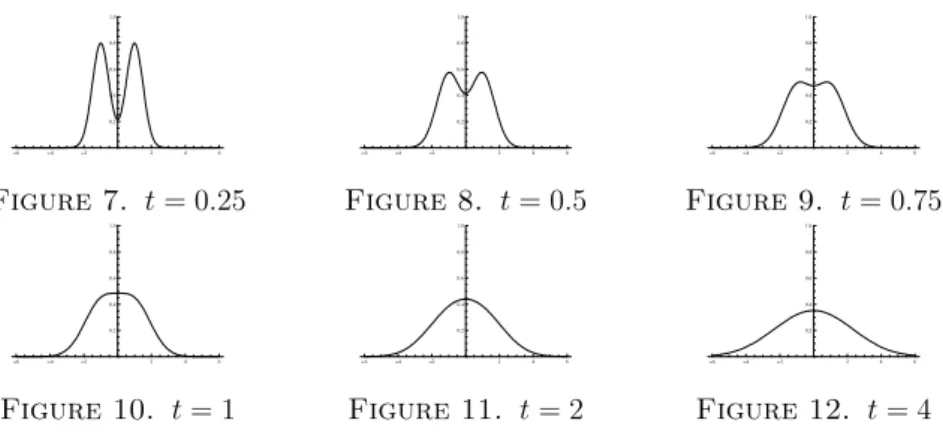
Again, starting from an elementary example, we can show by calculus that
(3.1)
\frac{1}{2}(\delta_{-1}+\delta_{1})*N(0, t)
is unimodal if and only if t\geq 1; see Figures 7‐12. For more general initial distributions, we obtained the following results.
49
FIGURE 7. t=0.25 FIGURE 8. t=0.5 FIGURE 9. t=0.75
FIGURE 10. t=1 FIGURE 11. t=2 FIGURE 12. t=4
Theorem 3.1. (1) Let \mube a probability measure on \mathbb{R} such that
(3.2)
\alpha :=\int_{\mathbb{R}}e^{\varepsilon x^{2}}d\mu(x)<\infty
for some \varepsilon>0 . Then the distribution \mu*N(0, t) is unimodal for all
t\geq 36\varepsilon^{-1}\log(2\alpha)
.(2) There exists a probability measure \muon \mathbb{R} satisfying that
(3.3)
\int_{\mathbb{R}}e^{A|x|^{p}}d\mu(x)<\infty
for all
A>0and
0<p<2such that \mu*N(0, t) is not unimodal for any t>0.
Thus, in the classical case, the tail decay (3.2) is sufficient and almost necessary to
guarantee the large time unimodality.Remark 3.2. If \mu is unimodal then \mu*N(0, t) is unimodal for all t>0 . This is a
consequence of the strong unimodality of the normal distribution
N(0, t)
, in contrast with the failure of freely strong unimodality of the semicircle distribution (see Theorem 4.2).One open problem is the following.
Problem 3.3. Estimate the position of the mode of classical Brownian motion with initial
distributions satisfying the assumption (3.2). The proof of Theorem 3.1 (1) in [5] shows
that fort\geq 36\varepsilon^{-1}\log(2\alpha)
, the mode is located in the interval[-\sqrt{t}/2, \sqrt{t}/2]
. How aboutfree Brownian motion?
4. Related results, problems and conjectures
It is known that there two unimodal distributions whose classical convolution is not
unimodal. Then a probability measure \muis said to be strongly unimodal if the convolution
\mu*\nu is unimodal for every unimodal distribution \nu. Ibragimov showed that \muis strongly
unimodal if and only if \muis Lebesgue absolutely continuous on a (finite or infinite) interval
and the density is \log concave. On the other hand, the classical convolution of two symmetric unimodal distributions is again (symmetric and) unimodal. For further details
see Sato’s book [6].
We discuss those facts in the context of free probability. The first basic observation is the following.
50
Proposition 4.1. There two unimodal distributions whose free convolution is not unimodal. Actually, in the proof we take a Cauchy distribution \muand another distribution \nu. Then
the interesting relation \mu*\nu=\muffl \nu holds. Since the density of the Cauchy distribution
is not \log concave, we can find \nusuch that \mu*\nu is not unimodal.
We say that a probability measure \muis freely strongly unimodal if the free convolution
\mu H\nu is unimodal for every unimodal distribution \nu. We obtained the following.
Theorem 4.2. Let \lambda be a probability measure with finite variance, not being a delta
measure. Then \lambda is not freely strongly unimodal.
By contrast, there are many strongly unimodal distributions with finite variance in clas‐ sical probability including the normal distributions and exponential distributions. Thus the notion of strong unimodality breaks the similarity between the classical and free probability theories.
One open question is:
Problem 4.3. Is there a probability measure, not being a Dirac delta, which is freely strongly unimodal?
In the classical case convolution preserves symmetric unimodal distributions as men‐ tioned. In this direction we obtained the following partial result.
Proposition 4.4. If \mu is symmetric unimodal then so is \muffl S(0, t).
The proof heavily depends on Biane’s formula for the density of \muffl S(0, t). We pose
the full analogy as a conjecture.
Conjecture 4.5. If \mu and \nu are symmetric unimodal then so is \mu H\nu.
Finally, we would like to mention that we proved an analogue of Theorem 3.1 for Cauchy distributions and a partial analogue for Lévy distributions. Interested readers can consult [5].
Acknowledgment. TH was financially supported by JSPS Grant‐in‐Aid for Young Sci‐
entists (B)
15K17549. Both authors are financially supported by JSPS and MAEDI
Japan‐France Integrated Action Program (SAKURA).
References
[1] Hari Bercovici and Dan Voiculescu. Free convolution of measures with unbounded support. Indiana
Univ. Math. J., Vol. 42, No. 3, pp. 733‐773, 1993. MR1254116.
[2] Philippe Biane. On the free convolution with a semi‐circular distribution. Indiana Univ. Math. J.,
Vol. 46, No. 3, pp. 705−71S, 1997. MR14SS333.
[3] Takahiro Hasebe and Noriyoshi Sakuma. Unimodality for free Lévy processes. Ann. Inst. Henri
Poincaré Probab. Stat., Vol. 53, No. 2, pp. 916‐936, 2017. MR3634280.
[4] Takahiro Hasebe and Steen Thorbj\emptysetrnsen. Unimodality of the freely selfdecomposable probability
laws. J. Theoret. Probab., Vol. 29, No. 3, pp. 922‐940, 2016. MR3540484.
[5] Takahiro Hasebe and Yuki Ueda. Large time unimodality for classical and free Brownian motions with
initial distributions. ALEA Lat. Am. J. Probab. Math. Stat., Vol. 15, pp. 353‐374, 201S.
[6] Ken‐iti Sato. Lévy processes and infinitely divisible distributions, Vol. 68 of Cambridge Studies in
Advanced Mathematics. Cambridge University Press, Cambridge, 2013. MR3185174.
[7] Stephen James Wolfe. On the unimodality of infinitely divisible distribution functions. Z. Wahrsch.
Verw. Gebiete, Vol. 45, No. 4, pp. 329‐335, 197S. MR51177S.
[8] Makoto Yamazato. Unimodality of infinitely divisible distribution functions of class L. Ann. Probab.,
Vol. 6, No. 4, pp. 523‐531, 197S. MR0482941.