23
Invariants
of3-manifolds based on conformal field theoryand Heegaard splitting
TOSHITAKE KOHNO
Department of Mathematics, Kyushu University, Fukuoka
812
Japan九大理・河野俊丈
1.
Introduction
The purpose of this note is to give abrief description on the construction oftopological
invariants
of3-manifolds
by means of projectively linear representations ofthe mappingclass
group
of aclosed orientable surface appearing in conformal field theory. First, wegive acombinatorial description of the holonomy of $SU(2)$
-Wess-ZuminrWitten
model.More precisely, we derive the fusing matrices, conformd dimensions and switching oper-ators by $an4yzing$ the monodromy representation of the Knizhnik-Zamolodchikov equa-tion, and usingthe fact that these data give solutions to Moore and Seiberg’s polynomial
equations ([12])) we construct projectively linear representations of the mapping class
group on avector space caUed the space of conformalblocks. Based on these
representa-tions, we define topological invariants of3-manifolds using aHeegaard splitting. Amore
detailed description of this part is given in [10]. Shortly after the discovery of new
3-manifold invariants due to Witten [19],
Reshetik.hin
and Turaev [16]gave
aDehn surgeryformula using representations of the quantized universal enveloping algebra $U_{q}(sl(2, C))$ with $q$ aroot of unity. Our approach described in this note is different from theirs.
Our principle to define 3-manifold invariants can be applied to other class ofsolutions to the Moore and Seiberg’s polynomial equations. It should be noted that asimilar
program was also proposed by Crane [2](see also [3]). In this note we focus in particular
on the invariants derived $hom$ cyclic group fusion rules. It turns out that these invariants
are closely related to Gocho’s geometric construction based on $U(1)$ gauge theory ([4]).
We also give aDehn surgery formulafor these invariants. We are planning to give amore
detailed account on this subject elsewhere.
Acknowledgement; I would like to thank the members of the Euler International
Math-ematical Institute for their hospitality and stimulating discussions.
数理解析研究所講究録 第 756 巻 1991 年 23-32
24
2. $SU(2)- Wess- Z_{U1}nino$-Witten model
Let $\Sigma_{g}$ be aclosed orientable surface of
genus
$g$.
We denote by $\mathcal{M}_{g}$ the mapping classgroup $\pi_{0}Diff^{+}(\Sigma_{g})$
.
Weare going toassociate to $\Sigma_{g}$ afinitedimensional complex vectorspace $Z_{K}(\Sigma_{g})$, which is caUed the space of
conformal
blocks in $SU(2)$Wess-Zumino-Witten model at level $K$
,
and then we define the action of{he mapping class group onthis vector space.
Amarking $\mu$ ofthe closed orientable surface $\Sigma_{g}$ is by definition amaximal coUection
of disjoint, non-contractible, pairwise non-isotopic
smooth
circles on $\Sigma_{g}$.
We associate to$\mu$ adual trivalent graph $\gamma(\mu)$ as shown in Figure 1. We fix apositive integer $K$ caUed alevel. Now the vector space $Z_{K}(\gamma(\mu))$ is by definition acomplex vector space with
basis $\{e_{f}\}$, which is in one to one correspondence with afunction $f$ : edge$(\gamma(\mu))arrow$
$\{0,1/2,1, \cdots K/2\}$ satisfying
$|f(c_{1})-f(c_{-})|\leq f(c_{3})\leq f(c_{1})+f(c_{2})$
$(2arrow 1)$ $f(c_{1})+f(c_{2})+f(c_{3})\in Z$
$f(c_{1})+f(c_{2})+f(c_{3})\leq K$
fortheedges $c_{1},$$c_{2}$ and$c_{3}$ meeting at each vertex. Let us note that the first two conditions
are so-called the Clebsch-Gordan condition for $sl(2, C)$
.
Figure 1
The basic ingredients to define the action of themapping class group $\lambda 4_{g}$ on this vector
space are the fusing matrices, conformal
dimensions
and switching operators. Thesedata are obtained in a natural way by analyzing the monodromy representations of the
following Knizhnik-Zamolodchikov differential equation ([9]). For a half integer $j$, we denote by $V_{j}$ the spin $j$ representation of$sl(2, C)$, which is an irreducible representation
ofdimension $2j+1$. Let $j_{p},$ $1\leq p\leq K/2$ be half integers. We put
$\Omega=\sum_{\mu}I_{\mu}\otimes I_{\mu}$
where $\{I_{\mu}\}$ is an orthonormal basis of $sl(2, C)$ with respect to the
Cartan-KiUing
form.25
We
define thematrices
$\Omega_{ij},$ $1\leq i,j\leq n$ by$\Omega_{ij}=\sum_{\mu}\pi;(I_{\mu})\pi_{j}(I_{\mu})\in End(V_{j_{1}}\otimes\cdots\otimes V_{j_{n}})$
where $\pi_{i}$ and $\pi$
;
stand for the operation on the i-th and $j$-th components respectively.The
Knizhnik-Zamolodchikov
equation is by definition(2-2). $\frac{\partial\Phi}{\partial z_{i}}=\frac{1}{K+2}\sum_{j\neq:}\frac{\Omega_{ij}}{z_{i}-z_{j}}\Phi,$ $1\leq i\leq\dot{n}$
Now we define the fusing matrix, which will be used to identify the space of conformal
blocks associated with the two different “pants” decompositions as shown in Figure 2.
Figure 2
Let us consider the Knizhnik-Zamolodchikov equation offour variables with values in
$Hom_{sl(2,C)}(V_{j_{1}}\otimes V_{j_{2}}\otimes V_{j_{3}}, V_{j_{4}})$
Let us denote by
$C_{j}^{j_{1}j_{2}}$ : $V_{j_{1}}\otimes V_{j_{2}}arrow V_{i}$
the $sl(2, C)$ homomorphismgiven by the Wigner)$s3j$-symbols (see [8]). To each weighted
graph depicted in Figure 2 we associate a solution ofthe Knizhnik-Zamolodchikov
equa-tion defined in the region $|z_{1}|\leq|z_{2}|\leq|z_{3}|\leq|z_{4}|=\infty$ in the following way. Let us
suppose that the weights in the graphs in Figure 2 satisfy the admissibility condition 2-1 at each vertex. For the weighted graph $\gamma_{1}$, we consider the solution normalized around $z_{1}=z_{2}$ as
$\Phi_{\gamma_{1}j}=(z_{2}-z_{1})^{\Delta_{j}-\Delta_{j_{1}}-\Delta_{j_{2}}}$ ($C_{j_{4}}^{jj_{3}}\cdot C_{j}^{j_{1}j_{2}}+higher$ order holomorphic terms).
Here $\Delta_{j}=\frac{j(j,+1)}{I\backslash +\sim}$ which is called the conformal dimension. In a similar way, we have
$\Phi_{\gamma i}2,=(z_{3}-z_{2})^{\Delta;-\triangle_{j_{2}}-\triangle_{j_{3}}}$($C_{j_{4}}^{j_{1}i}\cdot C_{i}^{j_{2}j_{3}}+higher$ order holomorphic terms)
26
normalized around $z_{2}=z_{3}$ associated with the weighted graph $\gamma_{2}$
.
Using an analyticcontinuation, it follows
&om
a work of Tsuchiya and Kanie [17] that we have a constantmatrix connecting these two solutions. We write it as
(2-3) . $\Phi_{\gamma_{1\prime}j}=\sum_{i}F_{ij}\{\begin{array}{ll}j_{2} j_{3}j_{l} j_{4}\end{array}\} \Phi_{\gamma_{2},i}$
The above matrix is called a fusing matrix. In a similar way, we
introduce
the following braiding matrix which represents the action ofthe halfmonodromy on thesolution $\Phi_{\gamma_{1},i}$interchanging $z_{2}$ and $z_{3}$
.
$B\{\begin{array}{ll}j_{2} j_{3}j_{l} j_{4}\end{array}\}=F\{\begin{array}{ll}j_{3} j_{2}j_{l} j_{4}\end{array}\}\cdot di$a$g_{i}((-1.)^{j_{2}+j_{3}-i}\exp\pi^{\sqrt{-1}}(\Delta_{i}-\Delta_{j_{2}}-\Delta_{Js}))\cdot F\{\begin{array}{ll}j_{2} j_{3}j_{l} j_{4}\end{array}\}$
Using acomposition of fusing matrices we have an isomorphism
(2-4) $Z_{K}(\gamma_{1})\cong Z_{K}(\gamma_{2})$
for any two dual trivalent graphs of the closed orientable surface. This isomorphism does
not depend on the choice offusing matrices involving in the above process.
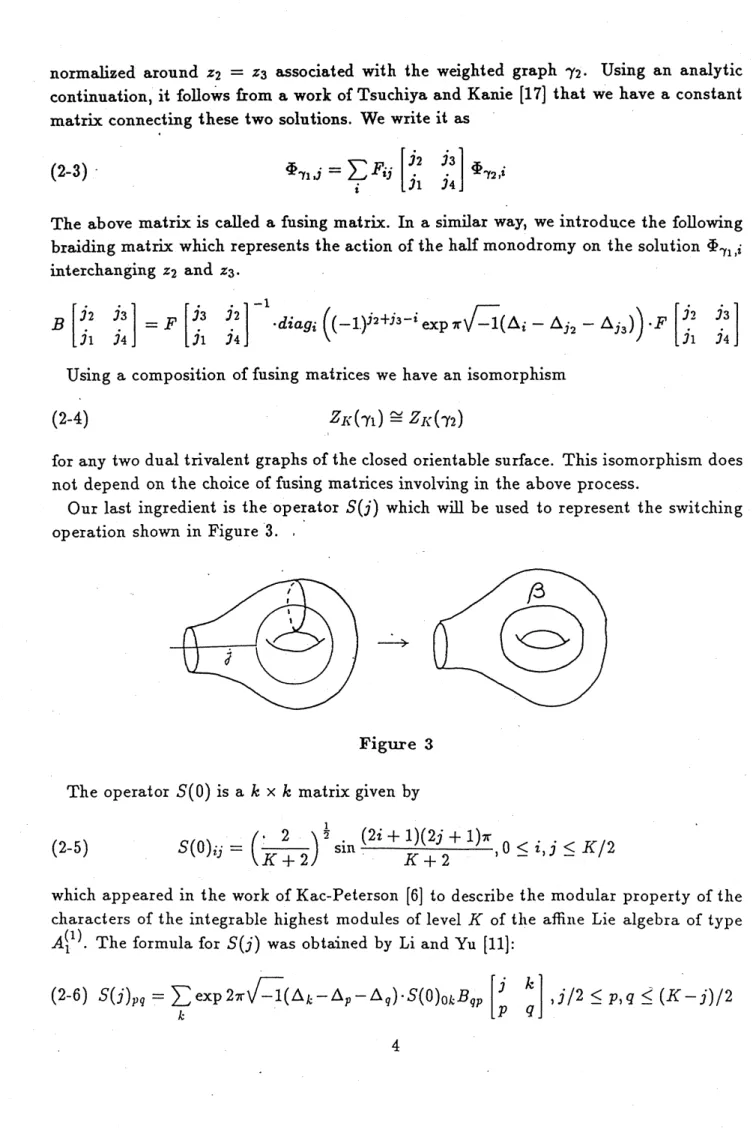
Our last ingredient is the operator $S(j)$ which will be used to represent the switching
operation shown in Figure
3.
,$arrow$
Figure 3
The operator $S(O)$ is a $k\cross k$ matrix given by
(2-5) $S( O)_{ij}=(\frac{2}{K+2})^{\frac{1}{2}}\sin\frac{(2i+1)(2j+1)\pi}{K+2},$ $0\leq i,$$j\leq K/2$
which appeared in the work of Kac-Peterson [6] to describe the modular property of the
characters of the integrable highest modules oflevel $K$ of the affine Lie algebra oftype
$A_{1}^{(1)}$. The formula for $S(j)$ was obtained by Li and Yu [11]:
$\varpi^{-}$
27
We put
(2-7)
$T(j)=diag_{j/2\leq i\leq(K-j)/2}( \exp 2\pi\sqrt{-1}(\Delta;-\frac{c}{24}))$with
$c= \frac{3K}{K+2}$.
Then we have the following modular relations:$S(j)^{2}=(-1)^{j}\exp(-\pi\sqrt{-1}\Delta_{j})\cdot id$
(2-8)
$(S(j)T(j))^{3}=S(j)^{2}$
Thuswe havedefined thefusing
matrices
$F$,
conformal dimensions $\Delta_{j}$ and the switchingoperators
$S(j)$ based on the structure of the holonomy of the Knizhnik-Zamolodchikovequation.
These provide solutions to the Moore and Seiberg’s polynomial equations. Letus now define the action of the mapping class groups. We start with atrivalent graph
$\gamma$ associated with amarking of the closed orientable surface $\Sigma_{g}$. Let $V$ be aregular
neighbouhood of the graph $\gamma$ in
$R^{3}$ considered as ahandlebody of genus
$g$, and we
realize
$\Sigma_{g}$ as its boundary. For an edge $a$ ofthe graph $\gamma$,
we take adisk$\Delta$ in $V$
meeting
transversely with $a$ lvith one point and satisfying $\partial\Delta\subset\partial V$
.
Let $\alpha$ denote the Dehn twistabout the circle $\partial\Delta$. We define the action of
$\alpha$ on the vector space $Z(\gamma)$ by
(2-9) $\alpha\cdot e_{f}=\exp(-2\pi\sqrt{-1}\Delta_{f(a)})e_{f}$
Let us recall that according to Humphries [5] the mapping class group $\Lambda 4_{g}$ is generated
by the Dehn twists $\alpha_{1},$ $\cdots$ ,$\alpha_{g},\beta_{1},$$\cdots\beta_{g},$$\delta$ shown in Figure 4.
Figure 4
Considering various trivalent graphs and by identifying the associated vector spaces by
fusing matrices, we can define the action ofthe Dehn twists $\alpha_{1},$ $\cdots$ ,$\alpha_{g},$
$\delta$. The action of
the Dehn twists $\beta$; is defined in the following way. Let us go back to Figure 3 and we
consider the Dehn twist $\beta$
.
We define the action of$\beta$ by $T(j)S(j)T(j)$. CoInbining withfusing matrices we can define the action ofthe Humphries generators. More precisely, we
have
28
Proposition 2.10. Let $\Omega_{K}$ denote the cyclic gmup generated by $\exp\frac{\pi\sqrt{-1}}{4}c\cdot id$
.
Then,the above construction
defines
awell-defined
homomorphism$\rho K^{;\mathcal{M}_{g}}arrow GL(Z_{K}(\gamma))/\Omega_{K}$
Remark. After asuitable normalization of solutions of the
Knizhnik-Zamolodchikov
equation, it is known that the fusing matrices $\dot{a}$
re expressed as the $q-6j$-symbols at
$q= \exp\frac{2r,\sqrt{-1}}{K+2}$ (see [1], [8] and [22]). Hence we can also
start&om
these $q-6j$-symbolin apurely algebraic way and we might avoid the above analytic construction related to the holonomy of the Knizhnik-Zamolodchikov equation. In [18], Turaev and Viro
gave
adifferent
construction
of invariants using $q-6j$-symbols and atriangulation.Now we are in position to define our 3-manifold invariants. Let $M$ be aclosed oriented
3-manifold. It is known that $M$ admits aHeegaard splitting. Namely, there exi$sts$ a
handlebody $V_{1}$ and it$s$ second copy $V_{2}$ such that $M$ is obtained from $V_{1}$ and $V_{2}$ by attaching their boundaries by some $h\in \mathcal{M}_{g}$
.
Let us denote by $e_{0}$ amember of the basisof $Z_{K}(\gamma)$ corresponding to the weight $f$ such that $f(a)=0$ for any edge $a$
.
We definethe $(0,0)$-entry $\rho_{K}(h)_{00}$ by
(2-11) $\rho_{K}(h)e_{0}=\rho_{K}(h)_{00}e_{0}+\sum_{f\neq 0}\rho_{K}(h)_{f,0^{e_{j}}}$
We put
(2-12) $\phi_{K}(M)=((\frac{2}{K+2})^{1/2}\sin\frac{\pi}{K+2})^{-g}\rho_{K}(h)_{00}$
We have the following theorem.
Theorem 2.13 [10]. Let $M_{1}$ and $M_{2}$ be closed oriented
3-manifolds.
If
there exists an orientation preserving homeomorphism $M_{1}\cong M_{F},$,
then we have$\phi_{K}(M_{1})=\phi_{K}(M_{2})$
in $C^{*}/\Omega_{K}\cup\{0\}$.
29
3. $Z/kZ$ fusion rules
In this section, we discuss amodel associated with the group algebra ofafinite cyclic
group.
Let $k$ be apositive integer. For aclosedorientable
surface $\Sigma$ we construct a $ve$ctor space $Z_{k}(\Sigma)$ in the foUowing way. Let $\gamma$ be adirected graph associated with apants
decomposition of $\Sigma$ depicted as in Figure 1. The vector space $Z_{k}(\Sigma)$ has abasiswhich
is in one to one correspondence with weights $f$ : edge$(\gamma)arrow Z/kZ$ such that for eachvertex
the sum ofweights corresponding to the “ingoing” edges is congruent to the sumof weights corresponding to the “outgoing” edges modulo $k.\dot{H}$ere we use the convention
that an edge with weight $x$ is identffied with the edge having the opposite direction with
the weight $-x$
.
We see that the vector space $Z_{k}(\Sigma)$ is naturaUy isomorphic to the tensorproduct $V^{g}$ with a $k$ dimensional complex vector space, where
$g$ denotes the genus of $\Sigma$
.
Now we describe the action ofthe mapping class group $\mathcal{M}_{g}$ on $Z_{k}(\Sigma)$ using asolution
of the polynomial equations due to Moore and Seiberg ([12]Appendix E) associated with
$Z/kZ$ fusion rules. Let $m$ be apositive integer such that $m$ and $k$ are relatively prime
and we suppose that $m$ is even if $k$ is odd. We put
$mx^{2}$
(3-1) $\Delta_{x}=\overline{2k}$ $x\in Z/kZ$
(3-2) $S_{xy}= \frac{1}{\sqrt{k}}\exp 2\acute{\pi}\sqrt{-1}(-\Delta_{x+y}+\Delta_{x}+\Delta_{y}\cdot)$,
$x,$$y\in Z/kZ$
Let $T$ be a diagonal matrix defined by
(3-3) $T=diag_{0\leq x\leq k-1}(\exp 2\pi\sqrt{-1}\Delta_{x})$
One can check that the above matrices $S$ and $T$ satisfy the modular relations
$S^{2}=C$
(3-3)
$(ST)^{3}=\xi(m)k)S^{2}$
where $C$ is the duality matrix defined by $C_{xy}=\delta_{x,-y}$ and $\xi(m, k)$ is the Gauss sum
(3-4) $\xi(m, k)=\frac{1}{\sqrt{k}}\sum_{0\leq x\leq k-1}\exp\frac{\pi\sqrt{-1}mx’}{k}$
which is known to be an eighth root ofunity. We introduce the fusing matrices as
$F_{g_{-}’+g_{3},g_{1}+9’\underline{)}}\{\begin{array}{ll}g_{2} g_{3}g_{l} g_{l}+g_{2}+g_{3}\end{array}\}=1$
30
for any $g_{1},g_{2}$ and $g_{3}$ in $Z/kZ$
.
By means of the above data, one can construct an action of the mapping class group
$\lambda 4_{g}$ on $Z_{k}(\Sigma)$ as in the previous section. More precisely, we obtain a projectively linear representatidn
$\varphi_{mk}$ : $\mathcal{M}_{g}arrow GL(V^{\otimes g})/<\xi(m, k)>$
where theimage ofDehn twistsis describedin the following way. We put $U=STS,$$W=$ $T^{-1}\otimes T^{-1}$ and we adapt the notation for Dehn twists in the previous section. We set
$\varphi_{mk}(\alpha_{1})=T_{1}^{-1}=T^{-1}\otimes\cdots\otimes 1$
$\varphi_{mk}(\alpha_{2})=W_{12},$$\cdots\varphi_{mk}(\alpha_{9})=W_{g-1,g}$
$\varphi_{mk}(\delta_{2})=T_{2}^{-1}=1\otimes T^{-1}\otimes\cdots\otimes 1$ $\varphi_{mk}(\beta_{1})=U_{1},$$\cdots\varphi_{nk}(\beta_{g})=U_{g}$
Here the symbol $W_{k,k+1},1\leq k\leq g-1$, stands for the operation of $W$ on the k-th
and $(k+1)- st$ components of the tensor product $V^{\emptyset g}$
.
One can sh$ow$ that the above
representation factors through $Sp(2g, Z)$
.
Let $M$ be a closed oriented 3-manifold obtained as a Heegaard decomposition $V_{1} \bigcup_{h}V_{2}$, where $V_{1}$ and $V_{2}$ are handlebodies of genus
$g$
.
As in the previous section we consider the$(0,0)$-component $\varphi_{mk}(h)_{00}$. We have the following theorem
Theorem 3.5. We put
. $I_{mk}(M)=\sqrt{k^{-g}}\varphi_{mk}(h)_{00}$
Then, $I_{mk}(M)$ is a topological invariant
of
$M$.In the case $m=1$ and $k$ is even, the above invariant was discovered by Gocho [4] from
a geometric viewpoint. In fact he constructed a vector bundle over the Siegel upper half
plane with a projectively flat connection whose holonomy gives the above representation
of $Sp(2g, Z)$.
Now we describe the Dehn surgery formula ofthe invariant $I_{mk}$
.
Let us suppose thatthe closed oriented 3-manifold $M$ is obtained from the Dehn surgery on a framed link $L$
with $n$ components in $S^{3}.$
.
Let $A$ be the linking matrix whose diagonal entries are givenby the firaming. We denote by $\sigma$ the signature ofthe linking matrix $A$. Using {$.1\iota e_{e\iota\dagger\supset O1’ G}$’
notations, we have the following theorem.
Theorem 3.6. We put
31-Then, $J_{mk}$ is a topological invariant
of
M. $Mo$reover, the invartant $I_{mk}$ computes thisinvariant
up to some powerof
the Gauss sum $\xi(m, k)$.
Remark.
The invariant $J_{mk}$ can be written as the state sum $\xi(m, k)^{-\sigma}\sum_{\lambda}S_{0,\lambda(1)}\cdots S_{0,\lambda(n)}F(L, \lambda)$for any $\lambda$ : $\{1, \cdots n\}arrow Z/kZ$, where $F(L, f)$ denotes the product for all crossing points
in the link diagram
given
by$\prod\exp\pi^{\sqrt{-1}}(\Delta_{\lambda(i)+\lambda(j)}-\Delta_{\lambda(i)}-\Delta_{\lambda(j)})$
$i$ $j$
Figure 5
Here to each crossing point of i-th and j-th components we associate the weight as shown in Figure
5
and we take the product for all crossing points. The Dehn surgeryformula corresponding to the case of Gocho’s invariant was discussed by Ohtsuki [15].
We observe that the case $k=2$ coincides with the Reshetikhin-Turaev invariant for
$r=3$
.
Generalizing the investigation due to Kirby and Melvin [7], Ohtsuki showedthat the absolute value of $J_{1k}$ is equal to the square root of the number of elements in $H^{1}(M;Z/kZ)$ if we do not have $\alpha\in H^{1}(M;Z/kZ)$ suchthat $\alpha\cup\alpha\cup\alpha\neq 0$ and is equal to $0$ otherwise. In the case $k$ is even, we have a slightly different representation of$Sp(2g, Z)$
by putting
$\Delta_{x}=\frac{mx^{2}}{2k}+\frac{x}{2}$
and by replacing the above Gauss sum by
$\delta(m, k)=\frac{1}{\sqrt{k}}\sum_{0\leq x\leq k-1}(-1)^{x}\exp\frac{\tau\sqrt{-1}m}{k}x^{2}$
We have a similar construction and the resulting Dehn surgery formula
$\sqrt{k^{-n}}\delta(m, k)^{-\sigma}\sum_{\iota\in(Z/kZ)^{n}}(-1)<diogA,h>\exp(\frac{\pi\sqrt{-1}m}{k}{}^{t}hAh)$
32
was
introduced
by Murakami and Okada [14] related to the cyclotomic invariants forlinks
discovered
in [13] based on the IRF model due to Kashiwara and Miwa. Here$<diagA,$$h>stands$ for $\Sigma_{i}A_{ii}h;$
.
REFERENCES
[1] L. Alvarez-Gaum\’e, G. Sierra and C. Gomez, Topics in conformalfield theory, Physics and
Mathe-matics ofStrings, World Scientific (1990).
[2] L. Crane, Topology of $3arrow manifolds$ and conformalfield theories,preprint, YaleUniversity (1989).
[3] S. E. Capell, R. Leeand E. Y. Miller, Invariants of3-manifoldsfrom conformalfield theory, preprint (1990).
[4] T. Gocho, The topological invariant of three-manifolds based on the $U(1)$ gauge theory, preprint,
University of Tokyo(1990).
[5] S. Humphries, Generatorsfor the mapping class group, LNM, Springer (1979), 44-47.
[6] V. G. Kac and D. H. Peterson, Infinite dimensional Lie algebras, thetafunctions and modularforms,
Advancesin Math. 53 (1984), 125-264.
[7] R. $1\acute{\dot{\cdot}}rby$ and P. Melvin, Evaluations of the 3-manifold invariants of TVitten andReshetikhin-Turaev,
London Math. Soc. Lect. Notes Series 151 (1990), 101-114.
[8] A. N. $I\langle iriUov$ and N. Y. Reshetikhin, Representation of the algebra $U_{q}(sl(2, C)$, g-orthogonal
poly-nomials and invariants oflinks, Infinitedimensional Lie algebras and groups,NVorld Scientific (1988),
285-342.
[9] V. G. Knizhnikand A. B. Zamolodchikov, Current $alg$ebra and Wess-Zumino models in two
dimen-sions, Nucl. Phys. $B247(1984.),$ $83-103$.
[10] $T$, Kohno, Topological invari antsfor 3-manifolds using representations of mapping class groups, to
appearin Topology.
[11] M. Li and M. Yu, Braiding matrices, modular transformations and topologicalfield iheories in 2+1
dimensions, Comm. Math. Phys. 127 (1990), 195-224.
[12] G. Moore and N. Seiberg, Classical and guantum conformalfield iheory, Comm. Math. Phys. 123
(1989), 177-254.
[13] T. Kobayashi, H. Murakami and J. Murakandi, Cyclotomic invariants for links, Proc. Japan Acad. 64 (1988), 235-238.
[14] H. Murakami and M. Okada, talk $ai$ Waseda University, Dec. 1990.
[15] T. Ohtsuki, private comminucation.
[16] N. Y. Reshetikhin and V. G. Turaev, Invariants of 3-manifolds via link polynomials and guanium
groups, to appearin Invent. Math.
[17] A. Tsuchiya andY. Kanie, Vertex operators in conformalfield theory on $P^{1}$ and monodromy
repre-sentations of braidgroups, Advanced Studies in Pure Math. 16 (1988), 297-372.
$[1\mathfrak{d}\neg]$V. G. Turaev and O. Y.Viro, State sum invariants ofS-manifolds and guanium \^oj-symbols. $prepri_{1}\tau t$,
LOMI (1990).