
近畿大学学術情報リポジトリ
4
0
0
全文
(2) 20. degenerate oligonucleotide primers (data not shown), were designed and synthesized to amplify part of the gIVES gene from S. violacea. A fragment of approximately 300 bp amplified by PCR and expected to contain part of the rpoB gene was cloned into the pCR2.1 vector and its nucleotide sequence was determined. Th clone the complete groESL operon, the partial groES gene fragment was labeled with digoxygenin (DIG) in PCR as a hybridization probe for plaque hybridization. Chromosomal DNA isolated from S. violacea was partially digested with Sau3AI. These fragments were inserted into the BamHI site of lambda DASH II (Strata gene Co., La Jolla, CA, USA). Then, in vitro packaging of the ligated DNA was performed using GIGAPACK III XL packaging extracts (Stratagene Co.) according to the manufacturer's instructions. The DSS12 A phage library was screened for plaque hybridization with the groES probe and a positive clone was obtained. The positive clone containing the groES gene was purified by several single-plaque isolation steps. The insert in the A phage was amplified by long PCR and was subcloned into the pCR-Blunt vector (Invitrogen Co., Carlsbad, CA, USA). For sequencing of these cloned fragments, the random shotgun sequencing method was used with a DNA sequencer model 377 (Perkin-Elmer/Applied Biosystems Co., Foster City, CA, USA).. Pstl. mate. . ~oE_S. groE l. "1---=~:::::::::::~~iMmJl:t_. Northern hybridization analysis Total cellular RNA was prepared from S. violacea cells cultivated at 0.1, 10, 30, and 50 MPa, using Sepasol RNA I (Nakalai Tesque, Japan) as described previously 6). The RNA pellet was dissolve in diethyl pyrocarbonate-treated water, quantified by spectrophotometry, and stored at -80°C. Northern blot analysis was performed by the method reported previously 6). Probes for Northern blot analysis were constructed by the PCR DIG Probe Synthesis Kit(Boehringer Mannheim Co.>. Primer extension analysis Total cellular RNA was prepared from S. violacea cells cultivated at 0.1, 10, 30, and 50 MPa, using Sepasol RNA I (Nakalai Tesque, Japan) as described previously 6). Primer extension analysis was carried out according to the procedure previously reported 7), using the following synthesized oligonucleotides primers, ES-l, 5'-ACC ACG GGT ATC GGT AAA GCG TAG ATC AAC-3' and ES-2, 5'-GGA TTG AGA CGT GCT GTT CTT TAC CAC GGG-3'. Transcripts were analyzed on a 5% polyacrylamide gel under denaturing conditions The sequencing ladder was generated using the same primers as those used in the dideoxy sequencing reactions.. ,. Pstl. ¢:::J<)"---"'I kbp 1. Fig. 1 Restriction map of the genomic region containing the groES and groEL genes in ShewlHlel1a violacea.. Results and discussion Structural analysis of the rpoBC genes of S. violacea By screening the A phage library, a fragment containing groES followed by groEL was obtained (Fig. 1). Sequence analysis showed that the gene organization and orientation of the fragment containing groESL operon is identical with those in E. coli. Therefore, groESL oepron is likely to be transcribed as an operon, as reported for E. coli The open reading frames of the groES and groEL genes consist of 291 and 1,638 bp, respectively. The groES gene encodes a protein consisting of 96 amino acid residues with a molecular mass of 10,213 Da, whereas the groEL gene encodes a protein consisting of 545 amino acid residues with a molecular mass of 57,979 Da (data not shown).. Significant homology was found when comparing the GroESL proteins of S. violacea with those of E. co1i(groES, 79.5%; groEL, 78.6%), P. putida (gIVES, 69.1%; groEL, 71.0%), and Bacillus subti1is (groES, 44.2%; groEL, 46.2%). Evolutionarily conserved regions were also found to exist over the predicted amino acid sequences. Expression studies of the groESL genes of S. violacea In order to understand pressure response (piezoresponse) at molecular level of the genes for groES and groEL, Northern blot analysis of RNAs from the moderately piezophilic bacterium, Shewanella violacea grown under varied pressure conditions, was carried out. As shown in lane 1 of Fig. 2, small quantity of mRNA for groEL gene was.
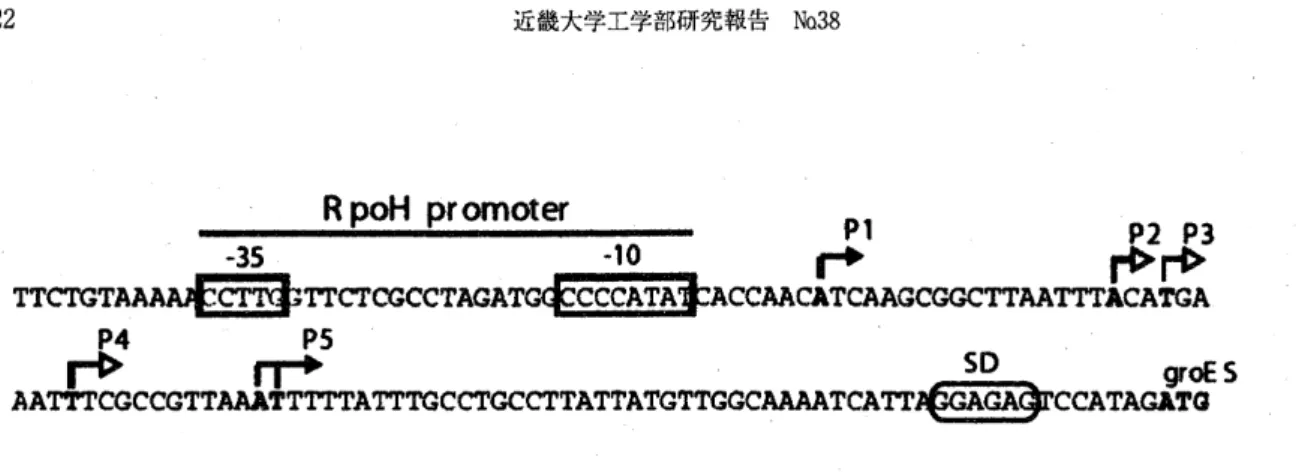
(3) 21. observed under atmospheric pressure condition (0.1 MPa) and relatively large quantity of mRNA for. groEL gene was observed under both 30 MPa and 50 MPa (lane 2 and 30f Fig. 2).. groEL. 2. 1. 3. Fig. 3. Different effects of groEL gene in S vioiBceB under the pressure conditions. Lane: 1, total RNA from 0.1 MPa culture; 2, 30 MPa; 3, 50 MPa.. The result shows that the expression of the gene, groEL, was positively controlled at transcriptional level by elevated pressure. The molecular basis for the mechanism in transcription under high pressure conditions may depends upon the natures. upstream region (promoter sequence) of the gene for groESL operon. It is, therefore, necessary to determine transcription initiation site(s) of the operon and analyze sequence features of the cis-elements 8, 9) .. A A (. Pl.r~. c. 1. P2.f~ A. PJ.f~ A. A A T. p4f~ Ii. c. I 1 A A. psf~ T T A. Fig. 3. Primer extension analysis of transcription of the ginA gene in S vioiBceB under different pressure conditions. Total cellular RNA was prepared from cells grown at 0.1, 10, 30 and 50 MPa. The sequencing ladder was generated using the same primers as those used in the dideoxy sequencing reactions. The transcripts are shown by arrows.. Primer extension and promoter analysis of the region upstream of the groESL operon To identify the promoter regions of the groESL operon, we determined the transcription initiation sites by primer extension analysis. As shown in Fig. 3, five transcription sites for the groESL operon were detected. They were located from 52 to 90 nucleotides upstream of the translational initiation site of groES The levels of these extension products were increased by elevated pressures. The sequences of the -35 and -10. regions of the putative promoter (PI) for groES were CCrrG and CCCCATAT, respectively. These are similar to the consensus sequence of the cr32 -dependent promoter in E coli 10). No consensus sequences were not found in the promoter for the transcription initiation site for P2 - P5 (Fig. 4). For future study, detailed sequence analysis of the promoter elements is definitely required to understand molecular mechanisms for transcription under high pressure conditions..
(4) 22. R poH promoter -35. P1 -10..... P2 P3 rl>r«>. TTCTGTAAAA4fCTTgbTTCTOGCCTAGATGQFCCCATA~ACCAACATCAAGCGGCTTAATTTACATGA P4. PS. rt> rr+ so groE S AATTTCGCCGTTAAATTTTTATTTGCCTGCCTTATTATGTTGGCAAAATCATT~GA~CCATAGATQ Fig. 4 Nucleotide sequence of the region upstream of the groESLoperon. Transcription initiation sites (PI . P5) are indicated with arrows. The initiation site at the most upstream (PI; the Escherichia coli s32-like promoter) is indicated in the box.. References 1) Kato, C., Sato, T. and Horikoshi, K Isolation and properties of barophilic and barotolerant bacteria from deep'sea mud samples. Biodiv. Conserv. 4, 1'9 (1995). 2) Nogi, Y., Kato, C. and Horikoshi, K. Taxonomic studies of deep'sea barophilic Shewanella species, and Shewanella violacea sp. nov., a new barophilic bacterial species. Arch. Microbiol. 170, 331-338 (1998). 3) Kato, C., Smorawinska, M., Sato, T. and Horikoshi, K Cloning and expression in Escherichia coli of a pressure'regulated promoter region from a barophilic bacterium, strain DB6705. J. Mar. Biotechnol. 2, 125-129 (1995). 4) Yura, T. & Nakahigashi, K. Regulation of the heat" shock response. Curro Opin. Microbiol. 2:153'158 (1999). 5) Segal, R. & Ron, E. Z. Regulation and organization of the groE and dnaK operons in Eubacteria. FEMS Microbiol. Lett., 138:1-10 (1996). 6) Yamada, M., Nakasone, K, Tamegai, H., Kato, C., Us ami, R. & Horikoshi, K. Pressure regulation of soluble cytochromes c in a deep-Sea piezophilic. bacterium, Shewanella violacea. J Bacteriol. 182:2945-52 (2000). 7) Fujii, S., Nakasone, K and Horikoshi, K. Cloning of two cold shock genes, cspA and cspG, from the deep-sea psychrophilic bacterium Shewanella violacea strain DSS12. FEMS Microbiol. Lett. 178, 132-128. (1999) 8) Nakasone, K., Ikegami, A., Kato, C., Usami, R. and Horikoshi, K Analysis of cis-elements upstream of the pressure-regulated operon in the deep-sea barophilic bacterium Shewanella violacea strain DSS12. FEMS Microbiol. Lett. 176,351-356 (1999). 9) Ikegami, A., Nakasone, K, Fujita, M., Fujii, S., Kato, C., Usami, R. and Horikoshi, K. Cloning and characterization of the gene encoding RNA polymerase sigma factor a 54 of deep-sea piezophilic Shewanella violacea. Biochim. Biophys. Acta. 1491, 315-320 (2000). 10) Cowing, D. W., Bardwell, J. C. A., Craig, E. A., Woolford, C., Hendrix, R. W. and Gross C. A. Consensus sequence for Escherichia coli heat shock gene promoters. Proc. Natl. Acad. Sci. USA 82, 2679-2683 (1985)..
(5)
図


関連したドキュメント
Character- ization and expression analysis of mesenchymal stem cells from human bone marrow and adipose tissue. IGFBP-4 is an inhibitor of canonical Wnt signalling
Key words: acorn worms, reproductive season, the Sea of Japan, synchronized spawning, tidal
東京大学 大学院情報理工学系研究科 数理情報学専攻. [email protected]
In this paper we develop a general decomposition theory (Section 5) for submonoids and subgroups of rings under ◦, in terms of semidirect, reverse semidirect and general
This paper develops a recursion formula for the conditional moments of the area under the absolute value of Brownian bridge given the local time at 0.. The method of power series
We consider numerical simulations of a compressible fluid in a spherical shell rotating at a constant rotation rate ⌦ about the z-axis.. Entropy is given in units of s, the
While conducting an experiment regarding fetal move- ments as a result of Pulsed Wave Doppler (PWD) ultrasound, [8] we encountered the severe artifacts in the acquired image2.
In order to predict the interior noise of the automobile in the low and middle frequency band in the design and development stage, the hybrid FE-SEA model of an automobile was
