L
ung transplantation (LT) is the last resort for end-stage lung disease [1]. Survival after LT has been improving decade by decade [1], which has led to an increase in long-term survivors after LT [2]. However, long-term survivors after LT are generally susceptible to chronic kidney disease (CKD), which is a common complication after non-renal organ transplantation [3,4] and is associated with a 4- to 5-fold increased risk of mortality after LT [5]. As a renal replacement ther-apy for CKD, late living-donor kidney transplantation (LDKT) after LT has been shown to be associated with excellent long-term survival as well as acceptable kidney and lung allograft function [6]. Accordingly, improved survival after LT results in an increased number of long-term survivors after LT who require KT for CKD. Although the number of LT recipients in Japan reached 763 at the end of 2019, to the best of our knowledge, KT after LT has never been reported in Japan. We describe the long-term follow-up findings of a patient who underwent LDKT for CKD 18 years after receivingbilateral cadaveric LT.
Case Report
The details of the patient’s clinical course before and after his initial cadaveric LT are described in a previous report [7]. Briefly, an 18-year-old male with idiopathic pulmonary arterial hypertension underwent bilateral cadaveric LT and closure of a patent foramen ovale in the United States before the establishment of the organ transplant law in Japan. His postoperative immuno-suppression regimen consisted of cyclosporine, azathi-oprine and prednisolone. However, cyclosporine and azathioprine were switched to tacrolimus and mycophe-nolic acid due to a temporary decline in forced expira-tory volume in 1 sec (FEV1) that raised suspicions of chronic lung allograft dysfunction (CLAD) 14 years after LT. The patient’s renal function gradually wors-ened during the chronic phase after LT. Despite a switch in his immunosuppression protocol from twice-Acta Med. Okayama, 2021
Vol. 75, No. 1, pp. 87-89
CopyrightⒸ 2021 by Okayama University Medical School.
http ://escholarship.lib.okayama-u.ac.jp/amo/
Case Report
Long-term Follow-up of Living-Donor Kidney Transplantation
after Cadaveric Lung Transplantation
Toshio Shiotani
a, Seiichiro Sugimoto
a*, Kota Araki
b, Yasuaki Tomioka
a,
Kentaroh Miyoshi
b, Shinji Otani
b, Masaomi Yamane
b, and Shinichi Toyooka
bDepartments of aOrgan Transplant Center and bGeneral Thoracic Surgery, Okayama University Hospital, Okayama 700-8558, Japan Although chronic kidney disease (CKD) commonly develops after lung transplantation (LT), living-donor kid-ney transplantation (LDKT) for CKD after LT is known to provide favorable outcomes. We describe the long-term follow-up findings of a patient who underwent LDKT after bilateral cadaveric LT. A 37-year-old male underwent LDKT for CKD 18 years after receiving bilateral cadaveric LT. He developed chronic lung allograft dysfunction (CLAD) 20 years after the LT; however, at 26 years after the initial LT, he is still alive with no pro-gression of CLAD or CKD. KT could be a viable option for CKD even after LT in Japan.
Key words: lung transplantation, kidney transplantation, chronic kidney disease, non-tuberculous mycobacterial
infection, chronic lung allograft dysfunction
Received May 28, 2020 ; accepted August 25, 2020.
*Corresponding author. Phone : +81-86-235-7265; Fax : +81-86-235-7269
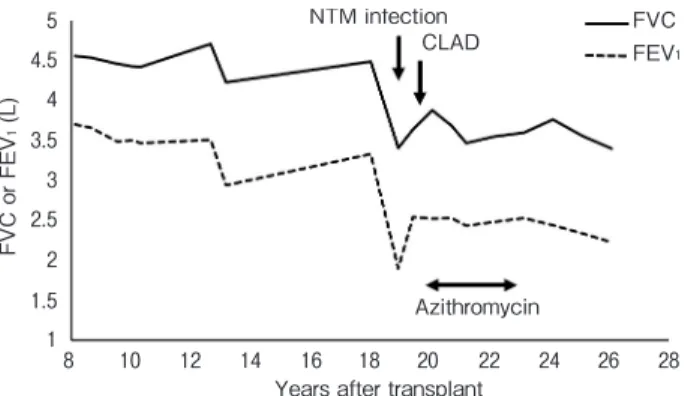
daily tacrolimus to once-daily prolonged-release tacro-limus to maintain serum trough levels around 5 ng/mL, he ultimately required renal replacement therapy. Hemodialysis was initiated at age 35 (Fig.1), at which time his lung function was preserved with no evidence of CLAD after LT (Fig.2).
At the age of 37, 18 years after his initial LT, the patient underwent LDKT using the right kidney of his mother. His postoperative immunosuppression regi-men for KT consisted of once-daily prolonged-release tacrolimus, mycophenolic acid and prednisolone. The target trough level of tacrolimus was around 10 ng/mL. The patient’s postoperative course was uneventful, however, he developed a non-tuberculous mycobacte-rial (NTM) infection in the transplanted lungs 8 months after KT (Fig.3). The target trough level of
tacrolimus was then decreased to around 5 ng/mL. The patient received triple-antibiotic therapy consisting of imipenem/cilastatin, amikacin and clarithromycin to treat the NTM infection, which resolved 12 months after KT. After the resolution of the NTM infection, the patient’s forced vital capacity (FVC) and FEV1 decreased from 4,635 to 3,880 mL and from 3,680 to 2,520 mL, respectively. At 21 months after KT (20 years after the initial LT; Fig.2), he was diagnosed with CLAD, which was treated with azithromycin. Because the patient’s impaired lung function remained stable and CLAD progression was prevented, azithromycin was discontinued 3 years after the diagnosis of CLAD to protect his renal function. Despite CLAD after LT, he returned to his normal social life and, at the time of writing, has survived without the development of CKD for 8 years after KT, which corresponds to 26 years after the initial LT.
Discussion
Lifelong immunosuppression, which is inevitable after LT, is associated with the development of late complications such as malignant tumors [8], infectious disease [1], and CKD [1]. CKD is caused mainly by calcineurin inhibitors of immunosuppresive agents, which lead to the development of renal ischemic injury and the activation of proinflammatory and profibrotic mediators, resulting in renal interstitial inflammation and fibrosis [9]. To the best of our knowledge, this is the first report of a successful case of LDKT for CKD after bilateral cadaveric LT in Japan. In our case, the patient developed CLAD 20 years after LT, triggered by an NTM infection after KT. CLAD is defined as an
irre-88 Shiotani et al. Acta Med. Okayama Vol. 75, No. 1
0 2 4 6 8 8 10 12 14 16 18 20 22 24 26 28 10 12
Years after transplant
Serum creatinine levels (mg/dL)
Living-donor kidney transplantation Hemodialysis
Fig. 1 Postoperative changes in serum creatinine levels after
lung transplantation. After the patient underwent living-donor kidney transplantation, his serum creatinine levels decreased and stabi-lized. 8 10 12 1 1.5 2 2.5 3 3.5 4 4.5 5 14 16 18 20 22 24 26 28
Years after transplant
FVC or FEV 1 (L) Azithromycin FVC FEV1 CLAD NTM infection
Fig. 2 Postoperative changes in forced expiratory volume in one
second (FEV1) and forced vital capacity (FVC) values after lung
transplantation. The patient developed chronic lung allograft dys-function (CLAD) after a non-tuberculous mycobacterial (NTM) infection. FEV1 and FVC were maintained after treatment with
azi-thromycin for CLAD.
A B
Fig. 3 Chest computed tomography showing non-tuberculous
mycobacterial (NTM) infection in the bilateral lungs (A) and the resolution of NTM at the diagnosis of chronic lung allograft dys-function (CLAD) (B). The nodular shadows in the bilateral lungs (A) improved after treatment for NTM at the time of the diagnosis of CLAD (B).
versible decline of FEV1 to <80% of the baseline value, which is calculated as the average of the two best FEV1 values obtained at least 3 weeks apart, according to the classification system proposed by the International Society of Heart and Lung Transplantation [10]. Fortunately, the progression of CLAD was prevented in our case by treatment with azithromycin for more than 8 weeks, which is one of the recommended treatment options for CLAD [10]. We speculate that the patient’s altered immunosuppression status after KT may have caused the NTM infection in the lungs [11]; therefore, care must be taken in the management of immunosup-pression therapy in KT after LT. In addition, as part of the management of NTM after LT, physicians must pay close attention to interactions between calcineurin inhibitors for immunosuppression and antibiotics for NTM, especially rifampicin [12].
Because the average wait time for cadaveric KT is more than 14 years due to a severe shortage of donors in Japan, LDKT, as performed for various end-stage kid-ney diseases, is a realistic option for CKD after LT. LDKT after LT has been shown to provide excellent long-term outcomes [6]. In Japan, living-donor lobar LT from two healthy donors, including blood relatives within the third degree and a spouse, was mainly per-formed until the organ transplant law was modified in 2010 [13]. Even in living kidney donation, an increased risk of postoperative pulmonary complications is asso-ciated with an FEV1 of <70%, an FVC of <70% of the predicted value, or a FEV1/FVC ratio of <65% [14]. Given the donor’s decreased lung function after living lobar lung donation, living kidney donation from the same donor might be difficult. In our case, since the patient initially underwent cadaveric LT rather than living-donor lobar LT, a living donor was fortunately available for KT. Further accumulation of cases of KT after LT is required for a detailed evaluation in Japan.
Acknowledgments. This case report was supported by a Grant-in-Aid for Scientific Research, Grant No. 20K1774702, from the Japan Society for the Promotion of Science.
References
1. Chambers DC, Cherikh WS, Harhay MO, Hayes D, Jr., Hsich E, Khush KK, Meiser B, Potena L, Rossano JW, Toll AE, Singh TP, Sadavarte A, Zuckermann A and Stehlik J: The International Thoracic Organ Transplant Registry of the International Society for
Heart and Lung Transplantation: Thirty-sixth adult lung and heart-lung transplantation Report-2019; Focus theme: Donor and recipi-ent size match. J Heart Lung Transplant (2019) 38: 1042-1055. 2. Sugimoto S, Yamamoto H, Kurosaki T, Otani S, Okazaki M,
Yamane M, Toyooka S and Oto T: Impact of chronic lung allograft dysfunction, especially restrictive allograft syndrome, on the survival after living-donor lobar lung transplantation compared with cadaveric lung transplantation in adults: a single-center experience. Surg Today (2019) 49: 686-693.
3. Bloom RD and Doyle AM: Kidney Disease After Heart and Lung Transplantation. Am J Transplant (2006) 6: 671-679.
4. Hirano Y, Sugimoto S, Mano T, Kurosaki T, Miyoshi K, Otani S, Yamane M, Kobayashi M, Miyoshi S and Oto T: Prolonged Administration of Twice-Daily Bolus Intravenous Tacrolimus in the Early Phase After Lung Transplantation. Ann Transplant (2017) 22: 484-492.
5. Ojo AO, Held PJ, Port FK, Wolfe RA, Leichtman AB, Young EW, Arndorfer J, Christensen L and Merion RM: Chronic renal failure after transplantation of a nonrenal organ. N Engl J Med (2003) 349: 931-940.
6. Otani S, Levvey BJ, Westall GP, Paraskeva M, Whitford H, Williams T, McGiffin DC, Walker R, Menahem S and Snell GI: Long-term successful outcomes from kidney transplantation after lung and heart-lung transplantation. Ann Thorac Surg (2015) 99: 1032-1038.
7. Shimizu N, Aoe M, Date H, Yamashita M, Sano S and Tanemoto K: Bilateral lung transplantation in a Japanese adolescent with pri-mary pulmonary hypertension. J Jpn Assoc Chest Surg (1995) 9: 546-550.
8. Toyooka S, Waki N, Okazaki M, Kato K, Yamane M, Oto T, Sano Y and Date H: Recurrent lung cancer in the mediastinum noticed after a living-donor lobar lung transplantation. Ann Thorac Cardiovasc Surg (2009) 15: 119-122.
9. Luo K, Lim SW, Quan Y, Cui S, Shin YJ, Ko EJ, Chung BH and Yang CW: Role of Klotho in Chronic Calcineurin Inhibitor Nephropathy. Oxid Med Cell Longev (2019) 2019: 1825018.
10. Verleden GM, Glanville AR, Lease ED, Fisher AJ, Calabrese F, Corris PA, Ensor CR, Gottlieb J, Hachem RR, Lama V, Martinu T, Neil DAH, Singer LG, Snell G and Vos R: Chronic lung allograft dysfunction: Definition, diagnostic criteria, and approaches to treatment-A consensus report from the Pulmonary Council of the ISHLT. J Heart Lung Transplant (2019) 38: 493-503.
11. Sugimoto S, Miyoshi K, Kurosaki T, Otani S, Yamane M, Kobayashi M and Oto T: Favorable survival in lung transplant recipients on preoperative low-dose, as compared to high-dose corticosteroids, after hematopoietic stem cell transplantation. Int J Hematol (2018) 107: 696-702.
12. Suzuki H, Matsuda Y, Noda M, Oishi H, Watanabe T, Sado T, Yamada M, Tamada T and Okada Y: Management of De Novo Mycobacterial Infection After Lung Transplantation Without Rifampicin: Case Series of a Single Institution. Transplant Proc (2018) 50: 2764-2767.
13. Sugimoto S, Yamane M, Otani S, Kurosaki T, Okahara S, Hikasa Y, Toyooka S, Kobayashi M and Oto T: Airway complications have a greater impact on the outcomes of living-donor lobar lung trans-plantation recipients than cadaveric lung transtrans-plantation recipients. Surg Today (2018) 48: 848-855.
14. Delmonico F: A Report of the Amsterdam Forum On the Care of the Live Kidney Donor: Data and Medical Guidelines. Transplantation (2005) 79: S53-S66.