Export Diversification of Agricultural
Products in Vietnam under French Rule :
Reconsideration of the Rice Monoculture
著者
Takahashi Rui
journal or
publication title
THE KEIZAI GAKU (Annual report of the Economic
Society, Tohoku University)
volume
76
number
1
page range
101-123
year
2017-08-31
The Keizai Gaku, Annual Report of the Economic Society, Tohoku University
Vol. 76 No. 1 March 2018
Export Diversification of Agricultural Products in
Vietnam under French Rule :
Reconsideration of the Rice Monoculture
*Rui Takahashi
** Abstract This study queries the validity of the stereotype ‘rice monoculture’ about Vietnam from the colonial period to the present and clarifies that Vietnamese agriculture was developed with diversification by local Vietnamese in the colonial period. In addition, we confirm the significance of their market adaptability and entrepreneurship in agricultural development. We indicate that many materials in the colonial period were unevenly distributed to Cochinchina, which is the present southern Vietnam including the Mekong Delta, the largest breadbasket in Vietnam, as one of the rea-sons that Vietnam is regarded a ‘rice monoculture’. Additionally, we clarify that the concept of monoculture, which focuses only on agricultural products with a large share of exports, obscures various activities of agricul-ture in a northern and central area called Tonkin, Annam in the colonial period, and the development of natural rubber cultivation and exportation in the southern area. Based on this, we indicate that various agricultural products were cultivated and exported in the northern and central area and evaluate the market adaptability and entrepreneurship of the local Vietnamese who supported them. The progress of natural rubber cultivation and exportation since the late 1920s in Cochinchina, which was the main rice exporter, is a phenomenon that breaks stereotypes such as the ‘rice monoculture’. We confirm the increase of small-scale plantations as an appropriate response by the local Vietnamese to the development of the international rubber market. Considering that the plantation is a new production system introduced from Europe, we can evaluate the entrepreneurship of the local Vietnamese who operated small plantations with a risk-taking attitude.1. Introduction : Reconsideration of the rice monoculture
The global food crisis that occurred from 2007 to 2008 revealed the presence of Vietnam, which is
the world’s second largest rice exporter.
1)However, the stereotype of Vietnam as a rice exporter was
* This research was supported by MEXT-
Supported Program for the Strategic Research Foundation at Private Uni-versities, 2010-2012, No. S1002006. I am grateful to the project members for their helpful comments.
** Department of Economics, School of Political Science and Economics, Tokai University.
E-mail : [email protected]
1) According to FAO, Rice Market Monitor, October 2016, XIX, (3), Vietnam is the third largest rice exporter with 7.2 million tons after India (10.0 million tons) and Thailand (9.9 million tons).
widespread during the colonial period.
2)The problem with this view is that many researchers regarded
the economy of French Indochina (Indochine
française in French), the name of Vietnam during the colo-nial period (Figure 1), which was one of the major rice exporters to places such as Siam, Burma, as the
rice monoculture.
3)In particular, colonial Vietnam, defined as the rice monoculture, has been consid-ered a food supply base for the plantations (e.g. rubber and sugar cane) in another area.
4)Obviously, although we have no objection to the functions of colonial Vietnam as a major rice
exporter, we should carefully consider the view that colonial Vietnam was characterised as a rice mono-culture, specialised in rice export only. The view of the rice monoculture obscures the fact that various
agricultural products were planted in colonial Vietnam and exported from there, and gives a biased evalu-ation of agricultural development in Vietnam. In fact, as mentioned in this study, various agricultural
products were produced in northern, central, and southern Vietnam during the colonial period. Addi-tionally, the export of natural rubber saw dramatic growth in the 1930s in southern Vietnam, which was a
base for the export of rice.
Why did colonial Vietnam come to be regarded as a rice monoculture ? We consider two main
issues related to this view. Most of the existing materials on colonial Vietnam are about Cochinchina.
Colonial Vietnam is often considered to be separated into northern, central, and southern regions
; tradi-tionally, Cochinchina, which is a southern region, was only a crown colony of France. Therefore, we can
use detailed documentation prepared by the colonial authorities, such as the Governor General of Indo-china (Gouvernément général de l’Indochine).
5)Additionally, Cochinchina included the Mekong River
2) A detailed discussion of colonial Vietnam as a rice exporter can be found in Takahashi [2006].
3) In this study, we explicitly distinguish between the terms ‘colonial Vietnam’ and French Indochina. French Indochina refers strictly to Federal Indochina (L’Union Indochinoise) established in 1887. It was composed of Cochinchina, centred on Saigon ; Tonkin protectorate, centred on Hanoi and corresponding to the northern part of current Vietnam ; Annam protectorate, centred on Hue, and corresponding to the central part of current Vietnam ; the Cambodia protectorate ; Laos protectorate ; and the Kwangchowan leased territory (the Laos pro-tectorate and Kwangchowan leased territory were integrated in 1893 and 1900, respectively). Therefore, we regard ‘colonial Vietnam’ as the combined area of Tonkin, Annam, and Cochinchina. 4) In a study of Vietnam during the colonial period, for example, Kikuchi [1988], Brocheux, and Hémery [2009 : 189] debate using the term ‘monoculture of rice’ directly. Additionally, Kano [2001] and Sugihara [1996] positioned French Indochina as a specialised economy for rice exportation with the progress of interregional divi-sion among the colonial economy in Asia. We consider that this is also a kind of rice monoculture view. 5) Most of the materials published from 1862, when the first treaty of Saigon was signed, by which eastern Cochi-nchina was ceded to France, to around 1900 are those of Cochinchina, such as Etat de la Cochinchine Française. There were little information of Tonkin and Annam compared to Cochinchina in the early 20th century. There- fore, the studies carried out in rural areas in Tonkin and Annam by French geographer P. Gourou and French agri-cultural economist Y. Henry were very interesting. These findings are summarised as Gourou [1936] and Henry [1932], respectively. Additionally, there is an issue of whether colonial Vietnam, which was divided into northern, central, and south-ern parts, can be regarded as a unity, such as a market area. Considering that the Nguyen Dynasty already carried out unified governance of the northern, central, and southern parts, the whole of colonial Vietnam is considered to be a market area consisting of these three parts. Additionally, the fact that workers of Tonkin flowed into the natu-ral rubber plantations in Cochinchina means that the labour markets of Tonkin and Cochinchina were integrated.
1 2 3 6 5 7 8 9 10 11 12 13 14 15 16 17 18 19 1 20 20 20 2121 22212121 1 23 24 25 26 27 28 29 30 31 32 33 34 35 36 37 38 39 40 41 42 43 44 45 46 47 48 49 49 49 50 50 51 52 53 54 55 56 57 58 59 47 60 4 Ha Noi Hai Phong Hue Tourane Sai Gon
Figure1 Map of Vietnam under French Rule 1. Lai Chau 2. Lao Cay 3. Ha Giang 4. Cao Bang 5. Yen Bay 6. Tuyen Quang 7. Bac Kan 8. Lang Son 9. Son La 10. Phu To 11. Vinh Yen 12. Thai Nguyen 13. Bac Giang 14. Hai Ninh 15. Son Tay 16. Bac Ninh 17. Kien An 18. Quang Yen 19. Hoa Binh 20. Ha Dong 21. Hung Yen 22. Hai Duong 23. Ha Nam 24. Thai Binh 25. Ninh Binh 26. Nam Dinh Tonkin 27. Thanh Hoa 28. Nghe An 29. Ha Tinh 30. Quang Binh 31. Quang Tri 32. Thua Thien 33. Quang Nam 34. Kontum 35. Quang Ngai 36. Binh Dinh 37. Dar Lac 38. Khanh Hoa 39. Lang Bian 40. Binh Thuan Annam
41. Thu Dau Mot 51. Long Xuyen 42. Tay Ninh 52. Chau Doc 43. Bien Hoa 53. Ha Tien 44. Ba Ria 54. Rach Gia 45. Gia Dinh 55. Bac Lieu 46. Cho Lon 56. Soc Trang 47. Go Cong 57. Tra Vinh
48. Tan An 58. Can Tho
49. Mi Tho 59. Vinh Long 50. Sa Dec
Cochinchina
Source : Maspero, G. [1930] L’Indochine,un empire colonial français, Tome 2e: L’Indochine française, l’Indochine
économique, l’Indochine pittoresque. Paris : G. Van Oest.
Notes : 1) The numbers in the figure indicate the locations of each province. Although the names of provinces such as Phu To and Mi Tho are possibly misprints, we spell them as described in the source. ‘Tourane’ is present ‘Da Nang (Đà Nẵng)’. 2) On the map of the source, there is no description of the time point. However, considering that we can confirm Lam Bian (Lam Vien) province which existed from January 1916 to October 1920 (Haut Dongnai or Dong Nai Thuong during the period other than above before January 1941) on the map, the map is considered to show condition in the late 1910s.
Delta, which is famous as a breadbasket, and the rice of the Mekong River Delta is integrated into Cholon
and Saigon.
6)Large amounts of rice, often known as ‘Saigon rice’, were exported to other Asian areas
mainly.
7)We understand that the analysis of Cochinchina, which is the rice export region, has often
been regarded as an analysis of all of Indochina. Furthermore, we have no alternative but to use the
data on agricultural exports to analyse the agricultural development of colonial Vietnam, because data on
agricultural production of materials during the colonial period is scarce.
8)Second, the concept of monoculture has the characteristic that it disguises the diversity of
agriculture. Arthur Lewis (Lewis, W.A.) defined the concept of monoculture as ‘to export a single
crop’
9)(i.e. this concept of monoculture has the possibility of providing misleading evaluations of agricul-tural development by ignoring the production of agricultural products for the domestic market or export
shares that are relatively low). Sufficient attention has not been paid to agricultural products other than
rice that were produced in the northern, central, and southern regions of colonial Vietnam, which is con-sidered to be a rice monoculture.
From these points of view, this study raises questions about the view that colonial Vietnam is
regarded as a rice monoculture, aiming to examine the following two hypotheses and give our own
answers. The first hypothesis is that the agriculture of colonial Vietnam was characterised by a diver-sity of production and export, as in Tonkin and Annam, which have not been mentioned much in the
existing studies. We note the diversification of agricultural exports even in Cochinchina, which was the
major rice exporter (i.e. the growth of rubber export was equal to rice in the 1930s).
Second, the agricultural diversity, which is different from the rice monoculture, was created by Viet-namese peasants and plantation farmers who could respond appropriately to market opportunities with
the development of the domestic and international market of agricultural products. Therefore, we
should pay attention to the natural rubber section in southern Vietnam which increased in exports, pro-vide much information on the materials available, observe the process of rubber export growing in the
1930s, clarify the characteristics of plantations that supported the export of natural rubber, and indicate
the adaptation of ethnic Chinese and Vietnamese to the international market. Thus, their entrepreneur-ship was very important.
In this study, the Statistical Yearbook of Indochina (Annuaire Statistique de l’Indochine in French) is
mainly used for our analysis because it includes time series data on the export of agricultural products for
6) Cholon district corresponds to a part of the fifth and sixth wards of Ho Chi Minh City today. Large canals (Arroyo Chinois) were founded around the area called Khanhhoi, many junks came and went, and great quantities of rice were brought and milled. 7) About 97% of the rice exported from French Indochina consisted of ‘Saigon rice’, which was exported from Saigon. Additionally, nearly 80% of Saigon rice was from Cochinchina, including the Mekong River Delta. For more information, see Takahashi [2006]. 8) Generally, the system of trade statistics is established for the purpose of custom collection before the system of production statistics is established at an early stage of economic development.9) Lewis [1970 : 37] gives the following description : ‘Agriculture shows quite a different picture, for this is the era in which ‘monoculture’ became established. The term is misleading since it implies cultivation of only one crop, whereas what happens is a tendency to export only one crop.’
the northern, central, and southern regions. Additionally, to analyse the second hypothesis, which
focuses on the economic agent (i.e. plantations managed by ethnic Chinese and Vietnamese) at the micro
level, we use Annuaire du Syndicat des Planteurs de Caoutchouc de l’Indochine 1926 and 1937, which
include rosters of members of the rubber plantation’s union. Attempts to analyse using these micro
data have not been carried out so far, and this analysis is a major feature of this study. The reference
period is from the late 19th century, when the data on agricultural exports are available, to about 1945,
when World War II ended and North Vietnam was established.
Next, we consider the diversification of agricultural exports in colonial Vietnam using the data of
Tonkin, Annam, and Cochinchina, and present a point of view that is different from the traditional per-
spective of the rice monoculture in Section 2. In particular, we note that natural rubber export pro-gressed in Cochinchina, which has been linked closely with the view of the rice monoculture, and provide
an overview of the process. In section 3, we conduct an analysis of the adaptation of plantations to the
international rubber market and entrepreneurship of the ethnic Chinese and Vietnamese.
2. Diversity of agriculture during the colonial period
2-1. Diversification of export items
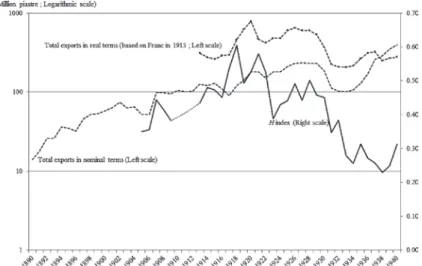
In the beginning, we confirm the total exports of Vietnam during the colonial period in Figure 2.
Except for the 1930s when rice export diminished under the influence of the Great Depression,
10)the
total export increase over roughly the whole period. On the other hand, H index observes that the
diversification or specialization of the export (for details, refer to the note to Figure 2) has been increas-
ing steadily although there were fluctuations until the 1920s. Therefore, the H index indicated the spe-cialization of the export until the 1920s. However, the index continued to decrease, and while the value
in the 1920s was greater than 0.6, it fell to 0.2 in the second half of 1930s. We knew that export items of
French Indochina had been rapidly diversified since the 1920s, behind the growth of total exports.
Why did such an export diversification happen ? To clarify this, we will confirm trends in export
values by region and the change in the composition of the main export items. Figure 3 shows what was
observed in the time series data of export values for Cochinchina, Tonkin, Annam, Cambodia, and Laos,
which made up French Indochina. According to the figures, export values are highest for Cochinchina,
followed in order by Tonkin, Annam, Cambodia, and Laos, and we know that there are no changes for
their positional relationship from the end of the 19th century until 1940.
When we check the composition change of major export items in Figure 4, we see that the export
share of rice is extremely high in the group that includes rice, maize, coal, smoked and dried fish, natural
rubber, cement, leather, pepper, copra, and other items.
11)Most of the rice exported was from Cochi-10) The decline of rice exports in the 1930s seems to have been due to the falling of rice prices related to the Great Depression and the block economy. See also the discussion in Takahashi [2006].
11) In particular, the coalfield Hongai (Hòn Gai) at Halong (Hạ Long) City (the capital of current Quang Ninh (Quảng
Ninh) province, also known for Halong Bay, the world heritage site) is very famous. For more information, see
nchina (see Note 7) ; as described above, the view of the rice monoculture was created by the export
structure specialised in rice. The export structure that was specialised for rice continued to the mid
-1920s ; thereafter, the proportion of exports other than rice, such as natural rubber and maize, expanded
rapidly and, because exports diversified due to the collapse of the export structure specialised for rice, it
is no longer regarded as a rice monoculture. In particular, natural rubber was often grown in Cochi-
nchina and exported from there, as detailed below. Therefore, it is remarkable that export diversifica-tion progressed due to increasing natural rubber in the 1930s, notwithstanding the superiority of exports
from Cochinchina confirmed in Figure 3.
On the other hand, maize has been cultivated in all regions of Tonkin, Annam, and Cochinchina as a
food of the Vietnamese since ancient times,
12)and maize export grew rapidly with the development of the
international market, especially after the implementation of the protective policy for products of French
colonies in 1932 (the tariff hikes for grain from other countries using production quotas) (Robequain
[1939]). Importantly, the indigenous peasants were able to adapt to changes in the market, such as the
increase of imports from France and the development of the international market. As noted above, not
only in Cochinchina, but also in all of Vietnam, including Tonkin and Annam, the adaptation of Vietnamese
12) Maize had been grown after the harvest of the rice in the tenth lunar month (lúa mùa) in Tonkin, and double or triple cropping of maize was done in Annam and Cochinchina (Henry [1932]). Regarding the situation of maize production in Annam prior to the exportation of maize, see ‘La culture du mays en Annam,’ on Bulletin Economic de l’Indochine, 40 (October 1, 1901).Figure 2 Changes and Diversification in Total Exports
Source : Résumé statistique relatif aux années 1913 a 1940.
Note : H index is the Hirschman=Herfindahl index calculated as Σ αi2 when the export share of item i is shown as
αi.
This index indicates the concentration of the export component if this value is high (if lower, diversifi-cation). We calculated αi
of rice, maize, coal, smoked and dried fish, natural rubber, cement, leather, pep-per, copra, and other items. Additionally, the dotted line of the H index indicates that the data were obtained by linear interpolation.
(and ethnic Chinese, who were deeply involved in the export of agricultural products) was confirmed as
the expansion of agricultural exports (the diversification of exports of agricultural products) or the
development of natural rubber plantations during the colonial period.
Source : British Consular Reports in the British Parliamentary Papers, various years. Note : Linear interpolation was used to estimate trends in exports.
Figure 3 Trends in Exports by Region
0% 10% 20% 30% 40% 50% 60% 70% 80% 90% 100% Other items Copra Pepper leather Cement Natural rubber Smoked and Dried fish Coal Maize Rice Source : The same as Figure 2. Note : The dotted line drawn in 1909 and 1913 indicates that the data in that section were obtained by linear inter-polation.
2-2. Diversification of agricultural products and export growth of natural rubber
By limiting our consideration to exports of agricultural products, we can understand the importance
of agricultural diversity in Tonkin, Annam, and the rubber export of Cochinchina, thereby clarifying the
type of agricultural development, unlike the rice monoculture discussed above.
The trends in the contribution ratios of the exports in major agricultural products are given in Figure
5. Until the early 1930s, it was known that most of the year
-on
-year growth rate of exports could be
explained by the export of rice. However, the contribution of rice in agricultural exports is weak for the
late 1930s, recovering from the effects of the Great Depression, and the agricultural export growth is
explained by the exports of maize and natural rubber described above. It is certain that the role of rice
export was great until the early 1930s in the development of agricultural exports, consistent with Figure
4. However, except for the year 1940,
13)it is clear that the exports of maize and natural rubber had
made important contributions to the agricultural exports of French Indochina in the late 1930s. In par-ticular, the contribution of rubber exports gradually increasing to the year 1939 cannot be ignored. As
mentioned above, cultivation of natural rubber was carried out mainly in Cochinchina, and we understand
that the driving force for the growth of the agricultural export had changed from rice to natural rubber
there.
13) Per Annuaire Statistique de l’Indochine, exports of rice (total of white rice, brown rice, broken rice, and bran) for Japan increased rapidly, from 7,629 tons in 1939 to 468,280 tons in 1940. We should note that this period overlaps the time when Japan strengthened its involvement with French Indochina, including the Japanese military occupa-tion of French Indochina. Therefore, we understand the increase in rice exports to Japan from French Indochina during this period.
Source : The same as Figure 2.
Additionally, we understand the important role of products categorised as ‘Other items’ in Figure 5,
especially in 1905 and 1923. The fact that agricultural diversity progressed in Tonkin and Annam is
known by confirming the export development of agricultural products, which is summarised in the ‘Other
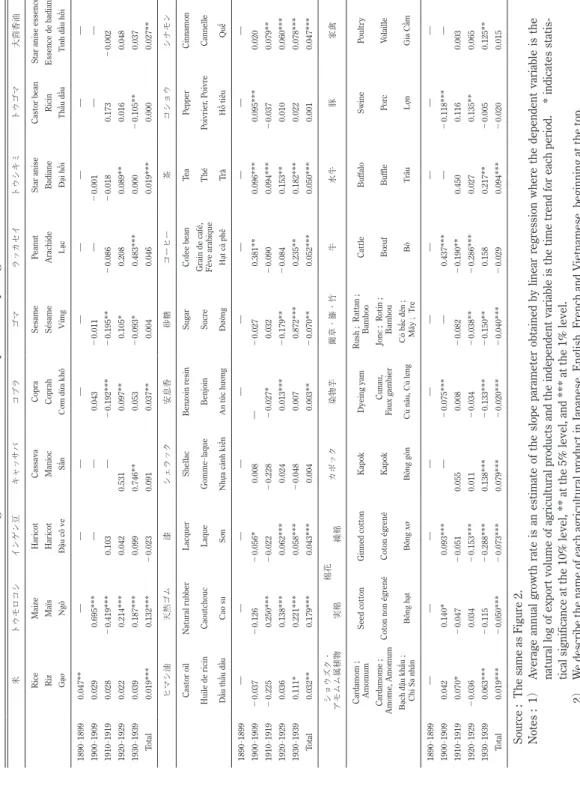
items’ in detail. Table 1 shows the average annual growth rate of exports for 29 items including
major export items such as rice, maize, natural rubber, and 26 other items over half a century, from the
1890s to the 1930s. We know the following facts, per Table 1 :
1) although rice exports increased signif-
icantly in the late 19th century, such rapid growth was not seen thereafter, 2) exports of maize and natu-ral rubber increased from a relatively early stage, 3) copra, star anise, castor oil, lacquer, benzoin resin,
coffee, tea, cardamom
-amomum, cotton (seed cotton and ginned cotton), kapok, and buffalo showed posi-tive export growth on average during the entire period. These facts are consistent with our conflicting
view about the rice monoculture mentioned repeatedly above, especially observation 3. In other words,
the agricultural products mentioned in observation 3 are those that are grown in large volumes in Annam
and Tonkin for export, demonstrating that diversified agriculture developed in Tonkin and Annam (Robe-quain [1939], Henry [1932]).
14)Furthermore, because many crops experienced rapid export growth
since the early 20th century, we suggest that indigenous peasants in Tonkin and Annam adapted to the
development of export markets early.
As mentioned above, the development of the cultivation and export of various crops in Tonkin and
Annam, as well as the expansion in exports of natural rubber, are difficult to reconcile with the conven-tional rice monoculture view, and the agriculture of Vietnam was characterised by the diversification of
agricultural exports during the colonial period. More importantly, the diversification of agricultural
exports was supported by indigenous peasants and plantations. In the next section, we focus on the
natural rubber sector with many materials, relatively ; because rubber exports supported the export
diversification of agricultural products in colonial Vietnam in the 1930s, we analyse the adaptation of rub-ber plantations to markets.
3. Development of rubber plantations and rubber exportation
3-1. Development of rubber plantations
Against the background of an increase in exports of natural rubber in the 1930s, which also led to the
diversification of agricultural exports, there was a development of rubber plantations. The rubber tree
(Hevea
brasiliensis) was introduced into FrenchIndochina for the first time by Raoul, who was a pharma-cist of the French Navy, and who sent 2,000 saplings to the botanical garden in Saigon from British
Malaya where he worked in 1897 (Robequain [1939]). After many complications, French settlers culti-14) Per Henry [1932], the production areas of products described above are as follows : copra was produced in Cochinchina and Annam ; star anise in Tonkin ; castor oil in Tonkin ; lacquer and benzoin resin in Tonkin andAnnam ; coffee in Tonkin and Annam ; tea in Tonkin, Annam, and Cochinchina ; cardamom-amomum in Tonkin
and Annam ; cotton in Tonkin, Annam, and Cochinchina ; kapok in Cochinchina ; and buffalo in Tonkin, Annam, and Cochinchina. There were many agricultural products produced in Tonkin and Annam but not in Cochinchina.
Table 1
A
verage Annual Gr
owth Rate of Exports of Major Agricultural Pr
oducts 米 トウモロコシ インゲン豆 キャッサバ コプラ ゴマ ラッカセイ トウシキミ トウゴマ 大茴香油 Rice Maize Haricot Cassava Copra Sesame Peanut Star anise Castor bean Star anise essence Riz Maïs Haricot Manioc Coprah Sésame Arachide Badiane Ricin Essence de badiane Gạo Ngô Đậu cô ve Sắn Cơm dừa khô Vừng Lạc Đại hồi Thầu dầu
Tinh dầu hồi
1890 -1899 0.047** ― ― ― ― ― ― ― ― ― 1900 -1909 0.029 0.695*** ― ― 0.043 − 0.011 ― − 0.001 ― ― 1910 -1919 0.028 − 0.419*** 0.103 ― − 0.192*** − 0.195** − 0.086 − 0.018 0.173 − 0.002 1920 -1929 0.022 0.214*** 0.042 0.531 0.097** 0.105* 0.208 0.089** 0.016 0.048 1930 -1939 0.039 0.187*** 0.099 0.746** 0.053 − 0.093* 0.483*** 0.000 − 0.105** 0.037 Total 0.019*** 0.132*** − 0.023 0.091 0.037** 0.004 0.046 0.019*** 0.000 0.027** ヒマシ油 天然ゴム 漆 シェラック 安息香 砂糖 コーヒー 茶 コショウ シナモン Castor oil Natural r ubber L acquer Shellac Benzoin r esin Sugar Cofee bean Te a Pepper Cinnamon Huile de ricin Caoutchouc L aque Gomme -laque Benjoin Sucr e Grain de café, Fève arabique Thé Poivrier , P oivr e Cannelle
Dầu thầu dầu
Cao su Sơn Nhựa cánh kiến An tức hương Đường Hạt cà phê Tr à Hồ tiêu Quế 1890 -1899 ― ― ― ― ― ― ― ― ― ― 1900 -1909 − 0.037 − 0.126 − 0.056* 0.008 ― − 0.027 0.381** 0.096*** 0.095*** 0.020 1910 -1919 − 0.225 0.250*** − 0.022 − 0.228 − 0.027* 0.032 − 0.090 0.094*** − 0.037 0.079** 1920 -1929 0.036 0.138*** 0.062*** 0.024 0.013*** − 0.179** − 0.084 0.153** 0.010 0.060*** 1930 -1939 0.111* 0.221*** 0.058*** − 0.048 0.007 0.872*** 0.235** 0.182*** 0.022 0.078*** Total 0.032** 0.179*** 0.043*** 0.004 0.003** − 0.070** 0.052*** 0.050*** 0.001 0.047*** ショウズク・ アモムム属植物 棉花 実棉 繰棉 カポック 染物芋 藺草・籐・竹 牛 水牛 豚 家禽 Car damom ; Amomum Seed cotton Ginned cotton Kapok Dyeing yam R ush ; R attan ; Bamboo Cattle Buffalo Swine Poultr y Car damome ; Amome, Amomum Coton non égr ené Coton égr ené Kapok Cunau, Faux gambier Jonc ; R otin ; Bambou Bœuf Buffle Po rc Volaille Bạch đậu khấu ; Chi Sa nhân Bông hạt Bông xơ Bông gòn Củ nâu, Củ leng Cỏ bấc đèn ; Mây ; Tre Bò Trâu Lợn Gia Cầm 1890 -1899 ― ― ― ― ― ― ― ― ― ― 1900 -1909 0.042 0.140* 0.093*** ― − 0.075*** ― 0.437*** ― − 0.118*** ― 1910 -1919 0.070* − 0.047 − 0.051 0.055 0.008 − 0.082 − 0.190** 0.450 0.116 0.003 1920 -1929 − 0.036 0.034 − 0.153*** 0.011 − 0.034 − 0.038** − 0.286*** 0.027 0.135** 0.065 1930 -1939 0.063*** − 0.115 − 0.288*** 0.138*** − 0.133*** − 0.150** 0.158 0.217** − 0.005 0.125** Total 0.019*** − 0.050*** − 0.073*** 0.079*** − 0.020*** − 0.040*** − 0.029 0.094*** − 0.020 0.015 Sour ce : The same as F igur e 2. Notes : 1) A vera ge an nu al gr owth ra te is a n es tima te of th e slope pa ra meter obta in ed by lin ea r regr es sion wh er e th e depen den t va ria ble is th e natural log of expor t volume of agricultural pr oducts and the independent variable is the time tr end for each period. * indicates statis -tical significance at the 10% level, ** at the 5% level, and ** * at the 1% level. 2 ) W e describe the name of each agricultural pr oduct in Japanese, English, F rench and V ietnamese, beginning at the top.
vated the rubber tree, and natural rubber plantations evolved.
15)As described above, the cultivation of natural rubber in plantations was concentrated in Cochinchina
(it is easy to confirm this in Figure 6). The rubber cultivation area in Cochinchina consistently domi-nated the cultivated area of Indochina from the end of the 19th century to 1940, and rubber was cultivated
in Cambodia and Annam. Additionally, the cultivated area increased rapidly in the 1920s.
16)Although
the time lag of an increase of cultivated area in the 1920s and rubber export growth in the 1930s seem
strange at first glance, it is understandable because the rubber tree is a perennial crop.
17)Why did the cultivation area of the natural rubber increase during the late 1920s and the rubber
export expand in the 1930s ? It is conceivable that French capital flowed into Indochina because of the
rise in the international price for rubber, as mentioned by Takada [1988].
18)However, we must empha-sise that local Chinese and Vietnamese, as well as French, adapted to changes in the market, such as the
rise of the international price for rubber. Namely, the increase of cultivated area after the late 1920s in
Figure 6 included the effect of the increase of small plantations managed by Vietnamese and ethnic
Chinese. To confirm this point, we have conducted an analysis using micro data that have not been used
much for colonial Vietnam studies. The micro data are required for an analysis of the characteristics of
plantations and adaptation to markets because the analysis is difficult using aggregated data only.
19) 15) More information about the process of the spread of Hevea brasiliensis and the development of the plantation sector can be found in Lan [1911], Crevost [1927], and Groupment Professionnel de la Production Agricole et For-estière de l’Indochine [1942], in addition to Robequain [1939], mentioned above. 16) Note that the growing area displayed in Figure 6 is the cumulative area planted by the end of that period. Therefore, the differences between the heights of the bins indicate the newly planted area. 17) The plantations, which had planted rubber trees and were established by the rise of rubber prices in the late 1920s, encountered falling international prices thereafter. However, these plantations were supported by the Governor General of Indochina, and contributed to the increase in exports in the 1930s. See also Note 18 below. 18) International prices had fallen due to excess supply and an increase in the production of natural rubber in British Malaya, in the Dutch East Indies during worsening economic conditions after the First World War. Thereafter, the price rose due to the plan for the reduction of international production in 1921 of the Stevenson Committee, appointed by the Government of the United Kingdom. This caused prices to rise in the late 1920s. However, this draft had been abolished in 1928 due to massive increase in production in the Dutch East Indies, due to prices rising (this meant the violation of the Stevenson draft) and regulations of demand in the United States (there were many demands for tires in the automotive industry in the U.S.). After that, prices tumbled again with the Great Depression. Under these circumstances, for the impoverished plantations in French Indochina, the Governor General of Indochina made bailout loans and an export subsidy in the central budget. Obviously, non-competitive plantations could not survive even with this temporary assistance. Additionally, new controls on rubber produc-tion were provided by the London Agreement of 1934, and the output ceiling of French Indochina was 30,000 tons (60,000 tons in 1938), which was higher than the others. If a tax on excess production was paid to the Interna- tional Committee, French Indochina was able to exceed the upper limit of production. Plantations in French Indo-china adapted to the changes in international rubber prices and political intervention. For more information, see Robequain [1939], Kano [2001 : Ch.2] (written by Tsukasa Mizushima), and Narusawa [1982]. 19) More specifically, our purpose is to analyse the phenomenon of market adaptation of the plantation at the micro level, notwithstanding the phenomenon of an increase in exports and growth of rubber cultivated area at the macro level, with data obtained from official publications such as Annuaire Statistique de l’Indochine.We created a panel data set by merging the data of plantations using information like name, location,
and owner of each plantation in the 1926 edition and the 1937 edition of Annuaire du Syndicat des Plant
-eurs de Caoutchouc de l’Indochine, which is a yearbook of the rubber plantation’s union.
Table 2 shows
the result of matching data of plantations from these materials (with a total sample size of 1062). Per
Table 2, 122 plantations were identified in 1937 and also found in 1926, while 245 existed in 1926 but
were not identified in 1937. I have also found that 695 plantations were identified in 1937 although they
were not in 1926. Rubber plantations greatly increased by the year 1937, if this information can be
confirmed.
Next, we will confirm the features of these plantations. Figure 7 indicates the intertemporal com-parison of scale distributions of plantations in 1926 and 1937. Per the figure, we know that most of the
695 plantations, which increased from 1926 to 1937, were small plantations, because plantations of less
than 1,000 ha increased by the year 1937, the scale distribution converged to a small scale as a whole, and
the median value decreased in 1937.
20)These facts have not been emphasised in existing characteris-
tics of the data mentioned in Table 2. First, as confirmed in Figure 7, the average cultivation area of nat-ural rubber from 1926 to 1937 is small.
21)Furthermore, we confirmed the average cultivation areas on
20) The median value is also low in 1926 because there were many small plantations of less than 100 ha. However, a massive increase of small plantations by the year 1937 led to a decrease in the median value in 1937. 21) However, as can be seen from Figure 7, because the scale distributions of plantations are positively skewed in both 1926 and 1937, using the mean of cultivation area shown in Table 3 as the representative value of the planta-tion scale is normally inappropriate. Hence, we should use a median value that is robust to the skewness as the representative value. In fact, the mean of cultivation area shown in Table 3 makes a large divergence from the median value of the cultivation area shown in Figure 7. Therefore, in the case of using the mean, it is meaningfulSource : Annuaire Statistique de l’Indochine 1939-1940.
Note : The areas of 1897-1919, 1920-1925, and 1926-1929 are cumulative areas planted by the end of each period.
plantations that survived from 1926 to 1937 (plantations confirmed in both the 1926 and 1937 data, here-inafter referred to as ‘survivors’) and plantations considered to have newly entered in 1937 (plantations
confirmed only in 1937, hereinafter referred to as ‘new entrants’). The former group is larger than the
overall average in 1926 and the latter is smaller in 1937. It can be seen, therefore, that large
-scale plan-tations had been in existence since 1926 and small
-scale plantations had been established in 1937.
Based on the above observations, we estimate a probit model to confirm the characteristics of survi-vors and new entrants. The results are summerised in Table 4 as ‘entry model’ and ‘survival model’,
respectively. At a glance, we know that plantations which had been in existence from 1926 to 1937
tended to be large in scale. This means that survival probability increases with expansion of the scale,
although the effect diminishes.
22)Additionally, although provincial dummies explaining the geographical conditions of plantations
excluding soil conditions have no significant effect on survival,
23)the owner dummy is significantly nega-to discuss the relative positional relationship of the scale distributions of 1926 and 1937 for survivors and new entrants. The median value of survivors and new entrants are 125 ha and 17 ha, respectively. 22) In the survival model (1), the square of cultivation area in 1926 is significantly negative. This indicates that the greater the cultivation area, the higher the probability of survival, although the effect diminishes. With this back-ground, as the scale of a plantation becomes larger, the monitoring cost of employment also becomes larger, which is disadvantageous for large-scale plantations. Although the square of cultivation area in 1926 is not significant in the survival model (2), the p value is very close to the boundary of the significance level of 10%. 23) Another variable which measures geographical conditions on the roster in 1926 is ‘distance from Saigon’. How-ever, because plantations which reported such information are relatively few, there is an increase in missing values. Additionally, although we conducted an analysis including the ‘distance from Saigon’, the result was not significant. Hence, the ‘distance from Saigon’ was not included in the analysis of Table 4. In the 1926 version of Annuaire du
Syndicat des Planteurs de Caoutchouc de l’Indochine, the information on the plantation called ‘Plantation de Phu
-Table 2 Changes in the Number of Rubber Plantations
1937 0 1 Total 1926 0 0 695 695 1 245 122 367 Total 245 817 1,062
Source : Annuaire du Syndicat des Planteurs de Caoutchouc de l’Indochine 1926, 1937. Note : 1) ‘1’ in 1926 means the plantations in this category are able to be confirmed in the year 1926 ; ‘0’ means not confirmed. ‘1’ in 1937 means the plantations in this category can be confirmed in the year 1937 ; ‘0’ means not confirmed. 2) Both samples in 1926 and 1937 include plantations in Annam, Tonkin, Cambodia, and Laos, other than Cochinchina. However, they are in a minority. We can confirm 19 plantations in Annam, 1 in Tonkin, 34 in Cambodia, and 4 in Laos out of 1,062 sample plantations in 1927 and 1937.
tive in 1926 and plantations with non
-indigenous owners (e.g. the French) are likely to survive. This
contrasts with the case of ‘entry model’, and it is also an important issue. Therefore, we discuss it fur-ther below.
Because soil dummies are not significant, the survival probability has little relevance to the soil of
plantations. This requires a little more explanation. Generally, rubber plantations of French Indochina
can be divided into two major types of soil. One is grey soil (terres grises) and the other is red soil (terres
rouges).
24)The former was more common in early plantations located near densely populated areas such
as Saigon. Additionally, rice cultivation had been carried out by the local Vietnamese in the soil.
Although adequate fertilization is essential for fertility of the inferior red soil, the grey soil is easy to
reclaim, and land with grey soil therefore needs less initial investment for the establishment of a
plantation. Because there are also many villages of Vietnamese near the plantations, workers for the
plantations were employed easily from villages in the vicinity (Robequain [1939]). Land with red soil
was spread in the densely wooded country of Cambodia, the Mekong Delta, and south of Annam, and
required a large initial investment for the establishment of a plantation due to the great difficulties of land
Quoc’ is described and the distance from Saigon is shown to be 460 miles. However, it is obviously 460 kilome-tres rather than 460 miles, because this plantation was in the present Phu Quoc Island (Đảo Phú Quốc), which is
actually about 460 kilometres from Saigon.
24) For more information on the soil of plantations, see Robequain [1939] and Henry [1932]. They are also refer- enced in our description of the soil. See also Takada [1988]. The Japanese edition of Robequain [1939] trans-lated by Matsuoka and Okada indicates that the grey soil is called black soil in the translator’s note on page 250.
Source : Annuaire du Syndicat des Planteurs de Caoutchouc de l’Indochine 1926, 1937. Note : Me 1926 indicates the median of the scale distribution in 1926, also Me 1937 in 1937.
Table 3 Characteristics of Natural Rubber Plantations (Descriptive Statistics)
Observations Mean SD Min. Max.
1) All sample plantations in 1926 Growing area in 1926 (1,000 ha) 363 0.462 1.424 0.0005 10.8 Soil dummy (Gray soil = 1) 364 0.860 0.348 0 1 Owner dummy in 1926 (Local = 1) 360 0.481 0.500 0 1 Province dummy Ba Ria 367 0.046 0.210 0 1 Bien Hoa 367 0.147 0.355 0 1 Gia Dinh 367 0.332 0.472 0 1 Tay Ninh 367 0.057 0.233 0 1 Thu Dau Mot 367 0.373 0.484 0 1 2) All sample plantations in 1937 Growing area in 1937 (1,000 ha) 817 0.176 0.665 0.0002 9.1 Owner dummy in 1937 (Local = 1) 817 0.547 0.498 0 1 Province dummy Ba Ria 817 0.035 0.185 0 1 Bien Hoa 817 0.159 0.366 0 1 Gia Dinh 817 0.337 0.473 0 1 Tay Ninh 817 0.108 0.310 0 1 Thu Dau Mot 817 0.288 0.453 0 1 3) Survivor in 1926 Growing area in 1926 (1,000 ha) 121 0.949 2.036 0.0007 10.8 Soil dummy (Gray soil = 1) 122 0.770 0.422 0 1 Owner dummy in 1926 (Local = 1) 121 0.273 0.447 0 1 Province dummy Ba Ria 122 0.074 0.262 0 1 Bien Hoa 122 0.230 0.422 0 1 Gia Dinh 122 0.295 0.458 0 1 Tay Ninh 122 0.074 0.262 0 1 Thu Dau Mot 122 0.270 0.446 0 1 4) New entrants in 1937 Growing area in 1937 (1,000 ha) 695 0.099 0.303 0.0002 4.02 Owner dummy in 1937 (Local = 1) 695 0.596 0.491 0 1 Province dummy Ba Ria 695 0.029 0.167 0 1 Bien Hoa 695 0.147 0.354 0 1 Gia Dinh 695 0.344 0.475 0 1 Tay Ninh 695 0.114 0.318 0 1 Thu Dau Mot 695 0.291 0.454 0 1
Source : Annuaire du Syndicat des Planteurs de Caoutchouc de l’Indochine 1927 and 1937.
Note : 1) The soil dummy is based on the information on the soil quality (Nature du terrain) of each plantation described in the annual for 1926. However, some plantations do not report the soil quality information, in which case they must be treated as missing values. To minimise the missing values, we have taken the following mea-sures : 1) For plantations which do not report the soil information, we can obtain location information, access information (Voie d’acceès) and distance from Saigon (Distance de Saïgon) to the plantation. Therefore, we iden-tify the location of the plantation using such information. 2) By comparing the location information of the plan-tation and location map of the plantations in Cochinchina, including information on whether the plantation in red soil area or not, obtained from Henry [1932], we confirm the soil of the plantation. We create soil dummies from this operation. 3) If the location obtained in the operation 1) is not described on the map of Henry [1932], we identified the location using Google Maps (http://maps.google.co.jp/ viewed on July 19, 2014) (in this case, we assume that the location name of the plantation is same as the present). 4) Soil quality information of them can be obtained although plantations located in Annam cannot be identified on the map of Henry [1932]. As we can
confirm the descriptions such as Silico-argileux (siliceous clay) and Sablonneux
(sandy land), we create soil dum-mies referring to Henry [1932 : 549-552] and the result of soil analysis on Bureau of Southern Affairs [1943 :
227], for example the red soil contains a small amount of silicic acid.
2)
We created the owner dummy in 1926 and 1937 by confirming whether the owner is local or not for the planta-tions listed on the annual 1926 and 1937 respectively. If owner dummy is 1, the plantation is owned by local or a joint venture with local capital.
Table 4 Characteristics of Survival Plantations and New Entries Survival model Entry model (1) (2) (1) (2) Growing area in 1926 (1,000 ha) 0.415 0.400 (2.64)*** (2.46)** Square of growing area in 1926 −0.036 −0.029 (−2.07)** (−1.62) Growing area in 1937 (1,000 ha) −0.527 −0.656 (−2.72)*** (−2.91)*** Square of growing area in 1937 0.017 0.024 (0.43) (0.46) Soil dummy (Gray soil = 1) −0.329 0.056 (−1.47) (0.18) Owner dummy in 1926 (Local = 1) −0.613 −0.607 (−3.97)*** (−3.82)*** Owner dummy in 1937 (Local = 1) 0.606 0.610 (5.00)*** (4.81)*** Province dummy Ba Ria 0.814 −1.226 (1.46) (−3.38)*** Bien Hoa 0.593 −0.808 (1.49) (−2.72)*** Gia Dinh 0.233 −0.787 (0.61) (−2.66)*** Tay Ninh 0.639 −0.562 (1.37) (−1.68)* Thu Dau Mot 0.006 −0.595 (0.02) (−2.03)** Intercept 0.023 −0.576 0.877 1.590 (0.10) (−1.22) (10.29)*** (5.57)*** Sample size (N) 354 354 817 817 Pseudo R2 0.109 0.130 0.110 0.132 Log-Likelihood −201.911 −197.233 −306.687 −299.022
Source : Annuaire du Syndicat des Planteurs de Caoutchouc de l’Indochine 1926, 1937.
Notes : 1) ‘Survival model’ indicates the result of the probit analysis, where we regard the dependent variable=1 as a case of the plantation shown in both 1926 and 1937. Additionally, ‘Entry model’ indicates the re-sult of a probit analysis, where we regard the dependent variable=1 as a case of the plantation found in 1937 but not in 1926 among all plantations in the 1937 annual. 2) In the table, the coefficients of each probit model are described on the upper line. The values in pa-rentheses are z values. * indicates statistical significance at the 10% level, ** at the 5% level, and *** at the 1% level. 3) ‘Soil dummy’ is not included in ‘Entry model’ because the information related to soil cannot be ob-tained from the 1937 annual. Additionally, we confirm some plantations for which such data could not be obtained in the 1926 annual. We therefore attempted to prevent the missing values using the method mentioned in Table 3.
reclamation ; hence, ethnic minorities were employed for labour
-intensive work, such as land clearing.
25)It was difficult to ensure a supply of workers for plantations established on population sparse jungle, and
many existing studies have noted this problem (Takada [1988], for example). Many workers employed
as cultivators or latex harvesters were hired from the Red River Delta of Tonkin, which has a dense pop-ulation, but labour problems often emerged.
26)On the other hand, soil with higher fertility than grey
soil was advantageous for natural rubber cultivation (Robequain [1939], Bureau of Southern Affairs
[1943 : 226
-227]). Plantations in the red soil were established relatively late, grew larger, and devel-oped via high land productivity, as noted by Takada [1988].
Although the advantage of the red soil for natural rubber cultivation is seen in the above studies, our
results show that soil conditions had little effect on the survival probability, unlike the referenced views.
The reason is that both grey and red soil had advantages and disadvantages. First, because of the intro-duction of fertiliser, the problem of less fertility in grey soil could be resolved partially.
27)Second, the
cost to ensure disciplined labour was lower in plantations with grey soil than in those with red soil. As
described above, people of Tonkin and ethnic minorities had been hired as workers in plantations with red
soil, even though ethnic minority workers were less likely to be disciplined labourers ;
employing Viet-
namese workers from Tonkin was very expensive due to their migration and recruitment and the provi-sion of food, clothing, and shelter ; and the labour monitoring cost increased with the expanding scale of
a plantation. The common belief that red soil is advantageous is not necessarily relevant.
28)For plantations established by the year 1937, we found that the smaller scale of the plantation, the
higher the probability of its establishment. Province dummies are significantly negative. This means
25) Robequain [1939]. The data of the workers in some plantations are obtained from Annuaire du Syndicat des
Planteurs de Caoutchouc de l’Indochine 1926. According to that work, the Moi (a term that refers to ethnic minori-ties in today’s Central Highlands, but which is rarely used because of its derogatory nature) who were good at life in the jungle were employed to reclaim the land. 26) With the increase of plantations, because the workers supplied from Cochinchina were inadequate for the labour demand, workers were hired from the Tonkin population. In plantations of the French capital, jobs brokers, called Caï, were used for the employment of the Vietnamese people. For more information, see International Labour Office [1938], Robequain [1939], and Takada [1988]. 27) Bureau of Southern Affairs [1943 : 233] explains that ‘Fertiliser are applied only to gray soil and not applied to red soil at all’. 28) The concept of disciplined labour is closely related to labour monitoring problems, as moral hazards raised by S.A. Marglin (Marglin [1974]). As Hayami [2004 : 294] noted, family labour is ‘the labour that works without supervision based on strong community relationship’, and does not cause monitoring problems. Therefore, the supervision problems and the imposition of discipline are problems for employed labour. Workers from Tonkin were hired in accordance with the system of long-term contracts which also imposed detailed obligations on employers. They were recruited in authorised employment agencies, transported by sea from Haiphong and other locations to Saigon. The employers had to consider the welfare of workers, such as the provision of food, clothing, and shelter, and the prevention of malaria. Additionally, villages of workers had been formed in large -scale plantations. In fact, we can confirm that there are many dwellings of plantation workers in the Annuaire du
Syndicat des Planteurs de Caoutchouc de l’Indochine 1926, including much data of large-scale plantations. For more
that many plantations had already existed in these provinces in 1926 ; therefore, the establishments of
new plantations there declined. The owner dummy in 1937 shows a positive significant effect on the
probability of new entrants. It indicates that the plantations of indigenous owners tended to be estab-lished by 1937. This result contrasts with the survival model, and is very important for evaluating local
Vietnamese and Chinese entrepreneurship. Therefore, we discuss this issue further in the next sec-tion.
3-2. Entrepreneurship and small plantations
From the above analyses, it is found that the large plantations of non
-local capital were more likely
to survive, and, more importantly, most new entrants were small plantations with local capital. We con-firm the reason for the increase in these small plantations.
The first reason is that small plantations require less initial investment. Because the development
of rubber plantations in the late stage had progressed in red soil, where initial investments were costly, it
was important that the scale of a plantation be small.
The second reason is that it was easy to overcome the problem of the employment of disciplined
labour when a plantation was established. Hayami [2004 : 291
-295] [2010] noted that plantations were
motivated to expand their scale to promote the pursuit of scale economics, and the problem of the moni-toring cost for hired labour also emerged.
29)In the case of small plantations, such a dilemma was
unlikely to occur originally. Figure 8, in which we confirmed the relationship between the amount of
labour input per area (lnL) and management scale (lnA) for the data of 1926, indicates the negative
correlation ; in other words, the larger the management scale of a plantation, the less intensive the
labour input. For a small operation, monitoring problems do not really matter and the plantation tends
to become labour extensive as it grows.
The third reason is the most important. Most of the owners and management of small plantations
were local Vietnamese and ethnic Chinese. Their entrepreneurship and ability to adapt to the rubber
markets emerged with an increase in the establishments of small
-scale plantations. Table 5 displays the
small plantations with less than 40 ha, most of which were those of indigenous capital.
30)This recon-29) Using this logic, Hayami [2004 : 291-295] [2010] argues that peasants using family labour, who were free of the monitoring problems of hired labour, contributed to the agricultural development in Asia, referring to Lewis [1970]. 30) Per East Asiatic Economic Investigation Bureau [1939 : 157], there were 70 small rubber plantations managed by ethnic Chinese in the suburbs of Saigon. The size of 40 ha is almost the same as the average plantation size in 1926 from the median value (45 ha) in 1926 in Figure 7. However, the size of 40 ha is almost twice as large as the average in 1937. It suggests an increase in small plantations.
Encyclopedia Britannica’s first edition, published in 1768-1771, had already provided an article about ‘plantation’,
which ‘in the West-Indies, denotes a spot of ground which a planter or person arrived in a new colony, pitches on to cultivate for his own use, or is assigned for that purpose. However, the term plantation is often used in a synony-mous sense with colony.’ Additionally, the article in the 11th edition published in 1911 states as follows : ‘The term was early applied, in a figurative sense, to the settlement of people, and particularly to the colonization of North America in the early part of the 17th century and to the settlement of Scotch and English in the forfeited