第 54 卷 第 4 期
2019 六 4 八月
JOURNAL OF SOUTHWEST JIAOTONG UNIVERSITY
Vol. 54 No.4 Aug. 2019
ISSN
0258-2724 DOI:10.35741/issn.0258-2724.54.4.6
Research article
Computer Science
T
HE COUNTRY OF ORIGIN
(
COO
)
MODEL OF THE
I
NDONESIAN AND
C
HINESE PRINTED BATIK PRODUCTS
Mahrinasari M.S.Faculty of Economics and Business, The University of Lampung, Bandarlampung, Indonesia, [email protected]
Abstract
Indonesia has become one of the destination countries to market their products and services, and there are various products that are quite widely available in the Indonesian market. The country of origin (COO) model in this research is a new developed model that aims to analyze the moderating role of Ethnocentrism in the effect of the COO and brand preference (BP) on purchase intention toward the Indonesian and Chinese Batik. To address this research purpose, 414 respondents took part in the survey, and the data obtained were analyzed by Structural Equation Model (SEM) with Lisrel 8.80 application. The result of this study shows that Ethnocentrism plays a role as the moderating variable in the effect of COO on purchase intention. However, whenever the effect of the brand preference on purchase intention exists, there is no moderating role of Ethnocentrism. Consumer Ethnocentrism shows that the Chinese batik is purchased in the case if the Indonesian batik is unavailable. It implies that consumer preference to the Chinese Batik exists, because it has a superior quality, a unique or authentic design, and more experience, as the impact of Global Business aspect. The study concluded that the company management must apply global Brand Repositioning Strategy in terms of the superior quality and unique design in fulfilling the global consumers‟ needs. Keywords: country of origin, brand equity, brand preference, purchase intention, ethnocentrism, Indonesian and Chinese printed batik product.
摘要 : 印度尼西亚已成为推销其产品和服务的目的地国家之一,印度尼西亚市场上有各种产品可供广泛使用 。本研究中的原产国(COO)模型是一个新开发的模型,旨在分析民族中心主义在首席运营官和品牌偏好( BP)对印尼和中国蜡染的购买意愿的影响中的调节作用。为了解决这一研究目的,414 名受访者参与了调查 ,获得的数据通过结构方程模型(SEM)和 Lisrel 8.80 应用进行分析。这项研究的结果表明,民族中心主义 在 COO 对购买意愿的影响中起着调节作用的作用。然而,每当品牌偏好对购买意愿的影响存在时,种族中心 主义就没有调节作用。消费者民族中心主义表明,如果没有印尼蜡染,就会购买中国蜡染。这意味着消费者 对中国蜡染的偏好存在,因为它具有卓越的品质,独特或真实的设计,以及更多的经验,作为全球商业方面 的影响。该研究的结论是,公司管理层必须在卓越的品质和独特的设计方面应用全球品牌重新定位战略,以 满足全球消费者的需求。 关键词: 原产国,品牌资产,品牌偏好,购买意愿,民族中心主义,印尼和中国印刷蜡染产品。
I. I
NTRODUCTIONMarket globalization creates a stream of products or services easily in and out of a country, so this condition is also said to be an era of free trade. The free trade era has made several countries enter into collective agreements, specifically in terms of eliminating import quotas and inter-country tariff fees. This makes products and services of foreign origin easily to get in and out, so that there are many variations in the choice of products and services available in the country where the products and services are from abroad.
Recently, Indonesia has become one of the destination countries (foreign companies market their products and services to Indonesia), Indonesia offers a variety of products that are quite widely available and are based on Indonesian cultural heritage. Batik fabric is one of such products, which has been recognized as a World Heritage by the United Nations Educational, Scientific and Cultural Organization (UNESCO) on October 2, 2009.
The Indonesian batik is involved in competition with other types of batik designs from outsiders, one of which is a type of batik fabric design originating from China. The origin of the design of the Chinese country‟s batik fabric makes Indonesian consumers face with two product choices, and as a result, Indonesian consumers are more likely to buy and use the design of batik from China than the design of the Indonesian batik. The tendency of Indonesian consumers to prefer foreign products corresponds to the result of expert reviews [1]. The consumers‟ tendency to choose foreign products is also supported by the research result presented in [2] and stating that consumers would prefer foreign products compared to products from their own countries (called as, xenocentrism). The consumers‟ tendency to use products or services from other countries is known as a Country of Origin (COO) effect. The COO is defined as a country with which a particular product or service is associated, as place-based branding [3], [4], [5].
The concept of the COO is still in conflict. The COOs, on the one hand, are seen as unidimensional measurements [6, 7]. On the other hand, the COO can be measured from a multidimensional point of view [6], [8], [9], [10]. Multidimensional COO investigations can be
considered from the viewpoint of the Country of Design (COD, which is a product design-based branding that reflects the image of the country because of specialized production, for example carpets made in Turkey, Paris-made perfumes, and Indonesia is known by experts and designers manufacturing unique batik fabrics), and the Country of Assembly (COA, products from the country of origin are manufactured and assembled in another country, for example, Sony TV sets are a Japanese brand, they may be assembled from imported parts in Sony‟s plants worldwide).
However, while planning a purchase of products consumers are not only influenced by the consumer knowledge of the COOs, but also by other factors [8], such as price and quality [11], and brand equity (BE) value [12], [6], [13], [14]. Although, [15] revealed that COO is not a relevant attribute in determining product choices. Meanwhile, specifically, the findings of [1] [3] and [15] [26] show that the COO has a strong influence on the brand value, and affects the creation of consumer purchase intentions (PI) on products that have COO image. As found in [16], [17], the reputation of the Country of Brand affects brand equity and purchase intention. On the contrary, the reputation of the Country of Manufacture has no effect on purchase intention and brand equity. Also, [1] found that a strong brand value does not mean being able to improve negative COO reputation. It was suggested that the COO reputation should be investigated as a multidimensional concept to increase the value of brand equity [13]. Then, according to [18], the Country of origin of the brand (COB) and Country of Manufacture (COM) affected the brand equity.
It was also found that the COO has relationships with different dimensions of brand equity for different product categories and affects them differently [6]. The COO reputation for the category of automobile products has a stronger influence on the brand equity than for the category of electronic products, such as TV sets. The results of this study imply that depending on differences in product categories, products that were designed and manufactured in the country of origin have different effects on strengthening the brand equity and exert an impact on consumers‟ purchase intentions in the different way.
However, the brand equity has an impact on brand preference and purchase intentions, but the COO is not proven to act as moderating variable [19]. The same findings were also obtained by [20] confirming that the COO did not moderate the effect of product attribute knowledge on purchase intention of printed fabric batik products. Reversely, the COO had a direct effect on purchase intention. Both of these studies imply that the COO plays the main role as an independent variable in influencing consumers to make purchases or intend to make purchases.
Specifically, the results of [21] imply that consumers do not pay attention to the COO when choosing a product, even though the product is a type of cultural heritage, which should be associated with Ethnocentrism thinking that Indonesian consumers will choose products based on the Indonesian culture ownership. In general, this is the culture of the Indonesian people who like to hold a group culture, not an individual culture. Universally, the phenomenon of inter-group relations will increasingly form the culture of groups, and these groups will be proud of group ownership that will form a sense of nationalism or high nationalism, referred to as Ethnocentrism in [22]. It means that if Indonesian consumers are faced with two choices of the same products, one coming from Indonesia's cultural heritage, and the other coming from a foreign country, then Indonesian consumers will like or prefer the original Indonesian heritage products because of a high sense of nationalism, as the formation of a strong group culture. This idea is supported by the research results [23] confirming that Indonesian consumers with a high level of Ethnocentrism intend to purchase Indonesian native products and support promotion with the moto “Buy the Local Products”.
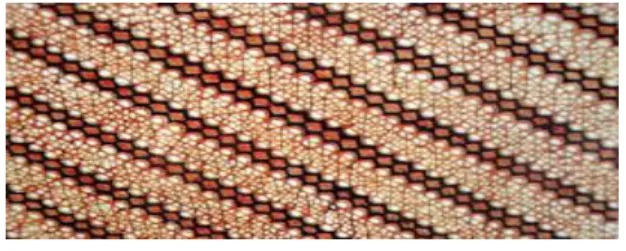
Thus, it was revealed that consumers intend to buy products not as the COO effects, but consumers‟ purchase intention does not depend on the COO which is moderated by Ethnocentrism [19]. This research studying Indonesian and Chinese printed batik clothing materials, circulating in the Indonesian stores, is similar to the following types of batik.
Figure 1. Printed batik from China (COO: BATIK of China. Source: [13]
Figure 2. Printed batik from Indonesia (COO: BATIK of Indonesia) Source: [21]
Both types of batik material comply with the following characteristics of batik cloth products revealed by Edward Hutabarat [21]: (a) Usually the model of the Chinese batik is almost similar to the Indonesian batik in general, but the Indonesian batik usually looks duller, (b) the Chinese batik tends to use more colors, (c) the Chinese batik motifs widely sold in the market tend to be contemporary (not clear in shape) with a plaid archetype or like a large patchwork alloy, (d) the combination of colors in the Chinese batik tends to be less harmonious than in the Indonesian batik, (e) the prices for the Chinese Batik tend to be very cheap compared to those of the Indonesian batik.
The Indonesian batik is generally distinguished by origin. Patterns or techniques for making types of batik are based on the area of origin. In general, the Indonesian batik is named according to the locality where the batik came from, for example Balinese Batik, Madura Batik, Solo Batik, and Surakarta Batik.
The design of batik is based on patterns and shape in various types, such as Batik Keraton, Batik Kawung, Batik Sekar Jagad, and Batik Pringgodani. In addition, the manufacturing techniques also have an impact on the difference in naming of the types of batik, which is reflected in these names: Batik Tulis, Batik Cap, and Batik print (www.ebatiknusantara.com).
In addition, Research findings by [10] showed that Indonesian consumers tend to be xenocentric or prefer foreign products. (However, Indonesian consumers with high ethnocentric levels prefer Indonesian local products compared to foreign products [23]. According to [1], [19], the COO acts rather like an independent variable than as a moderating variable in determining consumer purchase intention either directly or indirectly influenced by brand equity and brand preference. Therefore, this research mainly aims to analyze the moderating role of ethnocentrism in the effect
of the COO and brand preference on purchase intention.
II. LITERATURE
REVIEW
Referring to the concept of consumer behavior, consumers behave to determine purchases viewed from the cognitive and affective aspects, namely Purchase Intention that has not been realized as an action behavior, like the concept of Ajzen and Fishbein [16] who developed Theory of Reason Action (TRA) to explain the intention of consumer behavior. Their concept of purchase intention is further revealed as the predictors of consumer behavior, as cited in [6].
TRA addresses cognitive components effect [19]. TRA is effective in explaining the psychological level of consumers to understand consumer contextual decision making [7]. TRA central principle is the individual's intention to conduct certain behaviors. In this context, "Intention" refers to the willingness or desire to engage in behavior with consideration [16].
Intention is thought to be the most expensive prerequisite and behavior [16]. In social psychology, TRA has been widely studied [24]. Various researchers have tested and validated Fishbein and Ajzen's models with different settings, including health behavior, voting, online media, organic food, alcohol etc. [25]. TRA has been quite useful for predicting behavioral intentions in marketing and consumer behavior [18], [26], [27]. Likewise in this research, the intention to make a purchase is influenced by COO, brand equity, and brand preference, that is a human psychological aspect, perceived as cognitive / perceptive and affective to generate a sense of pleasure. The relationship between COO and brand image that encouraged Purchase Intention was investigated in [2]. COO effect research on brand value is widely done where the results show that COO has an influence on the development of brand value, especially in brand equity [14], [6].
It was noted in [28], [29], [30], and [31] that COO is the main source of information that can affect the brand value of the country itself. Sony brand, for example, can improve the image or brand association of the product as a product that has a quality brand and a reflection of the country with quality products. This condition makes it possible to encourage the development of brand equity because it is reflected in the brand association and brand quality that are built as part of the brand equity component.
However, the theory of Reasoned-action model reveals that the attitudes and norms of confidence formed against a brand will be reflected in purchase intention and the realization of future buying behavior can be predicted better by the current purchase intention. This statement is in line with the thinking of [16] that purchase intention is used as a strong prediction for actual consumer buying behavior and is most likely to be realized in the future [10]. It means that purchase intention can be said to be a powerful predictor to create actual purchase realization on product brands that have COO effects.
Thus, brand equity can have a positive effect on Purchase Intentions, as a result of the COO effect. This statement is supported by research by [32], [33], [34], and specifically, proved that with high brand equity, brand categories have a significant effect on purchase intention of the consumers. Meanwhile, [35] stated that brand associations as an element of BE have an effect on BP and differential PI. It was shown in [36] that among the elements of perceived brand quality, brand equity and brand awareness that American students responded to had a significantly positive effect on which is greater than those who responded by South Korean (SK) students in the USA and Korea.
It is also believed that buyers respond to brand values by buying the same brand products or services or through expressions of preference for special brands, thus impacting the company's higher market share, higher profits or higher stock value [37]. These findings specifically showed that brand equity in purchase intention has a significant positive effect, which also supports [37] findings that brand equity has a significant positive impact on brand preference and is inferred that brand preference has an effect on the intentions to purchase COO products.
The brand equity is considered to have a number of benefits in the perspective of consumer behavior, including increasing stakeholder preferences in brands and purchase intentions [38]. These findings were supported by [37] revealed that higher brand equity values result in greater brand preference. Later, [37] revealed that brand equity has a positively strong relationship with the brand preference. strong relationship with brand preference. Meanwhile, [37] stated that high brand equity is related to brand preference, high brand retention, customer satisfaction, increased market share, loyalty, stronger premium prices, high profits, and high market share value. Therefore, brand equity is a
vital contributor in creating positive brand preferences.
The research model of [8] specifically showed that brand quality perceived as one component of brand equity [16], is the dominant predictor in shaping positively significant brand preferences. The research findings of [39] also showed that perceived brand quality has a stronger effect with brand preference when older age moderates the effect of brand quality perceived on brand preference. Thus, brand equity can have an influence on product brand preferences that have the potential as COO effects.
The COO also has an influence on the selection of alternative product variations from other countries as a result of global marketing activities. This condition allows the consumers to have a preference for a variety of products that have a COO effect whether it is viewed from the product design or where the product is made or assembled. This is supported by the statement that the preference of American consumers in determining product choices cannot be avoided as the effect of COO [6].
Some research results have found that American consumer preferences focus more on domestic products as a result of promotional activities “Made in the USA” [24], [40]. This reflects that COO has an effect on the country's own product brand preferences, which is thought to be the effect of normative aspects. The normative aspect, according to [36], meant that consumers hold firmly to social and personal norms, even when dealing with products that have COO images from other countries, both in terms of COA and COD dimensions. The tendency of consumers to have or to buy local or domestic products will be higher in order to support local or domestic economic growth.
Brand preference which is attributed as the influence of the formation of brand equity value, will actually have an impact on the formation of individual consumer buying behavior on brand products or services that have COO effects. This statement is supported by the statements of [5], [9], [16], [37].
Brand preference on COO-based products can occur both from the COD and COA categories [41]. However, the tendency of consumers to prefer their own country products, such as American consumers, as a result of the promotional activities of the favorite product "Made in the USA". In line with this, [40] found that Indonesian consumers with a high level of ethnocentrism intend to purchase Indonesian
original products and support promotion with the language of the message "Buy the Local Products". Therefore, Indonesian consumers will like or prefer Indonesian original products because of their high sense of nationalism, as a strong group culture.
On the other hand, [19] had formulated that consumer preferences for COO-based products occur as a result of the culture of a country that is owned and the economic and political effects. It was also stated [19] in that consumers would prefer the country "X" as the country of origin of the product when consumers believe that the country "X" has the power and ability of the skills needed to produce the products. For examples, the consumers‟ preferences for cars produced by Germany can occur as an effect of consumers' perceptions of the skills and expertise possessed by German technicians, and the fact is that German society is a society with technologically advanced thinking.
Findings of [41], which supported the results of research [38], showed that consumers have a preference for local products in planning purchases as an effect of normative aspects, which upholds high local culture and respects the own country's interests for the economic growth of the country and nation. It means that consumer preferences in planning purchases prefer to domestic products when consumers are faced with two product choices between domestic products and foreign products due to consideration of the local culture, economy and politics of the domestic country. This illustrates the effect of consumer ethnocentrism which can strengthen the consumers in purchasing products from their own countries [2]. This statement is also supported by the findings of [20] that ethnocentrism consumers are positive in buying preferentially domestic products and are negative in buying foreign products. Additionally, [42] supported the findings of [20] that the more important consumer purchases products made in his own country, the higher the existence of the effects of ethnocentrism. Likewise, [25] and [42] stated that the higher the consumer with the ownership of ethnocentrism, the more they have preferential and moral bonds to buy domestic products from their own country.
Based on [43], the COO provided an important role in influencing the purchase intention. Their findings specifically implicated that it is very important for managers to use JV's foreign partners to improve the positive COO image globally to be a big attraction for Chinese consumers. In line with this, [2] found that COOs
either directly or indirectly mediated by brand image have an effect on consumers' Purchase Intentions on COO products. This statement supports the findings of
[1]
which showed that COD and COA-based COO has a stronger effect on the purchase of automobile products, Video Camera Records (VCRs), and shoes compared to brand name factors.It was observed in [31] that COO has the main effect on the developed brand model. They suggested that the COO image signals influence the quality perception both directly and through brand cues. When a brand can be distinguished from other brands seen from COD and COA, consumers assure their perception of planning purchases. The research findings of [31] were also supported by [37], confirming that COO has an effect on the consumers‟ purchase intentions to buy COO products.
The ideas of [31] were also supported by the results of [42] study which resulted in higher consumer Purchase Intentions when products were assembled and manufactured in the United States (American COA), and consumer buying attitudes were more positive for products made and assembled in America is compared to being made in Mexico. The intention to buy from the American consumers is higher for American COO products reflects that there are variables that moderate or strengthen the COO effect on Purchase Intentions. The effects of moderating variables include the effects of consumer ethnocentrism primarily as a result of the normative effects of consumers where consumers will support domestic products more than foreign products. The conclusions of [38] are in lines with the thought [31] that ethnocentrism can act as a moderating variable, which can strengthen the relationship of COO with the image of imported product quality.
Therefore, the hypothesis then could be seen as follows:
H1: COO has significantly positive effect on Brand Equity. H2: Brand Equity has significantly positive effect on
Purchase Intention toward COO-based products. H3: Brand Equity has significantly positive effect on Brand
Preference to COO-based products
H4: COO has significantly positive impact on Brand Preference to COO-based products
H5: Brand Preference has a significantly positive effect on Purchase Intention as the effect of COO
H6: The higher the effect of the ethnocentrism moderation, the stronger the effect of Brand Preference on Purchase Intention toward the COO domestic products will be
H7: COO has effect on Purchase Intention of COO-based products
H8: The Higher the effect of the consumers’ ethnocentrism moderation as the normative effect, the stronger the effect of COO on Purchase Intention toward the domestic products will be (Indonesian Batik)
Those eight hypotheses could be illustrated in the conceptual model, Figure 3.
Figure 3.
The Conceptual Model of “COO Research on Indonesian and Chinese Batik, 2019
III. R
ESEARCHM
ETHODOLOGYThe sample of this research fulfil the criteria corresponding to the research purposes: 1) knowing and seeing printed batik products, designed and made from Indonesia and China; 2) have never bought a printed batik product with Requirements/Considerations of Design and Country of Origin Batik maker both Indonesia and China, the most important thing for consumers is the factor of affordable price, Color and Pattern of Attractive Design, and not paying attention from the country of origin (COO). Sample size used was 414 individual potential consumers on printed batik products designed and made in Indonesia and China.to respond the Questionnaires, distributed through online and offline media, and data analysis used a covariance-based Structural Equation Modeling (SEM) model with the Lisrel 8.80 application.
Instrument measurements used adopted the previously instruments, with a 7-point interval scale. However, Validity and Reliability Test were still done to ensure construct accuracy and consistency of research instruments. COO measurement used the measurement of
[43];
Brand Equity, Brand Preference, and Purchase Intention adopted the measurement by
[22]
ethnocentrism adopted the measurement by [20]
.
Based on CFA in covariance-based SEM results with the Lisrel 8.80 application, Validity test used AVE value, shows all instruments are valid, loading factors of AVE value are more than 0.70. Also, reliability test shows all
instruments are reliable, by Construct Reliability Coefficients more than 0.80
IV. R
ESULTSBy applying a covariant-based Structural Equation Modelling (SEM) analysis model, with in two stages, 1) measuring fit model; 2) hypothesis testing phase based on the SEM structural estimation model.
The SEM model statistically requires normal data requirements. The data in this study uses interval-scale data that is converted into continuous data, which is considered to be approaching normally distributed, such as assumptions on metric or continuous data that are normally distributed
[7].
Although, the results of the data normality test both univariate and multivariate, showed the distribution of data was under normal conditions.
The test results of the fit model shows FitValue, as seen in Table 1.
Table 1:
Results of Fit Model, Based on the Covariant Based SEM Model Fit Model Index Recommende d Fit Model Fit Model, Lisrel Application of 8.80 Category Normed Chi-square(χ 2/df; atau CMIN/DF) ≤ 5,00 1,483 Good GFI > 0,90 0,990 Good RMR < 0,05 0,032 Good RMSEA < 0,07 0,034 Good NFI > 0,95 1,000 Good CFI > 0,95 1,000 Good Source: SEM Results, 2019
Therefore, the results of SEM estimations are suitable and appropriate to be used for hypotheses testing.
All hypotheses are supported by the data, except when testing the moderating effect of Ethnocentrism in Brand Preference effect on Purchase Intention is not supported because the t-statistic value is unsignificant (<1.64), even though it has a positive direction in accordance with the hypothesis, that can be seen in Table 2. The results of the Structural Model Estimation based on the Lisrel 8.80 SEM Application can also be reported in the form of Structural Equations as shown in the following structural equation results.
Results of Structural Equation
EKM/BE = 0.75*COO, Errorvar.= 0.44 , R² = 0.56 (0.060) (0.057)
12.33 7.75
BP = 0.66*EKM + 0.34*COO, Errorvar.= 0.13 , R² = 0.87 (0.056) (0.047) (0.029) 11.64 7.08 4.35 NB/PI = 0.44*EKM+0.31*BP+0.61*COO+0.37*COOEN+0.2 9*BPEN, Errorvar.= 0.30 (0.12) (0.17) (0.30) (0.15) (0.25) (0.067) 3.61 1.80 2.03 2.45 1.15 4.46 R2 = 0,70 Table 2.
Results of the Hypothesis Testing Based on SEM Covariance Estimation Hyp othe sis S. Coeffi cient T-Values Direction Hypothesis Decision H1: 0,75 12,33 corresponding, positive Supported H2: 0,44 3,61 corresponding, positive Supported H3: 0,66 11,64 corresponding, positive Supported H4: 0,34 7,08 corresponding, positive Supported H5: 0,31 1,80 corresponding, positive Supported H6: 0,29 1,15 corresponding, positive Not Supported H7: 0,61 2,03 corresponding, positive Supported H8: 0,37 2,45 corresponding, positive Supported Source: SEM Results, 2019
The Results of the SEM Estimation could also be seen in the structural model below.
Figure 4.
Structural Model of the COO Model of Batik Indonesia and China, 2019
V. D
ISCUSSIONThe COO has a significant positive effect on brand equity with the highest value of influence of 75% compared to the COO effect on brand preference of 34% and Purchase Intention of 61%. This condition reflects that Indonesian consumers in buying COO-based products affect the strengthening of the value of Indonesian Batik Brand Equity, and the tendency to form a level of consumer loyalty in Indonesian batik products is high. This can be seen from the consumer's response to the indicator of commitment to loyalty to Indonesian high quality Batik products at 96.62% and was followed by a response rate of love rising by 97%. Meanwhile, consumer response to COO-based products in forming high brand equity shows that COO indicators that reflect Indonesian Batik products are produced with Advanced and High-Quality Technology of 73.07%. The response to the indicators of the design of COO-based products of Indonesian Batik reflects the design of Indonesian Batik products which are seen from the Pattern, Color and Display of 92.21%. Similarly, the response to the indicator of the endurance of COO-based products of Indonesian Batik in the high category was 95.29%. Respondents' responses to Indonesian Batik product prestige reflect that Indonesian Batik products are made by Advanced Countries and have an international reputation of 90.46%. The response towards the indicators of COO variables in the high category affects the magnitude of influence on high brand equity by 75.00%. This result supports the research finding of [12] showing that the positive COO product can increase the brand equity value.
Brand Equity has a significant positive effect on the Intention to Buy of the COO-based products with the amount of influence increasing by 44%. The value of this magnitude of influence is unlike when COO affects the Brand Equity of 75%. This happens to be expected from the indicator value on the Brand Equity dimension which is formed from the awareness/brand association dimension, with an average response of 97.10%. Similarly, the Brand Equity dimension which was formed by perceived Quality dimensions, responded to an average height of 91.17% and the Loyalty dimension of Indonesian batik products also responded to a high average of 94.53%. This data reflects that the awareness/association of potential consumers in Indonesian Batik products is higher than the response of prospective consumers on the dimensions of quality and loyalty to Indonesian Batik products. Nevertheless, the level of
prospective customer loyalty in Indonesian Batik products is higher than when responding to product quality, which means high product quality is highly correlated and will increase the loyalty of prospective customers in Indonesian Batik products are also very high, reflected in an increase response toward the quality dimension of 91.17% became a response to the loyalty dimension of 94.53%. The response to this very high loyal dimension was formed from indicators of commitment and love for Indonesian Batik products, each at 96.62% and 97.34%, which resulted in an average 98.91% of the Purchase Intention to the Indonesian products. This finding supports the research findings of [37], even though they found that COO products as a mediating role in the effect of Brand Equity on Purchase Intention.
As well as, Brand Equity has a positive effect on Brand Preferences of the COO-based Product of Indonesian Batik, with a magnitude of influence of 66 %. This data shows the magnitude of the effect is greater than when it directly affects Purchase Intention. Establishment of Brand Equity on prospective consumer preferences for high quality of Indonesian Batik products is thought to be the result of potential consumers who do not like and are not interested in using Indonesian Batik products at 2.42% and 12.08% respectively. This also happened as a result of the influence of Indonesian Batik products being responded to not superior compared to Chinese Batik products at 12.08% and also this will affect the potential to replace the Chinese Batik product by 3.86%. This research finding also supports [8].
COO has a significant positive effect on Indonesian Batik product preferences, with the magnitude of the influence of 34.00%. This data shows lower than when COO affects the Brand Equity and the effect of Brand Equity on product Preference. This happens to be expected as a result of the tendency of prospective customers not to use Indonesian Batik products at 3.86% and the quality of Indonesian Batik products is considered not superior compared to Chinese Batik products (5.56%) and this has an effect in the brand preference effect on Intention to buy only 31.00%. Another factor is as a result of the COO dimension, which is viewed from the Innovative COO dimension, responded by an average of 26.93% of potential customers who stated that Indonesian Batik products were reflected not innovative or did not reflect High Technology and Advanced or Modern production. In line with the Indonesian Batik product Prestige dimension factor, 9.54% of the potential
customers stated that Indonesian Batik products do not reflect the products of Advanced and International Reputable Countries. It implies that Indonesian Batik is not a superior product. This condition brings about consumer ethnocentrism do not moderate consumer‟s preference to purchase intention toward COO product, even though consumer preference has a significant effect on purchase intention toward the COO products, but the prefer to buy Chinese Batik product when Chinese Batik product has a superior quality based on country of makers image, a unique design (country design), and make consumers have more experience toward global culture. It means that there will be another moderating variable, considered as consumer cosmopolitan or “xenocentrism”, that is not yet investigates in this research. Like findings of [33], , consumer cosmopolitan or “xenocentrism” is considered as a moderating effect in the effect of COO on purchase intention. Also, [13] and [34] found that more cosmopolitan or xenocentrism consumers prefer foreign products as a part of a global consumer culture.
Brand Preference has a positive effect on Purchase Intention of the Indonesian Batik products, with a magnitude of influence of 31%. This value is lower than the value of the effect of the Brand Equity on Purchase Intention (44%). This is presumably as a result of potential consumers‟ response on the Product Superiority indicator that forms the Brand Preference dimension, who states that Indonesian Batik products are not superior compared to Chinese Batik products of 5.56%, so that the potential customers do not purchases the Indonesian Batik products ranges from 2.5%. The effect of brand preference on Purchase Intention is expected to have a greater magnitude of influence; this is due to the COO effect, which means that Brand Preference can act as a mediating variable that can increase the amount of influence on Purchase Intention. The mediating effects of Mediation Variables Brand preferences can be seen from the total effects obtained, by multiplying the number of magnitudes of the influence of COO variables on Brand Preferences and supplemented with COO effects on Intention to buy directly (0.61 + (0.34x 0.31) = 0 7154. This data reflects that Brand Preference acts as a mediating effect that strengthens the influence of COO on Purchase Intention, although the effect of Brand Preference on Purchase Intention is lower than the COO Effect on Brand Preference. This result also supports the research result of [34]. This result implies that as long as the foreign product has a superior quality and has a more positive image of
COO products, the consumers would prefer to the foreign products, as a factor of global knowledge and experience.
The moderating effect of ethnocentrism in the effect of consumer brand preference on product Purchase Intention shows insignificant results. The inconsistency of the results of this statistical test is allegedly influenced by the aspects of economic globalization that cannot be avoided, especially in the country of Indonesia, which adheres to the World Trade Association, as a kind of International Business scope both from AFTA, MEA, and ACFTA. Another contributing factor is reflected in some indicators of Indonesian consumer ethnocentrism, who states that as many as 15.70% of Indonesian consumers who buy Foreign Batik products (China) do not agree to be responsible for unemployed Indonesians and 12.80% of Indonesian consumers who buy Foreign Batik (China) do not agree that the purchase of Foreign Batik products (China) is not a characteristic of Indonesians. This statement reflects that around an average of 14.25% of Indonesia's nationalism level consumers are still in the low category. Buying foreign products does not mean affecting unemployment and does not reflect Indonesians culture. This is presumably the impact of the economic globalization which has penetrated the minds of the Indonesian people, where the appreciation of the values of norms in Indonesia is not the main thought of the Indonesian people, which is also suspected to be due to the impact of the Indonesian people knowledge and understanding on the global economic system. This situation also represents that in term of Global Business effect, the Indonesian people would prefer to foreign products that assure superior products and country image exist, as findings by [26], [33].
COO has a positive effect on the intention to buy; it reflected that consumer Purchase Intention is very strong as a result of COO. This is presumably as a result of the average potential customers‟ response intending to buy Indonesian Batik products, which are influenced by COOs that have a high product quality and durability of Indonesian Batik products lasting/not quickly damaged, based on respondents' responses of 98.29 %.
This research finding supports the research done by [35] and [43] who stated that COO has a significant positive effect on Purchase Intention of the products, although the research contexts of [35] and [43] differ specifically in the intention to buy Chinese cars, by upper-middle-class
consumers who have cars located in four cities of Beijing, Shanghai, Guangzhou, and Chengdu.
The moderating effect of ethnocentrism in the effect of COO on Purchase Intention shows positive results. It means that the higher the effect of Indonesian consumers' Ethnocentrism level, the stronger the consumer's Purchase Intention as a result of COO products designed and made in Indonesia. This reflects as long as there are original Batik products made and designed from Indonesia, then the main choice remains in Indonesian Batik products, although Foreign Batik Products have good quality. This data comes from the potential customers‟ responses that there are 93.00% of Indonesian consumers tend to say Indonesian Batik has high quality. Similarly, the data on the first choice shows that 97.10% of Indonesian consumers determine the choice of Indonesian Batik as the main choice when they want to make a purchase. The results of this research support the study findings of [25],
[31], [43] that domestic consumer
onPurchaseIntentionishigherwhenproducts are assembled and made in their own country. Although there is a 2.90% tendency of Indonesian consumers not to buy as a result of the low level of consumer ethnocentrism, which is also hypothesized as a result of the global economic system knowledge and understanding that is quite good.
VI. C
ONCLUSIONEthnocentrism factors of Indonesian consumers will dominate the intention to buy domestic products, especially Indonesian batik products, where the concept of strengthening the COO effect on purchase intention, with the understanding of ethnocentrism the average level of Indonesian consumer nationalism towards Indonesian Batik Products, is 94.99%, contributed by understanding that Indonesian people must always buy Indonesian Batik products without buying imported batik products (99.03%); it means that Indonesians must buy local Batik products so that the Indonesian economy is always prosperous.
The COO variable that contributes most to Purchase Intention comes from the COO dimensions of product quality and durability and is followed by the COO design dimensions (color, style, and appearance), and the COO dimensions of prestige made by Advanced Countries and International Reputation. This reflects that Indonesian Batik products have penetrated Indonesian consumers' thinking and understanding, which has an impact on
strengthening Indonesian Batik Image. These conditions indicate that the image of Indonesian batik is influenced by known as Indonesian Cultural Heritage products according to UNESCO, so Indonesian Batik products have an International Reputation and coupled with the launch of "National Batik Day Campaign", which has an impact on the desire of Indonesian consumers to buy and use Batik clothing at the National Batik Day commemoration every year on October 2.
The COOs also contribute to the creation of strong value from the Indonesian Batik Brand Equity due to the influence of the COO's prestige dimension that is associated with prospective customer responses in aspects of International Reputation, and high Durability of Indonesian Batik products. While the decrease in the influence of Brand Equity on Purchase Intention as a COO effect is caused by loyalty factors which have implications for managerial aspects so that future producers need to find solutions to improve the quality of Indonesian Batik Products and create solutions or strategies to keep Indonesian consumers loyal to Indonesian Batik.
The effect of Brand Preference on Purchase Intention decreases when compared to the effect of COO on Brand Preference. This is influenced by prospective consumer response factors for priority indicators for Indonesian Batik Product Quality which is lower than Chinese products. This implied that company management needs to find a solution for the thinking of prospective customers that the quality of Indonesian products is not superior to China‟s. When moderated by the potential consumer‟s ethnocentrism in the effect of Consumer Preference on Purchase Intentions, the moderating effect of Ethnocentrism has no effect. This means that when consumers prefer something in COO-based products, they do not consider nationalism or norms that can support economic growth and the welfare of the Indonesian people, the most important for them is the level of preference for Indonesian products because of Superior Quality. Another factor is the impact of understanding the global economic system, which encourages consumer attention to the open economy to accept the entry of products from abroad provided the product contains elements of superior quality, durability and has the prestige of developed and internationally reputable countries. This has implications for company management for displaying High Quality Indonesian Batik products with ownership of Old Products and maintaining Reputation of International Reputation by incorporating
elements of Product Marketing Communication
with Language Design Communication
"International Reputation" together with the recognition of the UNESCO World Institute that Indonesian Batik is that its product is "World Wide Reputable".
VII.
R
ECOMMENDATIONSThe future research should be conducted to investigate the moderating role of Brand Reputation of Indonesian Batik, as a World Wide Reputable, in the effect of brand preference on purchase intention. It is hypothesized that the stronger brand reputation of the Indonesian Batik is, the positively stronger purchase intention could be achieved, due to brand preference. This suggestion is supported by the idea of Na Young Jung and Yoo-Kyoung Seock [44]. Also, the company management should consider applying a Global Brand Repositioning Strategy in term of superior quality and unique design in order to globally strengthen the Indonesian batik reputation toward the global consumers.
R
EFERENCES[1] AHMED, Z.U., JOHNSON, J.P., PEI
LING, C., WAI FANG, T., KAH HUI, A.
(2002)
Country-of-origin
and
brand
effects on consumers‟ evaluations of
cruise lines. International Marketing
Review, 19(3), pp. 279-302.
[2]
DIAMANTOPOULOS,
A.,
SCHLEGELMILCH,
B.,
PALIHAWADANA,
D. (2011)
The
relationship between country-of-origin
image and brand image as drivers of
purchase intentions: a test of alternative
perspectives.
International
Marketing
Review, 28(5), pp. 508-24.
[3] JOHANSSON, J.K., DOUGLAS, S.P.,
NONAKA, I. (1985) Assessing the impact
of
country
of
origin
on
product
evaluations:
a
new
methodological
perspective.
Journal
of
Marketing
Research, 22(4), pp. 388-96.
[4] INSCH, G.S., MCBRIDE, J.B. (2004)
The impact of country-of-origin cues on
consumer perceptions of product quality:
A binational test of the decomposed
country-of-origin construct. Journal of
Business Research, 57(3), pp. 256-65.
[5] INSCH, G.S., MCBRIDE, J.B. (1999)
Decomposing
the
country-of-origin
construct: an empirical test of country of
parts and country of assembly. Journal of
International Consumer Marketing, 10(4),
pp. 69-91.
[6] CHAO, P. 1993. Partitioning country of
origin effects: consumer evaluations of a
hybrid product. Journal of International
Business Studies, 24(2), pp. 291-306.
[7] SAMIEE, S. (1994) Customer evaluation
of products in a global market. Journal of
International Business Studies, 25(3), pp.
579-604.
[8] AHMED SA, D ′ASTOUS A. (1995)
Comparison of country of origin effects
on household and organizational buyers′
product perceptions. European Journal of
Marketing, 29(3), pp. 35-51.
[9] CHAO, P. (2001) The moderating effects
of country of assembly, country of parts,
and country of design on hybrid product
evaluations. Journal of Advertising, 30(4),
pp. 67-81.
[10] THEODOSIOU, M., LEONIDOU, L.C.
(2003) Standardization versus adaptation
of international marketing strategy: an
integrative assessment of the empirical
research. International Business Review,
12(2), pp. 141-71.
[11] KNIGHT, DK. (2012) Examining the
effects of apparel attributes on perceived
copyright
infringement
and
the
relationship between perceived risks and
purchase intention of knockoff fashion.
Unpublished
Doctoral
dissertation,
University of North Texas, USA.
[12]
MAHRINASARI,
M.S.,
MARQUETTE, C., BANGSAWAN, S.
(2017) Impact of electronic
word-of-mouth communication on building brand
equity: an Indonesian perspective. Journal
for Global Business Advancement, 10(5),
pp. 527-45.
[13] NATH SANYAL, S., DATTA, S.K.
(2011) The effect of country of origin on
brand equity: an empirical study on
generic drugs. Journal of Product &
Brand Management, 20(2), pp. 130-140.
[14] MOHD YASIN, N., NASSER NOOR,
M, MOHAMAD, O. (2007) Does image
of country-of-origin matter to brand
equity? Journal of Product & Brand
Management, 16(1), pp. 38-48.
[15] LIEFELD, J.P. (2004) Consumer
knowledge and use of country‐of‐origin
information at the point of purchase.
Journal of Consumer Behavior: An
International Research Review, 4(2), pp.
85-7.
[16] AJZEN, I., FISHBEIN, M. (1980)
Understanding attitudes and predicting
social behavior. Prentice-Hall, Englewood
Cliffs
[17] JAIN, V., and BARIAR, Sh. (2019)
Analysis of mediation effect of
country-of-origin
image
on
brand
equity.
International Journal of Business and
Data Analytics, 1(1), pp. 89-109.
[18]
PAPPU,
R.,
QUESTER,
P.G.,
COOKSEY, R.W. (2007) Country image
and
consumer-based
brand
equity:
relationships
and
implications
for
international
marketing.
Journal
of
International Business Studies, 38(5), pp.
726-45.
[19]
MORADI H., ZAREI, A. (2011) The
Impact of Brand Equity on Purchase
Intention
and
Brand
Preference-the
Moderating Effects of Country of Origin
Image. Australian Journal of Basic and
Applied Sciences, 5(3), pp. 539-545.
[20] SHIMP, T.A., SHARMA, S. (1987)
Consumer ethnocentrism: construction
and validation of the CETSCALE.
Journal of Marketing Research, 24(3), pp.
280-289.
[21] SATITI, S. (2015) Efek Pengetahuan
Atribut Produk terhadap Niat Pembelian
yang di moderasi oleh Country of Origin
Pada Produk Kain Batik Cetak (Doctoral
dissertation, Universitas Lampung).
[22] SHARMA, S., SHIMP, T.A., SHIN, J.
(1994) Consumer ethnocentrism: A test of
antecedents and moderators. Journal of
the Academy of Marketing Science, 23(1),
pp. 26-37.
[23] HAMIN, E.G. (2006) A less-developed
country
perspective
of
consumer
ethnocentrism and “country of origin”
effects: Indonesian evidence. Asia Pacific
Journal of Marketing and Logistics, 18(2),
pp. 79-92.
[24]
SWIFT, R.E. (1989) Sales power of
„made in USA‟. Review, 5(2), pp. 14-7.
[25] LU WANG, C., XIONG CHEN, Z. (2004) Consumer ethnocentrism and willingness to buy domestic products in a developing country setting: testing moderating effects.
Journal of Consumer Marketing, 21(6), pp.
391-400.
[26] DOGAN, M., YAPRAK, A. (2017)
Self-construal and willingness to purchase
foreign products: The mediating roles of
consumer
cosmopolitanism
and
ethnocentrism. In Creating Marketing
Magic and Innovative Future Marketing
Trends (pp. 1499-1511). Springer, Cham.
[27] SRIKATANYOO, N., GNOTH, J.
(2002) Country image and international
tertiary education. Journal of Brand
Management, 10(2), pp. 139-146.
[28] HARRIS, R.J., GARNER‐EARL, B.,
SPRICK, S.J., CARROLL, C. (1994)
Effects of foreign product names and
country‐of‐origin
attributions
on
advertisement evaluations. Psychology &
Marketing, 11(2), pp. 129-44.
[29] JOHANSSON, J.K. (1993) Missing a
strategic opportunity: managers‟ denial of
country-of-origin effects. Product-country
images: Impact and role in international
marketing. In PAPADOPOULOS, N.,
HESLOP, L.A. (Eds.) Product–Country
Images, Impact and Role in International
Marketing, pp. 77-86.
[30] LECLERC, F., SCHMITT, B.H.,
DUBÉ, L. (1994) Foreign branding and its
effects on product perceptions and
attitudes. Journal of Marketing Research,
31(2), pp. 263-70.
[31] THAKOR, M.V. (1996) Brand origin:
conceptualization and review. Journal of
Consumer Marketing, 13(3), pp. 27-42.
[32] HE, Y. (2016) Examining the effect of
social media communication on brand
equity creation (Doctoral dissertation,
Concordia University).
[33]
PRAMUDYA
KURNIAWAN
TRIANTO, F., MUSTIKA KARTIKA
SARI, M. (2019). Tingkat Nasionalisme
Anggota Unit Kegiatan Mahasiswa (Ukm)
Oni-Giri
Universitas
Pembangunan
Nasional Veteran Jawa Timur. Kajian
Moral Dan Kewarganegaraan, 7(2).
[34] OLVE, N.G., WETTER, M., ROY, J.
guide to using the balanced scorecard.
Willey.
[35] WANG, X., YANG, Z. (2008) Does
country-of-origin
matter
in
the
relationship between brand personality
and purchase intention in emerging
economies? Evidence from China's auto
industry. International Marketing Review,
25(4), pp. 458-74.
[36]
BALABANIS,
G.,
DIAMANTOPOULOS, A. (2008) Brand
origin identification by consumers: A
classification perspective. Journal of
International Marketing, 16(1), pp. 39-71.
[37]
BAMBER,
D.,
PHADKE,
S.,
JYOTHISHI,
A.
(2011)
Product-knowledge, ethnocentrism and purchase
intention: COO study in India. Global
Markets and Workforce, 22(8), pp.
59-130.
[38] BLUMENTHAL, K. (1989) Marketing
with emotion: Wal-Mart shows the way.
Wall Street Journal, 13, B1-6.
[39] AHMED, S.A., D'ASTOUS, A. (1996)
Country-of-origin and brand effects: a
multi-dimensional
and
multi-attribute
study. Journal of International Consumer
Marketing, 9(2), pp. 93-115.
[40] CHAO, P. (1993) Partitioning country
of origin effects: consumer evaluations of
a hybrid product. Journal of International
Business Studies, 24(2), pp. 291-306.
[41] BATRA, R., RAMASWAMY, V.,
ALDEN, D.L., STEENKAMP, J.B.,
RAMACHANDER, S. (2000) Effects of
brand local and nonlocal origin on
consumer
attitudes
in
developing
countries.
Journal
of
Consumer
Psychology, 9(2), pp. 83-95.
[42] HUDDLESTON, P., GOOD, L.K.,
STOEL,
L.
(2001)
Consumer
ethnocentrism, product necessity and
Polish consumers‟ perceptions of quality.
International
Journal
of
Retail
&
Distribution Management, 29(5), pp.
236-46.
[43] MUELLER, R.D., WANG, G.X., LIU,
G.,
CUI,
C.C.
(2016)
Consumer
xenocentrism in China: an exploratory
study. Asia Pacific Journal of Marketing
and Logistics, 28(1), pp. 73-91.
[44] JUNG, N.Y. and Seock, Y.‑K. (2016)
The impact of corporate reputation on
brand attitude and purchase intention.
Fashion and Textiles, 3(20), 1-15.
参考文:
[1] AHMED, Z.U., JOHNSON, J.P., PEI
LING, C., WAI FANG, T., KAH HUI, A.
(2002) 原产地和品牌对消费者邮轮评估
的影响。国
际营销评论,19(3),第
279-302 页。
[2]
DIAMANTOPOULOS,
A.,
SCHLEGELMILCH,
B.,
PALIHAWADANA, D. (2011) 作为购买
意
图驱动因素的原籍国形象与品牌形象
之间的关系:对替代观点的考验。国际
营销评论,28(5),第 508-524 页。
[3] JOHANSSON, J.K., DOUGLAS, S.P.,
NONAKA, I. (1985) 评估原产国对产品
评估的影响:一种新的方法论观点。
日志
营销研究, 22(4), 第 388-396 页.
[4] INSCH, G.S., MCBRIDE, J.B. (2004) 原
产国线索对消费者对产品质量的看法的
影响:
对分解的原产国构造的双重测试
。商
业研究杂志, 57(3), 第 256-265 页.
[5] INSCH, G.S., MCBRIDE, J.B. (1999) 分
解原
产国构造:部分国家和装配国家的
实证检验. 国际消费者营销杂志 10(4),
第 69-91.页.
[6] CHAO, P. 1993. 分解原产国构造:部分
国家和装配国家的实证检验。国际商业
研究
杂志, 24(2), 第 291-306 页.
[7] SAMIEE, S. (1994) 客户对全球市场产
品的评估。国际商业研究杂志, 25(3),
第 579-604 页.
[8] AHMED SA, D′ASTOUS A. (1995) 比
较原产国对家庭和组织购买者产品认知
的影响. 欧洲营销杂志, 29(3), 第 35-51
页.
[9] CHAO, P. (2001) 装配国,零件国和设
计国对混合产品评估的调节作用。. 广
告杂志, 30(4), 第 67-81 页.
[10] THEODOSIOU, M., LEONIDOU, L.C.
(2003) 标准化与国际营销战略的适应:
对实证研究的综合评估。国际商业评论
,12(2),第 141-71 页。
[11] KNIGHT, DK. (2012) 检查服装属性对
感知版
权侵权的影响以及感知风险与仿
冒时尚购买意愿之间的关系。未发表的
博士
论文,美国北德克萨斯大学。
[12]
MAHRINASARI,
M.S.,
MARQUETTE, C., BANGSAWAN, S.
(2017) 电子口碑传播对建立品牌资产的
影响:印度尼西
亚的观点. 全球商业进
步期刊, 10(5), 第 527-545 页。
[13] NATH SANYAL, S., DATTA, S.K.
(2011) 原产国对品牌资产的影响:对仿
制
药的实证研究. 产品与品牌管理杂志,
20(2), 第 130-140 页。
[14] MOHD YASIN, N., NASSER NOOR,
M, MOHAMAD, O. (2007) 原产国的形
象
对品牌资产有影响吗?产品与品牌管
理
杂志, 16(1), 第 38-48 页.
[15] LIEFELD, J.P. (2004) 消费者知识和购
买时使用原产国信息。消费者行为杂志
:国
际研究评论,4(2),第 85-87 页.
[16] AJZEN, I., FISHBEIN, M. (1980) 理解
态度和预测社会行为。普伦蒂斯霍尔,
恩格
尔伍德悬崖
[17] JAIN, V., BARIAR, Sh. (2019) 原产国
形象
对品牌资产的调解影响分析国际商
业和数据分析杂志,1(1), 第 89-109 页.
[18]
PAPPU,
R.,
QUESTER,
P.G.,
COOKSEY, R.W. (2007) 国家形象和基
于消
费者的品牌资产:国际营销的关系
和影响。国际商业研究杂志, 38(5), 第
726-745 页.
[19]MORADI H., ZAREI, A. (2011) 品牌资
产对购买意愿和品牌偏好的影响 - 原产
国形象的调节效应. 澳大利亚基础和应
用科学杂志,5(3), 第539-545页.
[20] SHIMP, T.A., SHARMA, S. (1987) 消
费者民族中心主义:CETSCALE 的构
建和验证. 营销研究杂志, 24(3), 第
280-289 页.
[21] SATITI, S. (2015) 产品属性知识对原
产国对博士论文产品(楠榜大学)主持
的采
购意向的影响。
[22] SHARMA, S., SHIMP, T.A., SHIN, J.
(1994) 消费者民族中心主义:对前因和
主 持 人 的 考
验 。 营 销 科 学 学 院 期 刊
23(1), 第 26-37 页.
[23] HAMIN, E.G. (2006) 一个欠发达的国
家对消费者民族中心主义和“原产国”
影响的
观点:印度尼西亚的证据。亚太
市
场营销与物流期刊, 18(2), 第 79-92 页
.
[24]SWIFT, R.E. (1989) “美国制造”的销
售力量。评论,, 5(2), 第 14-27 页.
[25] LU WANG, C., XIONG CHEN, Z. (2004) 消费者民族中心主义和在发展中国家购买 国内产品的意愿:调节效应测试. 消费者营 销杂志, 21(6),