
Research Article
Mechanical Engineering
M
ECHANICAL
P
ROPERTIES OF
N
ANOCOMPOSITE
M
ATERIALS
:
A
R
EVIEW
纳米复合材料的机械性能:综述
Mohammed Shaalan Abed Fathi
Faculty Member at The Department of Mechanical Engineering, College of Engineering, University of Mosul Al Majmoaa Street, 41002, Mosul, Iraq
Abstract
Working with nanomaterials requires descending to the atomic level of materials. Hence, the development of SEM and TEM played a large part in the rise of the science and technology of nanomaterials. A lot of research has focused on nanoscience and nanotechnology in the last two decades. There is ongoing development of nanomaterials with unique advantageous properties. This research looked at the problems associated with the production and preparation of nanomaterials and the improvement in the mechanical, physical, thermal, electrical, and chemical properties of the classical materials (metals, polymers, composites, etc.) that may be made into nanomaterials. This paper explains some of the basics of nanomaterials and reviews the behavior of the traditional mechanical properties in nanocomposites with different reinforcements and matrices.
Keywords:Nanocomposites, Carbon Nanotubes, Nanoparticles, Mechanical Properties.
摘要 使用纳米材料需要降低到材料的原子水平。因此,扫描电镜和透射电镜的发展在纳米材料科 学技术的兴起中起了很大的作用。在过去的二十年中,许多研究集中在纳米科学和纳米技术上。 具有独特的有利性能的纳米材料正在不断发展。这项研究着眼于与纳米材料的生产和制备有关的 问题,以及可以制成纳米材料的经典材料(金属,聚合物,复合材料等)的机械,物理,热,电 和化学性质的改善 。本文介绍了纳米材料的一些基础知识,并回顾了具有不同增强材料和基体的 纳米复合材料中传统力学性能的行为。 关键词: 纳米复合材料,碳纳米管,纳米颗粒,力学性能
I.
I
NTRODUCTIONA composite material is a combination of two or more materials: the matrix and the
reinforcement(s). The purpose of this combination is to obtain new properties that cannot be attained otherwise. For example, a
Boeing 787 is made of 50% composite materials, which increased the fuel efficiency by 20%. The shape of the reinforcement, also called the dispersion phase, determines the class of the composite material [1]. The most common are particles, whiskers, and fibers. The most common materials for the matrix, also called the continuous phase, are polymers, ceramics, and metals [1]. There are three categories of composite materials: particulate composites (a combination of unusual properties), fiber composites (better fatigue resistance, Yong’s modulus, and strength to weight ratio), and laminar composites (high surface resistance to corrosion, wear, etc.) [1].
The above definition for micro-composites is valid for nanocomposites with the difference that in nanocomposites the matrix material is reinforced by a nanomaterial. In terms of geometry, nanomaterials can be nanoparticles, nanotubes, or nanolayers. The particle size, diameter of the cross-section, or thickness of the layer is less than 100 nm (Figure 1) [2]. One nanometer is 10-9 (one-billionth) of a meter in SI units. Nanometer-sized fillers have been found to create composites with superior reinforcing properties compared to those with micron-sized fillers [3]. From the point of view of dimensionality, there are three classes of nanomaterials (Figure 3): zero-dimensional, one-dimensional, and two-dimensional [3]. In order of best to worst, the reinforcement efficiency of the nanomaterials are: spherical, cylindrical, and disk [2].
Microcomposite
Nanocomposite
Figure 1. Traditional composites versus nanocomposites from the length-scale point of view [28]
Figure 2. Nanoscale of different shapes of reinforcement materials [2]
Figure 3. Shape and nomenclature of reinforcing nanofillers (a) nanosphere (zero-dimensional); (b) nanofiber
(two-dimensional); (c) nanoplatelet (two-dimensional) [3]
Three different methods can be used to produce polymer nanocomposites: the mixing method, in situ techniques, and the solution meditated process [3]. This paper summarizes how the mechanical properties of nanocomposites are affected by the addition of nanomaterials. The referenced nanocomposites will include those reinforced with carbon nanotubes and oxide nanoparticles.
II.
M
ECHANICALP
ROPERTIES OFC
ARBONN
ANOTUBE-R
EINFORCEDN
ANOCOMPOSITESA. Morphology and Dimensions of Carbon
Nanotubes
Iijima discovered carbon nanotubes (CNTs) in 1991. The formation of a carbon nanotube requires rolling the traditional hexagonal graphite sheet. Some parameters and constants (Refer to references [3] and [4] for more details) related to the process of rolling (Figure 4a) determine whether the formed nanotube is an arm chair (Figure 4b) or a zig-zag (Figure 4c). Depending on the number of walls, carbon nanotubes can exist in single-wall (SWCNTs) or multi-wall (MWCNTs) form (Figure 5) [3], [4]. Table 1 lists the typical dimensions of SWCNTs and MWCNTs.
a
b c
Figure 4. a - Method of rolling a graphite sheet into a nanotube; b - armchair CNT; c - zig-zag CNT [3]
Figure 5. Schematic of SWCNT (left) and MWCNT (right) [3]
Table 1. Typical dimensions of CNTs [5] CNT type Outer diameter Inner diameters SWCNT 1-2 nm … MWCNT 2-40 nm 1-8 nm
To visualize this, a nanotube that measures a nanometer in diameter has a length of tens of microns. Factors such as length and diameter (Figure 6), surface morphology, and atomic arrangement can affect the properties of CNTs [3], [4].
Figure 6. Tensile strength (theoretically predicted) versus the diameter of a SWCNT [3]
graphite rods are pure, MWCNTs form (Figure 7) on the cathode. To produce SWCNTs (Figure 8a), the anode graphite rods should contain a metallic catalyst [6]. The type of catalyst used affects the process [6]. Impurities and the lack of control of dimensions are the main drawbacks of this method [7].
Figure 7. The structure of the deposit by the AD method shows graphene sheet on the surface and multi-walled
carbon nanotubes in the core [7]
(a)
(b)
Figure 8. SWCNTs (a) and MWCNTs (b) produced by AD method [8]
In the laser-furnace method, a laser beam is directed toward a target of graphite rod (Figure 9), which causes it to vaporize in a HT atmosphere of Argon gas to form MWCNTs. Metal catalysts should be added to the graphite target for the production of SWCNTs. This method increases the purity of the produced CNTs (90% purer than those produced by the AD method) and the control of their dimensions [6], [7], [8]. The diameter of the SWCNT depends on the type of laser. whether it is pulse or continuous [8].
(a)
(b)
Figure 9. Methods of carbon nanotubes synthesis: a - laser-furnace method; b - thermal CVD method [6]
The thermal CVD method includes thermal decomposition of flowing hydrocarbon gas and nitrogen on a metal catalyst in a tube furnace. This method exhibits low-cost, high-production rates of CNTs [6], [7]. Many research studies have reported various other techniques for synthesizing carbon nanotubes [9], [10], [11], [12], [13], [14], [15], [16], [17], [18].
Figure 10. CVD device [6]
C. Mechanical Properties of CNTs
Mechanical properties of CNTs should be compatible with those of the graphite from which they are rolled up [3]. Theoretically, CNTs have high strength and high elastic modulus [2], [7], [8], [19], [20], [21]. In fact, the mechanical properties (Table 2) of the produced CNTs are ruled by the degree of purity and method of fabrication, as mentioned above. For example, MWCNTs produced by the thermal CVD method have a lower elastic modulus than those fabricated by the arc-grown method [19]. Marino
Brcic et al. [23] claimed that most of the research on the mechanical properties of carbon nanotubes’ reinforced nanocomposites was based on the ideal form of the nanotube. According to them, carbon nanotubes inherit some defects, such as waviness and vacancies, during the production stage. Kumar and Srinivas [24] numerically predicted that the waviness in CNTs produces a decrement in the longitudinal elastic modulus, while the elastic modulus in the transverse direction maintains its values at smaller waviness ratios. Other papers confirm that the waviness reduced the elastic modulus by a factor of 50 to 200 [25].
Table 2. Mechanical properties of CNTs [22]
Property SWCNTs MWCNTs
Elastic modulus (TPa) ~1 ~1-12 Tensile strength (TPa) ~60 ~0.12
The failure of a multi-walled carbon nanotube under tensile strength is justified by the formation of a Stone-Wales defect. As the applied load continues to increase, Stone-Wales defects initiated increasingly in the outer wall of the nanotube leading to necking and ended in failure [25].
Good dispersion and interfacial bonding are the main challenges that have been proved to influence the mechanical properties of CNTs nanocomposites. Random or non-uniform dispersion of CNTs leads to affect the load transfer and, hence, the mechanical properties of the composite material [25], [26]. To clarify, carbon nanotubes tend to agglomerate in the matrix rather than being uniformly dispersed due to the effect of the aspect ratio (Figure 3b) and the presence of van der Waals forces between the nanotubes. Among the techniques used to improve dispersion and interfacial debonding are mechanical stirring and functionalization [3], [4], [26]. Functionalization of CNTs is an oxidation or chemical treatment that aims to increase the dispersion and strength of the nanofiller/matrix interface [25]. Chemical functionalization of CNTs may reduce their mechanical properties in the nanocomposite for its effects on the bonding of the graphene sheet [25].
Interphase is an interfacial region that forms between the matrix and the nanofiller for unknown reasons [2], [26]. This region (Figure 11) extends over nanometers to micrometers in thickness [2]. The effect of interphase on the elastic properties is negligible in composites with micro-sized fillers, while this effect should be considered in composites with nano-sized fillers for their large surface area [27].
Figure 11. Interphase in a nanoparticle [2]
Some research papers studied experimentally the mechanical properties of different nanocomposites reinforced with single-walled and multi-walled carbon nanotubes [29], [30], [31], [32], [33], [34], [35], [36], [37], [38], [39], [40], [41], [42], [43]. Other research papers adopted analytical and numerical methods to predict the mechanical properties of CNT reinforced nanocomposites [44], [45], [46], [47], [48], [49], [50]. In addition, many studies have been achieved in the fields of carbon nanotubes [19], [21], [51], [52], [53] and carbon nanotubes-reinforced nanocomposites [2], [4], [8], [20], [54], [55], [56], [57], [58], [59], [60], [61] that reviewed the synthesis, production, applications, and evaluation of their mechanical properties.
D. Mechanical Properties of CNTs
Reinforced Nanocomposites
Experimentally Measured
1) CNTs Polymeric NanocompositesChao-Kai Yang et al. [29] studied the effect of strain rates and the amount of MWCNTs in CNTs/epoxy composites. Their results (Figure 12) showed the sensitivity of mechanical properties to flow stress and wt.% of multi-walled carbon nanotubes. Hussein [30] infused multi-walled carbon nanotubes into a matrix of epoxy (0.1, 0.5, and 1 wt.%). Generally, the elastic modulus increases with the addition of carbon nanotubes. On the other hand, Shore D hardness values increase slightly with increasing wt.%. Abu-Hamdeh and Alnefaie [31] confirmed the increase in the elastic properties of a CNTs/ epoxy nanocomposite up to 1.5 wt.% (Figure 12). Yip et al. [32] incorporated multi-walled carbon nanotubes into the epoxy matrix of a laminar composite of GFFP. ILSS and flexural strength were improved up to 0.75 wt.% of the CNTs by 15.7% and 9.2% respectively.
Figure 12. Elastic modulus and tensile strength of CNTs/epoxy nanocomposite [31]
Shokrieh et al. [33] added multi-walled carbon nanotubes to polyester polymeric matrix at weight ratios of 0.05, 0.1, 0.5 wt.%. Increases in tensile strength and flexural strength of 20% and 6%, respectively, were observed. The reinforced composites exhibited rougher fracture surfaces than the pure polymer. The presence of agglomeration at 0.5 wt.% reduced the strengths of the nanocomposites to some extent.
Figure 13. Tensile and flexural strengths of MWCNTs/polyester nanocomposites [33]
Juan Li [34] reinforced a polypropylene matrix with multi-walled carbon nanotubes. Increasing the wt.% of MWCNTs led to increases in bending strength, impact strength, and tensile strength, whereas the elongation at break showed the reverse behavior. He also found that the modification of CNTs with hydroxyl improved dispersion as well as their mechanical properties. A similar study on MWCNTs/PP nanocomposites by Tserpes et al [35] with different CNTs content (2 and 5 wt.%) confirmed the results of tensile strength and elastic modulus tests.
Figure 14. Mechanical properties of MWCNTs/PP nanocomposites [34]
Figure 15. Stress-strain diagram of MWCNTs/PP nanocomposites [35]
Hadianfard et al. [36] examined the effect of the mechanical and chemical functionalization of CNTs on their performance in a phenolic matrix. Both techniques affected the strength of the nanocomposite. The highest strength was obtained by carbon nanotubes that were chemically functionalized and mechanically treated for two hours.
Miriket et al. [37] tested the impact resistance of a CNT/Polyethylene nanocomposite. In relation to the neat Polyethylene, increasing the weight percentage of the reinforcing CNTs decreases the impact resistance of the nanocomposite to about one-third (Figure 16).
Figure 16. Impact resistance of MWCNTs/PE nanocomposites [37]
2) CNTs Metallic Nanocomposites
Silicon-coated, multi-walled carbon nanotubes used by Park et al. [38] reinforce magnesium matrix composites. This coating led to an increase in the wettability and the dispersion of CNTs in the metallic matrix. Furthermore, there is an improvement in the tensile strength of the CNTs/magnesium composite. Koti et al. [39] studied the behavior of nickel-coated and uncoated MWCNT reinforced copper nanocomposites. Both microhardness and tensile strength exhibited an increase in their values with the MWCNTs content up to 0.75 wt.%. The nickel coat led to improving the dispersion of nanotubes in the matrix of the pure copper. Another approach to improve the dispersion and interfacial binding of CNTs in the CNT/copper composite was suggested by Chen et al. [40]. They prepared the CNT/copper composite using SP and FPM synergetic methods. Not only were the dispersion and bonding improved, but the tensile strength was also increased.
(a)
(b)
Figure 17. (a) Microhardness and (b) tensile strength of CNT and Ni-coated CNT/copper nanocomposite [39]
Yarahmadi et al. [41] fabricated a CNT/aluminum nanocomposite to observe the change of some mechanical properties as they add CNTs. Compared with pure aluminum, the compressive strength and HV hardness increased by about one-half and two-thirds respectively. Sandwich composites of aluminum sheets and CNT/PVA sheets were made by Isaza et al. [42]. Evaluating the mechanical properties, the results showed that a better tensile strength and nanohardness were achieved in the composites reinforced with 0.5 and 2 wt. % CNTs. Uriza-Vega et al. [43] synthesized MWCNTs to produce MWCNTs/ 7075-aluminum alloy nanocomposites. In relation to aluminum alloy, the nanocomposites showed an improvement in the yield strength, tensile strength, and microhardness. Although the ductility values of the composites dropped with the addition of the nanotubes, the composites had a higher ductility than that of the 7075-aluminum alloy.
(a)
(b)
Figure 18. (a) and (b) Mechanical properties of CNTs/7075 aluminum alloy composites at different wt.% of CNTs [43]
E. Mechanical Properties of CNTs Reinforced Nanocomposites Numerically Predicated
The two main approaches that are used in the modeling process of nanocomposites are finite element simulation (Representative Volume Element (RVE) method) and Molecular Dynamics Simulation (MD Simulation) [2]. Sheikhnejad et al. [44] applied MD simulation on a CNTs/acrylate nanocomposite. An increase of 57% in the elastic modulus of the neat polymer and drastic increase in the UTS was reported by the authors. Another important finding of their work is that increasing the interfacial interaction contributed to reversing the trend of the aforementioned results. Vineet et al. [45] used Molecular Mechanic simulations (MM simulations) to predict the tensile properties of CNTs/Polyethylene nanocomposite. The polyethylene matrix was either amorphous or crystalline. They reported that the increase in the strength of the CNT/crystalline PE composite was moderate. On the other hand, there was a significant improvement in the strength of the CNT/amorphous PE composite.
Figure 19. Stress-strain diagram of amorphous PE/SWCNTs composites [45]
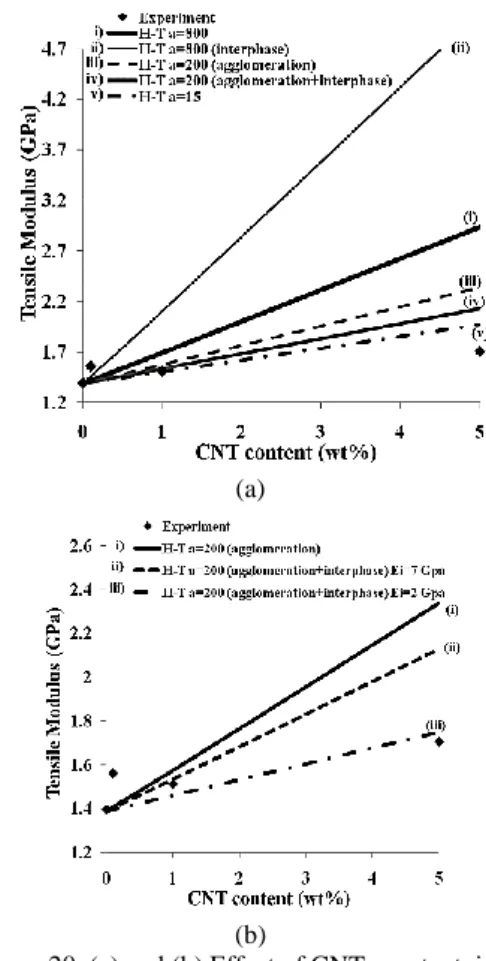
The effects of Interphase modulus and agglomeration in CNTs and graphite-based polypropylene polymeric composites on the
tensile modulus were studied by Karevan et al. [46]. The width of interphase and the size of agglomeration were investigated by atomic force microscopy. Halpin-Tsai micromechanical model was used to predict the modulus of the composites after being modified to take into account the presence of the interphase and agglomerations of the nanofillers. Experimental data for different wt.% of the nanofillers and the predicted data for different modulus values of the interphase were compared. Arash et al. conducted another study to investigate the effect of interfacial region and aspect ratio on the mechanical properties of CNTs/PMMA nanocomposite [47]. MD simulations were used to evaluate the elastic properties of the interfacial region. A three-phase micromechanical model was developed to predict the elastic properties of the nanocomposite. The modulus of elasticity of the CNT/ PMMA composite was sixteen times stiffer than that of the neat polymer. Furthermore, the higher the aspect ratio the higher the modulus of the interfacial region, which in turn increases the stiffness of the composite. Masud et al. [48], who adopted the FEM, confirmed the former results for the effect of the interphase on the effective elastic modulus of the nanocomposite. Using RVE models, Mamanpusha and Golestanian [49] considered the distribution of CNTs and interface strength in polymeric nanocomposites. In the longitudinal direction, better elastic modulus was obtained by the uniformly distributed CNTs. For the interface strength, increasing the elastic strength increases the elastic modulus of the uniformly distributed CNTs nanocomposite in the longitudinal direction, while the randomly distributed CNTs nanocomposite results exhibited increasing elastic modulus in all directions.
Other forms of carbon nanofillers, nanocones and nanocoils, were also used as reinforcing particles [50]. Khani et al. [50] developed an RVE model to investigate how the geometry of carbon coiled nanotubes may influence the properties of nanocomposites. As the diameter of the coil enlarges, the elastic modulus decreases. Also, under constant A/V ratio, single-walled carbon nanotubes showed better reinforcement than the coiled carbon nanotubes did.
III.
M
ECHANICALP
ROPERTIES OFO
XIDESN
ANOPARTICLES-R
EINFORCEDN
ANOCOMPOSITESNanoparticles are particles whose size ranges from 1-100 nm. These particles can be produced
by different methods. As in the case of carbon nanotubes, nanoparticles play a major role in the enhancement of the mechanical and physical properties of nanocomposites. Different nanoparticles such as alumina [62], [63], [64], [65], [66], [67], [68], [69], [70], [71], [72], [73], silica [74], [75], [76], [77], [78], [79], [80], [81], [82], [83], [84], and ZnO [85], [86], [87], [88], [89], [90], [91], [92], [93], [94] have been used to reinforce different polymeric and metallic matrices nanocomposites (MMNCs and PMNCs). Sallal et al. [67] prepared a nanomaterial of composite Al2O3-CaO nanoparticles by the
sol-gel method to evaluate the effect of these particles on some mechanical properties of a polymer blend matrix of epoxy and polyester resins. The weight percentages were increased from 0-2% and heat treatment with two different temperatures, 550°C and 850°C, was applied. In relation to the applied heat treatment, the tensile strength improved by 24% and 14%, the hardness by 25% and 22%, and the bending resistance by 23.5 and 16.8%. This nanomaterial, as the authors suggested, may find some applications as a bio material.
(a)
(b)
Figure 20. (a) and (b) Effect of CNTs content, interphase, and agglomeration on the tensile modulus of
CNTs/polypropylene nanocomposite [46]
Another study by Yousri et al. [68] on nanoparticles Al2O3/epoxy nanocomposite
showed that better strength was gained with the addition of alumina nanoparticles. This increase
nanocomposite with different weight fractions. The improvement in the properties (except for flexural strength) was better by the nano-alumina particles due to the high aspect ratio and (A/V) ratio of the nanoparticles, according to the authors. Noraiham Mohamad et al. [70] used Al2O3 as a reinforcing nanofiller in 53% EPR
matrix. They found that the addition of the nano-alumina particles reduced the absorbed energy (toughness), but improved the hardness up to 60%, while the addition of the reinforcing particle lessened the ratio of ENR to nano-silica, which in turn affected the impact strength.
(a)
(b)
(c)
Figure 21. The change in mechanical properties of epoxy-polyester reinforced by composite nanoparticles Al2O3-CaO
and heat treated to (a) 550°C and (b) 850°C [67]
Mazahery et al. [71] incorporated nanoparticles of alumina into a matrix of A356 aluminum alloy. The high amounts of the alumina tend to a structure of more casting defects and micro porosity. The highest tensile and compression stresses were at 1.5 and 2.5 wt.% of nano-alumina, respectively. Relative to the as-cast condition of the aluminum alloy, the ductility of alumina/A356 Al alloy and alumina/2024 Al alloy nanocomposites [72] decreased with the higher content of nano-alumina. In contrast, these nanoparticles improved the ductility of alumina/ 6061 Al alloy nanocomposite [73]. Ning Liao et al. enhanced a BN-SiC composite using nanofillers of Al2O3 and
ZrO3 [74]. The composite was hot pressed and
the percentages of SiC and Al2O3 were kept at
25% and 5%. ZrO3 was added in percentage
ranges from 0-25% in accordance with BN%. Both the fracture toughness and flexural strength were significantly improved.
Zhenga et al [75] dispersed nanoparticles of silica in an epoxy resin matrix. In order to uniformly disperse the particles ultrasonic waves, mechanical homogenizers were used. They found that there was 46.5% improvement in the impact strength until 3 wt. % of nano-SiO2 particles.
Then, the impact strength significantly dropped to the same value of the epoxy resin. The non-uniform dispersion of nano-silica at high wt. % content may be responsible for that drop.
Another study by Filippov [76] investigated the effect of the size of the nano-silica particles on the properties of a silica/epoxy nanocomposite. For this purpose, the concenrtation of the silica in the epoxy resin was holding at 1% and the
nanoparticles were supplied from two different origins. For the nano-silica particles of the same supplier, Filippov concluded that decreasing the size (diameter) of the nanoparticles resulted in the increasing of the elastic modulus of the nanocomposite. Tzetzisa et al. [77], and Hackett et al. [78] proved an improvement in the tensile strength and elastic modulus of nano-silica (0 and 45 wt. %) epoxy-based nanocomposites.
(a)
(b)
Figure 22. a - tensile stress-strain diagram, and b - compression stress-strain diagram for alumina/A356 alloy nanocomposite [71]
(a)
(b)
(c)
Figure 23. The percent elongation of: a - alumina/2024 Al alloy nanocomposite [72]; b - alumina/6061 Al alloy nanocomposite [73], and c - alumina/A356 Al alloy nanocomposite [71]
Forental and Sapozhnikov [79] studied the effect of volume fraction on the epoxy nanocomposites. They proposed a theoretical model to evaluate the strength of SiO2/epoxy
nanocomposites and held a comparison (Figure 24) between theoretical and experimental data. The difference was not more than 6%. On that, they recommended not to reinforce the epoxy resin with SiO2 nanoparticles more than 2%. Yi
Hua et al. [80] developed an RVE model to study the role of interfacial bonding and interphase on the stiffness of silica/epoxy nanocomposites. The distribution of stresses in the nanocomposite was increased with the increasing of the stiffness of the interfacial region. Furthermore, interfacial debonding caused the lower stiffness of the nanocomposite.
Figure 24. Impact strength of SiO2/epoxy nanocomposite [75]
Palza et al [81] observed the behavior of elastic modulus, among other properties, in a nanocomposite of polypropylene matrix reinforced two types of nano-silica particles: layered and spherical. Spherical particles displayed a better modulus of elasticity than layered particles. This suggested that the mechanism of failure is due to the entanglement of the polymer/particle rather than the traditional adhesion mechanism.
Figure 25. Strength versus wt.% for predicted and experimental values of SiO2/epoxy nanocomposite [79]
Figure 26. Interphase in a three-dimensional RVE model of nano-silica/epoxy nanocomposite [80]
(a)
(b)
Figure 27. REV models of: a - good bonding of the interphase-matrix; b - imperfect bonding [80]
Devaraju et al. [86] prepared a nanocomposite of palm fiber both with and without the addition of ZnO nanoparticles into an epoxy matrix to show their effects on mechanical properties. The weight percentages of ZnO nanoparticles were: 0.1, 0.3, and 0.5%. Tensile strength, impact strength, and flexural strength were increased over the range of the wt.% of the additives (Figure 28). The authors suggested that palm fibers could be used to replace glass fibers. Chang et al. [87] produced nano-zinc oxide (5-20 wt.%) reinforced UHMW polyethylene
claimed by Alam et al. [88], both stirring speed and concentration influenced flexural and tensile strength. The authors optimized the speed and concentration that give the best improvement in the mechanical properties using ANOVA analyses. Tobı´as et al. [89] studied the effect of synthesis process on the impact resistance of nano-zinc oxide/ABS nanocomposites using mass-suspension and mass-mass methods. The nanocomposites that were synthesized by the former method have a higher resistance to impact loads.
(a)
(b)
(c)
Figure 28. Mechanical properties of nano-zinc oxide/palm fiber/epoxy nanocomposites with different wt.% of zinc oxide nanoparticles: a - tensile strength; b - impact strength, and c - flexural strength [86]
(a)
(b)
(c)
Figure 29. Mechanical properties of nano-zinc oxide/PE nanocomposites with different wt.% of zinc oxide nanoparticles: a - compressive strength; b - Vickers hardness, and c - elongation [87]
IV.
C
ONCLUSIONSThis work reviewed the influence of adding nano-scale materials (carbon nanotubes and oxide nanoparticles) on the mechanical properties of nanocomposites with different metallic and polymeric matrices. In general, introducing the nanomaterials as a reinforcing phase improves mechanical properties such as tensile strength, flexural strength, hardness and fracture toughness. However, this improvement could be limited by the weight fraction. Optimum interaction between the reinforcing nanomaterials and the matrix of the nanocomposite leads to a transfer of the loads more effectively which is vital to enhance the properties of the reinforced nanocomposite.
The prescience of poor dispersion and interfacial debonding as well as some structural defects represents a challenge to attaining the desired mechanical properties in the produced CNT nanocomposites. These problems are proved to affect the experimentally-measured strength and elastic modulus of the nanocomposites relative to the theoretically predicted values assumed for good dispersion and interfacial bonding. In contrast, some research has attributed the discrepancies between the experimental and numerical approaches to the fact that most of the numerical studies have adopted ideal nanotube forms in the modeling process of the nanocomposites under investigation rather than including some of the defects that may be inherited during the synthesis of the carbon nanotubes such as waviness and other structural defects.
Interphase is an interesting phenomenon of the nanocomposites in comparison with their microcomposite counterparts due to the high aspect ratio of the former. The elastic properties and the thickness over which the interphase extends in the region between the matrix and the nanofiller were observed by many researchers who correlated the improvement in the elastic modulus of the nanocomposites with an increase in those of the interphase.
A
CKNOWLEDGEMENTThe author would like to acknowledge The Unversity of Mosul for its contineous support and encouregment.
R
EFERENCES[1]
ASKELAND, D.R. and FULAY, P.P.
(2009) Essentials of Materials Science and
Engineering. 2nd ed. Boston, Massachusetts:
Cengage Learning.
[2]
HU, H., ONYEBUEKE, L., and
ABATAN, A. (2010) Characterizing and
Modeling
Mechanical
Properties
of
Nanocomposites Review and Evaluation.
Journal
of
Minerals
and
Materials
Characterization and Engineering, 9 (4), pp.
275-319.
[3]
CISELLI, P. (2007) The potential of
carbon nanotubes in polymer composites.
PhD.
thesis,
Technische
Universiteit
Eindhoven.
[4]
MENSAH, B., KIM, H.G., LEE, J.-H.,
AREPALLI, S., and NAH, C. (2015) Carbon
Nanotube-Reinforced
Elastomeric
Master thesis, University of Texas.
[6]
ANDO, Y., ZHAO, X., SUGAI, T.,
and KUMAR, M. (2004) Growing Carbon
Nanotubes. Materials Today, 7 (10), pp.
22-29.
[7]
MARIETTA-TONDIN, O. (2005)
Molecular Modeling of Nanotube Composite
Materials: Interface Formation, Interfacial
Strength, and Thermal Expansion. PhD.
thesis, Florida State University.
[8]
DAENEN, M., DE FOUW, R.D.,
HAMERS,
B.,
JANSSEN,
P.G.A.,
SCHOUTEDEN, K., and VELD, M.A.J.
(2003) The Wondrous World of Carbon
Nanotubes: A Review of Current Carbon
Nanotubes
Technologies.
Eindhoven:
Eindhoven University of Technology.
[9]
PARK, Y.S., KIM, K.S., JEONG,
H.J., KIM, W.S., MOON, J.M., AN, K.H.,
BAE, D.J., LEE, Y.S., PARK, G.-S., and
LEE, Y.H. (2002) Low Pressure Synthesis of
Multi-Walled Carbon Nanotubes by Arc
Discharge Method. Synthesis Metals, 126, pp.
245-251.
[10]
WANG, Y., WEI, F., LUO, G., YU,
H., and GU, G. (2002) The Large-Scale
Production of Carbon Nanotubes in a
Nano-Agglomerate
Fluidized-Bed
Reactor.
Chemical Physics Letters, 364, pp. 568-572.
[11]
CHEN, G.Z. and FRAY, D.J. (2003)
Recent
Development
in
Electrolytic
Formation of Carbon Nanotubes in Molten
Salts. Journal of Mining and Metallurgy, 39
(1-2), pp. 309-342.
[12]
ZEIN, S.H.S., MOHAMED, A.R.,
SAI, P.S.T., and ZABIDI, N.A.M. (2004)
Production
of
Hydrogen
and
Carbon
Nanotubes from Methane. Journal of
Industrial and Engineering Chemistry, 10 (6),
pp. 869-876.
[13]
BERA,
D.,
KUIRY,
S.C.,
MCCUTCHEN, M., and SEAL, S. (2004) In
Situ
Synthesis
of
Carbon
Nanotubes
Decorated with Palladium Nanoparticles
Using Arc-Discharge in Solution Method.
[15]
TAKAO,
Y.,
NAGAI,
S.,
KUGIMIYA, A., TAKIKAWA, H., and
KOBAYASHI, A. (2007) Nanoparticles
Generation by Confront Electrode Type
Plasma Jet. Transaction of Journal of
Welding Research Institute, 36 (2), pp. 23-27.
[16]
TSAI, Y.Y., SU, J.S., and SU, C.Y.
(2008) A novel method to produce carbon
nanotubes using EDM process. International
Journal of Machine Tools & Manufacture, 48,
pp. 1653-1657.
[17]
TSAI, Y.Y., SU, J.S., and SU, C.Y.
(2009) An underwater arc discharge method
of CNT production using carbon electrode
physical vibrations. The Japan Society of
Plasma
Science
and
Nuclear
Fusion
Research, 8, pp. 612-614.
[18]
AHMADZADE, F., SAFA, S., and
BALASHABADY, P. (2010) Growth of
Vertically Aligned Carbon Nanotubes by
DCPECVD System and the Effects of C
2H
2Concentration and Plasma Current on the
Growth Behavior of CNTs. The Arabian
Journal for Science and Engineering, 35
(1C), pp. 29-36.
[19]
SALVETAT, J.P., BONARD, J.-M.,
THOMSON, N.H., KULIK, A.J., FORR´O,
L., BENOIT, W., and ZUPPIROLI, L. (1999)
Mechanical Properties of Carbon Nanotubes.
Applied Physics A, 69, pp. 255-260.
[20]
KHARE, R. and BOSE, S. (2005)
Carbon Nanotube Based Composites - A
Review. Journal of Minerals & Materials
Characterization & Engineering, 4 (1), pp.
31-46.
[21]
YU,
M.-F.
(2004)
Fundamental
Mechanical Properties of Carbon Nanotubes:
Current Understanding and the Related
Experimental
Studies.
Journal
of
Engineering Materials and Technology, 126
(3), pp. 271-278.
[22]
ANTISARI, M.V., GATTIA, D.M.,
BRANDÃO, L., MARAZZI, R., and
MONTONE,
A.
(2010)
Carbon
Discharge. Materials Science Forum,
638-642, pp. 1766-1771.
[23]
BRCIC, M., CANADIJA, M., and
BRNIC, J. (2015) Influence of Waviness and
Vacancy Defects on Carbon Nanotubes
Properties. Procedia Engineering, 100, pp.
213-219.
[24]
KUMAR, P. and SRINIVAS, J.
(2017) Elastic Behavior Of CNT-Reinforced
Polymer Composites with Discontinuities in
CNT Configurations. Materials Science and
Engineering, 178, pp. 1-11.
[25]
ANDREWS,
R.
and
WEISENBERGER, M.C. (2004) Carbon
nanotube polymer composites. Current
Opinion in Solid State and Materials Science,
8, pp. 31-37.
[26]
ZHENG, L. (2012) How Carbon
Nanotubes
Be
Used
in
Mechanical
Applications. Journal of Applied Mechanical
Engineering,
1
(3).
Available
from
https://www.longdom.org/open-access/how-
carbon-nanotubes-be-used-in-mechanical-applications-2168-9873.1000e108.pdf
.
[27]
DENG, F. and VAN VLIET, K.J.
(2011) Prediction of elastic properties for
polymer–particle nanocomposites exhibiting
an interphase. Nanotechnology, 22, pp. 1-7.
[28]
XU,
L.R.,
BHAMIDIPATI,
V.,
ZHONG, W.-H., LI, J., LUKEHART, C.M.,
LARA-CURZIO, E., LIU, K.C., and LANCE,
M.J.
(2004)
Mechanical
Property
Characterization
of
a
Polymeric
Nanocomposite Reinforced by Graphitic
Nanofibers with Reactive Linkers. Journal of
Composite Materials, 38, pp. 1563-1582.
[29]
YANG, C.-K., LEE, Y.-R., HSIEH,
T.-H., CHEN, T.-H., and CHENG, T.-C.
(2018) Mechanical Property of Multiwall
Carbon
Nanotube
Reinforced
Polymer
Composites.
Polymers
&
Polymer
Composites, 26 (1), pp. 99-104.
[30]
HUSSEIN, R.M. (2017) The Effect of
Walled Nano-Carbon on the Physical,
Thermal and Mechanical Properties of Epoxy.
Al-Khwarizmi Engineering Journal, 13 (4),
pp. 69- 79.
[31]
ABU-HAMDEH, N. and ALNEFAIE,
K. (2015) Mechanical Properties and
Gradient Effects of Carbon Nanotube as
Polymer Nanocomposites. In: Proceedings of
the International Conference on Computer
Information
Systems
and
Industrial
Applications. Atlantis Press, pp. 626-628.
[32]
YIP, M.-C., LIN, Y.-C., and WU,
C.-L. (2011) Effect of Multi-Walled Carbon
Nanotubes
Addition
on
Mechanical
Properties of Polymer Composites Laminate.
Polymers & Polymer Composites, 19 (2 & 3),
pp. 131-140.
[33]
SHOKRIEH, M.M., SAEEDI, A., and
CHITSAZZADEH, M. (2013) Mechanical
Properties
of
Multi-Walled
Carbon
Nanotube/Polyester
Nanocomposites.
Journal of Nanostructure in Chemistry, 3, 20.
[34]
LI, J. (2017) Multiwalled Carbon
Nanotubes
Reinforced
Polypropylene
Composite
Material.
Journal
of
Nanomaterials, 2017, 2171356.
[35]
TSERPES, K., CHANTELI, A.,
PANTELAKIS, S., KOUMOULOS, E.P.,
and CHARITIDIS, C.A. (2018) Mechanical
and
nanomechanical
properties
of
MWCNT/PP nanocomposite. Frattura ed
Integrità Strutturale, 46, pp. 73-83.
[36]
HADIANFARD, M.J., ALIZADEH,
M., and MORADZAMAN, M. (2019)
Effects
of
Chemical
and
Mechanical
Functionalization of Carbon Nanotubes on
the
Behavior
of
a
CNT/Phenolic
Nanocomposite. Boletín del Grupo Español
del Carbón, 51, pp. 20-25.
[37]
MIRIK,
M., EKINCI,
Ş., and
TAŞYÜREK, M. (2016) Charpy Impact
Resistances of Carbon Nanotubes Reinforced
High Density Polyethylene Nanocomposite
Materials. International Journal of Materials,
Mechanics and Manufacturing, 4 (4), pp.
247-250.
[38]
PARK, Y., CHOA, K., PARKA, I.,
and PARKA, Y. (2011) Fabrication and
Mechanical Properties of Magnesium Matrix
Composite Reinforced with Si Coated
Carbon Nanotubes. Procedia Engineering,
10, pp. 1446-1450.
[39]
KOTI, V., GEORGE, R., SHAKIBA,
A.,
and
MURTHY,
K.V.S.
(2018)
Mechanical
Properties
of
Copper
Nanocomposites Reinforced with Uncoated
and Nickel Coated Carbon Nanotubes. FME
Transactions, 46 (4), pp. 623-630.
[40]
CHEN, X., BAO, R., YI, J., FANG,
D., TAO, J., and LIU, Y. (2019) Enhancing
Interfacial Bonding and Tensile Strength in
Sintering Method (DPDS). Journal of
Nanostructures, 9 (1), pp. 94-102.
[42]
ISAZA,
C.A.M.,
LEDEZMA
SILLAS, J.E., MEZA, J.M., and HERRERA
RAMÍREZ,
J.M.
(2017)
Mechanical
Properties and Interfacial Phenomena in
Aluminum
Reinforced
with
Carbon
Nanotubes Manufactured by the Sandwich
Technique. Journal of Composite Materials,
51 (11), pp. 1619-1629.
[43]
URIZA-VEGA,
E.,
CARREÑO-GALLARDO, C., LÓPEZ-MELÉNDEZ, C.,
CUADROS-LUGO,
E.,
PÉREZ-BUSTAMANTE, R., LEDEZMA-SILLAS,
E., and HERRERA-RAMIREZ, J.M. (2019)
Mechanical Behavior of Multiwalled Carbon
Nanotube Reinforced 7075 Aluminum Alloy
Composites Prepared by Mechanical Milling
and Hot Extrusion. Materials Research, 22
(2), pp. 1-9.
[44]
SHEIKHNEJAD, O., NAKAMOTO,
T., KALTEIS, A., RAJABTABAR, A., and
MAJOR, Z. (2018) Molecular Dynamic
Simulation of Carbon Nanotube Reinforced
Nanocomposites: The Effect of Interface
Interaction on Mechanical Properties. MOJ
Polymer Science, 2 (1), pp. 6-10.
[45]
MOKASHI, V.V., QIAN, D., and
LIU, Y. (2007) A Study on the Tensile
Response and Fracture in Carbon
Nanotube-Based
Composites
Using
Molecular
Mechanics.
Composites
Science
and
Technology, 67, pp. 530-540.
[46]
KAREVAN, M., PUCHA, R.V.,
BHUIYAN, M.A., and KALAITZIDOU, K.
(2010) Effect of Interphase Modulus and
Nanofiller Agglomeration on the Tensile
Modulus of Graphite Nanoplatelets and
Carbon Nanotube Reinforced Polypropylene
Nanocomposites. Carbon Letters, 11 (4), pp.
325-331.
[47]
ARASH, B., WANG, Q., and
VARADAN,
V.K.
(2014)
Mechanical
properties
of
carbon
nanotube/polymer
composites. Scientific Reports, 4, 6479.
GOLESTANIAN, H. (2014) Evaluation of
Effective Material Properties of Randomly
Distributed Carbon Nanotube Composite
Considering
Interface
Strength.
Indian
Journal of Scientific Research, 2 (1), pp.
132-142.
[50]
KHANI, N., YILDIZ, M., and KOC,
B. (2016) Elastic Properties of Coiled Carbon
Nanotube Reinforced Nanocomposite: A
Finite Element Study. Materials and Design,
109, pp. 123-132.
[51]
YAKOBSON, B.I. and AVOURIS, P.
(2001) Mechanical Properties of Carbon
Nanotubes. In: DRESSELHAUS, M.S.,
DRESSELHAUS, G., and AVOURIS, P.
(eds.) Carbon Nanotubes. Topics in Applied
Physics, Vol. 80. Berlin, Heidelberg:
Springer, pp. 287-327.
[52]
AKILADEVI, D. and BASAK, S.
(2010)
Carbon
Nanotubes
(CNTs)
Production,
Characterization
and
Its
Applications.
International
Journal
of
Advances in Pharmaceutical Sciences, 1 (3),
pp. 187-195.
[53]
KARTHIKEYAN,
S.,
MAHALINGAM, P., and KARTHIK, M.
(2009) Large Scale Synthesis of Carbon
Nanotubes. E-Journal of Chemistry, 6 (1), pp.
1-12.
[54]
LI, Z., WANG, L., LI, Y., FENG, Y.,
and FENG, W. (2019) Carbon-Based
Functional
Nanomaterials:
Preparation,
Properties and Applications. Composites
Science and Technology, 179, pp. 10-40.
[55]
SONG, K., ZHANG, Y., MENG, J.,
GREEN, E.C., TAJADDOD, N., LI, H., and
MINUS, M.L. (2013) Structural
Polymer-Based Carbon Nanotube Composite Fibers:
Understanding the Processing–Structure–
Performance Relationship. Materials, 6, pp.
2543-2577.
[56]
MIYAGAWA, H., MISRA, M., and
MOHANTY,
A.
(2005)
Mechanical
Properties of Carbon Nanotubes and Their
Polymer
Nanocomposites:
A
Review.
Journal of Nanoscience and Nanotechnology,
5, pp. 1593-1615.
[57]
KHARE, R. and BOSE, S. (2005)
Carbon Nanotube Based Composites-A
Review. Journal of Minerals and Materials
Characterization & Engineering, 4 (1), pp.
31-46.
[58]
RANDJBARAN, E., ZAHARI, R.,
MAJID, D.L., SULTAN, M.T.H., and
MAZLAN, N. (2017) Reasons of Adding
Carbon Nanotubes into Composite Systems –
Review Paper. Mechanics and Mechanical
Engineering, 21 (3), pp. 549-568.
[59]
SATISH, G., PRASAD, V.V.S., and
RAMJI, K. (2017) Manufacturing and
Characterization of CNT Based Polymer
Composites.
Mathematical
Models
in
Engineering, 3 (2), pp. 89-97.
[60]
KAUSAR, A. (2018)
Nanocarbon-Based Nanocomposite in Green Engineering.
Research Journal of Nanoscience and
Engineering, 2 (1), pp. 28-33.
[61]
CHEN, J., LIU, B., GAO, X., and XU,
D. (2018) A review of the interfacial
characteristics of polymer nanocomposites
containing carbon nanotubes. RSC Advances,
49, pp. 28048-28085.
[62]
MA, P., JIA, Y., GOKULDOSS, P.K.,
YU, Z., YANG, S., ZHAO, J., and LI, C.
(2017) Effect of Al
2O
3Nanoparticles as
Reinforcement on the Tensile Behavior of
Al-12Si Composites. Metals, 7 (9), 359.
[63]
ANTIN, K.-N. and JALAVA, K.
(2015) Mechanical Properties of Cast
Aluminum Matrix Composites Reinforced
with
SiC
and
Al
2O
3Particles.
In:
Proceedings of the 20th International
Conference
on
Composite
Materials,
Copenhagen,
July
2015.
Denmark:
Scandinavian Organizing and Scientific
Committee of International Conference on
Composite
Materials.
Available
from
https://research.aalto.fi/files/3633161/Antin_
MMC.pdf.
[64]
AL-SALIHI,
H.A., MAHMOOD,
A.A.,
and
ALALKAWI,
H.J.
(2019)
Mechanical and Wear Behavior of AA7075
Aluminum Matrix Composites Reinforced by
Al
2O
3Nanoparticles. Nanocomposites, 5, pp.
67-73.
[65]
GOMEZ, I.V. (2011) Influence of
nano-particles of alumina (Al
2O
3) and
titanium
di-boride
(TiB2)
on
the
microstructure and properties of the alloy
Al-Cu 3-Fe1-Si9 for foundry applications to
high pressure. Doctoral thesis, Université
Sciences et Technologies - Bordeaux I.
[66]
ROUDINI,
G.,
RASTI
GHANFAROKHI, A., and BEHZADMEHR,
A. (2017) Copper laminated composites
reinforced with Al
2O
3nanoparticles by
suspension method and hot pressing. IOP
Conference Series: Materials Science and
Engineering, 201, 012026.
[67]
SALLAL, H.A., ABDUL-HAMEAD,
A.A., and OTHMAN, F.M. (2019) Effect of
nano powder (Al
2O
3-CaO) addition on the
mechanical properties of the polymer blend
matrix composite. Defence Technology.
Available
from
https://www.sciencedirect.com/science
/article/pii/S2214914719302922?via%
3Dihub.
[68]
YOUSRI,
O.M.,
ABDELLATIF,
M.H., and BASSIONI, G. (2017) Effect of
Al
2O
3Nanoparticles on the Mechanical and
Physical Properties of Epoxy Composite.
Arabian Journal for Science and Engineering,
43, pp. 1511-1517.
[69]
AL-MOSAWI, A.I., ABDULSADA,
S.A., and RIJAB, M.A. (2015) Mechanical
Properties
of
Epoxy
Nanocomposite.
International Journal of Advanced Research,
3 (6), pp. 1468-1472.
[70]
MOHAMAD, N., MUCHTAR, A.,
GHAZALI,
M.J.,
MOHD,
D.H.,
and
AZHARI, C.H. (2008) The Effect of Filler
on Epoxidized Natural Rubber-Alumina
Nanoparticles
Composites.
European
Journal of Scientific Research, 24 (4), pp.
538-547.
[71]
MAZAHERY,
A.
and
OSTADSHABANI, M. (2011) Investigation
on mechanical properties of nano-Al
2O
3-reinforced aluminum matrix composites.
Journal of Composite Materials, 45, pp.
2579-2585.
[72]
MOHAMMED,
A.-A.H.J.,
AL-RASIAQ, A.A., and AL-JAAFARI, M.A.A.
(2018) Studying the Effect of Different wt. %
AL
2O
3Nanoparticles
of
2024Al
Alloy/AL
2O
3Composites on Mechanical
Properties.
Al-Khwarizmi
Engineering
Journal, 14 (2), pp. 147-153.
[74]
LIAO, N., QIU, B., NATH, M., LI,
Y., and SANG, S. (2020) Effects of Nano
ZrO
2Content
on
the
Comprehensive
Properties of BN-SiC Composites. Journal of
Alloys and Compounds, 813, pp. 1-10.
[75]
ZHENG, Y., ZHENG, Y., and NING,
R. (2003) Effects of nanoparticles SiO
2on
the
performance
of
nanocomposites.
Materials Letters, 57, pp. 2940-2944.
[76]
FILIPPOV, А.А. (2018) Effect of the
Size of Silica Nanoparticles on the
Mechanical Characteristics of Heterogeneous
Epoxy Resin Materials. AIP Conference
Proceedings, 2053, 030014.
[77]
TZETZIS, D., TSONGAS, K., and
MANSOUR, G. (2017) Determination of the
Mechanical Properties of Epoxy Silica
Nanocomposites through FEA Supported
Evaluation of Ball Indentation Test Results.
Materials Research, 20 (6), pp. 1571-1578.
[78]
HACKETT, S.C., NELSON, J.M.,
HINE, A.M., SEDGWICK, P., and LOWE,
R.H. (2010) The Effect of Nanosilica
Concentration on the Enhancement of Epoxy
Matrix Resins for Prepreg Composites.
Available
from
http://multimedia.3m.com/mws/media/79170
4O/nanosilica-concentration-effects-in-epoxy-prepreg-white-paper.pdf.
[79]
FORENTAL,
G.A.
and
SAPOZHNIKOV, S.B. (2011) Strength
Prediction of Epoxy Nanocomposite. In:
Proceedings of the 18th International
Conference on Composite Materials, August
2011.
Available fromhttps://iccm-central.org/Proceedings/ICCM18proceedings/dat a/3.%20Poster%20Presentation/Aug24%28Wedn esday%29/P3-16~63%20Nanocomposites/P3-28-IF1363.pdf
.
[80]
HUA, Y., GU, L., PREMARAJ, S.,
and ZHANG, X. (2015) Role of Interphase in
the Mechanical Behavior of Silica/Epoxy
Resin Nanocomposites. Materials, 8, pp.
3519-3531.
[81]
PALZA, H., VERGARA, R., and
ZAPATA,
P.
(2011)
Composites
of
Composite Resins. Journal of Dental
Research, Dental Clinics, Dental Prospects,
10 (2), pp. 112-117.
[83]
AHN, S.H., KIM, S.H., and KIM,
B.C. (2004) Mechanical properties of silica
nanoparticle reinforced poly(ethylene 2,
6-naphthalate). Macromolecular Research, 12
(3), pp. 293-302.
[84]
MA, P., JIANG, G.G, LI, Y., and
ZHONG,
W.
(2015)
The
Impact
Compression
Behaviors
of
Silica
Nanoparticles—Epoxy Composites. Journal
of Textile Science and Technology, 1, pp.
1-11.
[85]
MOTAUNG,
T.E.,
SALADINO,
M.L., LUYT, A.S., and MARTINO, D.F.C.
(2012) The effect of silica nanoparticles on
the morphology, mechanical properties and
thermal
degradation
kinetics
of
polycarbonate. Composites Science and
Technology, 73, pp. 34-39.
[86]
DEVARAJU, A., SIVASAMY, P.,
and
LOGANATHAN,
G.B.
(2019)
Mechanical
properties
of
polymer
composites
with
ZnO
nano-particle.
Materials Today: Proceedings.
Available fromhttps://www.sciencedirect.com/science/article/pii /S2214785319331335?via%3Dihub.
[87]
CHANG, B.P., AKIL, H.M., NASIR,
R.B.M.,
BANDARA,
I.M.C.C.D.,
and
RAJAPAKSE, S. (2014) The effect of ZnO
nanoparticles on the mechanical, tribological
and antibacterial properties of ultra-high
molecular weight polyethylene. Journal of
Reinforced Plastics and Composites, 33 (7),
pp. 674-686.
[88]
RODRÍGUEZ‐ TOBÍAS, H.,MORALES, G., RODRÍGUEZ‐ FERNÁNDEZ, O.,
![Figure 1. Traditional composites versus nanocomposites from the length-scale point of view [28]](https://thumb-ap.123doks.com/thumbv2/123deta/8047039.1255138/2.892.488.749.89.262/figure-traditional-composites-versus-nanocomposites-length-scale-point.webp)
![Figure 4. a - Method of rolling a graphite sheet into a nanotube; b - armchair CNT; c - zig-zag CNT [3]](https://thumb-ap.123doks.com/thumbv2/123deta/8047039.1255138/3.892.143.393.88.436/figure-method-rolling-graphite-sheet-nanotube-armchair-cnt.webp)
![Figure 9. Methods of carbon nanotubes synthesis: a - laser- laser-furnace method; b - thermal CVD method [6]](https://thumb-ap.123doks.com/thumbv2/123deta/8047039.1255138/4.892.102.396.89.443/figure-methods-carbon-nanotubes-synthesis-furnace-method-thermal.webp)
![Figure 11. Interphase in a nanoparticle [2]](https://thumb-ap.123doks.com/thumbv2/123deta/8047039.1255138/5.892.488.802.88.533/figure-interphase-in-a-nanoparticle.webp)
![Figure 14. Mechanical properties of MWCNTs/PP nanocomposites [34]](https://thumb-ap.123doks.com/thumbv2/123deta/8047039.1255138/6.892.91.402.333.816/figure-mechanical-properties-mwcnts-pp-nanocomposites.webp)
![Figure 19. Stress-strain diagram of amorphous PE/SWCNTs composites [45]](https://thumb-ap.123doks.com/thumbv2/123deta/8047039.1255138/7.892.504.773.827.1044/figure-stress-strain-diagram-amorphous-pe-swcnts-composites.webp)
![Figure 21. The change in mechanical properties of epoxy- epoxy-polyester reinforced by composite nanoparticles Al 2 O 3 -CaO and heat treated to (a) 550°C and (b) 850°C [67]](https://thumb-ap.123doks.com/thumbv2/123deta/8047039.1255138/9.892.513.724.78.405/figure-mechanical-properties-polyester-reinforced-composite-nanoparticles-treated.webp)
![Figure 23. The percent elongation of: a - alumina/2024 Al alloy nanocomposite [72]; b - alumina/6061 Al alloy nanocomposite [73], and c - alumina/A356 Al alloy nanocomposite [71]](https://thumb-ap.123doks.com/thumbv2/123deta/8047039.1255138/10.892.98.402.274.718/figure-percent-elongation-alumina-nanocomposite-alumina-nanocomposite-nanocomposite.webp)
![Figure 27. REV models of: a - good bonding of the interphase-matrix; b - imperfect bonding [80]](https://thumb-ap.123doks.com/thumbv2/123deta/8047039.1255138/11.892.517.767.455.1044/figure-rev-models-bonding-interphase-matrix-imperfect-bonding.webp)
