西 南 交 通 大 学 学 报
第 54 卷第 6 期
2019 年 12 月
JOURNAL OF SOUTHWEST JIAOTONG UNIVERSITY
Vol. 54 No. 6
Dec. 2019
ISSN: 0258-2724 DOI:10.35741/issn.0258-2724.54.6.10
Research Article MathematicsO
PTIMUM
C
OST OF
T
RANSPORTING
P
ROBLEMS WITH
H
EXAGONAL
F
UZZY
N
UMBERS
具有六角模糊数的运输问题的最优成本
Marwan Abdul Hameed Ashour
Statistics Department, College of Administration & Economics, University of Baghdad Al-Jadriya, Karrada, Baghdad, Iraq, [email protected]
Abstract
Transportation problems can be used in managing shipments straightforwardly from the supply point to the demand point. More recently, there has been widespread interest in applying transportation problems to optimize the fuzzy number systems. The ability to distinguish and make use of particular structures is a significant factor in the efficacious application of optimization models. In this paper, fuzzy methods of hexagonal are used to solve transportation problems when the demand and destination are uncertain. The most important findings of this paper are reaching the optimum transportation cost minimization through magnitude hexagonal fuzzy numbers. The results verified that the optimal transport plan of the company succeeded in minimizing the total cost to 1222$. The outcomes of this paper can be optimized by particle swarm optimization as a future trend.
Keywords: Hexagonal Fuzzy Number, Optimization Model, Transportation Model, Minimizing Cost, Uncertain of Demand 摘要 运输问题可用于直接管理从供应点到需求点的货运。 最近,在应用运输问题以优化模糊数系 统方面引起了广泛的兴趣。区分和利用特定结构的能力是有效使用优化模型的重要因素。在需求 和目的地不确定的情况下,本文采用模糊六边形方法求解运输问题。 本文最重要的发现是通过数 量级六边形模糊数达到最佳运输成本最小化。结果证明,公司的最佳运输计划成功地将总成本降 至了 1222 美元。 可以将粒子群优化作为未来趋势来优化本文的结果。 关键词: 六角模糊数,优化模型,运输模型,成本最小化,需求不确定
I. I
NTRODUCTIONThe most common applications of linear programming (LP) are problems of transportation. Usually, the objective of the transportation
problem is to regulate the optimum plan from dissimilar sources to dissimilar destinations to minimize the cost of transportation [18]. In 1956, the idea of a transshipment problem was
introduced. To solve the transshipment problem, the overall shipping costs or the overall distance or time based on each shipping route can be minimized. Many other problems related to decision-making, which are quite dissimilar from that of the delivery-planning problem, minimize themselves to the transportation problem. The objective of the paper is to specify the optimum solution to the transportation problem with fuzzy demand and destination.
In many problems of fuzzy decisions, the data have been characterized based on fuzzy numbers. The fuzzy set theory has been applied using the function of membership since the values are not clear and definite due to uncertainties. In a fuzzy environment, fuzzy numbers of ranking are very important in the decision-making procedure. The fuzzy number of ranking has been applied mainly in data analysis. Jain [1] was first to propose fuzzy numbers of ranking for decision-making in uncertain (fuzzy) circumstances by expressing the imprecise quality as a fuzzy number set. The authors of [1], [2], have also proposed a sign distance technique for ranking fuzzy numbers. In addition to the proposal for a new ranking on hexagonal fuzzy numbers in the optimal problem application of other researchers.
In [3], supply, cost, and demand of an integer fuzzy transportation problem have been taken into consideration as an intuitionistic triangular fuzzy number. The costs have altered to crisp magnitudes as a result of defuzzifying in order to obtain the optimal solution. This technique is very supportive for decision makers, as the procedure is highly simple with fewer iterations.
In [4], a Fuzzy Russell’s algorithm was proposed for the basic practicable solution to a fuzzy transportation problem based on a solved numerical example. This process can be used for any class of fuzzy numbers: abnormal or normal, trapezoidal or triangular, or any LR fuzzy number.
A fuzzy project network with hexagonal fuzzy numbers in addition to generalized hexagonal fuzzy numbers is presented in [5] with detailed examples. The math operations are performed using hexagonal fuzzy numbers. Accordingly, a fuzzy critical path has been acquired by the ranking method.
In [6], a transportation problem with getting optimal solution has been formulated under various sources, destinations and costs with various fuzzy numbers. The algorithm can be employed in fuzzy, real as well as intuitionistic fuzzy numbers. Mixed intuitionistic fuzzy BCM has been employed to realize the optimum
solution based on triangular intuitionistic fuzzy numbers.
In [7], a generalized hexagonal fuzzy number has been recently presented for solving a fuzzy transshipment problem based on a balance and unbalance fuzzy transshipment problem by numerous algorithms. These algorithms are compared to catch the finest solution.
The transportation model (TP) has been extensively employed to solve real life problems as in investment, programming, production, inventory control, plant’s location, personal assignment, as stated in [8]. The transportation model is actually not restricted to transportation or distribution only since there are numerous methods to solve the TP characteristically. Exact data have been insufficient to model in real life situations under numerous conditions. Human judgments involving preference are frequently inexplicit and they cannot evaluate preferences with exact arithmetical data. Ranking fuzzy numbers stands for a significant tool in decision-making. Fuzzy numbers have been applied using fuzzy decision analysis to explain the functioning of alternatives in modeling a real world problem. In [8], Robust’s technique has been employed to find the least transportation cost of several commodities introducing an innovative way to solve the TP by means of a hexagon number with Alpha – cut for ranking technique and specified appropriate mathematical examples.
In this paper, we present a fuzzy transportation model, in which demand and destination are hexagonal fuzzy numbers, and apply it to the expected cost. The structure of this paper is divided into two main parts as follows: the theoretical part includes the concept of the transportation method and the hexagonal fuzzy number, and the other part represents the practical application in an Iraqi company for producing office furniture.
II. M
ETHODSA. Fuzzy Sets
Fuzzy Set [FS] a fuzzy set definitely on the real numbers universal set R is told to be a fuzzy number if its functions of membership have the following specifications [5], [7], [11]:
a. 𝜇 : R⟶ [0,1] is continuous
b. 𝜇 (y) = 0 for all xϵ[-∞,b1]∪ [b4,∞] c. 𝜇 (y) is exactingly cumulative on [b1,b2] and strictly decreasing on [b3,b4]
d. 𝜇 (y) = 1 for all x€[b2,b3] where b1 ≤ b2
B Fuzzy set C of the real line R with function of membership µ (z): R ⟶ [0,1] is called a fuzzy number if:
a. necessity is a normal and convex fuzzy set.
b. bound the support of necessity. c. α. necessity is a closed interval for every α in [0,1].
B. Generalized Fuzzy Number
A fuzzy set à = (b, c, d, e, ω) is a description of a universal set of real numbers in the case if its function of membership has the subsequent attributes [3], [8], [9]:
d. 𝜇 (y): R⟶ [0,1] is continuing e. 𝜇 (y) = 0 for all xϵ[-∞,b]∪ [c,∞]
f. 𝜇 (y) is strictly increasing on [b,c] and strictly decreasing on [e,d]
g. 𝜇 (y) = ω for all xϵ[c,d] where 0 < ω ≤ 1
C. Trapezoidal Fuzzy Number
A fuzzy number stands for a trapezoidal fuzzy number represented by (b1,b2,b3,b4) and its
relationship function is given by [12]:
where b1 ≤ b2 ≤ b3 ≤ b4.
D. Generalized Trapezoidal Fuzzy Number A fuzzy number of generalized = (b1, b2, b3,
b4: 𝓌) is told to be a generalized trapezoidal
fuzzy number membership function is given by equation (3) [4], [7]:
E. Hexagonal Fuzzy Number
A fuzzy number FL is a fuzzy number of
hexagonal represented by 𝐹 ̃L = (L1, L2, L3, L4, L5,
L6). It is a real number, and its function of
membership is given by equation (3) [12].
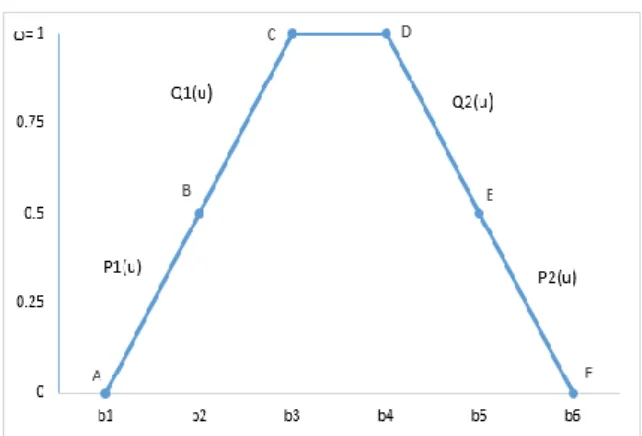
Figure 1. The fuzzy number of hexagonal behaviors
HFN denoted by 𝐹 ̃ω is definite as 𝐹 ̃ω = (P1
(𝓿), Q1 (𝓿), Q2 (𝓿), P2 (𝓿)) for 𝓿€ [0, 0.5] and
𝓿€ [0.5].
The fuzzy number of generalized hexagonal ranking functions BL=(b1,a2,b3,b4,b5,b6;𝓌) which
maps the set of all numbers of fuzz to a real number set [4], [5], [7].
F. Transportation Model
The transportation model is one of the most important models of mathematical programming in production institutions. This model works to transfer products from many sources represented by supply centers to different destinations represented by demand centers in the minimized cost if supply, destination, and the cost have been known and determined. The historical roots of the transport model date back to 1941, when Hitchcock presented his study on the distribution of products from several sources to different destinations. In 1947, Koopmans presented his study on the optimal use of the transport system, which was further developed by Danzig in 1963. Assume models of transport m from sources and n from destinations. The main objective is to determine the number of units transferred from the source m to the destination in so that the overall transportation cost has been minimized. The mathematical programming model for the problem of transport is as follows [10], [13], [14]:
where:
Sm represents the number of units displayed as source m.
Dn represents the number of units required at destination n.
Cmn represents the transport costs a unit at the path (m, n) that connects the source m to the destination n.
Zmn represents the number of units transferred from the source m to the destination n.
G represents the overall distribution cost.
III. A
PPLICATIONThe Iraqi Office Furniture Company is one of the formations of the Ministry of Industry. It has three factories and four marketing centers. Table 1 shows the fuzzy production capacity of each factory and the fuzzy demands of each center and the transportation cost from the factory in the center; the overall cost is 1527.5$.
Table 1.
Fuzzy production capacity of each factory and fuzzy demands of each center and the transportation cost from the factory in the center
Center/ factory C1 C2 C3 C4 Fuzzy capacity F1 2 0 40 22 27, 28, 29, 30, 31, 32 F2 24 14 18 40 47, 48, 49, 50, 51, 51, 52 F3 0 28 32 36 7, 8, 9, 10, 11, 12 Fuzzy demand 7, 8, 9, 10, 11, 12 27, 28, 29, 30, 31, 32 27, 28, 29, 30, 31, 32 17, 18, 19, 20, 21, 22
IV. F
INDINGS ANDD
ISCUSSIONHexagonal fuzzy numbers are converted in to expected capacity and Factories by using the magnitude of hexagonal fuzzy numbers based equation (4). These expected capacities and demand treated are calculated by using conventional methods.
Table 2.
Calculation of the expected demand
Marketing centers C1 C2 C1 7, 8, 9, 10, 11, 12 9 C2 27, 28, 29, 30, 31, 32 29 C3 27, 28, 29, 30, 31, 32 29 C4 17, 18, 19, 20, 21, 22 19 Table 3.
Calculation of the expected factories capacities
Factories Fuzzy capacity (hexagonal fuzz numbers) Fuzzy demand converted in to expected capacity F1 27, 28, 29, 30, 31, 32 29 F2 47, 48, 49, 50, 51, 51, 52 49 F3 7, 8, 9, 10, 11, 12 8
By applying the expected capacities and demand in the given company, we can obtain the following revised form of the transportation models. Table 4. Transportation model Marketing centers/ factories 1 2 3 4 Fuzzy capacity F1 0 2 29 F2 4 4 8 0 49 F3 8 2 6 8 Fuzzy demand 9 9 9 86
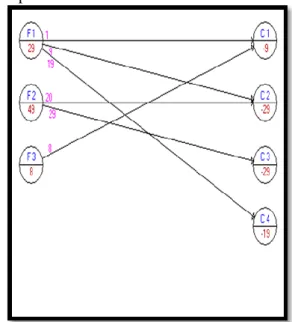
The form above the transportation table, based on Equation (5) the optimal transportation and by QSB software as follows.
Table 5 illustrates the optimal transport policy of the company with a total cost of 1222$, which reads as follows:
Supply Center 1 from both factories with (1) unit from the factory (1) and 8 units from the factory (3) to satisfy the demand.
Supply Center 2 from the factory (2) with 9 units and 20 units from the factory (2) to satisfy the demand.
Supply Center 3 from the factory (3) with 29 units only to satisfy the demand.
Supply Center 4 from the factory (1) with 19 units only to satisfy the demand.
Table 5.
Optimal solution result
From To Shipment Unit
cost Total cost Red uced cost F1 C1 1 2 2 0 F1 C2 9 0 0 0 F1 C4 19 22 418 0 F2 C2 20 14 280 0 F2 C3 29 18 522 0
F3 C1 8 0 0 0 Total Obje ctive Function Value = $1222
Figure 2 is the graphical representation of the optimal solution result, showing the optimal transportation networks.
Figure 2. Optimal transportation networks
This paper is unique in cooperation with other papers in [2], [3], [4], [5], [6], [7], [8] due to the minimization of the transportation cost when both the demand and destination are hexagonal fuzzy numbers. The outcomes of this study agree with [15], [16], [17].
V. C
ONCLUSIONIn this paper, the results proved that the adopted fuzzy numbers ranking function was able to solve fuzzy numbers of hexagonal by centroid ranking procedures. The outcome finding in this paper is the optimum transportation cost minimization through magnitude hexagonal fuzzy numbers. The results verified that the optimal transport plan of the company succeeded in the minimized total cost procedure from $1527.5 to $1222, where the improvement in total costs was 20%.
The future trend applications in this paper, is when the cost, demand and distention are octagonal fuzzy numbers. Also, the particle swarm optimization (PSO) can be employed to optimize the objective outcomes of this study. PSO stands for a mathematical technique that improves a problem by developing a candidate solution iteratively with reference to a specified quality measure. It resolves a problem as a result of taking a population of candidate solutions, at this point dubbed particles besides moving these particles in the search-space based on simple
equations over the particle's position and velocity. Every particle's movement has been affected by its finest identified location. However, it is correspondingly guided in the direction of the finest identified positions in the search-space, which are updated as better locations and are inspected by other particles. This is predictable to make the swarm headed for the finest solutions.