Modification by Nicotine of the Sensitization to Methamphetamine-induced
Ambulatory Stimulation in Mice: Possibility of Increase in Methamphetamine Dose
of Abuse and Enhancement of Its Psychotoxicity
Hisashi KURIBARA
Junior College, Tokyo University of Social Welfare (Isesaki Campus), 2020-1 San o-cho, Isesaki-city, Gunma 372-0831, Japan (Received October 18, 2012 Accepted December 6, 2012)
Abstract: Since methamphetamine (MAP) has been frequently inhaled simultaneously with nicotine, i.e., cigarette
smoking mixed with MAP, the modification by nicotine of the behavioral sensitization to MAP was evaluated in terms of ambulatory activity in mice. During the 5 repeated co-administrations of MAP (2 mg/kg s.c.) with nicotine (0.03, 0.1, 0.3 and 1 mg/kg s.c.) at 3 day intervals, nicotine dose-dependently inhibited the progressive enhancement of MAP-induced ambulatory stimulation. However, such pre-treatments did not modify the induction of ambulatory sensitization to MAP (2 mg/kg s.c.). In both the drug-naive and MAP-sensitized mice, nicotine reduced the ambulatory stimulant effect of MAP. These results suggest that, although nicotine reduces the expression of ambulatory stimulant effect of MAP, nicotine does not protect, but rather accelerate, the induction of psychotoxic effect of MAP.
(Reprint request should be sent to Hisashi Kuribara)
Key words: Methamphetamine-nicotine interaction, Ambulatory activity, Mice, Repeated co-administration, Behavioral
sensitization, Psychotoxicity
Introduction
Methamphetamine (MAP) abuse is the most serious drug abuse problem in Japan. Although MAP has tradition-ally been administered through intravenous route, an inha-lation of MAP vapor, namely ABURI, or smoking MAP mixed with tobacco, namely MOKU, is increasing not only because to avoid infections and the trace of picking needle, but also because of easy way for taking the drug.
The central stimulant effect of amphetamines is caused by an acceleration of dopamine release from the cytoplas-mic pool of neurons at nucleus accumbens and striatum (McMillen, 1873). It has been known that the repeated administration of MAP induces the sensitization to its behavioral stimulant effect in animals (Tadokoro and Kuribara, 1986) and causes the increased risk of psycho-toxic symptoms such as delusion and hallucination in humans (Wise and Bozarth, 1987).
Nicotine, an agonist of nicotinic acetylcholine receptors
(Fuxe et al., 1986; Imperato et al., 1986; Marks et al., 1986), also accelerates dopamine release in the brain (Marks et al., 1986; Sershen et al., 1991; Jutkiewicz et al., 2008), and shows an ambulatory stimulant effect in rodents, particularly in rats (Kita et al., 1992; Ann-Sophie et al., 2006). Such neurochemical and behavioral charac-teristics of nicotine are partially similar to those of amphet-amines. However, there are some reports which suggest an antagonistic effect of nicotine on the amphetamine-induced ambulatory stimulation and stereotyped behaviors (Stevens et al., 1995), and impairment of auditory sensory gating (Stevens et al., 1995).
Since MAP is inhaled simultaneously with nicotine fol-lowing the smoking MAP mixed with tobacco, it is important to behaviorally assess the combined effect of MAP and nicotine, although the combined effects of nicotine and N-cyanomethylmethamphetamine, a main pyrolysis product of smoking methamphetamine mixed with tobacco, have been reported (Sekine et al., 1997; Kuribara, 2010).
The aim of the present study was to evaluate the modifi-cation by nicotine of the induction and expression of behavioral sensitization to MAP in mice. The following two experiments were conducted: 1) Repeated co-administra-tions of MAP with nicotine, and followed by the challenge administration of MAP alone. 2) The induction of MAP-sensitization and followed by co-administration of MAP with nicotine. 3) Repeated administration of nicotine and was followed by the challenge administration of MAP.
Materials and Methods
Animals
Male mice of ddY strain (Japan Laboratory Animals, Tokyo) were used at the age of 6 weeks (weighing 25-30 g). These mice were housed in groups of 10 in polycarbonate cages (20W X 25L X 10H cm) in a controlled room (tem-perature; 23 ± 2 ℃ , relative humidity; 55 ± 3 %, and light on between 05:00-19:00 hr). They could eat a solid diet (MF: Oriental Yeast, Tokyo) and drink tap water except during the behavioral tests.
Apparatus
The ambulatory activity of 10 mice was individually and simultaneously measured with a tilting-type ambulometer (SMA-10: O hara & Co., Tokyo). This apparatus has 10 bucket-like activity cages of 20 cm in diameter and 15 cm in height. Each slight tilt of the activity cage generated by a horizontal movement (ambulation), but not by any vertical movements or turning, of the mouse was detected with one of 3 microswitches attached to the activity cage.
Drugs
The drugs used were methamphetamine HCl (MAP: Phylopone; Dainippon Pharm., Osaka) and nicotine free base (Nakarai Chemical., Tokyo). MAP and nicotine were dissolved in physiological saline, and the concentration of each drug solution was adjusted so that the volume injected (s.c.) was always constant at 0.1 ml/10 g body weight of the mouse. The dose of MAP was fixed to 2 mg/kg in the salt form which was optimum for increasing the ambula-tion without producing any strong stereotyped behaviors throughout the 5 repeated administrations at 3-day intervals in the ddY strain mice (Kuribara and Hirabayashi, 1985; Kuribara et al., 1996a, b).
Experimental schedules
Prior to the drug administration, mice were adapted to the activity cage for 10 min. After the drug administration, the ambulatory activity of each mouse was measured for 3 hr. All the behavioral tests were carried out between 09:00-16:00 hr.
Experiment 1. Repeated co-administrations of MAP with nicotine, and then challenge administration of MAP alone
Five groups of mice (10 each) were first treated with 5 repeated administrations of either MAP alone (nicotine dose=0) or MAP in combination with nicotine (0.03, 0.1, 0.3 or 1 mg/kg) at 3-day intervals. Three days after the 5th treatment, all mice were challenge-administered with MAP alone. In addition, the administration of MAP to the drug-naive mice (n=10) that were age-matched to the mice treated with the co-administrations of MAP with nicotine was also conducted.
Experiment 2. Induction of MAP-sensitization and then challenge administration of MAP in combination with nicotine
To induce the sensitization to MAP, 5 groups of mice (10 each) were first treated with 5 repeated administrations of MAP at 3-day intervals in the same way as in experi-ment 1. Three days after the 5th treatexperi-ment, all groups of mice were challenged with either MAP alone (nicotine dose=0), or combination of MAP with nicotine (0.03, 0.1, 0.3 or 1 mg/kg).
Experiment 3. Repeated administrations of nicotine and then challenge administration of MAP alone, or MAP in combination with nicotine
Two set of 2 groups of mice (10 each) were administered saline (nicotine dose=0), or nicotine (1 mg/kg s.c.) once a day for 10 days in their home cages. These drug treatments were not followed by the measurement of ambulatory activ-ities of mice. The days after the 10th treatment, 2 groups of mice of the first and second set were challenge-administered with MAP alone and MAP with nicotine (1 mg/kg).
Ethical consideration for experimental animals
All the experimental treatments of mice mentioned above were carried out according to the Guiding Principles for
the Care and Use of Laboratory Animals of The Japanese
Statistical analysis
Mean 3-hr overall ambulatory activity counts after the drug administrations were first analyzed by one- or two-way analysis of variance. In cases of significant variance, post-hoc analyses were carried out by Bonferoni test. Values of p less than 0.05 were considered significant.
Results
Experiment 1. Repeated co-administrations of MAP with nicotine, and then challenge administration of MAP alone
As shown in Table 1, the repeated co-administrations of MAP with nicotine induced a progressive enhancement of the ambulatory stimulant effect in all groups of mice. Nicotine reduced the stimulant effect of MAP in a
dose-dependent manner in the repeated administration phase. However, following the challenge administration of MAP, there was no significant difference in the activity counts among the groups of mice that had been treated with MAP alone or combination of MAP with nicotine.
Experiment 2. Combined administration of MAP with nicotine to the MAP-sensitized mice
Five repeated administrations of MAP (2mg/kg s.c.) at 3-day intervals resulted in an sensitization to the ambulatory stimulant effect of MAP in all groups of mice; the activity counts at the 1st and 5th administration being 1500-1600 and 5000-5200, respectively (data are not shown).
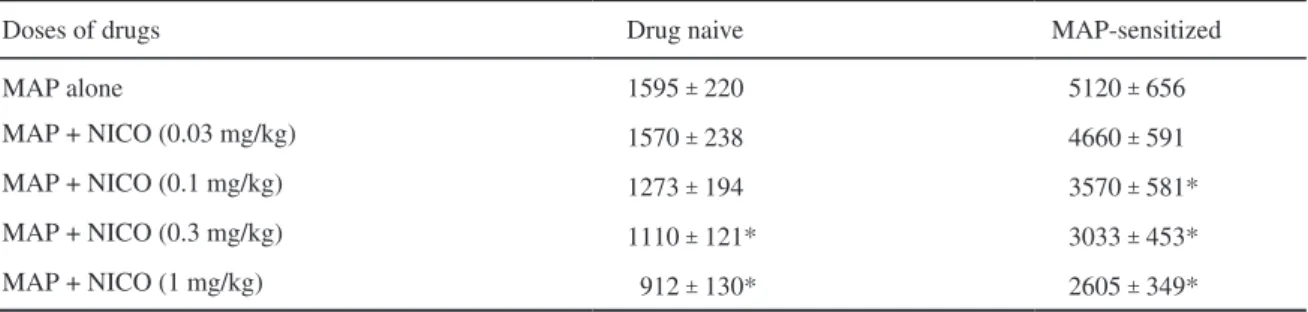
Table 2 shows mean 3-hr activity counts after the administration of MAP alone (nicotine dose=0) or MAP in combination with nicotine (0.03-1 mg/kg) to the
MAP-Table 1. Mean 3-hr ambulatory activity counts SEMs after 5 repeated administrations of methamphetamine
(MAP: 2 mg/kg s.c.) alone, and MAP with nicotine (NICO: 0.03, 0.1, 0.3 and 1 mg/kg s.c.) at 3-day intervals, and the challenge administration of MAP.
Doses of drugs 1st 2nd 3rd 4th 5th MAP-challenge
MAP only 1595 220 2206 311 4189 593* 4630 651* 4772 707* 5001 617# MAP+NICO (0.03) 1570 238 2122 274 3620 582* 4747 630* 4699 650* 5199 630# MAP+NICO(0.1) 1278 194 1807 239 2752 374*,$ 4139 511* 4254 630* 5166 619# MAP+NICO(0.3) 1110 121$ 1460 190$ 2754 410*,$ 3680 517* 3535 520* 5234 704# MAP+NICO(1) 912 130$ 1104 148$ 1906 293*,$ 3005 404*,$ 2918 445*,$ 4906 539# MAP 1549 207
*: Significantly different vs. the count at the first administration within each group (p<0.05). $: Significantly different from the count of MAP alone-treated group at the same administration number (p<0.05). #: Significantly different from the count following the administration of MAP to the drug-naive mice (p<0.05). N=10 in each group.
Table 2. Mean 3-hr ambulatory activity counts SEMs after the administration of methamphetamine
(MAP: 2 mg/kg s.c.) alone, co-administration of MAP with nicotine (NICO: 0.03-1 mg/kg s.c.), or nicotine alone to the MAP-sensitized mice.
Doses of drugs Drug naive MAP-sensitized
MAP alone 1595 220 5120 656
MAP + NICO (0.03 mg/kg) 1570 238 4660 591
MAP + NICO (0.1 mg/kg) 1273 194 3570 581*
MAP + NICO (0.3 mg/kg) 1110 121* 3033 453*
MAP + NICO (1 mg/kg) 912 130* 2605 349*
sensitized mice. For comparison, the activity counts in the drug-naive mice, which are shown in Table 1 (the counts at the 1st administration), are also presented.
The ambulatory stimulant effect of MAP was reduced by nicotine in both the drug-naive and MAP-sensitized mice. The activity counts following the co-administration of MAP with 0.3-1 mg/kg nicotine in the drug-naive and MAP-sensitized mice were significantly lower than those following the administration of MAP alone.
Experiment 3. Repeated administrations of nicotine and then challenge administration of MAP alone, or MAP in combination with nicotine
As shown in Table 3, the pretreatment with nicotine (1 mg/kg s.c., 10 times) did not change the sensitivity to MAP or MAP + nicotine.
Discussion
In agreement with our previous reports (Kuribara and Hirabayashi, 1985), the repeated administrations of MAP induced significant sensitization to the ambulatory stimulant effect of MAP. The central stimulant effect of MAP is caused by acceleration of dopamine release from the cyto-plasmic pool (McMillen, 1983). It is generally considered that the nicotine-induced behavioral stimulation is caused by an acceleration of dopaminergic neurotransmission through stimulation of acetylcholine release in the brain (Kita et al., 1992; Sershen et al., 1991). Amphetamine and nicotine interact to enhance their behavioral and neuro-chemical effects in rats (Huston-Lyons et al., 1993; Anne-Sophie et al., 2006).
However, it is notable that the ambulatory stimulant effect of MAP was significantly reduced by nicotine in
both the drug-naive and MAP-sensitized mice. These results are in consistent with the inhibitory effects of nico-tine on the amphetamine-induced locomotor stimulation (Stolerman et al., 1973), stereotyped behavior (Arnfred and Rundrup, 1968; Klawans et al., 1972), and impairment of auditory gating in rats (Stevens et al., 1995). Some mechanisms can be considered to be involved in the antag-onistic effect of nicotine on the behavioral stimulant effect of amphetamines.
The possible mechanism is the nicotine-induced dopa-mine release through a stimulation of the nicotinic acetyl-choline receptors in the brain, which may reduce the amphetamine-induced dopamine release (Sershen et al., 1991). Anne-Sophie et al. (2006) suggested a role of sero-tonergic mechanism in the nicotine-induced locomotor effect in mice.
Mesolimbic dopaminergic systems (Van der Heuval and Pasterkamp, 2008) play significant roles not only in the reward effect of drugs, i.e., substance abuse liability (Ikemoto, 2007; Piercem and Kumaresan 2006; Berridge, 2007), but also in the behavioral and psychological activi-ties, particularly, motivation (Matsumoto and Hikosaka, 2009). Janhunen and Ahtee (2007) reported differential nicotinic regulation of the nigrostriatal and mesolimbic dopaminergic pathways. It is therefore important to assess the changes in the behavioral effect following the repeated combined administration of central stimulants including MAP and related drugs with nicotine.
The behavioral sensitization to amphetamines has been considered to be related not only to the risk of the abuse liability (Wise and Bozarth, 1987) but also to the risk of the induction of psychotoxic symptoms, namely amphetamine psychosis, following the repeated abuse of amphetamines (Tadokoro and Kuribara, 1986; Robinson and Becker,
Table 3. The activity counts following the challenge administration of methamphetamine
(MAP: 2 mg/kg s.c.) to the mice pretreated with saline or nicotine (NICO: 1 mg/kg s.c.) daily for 10 days.
Pretreatment (10 times) Challenge administration
MAP MAP + NICO
Saline 1552±271 891± 93*
NICO (1 mg/kg) 1598±259 922±129*
1986). The present study showed that, although nicotine inhibited the acute ambulatory stimulant effect of MAP, the sensitization to MAP was not modified by nicotine. N-cyanomethylmethamphetamine, a main pyrolysis product of smoking methamphetamine mixed with tobacco, inhibited the behavioral stimulant effect of MAP (Sekine et al., 1997), but enhanced the induction of behavioral sensitization to MAP (Kuribara, 2010).
These results suggest that nicotine does not change the process of the behavioral sensitization to MAP. It is there-fore highly probable that the repeated smoking MAP mixed with tobacco may not protect the liability of MAP abuse. This result also indicates another problem of MAP abuse mixed with tobacco. Thus, to recover the reward effect of these drugs, the combined MAP abuse mixed with tobacco may increase the MAP dose, and may accelerate the risk of the MAP-induced psychotoxic symptoms.
References
Ann-Sophie, V., Lucas, S., Gerald, B., et al. (2006): Irreversible blockade of monoamine oxidase reveals the critical role of 5-HT transmission in locomotor response induced by nicotine in mice. Eur. J. Neurosci.
24, 1359-1365.
Arnfred, T. and Rundrup, A. (1968): Cholinergic mechanisms in brain inhibiting amphetamine-induced stereotyped behavior. Acta Pharmacol. Toxicol. 26, 384-394.
Fuxe, K., Andersson, K., Härstrand, A., et al. (1986): Increase in dopamine utilization in certain limbic dopamine terminal populations after a short period of intermittent exposure of male rats to cigarette smoke. J. Neural. Transm. 67, 15-29.
Huston-Lyons, D., Sarkar, M. and Kornetsky, C. (1993): Nicotine and brain-stimulation rewards: Interaction with morphine, amphetamine and pimozide. Pharmacol. Biochem. Behav. 46, 453-457.
Ikemoto, S. (2007): Dopamine reward circuitry: Two projection systems from the ventral midbrain to the nucleus accumbens-olfactory tubercle complex. Brain Res. Rev. 56, 27-78.
Imperato, M., Mulas, A. and Di Chiara, G. (1986): Nicotine preferentially stimulates dopamine release in the lim-bic system of freely moving rats. Eur. J. Pharmacol.
132, 337-338.
Janhunen. S. and Ahtee, L. (2007): Differential nicotinic regulation of the nigrostriatal and mesolimbic dopami-nergic pathways: Implications for drug development. Neurosci. Biobehav. Rev. 31, 287-314.
Jutkiewics, E., Nicolazzo, D., Kim, M., et al. (2008): Nicotine and amphetamine acutely cross-potentiate their behavioral and neurochemical responses in female Holzman rats. Psychopharmacology 200, 93-103.
Kalivas, P.W. and Stewart, J. (1991): Dopamine transmis-sion in the initiation and exprestransmis-sion of drug- and stress-induced sensitization of motor activity. Brain Res. Rev. 16, 223-244.
Kita, T., Okamoto, M. and Nakashima, T. (1992): Nicotine-induced sensitization to ambulatory stimulant effect produced by daily administration into the ventral tegmental area and the nucleus accumbens in rats. Life Sci. 50, 583-590.
Kuribara, H. and Hirabayashi, M. (1985): Reverse tolerance to psychotropic drugs. Jpn. J. Neuropsychopharmacol.
7, 421-439.
Kuribara, H. (2010): Interaction of nicotine and N-cyano-methylmethamphetamine, a main pyrolysis product of smoking methamphetamine mixed with tobacco, in terms of the sensitization to the ambulatory stimulant effect in mice. Bull. Tokyo Univ. Graduate Sch. Social Welfare 1: 121-129.
Marks, M.J., Miner, L.L., Cole-Harding, S., et al. (1986): A genetic analysis of nicotine effects on open field activity. Pharmacol. Biochem. Behav. 24, 743-749.
Matsumoto, M. and Hikosaka, O. (2009): Two types of dopamine neuron distinctly convey positive and nega-tive motivational signals. Nature 459, 837-841.
McMillen, B.A. (1983): CNS stimulants: Two distinct mechanisms of action for amphetamine-like drugs. Trends Pharmacol. Sci. 4, 429-432.
Piercem, R.C. and Kumaresan, V. (2006): The mesolimbic dopamine system: The final common pathway for the reinforcing effect of drugs of abuse? Neurosci. Biobehav. Rev. 30, 215-238.
Robinson, T.E. and Becker, J.B. (1986): Enduring changes in brain and behavior produced by chronic amphet-amine administration: A review and evaluation of animal models of amphetamine psychosis. Brain Res. Rev.
Sekine, H., Nagao, S., Kuribara, H., et al. (1997): Behav-ioral effects of N-cyanomethylmethamphetamine, a product from smoking methamphetamine with tobacco, in mice and rats. Pharmacol. Biochem. Behav. 57: 167-172.
Sershen, H., Hashim, A., Harsing, L., et al. (1991): Chronic nicotine-induced changes in dopaminergic system: Effect of behavioral response to dopamine agonist. Pharmacol. Biochem. Behav. 39, 545-547.
Stevens, K.E., Meltzer, J. and Rose, G.M. (1995): Nicotinic cholinergic normalization of amphetamine-induced loss of auditory gating in freely moving rats. Psycho-pharmacology 119, 163-170.
Stolerman, I.P., Fink, R. and Javik, M.E. (1973): Acute and chronic tolerance to nicotine measured by activity in rats. Psychopharmacologia (Berlin) 30, 329-342. Tadokoro, S. and Kuribara, H. (1986): Reverse tolerance to
the ambulation- increasing effect of methamphetamine in mice as an animal model of amphetamine psychosis. Psychopharmacol. Bull. 22, 757-762.
Van der Heuval, D.M.A. and Pasterkamp, R.J. (2008): Get-ting connected in the dopamine system. Prog. Neuro-biol. 85, 75-93.
Wise, R.A. and Bozarth, M.A. (1987): A psychomotor stimulant theory of addiction. Psychol. Rev. 94, 469-492.
Nicotine
による
Methamphetamine
のマウス移所運動促進効果に対する増感現象の修飾
−
Methamphetamine
乱用量の増加と精神毒性増強の可能性−
栗原 久
東京福祉大学短期大学部(伊勢崎キャンパス) 〒372-0831 伊勢崎市山王町2020-1
抄録:タバコに覚せい剤(methamphetamine: MAP)を混入して喫煙する乱用例がしばしばみられることから、MAPと
nicotineの相互作用の検討が必要である。すでに著者らは、MAPを反復投与すると中枢刺激作用に対する増加現象が引
き起こされ、この現象は乱用後の精神毒性の発現と共通することを報告した。本研究では、マウスの移所運動を指標に、
nicotineの併用によるMAPに対する増感現象の修飾を検討した。MAP(2 mg/kg s.c.)とnicotine(0.03, 0.1, 0.3および
1 mg/kg s.c.)の併用を3日間隔で5回反復投与すると、移所運動促進効果はnicotineの用量に依存して軽減された。しか
し、6回目にMAP(2 mg/kg s.c.)を単独投与してみると、nicotineの用量に関係なく、MAPに対する増感現象が誘発された。
MAPに対する増感を形成したマウスに対してMAP+nicotineを併用投与すると、nicotineの用量に依存して、MAPの運 動促進作用が軽減された。一方、nicotine(1mg/kg s.c.)の反復投与は、MAPに対する感受性の変化を引き起こさなかった。 本実験結果は、nicotineはMAPの精神運動効果に対して抑制的に働くが、覚せい剤乱用による精神毒性の誘発を防止する ことはなく、むしろ増強する可能性を示唆している。
(別刷請求先:栗原 久)