On
the Sato Conjecture for
$\mathrm{Q}\mathrm{M}$-curves
of
genus
two
TSUNOGAI
Hiroshi $(\ovalbox{\tt\small REJECT}\not\in\dot{7}\wedge$$\mathrm{F}\mathrm{f}_{1}^{a_{\rho\emptyset \mathrm{x}\mathrm{g}_{x}}})$
This is ajoint work with Ki-ichiro Hashimoto (Waseda University), and will
appear as [HT].
$0$
.
INTRODUCTIONIn this article we $\mathrm{s}\mathrm{h}\mathrm{a}\mathrm{l}\dot{1}$
report a computational result about the distribution
of the arguments of zeroes of $L$-functions of two-dimensional abelian varieties
with quaternionic multiplication $(\mathrm{Q}\mathrm{M})$
.
The result we obtainedsupports..
ananalogue of the Sato Conjecture for such abelian surfaces.
An abelian surface $A$ is called a $QM$-abelian
surface
if it has quaternionicmultiplication, that is, there exists an order $\mathcal{O}$ of an indefinite quaternion
algebra $B$ over $Q$ and an embedding $\iota:\mathcal{O}arrow>\mathrm{E}\mathrm{n}\mathrm{d}A$
.
A curve $C$ of genus twois called a
QM-C..u
$\Gamma ve$ if its jacobian variety is a $\mathrm{Q}\mathrm{M}$-abelian surface.$\ln[\mathrm{H}\mathrm{M}]$ K. Hashimoto and N. Murabayashi obtained algebraic families of
$\mathrm{Q}\mathrm{M}$-curves explicitly when the discriminants of $B$ are 6 and 10.
$\ln \mathrm{t}\mathrm{h}\mathrm{e}\backslash$ case
of
discriminant
6, the followinge.quations
give a family ofQM-cur.ve.s.:
(0.1)
$S_{6}(t, s)$ : $\iota\nearrow^{2}=X(X4+(A-B)x^{3}+Qx^{2}+(A+B)x+1)$,
$A= \frac{s}{2l}$, $B– \frac{1+3t^{2}}{1-3t^{2}}$,
$Q=- \frac{(1-2t^{2}+9l4)(1-28l^{2}+166t^{4}-252t^{6}+81t^{8})}{4t^{2}(1-3t^{2})^{2}(1-l^{2})(1-9t^{2})}$,
(0.2)
$S_{B_{6}}$ : $g(t, S)=S^{2}+3-14t+227t4=0$
.
(This is slightly modified from the form in $l_{oC.C}it$
.
We have obtained anotherfamily which has different arithmetic properties. See Remark 3.3) By
special-izing $(t,s)$ to points $(t_{0}, s_{0})\in S_{B_{6}}(\overline{Q})$, we can obtain a lot of examples of
$\mathrm{Q}\mathrm{M}$-curves defined over number fields.
For many examples of $\mathrm{Q}\mathrm{M}$-curves, we calculated the congruence
$\zeta$-functions
oftheir reductions modulo $\mathfrak{p}$ and studied the distribution of the argument of the
For a curve $C$ of
genus
two defined over a number field $k$, the congruence(-function of $C$ $\mathrm{m}\mathrm{o}\mathrm{d}$
$\mathfrak{p}$ for a good prime $\mathfrak{p}$ of $k$ can be written in the form
(0.3) $Z(u)= \frac{(1-\alpha u)(1-\overline{\alpha}u)(1-\beta u)(1-\overline{\beta}u)}{(1-u)(1-qu)}$,
where $-\mathrm{d}\mathrm{e}\mathrm{n}\mathrm{o}\mathrm{t}\mathrm{e}\mathrm{S}$ the complex conjugate, the absolute values of$\alpha,$ $\beta$ are $\sqrt{q}$, and $q=N\mathfrak{p}$, the absolutenormof$\mathfrak{p}$
.
In our case of$\mathrm{Q}\mathrm{M}$-curves, ifallendomorphismsof $\mathrm{J}\mathrm{a}\mathrm{c}C$ are defined over $k$, we have $\alpha=\beta$
.
Put $\alpha=\sqrt{q}e^{i\theta_{\mathrm{p}}}$ with $\theta_{\mathfrak{p}}\in[0, \pi]$.
On the distribution of $\{\theta_{\mathfrak{p}}\}$ there is a conjecture as an analogue of the
Sato
Conjecture for elliptic curves. Let us explain them.
The original Sato Conjecture is as follows. Let $E$ be an elliptic
curve
definedover a number field $k$
.
For a good prime $\mathfrak{p}$ of $k$,
thecongruence
(-function of$E$ $\mathrm{m}\mathrm{o}\mathrm{d}$
$\mathfrak{p}$ is in the form
(0.4) $Z(u)= \frac{(1-\sqrt{q}e\prime u)i\theta(1-\sqrt{q}e^{-}i\theta_{\mathrm{p}}u)}{(1-u)(1-qu)}$,
where $\theta_{\mathfrak{p}}\in[0, \pi]$
.
M. Sato conjectured that if $E$ has no complex multiplicationthe arguments $\{\pm\theta_{\mathfrak{p}}\}$ would be distributed in proportion to
$\sin^{2}\theta$
.
Also J.Tate arrived to this conjecture and noticed in [T].
H. $\mathrm{Y}\mathrm{o}\mathrm{s}\mathrm{h}\mathrm{i}\mathrm{d}\mathrm{a}[\mathrm{Y}\mathrm{o}\mathrm{l}]$ generalized the above conjecture for
higher-dimensional
abelian varieties $A$
.
He conjectured that the distribution of the argumentsis characterized by the image of the Galois group under the $l$-adic
represen-tation (more precisely, the Mumford-Tate group) of $A$
.
By Faltings’ theorem[F], for a $\mathrm{Q}\mathrm{M}$-abelian surface $A$ defined over a number field $k$
,
the image ofthe $l$-adic representation associated to $A$ is a subgroup of GSp(2) isomorphic
to $\mathrm{G}\mathrm{L}(2)$ (up to finite index). This suggests the following conjecture for the
case of $\mathrm{Q}\mathrm{M}$-abelian surfaces:
Conjecture. Let $A$ be a $Q\Lambda f$-abelian
surface defined
over a numberfield
$k$.
Assume that also all endomorphisms
of
$A$ aredefined
over $k$.
For a goodprime $\mathfrak{p}$
of
$k_{f}$ let $\pm\theta_{\mathfrak{p}}$ be the argumentsof
the eigenvaluesof
the Frobeniusendomorphisms
of
A mod$\mathfrak{p}$.
Then $\{\pm\theta_{\mathfrak{p}}\}$ would be distributed in proportion to $\sin^{2}\theta$.
Preceedingly Y. Yamamoto reported in [Ya] a result of computation which
fits with the generarized conjecture for abelian surfaces $A$ with $\mathrm{E}\mathrm{n}\mathrm{d}A\simeq Z$
.
H. $\mathrm{Y}\mathrm{o}\mathrm{s}\mathrm{h}\mathrm{i}\mathrm{d}\mathrm{a}[\mathrm{Y}\mathrm{o}2]$ proved an analogue of these conjectures for the cases of
elliptic curves and $\mathrm{Q}\mathrm{M}$-abelian surfaces over a function field over afinite field.
lf $C$ is a $\mathrm{Q}\mathrm{M}$-curve, then $A=\mathrm{J}\mathrm{a}\mathrm{c}C$ is a $\mathrm{Q}\mathrm{M}$-abelian surface, and the
eigen-values of Frobenius endomorphisms of $A$ $\mathrm{m}\mathrm{o}\mathrm{d}$
$\mathfrak{p}$ coincide with the zeroes of the congruence (-function of $C$ $\mathrm{m}\mathrm{o}\mathrm{d}$
$\mathfrak{p}$
.
Hence we can examine the conjectureby calculating the congruence (-function of $C$ $\mathrm{m}\mathrm{o}\mathrm{d}$
more than twenty curves $C$ and for primes $\mathfrak{p}$ with $N\mathfrak{p}<2^{20}$, and obtained the results which support the conjecture.
We carried out these calculation on PC with UBASIC and on UNIX Work
Station with GNU C. We thanks voluntary helpers of the computer room
of our department and stuffs of Centre for lnformatics, Waseda University.
Especially we would like to express our sincere gratitude to Kazumaro Aoki
for useful suggestions for improving algorithm.
1. CONGRUENCE $\zeta$-FUNCTIONS
First reca,11 basic facts about congruence (-functions. For a curve $C$ over
$F_{q}$, let $N_{m}$ denote the number of $F_{q^{m}}$-rational points on $C$
.
The congruence(-function of $C$ is defined to be
(1.1) $Z(C/Fq;u)= \exp(_{m=1}\sum^{\infty}\frac{N_{m}}{m}um)$
.
Let $C$ be a complete, non-singular curve of genus two. Then, by Weil
conjec-ture, we $1_{1}\mathrm{a}\mathrm{v}\mathrm{e}$
(1.2) $Z(C/F_{q};u)= \frac{P(u)}{(1-u)(1-qu)}$,
where $P(u)\in Z[u]$ is of degree 4, and $P(u)=(1-\alpha u)(1-\overline{\alpha}u)(1-\beta u)(1-\overline{\beta}u)$
with $|\alpha|=|\beta|=\sqrt{q}$
.
By putting $\alpha+\overline{\alpha}=a$ and $\beta+\overline{\beta}=b$, we can write(1.3) $P(u)=(1-au+qu^{2})(1-bu+qu^{2})$
with $a,$ $b\in R$ and $|a|,$ $|b|\leq 2\sqrt{q}$
.
From (1.1) and (1.3), $a$ and $b$ are evaluatedas
(1.4) $\{$
$a+b=1+q-N_{1}$,
$ab=-q-(1+q)N1+ \frac{1}{2}(N_{2}+N^{2})1$
.
Let $J=\mathrm{J}\mathrm{a}\mathrm{c}C$ be the Jacobian variety of $C$ over $F_{q},$ $l$ a prime different from
the chara,cteristic of $F_{q}$, and $\rho_{l}$ the
$l$-adic representation:
(1.5) $\rho\iota$ :
$\mathrm{G}\mathrm{a}1(\overline{p}_{q}/F_{q})arrow \mathrm{G}\mathrm{S}\mathrm{p}(4, Zl)$
.
Then, for Frobenius element $\sigma$, the characteristic polynomial of $\rho\iota(\sigma)$ does not
depend on $l$ and coincides with $P(u)$
.
Let $C$ be a $\mathrm{Q}\mathrm{M}$-curve over a number field $k,$ $J=\mathrm{J}\mathrm{a}\mathrm{c}C$ its Jacobian, $\mathcal{O}$ an
order of an indefinite quaternion algebra $B$ over $Q$ identified with $\mathrm{E}\mathrm{n}\mathrm{d}J$
.
Takea good prime $\mathfrak{p}$ of $k$ and let $p$ be its residue characteristic and $N\mathfrak{p}=q$
.
Fora prime number $l$ different from
$p$, we denote the associated completion of $\mathcal{O}$
$k’$ be an extension of $k$ over which all endomorphisms of $J$ are defined. First,
consi.der
the $l$-adic representation$\rho_{l}$ attached to $J$ of
$\mathrm{G}\mathrm{a}1(\overline{Q}/k’)$:
(1.6) $\rho\iota$ :
$\mathrm{G}\mathrm{a}1(\overline{Q}/k’)arrow \mathrm{G}\mathrm{S}\mathrm{p}(4, z_{l})\subset \mathrm{M}_{4}(Q_{i)}$
.
Denote by $\mathrm{E}\mathrm{n}\mathrm{d}_{\mathrm{G}\mathrm{a}\mathrm{l}\mathrm{t}}\overline{k}/k’$)$\tau lJ$ the centralizer of${\rm Im}\rho_{l}$ in $\mathrm{E}\mathrm{n}\mathrm{d}T_{l}J$
.
Then, by Faltings[F], $\mathrm{E}\mathrm{n}\mathrm{d}_{\mathrm{G}\mathrm{a}1\langle/}\overline{k}k)T\iota J\otimes \mathrm{z}_{\mathrm{t}}Ql\simeq \mathrm{E}\mathrm{n}\mathrm{d}_{k},J\otimes Q_{l}=B_{l}$
.
Hence$1\mathrm{m}\rho_{l}$ is contained in
the centralizer of $B_{l}$ in $\mathrm{M}_{4}(Q_{l})$, which is isomorphic to the opposite algebra
$B_{l}^{0}$ of $B_{l}$
.
For a prime $\mathfrak{P}$ of $k’$ above $\mathfrak{p}$, let$\sigma_{\mathfrak{P}}$ be the Frobenius element. Since
$\rho_{l}(\sigma_{\mathfrak{P}})$ belongs to $B_{l}^{0}$, it satisfies a quadratic relation in the form
(1.7) $1-c_{\mathfrak{P}}x+(N\mathfrak{P})x^{2}=0$
.
Now consider $\rho_{l}$ on
$\mathrm{G}\mathrm{a}1(\overline{Q}/k)$
.
Let $f=f(\mathfrak{P}/\mathfrak{p})$ be the inertia degree of $\mathfrak{P}$in $k’/k$
.
Then $\rho_{l}(\sigma_{\mathfrak{p}})$ satisfies(1.8) $1-c_{\mathfrak{P}}X^{f}+(qX2)f=0$
since $\sigma_{\mathfrak{P}}=\sigma_{\mathfrak{p}}^{f}$
.
On the other hand, since $\rho\iota(\sigma)\mathfrak{p}\mathrm{b}\mathrm{e}1_{0}\mathrm{n}\dot{\mathrm{g}}\mathrm{s}$to $\mathrm{M}_{4}(Q_{l})$, it satisfiesa quartic relation. From this we find a relation which must be satisfied by
$N_{1}$ and $N_{2}$, for each possible value
of.
$f$.
Hence we can determine the degree$.f$ from the values $N_{1}$ and $N_{2}$
.
For example, if $f=1$ then the characteristicpolynomial of $\rho_{l}(\sigma_{\mathfrak{p}})$ is $(1-c_{\mathfrak{P}}X+qX^{2})^{2}=(1-a_{\mathfrak{p}}X+qX^{2})^{2}$ with $a_{\mathfrak{p}}=c_{\mathfrak{P}}$
.
By (1.4), we have
Y.
(1.9) $(1+q-N_{1})22(=1+4q+q^{2}-N2),$ $a_{\mathfrak{p}}= \frac{1}{2}(1+q-N1)$
.
If $f=2$ then the characteristic polynomial of $\rho_{l}(\sigma_{\mathfrak{p}})$ is $1-c_{\mathfrak{P}}X^{2}+q^{2}X^{4}=$
$(1-a_{\mathrm{P}}x+qX^{2})(1+a_{\mathfrak{p}}X+qX^{2})$ with $a_{\mathfrak{p}}^{2}=c_{\mathfrak{P}}+2q$
.
By (1.4), we have (1.10) $N_{1}=1+q,$ $a_{\mathfrak{p}}^{2}= \frac{1}{2}(1+4q+q^{2}-N_{2})$.
Also for $f>2$ we have the relation between $N_{1}$ and $N_{2}$
.
Now one of the
remarkable
properties for our family $S_{6}$ given in (0.1) is that(numerically) we always have $f=1$
.
This shows that all endomorphisms ofJac$C$ are defined over the field of definition of $C$ in quite a large probability,
because, if almost all primes of a number fields $k$ decomposed completely in
an extention $k’/k$ then $k’=k$
.
Based on this assumption, for following many2. DENSITY FUNCTIONS
Let $\Theta=\{\theta_{j}\}_{j=1}^{\infty}$ be a sequence in $T=R/2\pi Z$, the unit circle. A real valued
distribution $\Phi=\Phi(\theta)$ on $T$ is called the density
function
of $\Theta$ if it has thefollowing property:
For any open interval $U$
of
$T$ and any natural number $m$, let(2.1) $n(U, m)=\neq\{j\in N|\theta_{j}\in U,j<m\}$
.
Then it holds that
(2.2) $\lim_{marrow\infty}\frac{n(U,m)}{m}=\int_{U}\Phi(\theta)d\theta$,
where $d\theta$ denotes the measure on $T$ induced
from
the Lebesgue measure on $R$.
Next lemma is basic (see, e.g. [Yo2]).
Lemma 2.1. For a sequence $\Theta=\{\theta_{j}\}_{j=1}^{\infty}$ on $T_{j}$ assume that
$c_{k}= \lim_{marrow\infty}\frac{1}{2\pi m}\sum_{j1}m=e-ik\theta_{j}$
exists
for
all $k\in Z$.
Then$\Phi(\theta)=\sum_{=k-\infty}^{\infty}Ckeik\theta$
converges in the sense
of
distribution and is the densityfunction
of
$\Theta$.
$\mathrm{h}$
Let $E$ be an elliptic curve defined over a number field $k$
.
For a good prime$\mathfrak{p}$ of $k$, let $\pm\theta_{\mathfrak{p}}$ be the arguments of zeroes of the congruence $\zeta$-function for
$E$ $\mathrm{m}\mathrm{o}\mathrm{d}$
$\mathfrak{p}$ (see (0.4)). Since we should consider the distribution of a sequence
of pairs $\Theta=\{\pm\theta_{\mathfrak{p}}\}_{\mathfrak{p}}$, we define the density function of $\Theta$ as a distribution
satisfying
(2.3) $\lim_{xarrow\infty}\frac{\#\{\pm\theta_{\mathfrak{p}}\in U|N\mathfrak{p}<x\}}{\#\{\pm\theta_{\mathrm{P}}|N\mathfrak{p}<x\}}=\int_{U}\Phi(\theta)d\theta$
.
The original Sato Conjecture asserts that, if $E$ has no complex multiplication,
then it would hold that $\Phi(\theta)=\pi^{-1}\sin^{2}\theta$
.
Let $C$ be a $\mathrm{Q}\mathrm{M}$-curve defined over a number field $k$
.
We assume that alsoall endomorphisms of $\mathrm{E}\mathrm{n}\mathrm{d}\mathrm{J}\mathrm{a}\mathrm{c}C$ are defined over $k$
.
Then, for a good prime $\mathfrak{p}$ of $k,$ tll.c congruence $\zeta$-function of $C$ $\mathrm{m}\mathrm{o}\mathrm{d}$$\mathfrak{p}$ is in the form
where $q=N\mathfrak{p}$ is the absolute norm of $\mathfrak{p}$
.
Similarly to the case of an ellipticcurve, we consider the density function of the pairs $\Theta=\{\pm\theta_{\mathfrak{p}}\}_{\mathfrak{p}}$
.
Ageneral-ization of the Sato Conjecture by H. Yoshida asserts that the density function
$\Phi$ of $\Theta$ would be
(2.5) $\Phi(\theta)=\pi-\mathrm{l}\sin\theta 2$
.
We checked this conjecture for many $\mathrm{Q}\mathrm{M}$-curves ofdiscriminant 6 by
calcu-lating Fourier coefficients of $\Phi(\theta)$ approximately. SiInilarly to Lemma 2.1, we
have the following lemma.
Lemma 2.2. For $\Theta=\{\pm\theta_{\mathfrak{p}}\}_{\mathfrak{p}}$, assume that the limit
$c_{k}:= \lim_{xarrow\infty}\frac{1}{\#\{\mathfrak{p}|goodprime,N\mathfrak{p}<x\}}N\mathfrak{p}<x\sum\cos k\theta \mathfrak{p}$
exists
for
all positive integer $k$.
Then$\Phi(\theta)=\frac{1}{2\pi}+\frac{1}{\pi}\sum_{k=1}^{\infty}Ck\cos k\theta$
converges in the sense
of
distribution and is the densityfunction of
$0$.
If the
conjectu’re
is $\mathrm{t}\mathrm{r}\mathrm{u}_{\mathrm{h}}\mathrm{e}$, then the Fourier coefficients $c_{k}$ of$\Phi$ must be
(2.6) $c_{2}=- \frac{1}{2}$, $c_{k}=0(k\neq 2)$
.
We calculated approximate values of $c_{k}’ \mathrm{s}$ as
(2.7) $c_{k}.=$. $\frac{\mathrm{l}}{\#\{\mathfrak{p}|\mathrm{g}\mathrm{o}\mathrm{o}\mathrm{d}\mathrm{p}\mathrm{r}\mathrm{i}\mathrm{m}\mathrm{e},N\mathfrak{p}<x\}}\sum\cos k\theta N\mathfrak{p}<x\mathfrak{p}$
for sufficiently large $x$
.
Remark 2.3. $\ln$ the definition of Fourier coefficients $c_{k}$, we can restrict primes
to those of degree one. But we calculated the $\mathrm{a}\mathrm{r}\mathrm{g}\mathrm{u}\mathrm{m}\mathrm{e}\mathrm{n}\mathrm{t}\mathrm{s}\pm\theta_{\mathfrak{p}}$ also for primes $\mathfrak{p}$
ofdegree more than one (in$\mathrm{f}\mathrm{a}_{\mathrm{m}}\mathrm{c}\mathrm{t}$,of degree two becausewe examined QM-curves
defined over (imaginary) quadratic fields) to check the absence of qualitative
3. RESULTS (3.1)
$S_{6}(t,s)$ : $\mathrm{Y}^{2}=X(X^{4}+(A-B)X^{3}+QX^{2}+(A+B)X+1)$, $A= \frac{s}{2t}$, $B= \frac{1+3t^{2}}{1-3t^{2}}$,
$Q=- \frac{(1-2t^{24}+9t)(1-28b^{24}+166t-252t6+81t8)}{4t^{2}(1-3t^{2})^{2}(1-t2)(1-9\iota 2)}--$,
(3.2)
$S_{B_{6}}$ : $g(t, S)=s^{2}+3-14t^{2}+27t=40$
.
We denote by $c_{\mathrm{t}^{t}\mathrm{o},s}\mathrm{o}$) the curve obtained by specializing $(t, s)$ to a point
$(t_{0}, s_{0})$ on $g(t, s)=0$
.
We can find that $c_{\mathrm{t}^{t,s)}}=c_{\mathrm{t}-t,-S}$) and that $c_{\mathrm{t}^{t,s)}}$ and$C_{(t,)}-s$ are generically isomorphic over $Q(\sqrt{-1})$ by
(3.3) $C_{(t,s)}\simeq c_{\mathrm{t})}\iota,-S$
(X, Y) $\infty(-X^{-1}, \sqrt{-1}X^{-}3\mathrm{Y})$
.
We checked the following curves and primes:
(3.4) $t\in Z,$ $2\leq t\leq 30(\#--29)$
$N\mathfrak{p}<2^{20}$ (primes of degree one).
Since $t\in Q,$ $c_{(t_{S)}}$, is
d.efined
over an imaginary quadratic field $k=Q(s)=$$Q(\sqrt{-t^{2}-3})$
.
Moreover $c_{\mathrm{t}^{t},S)}$ and $c_{\mathrm{t}^{t},-S)}$ are conjugate over $Q$.
If a rationalprime $p\mathrm{d}\mathrm{e}\mathrm{c}\mathrm{o}\mathrm{n}\mathrm{l}\mathrm{P}^{\mathrm{o}\mathrm{S}}\mathrm{e}\mathrm{s}$ as $p=\mathfrak{p}\mathfrak{p}’$ in $k$, then
(3.5) $c_{(t,S)}$ lnod $\mathfrak{p}’\simeq C_{\mathrm{t}^{t,-}}S$
) nlod $\mathfrak{p}$ (over $F_{p}$) $\simeq C_{(t_{S})}$, $\mathrm{m}\mathrm{o}\mathrm{d}$
$\mathfrak{p}$ (over $F_{p}(\sqrt{-1})$),
wluere $F_{p}(\sqrt{-1})$ means $F_{p}$ if $p\equiv 1$ mod 4 or $F_{p^{2}}$ if $p\equiv 3$ mod 4. Hence we
have $\theta_{\mathfrak{p}’}=\theta_{\mathfrak{p}}$ if $p\equiv 1$ mod 4 or $\theta_{\mathfrak{p}’}=\pi-\theta_{\beta}$ if $p-=3$ mod 4. This allows us
that we may consider only one prime above $p$ for a splitting prime $p$
.
For each curve $C=C_{(t,s)}$, we first computed the numbers of $F_{p^{-}}$ and $F_{p^{2-}}$
rational points of $C$ $\mathrm{m}\mathrm{o}\mathrm{d}$
$\mathfrak{p}$ for first thirty splitting primes $\mathfrak{p}$ of $k$ to check the assumption that all $\mathrm{e}\mathrm{n}\mathrm{d}_{\mathrm{o}\mathrm{n}1}\mathrm{o}\mathrm{r}_{\mathrm{P}}\mathrm{h}\mathrm{i}_{\mathrm{S}}\mathrm{m}\mathrm{s}$ of Jac$C$ are defined over $k$, and obtained
the data which shows the assumption is true. Under this assumption, the
congruence (-function of $C$ $\mathrm{m}\mathrm{o}\mathrm{d}$
$\mathfrak{p}$ is determined only by the number $N_{1}$ of $F_{p^{-}}$
ra,tional points. We computed $N_{1}$ of $C$ $\mathrm{m}\mathrm{o}\mathrm{d}$
$\mathfrak{p}$ for splitting primes $\mathfrak{p}$ of $k$ with
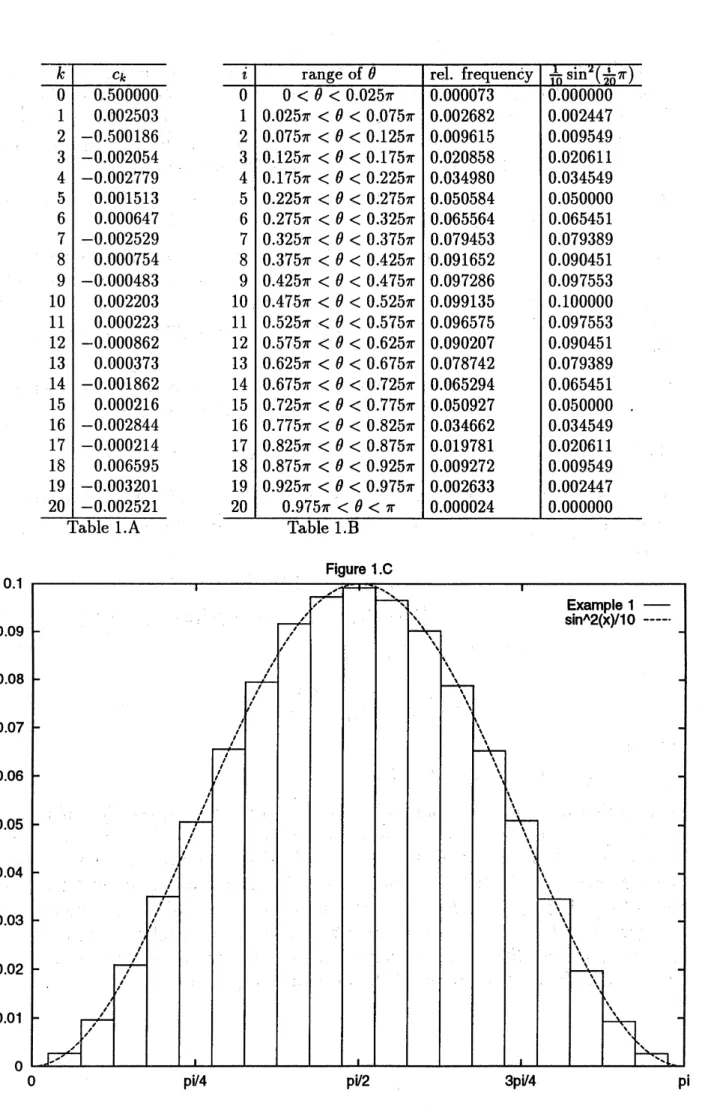
the Fourier coefficients $c_{k}$ of the density function by (2.7). For all curves we checked, all the approximate values of $c_{k}$ satisfy
(3.6) $|c_{2}+ \frac{1}{2}|<0.007$, $|\mathrm{c}_{k}|<0.\mathrm{o}\mathrm{l}1(k>0, k\neq 2)$
.
In fact, out of 551 va,lues of $|c_{k}|(k>0, k\neq 2)$, only 49 values are bigger than
0.005. For $c_{2}$, out of 29 values of $|c_{2}+ \frac{1}{2}|$, only 2 values are bigger than 0.005.
We also computed for remain primes $\mathfrak{p}=(p)$ of $k$ with $N\mathfrak{p}<2^{20}(p<2^{10})$,
which showed no qualititive difference from splitting primes.
We shall give precise data for $t=2,3$ in the following. In the examples,
Table A gives the approximate values of Fourier coefficients of the density
function and Table $\mathrm{B}$ gives the frequency distribution of the arguments and
$|\mathrm{t}\mathrm{h}\mathrm{e}\mathrm{c}.\mathrm{o}\mathrm{m}\mathrm{p}\mathrm{a}\mathrm{r}\mathrm{i}_{\mathrm{S}}$
.on
w.ith
$\sin^{2}\theta$
.
Example 1.$C_{\langle 2}, \frac{-379}{}\mathrm{Y}2X(=x^{4}+(\frac{\sqrt{-379}}{4}+\frac{13}{11})x^{3}-\frac{979961}{203280}x2+(\frac{\sqrt{-379}}{4}-\frac{13}{11})x+1)$
We calculated for 40823 splitting primes (Table 1.A, 1.B, Figure 1.C).
Example 2.
$C_{\langle 3,4\sqrt{-129})}$ : $\mathrm{Y}^{2}=x(x4+(\frac{2\sqrt{-129}}{3}+\frac{14}{13})X^{3}-\frac{1003831}{60840}x2+(\frac{2\sqrt{-129}}{3}-\frac{14}{13})x+1)$
We calculated for $40994\mathrm{r}$
. splitting primes (Table 2.
$\mathrm{A},$ $2.\mathrm{B}$).
The following example is the case that Jac$C$ is isogenous to a product $E\cross E$
of an elliptic curve $E$ with complex multiplication.
Example 3 ([HM] Example 2.5).
$C_{\langle\frac{\sqrt{-3}}{3},\frac{4\sqrt{-6}}{3})}$ :
$\mathrm{Y}^{2}=X(X^{4}+2^{\sqrt{2}X^{3}}+\frac{11}{3}X^{2}+2\sqrt{2}+1)$
Via the following morphism $\phi$ of degree two, Jac$C$ splits into $E\cross E$:
(3.7) $\emptyset:c_{\mathrm{t}}\frac{\sqrt{-3}}{3},\frac{4\sqrt{-6}}{3})arrow E$ : $y^{2}=(x+2)(x^{2}+2 \sqrt{2}x+\frac{5}{3})$
(X,$\mathrm{Y}$) $\mapsto(x,y)=(x+\frac{1}{X}, \frac{\mathrm{Y}(X+1)}{X^{2}})$,
where $E$ is an elliptic curve with complex multiplication by $Z[\sqrt{-6}]$, whose
invariant is $j(\sqrt{-6})=12^{3}(1399+988\sqrt{2})$
.
Remark 3.1. $\ln$ this case the Hasse-Weil $L$-function of $C$ coincides with a
square of that of $E$
.
For the primes inert in $Q(\sqrt{2}, \sqrt{6})/Q(\sqrt{2})$ (density $\frac{1}{2}$), the arguments of zeroes of the $\mathrm{c}1_{1\mathrm{a},\mathrm{r}}\mathrm{a}\mathrm{C}\mathrm{t}\mathrm{e}\mathrm{r}\mathrm{i}\mathrm{S}\mathrm{t}\mathrm{i}\mathrm{c}$polynomials of the Frobenius el-ements are all $\frac{\pi}{2}$, and for the primes splitting in $Q(\sqrt{2}, \sqrt{6})/Q(\sqrt{2})$ they are distributed uniformly on $T$by the property of $\mathrm{g}\mathrm{r}\ddot{\mathrm{o}}\theta \mathrm{e}\mathrm{n}\mathrm{C}\mathrm{h}\mathrm{a}\mathrm{r}\mathrm{a}\mathrm{c}\mathrm{t}\mathrm{e}\mathrm{r}$.
Hencethe k-th Fourier coefficients of the density function $\Phi(\theta)$ must be $\frac{(-1)\S}{2}$ for even $k$ and zero for odd $k$.
The data above fits with this fact very well.Remark 3.2. By similar argument to [HM] Example 1.6, we can prove that, in
Examples 1 and 2, $\mathrm{J}\mathrm{a}\mathrm{c}C$ are simple $\mathrm{Q}\mathrm{M}$-abelian surfaces, i.e. they never split
into a product of CM-elliptic curves. The qualitative difference between these
examples and Exa,rnple 3 is so clear tha.t we can distinguish experimantally
whether Jac$C$ is simple or not.
Remark 3.3. The family of$\mathrm{Q}\mathrm{M}$-curves $S_{6}(t, s)$ has an automorphism $w$of order
two which preserves fibration and is
de,fi
ned over $Q,$describe.d
as(3.8) $w:(t, s,X, \mathrm{Y})-(-\frac{1}{3l}, -\frac{s}{3t}, X-1, X-3\mathrm{Y})$
.
Hence we obtain another family $S_{6}^{0}(t, s)=S_{6}(t,s)/\langle w$) of $\mathrm{Q}\mathrm{M}$-curves over a
curve $S_{B_{6}}^{0}=S_{B_{6}}/\langle w\rangle$ by dividing it by $(w)$
.
Its defining equation is(3.9) $S_{6}^{0}(t, S):l^{\nearrow}2=(x^{2}-R)\{(2-Q+2A)X^{4}-4Rx3$ $+2R(6+Q)X^{2}+4R^{2}X+R^{2}(2-Q-2A)\}$, $A= \frac{s}{t’}\backslash$ $R=1+3t^{2}$, $Q= \frac{(1+t^{2})(1-4t^{2}+t^{4})}{t^{2}(1-l^{2})}$, . (3.10) $S_{B_{6}}^{0}$ : $g^{0}(i,s)=S^{2}+t2+3=0$
.
It is noticeable that the equation $g^{0}(t, s)=0$ of the base space $S_{B_{6}}^{0}$ coincides
with the defining equation of the canonical model of the Shimura curve for
discriminant 6 described in A. $\mathrm{I}\langle \mathrm{u}\mathrm{r}\mathrm{i}\mathrm{h}\mathrm{a}\mathrm{r}\mathrm{a}[\mathrm{K}]$
.
Our computation for this fam-ily suggests $\mathrm{t}\mathrm{h}\mathrm{a},\mathrm{t}$ the field ofdefinition of a.ll endomorphisms of Jac$C(t, s)$ is
not $Q(t, s)$ but $Q(t, s, \sqrt{R})$. Since this makes it impossible to determine the
congruence (-function of $C(t, s)$ $\mathrm{m}\mathrm{o}\mathrm{d}$
$\mathfrak{p}$ only from the number of $F_{q}$-rational
points $(q=N\mathfrak{p}),$ $S_{6}^{0}(t,S)$ is not suitable for our computation. For this reason
Table 1.A Figure 1.C 0.1 0.09 0.08 0.07 0.06 0.05 0.04 0.03 0.02 0.01 $0$
REFERENCES
[F] Faltings,G., Endlichkeitss\"atze f\"ur abelsche Variet\"aten \"uber Zahlk\"orpern,
Invent. Math. 73 (1983),
349-366.
[K] Kurihara,,A., On some examples of equations defining Shimura curves and
the Mumford uniformization, F. Fac. Sci. Univ. Tokyo, 25 (1979), 277-301.
[HM] Hashimoto,K., Murabayashi,N., Shilnura curves as
intersection
ofHum-bert surfaces and defining equations of $\mathrm{Q}\mathrm{M}$-curves of genus two, Tohoku
Math. J. (to appear).
[HT] Hashimoto,$\mathrm{I}\zeta.,\mathrm{T}\mathrm{s}\mathrm{u}\mathrm{n}\mathrm{o}\mathrm{g}\mathrm{a}\mathrm{i},\mathrm{H}.$, On the Sato-Tate Conjecture for QM-curves
of genus two, in preparation.
[T]
Tate:
J., Algebraic $\mathrm{C}^{\mathrm{t}}\mathrm{y}\mathrm{c}\mathrm{l}\mathrm{e}\mathrm{S}$ and Poles of Zeta Functions, in “Arithmetical Algebraic Geometry”, $(.\mathrm{F}.,\mathrm{G}’. \mathrm{S}\mathrm{c}\mathrm{h}\mathrm{i}\mathrm{l}\mathrm{l}\mathrm{i}_{:}\mathrm{n}\mathrm{g}, \mathrm{e}\mathrm{d}.\cdot),$ $\mathrm{H}\mathrm{a}.\mathrm{r}$per andRow.’
New York,1965.
[Ya] Yamamoto, Y., On Sato Conjecture for two-dimensional abelian varieties
(in Japanese), Number Theory Symposium at Kinosaki (1979),
236-244.
[Yol] Yoshida,H., Mumford-Tate groupsand its application to abelian varieties
(in Japanese), “Shimura varieties and $\mathrm{a}\mathrm{l}.\mathrm{g}$ebraic geometry” Symposium at
Kinosaki (1983), 106-131.
[Yo2] Yoshida,H., On an Analogue of the