$U(2,2)$
の留数スペクトル
今野拓也
$*$(
$-\mathrm{T}\mathrm{a}\mathrm{b}\mathrm{I}\mathrm{I}\gamma$。
$\psi_{on,fl\circ}$
)
March 13, 1995
Contents
1
問題
1
2
結果
2
3 証明の概説
3
3.1
$L^{2}-$内積公式の分解
.
.
. .
. .
..
..
.
.
. . . .
. . . .
.
. . .
.
.
. . .
. .
. .
.
. .
.
.
3
$.\cdot$. .
.
.
,
.
.
3.1.1
Pseudo-Eisenstein
級数の間の
$L^{2}-$内積
$\ldots.\ldots.\ldots\cdot\cdots\cdots$
4
3.12
$U(2,2)$
についての記号の準備
.
.
.
.
.
.
. .
.
.
. . .
. .
.
.
. . .
.
.
4
3.13
$A(\emptyset, \phi’)$の極.
.
. .
..
$\cdot$. . . . .
. .
. . . .
.
. . .
.
. . .
.
5
3.14
$L^{2}-$内積の分解
.
. . .
.
. .
.
.
.
.
. . . .
.
. . . .
.
.
. . . .
.
.
6
32
留数スペクトルの決定
.
.
.
.
. .
.
.
.
. . .
.
. . .
.
.
.
. . .
. .
. .
.
.
. .
9
1
問題
$G$
を代数体
$k$上の簡約代数群とする
.
簡単のため
$G$
の中心は
$k$上
anisotropic
であるとする
.
$k$
のアデール環を
A
と書くとき
,
$G$
の
A
有理点の群
$G(\mathrm{A})$は局所コンパクト位相群で
k-
有
理点の群
$G(k)$
を
covolume
が有限の離散部分群として含む
.
商空間
$G(k)\backslash G(\mathrm{A})$上の二乗可
積分関数の空間を
$L^{2}(G(k)\backslash G(\mathrm{A}))$と書き
,
$L^{2}-$保型形式の空間と呼ぶ
.
$L^{2}(G(k)\backslash G(\mathrm{A}))$上
の
$G(\mathrm{A})$の右正則表現
$R$
;
$[R(g)\phi](x):=\phi(xg)$
,
$(\phi\in L^{2}(G(k)\backslash G(\mathrm{A})), g\in G(\mathrm{A}))$
の「既約分解」が我々の興味の対象である
.
この表現は
$G(\mathrm{A})-$不変な
2
つの閉部分空間
$L_{dis}^{2}$ 。$(G)$
と
$L_{cont}^{2}(G)$
の直和に分解する
.
ここ
で
$L_{di_{SC}}^{2}(G)$は既約表現の直和に分解し
,
$L_{cont}^{2}(G)$
は既約表現の「連続和」になっている
.
従
って上の「既約分解」
とは正確には
$L_{di_{SC}}^{2}(G)$の既約因子を分類することである
.
*東京大学数理科学研究科 (博\pm 3 年)
〒
113
文京区本郷
7-3-1
今野拓也
$P$
を
$G$
の
$k$上定義された放物型部分群とし
$U$
をその
unipotent radical
とする.
$L^{2}-$保
型形式
$\phi$の
$P$
に沿っての定数項を
$\phi_{P}(g):=\int_{U\langle k\rangle\backslash \mathrm{t}}U\mathrm{A})\emptyset(ug)du$
と定義する
.
このとき
$L^{2}-$尖点形式の空間
$L_{0}^{2}(G(k)\backslash G(\mathrm{A}))$は,
$\phi\in L^{2}(G(k)\backslash G(\mathrm{A}))$
であっ
てその定数項
$\phi_{P}$が全ての
k-
放物型部分群
$P$
に対してほとんど至る所で消えているものた
ちで生成される.
これは明らかに
$G(\mathrm{A})-$不変な閉部分空間であって,
また
$L_{dis\text{。}^{}2}(c)$.
に含まれ
る
.
古典的な保型形式の
Fourier
展開の保型表現版である
Whittaker
モデルは
$L_{0}^{2}(G(k)\backslash G(\mathrm{A}))$の既約分解の有効な道具である. 実際
$G=GL(n)$
の時には
Jacquet,
Langlands,
Piatetskii-Shapiro
それに
Shalika
により
,
Whittaker
モデルを使っ
$\gamma_{}$’$L_{0}^{2}(G(k)\backslash G(\mathrm{A}))$
の満足のいく既
約分解が得られている
.
しかし
$G$
が
$GL(n)$
や
$SL(n)$
以外の時には
Whittaker
モデルで全
ての
$L_{0}^{2}(G(k)\backslash G(\mathrm{A}))$の既約因子を掴まえることはできない
.
従って $G=GL(n),$
$sL(2)$
そ
して
$U(2,1)$
以外の場合の
$L_{0}^{2}(G(k)\backslash G(\mathrm{A}))$の既約分解は全く未解決である
.
しかし我々の現在の知識で解決可能な問題が
1
つある
.
それは
$L_{0}^{2}(G(k)\backslash G(\mathrm{A}))$の
$L_{di_{S}}^{2}(CG)$での直交補空間の既約分解
,
つまり留数スペクトルの決定をランク
2
の古典群に対して行う
ことである
. 実際
,
(1)
Langlands
([La])
により留数スペクトルはある種の
Eisenstein
級数のそれらの極での
留数たちで張られることが知られている
.
(2)
-方
Shahidi
$([\mathrm{S}\mathrm{h}1])$によれば
,
ランク
2
の群に対してはこれらの
Eisenstein
級数の解
析的挙動はある種の下城
L-
関数のそれで支配される
.
(3)
従ってもしこの保型
L-
関数たちの極を決定できれば,
(原則的には)
留数スペクトルの
決定は
$G$
の
Levi
部分群
$M$
の尖点形式の空間
$L_{0}^{2}(M(k)Z_{M(}\mathrm{A})\backslash M(\mathrm{A}))$の既約分解に
帰着される
.
ここで
$Z_{M}$
は
$M$
の中心である
.
2
結果
今回はこの留数スペクトルの決定を二次拡大
$k’/k$
に対応するランク
2
の
quasi-split
なユ
ニタリ群
$G=U(2,2)_{k^{\prime/}}k$
に対して実行した
.
この場合には上の
(2)
の
み関数として
は
Hecke L-
関数
,
浅井- 織田の
L-
関数それに
$U(1,1)k’/k$
の標準
L-
関数が現れる
.
これら
の極はその積分表示を考えることにより決定可能である
.
また
(3)
の
Levi
部分群としては
$M_{0}:={\rm Res}_{k’/}kGL(1)^{\oplus}2,$
$M_{1}:={\rm Res}_{k’/k}cL(2)$
それに
$M_{2}:={\rm Res}_{k^{\prime/}}kGL(1)\cross U(1,1)k’/k$
を
考えればよく
,
これに対する
$L_{0}^{2}(M(k)Z_{M(}\mathrm{A})\backslash M.(\mathrm{A}))$の既約分解は
[J-L]
や
[L-L]
によって
知られている
. 我々の主結果は次の通りである.
定理
2.1
$(U(2,2)$
の留数スペクトル
)
$G=U(2,2)k’/k$ の留数スペクトルは次の既約表現た
ちからなる
.
各々の重複度は
1
である
.
$U(2,2)$
の呼数スペクトル
(2)
1
次のユニタリ群
$U(V, \mathrm{A})$の単位表現からの
$\theta$-lifls
$R(V, \chi)$
たち
. 但し
(V, (, )
$v$)
は
$k’/k$
骨の
1
次元
Hermite
形式付き空間を,
$\chi$は
$k^{\prime\cross}\backslash \mathrm{A}_{k}\mathrm{x}$
, の指標で
$\chi|_{\mathrm{A}^{\mathrm{X}}}=\eta_{k’}/k$であ
るものを走る
.
$\eta k’/k$は
$k’/k$
に類体論によって対応する
2
次指標である
.
(3) 2 次のユニタリ群
$U(1,1)_{k}’/k(\mathrm{A})$
の非自明な 1 次元表現
$\xi$からの
$\theta- liflsR(V, \chi)\epsilon$
た
ち
.
ここで
$\chi$は
$k^{\prime \mathrm{x}}\backslash \mathrm{A}_{k}\mathrm{X}$
, の指標で
$\chi|_{\mathrm{A}^{\mathrm{X}}}$が自明なものである
.
(4)
大局的な誘導表現
$\mathrm{I}\mathrm{n}\mathrm{d}_{p_{(}1}^{G\mathrm{t}}$)
$[\mathrm{A}\mathfrak{S}\mathrm{A})(.P_{1})\otimes 1_{U_{1}\mathrm{o}}]$
の
$‘ {}^{t}global$Langlands’
quotient”.
ただし
$P_{1}$
は上の
$M_{1}$を
Levi
成分に持つ放物型部分群であり,
$\mathfrak{S}(P_{1})$は
$M_{1}(\mathrm{A})$の尖点的な既
約思屈表現で
$(a)$
その中心指標が
$||_{\mathrm{A}}^{2}$で,
$(b)M_{1}\simeq{\rm Res}_{k’/}kGL(2)$
の部分群
$GL(2)_{k}$
を
$H$
と書くとき
,
ある
$\mathfrak{S}.(P_{1})$の元
$f$
に
対して
.
$\int_{H\langle k)}z(H,\mathrm{A})\backslash H\mathrm{t}\mathrm{A})|_{\mathrm{A}}f(h)|\det(h)-1dh\neq 0$.
が成り立つものである.
(5)
大局的な誘導表現
$\mathrm{I}\mathrm{n}\mathrm{d}_{P_{2}}^{G}\mathrm{t}^{\mathrm{A}}$)
$[\langle \mathrm{A})\mathfrak{S}(P2, \eta_{k’/}k)\otimes 1_{U_{1}\mathrm{t}^{\mathrm{A}})}]$
及び
$\mathrm{I}\mathrm{n}\mathrm{d}_{p_{2(\mathrm{A})}}^{G}\mathrm{t}\mathrm{A}$
)
$[\mathfrak{S}(P_{2},1)\otimes 1_{U_{1}}\mathrm{t}^{\mathrm{A}})]$
の
“global Langlands’ quotient”
たち
.
ただし
$P_{2}$は上の
$M_{2}$を
Levi
成分に持つ放物型
部分群であり
,
$\mathfrak{S}(P_{2}, \eta_{k’/}k)$は
$M_{2}(\mathrm{A})$の尖点的な既約保型表現で
$\mathfrak{S}(P_{2,\eta_{k}}’/k)=\chi\otimes\tau$と書くとき
$(a)\chi|_{\mathrm{A}^{\mathrm{X}}}=||_{\mathrm{A}}^{2}\eta_{k’/}k_{J}$
$(b)\tau$
は
$U(1, \mathrm{A})$からの
Weil 表現
$\omega_{\chi^{-1}1}|_{\mathrm{A}_{k}},,\psi$での
$U(1,1)_{k’}/k(\mathrm{A})$
への
$\theta-\iota ifl$.
であるもの
.
また
$\mathfrak{S}(P_{2},1)$は
$M_{2}(\mathrm{A})$の尖点的な既約保型表現でやはり
$\mathfrak{S}(P_{2},1)=$
$\chi\otimes\tau$
と書くとき
,
$\chi|_{\mathrm{A}^{\mathrm{x}}}=||_{\mathrm{A}}$であるものである
.
注意
22
$G=Sp(2)$ の時の類似の結果は
H. Kim
と著者自身によって独立に得られている
([Ki], [Ko2]).
もう少し詳しく言うと
,
筆者の結果
[Ko2] は基礎体が総実であることを仮定し
ている.
–
方
[Ki]
ではその仮定がない代わりに留数スペクトルの重複度が
1
であることがわ
からない.
しかし両者の情報をあわせれば定理 21 の
$G=S_{P}(2)$
版が得られる
.
3
証明の概説
3.1
$L^{2_{-}}$今野拓也
3.1.1
Pseudo-Eisenstein
級数の間の
$L^{2}-$内積
証明は
$L^{2}(G(k)\backslash G(\mathrm{A}))$での
$L_{0}^{2}(G(k)\backslash G(\mathrm{A}))$の直交補空間
$L_{Eis}^{2}(G)$
の
$L^{2_{-}}$内積の詳細な分
解から始まる
.
$P$
と
$U$
を
$G$
の
k-
放物型部分群とその
unipotent radical
とし
,
$P$
の
$k$上の
Levi
成分
$M$
を固定する
.
$M(\mathrm{A})$の
2
つの既約尖点的な保型表現
$\pi$と
$\tau$が同値とは
,
$\pi$をあ
る
principal
quasi-character
によってひねったものが
$\tau$に同型なこととする
.
既約尖点的な
保型表現の同値類磐には affine
複素多様体の構造が入る
.
各撃の上には
$G(\mathrm{A})$の表現のベ
クトル束でその
$\pi\in$撃上のファイバ一が
$\mathrm{I}\mathrm{n}\mathrm{d}_{p_{(}}^{G(}\mathrm{A}$)
$\mathrm{A}$
)
$[\pi\otimes 1_{U(\mathrm{A})}]$
であるものがある
.
このベクト
ル束の
Paley-Wiener
な切断
$\phi$に対して
Eisenstein
級数
$E(\phi, \pi)(g)$
を
$E( \phi, \pi)(g):=\sum_{(\gamma\in Pk)\backslash G(k)}\phi(\pi)(\gamma g)$
,
$(\pi\in \text{撃}, g\in G(\mathrm{A}))$
と定義する
.
これは
$\pi$の実部と呼ばれる
principal quasi-character
${\rm Re}\pi$が
$P$
に関して十分
正な撃の開領域で絶対収束し
, 撃全体に有理的に延びる.
この
Eisenstein
級数の空間から
$L_{Eis}^{2}(G)$
への
intertwining
作用素が十分正な
\mbox{\boldmath $\lambda$}o\in Re磐での
Fourier
変換
$\theta_{\phi}(g):=\int_{\pi\in \mathfrak{P}=\lambda 0},{\rm Re}\pi E(\phi, \pi)(g)d\pi$
(pseudo-Eisenstein 級数)
によって与えられる.
しかも
Plancherel
の公式により
$\theta_{\phi}$と
$\theta_{\phi’}$の間の
$L^{2}-$内積は
(3.1)
$\langle\theta_{\emptyset},$$\theta_{\phi}’)L^{2}(G(k)\backslash G(\mathrm{A}))=\int_{\pi\in \mathfrak{P}=\lambda 0},{\rm Re}\pi A(\phi, \phi’)(\pi)d\pi$
,
$\llcorner \mathrm{B}\text{し}$$A( \phi, \phi’)(\pi):=\int_{U(\mathrm{A})M\{k)\backslash \mathrm{t})}G\mathrm{A}(E(\phi, \pi)(g)\overline{E\phi’,\sim_{\overline{\pi}})\sim(g)}dg$
に等しい
.
ここで
$\overline{\pi}$は
$\pi$
の複素共役で
$\tilde{\pi}$は
$\pi$の反心表現である.
3.1.2
$U(2,2)$
についての記号の準備
以下
,
考察の対象を
$G=U(2,2)k’/k$
の場合に限定する
.
$k’/k$
を数体の二次拡大とし
,
$\mathrm{G}\mathrm{a}1(k’/k)$の生成元を
$\sigma$と書く
.
$GL(4, k’)$
への
$\sigma$の作用から定まる
$\tilde{G}:={\rm Res}_{k’}/kGL(4)$
上の
k-自己
同型を
5
と書こう
.
$\tilde{G}$の
k-
自己同型
$\theta_{2}$を
$\theta_{2}$
:
$\tilde{G}\ni garrow \mathrm{I}\mathrm{n}\mathrm{t}J_{2(g^{-})\tilde{G}}t1\in$,
$J_{2}$$:=$
と定義するとき
,
$G=U(2,2)k’/k$
は
$\tilde{G}$の
$\tilde{\sigma}\circ\theta_{2}$の固定点で定義される
k-
部分群である
.
$G$
の
$k$-Borel
部分群
$P_{0}$とそれに含まれる
Cartan
部分群
$M_{0}$を
$P_{0}=$
$’\backslash ($ $0_{0^{*}}**$ $****$$0***)\in G_{k’}\}$
,
$U(2,2)$
の留数スペクトル
と固定し
,
$P_{0}$の
unipotent radical
を砺と書く.
$M_{0}$の
$\mathrm{k}$-split component
は
$A_{0}$$:=$
$\{d(X1, X2);X1, x2\in \mathrm{G}_{m,k}\}$
となる.
$P_{0}$に関して
positive
な
$A\mathit{0}$の
roots
を
$R^{+}(P_{0},$
$A_{0)}=\{\alpha_{1}:=e_{1}-e_{2}, \alpha_{2}:=2e_{2}, \beta_{1}:=e_{1}+e_{2}, \beta_{2}:=2e_{1}\}$
と名付ければ
,
$\Delta(P\mathit{0}, Ao):=\{\alpha_{1}, \alpha_{2}\}$が
simple roots
の集合である
.
$G$
の放物型部分群としては上述の
島を含むようなもの (標準放物型部分群)
を考えれ
ば十分である
. このような放物型部分群
$P$
は
$M_{0}$を含む
Levi
成分
$M$
をただ
–
つ持ち
,
$A$
の
$M$
寡
$P_{0}$での
simple roots
の集合
\Delta (P
も寡
$M,$
$A_{0}$)
は
$\Delta(P_{0}, A_{\mathit{0}})$の部分集合である.
従
って今の場合
,
$G$
の標準放物型真部分厚としては島以外に
$\Delta$(
$P\mathit{0}$口
$M_{i}$,
$A_{0}$)
$=\{\alpha_{i}\}$となる
$P_{i}=M_{i}U_{i}(i=1,2)$
がある
.
$P_{1}$は
Siegel
放物型部分群と呼ばれ
$M_{1}\simeq{\rm Res}_{k’/k}GL(2)$
であ
り
,
$P_{2}$は
(時に)
Jacobi
放物型部分群と呼ばれ
$M_{2}\simeq{\rm Res}_{k^{\prime/k}}\mathrm{G}_{m}\mathrm{x}U(1,1)k’/k$である
. 標準
放物型部分群
$M$
の中心の
$k$-split
成分を
$A_{M}$
と書き,
その実
Lie
環を
$a_{M}$と書こう
.
この
とき
$M(\mathrm{A})$の既約尖点的表現の同値類撃の実部の集合は
$a_{M}$と同–視できる.
3.1 .3
$A(\emptyset, \phi’)$の極
$L^{2_{-}}$内積の分解を得るには
(3.1)
の積分軸
$\{{\rm Re}\pi=\lambda_{0}\}$を
(
$\tilde{\overline{\pi}}=\pi$となるように)
“
虚軸
”
$\{{\rm Re}\pi=0\}$
まで移動する. しかしその際にいくつかの
$A(\phi, \phi’)(\pi)$
の極
$\mathfrak{S}$たちをまたぐこと
になる
. それらの極を記述しよう.
まず
[Shl]
によれば
$A(\phi, \phi’)(\pi)$
の解析的挙動は次の保型
L-
関数のそれに
–
致する
.
(1)
$P=P_{0}$
の時
.
$M_{0}( \mathrm{A})\simeq \mathrm{A}\bigoplus_{k},2$の既約保型表現を
$\pi=\mu_{1}\otimes\mu_{2}$と書くとき
(
$\mu_{i}$は
$\mathrm{A}_{k}^{\mathrm{x}},/k^{\prime \mathrm{x}}$
の
quasi-character)
Hecke L-
関数
$L_{k’}(0, \mu 1\mu_{2}^{-1})$
,
$L_{k’}(\mathrm{o}, \mu 1\sigma(\mu_{2}))$,
$L_{k}(0, \mu_{1})$
,
$L_{k}(0, \mu_{2})$
たち
.
(2)
$P=P_{1}$
の時
.
$M_{1}(\mathrm{A})\simeq GL(2$
,
A
のの既約尖点的保型表現を
$\pi$と書くとき
,
$\pi$の浅井
-
織田
L-
関数
(cf.
$[\mathrm{H}- \mathrm{L}- \mathrm{R}|$)
$L_{\mathrm{A}\mathrm{s}\mathrm{a}\mathrm{i}(\pi}\mathrm{o},)$
.
(3)
$P=P_{2}$
の時
.
$M_{2}(\mathrm{A})\simeq \mathrm{A}_{k}^{\mathrm{x}},$$\cross U(1,1)k’/k(\mathrm{A})$
の既約尖点的保型表現を
$\chi\otimes\tau(\chi$は
$\mathrm{A}_{k}^{\mathrm{x}},/k^{\prime\cross}$
の
quasi-character,
$\tau$は
$U(1,1)k^{\prime/k}(\mathrm{A})$の尖刃的野型表現
)
と書くとき
,
$\tau$の
(
$\chi$-twisted)standard
L-
関数
(cf. [Kol]
Appendix
$\mathrm{B}$
, [G-PS])
$L_{st}(0, \chi\otimes \mathcal{T})$
.
これらの保型
L-
関数の極は
,
よく知られた
L-
関数を積分表示する方法により計算できる
:
命題
3.1
([Kol]
Lemma 3.2,
Proposition
A2and Theorem B.24) (1)
$P=P_{\mathit{0}}$の
時.
上の
Hecke
L-
関数たちの
(positive
chamber
内の)
極は
$\mathfrak{S}_{1}:=\{\pi\in \text{撃};\mu_{1}\mu_{2}^{-}=1||_{\mathrm{A}_{k’}}\}$
,
$\mathfrak{S}_{2}:=\{\pi\in \text{撃_{};\mu 2}|_{\mathrm{A}}\mathrm{x}.=||_{\mathrm{A}}\}$今野拓也
で与えられる.
(2)
$P=P_{1}$
の時. 浅井-織田
L-
関数の
(positive
chamber
内の
)
極は定理
21
の
(4)
の
$\mathfrak{S}(P_{1})$
.
(3)
$P=P_{2}$
の時.
$L_{st}(0, \chi\otimes\tau)$
の
(positive
chamber
内の)
極は定理
2.1
の
(5)
の
$\mathfrak{S}(P_{2}, \eta_{k’/}k)$
及び
$\mathfrak{S}(P_{2},1)$.
特に
$P=P_{0}$
の時を見てみると
pole
の実部は下の
Figure
1 のようになっている.
Figure 1:
${\rm Re}(\mathfrak{S})(\mathfrak{S}\in S_{(M0,\mathfrak{P}^{)}}^{+}\backslash )$.
3.14
$L^{2_{-}}$内積の分解
3.13
で述べたように
$L^{2_{-}}$内積の分解をするには,
(3.1)
の積分軸をユニタリ軸まで移動する
.
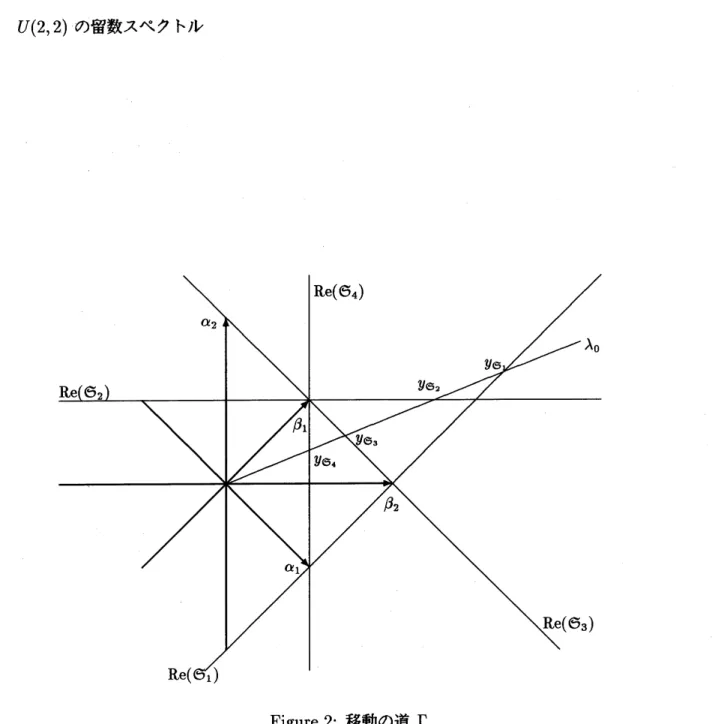
移動の道
$\Gamma(\in a_{M})$
は
$P=P_{1},$
$P_{2}$の時には選択の余地がないが,
$P=P\mathit{0}$
の時には
Figure 2
$U(2,2)$
の留数スペクトル
Figure 2:
移動の道
F.
さて
$P=P_{1},$
$P_{2}$の時は簡単なので
$P=P_{0}$
の時に内積を分解する.
まず
$\Gamma$に沿って積分
軸を移動し
$A(\phi, \phi’)(\pi)$
がその極
$\mathfrak{S}$をまたぐ際に留数定理を適用することにより,
(3.2)
$( \theta_{\phi}, \theta_{\phi’}\rangle_{L^{2}}\mathrm{t}^{G}\langle k)\backslash G(\mathrm{A}))=(\frac{1}{2\pi\sqrt{-1}}\mathrm{I}^{2}\int_{\pi\in}\mathfrak{P},{\rm Re}\pi=0A(\phi, \phi’)(\pi)d\pi$$+ \frac{1}{2\pi\sqrt{-1}}\int_{\pi\in \mathrm{e}_{1}},{\rm Re}\pi=y6_{1}{\rm Res}_{6_{1}}^{\mathfrak{P}_{A(}\prime}\emptyset,$$\emptyset)(\pi)d_{\mathfrak{S}_{1}}\pi$
$+ \frac{1}{2\pi\sqrt{-1}}\int_{\pi\in 6_{2},\mathrm{R}\pi=}\mathrm{e}y6_{2}{\rm Res}_{\mathfrak{S}_{2}}^{\mathfrak{P}}A(\emptyset, \emptyset’)(\pi)d\mathrm{e}_{2}\pi$
$+ \frac{1}{2\pi\sqrt{-1}}\int_{\pi\in \mathfrak{S}{\rm Re}\pi=y6_{3}}3,{\rm Res}_{\mathfrak{S}_{3}}^{\mathfrak{P}}A(\emptyset, \phi’)(\pi)d\mathrm{e}_{3}\pi$
今野拓也
を得る
.
ここで
${\rm Res}_{\mathfrak{S}}^{\mathfrak{P}}A(\emptyset, \emptyset’)$は
$A(\emptyset, \phi’)$の
$\mathfrak{S}$に沿っての留数である
.
次に撃
,
$A(\emptyset, \phi’)$をそれぞれ
$\mathfrak{S},$ ${\rm Res}_{\mathfrak{S}}^{\mathfrak{P}}A(\emptyset, \phi’)(\pi)$で置き換えて積分軸
$\{\pi\in \mathfrak{S};{\rm Re}\pi=$
$y_{\mathfrak{S}}\}$
を
$\mathfrak{S}$のユニタリ軸
$\{\pi\in \mathfrak{S};{\rm Re}\pi=o(\mathfrak{S})\}$
(cf.
Figures 1,
2) まで移動すれば,
各
$\mathfrak{S}$についての項は
(3.3)
$\frac{1}{2\pi\sqrt{-1}}\int_{\pi\in 6{\rm Re}\pi}1,=y6_{1}{\rm Res}_{\mathfrak{S}_{1}}^{\mathfrak{P}_{A(\emptyset,\emptyset}\prime})(\pi)d_{\mathfrak{S}_{1}}\pi$$= \frac{1}{2\pi\sqrt{-1}}\int_{\pi\in \mathrm{e}_{1},\mathrm{R}()}\mathrm{e}\pi=O\mathfrak{S}_{1}{\rm Res}_{\mathfrak{S}_{1}}^{\mathfrak{P}}A(\emptyset, \phi’)(\pi)d\mathrm{e}_{1}\pi$
$+{\rm Res}_{\mathrm{e}_{1,2}^{1}\mathfrak{S}_{1}}^{\mathrm{e}\mathfrak{P}\prime}{\rm Res} A(\emptyset, \emptyset)(\mathfrak{S}_{1,2})+{\rm Res}^{6_{1}}{\rm Res} \mathfrak{P}A(6_{1,3}\mathrm{e}_{1}\emptyset, \emptyset’)(\mathfrak{S}_{1,3})$
.
(3.4)
$\frac{1}{2\pi\sqrt{-1}}\int_{\pi\in \mathrm{e}_{2},{\rm Re}\pi=y\mathrm{e}}{\rm Res}_{\mathfrak{S}_{2}}\mathfrak{P}_{A}(\phi, \phi’)2(\pi)d_{6}\pi 2$
$= \frac{1}{2\pi\sqrt{-1}}\int_{\pi\in^{\mathrm{e}_{2},\mathrm{R}(}}\mathrm{e}\pi=\circ 6_{2})\mathfrak{P}{\rm Res}_{\mathfrak{S}_{2}}A(\phi, \emptyset’)(\pi)d\mathrm{e}2\pi+{\rm Res}_{6_{2,3}}^{6_{2}}{\rm Res} \mathfrak{P}_{A(2\emptyset}\emptyset\prime \mathrm{e}’)(\pi)$
$+{\rm Res}_{\mathrm{e}^{2},\mathfrak{S}_{2}}^{\mathrm{e}_{24}\mathfrak{P}\prime}{\rm Res} A(\phi, \phi)(\pi)$
(3.5)
$\frac{1}{2\pi\sqrt{-1}}\int_{\pi\in \mathfrak{S}_{3},\mathrm{R}\pi=}\mathrm{e}y63\pi{\rm Res}_{6}\mathfrak{P}A(3)()\emptyset,$
$\phi\prime d_{6}\pi 3$
$= \lim_{z(\mathrm{e}_{3})arrow o(\mathfrak{S}_{3})}\frac{1}{4\pi\sqrt{-1}}\int_{\pi\in \mathfrak{S}_{3}},{\rm Re}\pi=Z(63)([{\rm Res}_{\mathfrak{S}_{3}}\mathfrak{P}A\phi, \phi’)(\pi)+\mathrm{R}\mathrm{e}\mathrm{s}\mathrm{e}\mathfrak{P}A(3\phi, \emptyset’)(w_{1}\pi)]d\mathrm{e}_{3}\pi$
$+ \frac{1}{2}{\rm Res}_{\mathrm{e}_{2,3}^{3}\mathfrak{S}_{3}}^{\mathrm{e}\mathfrak{P}\prime}{\rm Res} A(\phi, \phi)(\pi)$
.
(3.6)
$\frac{1}{2\pi\sqrt{-1}}\int_{\pi\in \mathrm{e}_{4}},{\rm Re}\pi=y\mathrm{e}4){\rm Res}^{\mathfrak{P}_{A}}\mathfrak{S}_{4}(\phi, \phi’(\pi)d_{\mathfrak{S}}\pi 4$$= \frac{1}{2\pi\sqrt{-1}}\int_{\pi\in \mathfrak{S}_{4},\mathrm{R}\pi O}\mathrm{e}=(64)\mathrm{e}_{4}\mathrm{R}\mathrm{e}\mathrm{s}\mathfrak{P}_{A}(\emptyset, \emptyset’)(_{T)d_{\mathfrak{S}}\pi}4^{\cdot}$
となる
(cf.
Figure 1,
2).
これらの右辺の各項を詳しく計算し
,
それらの和をとることで次を
得る
.
定理
32(
$L^{2}-$内積の分解
)
$\theta_{\phi}$と
$\theta_{\phi’}$の間の
$L^{2}-$内積は次で与えられる
.
(1)
$P=P_{\mathit{0}}$のとき
.
$( \theta_{\emptyset}, \theta_{\phi}’\rangle L^{2}(G(k)\backslash G(\mathrm{A}))=(\frac{1}{2\pi\sqrt{-1}})^{2}\int_{\pi\epsilon \mathfrak{P}\mathrm{e}\pi},\mathrm{R}=0)A(\phi, \phi’)(\pi d\pi$
$+ \frac{1}{2\pi\sqrt{-1}}\int_{\pi\in \mathfrak{S}_{1},\mathrm{R}}\mathrm{e}\pi=\mathrm{o}(6_{1}){\rm Res}_{6_{1}}^{\mathfrak{P}_{A(\emptyset}},$$\phi’)(\pi)d\mathfrak{S}_{1}\pi$
$+ \frac{1}{2\pi\sqrt{-1}}\int_{\pi}\in \mathfrak{S}_{2},{\rm Re}\pi=o(6_{2}){\rm Res}_{6_{2}}^{\mathfrak{P}_{A(}\prime}\emptyset,$$\emptyset)(\pi)d\mathrm{e}_{2}\pi$
$U(2,2)$
の留数スペクトル
$+ \frac{1}{2\pi\sqrt{-1}}\int_{\pi\in 6_{4},{\rm Re}}\pi=\circ \mathrm{t}6_{4}){\rm Res}_{6_{4}}^{\mathfrak{P}_{A}\prime}(\emptyset, \phi)(\pi)d_{\mathfrak{S}_{4}}\pi$
(3.7)
+2
$c_{k}c_{k^{\prime(}}N(w2, w_{12}ww1\mathfrak{S}_{1,2})M(w1w2, w1\mathfrak{S}_{1},2)N(w1, \mathfrak{S}1,2)\phi(\mathfrak{S}1,2),$
$\phi’(-w_{-\overline{\mathfrak{S}}))}1,2$$(3.8)$
$+4c_{k}^{2},\{N(w1, w_{2}w1\mathrm{e}1,3)M(W2, w_{1}\mathfrak{S}_{1,3})N(w_{1}, \mathfrak{S}1,3)\phi(\mathfrak{S}_{1},3),$
$\phi’(-w-\overline{\mathfrak{S}}1,3))$(3.9)
$+4c_{k}^{2},$
$[(N(w_{2}, w_{1}w2\ominus_{2,4})M(w1, w2\mathfrak{S}_{2,4})N(w_{2}, \mathfrak{S}_{2,4})\phi(\mathrm{e}2,4),$
$\phi’(-w_{21}ww2\overline{\mathfrak{S}}2,4))$$+\langle M(w1, w2^{W}1w_{2}\mathfrak{S}2,4)N(w2, w_{1}w2\mathfrak{S}_{2,4})M(w_{1}, w2\mathfrak{S}_{2,4})N(w_{2}, \mathrm{e}2,4)\emptyset(\mathfrak{S}2,4)$
,
$\phi’(-w_{-}\overline{\mathfrak{S}}2,4))]$
.
但し
(3.9)
で
$\mathfrak{S}_{2,4}\neq \mathfrak{S}_{2,3}$.
(2)
$P=P_{1}$
のとき,
$\langle\theta_{\emptyset},$$\theta_{\phi}’)L^{2}\mathrm{t}c\langle k)\backslash G(\mathrm{A}))=\frac{1}{2\pi\sqrt{-1}}\int_{\pi\in}\mathfrak{P},{\rm Re}\pi=0)A(\phi, \emptyset’)(\pi d\pi$
(3.10)
$+c_{1}\{N(w(P1), \mathfrak{S}(P_{1}))\phi(\mathfrak{S}(P_{1})),$
$\phi’(-w(P1)\overline{\mathfrak{S}(P_{1})}))$.
(9)
$P=P_{2}$
のとき
.
$( \theta_{\phi}, \theta\emptyset’\rangle L2(c(k)\backslash G(\mathrm{A}))=\frac{1}{2\pi\sqrt{-1}}\int_{\pi\in \mathfrak{P}{\rm Re}\pi=0},A(\phi, \phi’)(\pi)d\pi$
(3.11)
$+c_{2}\langle N(w(P2), \mathfrak{S}(P2, \eta k’/k))\emptyset(\mathfrak{S}(P_{2}, \eta k’/k)),$
$\phi’(-w(P_{2})\overline{\mathfrak{S}(P2,\eta_{k’/k})}))$(3.12)
$+\mathrm{c}_{2}’\{N(w(P2), \mathrm{e}(P2,1))\emptyset(\mathfrak{S}(P_{2},1)),$
$\phi’(-w(P2)\overline{\mathfrak{S}(P2,1)})\rangle$3.2
留数スペクトルの決定
定理
32
の内積公式の各項のうち
,
離散的な内積を表す
(3.7), (3.8), (3.9),
(3.10),
(3.11)
そ
れに
(3.12)
が留数スペクトルの内積を与えている
.
従ってそれらの項の中の
intertwining
作
用素たちの像が留数スペクトルを与える
.
(3.9), (3.10), (3.11)
それに
(3.12)
については
,
intertwining
作用素を各素点での局所的
な
intertwining
作用素の
tensor
積に分解し
Langlands
分類を適用することにより
,
像その
ものが既約であることがわかる. これらは定理 2.1 の
(3),
(4)
それに
(5)
の寄与を与えてい
る
.
項
(3.7)
と
(3.8)
については
, ある
$\mathrm{A}_{k}^{\mathrm{x}},/k^{\prime\cross}$の指標
$\chi$of
$\mathrm{A}_{k}^{\mathrm{x}},/k^{\prime\cross}$
を使って
$\mathfrak{S}_{1,2}=\chi||_{\mathrm{A}_{k}}^{3/2},$$\otimes x||_{\mathrm{A}_{k}}^{1/2},$
$,$
$(\chi|_{\mathrm{A}^{\mathrm{X}}}=1)$
,
$\mathfrak{S}_{1,3}=\chi||_{\mathrm{A}_{k’}}\otimes\chi,$ $(\chi|_{\mathrm{A}^{\mathrm{X}}}=\eta_{k’/k})$と書けることに注意する.
また
$w_{-}=(w_{2}w_{1}w_{2})w_{1}$
と
${\rm Im} N(w_{1}, \mathfrak{S}_{1,2})=\mathrm{I}\mathrm{n}\mathrm{d}_{P_{1(}}^{G(}[\mathrm{A})\mathrm{A})(x\mathrm{o}\det)|\det|_{\mathrm{A}_{k}}, \otimes 1_{U_{1}\mathrm{t}^{\mathrm{A}})}]$
,
${\rm Im} N(w1, \mathfrak{S}_{1},3)=\mathrm{I}\mathrm{n}\mathrm{d}_{P_{1}(\mathrm{A}}^{G}\langle \mathrm{A})[)(x\mathrm{o}\det)|\det|_{\mathrm{A}_{k}}^{1/2}, \otimes 1_{U_{1}\{\mathrm{A})}]$今野拓也
から
,
決定すべきは
$P_{1}$からの退化主系列表現上の
intertwining
作用素の像の既約分解であ
る
.
対応する各素点
$v$での局所成分の既約分解は
[K-S]
及び
[Le], [Le-Z]
で決定されている
.
これからまず
${\rm Im} N(w-, \mathfrak{S}_{1,2})$が定理
2.1
の
(1)
の既約表現たちからなっていることがわか
る
.
次に
${\rm Im} N(w_{1}, \mathrm{e}_{1,3})$を考える. 局所成分
${\rm Im} N(w_{1}, (\mathfrak{S}_{1,3})_{v})$の既約成分は
$k^{j}\otimes_{k}k_{v}$上の
1
次元の
Hermite
形式付き空間
$V_{v}$の
unitary
群
$U(V_{v})$
の単位表現からの
$\theta$-lift
たち
$R(V_{v}, \chi_{v})$
である
.
このような
Hermite
形式付き空間の
coherent
な族砿
$=\{V_{v}\}_{v}$
に対して
$G(\mathrm{A})$
の既約で
smooth
な表現
$R(V_{\mathrm{A},x}):=\otimes_{v}R(V_{v}, x_{v})$
が得られる.
この
$R(V_{\mathrm{A},x})$を扱
うには
generalized
Whittaker model
を使う
(cf.
[K-R-S]
\S 2).
$U_{1}(\mathrm{A})/U_{1}(k)$
の指標はある
$k’-$
係数の
Hermite
行列
$\beta$を使って
$\psi_{\beta}$
:
$U_{1}(\mathrm{A})\ni u(B)arrow\psi(\mathrm{t}\mathrm{r}(B\beta))\in \mathbb{C}^{1}$,
と書ける. 我々の目的には
$\det\beta\neq 0$
となる
$\psi_{\beta}$のみを考えれば十分である
.
このとき既約で
smooth
な
$G(\mathrm{A})$の表現
$(\pi, V_{\pi})$の
generalized Whittaker functional
の空間を
$\mathcal{W}_{\beta}(\pi):=\{L:V8R\text{形}\mathrm{g}\ovalbox{\tt\small REJECT}arrow \mathbb{C}|(\mathrm{i}(\mathrm{i}\mathrm{i}))\mathcal{L}(\pi(u\mathcal{L}(d\pi(^{)f}X)f)=^{\psi})=d\psi_{\beta}\beta(u)\mathcal{L}(f),\forall u\in U(X)\mathcal{L}(f),\forall x^{1}(\in \mathrm{L}\mathrm{A}_{f})\mathrm{i}\mathrm{e}U_{1}(\mathrm{A}\infty)\}$
と定義する
.
$(\pi, V_{\pi})$が保型表現の場合には各
$f\in V_{\pi}$
に対してその
$\beta$-th Fourier
係数が
$W_{\beta}(f)(g):= \int_{U_{1}\langle k)}\backslash U_{1}(\mathrm{A})f(ug)\overline{\psi\beta(u)}du$
で定義され,
特に
Whittaker
functional
$W\rho\in \mathcal{W}_{\beta}(\pi)$が砿
$\ni farrow W\rho(f)(1)\in \mathbb{C}$
によって
与えられることに注意する
.
このとき重要な事実は
$R(V_{\mathrm{A}x},)$