Patterns
on
the
Fish Skins Induced by Anisotropy
in
Diffusion
九大大学院理学研究院 望月敦史 (MOCHIZUKI Atsushi)
Department of Biology, Faculty ofSciences, KyushuUniversity
[email protected].
kyushu-u.ac.jPMost of the stripes observed
on
fish skinsare
either parallelor
perpendicularto theirantero-posterior axis (Kondo&Asai, 1995). Some species have parallel stripes,
some
haveperpendicular ones, and small number of species has random stripes, where the direction of
the stripe is notfixed. Forexample,veryclose two species (Genicanthus melanosphilos and
Genicanthus watanabei) show very different pattems; G. melanosphilos shows perpendicular
and G. watanabei shows parallel stripes to the antero-posterior axis. On the otherhand, the
direction of stripes obtained by simple reaction diffusion systems is basically free. The
stripes patterns generated by the reaction-diffusionmechanism in two-dimensional space has
stable periodicity (Turing, 1952), however, the direction of the stripe is not stable; that is
variable depending
on
the initial distribution. What makes the strong directionality in theactualfish skin?
Figure 1.An example ofparallel stripeto the antero-posterioraxis(G. watanabei)
In fact, there is strong possibility that
a
fish skin has the property to makedirectionality in its structure. Inthe structure of fish skin,
we can see
that each scalecomes
out to the
same
direction along the antero-posterior axis. The epidermis is wrapping thescales and making zigzag form. As the zigzag structure $\mathrm{d}\mathrm{o}\mathrm{e}\mathrm{S}\mathrm{n}^{\mathrm{t}}\mathrm{t}$ exist along dorso-ventral
axis, the structure is different between the antero-posterior axis and the dorso-ventral axis.
This structural difference maymake difference in speed ofinformational transfer between the
two directions.
From the idea,
we
developeda
modified reaction-diffusion model where thesubstances likely to diffuse faster to the special direction rather than simple homogeneous
数理解析研究所講究録
diffusion. By using the anisotropic diffusion-reaction model,
we can
explain the transitionof the pattemin actualfish.
Model
The anisotropic property of the fish epidermis is modeled by incorporating the
anisotropyinto the diffusion term. The usualdiffusion term is derived by assuming thatthe
flux of substance is linear to the gradient ofthe substance. In this study, it is assumed that
the diffusion coefficientisnot
a
constant butafunction ofan
angle between the gradient anda
special direction. The special direction
means
the direction where the substances diffusefaster. In other word, we assumed that the flux would be enhanced if the direction of
gradient of the substance is
same as
the special direction, and it would be reduced if thedirectionofgradient isperpendicular to the special direction.
The assumption isexpressed mathematically in the following:
$\frac{\partial u}{\partial t}=\nabla\cdot(D_{\mathcal{U}}(\theta_{u})\nabla u)+_{V}(_{u},\mathcal{V})$ (1a)
$\frac{\partial v}{\partial t}=d\nabla\cdot(D_{v}(\theta)\mathcal{V}\nabla v)+_{l}g(u,\mathcal{V})$ (1b)
where $\theta_{u}$ and $\theta_{v}$ indicate the angles of the gradient of the variables
($\theta_{u}=\tan^{-1}((\partial \mathcal{U}/\partial y)/(\partial u/\partial x))$ and $\theta_{v}=\tan^{-1}((\partial v/\partial y)/(\partial v/\partial x))$), and $D_{\sigma}(\theta_{\sigma})$ indicates the
function of anisotropy in diffusion term. The form of the $D_{\sigma}(\theta_{\sigma})$ used in the analysis is:
$D_{\sigma}( \theta_{\sigma})=\{1-\delta_{\sigma}\cos 2(\theta\sigma-\varphi)\}\frac{1}{2}$
, where $\varphi$ indicates the angle of most diffusive direction.
We call the parameter $\delta_{\sigma}\dagger \mathrm{t}\mathrm{a}\mathrm{n}\mathrm{i}_{\mathrm{S}}\mathrm{o}\mathrm{t}\mathrm{r}\mathrm{o}\mathrm{p}\mathrm{y}^{\uparrow 1}$, which indicates the degree of distortion of the
diffusion range from
a
circle. If the anisotropy is $0$, the diffusionrange
is justa
circle(normal diffusion), and if the value is large the distortion of diffusionrange is large.
We can
choose different values of anisotropy for the two substances ($\delta_{\mathcal{U}}$ and $\delta_{v}$). On the other
hand, the diffusive direction $\varphi$ is assumed to be
common
between the two substances(because it
comes
from the structure of epidermis). This method to incorporate theanisotropy into the diffusion is first modeled by Kobayashi (Kobayashi, 1993), where he
studied pattem formation the dendritic crystal growth like
snow
crystal.The forms $f$ and $g$ indicate reaction terms. We
use
the form studied bySchnakenberg(Schnakenberg, 1972);
$f(u,v)=A-u+u^{2}v$ (1c)
$g(_{\mathcal{U}},v)=B-uv2$ (1d)
where A and$\mathrm{B}$
are
positive constants. Wealso triedsome
differentformulae later.
Result
We calculated the model $(\mathrm{l}\mathrm{a})-(\mathrm{l}\mathrm{d})$ andderivepattemsby usingcomputer simulation.
The used
Parameters
valuesare ones
that generate stripes in simple reaction-diffusion model.The boundary condition is periodic. The initial distribution is equilibrium value with small
random fluctuation. To
remove
the effect of the boundary, the periodic boundary conditionwas
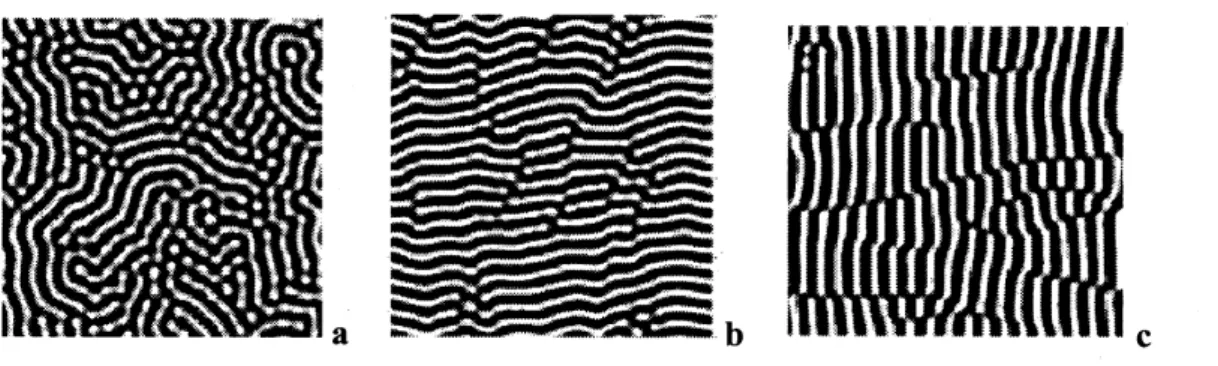
chosen.Figure2The obtained pattems by computer simulation
(1) The effectofpositive
same
anisotropyWe incorporate the
same
positive value of anisotropy in both substances (i.e.$\delta_{u}--_{\delta_{\mathcal{V}}})$. Fig. $2\mathrm{a}$ shows the simulation results, when the most diffusive direction is parallel
to the $\mathrm{x}$-axis $(\varphi--0)$. We cannot find any directionality in this figure. This
$\mathrm{r}\mathrm{e}\mathrm{s}\mathrm{u}\mathrm{l}_{b}\mathrm{t}$
was
observed
even
if thevalue of theanisotropy is verylarge.(2) The effect ofanisotropic diffusion$\mathrm{o}\mathrm{f}\mathrm{l}\mathrm{e}\mathrm{S}\mathrm{s}- \mathrm{d}\mathrm{i}\mathrm{f}\mathrm{f}\mathrm{f}\mathrm{i}\mathrm{s}\mathrm{i}_{\mathrm{V}\mathrm{e}- \mathrm{S}\mathrm{u}}\mathrm{b}\mathrm{S}\mathrm{t}\mathrm{a}\mathrm{n}\mathrm{C}\mathrm{e}\mathcal{U}$
Fig. $2\mathrm{b}$ showsthe simulationresults when the anisotropy of
$u$ispositive and that of$v$
is $0$. In the figure, the most diffusive direction is parallel to the $x$-axis $(\varphi--\mathrm{o})$. The
directionof the stripe becomes always parallelto the most diffusive direction of$\mathrm{u}$,
even
ifwe
changed the diffusive direction $\varphi$. Thewave-length of the stripeisnotinfluenced by $\delta_{u}$
.
(3) The effectofanisotropic diffitsion of$\mathrm{m}\mathrm{o}\mathrm{r}\mathrm{e}- \mathrm{d}\mathrm{i}\mathrm{f}\mathrm{f}\mathrm{f}\mathrm{i}\mathrm{s}\mathrm{i}\mathrm{v}\mathrm{e}- \mathrm{S}\mathrm{u}\mathrm{b}_{\mathrm{S}\mathrm{t}}\mathrm{a}\mathrm{n}\mathrm{C}\mathrm{e}\mathcal{V}$
Fig. $2\mathrm{c}$ show the results when the anisotropy of$v$is positive andthat of$u$ is $0$. The
mostdiffusive directionisparallel to the$x$-axis $(\varphi--\mathrm{o})$. Inthis case, the direction of the lines
is likely to be perpendicular to the diffusive direction of $v$. We
can
remember that $v$corresponds to whatis calledinhibitor. Then
we can
intuitively understand the result that thedirection of the stripes
crosses
the mostdiffusive direction of$v$.1
0.8
0.6
$f\mathrm{G}\triangleright \mathrm{O}.4$O.2
$0$ $\mathrm{O}$ $\mathrm{O}.5$1
$\delta_{Il}$Figure
3
Summaryof directionality of obtained stripesFig.
3
summarizes the directionality of stripe obtained pattems. The diffusivedirection is fixed to be parallel to the $x$-axis. Each point indicates the direction of the
observed stripe, horizontal, vertical,
or
not determined. To identify the direction is done byusing
a
computeralgorithm.The result depends only
on
the relative magnitude of anisotropy of$u$ and$v$. When$\delta_{u}$ is largerthan $\delta_{v}$, the direction of the stripe is horizontal; the direction is parallel to the
most diffusive direction. When $\delta_{v}$ is larger than $\delta_{u}$ , the direction of stripe is
perpendiculartothe most diffusive direction. Only when the anisotropies of both substances
are
almost the same,the direction is notdetermined.We tested several different conditions. We changed the value of parameter in
reactionterm,value of diffusion coefficient$\mathrm{d}$,the function of anisotropy indiffusion termand
also the form of the reactionterm. The result does not depend
on
these changes. Thesame
figure
was
obtainedfromallthetrialswe
tested. Wecan
saythatthis resultis verygeneral.References
Kobayashi R. (1993) Modeling and numerical simulations of dendritic crystal growth.
$Phy_{SiCa}D63$
: 410-423
Kondo S. andAsaiR. (1995)Areaction-diffusion
wave on
the marineangelfish Pomacanthus.Nature
376: 765-768
Schnakenberg J. (1979) Simple Chemical Reaction systems with Limit cycle behavior. $J$.
theor. Biol.
81: 389
TuringA. M. (1952) The chemical basisofmorphogenesis. Phil. Trans. R. Soc. London$B237$