Introduction
Estuaries, where rivers flow into the ocean forming a complex environment with transitional waters, represent a key ecosystem in coastal zones that fulfils various biotic and abiotic
functions, and is of both ecological and economic importance(COSTANZAet al., 1997; MCLUSKYand
ELIOTT, 2004; BARBIERet al., 2011). In addition, this
ecosystem, which lies adjacent to many of the world’s megacities(DAYet al., 2012a), is highly
Decadal changes in the fish assemblage structure at a modified
shore site in an urbanised estuarine canal
Atsunobu MURASE1, 2)*, Yusuke MIYAZAKI3), Masato MOTEKI4)and Hiroshi KOHNO4)
Abstract: We analysed datasets of fish assemblages for two timescales(decadal and annual,
composed of four periods: 1993Ȃ1994; 2004Ȃ2005; 2005Ȃ2006; 2006Ȃ2007)to estimate the temporal dynamics of assemblage structures and changes in estuarine use functional groups(EUFGs) along a modified shoreline. The datasets were obtained from monthly sampling using a light trap at a mooring berth site reinforced with a vertical hard structure in an estuarine canal in Tokyo, Japan. A comparison of the fish community parameters during the sampling periods showed significant decadal variation in some factors, but no significant variation across sequential annual timescales. Total species richness increased due to increased richness in fish in the marine EUFG category. The percent abundance of marine fish also significantly increased, whereas the abundance of estuarine fish(primarily Acanthogobius flavimanus predominated)decreased. Habitat degradation around the mooring berth site accompanying city planning might be responsible for the decline in estuarine fish species over several decades, whereas the increased species richness reflected a recent recovery in water quality in the Tokyo Bay. These results suggest that nowadays the study site functions as an ecological corridor between natural shore sites rather than as a true habitat for estuarine fish species.
Keywords : Artificial structure, community dynamics, estuarine fish, Tokyo Bay
1)Nobeoka Marine Science Station, Field Science Center, University of Miyazaki, 376Ȃ6 Akamizu, Nobeoka, Miyazaki 889Ȃ0517, Japan.
2)Department of Marine Biology and Environmental Sciences, Faculty of Agriculture, University of Miyazaki, 1Ȃ1 Gakuen-Kibanadai-Nishi, Miyazaki, 889Ȃ2192, Japan
3)Department of Child Education and Welfare, Shiraume Gakuen College, 1Ȃ830 Ogawa-cho,
Kodaira-shi, Tokyo 187Ȃ8570
4)Laboratory of Ichthyology, Department of Ocean Sciences, Graduate School of Tokyo University of Marine Science and Technology, 4Ȃ5Ȃ7 Konan, Minato, Tokyo 108Ȃ8477, Japan
*Corresponding author: Tel: + 81Ȃ982Ȃ20Ȃ7230 Fax: + 81Ȃ982Ȃ37Ȃ0327
vulnerable to anthropogenic impacts. Common artificial changes in coastal zones are modifica-tions of the shoreline and construction of urban infrastructures, typically classified in terms of the materials used and purpose, such as riprap/ rubble or vertical walls and their combination, breakwaters, groynes, jetties, seawalls, bulk-heads, and pilings(BULLERI and CHAPMAN, 2010;
SCYPHERS et al., 2015) . The negative effects of
these artificial structures on estuarine ecosys-tems have been reported as various ecological responses of fish communities(e.g., decreases in native fish diversity and/or abundance)(ABLEet
al., 1998; PETERSON et al., 2000; BILKOVIC and
ROGGERO, 2008; MUNSCH et al., 2014; M
ORENO-VALCÁRCELet al., 2016), and degradation of
habi-tats in relation to foraging(LOWEand PETERSON,
2015; DAVIDet al., 2016), growth(DUFFY-ANDERSON
and ABLE, 1999; ABLE et al., 1999)and
reproduc-tion(RICE, 2006; BALOUSKUSand TARGETT, 2012). In
contrast, several studies have reported the possible function of artificial hard structures as habitats for coastal and estuarine fish assemblag-es(GUIDETTI, 2004; CLYNICK, 2006; SAKAIet al., 2007;
INUIet al., 2012; TAKIGASAKIand SANO, 2013), and
the lack of significant negative effects of modified shorelines on fish communities in estuarine envi-ronments compared to natural shorelines (MCKINLEY et al., 2011; MORLEY et al., 2012).
However, some authors have noted the need for additional studies on the ecological effects of shoreline armouring(AIROLDIet al., 2005; BULLERI
and CHAPMAN, 2010; MORLEYet al., 2012),
particu-larly, over longer timescales(CHAPMAN and
UNDERWOOD, 2011). Although the cumulative
ef-fects of artificially altered environments have been previously reported(PETERSON and LOWE,
2009), there have been few long-term studies on this modified environment. SCYPHERSet al.(2015)
compared the stability of fish community struc-tures among three types of modified shorelines
and a natural shoreline using a series of 11Ȃyear samples(based on a fisheries database)in the Mobile Bay of the northern Gulf of Mexico. The authors reported that the most simplified shore-line(vertical wall)had the lowest assemblage stability, and that the natural shoreline had the most stable assemblages. This indicates the need for long-term studies of several months or even years to accurately assess modified shorelines as habitats for aquatic organisms and elucidate the impacts on this ecosystem as a basis for imple-menting effective policies to support sustainable development.
Guild classification, the categorisation of each organism relative to its pattern of using the space and resources in an ecosystem, is a key approach for evaluating systems as habitats for organisms in the current context of the global decrease in biodiversity and increase in ecosystem disturban-ces(WHITFIELDand ELLIOTT, 2002; BLONDEL, 2003;
CARDOSO et al., 2011b) . ELLIOTT et al.(2007)
performed a global-scale review and defined estuarine fish guilds covering three dimensions of resource usage: 1)the ways in which the fish use the estuary during their entire life cycle(refined by POTTERet al., 2015);2)primary feeding
meth-od; and 3)use of the site to reproduce. This guild classification, which has been applied in the assessment of the ecosystem value of estuaries (FRANCO et al., 2008), the understanding of the
relationships between the condition of each estu-ary and structure of the functional groups (NICOLAS et al., 2010) , and the assessment of
estuary habitat quality(CARDOSO et al., 2011a;
GAMITOet al., 2012; PÉREZ-DOMÍNGUEZ et al., 2012),
has significantly contributed to enhancing our understanding of the connection between the structure of functional communities and the condition of the estuarine ecosystem. Moreover, long-term studies have revealed that extreme climate events have caused dramatic changes in
the functional trait structure of estuarine fish communities(NYITRAI et al., 2012; BOUCEK and
REHAGE, 2014). In addition, the long-term effects of
anthropogenic impacts(such as hydrological changes)on guild structures in estuaries have only recently been detected, and the combined effects with those of climate change could cause marked changes in ecosystem function(BAPTISTA
et al., 2015).
Tokyo is one of the world’s largest megacities, and is located along the shoreline of the inner-most part of the Tokyo Bay. Numerous rivers flow into the bay, creating various estuarine environments. The inner part of the bay formerly comprised a wide area of shallow tidal flats, but currently, the natural shore has completely disappeared due to land reclamation for industri-alisation, which has taken place at an increasing rate since the 1950s(ENDOH, 2004; NOMURA, 2012).
A number of studies on fish assemblage struc-tures and their temporal changes have been performed during the last 20 years in several semi-natural shoreline areas(shallow tidal flats formed after reclamation)of the estuarine envi-ronment adjacent to the city, suggesting that environmental recovery is at least a short-term prerequisite as a habitat for marine and estuarine fish with fewer effects from severe pollutants and modified shoreline(NASUet al., 1996; KANOUet al.,
2000; YAMANE et al., 2003; KOHNO et al., 2008;
MOTEKI et al., 2009; KANOU and KOHNO, 2014;
MURASEet al., 2014). Despite extensive shoreline
development, few studies examining the function of modified shorelines as habitat have been performed in the inner part of the bay. Recent 1Ȃyear surveys on fish assemblages in the inner bay demonstrated that the artificial canal con-structed with vertical walls might provide suit-able habitat for parts of the lifecycle of several estuarine fish species(MURASEet al., 2007; SAKAI
et al., 2007). However, there is little information
on whether modified shorelines in estuarine envi-ronments can function as a consistent long-term habitat for fish species. In this context to reveal temporal dynamics of fish community of modified estuarine shorelines, the present study examined the long-term changes of fish community struc-ture including guild classification by combining previously published data(1993Ȃ1994: SAKAIet al.,
2007)with a more recent(2004Ȃ2007)dataset (collected using a method similar to that of the earlier dataset)of fish assemblages at an arm-oured site in the inner part of the Tokyo Bay. Materials and Methods
Study site. The study site was located at the mooring berth of the Shinagawa Campus of Tokyo University of Marine Science and Technol-ogy, in the Keihin Canal in the inner part of the Tokyo Bay, central Japan(35°37′33″N, 139°45′04″ E; Fig. 1) , approximately 1.6 km north of the mouth of the Meguro River and 4.0 km south of Sumida River. The site is classed as estuarine based on its year-round salinity(SAKAIet al., 2007)
. The entire shoreline at this site is armoured with vertical wall structures. The water depth ranges from 1.5 m to 3.0 m, and the bottom sediment comprises sandy mud including sludge. The armouring wall is almost fully covered in adhered oyster shells and blue sea mussels.
Sampling protocol. Although light-trap sam-pling has several problems caused by utilizing the positive phototaxis of fishes, it is a more favour-able sampling method in habitats where it is difficult to draw plankton, seine, and other fishing nets(DOHERTY, 1987; SAKAIet al., 2007). Following
the sampling protocol of a previous study at the same site(SAKAIet al., 2007), we conducted fish
sampling twice a month between December 2004 and November 2007(72 sampling events in total), using an aquatic lamp(300 W)and two hand nets
(1 mm mesh, 40 cm diameter). We set the aquatic lamp 0.5 m below the surface 0.5 m from the mooring berth, and turned on the lamp 30Ȃ60 min after sunset but did not consider the tide and moon’ s age. Subsequently, we collected all fish attracted to the light for 1 h after the light had been turned on for 5 min. All of the samples were fixed in 5Ȃ10% formalin in the field, and later preserved in 70% ethanol in the laboratory. Before each fish sampling, the surface water temperature and salinity were measured using a standard mercury thermometer and salinity refractometer, respectively. Fish were picked from the samples using a dissecting microscope and identified to the lowest possible taxon following OKIYAMA(1988)and NAKABO (2002).
Scientific names revised after NAKABO(2002),
fol-lowed NAKABO(2013)and HOSOYA(2015). All of
the specimens were deposited in the Kanagawa Prefectural Museum of Natural History, Oda-wara, Japan(KPM-NI 18477Ȃ18511), the Labora-tory of Ichthyology of Tokyo University of Marine Science and Technology, Tokyo, Japan (MTUF-P[L]16385Ȃ16627) , and the National Museum of Nature and Science, Tsukuba, Japan (NSMT-P 92707Ȃ92717).
Fish classification. ELLIOTTet
al.,(2007)devel-oped a classification of guilds for estuarine usage functional groups(EUFGs)for fish in estuarine environments and defined 10 traits. Refining this classification, POTTER et al.,(2015)divided the
EUFGs into 4 main categories(marine, estuar-ine, diadromous, and freshwater), and subdivided these into a total of 14 categories. Using the sampled fish as general indicators to assess the temporal variability in habitat quality at the study site, we classified them into three main categories and three subcategories(six catego-ries in total)following POTTER et al.,(2015):
marine, estuarine, and freshwater, and anadro-mous, catadroanadro-mous, amphidromous subcatego-ries in the diadromous category. For this clas-sification, we referred to KAWANABEet al.,(2001),
KOHNO et al.,(2011)and HOSOYA(2015)for
information on the ecological use of estuarine environments by each fish species.
Data analysis. To analyse the variation in structure of the fish assemblages and changes in EUFG composition on decadal and annual time-scales, we defined the following four sampling periods: Period 0 (P0), May 1993ȂApril 1994 (Sakai et al., 2007); Period 1 (P1), December 2004ȂNovember 2005; Period 2(P2), December 2005ȂNovember 2006; and Period 3(P3), Decem-ber 2006ȂNovemDecem-ber 2007. Due to the difference in monthly sampling frequency between P0(1Ȃ3
Fig. 1. Map showing the locations of the study site, a
mooring berth in Keihin Canal, and a semi-natural site, a tidal flat of Keihin-jima Island, for compari-son, in the inner part of the Tokyo Bay(partly modified from a 1:25000 topographic map from the Geospatial Information Authority of Japan).
times per month)and P1Ȃ3(2 times per month), the catch per unit effort(CPUE)was calculated for each month by comparing the mean abun-dance of fish among sampling periods. Monthly one-way repeated measures of analysis of var-iance(ANOVA)and a Tukey’s test were per-formed to analyse the variability in each variable for the fish assemblages, predominant EUFG categories, and environments among the sam-pling periods. When the condition of normal distribution was violated based on a Shapiro-Wilk test, the data were log10(x + 1.0)transformed or Friedman and Wilcoxon’s signed rank tests were adopted. Furthermore, to analyse differences in community structure among sampling periods, the similarity index of CHAO et al.,(2005), which
extended the Jaccard index so that it reflected unseen species and abundance data(DOI and
OKAMURA, 2011), was calculated and non-metric
multi-dimensional scaling(nMDS)was used to generate ordination plots based on the values of similarity index. All of the procedures were conducted using the software program R 3.2.2(R DEVELOPMENTCORETEAM, 2015).
Comparison with nearby tidal flat. The fish assemblage structures have been studied since 1994 on a semi-natural tidal flat of artificial Keihin-jima Island(35°34′05″N, 139°46′06″E; Fig. 1) , close to the present study site, and the results have shown consistent predominance of estuar-ine gobies for almost 20 years(MOTEKIet al., 2009;
MURASEet al., 2014), indicating a relatively stable
long-term community structure. To compare the temporal stability of the community structure between modified(the study site)and semi-natural sites over similar time periods, abundance data on each species from the tidal flat site were extracted from published papers and reflected in the composition of the EUFG and nMDS. Then, the following time periods were fixed for the data
from the tidal flat site: Period 0 on Keihin-jima Island(P0, 1994Ȃ1995: NASUet al., 1996);Period 1
(P1, 2006Ȃ2007: MOTEKIet al., 2009);Period 2(P2,
2007Ȃ2008);and Period 3(P3, 2008Ȃ2009: MURASE
et al., 2014). The abbreviations for these periods are the same as those of the mooring berth site unless mentioned in the text.
Results
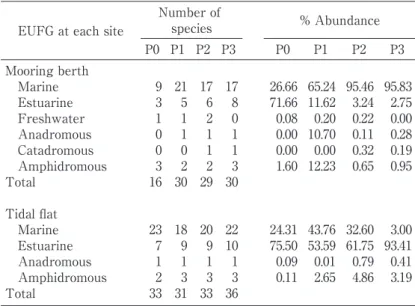
Composition of fish assemblages. A total of 4,211 individuals representing 47 fish species belonging to 28 families were captured during P0Ȃ3, with 1,249 individuals and 16 species in P0, and 925Ȃ1056 individuals and 29 or 30 species in P1Ȃ3(Table 1). The total sampling frequencies in P0(26 times)and P1Ȃ3(24 times in each period) were almost equal, resulting in no significant differences in total abundance, but the number of species in P1Ȃ3 was almost two-fold that in P0 (Table 1). The number of species and abundance of each EUFG in each sampling period are shown in Table 2, with values from the nearby tidal flat for comparison. The marine category was pre-dominant in terms of number of species across sites and sampling periods, but the most abun-dant group changed from estuarine in P0 to marine in P1Ȃ3 at the mooring berth site, whereas on the nearby tidal flat site the estuarine group was consistently dominant throughout all sam-pling periods. The four categories, freshwater, anadromous, amphidromous, and catadromous, were barely observed(0.00Ȃ0.95% in total abun-dance)throughout the sampling periods except for P1(10.70% and 12.23% for the anadromous and amphidromous categories, respectively; Ta-ble 2) . Corresponding to the changes in abun-dance of the EUFGs, the most abundant fish species also changed(Table 3), in that an estuar-ine gobiid, Acanthogobius flavimanus, was most abundant in P0 followed by a marine species, the marine pelagic clupeid(Sardinella zunasi)as the
Table 1. Fish species and their dominance(% abundance)in each sampling period collected at a mooring berth
Table 2. Summary of the composition of the estuarine use functional
groups(EUFGs)in each sampling period(P0Ȃ3)during 1993Ȃ 1994(Period 0)and 2004Ȃ2007(Periods 1Ȃ3)at a mooring berth in the Keihin Canal using light-trap sampling, and on a semi-natural tidal flat on Keihin-jima Island in the inner Tokyo Bay during 1994Ȃ1995(P0)and 2006Ȃ2009(P1Ȃ3)using seine net sampling
EUFG at each site
Number of species % Abundance P0 P1 P2 P3 P0 P1 P2 P3 Mooring berth Marine Estuarine Freshwater Anadromous Catadromous Amphidromous Total Tidal flat Marine Estuarine Anadromous Amphidromous Total 9 3 1 0 0 3 16 23 7 1 2 33 21 5 1 1 0 2 30 18 9 1 3 31 17 6 2 1 1 2 29 20 9 1 3 33 17 8 0 1 1 3 30 22 10 1 3 36 26.66 71.66 0.08 0.00 0.00 1.60 24.31 75.50 0.09 0.11 65.24 11.62 0.20 10.70 0.00 12.23 43.76 53.59 0.01 2.65 95.46 3.24 0.22 0.11 0.32 0.65 32.60 61.75 0.79 4.86 95.83 2.75 0.00 0.28 0.19 0.95 3.00 93.41 0.41 3.19
Table 3. Percent abundance(%)of the five most abundant fish species and their estuarine use functional
group(EUFG)classification(Am, amphidromous; An, anadromous; E, estuarine; M, marine)at the mooring berth in each sampling period
Period 0(1993Ȃ1994) Period 1(2004Ȃ2005)
Rank Family Species EUFG % Family Species EUFG %
1 Gobiidae A. flavimanus E 71.26 Clupeidae S. zunasi M 30.58 2 Engraulidae E. japonica M 17.05 Atherinidae H. valenciennei M 13.66 3 Gobiidae C. gulosus M 3.76 Gobiidae G. petschiliensis Am 11.93 4 Clupeidae S. melanostictus M 3.12 Cyprinidae T. brandtii maruta An 10.70 5 Clupeidae S. zunasi M 1.20 Gobiidae A. flavimanus E 5.71
Period 2(2005Ȃ2006) Period 3(2006Ȃ2007)
Family Species EUFG % Family Species EUFG %
Clupeidae S. zunasi M 36.65 Clupeidae S. zunasi M 60.04
Engraulidae E. japonica M 35.57 Engraulidae E. japonica M 16.29 Atherinidae H. valenciennei M 7.78 Mugilidae M. cephalus cephalus M 11.17 Mugilidae M. cephalus cephalus M 6.05 Gobiidae C. gulosus M 5.40 Scorpaenidae S. cheni M 2.59 Atherinidae H. valenciennei M 0.85 See Table 1 for initial of genera in each family
most abundant species during P1Ȃ3; 2Ȃ5 marine species were ranked in the top five abundant members over all sampling periods. This trend significantly differed from that of a nearby tidal flat, where estuarine gobiids were diverse and the most abundant group throughout 1994Ȃ2009 (MOTEKIet al., 2009; MURASEet al., 2014).
Variation in environmental parameters. The temporal variation in the environmental parame-ters at the study site is shown in Fig. 2. Mean water temperature(17.8Ȃ21.5°C)varied signifi-cantly on a decadal time scale(Tukey’s test, p < 0.001 for P0 versus the other sampling periods), but no significant annual variation was observed. Mean salinity(14.8Ȃ16.8)showed no significant variation across all sampling periods(Friedman test, p = 0.445).
The mean total number of species increased significantly from P0 to P1(Tukey’ s test, p = 0.047)together with an increase in the marine category from P0 to P1 and from P0 to P2
(Tukey’s test, p = 0.012 and 0.039, respectively), whereas no significant temporal variation was detected in the estuarine category(ANOVA, p = 0.864; Fig. 3a). The mean CPUE of the total fish abundance was constant throughout the sam-pling periods(ANOVA, p = 0.995; Fig. 3b), but the composition of those EUFGs that constituted the majority of the total abundance(marine and estuarine categories)in each sampling period changed with time. The percent abundance of the marine category increased from P0 to P1, and remained stable from P1 to P3(Fig. 3c), varying significantly among the sampling periods(Fried-man test, p = 0.024), although no significant dif-ferences between P0 and the other sampling periods were detected(Wilcoxon’s signed rank test, p = 0.222 for P0 versus P1; p = 0.087 for P0 versus P2; p = 0.147 for P0 versus P3). In con-trast, the percent abundance of the estuarine group decreased from P0 to P1 and remained stable from P1 to P3(Fig. 3c), varying signifi-cantly among sampling periods(Friedman test, p=0.027), whereas no significant differences between P0 and the other sampling periods were detected(Wilcoxon’s signed rank test, p = 0.480 for P0 versus P1; p = 0.570 for P0 versus P2; p = 0.480 for P0 versus P3).
Multi-dimensional scaling. The stress value of the nMDS ordination was 0.053, indicating that it was well-fitted and that the relative distances of similarities among the sampling periods were substantially greater at the mooring berth site than at the tidal flat site(Fig. 4). In particular, the plot of P0 for the mooring berth site had a significantly greater distance of similarity than those of the other three periods(P1Ȃ3). Because there was only 1 year-round dataset in the earliest sampling period, analyses of similarities could not be performed between the earliest(P0) and more recent sampling periods(P1Ȃ3) , but
Fig. 2. Decadal(broken lines)and annual(solid lines)
variation in the physical parameters over four time periods(P0Ȃ3): solid circles, mean water temperature; solid squares, mean salinity at the mooring berth site. Vertical bars indicate standard errors.
the above community parameter variation, which reflect changes in the number of species and composition of the EUFGs from P0 to P1Ȃ3, were reflected well in the nMDS results.
Discussion
In general, the transitional water environment of estuaries results in lower biodiversity but a higher abundance of the surrounding freshwa-ter/marine environments(MCLUSKYand ELLIOTT,
2004; DAY et al. 2012b), and fish of the estuarine
category are a common and abundant guild in many estuaries(ELLIOTT and DEWAILLY, 1995;
KANOUet al., 2000; PIHLet al., 2002; HARRISONand
WHITFIELD, 2008). Furthermore, a few generalist
species tended to be abundant in some developed areas of estuaries(e.g., BILKOVIC and ROGGERO,
2008; MORENO-VALCÁRCELet al., 2016), which were
also observed by SAKAI et al.,(2007)at the
mooring berth site. An estuarine gobiid, Acantho-gobius flavimanus, which is the most abundant fish in the inner part of the Tokyo Bay(KANOUet
al., 2000; MURASEet al., 2007, 2014), was dominant
in terms of abundance during 1993Ȃ1994, whereas other estuarine gobies had low abundance at the mooring berth site. SAKAIet al.,(2007)concluded,
on the basis of a 1Ȃyear dataset, that the mooring berth site could function as habitat primarily for estuarine gobies, and that its low-salinity condi-tions rendered it poorly suitable as a habitat for marine fish species. However, our dataset com-bined with the results of SAKAI et al.,(2007)
revealed that the composition of the EUFGs changed markedly after 10 years, and this was reflected in the nMDS plot(Fig. 4) , although salinity levels(Fig. 2)and total fish abundance (Fig. 3b)did not significantly vary during the entire study period. This change in community structure can be summarised as follows: the mean number of species in the marine category increased, whereas that in the estuarine category
Fig. 3. Variation in the fish assemblage parameters at
the mooring berth over decadal(broken lines) and annual(solid lines)time scales: a, monthly mean number of species in each sampling period (P0Ȃ3); b, monthly mean catch per unit effort (CPUE)of individuals; c, mean percent abun-dance of total catch. Solid circles, squares and triangles indicate total assemblages, and marine and estuarine categories, respectively.
remained unchanged, leading to an increase in the total number of species(Fig. 3a); and the percent abundance of the marine category increased while that of the estuarine category decreased. Most surprisingly, even an abundant generalist goby species(A. flavimanus)declined significantly after 10 years(in P1), and almost disappeared thereafter(in P2 and P3; Tables 1, 3) , causing a decrease in the total abundance of the estuarine category. A. flavimanus is constantly predominant at the nearby tidal flat site also in terms of decadal and annual time scales, and predominance of this species and the other estuarine gobies(NASUet al., 1996; MOTEKIet al.,
2009; MURASEet al., 2014)resulted in that the fish
assemblage structure and EUFG composition at the nearby tidal flat site did not show any conspicuous change(i.e. constant predominance of estuarine category was detected: Fig. 4, Table 2). Contrary to this, abundance of A. flavimanus at an artificial riprap shoreline was almost half of tidal flat environment within artificial lagoon of the inner part of the Tokyo Bay (KANOU, 2006). Although there have been no data
explaining habitat degradation around the study site, recent development of infrastructure for city planning in Tennozu Isle, an area of Shinagawa City, located in front of the mooring berth site, which started 1988(SHINAGAWA CITY , 2005) ,
might affect suitable habitat(such as soft-bottom
Fig. 4. Results of nMDS ordination based on Chao’s adjusted Jaccard index at the
mooring berth site(m)and the nearby tidal flat site(t). Numbers next to abbreviations of sites indicate each sampling period(P0Ȃ3)defined for each site (e.g., “m1” indicates Period 1 of mooring berth site).
shallow environment)for estuarine category, especially A. flavimanus.
On the other hand, an increase in the total number of species(16 to 29 or 30)over the course of one decade was recorded at the study site, and the total number of species in the estuar-ine category also increased(from 3 to 8 species; Table 2)despite no variation in the mean number of estuarine species over the sampling periods (Fig. 3a). Improvement in water quality in estua-ries can recover species richness (MCLUSKYand
ELLIOTT, 2004), and the increasing species
rich-ness over one decade at the study site may reflect water quality improvements in the inner part of the Tokyo Bay(NOMURA, 2012). In fact,
popula-tion recoveries in several diadromous fish species (e.g., Plecoglossus altivelis altivelis and Tribolo-don blandtii maruta)in the rivers flowing into the bay were reported(KOHNO et al., 2011; HOSOYA,
2015). Low abundances in these diadromous and other estuarine fishes at the mooring berth site, despite increases in species richness, suggest that the modified shoreline without surrounding shoreline habitat such as tidal flat may only function as an ecological corridor connecting natural or semi-natural environments rather than as true habitat for the lifecycles of fish in the inner part of the Tokyo Bay. Hydrological changes relating to man-made changes(e.g., bank regulation and dam interventions)causing variation in salinity levels are also important in determining estuarine fish community composi-tion(BAPTISTA et al., 2015), and generally, high
salinity attracts marine species into the estuary, leading to higher overall species richness (MCLUSKY and ELLIOTT, 2004). However, because
salinity showed no significant variation over the sampling periods in this study(Fig. 2) , water quality improvements might be the major contributor to the increase in species richness and abundance in the marine category rather
than salinity changes at the mooring berth site. In conclusion, this study highlights importance of maintaining surrounding natural/semi-natural environments in addition to water quality im-provement whereas an artificial structure such as the mooring berth site can be habitat for estuarine fishes. Although the present study is based on data from a single site, it can further our understanding of how the deployment of coastal infrastructures influences coastal assemblages (AIROLDIet al., 2005; BULLERIand CHAPMAN, 2010),
which can guide interventions in the broader context of marine spatial planning(FIRTHet al.,
2014). In particular, greater understanding of the factors directly and/or indirectly causing instabil-ity in guild structures based on future studies will enhance the development of more effective shoreline engineering that takes into account the long-term ecological impacts.
Acknowledgements
We are grateful to Drs. T. Kadoya and I. Washitani for their valuable advice. The following people assisted in sampling: Dr. T. Yokoo, Mrs. A. Gokita, E. Harunari, Y. Ishida, H. Kageyama, J. Kaiga, T. Kaniwa, Y. Kashiwagura, Y. Niwa, T. Okada, D. Okazaki, G. Okuyama, S. Saegusa, Y. Tamura, Y. Tazaki, K. Uchida and R. Yamashita, and Ms N. Kakimoto, M. Kobayashi and H. Yuki. This research was partly supported by JSPS KAKENHI Grant Number 15K00654.
References
ABLE, K. W., J. P. MANDERSON and A. L. STUDHOLME
(1998):The distribution of shallow water juvenile fishes in an urban estuary: The effects of man-made structures in the lower Hudson River. Estuaries, 21, 731Ȃ744.
ABLE, K. W., J. P. MANDERSON and A. L. STUDHOLME
(1999):Habitat quality for shallow water fishes in an urban estuary: the effects of man-made
structures on growth. Mar. Ecol. Prog. Ser., 187, 227Ȃ235.
AIROLDI, L., M. ABBIATI, M. W. BECK, S. J. HAWKINS, P. R.
JONSSON, D. MARTIN, P. S. MOSCHELLA, A. SUNDELÖF,
R. C. THOMPSONand P. ÅBERG(2005):An ecological
perspective on the deployment and design of low-crested and other hard coastal defence structures. Coast. Eng., 52: 1073Ȃ1087.
BALOUSKUS, R. G. and T. E. TARGETT(2012):Egg
depo-sition by Atlantic silverside, Menidia menidia: substrate utilization and comparison of natural and altered shoreline type. Estuar. Coasts, 35, 1100Ȃ1109.
BAPTISTA, J., F. MARTINHO, D. NYITRAI, M. A. PARDALand
M. DOLBETH(2015):Long-term functional changes
in an estuarine fish assemblage. Mar. Pollut. Bull.,
97, 125Ȃ134.
BARBIER, E. B., S. D. HACKER, C. KENNEDY, E. W. KOCH,
A. C. STIER and B. R. SILLIMAN(2011):The value
of estuarine and coastal ecosystem services. Ecol. Monogr., 81, 169Ȃ193.
BILKOVIC, D. M. and M. M. ROGGERO(2008):Effects of
coastal development on nearshore estuarine nek-ton communities. Mar. Ecol. Prog. Ser., 358, 27Ȃ39. BLONDEL, J.(2003):Guilds or functional group: does it
matter? Oikos, 100, 223Ȃ231.
BOUCEK, R. E. and J. S. REHAGE(2014): Climate
extremes drive changes in functional community structure. Glob. Chan. Biol. 20, 1821Ȃ1831. BULLERI, F. and M. G. CHAPMAN(2010):The
introduc-tion of coastal infrastructure as a driver of change in marine environments. J. Appl. Ecol., 47, 26Ȃ35. CARDOSO, I., S. FRANÇA, M. P. PAIS, S. HENRIQUES, L.
CANCELA DA FONSECA and H. N. CABRAL(2011a):
Fish assemblages of small estuaries of the Por-tuguese coast: A functional approach. Estuar. Coast. Shelf Sci., 93, 40Ȃ46.
CARDOSO, P., S. PEKÁR, R. JOCQUÉand J. A. CODDINGTON
(2011b):Global patterns of guild composition and functional diversity of spiders. PLoS ONE, 6(6), e21710.
CHAO, A., R. L. CHAZDON, R. K. COLWELLand T.-J. SHEN
(2005):A new statistical approach for assessing similarity of species composition with incidence and abundance data. Ecol. Lett., 8, 148Ȃ159.
CHAPMAN, M. G. and A. J. UNDERWOOD
(2011):Evalua-tion of ecological engineering of “armoured” shorelines to improve their value as habitat. J. Exp. Mar. Biol. Ecol., 400, 302Ȃ313.
COSTANZA, R., R.D’ARGE, R. DEGROOT, S. FARBER, M.
GRASSO, B. HANNON, S. NAEEM, K. LIMBURG, J.
PARUELO,R. V. O’NEILL, R. RASKIN, P. SUTTONand
M.VAN DENBELT(1997):The value of the world’s
ecosystem services and natural capital. Nature,
387, 253Ȃ260.
CLYNICK, B. G.(2006):Assemblages of fish associated
with coastal marinas in north-western Italy. J. Mar. Biol. Assoc. UK, 86, 847Ȃ852.
DAVID, A. T., C. A. SIMENSTAD, J. R. CORDELL, J. D. TOFT,
C. S. ELLINGS, A. GRAY and H. B. BERGE(2016):
Wetland loss, juvenile salmon foraging perform-ance, and density dependence in Pacific northwest estuaries. Estuar. Coast., 39, 767Ȃ780.
DAY. J. W., A. YÁÑEZ-ARANBICIA and W. M. KEMP
(2012a): Human impact and management of coastal and estuarine ecosystems. In Estuarine Ecology, 2nd edn. DAY, J. W., B. C. CRUMP, W. M.
KEMPand A. YÁÑEZ-ARANBICIA(eds.), John Wiley &
Sons, Hoboken, NJ, p. 483Ȃ495.
DAY. J. W., A. YÁÑEZ-ARANBICIAand W. M. KEMPand B.
C. CRUMP(2012b)Introduction to estuarine
ecolo-gy. In Estuarine Ecology, 2nd edn. DAY, J. W., B. C.
CRUMP, W. M. KEMPand A. YÁÑEZ-ARANBICIA(eds.),
John Wiley & Sons, Hoboken, NJ, p. 1Ȃ18. DOHERTY, P. J.(1987):Light-traps: selective but useful
devices for quantifying the distributions and abundances of larval fishes. Bull. Mar. Sci., 41, 423Ȃ431.
DOI, H. and H. OKAMURA(2011): Similarity indices,
ordination, and community analysis tests using the software R. Japan. J. Ecol., 61, 3Ȃ20.(in Japanese with English abstract)
DUFFY-ANDERSON, J. T. and K. W. ABLE(1999):Effects
of municipal piers on the growth of juvenile fishes in the Hudson River estuary: a study across a pier edge. Mar. Biol., 133, 409Ȃ418.
ELLIOTT, M. and F. DEWAILLY(1995):The structure
and components of European estuarine fish assemblages. Neth. J. Aquat. Ecol., 29, 397Ȃ417. ELLIOTT, M., A. K. WHITFIELD, I. C. POTTER, S. J. M.
BLABER, D. P. CYRUS, F. G. NORDLIE and T. D.
HARRISON(2007):The guild approach to
categoriz-ing estuarine fish assemblages: a global review. Fish Fish., 8, 241Ȃ268.
ENDOH, T.(2004): Historical review of reclamation
works in the Tokyo Bay area. J. Geogr., 113, 785Ȃ801.(in Japanese with English abstract) FIRTH, L. B., R. C.THOMPSON, K. BOHN, M. ABBIATI, L.
AIROLDI, T. J. BOUMA, F. BOZZEDA, V. U. CECCHERELLI,
M. A. COLANGELO, A. EVANS, F. FERRARIO, M. E.
HANLEY, H. HINZ, S. P. G. HOGGART, J. E. JACKSON, P.
MOORE, E. H. MORGAN, S. PERKOL-FINKEL, M. W. SKOV,
E. M. STRAIN, J. VAN BELZEN and S. J. HAWKINS
(2014): Between a rock and a hard place: Environmental and engineering considerations when designing coastal defence structures. Coast. Eng., 87, 122Ȃ135.
FRANCO, A., M. ELLIOTT, P. FRANZOI and P. TORRICELLI
(2008): Life strategies of fishes in European estuaries: the functional guild approach. Mar. Ecol. Prog. Ser., 354, 219Ȃ228.
GAMITO, R., S. PASQUAUD, A. COURRAT, H. DROUINEAU, V.
F. FONSECA, C. I. GONÇALVES, N. WOUTERS, J. L. COSTA,
M. LEPAGE, M. J. COSTAand H. N. CABRAL(2012):
Influence of sampling effort on metrics of fish-based indices for the assessment of estuarine ecological quality. Ecol. Indicat., 23, 9Ȃ18.
GUIDETTI, P.(2004):Fish assemblages associated with
coastal defence structures in south-western Italy (Mediterranean Sea). J. Mar. Biol. Assoc. UK, 84,
669Ȃ670.
HARRISON, T. D. and A. K. WHITFIELD(2008):
Geo-graphical and typological changes in fish guilds of South African estuaries. J. Fish Biol., 73, 2542Ȃ2570. HOSOYA, K.(2015):Frehwater Fishes of Japan.
Yama-Kei Publishers, Tokyo, 527 pp.(in Japanese) INUI, R., T. NISHIDAand N. ONIKURA
(2012):Character-istics of fish assemblages in boat slips(gentle slope revetments)built in fishing ports. Ecol. Civil. Eng., 15, 1Ȃ17.(in Japanese with English abstract) KANOU, K.(2006):Fish fauna in artificial structures
[original title in Japanese: Jinko-gogan no gyorui-soh]. In Natural History of Fishes in Tokyo Bay [original title in Japanese: Tokyo-wan sakana no shizen-shi]. KOHNO, H. and LABORATORY of
ICHTHYOLOGY, TOKYOUNIVERSITY of MARINE SCIENCE
and TECHNOLOGY(eds.), Heibon-sha, Tokyo, p. 81Ȃ
84.(in Japanese)
KANOU, K. and H. KOHNO(2014):Fish diversity and
conservation on tidalflats: A case study of Tokyo Bay. J. Japan Soc. Wat. Environ., 37(A), 106Ȃ110. (in Japanese)
KANOU, K., T. KOIKEand H. KOHNO
(2000):Ichthyofau-na of tidelands in the inner Tokyo Bay, and its diversity. Jap. J. Ichthyol., 47, 115Ȃ129.(in Japa-nese with English abstract)
KAWANABE, H., N. MIZUNO and K. HOSOYA(2005):
Frehwater Fishes of Japan, 3rd edn. Yama-Kei Publishers, Tokyo, 719 pp.(in Japanese) KOHNO, H., K. KANOU and T. YOKOO(2011):A
Photo-graphic Guide to the Fishes in Tokyo Bay. Heibon-sha, Tokyo, 374 pp.(in Japanese)
KOHNO, H., T. YOKOO, M. MOTEKIand K. KANOU(2008):
Ichthyofauna of the artificial lagoon, Shinhama-ko, located along the northernmost shore of Tokyo Bay. Bull. Biogeogr. Soc. Japan, 63, 133Ȃ142.(in Japanese with English abstract)
LOWE, M. R. and M. S. PETERSON(2015):Body condition
and foraging patterns of nekton from salt marsh habitats arrayed along a gradient of urbanization. Estuar. Coast. 38: 800Ȃ812
MCLUSKY, D. S. and M. ELLIOTT(2004):The Estuarine
Ecosystem: Ecology, Threats and Management, 3rd edn. Oxford University Press, Oxford, 214 pp. MCKINLEY, A. C., K. A. DAFFORN, M. D. TAYLORand E. L.
JOHNSTON(2011):High levels of sediment
contami-nation have little influence on estuarine beach fish communities. PLoS ONE, 6(10), e26353.
MORENO-VALCÁRCEL, R., F. J. OLIVA-PATERNA, S.
BEVILACQUA, A. TERLIZZIand C. FERNÁNDEZ-DELGADO
(2016): Long-term effects of tidal restriction on fish assemblages in east Atlantic coastal marsh-lands. Mar. Ecol. Prog. Ser., 543, 209Ȃ222.
MORLEY, S. A., J. D. TOFTand K. M. HANSON(2012):
Ecological effects of shoreline armoring on interti-dal habitats of a Puget Sound urban estuary. Estuar. Coast., 35, 774Ȃ784.
MOTEKI, M., K. YASUDA, K. YAMAMOTO, T. YOKOO, H.
KOHNO, K. MOROHASHI, N. SUZUKI, S. MATSUZAKAand
the Keihin-jima artificial tidal flat in the inner Tokyo Bay, with special reference to the necessity of long-term biological monitoring. La mer, 46, 121Ȃ134.(in Japanese with English abstract) MUNSCH, S. H., J. R. CORDELL, J. D. TOFT and E. E.
MORGAN(2014)Effects of seawalls and piers on
fish assemblages and juvenile salmon feeding behavior. N. Am. J. Fish. Manage., 34: 814Ȃ827. MURASE, A., C. KAKUBARI, Y. KASE, Y. SAITO and H.
KOHNO(2014):Effects of the construction of new
runway on the fish assemblages inhabiting tidal flats around the Haneda Airport located at the mouth of Tama River in the inner part of Tokyo Bay. Bull. Biogeogr. Soc. Japan, 69, 57Ȃ75.(in Japanese with English abstract)
MURASE, A., Y. NEMOTOand H. MAEDA(2007)Gobiid
fishes from Shioirino-ike, Hama-rikyu Garden and Takahama Canal, Tokyo Bay. Nat. Hist. Rep. Kanagawa, 28, 75Ȃ83.(in Japanese with English summary)
NAKABO, T.(2002):Fishes of Japan with pictorial keys
to the species, English edn. Tokai University Press, Tokyo, 1800 pp.
NAKABO, T.(2013):Fishes of Japan with pictorial keys
to the species, 3rd edn. Tokai University Press, Hadano, 2428 pp.(in Japanese)
NASU, K., M. KOUHARA, K. SHIBUKAWA and H. KOHNO
(1996):Fishes occurring to the tideland at Keihin-jima in the recesses of Tokyo Bay. J. Tokyo Univ. Fish., 82, 125Ȃ133.(in Japanese with English abstract)
NICOLAS, D., J. LOBRY, O. LEPAPEand P. BOËT(2010):
Functional diversity in European estuaries: Relat-ing the composition of fish assemblages to the abiotic environment. Estuar. Coast. Shelf Sci., 88, 329Ȃ338.
NOMURA, H.(2012):Succession of Tokyo Bay
ecosys-tem with increasing anthropogenic activities in the coastal area and river basin. J. Japan Soc. Wat. Environ., 35, 138Ȃ143.(in Japanese)
NYITRAI, D., F. MARTINHO, M. DOLBETH, J. BAPTISTAand
M. A. PARDAL(2012)Trends in estuarine fish
assemblages facing different environmental condi-tions: combining diversity with functional attrib-utes. Aquat. Ecol., 46, 201Ȃ214.
OKIYAMA, M.(1988): An Atlas of the Early Stage
Fishes in Japan. Tokai University Press, Tokyo, 1154 pp.(in Japanese)
PÉREZ-DOMÍNGUEZ, M., S. MACI, A. COURRAT, M. LEPAGE,
A. BORJA, A. URIARTE, J. M. NETO, H. CABRAL, V. ST.
RAYKOV, A. FRANCO, M. C. ALVAREZand M. ELLIOTT
(2012): Current developments on fish-based indices to assess ecological-quality status of estuaries and lagoons. Ecol. Indicat., 23, 34Ȃ45. PETERSON, M. S., B. H. COMYNS, J. R. HENDON, P. J. BOND
and G. A. DUFF(2000):Habitat use by early
life-history stages of fishes and crustaceans along a changing estuarine landscape: differences be-tween natural and altered shoreline sites. Wetl. Ecol. Manag., 8, 209Ȃ219.
PETERSON, M. S. and M. R. LOWE(2009):Alterations to
estuarine and marine habitat quality and fish and invertebrate resources: What have we wrought and where do we go? Proc. Gulf Carib. Fish. Inst.,
61, 256Ȃ262.
PIHL, L., A. CATTRIJSSE, S. CODLING, S. MATHIESON, D. S.
MCLUSKY and C. ROBERTS(2002): Habitat use by
fishes in estuaries and other brackish area. In Fishes in Estuaries. ELLIOTT , M. and K. L.
HEMINGWAY(eds) , Blackwell Science, Oxford, p.
10Ȃ53.
POTTER, I. C., J. R. TWEEDLEY, M. ELLIOTT and A. K.
WHITFIELD(2015): The ways in which fish use
estuaries: a refinement and expansion of the guild approach. Fish Fish., 16, 230Ȃ239.
R DEVELOPMENTCORETEAM(2015):R: a Language and
Environment for Statistical Computing. R Founda-tion for Statistical Computing, Vienna, Austria. ISBN 3Ȃ900051Ȃ07Ȃ0. http://www.R-project.org/ RICE, C. A.(2006):Effects of shoreline modification on
a Northern Puget Sound beach: Microclimate and embryo mortality in surf smelt(Hypomesus pr etiosus). Estuar. Coast., 29, 63Ȃ71.
SAKAI, Y., M. MOTEKIand H. KOHNO(2007):Seasonal
occurrence of fishes gathered with an aquatic lamp in the inner part of Tokyo Bay. J. Tokyo Univ. Mar. Sci. Tech., 3, 45Ȃ50.(in Japanese with English abstract)
SCYPHERS, S. B., T. C. GOUHIER, J. H. GRABOWSKI, M. W.
shorelines promote the stability of fish communi-ties in an urbanized coastal system. PLoS ONE, 10 (6), e0118580.
SHINAGAWA CITY(2005):Shinagawa landscape guide
plan report. Available at http://www.city.shinaga-wa.tokyo.jp/ct/other000000800/report.pdf TAKIGASAKI, K. and M. SANO(2013):Fish assemblage
structure in an artificial canal on reclaimed land in Lake Hamana, central Japan: comparison with an adjacent shore zone. La mer, 51, 73Ȃ84.(in Japanese with English abstract)
WHITFIELD, A. K. and M. ELLIOTT(2002): Fishes as
indicators of environmental and ecological changes within estuaries: a review of progress and some suggestions for the future. J. Fish Biol., 61 (Suppl A), 229Ȃ250.
YAMANE, T., M. KISHIDA, I. HARAGUCHI, R. ABE, M. DAITO,
H. KOHNO and K. KANOU(2003): Larval and
juvenile ichthyofauna in artificial beaches facing Tokyo Bay. La mer, 42, 35Ȃ42.(in Japanese with English abstract)
Received: January 4, 2017 Accepted: April 8, 2017