Trade and Growth Relationship: Some Evidence from Comoros,
Madagascar, Mauritius and Seychelles
1)HAMORI Shigeyuki* and Ivohasina F. RAZAFIMAHEFA**
Abstract
This paper applies time-series analysis to examine the effects of trade on growth for four African countries (Comoros, Madagascar, Mauritius, and Seychelles). Results might suggest that the size of the economy and the importance of trade relative to the GDP markedly determine the effects of trade on growth.
1. Introduction and Review of Literature
The net effect of trade openness on economic growth has been and remains a subject of contro-versy. Two issues are at the center of the debate: theoretical elaboration and empirical investigation.
On the theoretical side, since the time of Smith through Ricardo and Solow, trade has been shown to allow a country to reach a higher level of income since it permits a better allocation of resources. The growth effects of trade openness are made more explicit by the use of the new growth theory led by Romer [1986] and Lucas [1988]. Within such framework, Grossman and Helpman [1991] establish that openness enhances economic growth through the following channels. Trade enlarges the available va-riety of intermediate goods and capital equipment, which can expand the productivity of the country’s other resources. Trade permits developing countries the access to improved technology in developed countries, in the form of embodied capital goods. Trade allows intensifi cation of capacity utilization that increases products produced and consumed. Openness offers a larger market for domestic produc-ers, allowing them, on one hand, to operate at minimum required scale, and on the other hand, to reap benefi ts from increasing returns to scale.
Skepticism about the effect of trade openness on income is based essentially on two premises, as put forward by Prebisch [1950] and Singer [1950]. First, incessant decrease in the international price of raw materials and primary commodities would lead, without industrialization in developing countries, to more profound differences between developed and developing countries. Second, for their
* ᒽගᗛψ⏋Graduate School of Economics, Kobe University ** Graduate School of Economics, Kobe University
trialization, developing economies require short or medium term protection of their infant industries. Furthermore, the structure of trade, under which exports are concentrated on a few primary products and imports are constituted mostly by manufactured goods, renders developing countries overly dependent and vulnerable. Due to the low price elasticity of developing countries’ export products and the fact that demand for primary products is rather contained in the international market, these small economies face continuously deteriorating terms of trade.
Levine and Renelt [1992] show that trade openness may affect growth through investment. Continuous openness may lead to faster long-run growth since openness allows larger access to invest-ment goods. Trade liberalization provides incentives for foreign direct investinvest-ment; nevertheless, foreign investment may crowd-out domestic investment. In sum, the impact of trade openness on income is rather uncertain. Rodriguez and Rodrik [1999] also emphasize the indefi nite sign of the effects of trade on growth. Net effects are positive if the resource allocation driven by trade policy promotes sectors that generate more long-run growth, but are negative otherwise.
As for the empirical investigation, disagreement concerning the analysis of the effects of trade on growth usually turns around the three following issues: the construction of a single appropriate trade openness index, the use of cross-section analysis and the direction of causality. Measures vastly used, among other proxies, are ratio of trade (sum of imports and exports) to GDP, the importance of tariffs and the coverage of non-tariff barriers. Rodrik [1995] argues that in most studies of openness and growth, indicators used inappropriately refl ect the trade regime.
Edwards [1997] tests, for a data set of 93 countries, the robustness of the impact of trade on growth by introducing, fi rst alternatively and then simultaneously, nine measures of openness. He concludes that each proxy for openness is correlated positively with economic growth and the composite index from those proxies also enters with a positive coeffi cient in the growth regression.
Krueger [1978] fi nds a positive effect of openness on growth through testing two hypotheses: more liberalized regimes result in higher rates of growth of exports, and a more liberalized trade sector has a positive effect on aggregate growth.
Feder [1982] from a cross-sectional analysis of a set of 31 semi-industrialized countries discovers that exports have positive externality effects on economic growth. Esfahani [1991] extends Feder’s work by introducing the idea that apart from the externality effects, the contribution of exports to growth appears more substantial through its effect of reducing import shortages. Esfahani tests the robustness of his fi ndings by running a cross-sectional analysis of a set of semi-industrialized countries. He concludes that the signifi cant impact of exports on growth is the alleviation of scarcity of imports faced by those countries. When the second channel is taken into account, the coeffi cient of the
externality effects drops rather remarkably.
Coe, Helpman and Hoffmaister [1997] show that trade allows developing countries to benefi t from research conducted in developed countries. Imports of a larger variety of intermediate and capital goods, which incorporate the outcome of research led in the developed trading partners, can increase the productivity of the developing economy. From a cross-sectional study of 77 developing countries, the work shows that R&D spillovers through trade are transmitted from 22 industrial countries to the former group.
To address the controversy related to the endogeneity between trade variables and growth, Frankel and Romer [1996] introduce geographic factors to derive instrumental variables. They argue that those factors substantially determine conditions of trade and are unlikely to be directly correlated to growth. They conclude that trade has a signifi cant positive effect on growth, and that results from ordinary least squares underestimate that effect.
Wacziarg [2001] suggests a new trade openness indicator, namely a composite index of the usual measures. He studies the trade and growth relationship in a set of 57 countries. To deal with the direc-tion of causality problem, he estimates the effects of the new openness indicator on six principal sources of economic growth: macroeconomic policy, government size, price distortion, factor accumulation, technology transfer and foreign direct investment. He concludes that, depending on the specifi cation, between 46% and 63% of the impact of trade openness on growth occurs through the accumulation of physical capital. Furthermore, he argues that the analysis thoroughly captures the impact of trade on growth.
The cross-sectional approach vastly used, until recently, for the analysis of the trade and growth relationship contains two main shortcomings. First, as pointed out by Harrison [1996], long-run averages are unsatisfactory measures of openness since they do not refl ect the signifi cant fl uctuations in trade policy over time. Second, according to Jin [2000], cross-sectional analysis cannot distinguish the specifi c characteristics of each country, and it might be misleading to generalize the effect of trade on openness in one economy to other economies even of rather similar characteristics.
Harrison [1996] provides ways to address the measurement error and cross-sectional analysis controversy. Seven different measures are used to proxy the degree of openness of each country. The analysis covers the period 1960-88 for 51 countries. Both long-run average cross-sectional analysis and cross-country time series panel analysis are conducted. It is shown from the former method that i) only one of the seven openness indices enters the growth regression with a positive and statistically signifi cant coeffi cient, ii) three out of seven indices affect growth positively when average fi ve-year data are analyzed and iii) six from the seven indices become statistically signifi cant when annual data are
taken in consideration. Hence, the study accentuates on the importance of a time-series approach in analyzing the trade and growth relationship.
Jin [2000], by analyzing time-series data for each country, studies the short-run dynamics of trade openness and economic growth in six East Asian economies. A fi ve-variable Vector Auto Regression (VAR) model is employed incorporating GDP, money supply, government spending, foreign price and openness. Impulse Response Functions (IRF) and Variance Decompositions (VDC) are computed to look at the effects of trade on growth. From the IRFs, he fi nds that short-run output impacts of trade are positive but small and insignifi cant for fi ve countries. From the VDCs, the forecast error variance of GDP explained by the trade openness innovation is also small and insignifi cant for the fi ve countries. Effects of the shocks on government spending and foreign price are more substantial.
Hatemi and Irandoust [2001] study the direction of causality between export and productivity in fi ve OECD countries. First, the Johansen method suggests the existence of one cointegrating vector between export and productivity. Then, the Granger causality test augmented with the error-correction term is carried out for each country. Although results are rather disparate, causality generally runs from export to productivity. VDCs between export and Total Factor Productivity (TFP) are also computed. The export innovations explain around 3% of the forecast error variance of TFP in France, 48% in Germany, 42% in Italy, 80% in Sweden and 86% in the UK.
Van Den Berg [1996] addresses the causality controversy in six Latin American countries by comparing results from single equation and simultaneous equation models. He argues that, fi rst, both imports and exports have positive and distinct effects on economic growth; second, there exists a simultaneity between trade and growth; and fi nally, impacts of openness on growth are higher and more signifi cant through a simultaneous over a single equation model.2)
Finally, for the case of Africa, Rodrik [1998] suggests that the effect of trade openness on economic growth seems to be indirect and small. The exports share of GDP, the Sachs-Warner openness index, import taxes and the black market premium do not enter the growth equation signifi cantly. He shows that trade policy plays a rather secondary role in output growth, after human capital, physical infrastructure, macroeconomic stability and rule of law.
The present paper is motivated by three main issues. First, although the thought that trade open-ness enhances economic growth seems to be dominant nowadays, results of theoretical and empirical investigations still show disparate conclusions. Our study tries to bring more insights into the debate. Second, the trade and growth relationship in the case of African economies remains, comparatively,
insuffi ciently investigated. We attempt to reduce that gap. To our knowledge, there has not yet been a specifi c study of openness and income growth focusing on the four countries presented here. Finally, the preponderant empirical studies in the fi eld employ cross-sectional methodology. Given the limits of such a method, as mentioned earlier, we apply a time-series analysis to examine the effects of trade on growth in each of the four countries.
2. Data
The choice of the four African countries of Comoros, Madagascar, Mauritius and Seychelles to form the objects of the present analysis was driven by the fact that these four economies possess rather similar geographical and historical conditions. The four countries are islands, and distances from the major international markets are almost equal. The four countries have strong historical ties with large economies in Europe. Therefore differences in the effects of trade on economic growth in the four countries may be considered as results of policy measures rather than other conditions. Moreover, the four countries constitute, with La Réunion, a regional economic cooperation named ŋComité de l’Océan IndienŌ (Indian Ocean Committee). Since La Réunion is classifi ed as part of France, it is not included in the present analysis.
This paper uses the annual data for Comoros, Madagascar, Mauritius and Seychelles. The sample period for each country is as follows: 1980 through 2000 for Comoros, 1960 through 2000 for Madagascar, 1960 through 2000 for Mauritius, and 1976 through 2000 for Seychelles. The model variables include real GDP in 1995 prices and the trade share as a proxy of the openness measure (OPEN) of each country. Although the use of trade share as a measure of the openness of an economy receives continuously severe criticisms, we take the proxy for two reasons. First, alternative measures are not available on a long-term basis to conduct an appropriate time-series analysis, which is the core of the present paper. Second, among trade openness indexes, trade share appears to be the measure that has the highest correlation coeffi cients with other proxies.3) The logs of variables are used for empirical
analysis. The sources of all data are explained in the Appendix.
3. Empirical Results
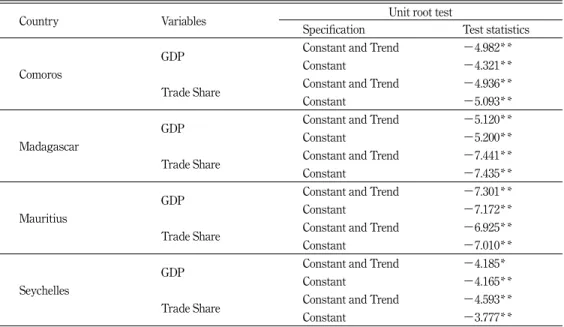
Prior to specifi cation and estimation of the VAR, the unit root test developed by Phillips and Perron [1988] is carried out to see if each variable includes a unit root or not. Table 1 and Table 2 show the
3) As in Harisson [1996], trade share shows, generally, the largest correlation coeffi cients with high signifi cance level. Stryker and Pandolfi [2000] also choose the trade share for analyzing the case of Sub-Saharan African economies.
Table 1. Unit root test (Level)
Country Variables Unit root test
Specifi cation Test statistics
Comoros
GDP Constant and Trend ⏎2.404
Constant ⏎3.533*
Trade Share Constant and Trend ⏎2.491
Constant ⏎2.255
Madagascar
GDP Constant and Trend ⏎1.944
Constant ⏎0.735
Trade Share Constant and Trend ⏎2.622
Constant ⏎1.899
Mauritius
GDP Constant and Trend ⏎2.226
Constant ǵ0.054
Trade Share Constant and Trend ⏎2.744
Constant ⏎1.209
Seychelles
GDP Constant and Trend ⏎2.259
Constant ⏎0.803
Trade Share Constant and Trend ⏎0.502
Constant ⏎1.575
Note: ŋConstant and TrendŌ shows that the auxiliary regression includes a constant and a time trend. ŋConstantŌ shows that the auxiliary regression includes a constant only.
* shows that the null hypothesis of a unit root is rejected at the 5⎾ signifi cance level.
Table 2. Unit root test (First difference)
Country Variables Unit root test
Specifi cation Test statistics
Comoros
GDP Constant and Trend ⏎4.982**
Constant ⏎4.321**
Trade Share Constant and Trend ⏎4.936**
Constant ⏎5.093**
Madagascar
GDP Constant and Trend ⏎5.120**
Constant ⏎5.200**
Trade Share Constant and Trend ⏎7.441**
Constant ⏎7.435**
Mauritius
GDP Constant and Trend ⏎7.301**
Constant ⏎7.172**
Trade Share Constant and Trend ⏎6.925**
Constant ⏎7.010**
Seychelles
GDP Constant and Trend ⏎4.185*
Constant ⏎4.165**
Trade Share Constant and Trend ⏎4.593**
Constant ⏎3.777**
Note: ŋConstant and TrendŌ shows that the auxiliary regression includes a constant and a time trend. ŋConstantŌ shows that the auxiliary regression includes a constant only.
* shows that the null hypothesis of a unit root is rejected at the 5⎾ signifi cance level. ** shows that the null hypothesis of a unit root is rejected at the 1⎾ signifi cance level.
results for the level of the logs of each variable and the fi rst difference of them. As is clear from these tables, each variable is found to include only one unit root, i.e., I (1) variable.
Then, the cointegration test developed by Johansen and Juselius [1990] is carried out to see if variables are cointegrated for two variables in each country. As is clear from Table 3, there is no clear evidence of cointegration for all countries.4) Thus, it is not necessary to include an error correction term.
The model is estimated using the log difference of system variables. Regarding the selection of the VAR lag order, all information criteria suggest VAR(1) for Comoros, Madagascar and Seychelles. For Mauri-tius, the sequential modifi ed likelihood ratio test, the fi nal prediction error test, the Akaike information criterion and the Hannan-Quinn information criterion recommend VAR(5), while the Schwarz Bayesian information criterion proposes VAR(1). Therefore, VAR(1) is opted for Comoros, Madagascar and Seychelles, and VAR(5) for Mauritius. However, given the limited sample size, a lag order of fi ve seems rather long. Hence, shorter lag lengths were also investigated for the case of Mauritius in order to assert the robustness of the fi ndings. Except for VAR(1), all lower lag lengths produced similar conclusions to those presented hereafter, for both the IRF and VDC.5) To check the model specifi cation, this paper
reports, in Table 4, the results of VAR residual portmanteau tests for serial correlation, which is shown by Q(10) and its P-value. The null hypothesis is that there is no autocorrelation up to lag 10. This test is valid only for lags larger than the VAR lag order. As is clear from the table, there is no evidence of
4) The trace test shows that there can be one cointegrating vector for Mauritius. Since the maximum eigen-value test does not support this result, however, we simply assume that there is no cointegration for Mauritius.
5) Results are available from the authors on request.
Table 3. Cointegration test
Country Null hypothesis Maximum eigen-value test Trace test
Comoros R⏮0 16.752 21.928
Madagascar R⏮0 8.034 13.178
Mauritius R⏮0 15.944 26.557*
Seychelles R⏮0 10.705 17.777
Note: R is the number of cointegrating vector.
* shows that the null hypothesis of a unit root is rejected at the 5⎾ signifi cance level.
Table 4. Model specifi cation and diagnostics
Comoros Madagascar Mauritius Seychelles
Model VAR(1) VAR(1) VAR(5) VAR(1)
Q(10) 22.208 42.705 28.973 19.735
P-value 0.9653 0.205 0.088 0.987
serial correlation and thus the model specifi cation used in this paper is empirically supported.
Based on the estimated VAR model, the IRF and VDC are computed. Here the variables are ordered as OPEN and GDP. The placement of GDP after OPEN allows the former to respond to current-period as well as previous-period shocks to the latter. Moreover, based on theoretical elaborations, historical considerations of the four countries here and previous literature, trade openness can be considered as preceding output, not vice versa.
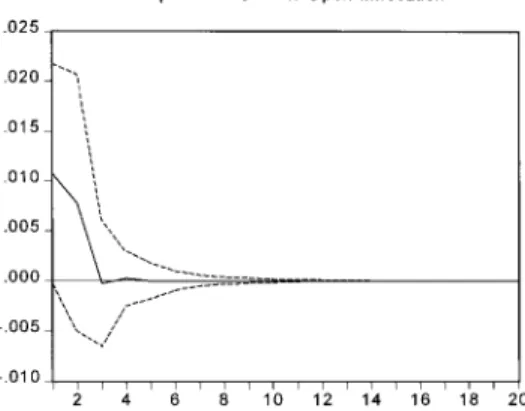
Figures 1, 2, 3 and 4 show the IRF for each country. In each fi gure, the point estimates are plotted with a solid line, whereas the dotted lines represent a two standard deviation band around the point estimates. These show the response of GDP to the innovation of tariff share (OPEN). In the case of Comoros, the IRF begins with negative response. Then it fl uctuates around zero and becomes zero in fi ve years. For Madagascar, the IRF starts with positive response, then fl uctuates around zero and
Fig. 1. Impulse response function: Comoros Fig. 2. Impulse response function: Madagascar
fi nally becomes zero in fi ve years. For Mauritius, the IRF begins with negative response and fl uctuates around zero up to the 19th period. For Seychelles, the IRF starts with positive response and monotoni-cally decreases to zero in fi ve years. It is interesting to see the response differs from country to country. In particular, the GDP in Mauritius has a relatively long response to the innovation of trade share.
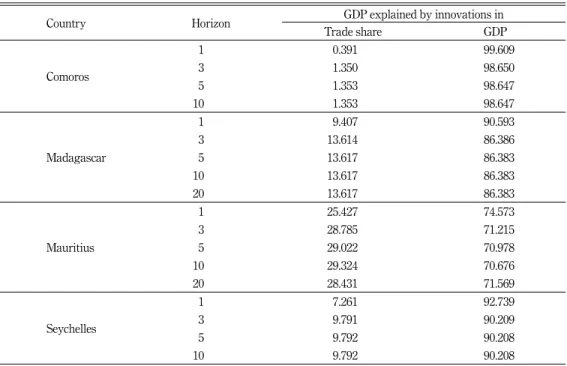
Table 5 shows the results of VDC. The ten-period forecast error variance of GDP explained by OPEN innovation is 1.353% for Comoros, 13.617% for Madagascar, 29.324% for Mauritius and 9.792% for Seychelles. Thus, these large values are consistent with the view that OPEN shock is an important source of economic growth, especially for Madagascar and Mauritius but not for Comoros.
The results might suggest two conclusions. First, the extent of the effects of openness on economic growth depends on the size of the economy and the importance of trade in GDP. And second, the size of the economy seems to be more determining.
Computation of the VDC displays that innovation in the openness variable accounts for 29.324%, 13.617%, 9.792% and 1.353% of the ten-period forecast error variance of GDP in Mauritius, Madagascar, Seychelles and Comoros, respectively. Classifying the four countries based on country size and importance of trade in GDP produces similar ranking. The GDP of Mauritius varies between 35% and 137% of that of Madagascar, and the trade share increases from 74% in 1960 to 130% in 2000. For
Table 5. Variance decomposition
Country Horizon GDP explained by innovations in
Trade share GDP Comoros 1 0.391 99.609 3 1.350 98.650 5 1.353 98.647 10 1.353 98.647 Madagascar 1 9.407 90.593 3 13.614 86.386 5 13.617 86.383 10 13.617 86.383 20 13.617 86.383 Mauritius 1 25.427 74.573 3 28.785 71.215 5 29.022 70.978 10 29.324 70.676 20 28.431 71.569 Seychelles 1 7.261 92.739 3 9.791 90.209 5 9.792 90.208 10 9.792 90.208
Madagascar, trade represents 26% of GDP at the beginning of the period of our analysis and reaches 59.42% at the end of the period. Concerning Seychelles, the GDP fl uctuates between 4% and 16% of that of Madagascar, and trade share is within the range of 107% and 165%. As for Comoros, the GDP is between 5% and 8% of the GDP of Madagascar and trade amounts for 51.398% to 73.51% of GDP.
Hence, from those fi ndings, it appears that in a larger economy with a higher trade share, in this case Mauritius, effects of openness on growth are more considerable. Openness effects are more sig-nifi cant in a larger economy with a lower trade share, i.e. Madagascar, than in a smaller economy with a higher trade share, i.e. Seychelles. Effects of openness are least important in the smallest economy with the lowest trade share, i.e. Comoros.
Moreover, IRFs show that the response of GDP to the openness innovation last the longest (19 peri-ods) in the larger economy with the larger trade share. Results in the present paper put two contrasting thoughts together. On one hand, openness to international trade is advocated to policy makers, mainly in developing economies, as an indispensable way for economic development. On the other hand, it is asserted that the small size of the economy and the trade structure do not allow developing countries to reap benefi t from openness, and to use trade as an instrument for economic growth. In line with the fi rst theory, the countries in our analysis are all developing economies, and indeed, we can confi rm that trade openness contributes to output enhancement, mainly in Mauritius and Madagascar. Along with the second thought, we fi nd that the size of the economy is an important factor determining the gain that a country can obtain from trade.
4. Some Concluding Remarks
Although a large bulk of studies has focused on the relationship between trade and growth, the subject remains a topic of intense debate for economists. We attempted to offer further insights into the discussion. We studied the case of four economies of Africa, a region where examination of this topic is largely insuffi cient. Instead of the period-average cross-sectional method, vastly used up to now, we applied a time-series analysis for each country. The latter approach allows us to analyze signifi cant fl uctuations in trade openness during the period, and to distinguish specifi c characteristics for each country. Results of the VDCs show that openness innovation explains 29.324% of the ten-period forecast error variance of GDP in Mauritius, 13.617% in Madagascar, 9.792% in Seychelles and 1.353% in Comoros. Results might suggest that the size of the economy and the importance of trade relative to the GDP determine markedly the effects of trade on growth.
As a policy suggestion, despite the initial small size of the economy, it would still be advisable for a developing country to intensify participation in international trade, i.e. to increase the share of trade in
GDP. Such measures would enhance, probably slowly but steadily, the size of economy. Thereafter, the larger the size of the economy becomes, the more substantially trade openness will contribute to growth.
To close the paper, we would like to notice the following two points. First, we recognize that the sizes of the samples are relatively small, mainly for Comoros and Seychelles. Data of a larger span or higher frequency are not available. This might imply a limited robustness of the conclusions, however, the present analysis provides, at least, an insight into the investigated subject. Second, the present study is based on bivariate VARs. Since results of IRFs and VDCs are sensitive to the variables included in the model, using a trivariate model might offer more pertinent conclusions. Such a framework would extend the study for future research.
Appendix
The GDP, exports and imports of goods and services of the four countries are in Constant 1995 USD. Data on GDP, exports, imports and trade share were taken from the World Development Indicators 2002, World Bank.
References
Afxentiou, Panos C. and Apostolos Serletis. 2000. Output Growth and Variability of Export and Import Growth: International Evidence from Granger Causality Tests, Developing Economies 38(2): 141-163.
Coe, David, Elhanan Helpman and Alexander Hoffmaister. 1997. North-South R&D Spillovers, Economic Journal 107: 134-149.
Edwards, Sebastian. 1997. Openness, Productivity and Growth: What Do We Really Know? National Bureau of
Economic Research Working Paper, http://papers.nber.org/papers/w5978.
Esfahani, Hadi S. 1991. Exports, Imports, and Economic Growth in Semi-industrialized Countries, Journal of
Development Economics 35: 93-116.
Feder, Gershon. 1982. On Exports and Economic Growth, Journal of Development Economics 12: 59-73.
Frankel, Jeffrey and David Romer. 1996. Trade and Growth: An Empirical Investigation, National Bureau of
Economic Research Working Paper, http://papers.nber.org/papers/w5476.
Grossman, Gene M. and Elhanan Helpman. 1991. Innovation and Growth in the Global Economy. Boston: MIT Press. Harrison, Ann. 1996. Openness and Growth: A Time-series, Cross-country Analysis for Developing Countries, Journal
of Development Economics 48: 419-447.
Hatemi, Abdulnasser J. and Manuchehr Irandoust. 2001. Productivity Performance and Export Performance: A Time-Series Perspective, Eastern Economic Journal 27(2): 149-164.
Jin, Jang C. 2000. Openness and Growth: An Interpretation of Empirical Evidence from East Asian Countries, Journal
of International Trade and Economic Development 9(1): 5-17.
Johansen, Soren and Katarina Juselius. 1990. Maximum Likelihood Estimation and Inference on Cointegration with Application to the Demand for Money, Oxford Bulletin of Economics and Statistics 52: 169-209.
Krueger, Anne. 1978. Foreign Trade Regimes and Economic Development: Liberalization Attempts and Consequences. Cambridge MA: Ballinger Pub CO for NBER.
Economic Review 82(4): 942-963.
Lucas, Robert. 1988. On the Mechanics of Economic Development, Journal of Monetary Economics 22: 3-42. Phillips, Peter C.B. and Pierre Perron. 1988. Testing for a Unit Root in Time Series Regression, Biometrika 75: 335-346. Prebisch, Raul. 1950. The Economic Development of Latin America and Its Practical Problems, NY United Nations. Rodriguez, Francisco, and Dani Rodrik. 1999. Trade Policy and Economic Growth: A Skeptic’s Guide to the
Cross-national Evidence, National Bureau of Economic Research Working Paper, http://papers.nber.org/papers/w7081. Rodrik, Dani. 1995. Trade Policy and Industrial Policy Reform. In Jere Behrman and T.N. Srinivasan, eds., Handbook
of Development Economics, vol. 3B, Handbooks in Economics, vol. 9. Amsterdam: New York and Oxford,
Elsevier Science, North Holland, pp. 2925-2982.
.ǵ1998. Trade Policy and Economic Performance in Sub-Saharan Africa, National Bureau of Economic
Research Working Paper, http://papers.nber.org/papers/w6562.
Romer, Paul. 1986. Increasing Returns and Long Run Growth, Journal of Political Economy 94: 1002-1037.
Singer, Hans W. 1950. The Distribution of Gains between Investing and Borrowing Countries, American Economic
Review 40(2): 473-485.
Stryker, Dirck J. and Selina Pandolfi . 2000. Effects of Policy Reform on Investment, Trade and Growth in Sub-Saharan Africa, African Economic Policy Discussion Paper, prepared for United States Agency for International Development/Bureau for African Offi ce of Sustainable Development (Associates for International Resources and Development).
Van Den Berg, Hendrik. 1996. Does Simultaneity Exaggerate Empirical Tests of Trade-growth Relationship? Applied
Economics Letters 3(4): 225-231.
Wacziarg, Romain. 2001. Measuring the Dynamic Gains from Trade, The World Bank Economic Review 15(3): 393-429.