THE GENOM□
OF
NUCLEAR POLYHEDROSIS
Ⅵ
RUSES
核 分 衛 ネ 蒲 ン イ ル ス の
逍 任 チ 梯 ご
t〔関 す る所 完
KEI MAJIMA
Mo■ ecu■ar Bio■ ogica■
studies of the Cenome of
Nuc■ear Po■
yhedrosis Viruses
By
Kei Maコ■ma
B.A., TOttori University′
Tottori,
■986M.A.′
TOttori University′
Tottori′ ■988DISSERTATION
DOCTOR OF PHILOSOPHY IN AGRICULTURE
in the
GRADUATE D工 VISION
of the
FACULTY OF AGRICULTURE TOTTORI UNIVERSITY′ TOTTORI
To my parents for their enduring love and support
Yoshiko Maぅ
ima and Mototoshi Maう
ilna・ ユ
ACKNOWLEDGEMENTS
I wish to express my sincere thanks to Dr. Ryuzo
Kobara7 my maう 。
r prOfessor for his guidance during my work
at Tottorェ
Universityo My spec■
a■thanks go to Dr. Hidenor■
Kai′
Dr. Yasuo Maeta, and Dr. Masaaki Azuma for their advice
and critical rev■ ews for this dissertation。
I a■
so wish to thank Dre Susumu Maedaァ Mre Shizuo G.
Kam■
ta, and Dre Atsushi Nakamura for the■
r encouragement′gu■dance, and cr■
tical reading of this dissertation。
工thank the students and staff of Dr. Kobara′
s ■ab for their
friendship and he■
p.Final■
y, I wish to thank all my family who encouraged
and supported me to complete my studies at Tottor■
Un■vers■ty.
CHAPTER Io Abstract PAGE II. Introduction III. COnstruction o ical maps of t A. Introduction
f DNA fragment librar■ es and phys― wo nuclear polyhedros■ s v工ruses
■3 ■4
B. Materials and Methods C. Results and Discuss■ on
1. Bombyx mori nuc■ ear polyhedrosis virus (BmNPV)
2. Spodoptera ■
itura nuclear polyhedros■
s v■rus (SlNPV)IVo Cloning′ sequence analysis, and expression of polyhedrin genes and their crystallization and nuclear loca■ ization mechan■ sms
A. Introduction
Bo Materials and Methods C. Results and Discuss■ on
1. Cloning and sequence analysis of the polyhedr■ n genes of the BmNPV and SlNPV
18 26 39 42 ■so■ates ■V 52
2. ExpressiOn of the polyhedrin genes
3. Structure and localizatiOn of the
po■
yhedron crystals
V. Gene structure and expressiOn Of BmNPV A. IntroductiOn
B. Mater■
als and MethOds
Ce Results and Discuss■
On■
. Repeated sequences
VII. References 78 86 95 96 952. Nuc■
eotide sequence ana■
ys■s Of the regiOn
between 86.3 and 99.6 map pOsitiOn Of the
BmNPV genOme .。 ...● ●。●。●●●0● ●0● ●●●●●●●●●●●●●● ■■9
VIo Cenera■ DiscussiOn and cOnclusion ■35
●●●●0● ●●●●●●●●。 ■4■
Bomby∠
mori nuclear pOlyhedrosis virus (BmNPV)and
S⊇OdQ⊇
tera
■itura NPV (SlNPV)were ana■ yzed using various
mo■ecu■ar biO■
Ogical techniques tO examine the structure and
functiOns of bacu■
ov■ ra■genOmes. cene
■ibrar■es cOvering
the entire genomes Of the two viruses were initially
constructed in plasmid vectors. cOmplete phys■
cal maps Of
the BmNPV and slNPV genomes fOr several restr■
ction
endonucleases were cOnstructed by hybr■ dization and dOub■
edigestiOn exper■ ments.
In the BmNPV genome five major regiOns of hOmo■ ogously
repeated (hr)Sequences were fOund. The BmNPV hr sequenceshad very high cOnservatiOn of sequence7 ■OCation′ and or■entation cOmpared tO hr sequences prevェ ously fOund in Autocrrapha californica NPV (AcNPV)′ hOWeverr an inversiOn and rearrangement of sOme sequences were observed. Excluding the
hr sequences, the BmNPV genome was made up of unique
sequences, which cOnsisted of Open reading frames (oRFs)and their f■ anking sequences. MOst oRFs identified between 86.3
and 99.6 map un■
ts possessed
■ate and/Or early gene promOter
motifs and pOly (A)+ signals′
indicating that they were
actively translated. Furthermore′ the coding sequences and location of fOur immediate― early genes and One late gene
(p74)were found to be well cOnserved between BmNPV and AcNPV.
Four different polyhedrin genes of BmNPV and slNPV were
ェso■ated, sequenced, and character■ zedo An amino ac■ d sequence substitution was found to be respons■ b■e for a
change in the ■nc■usion body shape from po■ yhedral to cuboidale sequence ana■ ysis of the polyhedrin genes of two SlNPV isolatesァ oT2 and CC5, showed that OT2 is an AcNPV
variant and cc5 be■ ongs to a previously unknown 旦. ■ittOralis
NPV group, which is re■ ated to orvcTia pseudotsucTata NPV. Based on the effects of the 5′ non―translated region of the polyhedrin gene′ new transfer vectors with high expression characteristics and with multip■ e c■oning sites were constructed for foreign gene express■ on.
The po■ yhedrin gene was used to study the mechanisms of prote■ n ■ocalization in the nuc■ eus. A spec■ fic consensus
nuc■ear ■oca■ization signa■ found in other eukaryotic ce■ ■s
was found in the BmNPV p01yhedrin geneo when this region was deleted by treatment with Ba13■ exonuc■ ease and examined using a marker rescue technique, the resu■ ting recombinant
v■ruses expressed mutated polyhedr■ n which localized in the
ce■■ cytOp■asm. These results showed that insect cel■ s use
the same protein trafficking mechan■ sms genera■ ■y found in
other eukaryotic cel■ s. It was also found that nearly the entire amino ac■ d sequence of po■ yhedrin ■s necessary for
norma■ crysta■■ization to occur. The deletion exper■ ments
showed that ■)the Shape of polyhedra is cOntro■ ■ed by C―
terminal amino acids and 2)aminO acid information controls po■yhedra■ size.
Insect― pathogenic viruses are general■ y classified into seven families. Most insect― pathogenic viruses fa■ ■ into
the fami■y′ Baculoviridae, which consist of three
subfamilies′ nuc■ ear polyhedrosis viruses (NPV)′ granu■ osis viruses (GV)′ and nOn― occ■uded viruses. Viruses in the
fami■y Bacu■oviridae are characterized by circu■ ar doub■e―
stranded DNA genomes 80-■ 60 kilo bases (kb)in ■ength and
rod―shaped enve■ oped virions (Matthews, ■982).
NPVS are found in several orders of insects′ main■ y
■epidopterans′ and have the unique characteristic of
produc■ng prote■nac■ous nuclear occ■ us■on bodies, which can each incorporate a ■arge number of progeny v■ ra■ particles.
GVs prOduce prote■ nac■ous ■nc■ us■ ons′ ca■■ed granu■es′ which
can each incorporate one progeny v■ ra■ partic■ es. Other
■nsect v■ rus fam■ lies, including cytoplasm■ c po■yhedros■s
virus (CPV)and insect poxvirus′ are also able to produce large prote■ nac■ous inc■us■on bodies which conta■ n many
progeny v■ ral particles. The production of v■ ral inc■us■on bodies ■s a unique character■ stic of insect― pathogen■ c
viruses. These inc■ usion bodies p■ ay an important role for
v■ra■ transm■sS■on ■n the fie■ d by protecting embedded v■ ra■
partic■es from UV light′ chemicals′ etc. in the soi■ for
pro■onged per■ ods′ presulnably more than severa■ years.
viral epidemics in the field are a maう or faCtOr in the
contro■ of insect populations (Granados and Federici′ ■986).For this reason they have been consェ dered for use as a
natura■ insectic■
de. For exampler oryctes rhinoceros
bacu■
ovirus has been heavily used for pest cOntro■
of
coconut trees in the south Pacific (Redford,
■986)′and
Anticars■
a gemmatalis NPV has been used for pest cOntro■
of
soybean in Brazil (」 ohnSOn and Maruniak,
■989). TheSe
applications have been pr■
mar■■y based on the efficacy of
baculoviruses fOr pest cOntrol (Granados and Federici7
■986)and safety factOrs (summers et al.,
■975)。SpOdOptera
■itura NPV (S■
NPV)is alSO COnsidered as an efficient
contro■■
ing agent for
旦・ ■itura (okada,
■977), whiCh iS a
major pest of vegetable crops in Southern and western
」apan′however, very few genetic studies have been performed on
this virus (See Maeda et al.′
■99o).BombMx mori NPV (BmNPV)is a maぅ
Or diSease of the
s■lkwottlll, 旦。
mOri7 in Sericu■ ture. PrOtection of reared
s■lkworm colon■es from vェ
ral infectiOn is cruc■ al for
obtaining high quantities of high qua■ ity cocOOn for si■
kproductiOn. A■ though many etiological and histOpatho10gical
studies have been cOnducted7 1itt■ e has been reported On the
genetics Of BmNPV at the molecular
■eve■(see review of
Horie & watanabe,
■980). NPVs are generally characterized
as e■
ther sNPV or MNPV depending on the number of
nucleocapsids within a v■
ra■ enve■ope embedded in the
po■yhedrao A■
though BmNPV is
■isted as representative Of
SNPV (Matthews,
■982), BmNPV also produces a MNPV form. In
most progeny viral partic■ es (more than 9oそ )are the
S― fo■lll and the ratiO Of s― and M―
fOrms depends On the
infected organ (watanabe,
■975)。Even after p■ aque
purificatiOn, BmNPV sti■
■shOws this heterogene■ ty and this
ratio does not change sign■
ficant■y after passage in vivO Or
in vitro (see Maeda and Majima′
■99o). The mechanisms
behind the MNPV and sNPV phenotypes pOse an interesting
sc■
entific questiOn with regard to the processes of prOte■
n assoc■ation within cells and v■
ral assembly。Bacu■ov■
ruses have been cOns■
dered as effic■ent vectOrs
for expression of fOreign genes in insect cells (Luckow and
Summers′ ■988, Mi■ ■
er,
■988デMaeda,
■989a, Luckow′ ■99■).Bacu■ovェ ra■
expression systems exhibit numerous advantageous
characteristics
ェncluding high express■ on rates, correct
post―translationa■ modificatiOns′
and authentic antigenic
properties. The very strOng prOmoter of the pO■
yhedrin gene
■s essentia■
fOr high
■evel production of fOreign genes by
recombinant baculov■
ruses′ hOwever′the pOlyhedrin gene Or
gene product is not essentia■
fOr v■ral prOgeny productiOn.
The pO■
yhedrin prOtein accOunts fOr about 30そ of tOtal
ce■■ular prOte■
ns at a late stage of infectiOn.
Furthettll10re, Since pOlyhedra are visible under the light
micrOscOpe, a recOmbinant NPV carrying a fOreign gene after
the po■
yhedrin prOmoter by replacement of the po■
yhedrin
gene can be
■sOlated eas■ ly by screen■ng fOr infected ce■
lslacking polyhedra■
production。TWO NPVs, BmNPV and Autographa ca■
ifOrnica NPV (AcNPV)ァare cOmmon■
y used for express■
On experェments′ hOwever′the
BmNPV system has the advantage of having a wel■
studied and
easy tO use in vivO hOst′ the silkworm (Maeda et a■
.′ ■985)。To date more than twO hundred different genes have been
expressed using bacu■ ovirus expression vectOrs (see review
Of Luckow′ ■99■
)for basic research and specific
app■
ications. of current interest in medicine in the un■
ted
States is the use of a recombinant bacu■
ovェrus―expressed
enve■
ope protein of the AIDS virus (HIv―
■) (See Maeda′■
989a)for testing as a possib■
e AIDS vaccineo Recently′
the silkwOrm and the bacu■
Ov■rus express■on vectOr system
has a■
sO been used fOr the productiOn Of can■ ne interferon
a■
pha fOr veterinary use
■n 」apan。Until recently most studies Of bacu■ ovirus replicatiOn
have been conducted using in vivO systems (larvae)mainly by
histo10gical, histochem■
cal and m■croscopic analysis.
Initial infectiOn Of larvae by bacu■ oviruses Occurs after
v■ra■particles are re■ eased from ingested inc■
us■on bOdies
by a■ka■
ine protease degradatiOn in the digestive juice。
Released viral particles attach tO microvilli Of midgut
cel■s and rep■ icatiOn initiates in the midgut tissue′however, only a limited nulnber of midgut ce■ ls, cOlumnar and regenerative cells′ are initially infectedo After the
replication Of baculov■ ruses in m■ dgut cells, budded non― occ■uded v■ ruses fron the basement membrane spread into
■
ate stage of infection (3-4 days post
infectiOn), Viruses can infect and rep■ icate in almost a■
llarva■
tissuese Fat body is the major target organ of viral
rep■
ication and production of po■ yhedra
■s observed in most
fat body cells. At a very
■ate stage of infectiOn (one Or
two days prior to larval death)′ fat bOdy and other cells
start to degenerate, resulting in the whitish appearance of
hemolymph due to the large number (mOre than a hundred per
Cell)Of po■
yhedra■inclusion bOdies released from lysed
ce■■s.The establishment of an in v■ trO replication system
(eStab■iShed ce■■
lines)and mO■ ecular biological techniques
(See Cranados and Federici,
■986)has
■ed tO a greater
understanding of the rep■
ication of bacu■ ov■ruses. MOst
insect v■ruses do not replicate or replicate poorly in
established cell lines. AcNPV′ however, which possesses
re■atively w■de host spec■ ficity rep■ icates rapid■
y in vitro
and a great wea■
th of know■edge of the mechan■
sms of v■ra■ rep■ication has been accumulated using this bacu■
ovirus as a
mode■ .
Historical■
y insect viruses inc■
uding bacu■oviruses
have been c■
assified (Latin name p■ us subfamily name)based
on the■r host spec■fic■
ty which is general■
y narrow。Recent■y′
hOwever, DNA restriction ana■
ysis has a■lowed more
sensitive and accurate c■
ass■ fication of bacu■ ov■ruses.Using these techniques the genetic relatedness of many
insect viruses have been quantitative■
y compared (e・ g。 ′smith and Summers,
■982). In addition,
■n vitro systems
have spawned p■ aque isolation techniques for the recovery of
pure v■ra■ c■
ones including mutant clones. Using these
techniques, w■ ■
d stocks of baculovェ ruses have been found to
be genetical■
y heterogeneous (Lee and Miller′
■979)and are
sometimes mixtures of complete■ y different viruses (Maeda et
al.′ ■990). Taxonomical distance among baculoviruses has
a■
so been studied using hybridization techniques (Smith and
Summers′ ■
982). Although Kondo and Maeda (■
99■)haVe
recently shown that hoSt specificity of baculovirus can be
changed (expanded)by reCOrnbination of two baculoviruses
having different host Specificity′ the real mechanisns of
host specificity are stil■ unknown.
To date about 40猪 Of the entire genome of ACNPV has been
sequenced and more than ten genes have been
■dentified′sequenced′
and character■ zed. The polyhedrin gene of AcNPV
was the first bacu■ oviral gene to be identified and
sequenced (Van lddekinge et al.′
■983). StruCtural
polypeptides of AcNPV that have been isolated and sequenced
inc■ude: enve■
ope protein (WhitfOrd et al.′
■989), CapSid
protein (Thiem and Miller,
■989), DNA binding protein (WilSOn
et a■., ■
987), and pOlyhedral enve■ ope protein (Russe■
■and
Rohrmann′ ■990)。 Non―
Structural proteins that have been
isolated and sequenced include: DNA pO■ ymerase (TomalSki et
al.′ ■988), p74 related to virulence (Kuzio et al.ァ
■989),Henner,
■988)′ IE―■(Guarino and Summers,
■987), IE―N(CarSOn et al.′ ■99■)′
PE-38 (Krappa and Knebel―
Morsdorf′■99■
)), PCNA (ETL and ETS)WhiCh accelerate
■ate genes
(CraWfOrd and Mi■ ■er′ ■
988), ubiquitine-1土
ke gene (Guarino′■990), DNA he■
icase (Lu and Carstens,
■99■)F superOxide
dismutase (TOmalski et al.,
■99■), eCdysteroid UDP― glucosyl
transferase (0′ Rei■
ly and Miller,
■989), and apoptosis―
preventing protein (Clem et al.,
■99■)。 SeVera■ structura■ and non―structural genes from Orvqia pseudotsucTata NPV
(BliSSard and Rohilmann′ ■
990)and BmNPV (Maeda et al.′
■991a)have alSO been isolated.
unique repeated sequences are characteristic of the
baculoviral genorne (Arif and Doerf■
er, ■984, Cochran and
Faulkner,
■983)。AcNPV has 6 repeated sequences in five
discrete regions (Guarino et al.′
1986)。SinCe all
baculoviruses exanined have repeated sequences (see B■
iSsard
and Rohrmann′ ■990)′
these regions are considered to be
essentia■
in the baculoviral genome construct. The gene
arrangement of baculoviruses is also relatively conserved′
although insertions′
deletions′and inversions of genes have
been observed (BliSSard and Rohrmann′
■990).Inュ
tial studies on the regulation of gene express■
onexamined viral protein synthesis in established cell lines
by SDS pblyacrylanide gel electrophoresis and radio―
labeling
of protein synthesis (e・ g., Dobos and Cochran′
■980).Thirty to forty vira■ polypeptides have been identified and
10
The contro■
of protein synthes■ s is related direct■ y to
transcription
■eve■s. Bacu■ovェrus gene expression has been
characterized by Northern b■
ot ana■ysis, cDNA c■ oning7primer extensiOn, cAT (ch■ Oramphenicol acetyltransferase)
assay′ and s■ nuc■
ease mapping.
Baculov■
rus gene expression
■s c■assified into four
phases: immediate―
early′ de■ayed early,
■ate′and very late
(See BliSSard and Rohrmann,
■99o)。 Immediate… ear■y genes do
not requェre vェral gene products for the■
r express■ on′ i.e.′host factor(s)can activate the gene expression of
immediate― ear■
y genes. Four major immediate―
ear■y genes,
IE-0, IE…■′ IE―N′and PE-38 have been iso■ ated and
characterized (see abOve references). The IE―
■ and IE―Ngene products can trans―
activate de■ayed ear■y genes (carSOn
et a■ ., ■988)7 hOWeVer′
the real functions of these genes
inc■
uding their target sites are stil■ unclear. The TATA
box and a CAGT motif located about 25 bp dOwnstream of the
TATA box are believed to be essentia■ for immediate― early
gene expression (B■ iSSard and Rohrmann,
■99o)。MOSt
■
dentified immdiate― early genes possess these sequences。
The polyhedrin (Rohrmann′
■986)and p■
0 (Leisy et al.′ ■986)genes are expressed at a very
■ate stage of infection. The
upstream region of (very)■
ate genes contain the cOnsensus
sequence ATAAG. Transcription of these genes starts from
the second adenine of this cOnsensus sequence. At a late
stage of infection early gene and host gene express■
On are
suppressed. Furthermore, splicing of host and viral genes
is a■
sO b10cked (chiShO■ m and Henner,
■988). Ooi and Mil■
er(■
990)have hypothesized that this suppressiOn is caused by
the production of antisense RNA。
I have chosen two baculoviruses, BmNPV (T3 iso■
ate)and
S■NPV (OT2 isolate)′
fOr the study of bacu■
ovira■replication in insect ce■ ls. BmNPV is important as an
express■
on vector and in the sericultural industr■
es. s■NPV
has potentia■
for use as an effective contrO■
■ing agent fOr
a naう。
r pest Of vegetable crops in
」apane since pub■ ished
mo■ecu■
ar bio10gical studies Of these two viruses are very
■inited′ physical maps′
which are essential for further
exper■
ments at the mo■
ecu■ar
■eve■ 7 0f the v■ra■ genome′were initial■
y constructed (Section III)。 A DNA fragment
library of the viral genOme, which can be directly used for
gene analysis′
was also cOnstructed. In section lv′ the
characteristics of the polyhedrin genes Of BmNPV T3′
SlNPV
OT2 and various mutants are repOrted. To test the
re■
atiOnship between nucleotide sequence and phenotypic
characteristics such as the shape of the polyhedra′
recombinant vェ
ruses were constructed. Four different
polyhedrin genes were isOlated from various mutants and the
entire sequence of these genes was determinede var■
ousmutants with appropr■
ate de■etiOns in the polyhedrin gene Of
BmNPV were examined tO determine the mechanisms of
■)
nuc■
ear
■oca■ization of po■yhedrin7 2)crysta■ lization Of
po■yhedrin′
and 3)shape and size determination of inclusion
■2
is reported. The structure of the repeated sequences of
BmNPV vere characterized after iso■ ation and sequencing. A
sequence of about
■7 kb (■3Z)of the BmNPV genome7 WhiCh
contains four immediate―
early genes was determined, and gene
structure and expression in this region was examined.
III. COnStruction of DNA fragnent libraries and physica■
maps of two nuclear polyhedrosis viruses.
A. Introduction
Recent■y′ over ■00 isolates from four different wild
stocks of NPVs of Sゃ odOptera litura (the Same Or closely
related species to
旦。 littOraliこ ), WhiCh is a maうor
agricultural pest in AfriCa′
As■a, and Mediterranean
regions′
have been p■
aque―purified and characterized (Maeda
皇二 皇■・, ■
990). TheSe
旦・litura NPV (S■ NPV)iSO■ ates were
classified into four distinct groups (SlNPV―
A, SlNPV―B′SlNPV―
C, and AcNPV (an AcNPV Variant))by
二里VitrO host
range and DNA restr■ ction endonuclease patterns using EcoRI.
AnOther NPV′
the BmNPV T3 isOlate′ has been used extensively
for basic molecular biological research (Maeda et al.′
■99■a)and itS applications for foreign gene expression
(Maeda et al.,
■985, Maeda′ ■989a), and as a model system
for the construction of recombinant v■
ral insectic■des
(Maeda et ale,
■99■b).Plaque isolation and DNA analysis techniques have
demonstrated the precise genetic relatedness of NPVSo AcNPV
is the lnost well studied baculovirus at the molecular level
and several AcNPV Variants have been isolated and
characterized (see Blissard and Rohilllann,
■990).construction of a physical map of the viral genome using
restriction endonucleases
■s essential for further t
experiments at the molecular level. Restriction
■4
endonuclease maps have been constructed for severa■ NPVs including: AcNPV and its variants (Mil■ er and Dawes, ■979,
Smith and Summers, ■979, Vlak, ■980, Cochran et al., ■982,
Brown et al., ■984), Anticarsia gemmata■ is NPV (」 ohnsOn and
Maruniak′ ■989), PanOliS flammea NPV (PoSSee and Ke■ ■y, ■988), MameStra brassicae NPV (Wiegers and V■ ak, ■984,
Possee and Kelly, ■988), OrqVia pseudotsucrata NPV (Chen et
al。 ′ ■988)′ HeliOthis zea SNPV (Kne■ l and Summers, ■984),
Spodoptera littoralis NPV (CrOiZier et al., ■989)and
Spodoptera frucriperda NPV (Loh et al., ■98■, Maruniakァ et al.′ ■984).
In this section′ I descr■ be the construction of
restriction fragment ■ibrar■es cover■ ng the entire genomes
of BmNPV T3 and S■ NPV OT2 (AcNPV variant)in p■ asmids, and construction of the■ r phys■ca■ maps for severa■
endonucleases. In addition′ five areas of EcoRI― rich repeated sequences were found and ■ocalized in the physical
map (See section V for detai■ s).
Bo Mater■a■s and Methods.
Chemicals, media, gene c■ oning techniguesP and plasmid
preparations: are described in Figso III―
■to III-3.
Virus: BmNPV. A plaque purified isolate′
T3′of BmNPV
(Maeda′ ■
984)and a p■ aque purified iso■
ate′ OT2′of SlNPV
(AcNPV variant) (Maeda et al.7
■990)Were used. For
pur■
fication of BmNPV v■
ra■ particles′ po■yhedra■ inclus■onbodies propagated in the s■ lkworm were used. Inclusion
A. Ligation: (uSing the Takara Ligation kit)
■. Take 2-5 u■ of digested p■
asmid prefered for
■igation′and add 4-8 times volume of A buffer and
■ times vo■ume of
buffer. Mix by gent■ e tapping (dO not VOrtex).
2. Incubate in a
■6 C water bath for 30 min.
B. Transformation:
3. Mix the following in a microfuge tubei
5 ul
■igated plasmid (apprOX. 0.■
ug)40 ul competent ce■
ls4. Incubate
■o min on ice.
5。
(Invert Once to mix)and incubate 40 sec in a 43.5 C
water bath。
6. Quickly transfer tube to ice bath (O C)fOr 2 min.
7. Add 70u■
TUM without ampicillin and incubate at 37 C
(air incubator)fOr
■o min. Mix by gentle tapping。
ζ
ter三呈
と
e]:r:彗
dErpきRIeilこ
と
b詈と
gteS
°
r Taxi p■
ates)uSing
at 37 C at ■east 7 hours.■6
■
. Add
■ml of TuM/AMP★ medium into steri■
e microfuge tubes
using a steri■
e pipet.
2. Pick up a sing■
e colony using a sterile toothpicke Touch
the toothpick tO a replica plate, then insert it into a
microfuge tube.
3. Incubate the microfuge cu■
tures at
■east 7 hours at 37 C
with rocking (■ 75 rpm). Incubate the rep■ ica plates at 37 C
without rocking。
4. Centrifuge cultures at 4000 rpm for
■ min。こ
と
qこと
員
gttx3)Sは塁
e王
子
]:Bttie2]呈E旱軍
d(を
::mど,mと,° :。1とtf:舌
into each
tube and vortex unti■ the pe■■et is comp■ ete■y disO■ ved. 6. Boil tubes in a boiling water bath for ■ min.
7. Place each rack into an ice/water bath until cOld (2
minutes).
8. Centrifuge at
■2,000 rpm for
■5 min.9。
Remove precipitate with sterile toothpicks。
■0。
Add
■00 u■ (200 u■for sequencing)of iSOpropano■
. Mix
we■■ by invers■ on and shakingデ
incubate at -80 C for at
least
■o m■n。■■
. Centrifuge at
■2,000 rpm for
■o mino Discard
supernatant and dry in vacuum for 30 min or until dry.
★
TUM/AMP Medium
Bacto tryptone (Difco) Bacto yeast extract (Difco)
NaC■ KCl MqS04・
7H2Q
g g g g 0 0 5 5 7 5 ■ ・ い 0 2 H20 Autoclave for ■5 temperatureo Add ★ STttT Buffer Sucrose Triton x―■oo O.5M EDTAto
■ lminutes at
■2■C. Stock at 5 C or room
Amp■cil■
in to 50 mg/1iter.
80 g 50 g
■00 m■
■M Tris―
cl
っH8 50 ml
H20 tO
■l
■
. Add 50 ml of TuM/Amp medium into a
■50 ml Ehrenmyer
f■
asks and innocu■ ate media with a single bacteria■ colony
using a steri■
e toothpick.
2. Incubate (■ 40-■
60 rpm)at
■east 7 hours at 37 C.
3. Transfer cu■
ture medium into a 50 ml centrifuge tube and
centrifuge at 3000 rpm for
■O min at 5 C.
4. Discard supernatant by decantation. Add 3m■
of TE (20mM
Tris―cl′ ■
mM EDTA pH 8.0). COmp■
ete■y suspend pe■ ■et by
vortex■ng。
5。
Add
■ml of 2 mg/ml
■ysozyme in 25名sucrose-20mM Tris―
C■(pH 7.5). Mix Wel■ and incubate at room temperature for 5
min。
6. Add 4 ml of
■.5Z SDS, 0.3 N NaOHo Shake vigorous■
y.Incubate at room temp. for 5 m■
n.7. Add 4 ml of 5M Potassium Acetateo Shake vigorously.
Centrifuge at 3′
000 rpm for
■o min at 5 C.
8. Transfer supernatant into another 50 ml tube. Add 6 ml
of isopropano■
. Mix well. Incubate
■5 min at room temp.
9. centrifuge at 3,000 rpm for
■o min at 5 C. Discard
supernatant by decantation. Turn upside―
down on a Kimwipe.
■
0. Add 300 ul of RNase (■
Oug/ml)in TE (■
0:■)′Suspend
pel■et by vortex■ ng and transfer to a m■ crofuge tube. Centrifuge at ■2′ 000 rpm for 2 min to remove precipitates.■■. Transfer into a new microfuge tube. Incubate for 30 min
at 37 C.
■2. Extract with 300 u■ of
Centrifuge ■2,000 rpm for
to a new tube.
■3. Extract once with 300
Centrifuge ■2,000rpm for 3
new tube.
pheno■―chloroform (vortex we■ l)。
3 min and transfer aqueous layer
u■ of chloroform (VOrtex wel■ ).
m■n. Transfer aqueous ■ayer to a
■
4. Transfer aqueous
■ayer into another tube. Add
■5u1 5M
NaCl′
750ul EtOH and mix well. Incubate 30 min at -20 C.
■5。
Centrifuge
■2′ 000 rpm′ ■O mino Discard supernatant and
dry under vacuumo Add 200-300 ul TE (■
OmM Tris―cl′ ■mM EDTA)
and suspend wel■ .
■8
bodies were dissO■
ved in alka■ine sO■ution and the re■ eased
vェra■ partic■es were pur■fied by u■tracentrifugation
(Kawarabata and MatsumotO′
■973)。 S■NPV OT2 was purified
from the cu■
ture medium Of infected sf ce■ ls as described by
Maeda et al。 (■ 989)。
Endonuclease analysis: vttral DNA was extracted from
vira■
particles after treatment with proteinase K (Merk)in
the presence of
■そ sDS (Maeda′ ■989b). DNA was c■ eaved by
digestiOn with EcoR17 HindIII′
Pstェ「 BamHI′ KpnI′
or smaI
(New England BiOlabs)under conditions recOmmended by the
supp■
ier. The cleaved fragments were separated On O。
7老agarose gels a■
ong with
■ambda phage DNA size markers using
a Tris―
acetate buffer system (ManiatiS et al.′
■982)。Southern b■ ot analysttsi Southern b■
Ot analysis was
performed by a modificatiOn of the methOd Of Maniatis (■
982)as shOwn
ェn Figo III-4. De■
on■zed formam■de was prepared by
adding 50-■
Oo g of iOn exchange resin (BiORad AG 50■
―X8)per
■
iter Of fOrmamide and shaking gent■ y fOr at least
■hOur.
Sa■
mon sperm DNA (Type―
III sodiun sa■t, sigma)was diSsolved
in disti■■ed water tO a cOncentration of 2 mg/m■ , Stirred
fOr 2 to 4 hours at room temperature′ sheared by severa■
passages thrOugh an
■8 gauge need■ e, and boi■ed fOr
■o minutes. The DNA was stOred at -20 C in small a■ iquotsunti■ used。
■. BmNPV.
■
. After electrophores■ s, carefully transfer gel into a
g■ass baking dish。
急と :;:attu馬:cihttn:Nと。:yM 黒且むinと。と
h三
5gttin ttt !:廿孫
with cOnstant shakingo Rep■ ace with ■.5 M NaC■ NaOH and soak for an additional ■5 min.
ユ ・
M
ニユ:き 皇とiZttptth:.:,・a:晋 三!]缶 i辞 :cinf」こ r三 5 1こ1 まと ° r苫:iumes of
temperature with constant shakingo Rep■
ace with
■ M Tris―c■and
■.5M NaCl and shake fOr an additiona■
■5 min。4. Transfer DNA to a nitrocellulose filter us■
ng
■ox ssc.
5。
Wash the filter with 5x SSC★ at room temperature.
6. Place filter onto whatman 3MM paper and a■
10w tO dry.
7. Wrap fi■
ter in 3MM paper and bake for
■hre at 80 C under
vacuum。
:::1こ:と
こ
::::抵:in盈:専r:::i54ilii: :とと
i;:ridi3atr:Iigと
互
こ
と
i:R★′
After prehybridizatiOn add
■O u■
of denatured probe and incubate 6 to 24 hours at 42 C.
9。
Wash twice with 2x SSCァ
0.■そsDS (20 min per wash):
■0。
Wash twice with o.■
x ssc7 0・ ■そSDS (20 min per wash):
■■. Air dry filter′
and expose tO x― ray film at -80 Ce
★
20x SSC
ざ
]:lum citrate ::二
:
two vo■ umes temperature and O.5 M
H20 to ■o l
★
Prehybr■dization so■
utiOn
::i°:き
岳
員
grSE手習
a轡 :呈itと:l筆 ) ■0そ SDS (0.5そ )2 mg/m■
SalmOn sperm DNA
20x SSC (5x)dd H20
★
50X Denhardt′ s solution
Fico■l
pO■yviny■
pyrrolidOne
(5x) (0。■ g/ml) 50 m■ ■O ml 5 ml 5 ml 25 ml 5 ml g g 5 5
dd H20
Fig. III-4. Southern Transfer
l l
20
Figo III…
5, shows BInNPV DNA digested with the indicated
enzymeso No submo■ ar bands, sometimes found in the
preparation of Other NPVs (Mi■
■er and Mi■ler,
■982), were
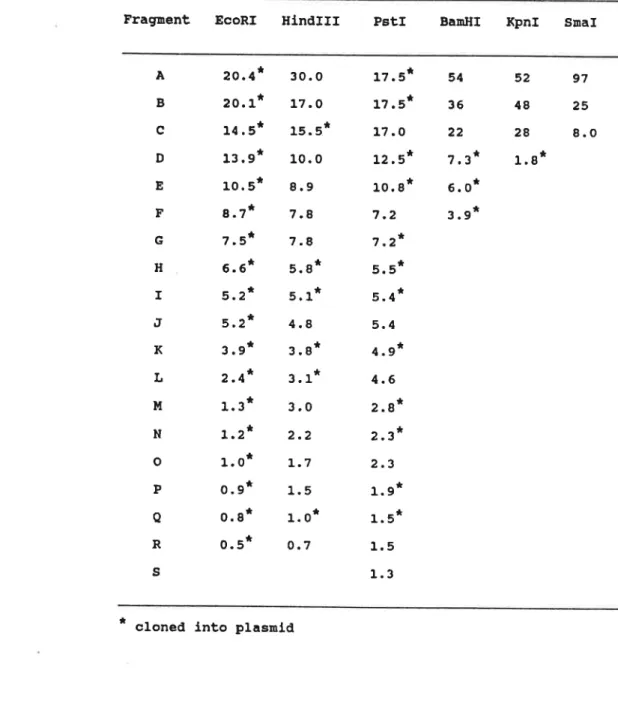
seen. MO■ ecu■
ar veights Of the fragments were estimated as
shown in Tab■e ttII―■ by cOmpar■
son to the migratiOn of the
s■
ze markers. MO■
ecu■ar weights Of some of the
■arger
fragments were estimated by summing the sizes of the smaller
fragments of which it was cOmposed as descr■
bed
■ater. The
molecular weight of the entire BmNPV genome was estimated to
be about
■30 kbp by summing the weights of the fragments
generated by the restr■
ctiOn endonuc■eases. This estimated
size is quite sinilar with that of AcNPV (Lee and Mi■
ler′■978)。
DNA fragments digested with EcoRI′
HindIII′ KpnI′ PstI′or BamHI were c■
Oned into pBR322′ puc9′ or puc■9. Two
■arge
fragments of EcoRI′ EcoRI A and B′
vere first c■ oned into
Charon 4A (ManiatiS,
■982)′digeSted with restrictiOn
endonuc■
eases, HindIII and/Or BamHI′ and then subc■ oned into
puc p■asmttds. MOst of the cloned DNA was authenticated by
comigration in agarose gels with digested vira■
DNA. A■ ■EcoRI fragments
■arger than 500 bp were successful■ y c10ned
■nto p■asm■ds. These EcoRI c■ ones and additional c■ Ones of
the 22 DNA fragments listed in Table III―
■cOmpletely
over■
apped the entire viral genome withOut breaks at any
restrictiOn site.
Hybr■
dization analys■ s was employed tO construct
一A 一試B 聾 手 ヽ 一 H 〓刊︲ 引 一 L﹁ 一 N 一 。 コ 一 M ィ N
〕
8 二 RKpnI Smal Lambda/Hindl‖
蜀 G I \ JK ――DE A B C G 製 I 輝 K A B C D E F A B C
/
一
\
_A 一 B ― C -22 --9.4 -66 -4.3 -23 -20 一 D S 056Figo III-5. Cleavage patterns of BmNPV DNA by the
restriction endonucleases EcoRI′
HindIII′ Pst工′ BamHI′ KpnI′or SmaI. Vira■
DNA cleaved with these restriction
endonuc■
eases were separated on a o。
7 そagarose gel. Lane
marked Lambda/HindIII Shows molecular weight markers in kbp.
Pstl EcoRI 〓 一 一 .
22
Tab■e rII―■. sizes (kbp)。 f BnNPV reStriction fragnents
Fragnent EcoRI HindIII PstI BanHI Xpnェ SnaI
A B C D E F G H I 」 K L M N O p Q R S 20。4' 30.0 20.■・ ■7.0 ■4.5' ■5.5' ユ3.9・ ■0。O ■0.54 8.9 8.7・ 7.8 7.5' 7.8 6.6・ 5.8・ 5。 2・ 5.ユ・ 5。2・ 4.8 3.9・ 3.8・ 2.4・ 3.■士 ■.3・ 3.0 ■.2・ 2.2 ■.0・ ■.7 0.9・ ■.5 0.3・ ■.0・ 0。5' 0。 7 54 52 36 48 22 28 7.3・ 1.8・ 6.0' 3.9・ ユ7.5' ■7.5・ ■7.0 12.5・ iO.8・ 7.2 7,2・ 5.5・ 5.4' 5.4 4.9・ 4.6 2.8・ 2.3士 2.3 ■.9士 ■.5・ ■.5 ■.3 O 7 5 ・ 9 2 8
digested with the same restr■
ctiOn endonuc■eases used fOr
cloning and electrOphOresed On agarOse gels. The separated
DNA fragments were sOuthern― transferred onto a
nitrOce■■u■ose fi■
ter, fixed at 80 C, pre―
hybr■ dizedァthen
hybr■dized with c■ oned p■asm■
d DNA probes
■abe■ed with
[32P]_dcTP (Maniatis′ ■
982). HybridizatiOns were carried
Out in 50そ
formamide at 42 C for 6-■ 6 hours and the filters
were washed with o.■ x ssc at room temperature. Analysis Of
the hybridizatiOn data shOwed that most Of the sequences of
the BmNPV genome were unique (see sectiOn v).
By comparing the over■ apped areas of DNA for each
restrictiOn fragment a pre■
iminary physica■map was
constructed. TO Obta■
n high■ y deta■ led maps′the
■
arger
C■
Oned DNA fragments were digested with twO Or more
restrictiOn enzymes and physical maps of these fragments
were cOnstructed. TO cOnfirm the location of these smal■
er
fragmentsr they were compared with the initia■
ly c■oned
fragments or wェ th Original v■
ral DNA by electrophOres■
s ■nagarose ge■ s. By combin■
ng the variOus data obta■
ned abOve′deta■
led physical maps were cOnstructed fOr s■
x restr■ction
endonucleases (Fig. III-6). The zerO― point of the physical
map was established as one end of the EcORI E fragment
following the proposa■ Of vlak and smith (■ 982). The zerO―
point was chOsen here because the po■ yhedrin gene (indiCated
by the arrowhead in Fig. III-6)has been mapped in this
E∞ RI 87.3 KlL
」
!HR
13.0 17.7 23.5 13.7 22.1 31.7 36.3 30.1 32.4FF
58.0 66.4 74.0 60.5 67.7 99.6 93.396_11∞ 94.6 2.6 5。 1 >F QS 5.5 23.3 11.6 17.5 12.9 18.8 50.1 53.8 7S.3 79.4 76.6 77.3 85.8 86.8 Kpn: Srrlal 糾 ap unl ЮヽEcoRI, HindIII, PstI′
Eと
運
」
HI′
KonI, and
near fOrm. Map un■
ts are ca■
cu■
ated based
From the hybr■ dization exper■
ments, five regions
conta■
ning hOmologous■y repeated sequences rich in EcoRI
sites were found in the genome. TO cOnfirm the ex■
stence of
the repeated sequences, c10ned or subc■
Oned p■asmids (
HindIII H′ PstI K′ HindIII―
PstI (67.7-75.3 map unit)Of PStI
B′ Kpntt D′ and PstI― HindIII (96.■
-99.6 map unit)Of
HindIII)′
were digested with EcoRI and analyzed
electrophoretica■
■y. As expected′several EcoRI fragments
with mo■
ecular weights less than 400 bp were identified On
an
■.5Z agarose gel. These areas conta■
n■ng several sma■ lerEcoRI fragments seelRed tO be the sO― called repeated
sequences found in AcNPV (Er■
andsOn et al.′ ■984デGuarino et
a■ .ァ ■
986)and other bacu■ oviruses (Kuzio and Fau■
kner′■
984, Arif and Doerf■
er′ ■984). Three repeated sequences
cou■
d not be mapped exactly′
however the■r 10cations were at
either end or On bOth ends of the small EcoRI N′
P′
or R
fragments′
these areas were mapped and are
■ndicated by the
barS in Fig. III-6. A■ l five repeated sequences Of the
BmNPV genOme were located at similar positiOns as the
repeated sequences mapped in the AcNPV genOme (summers and
Smith′ ■987). Furthermore′
the positions of 7 (3.4′
28.■′
38.9, 64.4 (KpnI)′ 64.4 (SmaI)′ 77.5′
and 80.6 map units)Of
■
4 restrictiOn endonuc■ ease sites for BamHI′
KpnI′and smaI
were
■ocated very c10se■ y to the analogous s■ tes mapped in
the AcNPV genomee This
■s cOns■stent with data shOwing
arOund 80そ
DNA homology Of the polyhedrin gene areas between
BmNPV and AcNPV (Maeda et al.′
■985デ エatrou et al.′ ■985).26
DNA hybridizatiOn ana■ ysis also indicated that the BmNPV genome was more than 50Z homologous to the AcNPV genome by
ca■culation from the ■ntens■ty Of fi■ m exposed to hybr■ dized
Viral DNAse
lt has been reported that the genome organ■ zation of NPVs is re■ atively cOnserved even between viral DNAs with
low DNA homology (Leisy et al.′ ■984). From our analysis
AcNPV and BmNPV seem to be c■ Ose■y re■ated viruses in terms of sequence homo■ ogy. This ■s ■nteresting because of the
significant differences in the phenotypical and biOlogical
characteristics of the two vェ ruses′ such as hOst range. we
are now analyzing the viral genOme based on the physical map
we constructed. The phys■ cal map and gene library w■ 1l be usefu■ fOr further genetic studies of BmNPV.
2. S■NPV.
S■NPV OT2 was originally iso■ ated from a stock Of s■ NPV
co■■ected in ogasawara′ 」apan and characterェ zed as an AcNPV
variant (Maeda et al.′ ■99oF Kondo and Maeda′ ■99■ ).
Isolates of the AcNPV group were Obtained only from plaque assays on TN-368 ce■ ■s and only from one of fOur s■ NPV
stocks obta■ ned from var■ ous regions ■n 」apan′ indicating that this grOup is a minor part Of s■ NPV in 」apan. The productiOn rate of polyhedra per ce■ l var■ed depending on the AcNPV iso■ ate. A multip■ e polyhedra (MP)type iSO■ ate′ OT2, was se■ ected fOr the fo1lowing experiments.
Restriction enzyme analysis is the most sensitive
method for character■ zing c■ose■y re■ated vェruses. To
determine the genetic relatedness of S■ NPV OT2 and AcNPV L■ ′
purified oT2 and AcNPV L■ DNAs (Mil■ er and Daves, ■979)were
digested with seven different restriction endonuc■ eases EcoRIP HindIII, PstI′ BamHI′ KpnIP Xho工 ′ and SmaI′
e■ectrophoresed in a O。 7名 agarose gel and stained with
ethidium bromide. As shown in Fig. III-7′ the restriction patterns of c■ eaved OT2 DNA were simi■ ar to those of AcNPV
L■. Four Out of 20 EcoRI digested oT2 fragments migrated
different■ y compared to the EcoRI digested AcNPV fragments.
Four out of 25 HindIII fragnents of OT2′ one Out of ■5 PstI
fragments′ 3 out of ■4 Xhol fragments′ 4 out of 8 BamHI
fragments, O out of 4 Kつ nl fragments, and ■ out of 4 SmaI
fragments, migrated different■ y from the corresponding digested AcNPV fragments. In tota■ about 8■ Z of the OT2 fragments were ■ndistingu■ shab■e from those of AcNPV L■ ァ
indicating that oT2 is genetica■ ■y c■ose to AcNPVe The size
of each OT2 fragment was calculated by comparison with
lambda DNA c■ eaved with HindIII (Table III-2). The SiZes of
■arger fragments (> 20 kb)were ca■ cu■ated by summing the
s■zes of sma■ ■er fragments of which they were composed. The
estimated genome size of oT2 waS about ■30 kb′ which is
similar to that of AcNPV (Lee and Miller′ ■978)。
To further analyze the genome structurer a DNA fragment
■ibrary of oT2 was constructed in pUC■ 9 plasm■ ds using seven
n ︲ 2 p Kl ABCD BC 4
V
V ― 4 6 3 9 6 4Figo III-7. Restriction endonuc■
ease ana■
ysis of the OT2 genome. Vira■
DNA
(apprOXimate■
y o.5 ug/■
ane)waS digested with the indicated restriction endonuc■
eases and e■ ectrophoresed on a O.7そ agarose ge■ . Lanes ■, OT2, ■ anes 27 L■ . Lane M (SiZe markers)is ■ ambda DNA c■
eaved with HindII工
。
SiZes in kb are shown at the far right。
Table III-2. Sizes (kbp)。f SlNPV OT2 restriction fragments
Fragment EcoRI HindIII PstI BanHI XPnI XhoI Xbaエ
A B C D E F G H I J K L M N O p Q R S T U V W X Y ■6.2・ 20。 3 ■3.0・ 20.0 ■2.9・ io.5' ■0.6 iO.5・ 9。7・ 10.4・ 9.5' 3,5・ 8.8・ 8.2・ 3.O・ 5.5 7.4・ 5.0士 6.7・ 4.8 5.4・ 2.8古 3.9・ 2.3 3.7・ 2.2・ 2.5・ 2.2 2.3' 2.■・ 2.0・ 2.■ ■,9 2.05 ■.5・ ■.8☆ ユ.5 ■.6 ■.3 ■.■ 1.0 ■.o O.9 0.8 0,73 0.7 24.5 20.5 ■8.0・ ■■.0' ■0.2・ 9,3・ 7.5' 5.5' 5,5 5.5士 3.2・ 2.9' 2.7・ 2.6 ■.6士 49 30.5 23.4 ■0.5 6.3' 3.2・ 2.9・ ■.0' ■8.0 ■6.0 ■5.5' ■2.9☆ ■l.5 ■■,5 ■098・ ■0.3士 8.7・ 7.9士 3.6士 ■,7・ ■.6・ 47.8 25 43.6 23.3 29。9 ■4.4 5.3・ ■4.4 ■.9・ ■0,4 7.4 7.3 6.2' 5。7・ 4.■ 3.0' 2.25・ 2.■5 1.2・
30
BanHI, xbaI′
xhOIP and KpnI. Plasm■
ds in the
■ibrary were
extracted by the heat denaturatiOn procedure (Maniatis et
皇■., ■982), digested with the restriction endOnuc■ eases used
for c10ning, and e■ ectrophOresed in a o.7名
agarose ge■with
digested v■ra■
DNA in order to cOnfirm the ex■ stence of an
insert derived frOm viral DNA. Tota■ ly 57 different DNA
fragments were successfu■ ly c10ned into the plasmids (Table
III-2)。
Southern b■Ot hybr■
dizatiOn was perfOrmed tO cOnstruct
physical map Of the OT2 genome using labeled fragments from
the
■ibrary as probes. MOst probes hybridized specifica■
lyto a sing■
e fragment Or a limited number of fragments On the
nitrOce■■u■ose fi■
ter. HOwever, the
■abe■ed HindIII Q
fragment hybridized tO several
fragments, indicating the
existence of EcoRI― rich repeated sequences (see sectiOn lv).
To confirm the presence Of repeated sequences′
the
correspOnding HindIII fragments frOm the DNA fragment
library were digested with EcoRI and analyzed by cOmigratiOn
with nOn―
EcoRI digested fragments. HindIII A′
B′
F, L, and
Q fragments generated several
fragments smal■ er than 300 bp′indicating the existence of repeated sequences (data nOt
Shown). HindIII fragments G′
M″ N′ O′
and P did nOt
generate smal■
EcoRI fragnentsr indicating the
■
ack Of
repeated sequences cOnta■ ning EcoRI. Rough phys■ cal maps
Were initially constructed by analysis Of this pre■
iminary
datao MOre deta■
led physica■maps were cOnstructed by
fragment library which were double digested with restrictiOn
endonuc■
easese The deta■ led physical maps Of the oT2 genome
fOr EcoRI, HindIII, PstI′
BamHI′xhO17 KpnIP and smal are
shown in Figo III-8. The map units of oT2 were adjusted tO
that of HR3 as reported by cOchran et al。
(■982)for eaSe Of
comparison, ioe.′
the two
■nsertions and One deletion found
only in the oT2 genome were nOt incorporated into the map′
but rather shOwn separate■ y at the top of the figure.
When the restrictiOn patterns of oT2 and L■
(or HR3)
(COChran et al.,
■982デ AcNPV L■and HR3 are near■ y identical
except fOr the ex■ stence of an additiona■
Hindlttl s■te
■nthe HindIII B (20.O kb)fragment Of L■
)were COmpared for
the HindIIIP BamHI′
PstI′ EcoRI′ XhoI′and Kpnl physica■
maps, the c■
eavage patterns of BamHI showed the greatest
disparity, 4 out of 8 BamHI digested oT2 fragments were
different from thOse of AcNPV L■ . This difference was
caused by One deletion and twO additions Of BamH11
■tes
■nAcNPV L■ . De■
etion of a BamHI site of L■ between BamHI c
(8.5 kb)and BamHI F (■ .92 kb)at the 4.8 map units
generated BamHI D (■
■.5 kb)of OT2. Insertion Of twO BamHI
sites at 35.O and 70.8 map units in the BamHI A (86.5 kb)
fragment of L■
generated the three fragmentsァ
BamHI A (49。 4kb)′
BamHI B (30.8 kb)′ and BamHI E (6.3 kb) in OT2. The
Pstl patterns shOwed twO detectab■ e differences. PstI A
(24.5 kb)of OT2 contained a o.5 kb deletiOn causing it tO
be slightly smaller than PstI A (25.O kb in our estimation,
25。7 kb by cOchran et al。
(■982) (thiS Value for L■ will be
蜘
Y
剣
b︲
・
6
k
﹀
I
I
*
茸
L ° 5.9 8.7 ■ 0 レー 5範
4
。
.
4
8
.
19.8 JTM
E W 25.0 30.2 35.0 41.943.4 29,233.1 42.6 52.9 59.7 60.1 54.3 5■ 6 79.8 86.889.6 87.7 “ .1 68.3 72.8 69.3 F▼ D ttJF E PIY:
14.2 18.4 22 14.7 20。 4 23.6 13.1 19.1 24.1 H ll Rtt G 85。 1 90。 496.8 8■ 2電
評
子
7
田
.3
髄
c瑠
.2B IЧ
QPstl ■ 0 13.4 18.5 23.5 30。 1 38.2 422 62.3 75.7 80。 1 9■ o 14.7 21,2 77.9 99.0 響 ■ 」 竺 半 ― 聖 二 _半 山 王 _BamⅢ 70.8 78.9 82.3 H諭 遭 III KpnI Smal 8 “3
2
2
.
印
75.7 81.6 89.0 86.490.7 稗 ap unk :igξ l:;Iξ :::;:yS:i:・ 11::こ E::ti:員 :12。 75n二 習 eaξ ;Isを と 屋 と :dと ::t::E::員 :i:C:::nlttieと こ :三 hξ こ と ns cOnta■ning HindIII and xh(
:1塁
ど遣
rEicと」
eii。ュ
e:[ri:Ei恐景
pき nz3景と
eき :尼哲目
とと
こ
iEgie。二
:Sξ ii°置民
3 :::e::i:阜 :!予 iE:i:::::E・△
indicate de■etiOns Of restrictiOn endonuc■
ease sites in t EttEi::gnk:fi吾 :Eと
をと
:ii719
景
gsn檻貫と
EFSgrEiき員
:winiih二 ig12ェ 7三 E:Fe. Deta■led maps around
ω的
used hereafter))Of L■
. Psttt 」(5.5 kb)of OT2 contained a
■.6 kb insertiOn cOmpared tO Psttt
」(3.45 kb)of L■ . This
insertion was alsO cOnfirmed by the s■ ze difference of EcoRI
A (■
4.2 kb)of L■
and EcoRI A (■6.2 kb)of OT2. The EcoRI
digestiOn patterns shOwed three detectab■
e differences. one
EcoRI site was de■ eted between EcoRI F (8.8 kb)and EcoRI V
(0.94 kb)of L■ resulting in the 9。 7 kb EcoRI E fragment of
OT2. A O.■ kb de■etiOn in EcQRI H (8。
7 kb)of L■
resu■ted
in the 8.O kb EcoRI H fragment Of oT2. A O.■
kb insertiOn
in EcoRI L (3.8 kb)of L■ resulted in the 3.9 kb EcoRI L
fragment of oT2. The Xbal digestion patterns shOwed no
detectab■
e differencee The addition of a xhOI site in xhOI
A (29.2 kb)of L■ resulted in the 25 kb Xhott A and 4.5 kb
XhoI
」fragments of oT2. The smal digestions patterns
produced minor detectab■ e differences. smal c Of oT2 was
slight■
y smaller than that of L■ as a result of a deletion
in the EcoRI C fragment (52,9-59。 7 map pOsitiOn)of L■ as
descr■ bed ear■
ier. No detectab■ e differences in the KpnI
digestiOns patterns were Observed between oT2 and L■
.
AcNPV var■
ants have been repOrted from var■
ous■
epidopteran insects inc■
uding: TrichOp■ usia n■(Mi1ler and
Dawes,
■978, Smith and summers,
■979)′ Ga■leria mel■ onel■ a(Smith and summers,
■979)′Rachiplusia ou (summers et al.′
■
980), and SpodOptera exiqua (BrOWn et al.′
■984)。TheSe
AcNPV variants shOwed similar restrictiOn patternse of
these var■ants′ GmNPV′
showed the greatest difference
■n its
34
inc■uding Trichoplusia n■ NPV (TnNPV). The BamHtt digestion patterns showed the most differences between GmNPV and the
other AcNPV variants. The BamHI pattern of OT2 seemed to be completely identical to that of GmNPV (SInith and Summers′
■979)。 Furthermore′ the EcoRI pattern of OT2 was identical
to that of GmNPV′ and slight■ y different from five AcNPV isolates and TnNPV (Smith and Summers′ ■979). Only OT2 and
CmNPV pOssessed the ■arger (■ 6.2 kb)EcoRI A fragment and
the sma■ ler (8.O kb)EcoRI H fragment. When the XhoI digestion patterns were compared′ on■y oT2 and CmNPV
contained 25 kb (XhOI A)and 4.3 kb (XhOI 」)fragmentsァ
while a■■ of the other iso■ ates possessed a 29.2 kb XhOI A
fragment presumably corresponding to the XhoI A and 」
fragments of OT2 and GmNPV. OT2 and CmNPV a■ So had smal■ er
■0.5 kb HindIII C fragments′ while AcNPV E2 (Fraser et al.′ ■983)and L■ have ■■.■ kb HindIII C fragments. These
resu■ts indicated that OT2 is genetica■ ■y c■oser to CmNPV
than to AcNPV.
The GmNPV EcoRI A fragment seemed to conta■ n the ■.6 kb
insertion found at ■9 map units in oT2, Since it was larger
than the corresponding EcoRI A fragments of the other AcNPV
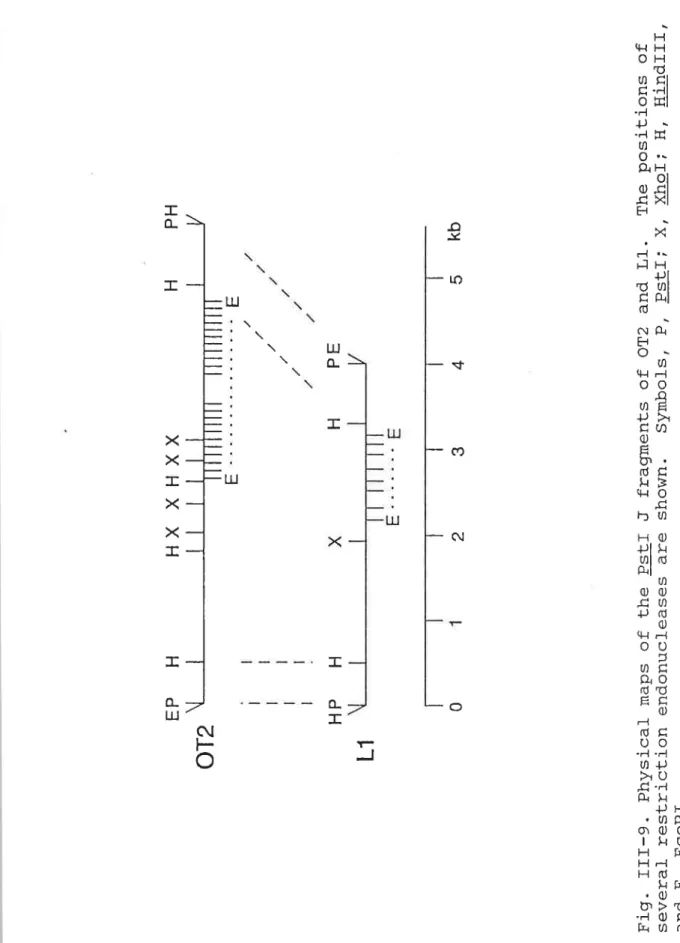
variants. To further analyze this area′ the PstI 」 fragment
of OT2 in the constructed ■ibrary was compared to the PstI 」
fragment of L■ C■Oned into pTz■ 8R. Since additional HindIII
and Xhol sites were speculated in oT2 frOm previous
restriction enzyme ana■ ysisァ these two fragments were first
an additiona■ three Xhol and one HindIII fragments were
observed in oT2. Two fragments from oT2 and L■ generated by HindIII and xhol doub■ e digestion migrated to identica■
positions (0。 7 kb and o.5 kb)on an agarose ge■ (Fig. III―
9)′ indiCating that bOth ends of the PstI 」 fragment covered
by these fragments were presumably identical (Fig, III-9)。
EcoRI digestion revea■ ed different patterns between L■ and OT2. EcoRI cleavage of the L■ fragment generated 7
fragments (4 discrete bands in a 3そ ge■ presumably due to repeated sequences)as previous■ y reported (COChran and
Fau■kner′ ■983デ Guarino et aler ■986). A■ though the oT2
fragment generated many EcoRI fragments 70-80 bp in ■ength′
fragments longer than ■oo bp were not detectedo Deta■ ■ed
physica■ map analysis showed approximate■ y 20-25 of these 70-80 bp fragments. The pOsitions of the four Xhol sites,
two HindIII s■ tes′ and PstI 」 fragment are shown ■n Fig。
III-9。 Repeated sequences conta■ n■ng EcoRI s■ tes extended
through the second Xhol site as indicated in Fig. III-9。
Several reports on the ■nsertion of DNA fragltnents into
the baculovirus genome have been published. Hot spot(s)for DNA insertion have been found in the AcNPV genome between
8.4 and 9.6 map units (Kumar and Miller′ 1987)′ 35.5-37,7 map units (Fraser et a■ 。′ ■983, Beams and Summers′ ■988デ
■989)ァ and 80-86 map units (Mil■ er and Mil■ er′ ■982). It
has also been reported that insertions which originated from the chromosomal DNA of the cell line used were often
EP H H
HX XHXX
PH E H H PE Ll │5 kb
1 4 1 3 1 2 1 0 Fig。 ェ ェ エ ー9。 Physica■ severa■ restr■ ction and Eァ EcoRI.maps of the PstI endonuc■
eases are
」
fragments of OT2 and L■
. showno Symbo■ s, P′ Pstエ デ The positions of X′ Xhoエ デ H′ Hind工 工 工′ ω6
OT2
E / / / / / HPareas. Howeverr the insertion found at the ■9 map unit
pos■tion seemed not to be related to this type of insertion′ since ■)the insertion site was different from other
previously reported sties and 2)the physical mapping pattern of the inserted area (Fig. III-9)waS unique。
Homo■ogy between OT2 and AcNPV was examined by
compar■ng the nuc■ eotide sequences of the■ r po■yhedr■ n genes. The po■ yhedrin gene of AcNPV has already been
pub■ished (Iddekinge et al.′ 1983)。 The nuc■ eotide sequence of the S■ NPV OT2 pO■ yhedrttn gene was determined by dideoxy sequencing (see seCtiOn IV). The nucleotide sequences of the polyhedrin gene was comp■ etely identica■ to that
reported for the AcNPV L■ ′ E2′ and HR3 iso■ ates′ indicating that OT2 is closely re■ ated to previous■ y characterized AcNPV isolates such as L■ and E2. Completely identical sequence homology of the po■ yhedr■ n genes was not expected from the restriction endonuclease patterns showing an
average genomic difference of 19猪 . The perfectly conserved nucleotide sequence in the polyhedrin gene region may be
exp■ained by ■)the importance of the two genes for viral
growth or replication′ 2)specifiC insertions or deletions
in other regionァ
and/Or 3)the eXiStence of sequences
(geneS)essentia■ for replication in Ga■ ■eria mellonera
other than the po■ yhedr■ n gene.
Restriction enzyme analysis showed that the oT2 iso■ ate was very c■ Osely related to cmNPV, which is character■ zed as a variant of AcNPV (Smith and summers, 1979)。 AcNPV
38
variants have also been isolated from NPV stocks from
several lepidopteran insects by p■
aque pur■ fication′ however′they have not been iso■ ated in
」apan until our
finding. This is probab■ y due to the fact that the original
hosts of AcNPV such as TricopluSia ni and Heliothis
vェ
rescens do not ex■
st or ex■st only as minor spec■ es in
」
apan, while c. mel10nella is commonly found in Japanc oT2
was found as a very minor portion (leSS than
■猪)of the
population in only one of the four S■ NPV stocks (Maeda et
a■ 。, ■
990)eXarnined. These observations suggest that OT2 is
a virus which originated in
⊆. mellonella. The specific DNA
pattern of GmNPV may be related to the specificity of this
virus to
⊆. rnellonella, i.e.′specific sequences (genes)may
IVe C■on■
ng, sequence ana■
ys■s, and express■ on of p。■yhedrin
genes and the■ r crysta■■ization and nuc■
ear
■oca■ization
mechan■ sms
Ac lntroduction
Bacu■oviruses produce many (presumably ■00-■50)
structural and nonstructural polypeptides. The unique
character■ stic of produc■ ng two different types of progeny is considered to be contro■ led by mechanisms unique to
bacu■oviruses. During an ear■ y stage of infection a■ l viral
components are transported to the cel■ surface froln the cytop■asm (fOr gp64)and nuC■ eus (for nucleocapsid
conta■ning genom■ c DNA′ bas■ c DNA binding prote■ n′ and
capsid protein)where vira■ partic■ es are assemb■ edo At a late stage of infection′ many structural polypeptides
inc■uding polyhedrinァ basic― DNA binding protein′ capsid prote■n′ and pO■ yhedral enve■ ope prote■ n, as we■■ as many
nonstructura■ proteins (see Section III, B■ issard and Rohrmann, ■99o)are transported into the nuc■ eus where the
v■ra■ enve■ope and po■ yhedra■ envelope are constructed. In
genera■ ′ po■ypeptides produced in eukaryotic ce■ ls are transported to target organs, These proteins have been
shown to have or are cons■ dered to have spec■ fic signa■ sequences (e・ g.ァ specific amino acid sequences)for
transportation (See review of Garoff′ 1985). Bacu■ OVira■
po■ypeptides which are transported into the nuc■ eus are also expected to have spec■ fic sequences for transportation and