Panel Data Research Center at Keio University
DISCUSSION PAPER SERIES
DP2014-001 August, 2014
The ‘Re-segmentation” of the Japanese labor market. Investigating the impact of industrial dynamics
Sébastien Lechevalier*
【Abstract】
The purpose of this paper is to propose a synthesis and an original interpretation of recent empirical works dealing with inequalities in Japan. Most of them have been able to use panel micro data – and sometimes linked employers-employees data – and it has allowed them disentangling individual and firm effects and linking the evolutions of productivity dispersion and of wage differentials. The major result is that rising inequalities in Japan from the 1990s correspond to a large extent to an unprecedented growth in the disparity of wages and employment security between wage earners of comparable status, working in firms of similar size and belonging to the same sector. The second result is that it is possible to link these structural changes on the labor market to industrial dynamics, namely deindustrialization and increasing corporate heterogeneity. We interpret this evolution as a ‘resegmentation’ of the Japanese labor market.
* EHESS
Panel Data Research Center at Keio University Keio University
1 The ‘Re-segmentation” of the Japanese labor market
Investigating the impact of industrial dynamics
Sébastien Lechevalier (EHESS)1
Abstract
The purpose of this paper is to propose a synthesis and an original interpretation of recent empirical works dealing with inequalities in Japan. Most of them have been able to use panel micro data – and sometimes linked employers-employees data – and it has allowed them disentangling individual and firm effects and linking the evolutions of productivity dispersion and of wage differentials. The major result is that rising inequalities in Japan from the 1990s correspond to a large extent to an unprecedented growth in the disparity of wages and employment security between wage earners of comparable status, working in firms of similar size and belonging to the same sector. The second result is that it is possible to link these structural changes on the labor market to industrial dynamics, namely deindustrialization and increasing corporate heterogeneity. We interpret this evolution as a ‘resegmentation’ of the Japanese labor market.
Keywords: Inequalities, poverty, deindustrialization, corporate heterogeneity, Japanese Employment System, panel data.
JEL classification: C23, E24, I32, J31, L16, L60
1 Associate Professor at EHESS, 105 bd Raspail, 75006 Paris France ; [email protected]. The author wishes to thank Ryo Kambayashi, Toshiaki Tachibanaki and Kazufumi Yugami for their helpful comments. I am also grateful to Yoshio Higuchi for a very useful reference. Usual caveats apply. This paper has been prepared for the book
Social Inequality in Post-Growth Japan: Structure, Discourse, Agency under Economic and Demographic Stagnation
edited by David Chiavacci and Carola Hommerich. It has been presented at the conference "Inequality in Post-Growth Japan: Social Transformation During Economic and Demographic Stagnation" organized by the German Association for Social Science Research on Japan (Japanese- German Center Berlin, 22-24 November 2013) and I wish to thank the organizers for their invitation.
2 1. Introduction
Substantial increases in inequalities have been observed for more than two decades in a wide range of countries, including the US, the UK and many other OECD countries. This has given birth to a sizable literature, which first reached the consensus that skill-biased-technological change was the main factor driving inequalities, especially wage inequalities, in the late 1990s and the early 2000s (Katz & Autor, 1999). Another type of explanation, partly complementary to the previous one, concerns the very high concentration of income among top income earners, which might have been caused by the capture by them of an increasing share of value added but also by regressive fiscal reforms (Krugman, 2007; Atkinson, Piketty & Saez, 2011).
As emphasized by Machin (2008), the topic has seen a recent renewal of interest as a result of several developments. Among them, the fact that some countries, previously characterized by relatively stable wage structures, have started to experience rising inequalities certainly deserves a new generation of research. Japan is one of them. There is indeed a consensus - exemplified by the OECD report of 2006 - that inequalities in Japan, as measured by various indicators such as Gini coefficient or inter-decile ratio, have substantially increased over the past 30 years to a point that places Japan among the most unequal OECD countries (Mira d’Ercole, 2006).
If the increase of inequalities in Japan is no more a matter of debate, it is worth saying that there is a need for clarification about the nature of inequalities (e.g. wage vs. other types of income), the nature of the line of cleavage among different groups, and even more important about the underlying mechanisms.
After having identified wages as a key component of incomes that have experienced rising differentials, this article proposes an explanation that focuses on structural changes on the labor markets as a consequence of industrial dynamics. In doing so, we put aside a certain number of other relevant explanations, such as the evolution of the welfare system or of the education system, which obviously matter but which are studied in depth in the rest of the contributions of the book. We do not also consider political economy type of explanations – such as the impact of neoliberal transition in Japan – which we have emphasized in other works (Lechevalier, 2014). Our main purpose is to put rising inequalities in Japan in historical perspectives in order to highlight their structural nature. Rather than conducting an original investigation, we provide a synthesis of recent empirical works that have been successful in disentangling individual and firm effects and in linking the evolutions of productivity dispersion and of wage differentials thanks to the access to panel micro data.
3 2. Rising inequalities in Japan: which stylized facts?
2.1 Income and wage inequalities
Japan has experienced a significant increase of inequalities since the early 1980s. In figure 1, it is possible to state that, while the Gini coefficient for incomes after taxes had only slightly increased between 1989 and 2001, from 0.355 and 0.360, it has dramatically risen until 2008 to reach a level of 0.375. This statement, now widely accepted, has first been the subject of an intense academic debate. On one side, Toshiaki Tachibanaki (2005) claimed that income inequalities substantially rose during the 1980s and 1990s; on the other side, Ohtake (2005) argued that this observed increase in income inequalities was a statistical artifact largely driven by the aging population.
Before entering into this discussion between two contradictory visions on inequalities in Japan, it is good to put the evolution into comparative perspective. A first contribution has been made from the OECD. From this viewpoint, it is indisputable that Japan has experience a unique trajectory between the mid-1970s and the mid 200s: an OECD report that appeared in 1976 identifyed in Japan a level of inequality comparable with that of Sweden, while emphasising the different mechanisms in play - inclusive wage labour nexus in the case of Japan vs. redistribution in the Swedish case (OECD, 1976); on the contrary, nowadays, the level of Gini coefficient are closer to those observed in the UK, thus among the highest within the OECD countries. More precisely, the 2006 issue of the OECD Study of Japan estimated that income inequalities in Japan had surpassed the OECD average and had experienced the strongest growth of any developed country (OECD, 2006, Mira d’Ercole, 2006).
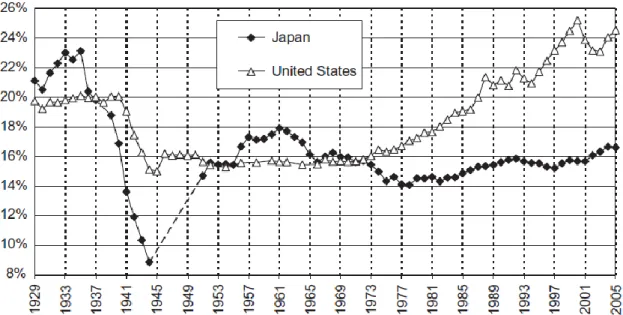
A second comparative perspective, which also adopts a much longer historical view, tends to relativize this first conclusion. In a systematic comparison between the US and Japan, which focuses on top incomes (alternatively top 1% or top 5%) on the basis of fiscal data (more precisely income tax statistics), Moriguchi & Saez (2008) provides interesting results and interpretations. The major result is that, by contrast with developments in the United States from the 1970s, the share of high incomes in Japan remained relatively stable over the past forty years. For example, in 1973, the income of the top 5% richest represented 16% of total income in both countries whereast it represented 16.5% in 2005 in Japan and 24% in the US (Figure 2). Two further results emerge from
4 this comparison between the United States and Japan: Technological change and new fiscal situations do not explain the differences between Japan and the US. Rather than this, it was institutional factors, such as internal labour markets and the union structure, that were the most important determinants of the concentration of income from work. It means that our investigation should focus on wages and mechanisms that directly affect labor market.
2.2 Focusing on wage inequalities: disentangling interfirm and intra firm inequalities by taking into account individual and firm characteristics
Various contributions have focused on wage inequalities and tried to account for the overall rise of inequalities. However, for some technical reasons, it is not easy to disentangle between individual and firm effects in the evolution of wage inequality.2 From this methodological viewpoint, the contribution by Yamaguchi (2012) is of importance as its multiple subgroup-decomposition method allows getting interesting results. Using the micro-level dataset obtained from the Employment Status Survey for the years 1992, 1997 and 2002, he decomposes the factors explaining the evolution of wage inequalities for full-time workers. The first result of importance is as follows. The decrease of inequalities between 1992 and 1997 and the subsequent increase of inequalities up to 2002 is explained by the decreasing effects of between age group inequality and between education group inequality, whereas an increasing effect of between-firm size group inequality is observed. This result is in fact a confirmation of what has been found by Kambayashi et al. (2008), who used an ever richer panel dataset (Basic Survey on Wage Structure) for the years 1989-2003. They are indeed able to reconcile both sides of the debate between Tachibanaki and Ohtake. More precisely, they show that the distribution of wages remained apparently stable as a result of two opposing trends: (i) declining between-group (defined by education, experience, tenure, and establishment size) wage inequality; but (ii) increasing within-group inequality among male workers. These are important results that deserve several comments.
First of all, it concerns gender issues. In the general context of rising inequalities, we might think that women, ‘dominated’ in the context of a patriarchal wage labour nexus, would be the first ‘victims’ or losers (Houseman & Abraham, 1993). In fact, this has been observed in the 1970s,
2
To summarize, the Oaxaca-Blinder decomposition method (used for example by Fortin et al., 2011) is the most popular tool but it suffers from various problems such as endogeneity in the estimation of wage equation. An alternative method is purely statistical, the subgroup decomposition, but, in its basic form, it does not allow identifying multiple factors.
5 when women massively left the labor market at the time of growth slowdown. It did not happen during the lost decade, from the early 1990s. If one considers all workers, the wage gap (ratio between female and male average wage) has decreased from about 55% in the early 1980s to about 50% in the late 2000s (Basic Survey on Wage Structure and Monthly statistics on employement). However, this evolution incorporates the increase of non-regular workers and the fact that a large majority are female. If one considers only regular workers, the wage gap has been reduced over the same period from about 55% to about 67%. The counterpart of this evolution is a rise in inequalities between women themselves, depending on their job status. The origin of this phenomenon relates to the fact that more and more women make a career for themselves, and this is only achieved at the expense of family life, whereas those who choose to have a family only have more or less access to non-regular jobs (Arai & Lechevalier, 2004, 2005). To put differently, the contemporary paradox of Japanese women may be summarized in the fact that on the one hand they benefit from a greater set of choices but on the other they face rising levels of inequality among themselves (Tachibanaki, 2010b).3
Another stylized fact concerns the evolution of inequalities across different age categories. Both empirical studies show that inequalities across age group have decreased.4. On the contrary, they both find increasing differentials within age groups from early 2000s. Overall, these results contradict the argument by Ohtake (2005) and leads us to look at other variables in order to analyze rising inequalities in Japan. The same apply to groups of individual defined by their education level, which have been at the center of empirical investigations of wage inequalities among OECD countries as recalled in the introduction.
Overall, the most important conclusions are the following. Although there are significant wage differentials between individuals with different sex, education level and age, globally these individual characteristics do not explain the increase of wage inequalities in Japan: the rising overall inequality from the late 1990s is related to the increase in within-group inequality for groups of identical age, education and firm size. It means that it is necessary to look for other determinants, on the side of firms’ characteristics, besides the size. This is confirmed by Ito & Lechevalier (2009) in their investigation of the determinants of increasing productivity differentials (and associated wage
3 Lise et al. (2013) confirm this finding. The authors find in fact a decreasing wage inequality for women over the period 1981-2008 (Basic Survey on Wage Structure) but they also observe a sharp rise in hours inequality and the correlation between hours and wages, resulting in an overall rise in earlings inequality for women.
4 More technically, the slope of age-wage profile is getting more flatter; which implies the wage differentials between young and elder are decreasing.
6 differentials) for firms of similar size and belonging to the same narrowly defined sectors. It means it is necessary to identify the endogenous causes of the differenciation of performance such as the combination of internationalization and innovation strategies that may help defines different productive models (Ito & Lechevalier, 2010), before trying to connect them to wage inequalities by opening the black box of firms’ organization (Kalantzis et al., 2012). This point is explained in section 6. Before this, it is important to further specify the characteristics of rising inequalities by investigating the evolution of poverty rates.
2.3 Poverty rates
In the US, the fact that the top incomes represent an increasing share of total income goes hand in hand with rising poverty rates. We have just seen that, in the Japanese case, we do not observe in the 1990s and 2000s such a massive enrichment of the richest. What about the evolution at the bottom of the income distribution? The percentage of persons living in absolute poverty grew by 5% between the middle of the 1980s and 2000, Japan being the only country in the OECD having experienced such a rise of poverty (OECD, 2006, Mira d’Ercole, 2006). More precisely, the poverty rate has risen from 12% in the mid 1980s to 16% in 2009 (Higuchi, 2013). This tendency only became more marked during the course of the 2000s (Figure 3). As a result, in the late 2000s, Japan is one of the OECD countries with the highest poverty rate (Figure 4).
This evolution is obviously the outcome of a complex set of mechanisms, including welfare system (explored in chapters by Shirahase, Conrad and Estevez-Abe). In this chapter, one tries to identify what is related to structural changes on the labor market. It leads us to raise the question of working poor (Sekine, 2008). Beyond the dysfunctions of the public assistance system and situation of single-parent households, which are considered in subsequent chapters, what is clear is that rising unemployment rates (although low for European standards), increasing non regular employment and more generally employement instability are at the origin of the re-emergence of this category in Japan. More precisely, a specificity of Japan is that households headed by a non-regular worker, even if employed, are highly likely to fall into poverty and experience long-term poverty. Moreover, the proportion of the long-term poor is slightly higher in Japan than in Europe (Higuchi, 2013).
Identifying their number and their characteristics is not an easy task as there is no agreement on the definition. To our knowledge, the best recent statistical effort to provide an evaluation based on a clear definition (“Individuals [excluding students] active in the labor market [working or
7 seeking work] for three months or more, but who still belong to a poor household) is provided by Murakami (2011). Unfortunately, his data covers only the period 1997-2002 and does not include more recent trends but what is clear from this study is that the number of working poor in Japan has drastically increased from 2.2 million in 1997 to 3.4 million in 2002.
Another way to see this link is to study the poverty rates by types of job (Cabinet office, 2010): whereas the poverty rate is only of 6% for male regular workers in late 2000s, it is 19% for male part-time workers, almost 21% temporary workers and almost 22% for self-employed. The figures are relatively similar for female workers in terms of structure but with some higher number such as a poverty rate of almost 27% for female self-employed workers. An important conclusion to this is that the evolution of the structure of jobs is a key candidate to explain rising inequalities in Japan. In particular, the origin of the rise of non regular jobs should be carefully examined, while it should not be forgotten that the highest poverty rates are observed among self-employees, whose number are dramatically fallen over the last thirty years (Genda & Kambayashi, 2002). In any case, the emergence of this new category – the working poors – is a new stage in the growth in inequality and the labour crisis in Japan, as employment – together with prospects of social mobility - was the basic factor of social integration in the postwar social compromise.
3. Explaining rising inequalities: a critical literature review
Based on the stylized facts that have been derived from the former section, the aim of this section is to examine a certain number of explanations that have been given to explain rising inequalities in OECD countries in general and in Japan in particular, before introducing our own explanation that focuses on industrial dynamics and its impact on labor market outcomes, from structural and historical perspectives. Among these explanations, we particularly focus on skill-biased technical change, which has been the dominant explanation until recently in the economic literature, and on aging, which has been more specifically introduced in the debate on the extent of rising inequlaties in Japan. We also introduce labor market related explanations. However, we do not discuss explanations such as the evolution of the welfare system or family structures, two aspects that are considered in the rest of the book.
In the 1990s, increasing inequalities were considered an important problem in almost all developed societies. Skill-biased technical change, especially, seemed then to have affected many
8 economies and to be a good candidate to explain growing inequalities in OECD countries, of course to varying degrees. According to this explanation (see for example Katz & Autor, 1999), the major driver of wage inequalities was the new wave of technological change, which beneficiated to some workers, the most skilled in improving their productivity, but not to others. To put it simply, the key differential was concerning workers with different skills. The consensus among economists at the end of the 1990s and early 2000s was hence that skill-biased technical change was the main driver of rising wage inequalities, more than any other explanations, being globalization or institutions of the labour market (unions, minimum wage). The problem with this explanation in the case of Japan is that one did not observe a significant rise in inequality related to the level of qualification (Kambayashi et al., 2008; Yamaguchi, 2012). It explains why it has never been popular among Japanese labor economists.
Rather, following the contribution by Ohtake (2005), the debate has focused on the assessment of the impact of aging on the growth in inequality during that period. The basic argument is the following. Although the rise of Gini coefficient seems to indicate a substantial increase in wage inequalities, this is only a statistical artifact. In the Japanese institutional context, at a given point of time, the wage inequalities increase with the age categories. Therefore, the current aging of the population mechanically produces an apparent increase of the inequalities when one considers the whole population. However, from the 2000s, we observe a rise in inequality within given age groups, notably among the young, which this kind of analysis does not allow us to explain. Even, more importantly, in the course of the 2000s, wage inequality began to rise strongly without aging, globalisation and technical progress actually accelerating (see Figure 1). This means that have to turn to other types of explanation. Given the above stylized facts, and in particular the evolution of wage differentials, it is natural to focus on labor market mechanisms.
The first candidate to explain this increasing wage gap is the introduction of individual performance-based systems, but it does not seem to have played an important role in Japan even though such systems have been experimented with.5 The second candidate is related to the wage differential between regular and non-regular workers. The rising share of non-regular workers, which has more than doubled in 20 years to reach more than a third of the workforce, has been
5 First, not all firms have tried to introduce such systems. Second, among those who have tried, many have abandoned them after a while because of negative externalities. This is for example the case of Fujitsu. The current attempts at reforming the wage system focus less on setting individual performance-based wage schemes than on modifying deferred compensation schemes to allow employees to get short term reward for their engagement in the firm, in a context of rising risks and uncertainty (Fujimura, 2003).
9 indeed a popular explanation of rising inequalities in Japan, especially within firms (Ota, 2005). A peculiarity of the Japanese labor market is that non-regular workers are mostly female while regular workers are mostly male. For example, according to 2007 Employment Status Survey, female workers represented 74.3% of non-regular workers aged 15 to 59 and 30.3% of regular workers.
We have here a powerful mechanism that may explain rising inequalities. However, this explanation is limited since it does not take account of the rise in inequalities among male regular workers themselves (Kambayashi et al., 2008; Kalantzis et al., 2012). To explain these rising “within-group” inequalities, it is natural to turn to firms’ characteristics. The higher share of non-regular workers does not indeed explain why wage inequalities have also increased between firms (Tachibanaki, 2005; Ito & Lechevalier, 2009). This has first gone unnoticed since the literature has first focused on firms of different size and found that firm-size differential does not explain the increasing wage gap (e.g. Kambayashi et al., 2008; Yamaguchi, 2012). Rising wage inequalities are not often connected to a second stylized fact that has characterized the lost decade, increasing productivity differentials at the firm level, and a purpose of the rest of this chapter is to investigate this point.
Both explanations – rising intra-firm inequalities (rising wage gap between regular and non regular worker) and rising inter-firm inequalities – are not exclusive from each other. Moreover, at this stage, we do not know of any systematic comparison between these two types of inequalities, which makes impossible to reach a conclusion regarding the relative importance of each type of inequalities.6 Our argument is that these two trends are connected to industrial dynamics, which will be explored in sections 5 and 6. Before this, it is essential to define our framework of analysis in adopting a historical and structural perspective that focus on the segmentation of the labor market, in order to show how what are the conditions for industrial dynamics to affect labor market outcomes in the case of Japan.
4. The re-segmentation of the Japanese labor market
4.1 Introducing the concept of segmentation and its use in the Japanese context
10 Our thesis is that the segmentation of the Japanese labor market is the underlying structural characteristic that conditions the evolution of inequalities. This concept of segmentation has been widely used in the related literature. A labour market is considered ‘segmented’ when it is divided by a cleavage between two or several segments between which there is very little mobility, and characterised by differentials in wages, in employment security and more generally in conditions of work and career possibilities. This segmentation concerns both jobs and workers. The problem is not so much that the jobs are different, but that a part of the workforce is confined to a certain type of work. The key for the segmentation hypothesis is the discontinuity between the different segments (Berger & Piore, 1980; Lechevalier, 2003).
In the Japanese context, what is remarkable is that the term dualism (niju kozo 二重 構造) has been preferred to the one of segmentation, whose translation into Japanese (bundanka 分断化) did not have the same “success” than niju kozo.7
Moreover, in most of the contributions on the dualism/segmentation of the Japanese labor market, issues of wages and labor stability have been treated separately. We argue that it is a mistake and that they should be jointly studied and articulated. It requires a clarification of the concept of employment security. It is not only a right acquired as a result of social struggles and compromise between employees and employers (Gordon, 1988) but it corresponds also to a certain mode of production in which labor is quasi-fix input and therefore should be considered as a part of the firm (Berger & Piore, 1980). This is sustainable only if there is a joint investment from the workers and the employers, which make the skills specific to the firm. It is also conditioned by the temporal horizon of the firm, which itself depends on the institutional (e.g. financial) environment. This theoretical perspective is essential to understand how employment security can be affected by changes in the industrial structure (e.g. through desindustrialization) but is also one key component of the heterogeneity of firms, complementary to others, such as their employment structure. From an empirical viewpoint, there are various possible
7 The term dualism is used for the first time officially in a report of 1957, Keizai Hakusho 経済白書 (Economic White
Paper), and refers most exclusively to the industrial structure, the divide between SMEs and large firms. Moreover, the
key variable characterizing the gap is the wage (chingin no niju kozo 賃金の二重構造). To this form of dualism, a second one shoud be added that correspond to a cleavage within the firms, especially the larger ones, between the core and the periphery of the workforce (chûshin/enpen rôdô ryoku 中心/縁辺労働力). This distinction corresponds to status differentials, regular and non regular workers (seishain/hiseishain 正社員/非正社員), and among them, temporary workers, part-time workers, contracts workers (haken-rôdôsha 派遣労働者, pâtotaimâ パートタイマー or more simply pâto パート, rinji-hiyatoi 臨時日雇, keiyaku-tôrokushain 契約登録社員). This is this approach that has been adopted in another report in 1989, which has been also important in the study of the segmentation in Japan, Rôdô
11 measures such as job status, separation rate or speed of adjustment of employment to the production, which is calculated through the estimation of a labor function demand (Lechevalier et al., 2014).
If the labour market is the matrix of inequalities in Japan, at the same time, the issue is to identify mechanisms at work outside the labor market and that plays in interaction with labor market dynamics. Industrial dynamics is one of them. Our hypothesis is that not only the intensity of segmentation but also lines of cleavages and underlying mechanisms evolve over time. It means that a historical perspective is required to analyze the current re-segmentation of the Japanese labor market.
4.2 The segmentation of the Japanese labor market in historical perspective
As recalled in the previous subsection, the structure of inequalities in Japan in the 1950s was essentially explained by the dualism of the Japanese economy. In many respects, the 1950s can be considered as the « Golden Age » of segmentation in Japan (Lechevalier, 2003). What is called at that time the dualism of labor market mainly corresponds to a dual industrial structure, characterized by a cleavage between small firms and large firms, often linked to each other by a subcontracting relationship. In the mid-1950s, the productivity level of manufacturing firms between 10 and 100 employees was around one third of the productivity of those with more than 1000 employees, whereas such level is 90% in the US or in the UK. At that time, the wage gap is similar to this productivity gap, as shown in the Economic White paper of 1957. To this wage differential, one should add a tenure differential: in 1955, the annual separation rate for firms between 30 and 99 employees is 2.5% while it is only 1.1% for the firms of more than 500 employees. Besides this inter-firm dualism, there is also an intra-firm dualism, characterized by a wage and employment security gap between regular workers and non-regular (at that time, still mainly male) workers. However, professional trajectories reveal an implicit hierarchy between the two types of secondary jobs: many regular workers in small firms do not hesitate to try to get hired as non-regular workers in large firms (Nakamura, 1981): the most unequal dimension of the Japanese wage labor nexus at that time is therefore linked to the inter-firm dualism at that time.
When one turns to the explanations of this situation, the major one is the existence of a labor surplus, from which derives a bargaining power that is favorable to firms (Minami, 1994). However, this is not enough to explain the dualism of the industrial structure. The key explanation refers to the differentiated introduction of foreign technology in the Interwar period, which has been the basis of a gap in terms of capital intensity and productivity after the WWII (Shinohara, 1970). This point is essential to our own interpretation of what happened from the 1990s.
12 A turning point occurs in the early 1960s with the end of the labor surplus, which can be measured through the imperfect indicator of ratio of job seekers to job offers that decreased from 1.04 in 1955 to 0.6 in 1960 and to 0.28 in 1965 (Shokugyô Antei Gyômu Tôkei, various years). It introduces deep changes from the viewpoints of cleavages on the Japanese labor market. One first observes an increasing mobility on the Japanese labor market between 1958 and 1964 (especially in the early career). Then, smaller firms were forced to increase their wages to keep their workers, which leads to a quick contraction of the wage differentials between SMEs and LEs. Finally, a substantial portion of non-regular workers were promoted to regular jobs status.
The end of the high growth period and the beginning of an era of turbulences in the 1970s does not fundamentally change the process of homogenization of labor conditions. More precisely, the gap between large firms and small firms keeps decreasing as shown by the evolution of the separation rate differential between them.8 However, in the context of growth slowdown, the Japanese economy enters a period of intense restructuration, especially in some sectors such as textile and steel industry, which downsize, while other competitive sectors such as the automotive industry and electronics are developing very quickly: the most important line of cleavage at that time is therefore sectoral. Finally, in this period of uncertainty, one observes a new increase of non-regular workers, who will be nonetheless integrated to the non-regular workforce during the bubble period (Kambayashi & Kato, 2010).
The relative homogenization of labor conditions comes to an end with the collapse of the bubble and the subsequent stagnation of the 1990s. It corresponds to the beginning of a new era of labor surplus as symbolized by the rise of unemployment that reached historical levels up to 6%. The sign that firms are trying to reduce labor costs can be also interpretated as a sign of labor surplus at the firm level. As well shown by Kambayashi & Kato (2010), one observes a rise of involuntary separation for the newly integrated workforce (who had changed their status from non-regular to non-regular during the bubble period). At the same time, the background is a decrease of the overall mobility on the Japanese labor market (due to the collapse of voluntary quits), which enters in an ice-age (Genda, 2005). This is a key precondition for the segmentation as seen above. Another remarkable stylized fact is the increase of non-regular workforce and the re-emergence of the intra-firm divide between regular and non-regular workforce. However, as emphasized in section 2, although this intra-firm dualism is particularly dramatic and may partly explain the rise of poverty rate, it is important to note that the use of non-regular workers is concentrated on some firms
8 The separation rate was around 1% for the firms with more than 500 employees and 1.7% for firms between 30 and 99 employees in 1975, whereast these figures were respectively 1.5% and 3% in 1965 according to Monthly Labour
13 (Survey on diversification of employement forms and Kalantzis et al., 2012). It can be therefore partly explained by the increasing differentiation of the firms, both in terms of performance and HRM practices (Lechevalier et al., 2014), including the use of non-regular workers. This is the basis of the re-segmentation (再分断化) of the Japanese labor market.
To put it briefly, the hypothesis of a resegmentation of the Japanese labor market emphasizes both a continuity in the structural evolution of the Japanese labor market conditioned by changes in the labor surplus/scarcity and ruptures in the industrial structure that define the line of cleavages and the different segment. Two key evolutions have affected the industrial structure in Japan, deindustrialization and the increasing heterogeneity of firms, and will be analyzed in the two following sections.
5. The Direct impact of industrial dynamics: deindustrialization and globalization
Labor markets of most OECD countries, including Japan, have been characterized by deindustrialization, that is, the decrease of the share of manufacturing industries in total employment. This is a powerful structural mechanism, which is a candidate to explain the decay of “good jobs” and the rise of non regular positions, mainly in the service sector (Schmitt & Jones, 2012). However, as far as inequalities are concerned, the impact of deindustrialization is not straightforward and it is necessary to disentangle its underlying causes in order to produce a clear assessment. The following two subsections are successively dealing with these two sides of the problem.
5.1 Deindustrialization as a major source of the rise of non regular positions
According to the OECD (STAN database), the share of manufacturing industries in total employment in Japan has fallen down from about 27% in 1970 to about 16% in the late 2000s. In terms of absolute numbers, it corresponds to a loss of 3.4 millions jobs (from 13.8 millions to 10.4 millions), which correspond to 25% of total manufacturing employment in 1970. Even if one takes into account the fact that manufacturing has changed over time during this period and that this deindustrialization is over-estimated because it does not take into account properly the process of service outsourcing, it means that Japan, as other OECD countries, experienced an important structural change. Moreover, it is important to notice that this trend has been less pronounced in the 1980s than in the 1970s and the 1990s and onward, which correspond to periods of respectively
14 growth slowdown and of stagnation, both characterized by intense restructuration. It means that macroeconomic context mattered in the process of deindustrialization.
The complementary side of this evolution is the increase of service jobs over the same period, from 24.4 million to about 44 million, which corresponds to an evolution of the share of services in total employment from 44.8% in 1970 to about 68.5% in the late 2000s.
This is a classical shift of the industrial structure of employment and is not a problem per se. However, the process has been accompanied by an increase of non regular jobs. For example, according to the Employment Status Survey of 2007, the share of regular workers in manufacturing was 72.8% against 58.3% on average in miscelleanous services and 41.2% in retail. To summarize, deindustrialization does not correspond only to a decrease of the share of manufacturing in total employment but it is biased and leads to a changing structure of labor markets. Moreover, in the case of Japan, the underlying mechanisms have changed over time (Uemura & Tahara, 2013), which has aggravated the situation on the labor market. These points are developed in the next subsection.
If the results obtained here are clear, there are not enough, for a least two reasons. First, it is important to take into account the evolution of labor supply especially in terms of sex, age, and education. Second, there have been some evolutions that are intra-sectorial, which require (possibly panel) micro-data to be analyzed. It will be done in section 6. Before this, in the following subsection, we specify the causes of deindustrialization in order to discuss the possible links with rising inequalities.
5.2 Deindustrialization and rising inequalities on the labor market
The impact of deindustrialization in terms of inequalities depends fundamentally on its underlying causes. If one puts aside the process of outsourcing from manufacturing to services, there are two major mechanisms that explain deindustrialization. One is domestic and corresponds to the changing structure of demand (from manufacturing goods to services) as income per capita is rising, coupled with a differential of productivity between the two sectors: as manufacturing industries are characterized on average by higher productivity, it leads, everything being kept equal, to a decrease of the number of workers needed to produce the same amount of goods. Given this productivity differential, deindustrialization leads to less workers in the manufacturing industry but with higher wages, which is confirms by data but is not enough to explain the rising inequalities.
15 The second mechanism incorporates the dynamics of globalization and includes two sub-mechanisms. The first one concerns the impact of outward foreign direct investment (FDI) on domestic employment; the second one exists without any mobility of capital and is the result of trade: if one country is losing competitiveness, its market share on the world market will be reduced and therefore, domestic manufacturing jobs will be destroyed. Then, the issue at stake to evaluate the impact of deindustrialization on labor market dynamics and inequalities is to distinguish between these different mechanisms and their respective impact, which is not an easy task.
Here, we put aside, the technical issue of disentangling the causes of deindustrialization and we summarize some of the results of Lechevalier (2015) on the impact of globalization as one of the causes of deindustrialization on labor markets. In fact, the study of deindustrialization has moved its focus from the impact in terms of volume of employment to more qualitative indicators such as job security or wage inequalities. The idea behind this evolution is that deindustrialization is a powerful trend that affects not only the sectoral composition of the economy (see 5.1) but also the very structure of the labor market in terms of wages, job status, among others. It leads to a revival of the debate on the determinants of inequalities - introduced in section 3 – which concluded until the mid 2000s to the unsignificant impact of globalization on inequalities. Empirical papers on Germany or Korea find indeed a negative and significant impact on some types of workers of outward FDI and trade (see for example Görg & Görlich, Lee and Lee in Lechevalier, 2015; Baumgarten, 2013). Japan is no exception. For example, Sato et al. (2011) successfully explains the rise of temporary workers by the rising international exposure of Japanese firms: trade liberalization encourages firms to reduce their variety of products, which in turn raises the demand for temporary workers since freely adjustable temporary workers function as a buffer against increasing revenue fluctuations. Moreover, Kiyota and Kambayashi (in Lechevalier, 2015) shows that not only outward FDI has a negative impact on the volume of employment but also explain a significant portion of the rising wage inequalities.
One mechanism should be of particular focus. It has been found that exporters have a higher productivity than non exporters. It corresponds partly to a selection effect (the most productive firms are going to the international market) but also to a learning effect (firms increase their productivity when they start exporting). The combination of these two effects leads to increasing productivity differentials and therefore to increasing wage differentials. This mechanism, which applies also to the fact to invest abroad (outward FDI), goes beyond what we characterized as “deindustrialization” and correspond to a more general mechanism, namely the increasing
16 productivity dispersion of firms and its impact on wage differential. This is the object of the next section.
6. The indirect impact of industrial dynamics: increasing heterogeneity of firms
What has been said about the impact of differentials between exporters and non-exporters can be generalized and connected to the increasing heterogeneity among Japanese firms as a major driver for rising wage inequalities. We argue that this is the basis of the current re-segmentation of the Japanese labor market (Lechevalier, 2011).
Recent studies on Japan have found an increasing productivity dispersion among Japanese firms during the ‘‘Lost Decade’’ (Ito & Lechevalier, 2009, 2010). Moreover, whereas Japan has been characterized by size and sector productivity differentials that were relatively higher than in other developed countries (see section 3. and Yoshikawa, 2008), these recent studies have emphasized productivity differentials for firms of similar size and belonging to the same narrowly defined sectors. This trend has been also observed in other countries (Dosi et al., 2010) but this is particularly marked in Japan from a comparative perspective (Lechevalier, 2014).
Surprisingly, there has been no recent investigation of between-firms wage dispersion in connection with productivity differentials. This is all the more surprising that various authors - such as Mortensen (2003), Dunne & al. (2004) or Faggio et al. (2010) - have investigated this link for other countries, which is now a well established stylized fact. One reason for the absence of this type of study might be the dominant concern for within-firm wage differential between regular and non-regular workers described above, or the fact that studies which have looked at between-firm inequality have focused on firms with different sizes, which failed to explain the increasing wage gap (Kambayashi et al., 2008; Yamaguchi, 2012). One condition for this type of investigation to be successful is not to consider categories of firms that are defined ex ante (e.g. by their sector or size class) but to leave the possibility open of an evolution of the lines of cleavage. It corresponds to the hypothesis of re-segmentation.
How can we describe the mechanisms at work in Japan that link increasing productivity differentials and rising wage inequalities? Kalantzis et al. (2012) propose a stylized model that provides a plausible explanation. This is a simple efficiency wage model with one sector but two types of firms of similar size, in which firms can choose between two types of work organizations, a complex structure with workers’ involvement and job security where the productivity of workers depend on their effort (type-I firms), and a simple competitive structure where workers have an
17 exogenous productivity (type-II firms). The prediction of the model is that a negative aggregate productivity shock (as the one that has been observed in Japan during the lost decade) produces increasing productivity and wage differentials, as well as a falling share of type-I firms. To put it differently, in this model, wage inequalities are the flip side of productivity differentials which themselves originated from choosing different models of work organization as a reaction to the productivity slowdown. 9 It means that recent rising wage inequalities are not only the mechanical effect for increasing productivity dispersion but that there is a structural dimension on the side of firms’ organization, something very similar to the logic that has been described for the dualism of the 1950s-1960s, as shown above in reference to the debate between Nakamura and Shinohara (section 3.2).
The basic predictions of the model are empirically confirmed. In merging the Basic Survey
on Wage Structure and the Employment Trend Survey at the micro level for the first time, the
authors are first able to distinguish between the two groups of firms.10 More precisely, the authors use a technique, the unknown regime switching regression à la Dickens and Lang, that allows them distinguishing endogeneously (without setting pre-conditions such as the size or the sector) between one group of establishments that can be characterized by efficiency wages and another one that cannot. Finally, a simulation shows a decrease of the share of type-I firms in case of growth slowdown, which implies a joint rise in productivity and wage differentials in Japan in recent years.
What is missing in this story is the origin of the increasing heterogeneity of firms. Section 5 has indicated one possible mechanism, the internationalization of the Japanese economy. Ito & Lechevalier (2009) and Lechevalier (2014) successfully test this hypothesis but propose at the same time a more general discussion that includes the impact of the introduction of new technology, the evolution of the competitive environment and the role of neoliberal policies. From this discussion, it is possible to draw a parallel between the contemporary period and the 1910s-1930s, when the differentiated introduction of foreign technologies at the firms level has been the basis of the dual structure of the Japanese economy decades later, in the 1950s (Shinohara, 1970). In the context of the 1990s, it was less the impact of the differentiated introduction of information and
9 The increased diversity of human resources and management practices and its impact on effort and productivity differentials has been documented by Bloom & Van Reenen (2007) for the US and Europe and by Miyagawa et al. (2008) in the case of Japan. Lechevalier et al. (2014) also show an increased dispersion of speed of downsizing for a panel of Japanese manufacturing firms between the 1990s and the 2000s.
10 More precisely, in merging the BSWS and the ETS for the years 2005–9, they build a rich employer–employee panel data set that allows them to disentangle individual and firm determinants of wage inequalities.
18 communication technologies (as shown by Ito & Lechevalier, 2009) than that of financial innovations and of international accounting norms. To summarize the argument developed in Lechevalier (2014), the major finding is that the mechanism at the origin of the current re-segmentation of the Japanese economy lies on the differentiated introduction by firms of opportunities created by the newly deregulated financial environment in the 1980s-1990s (new financial products such as corporate bonds for example) that condition the corporate behavior thereafter because of complementarities between financial structure and employment practices (see for example, Aoki, 1989 on this point). This discussion goes beyond the scope of the present chapter.
7. Conclusion
In this chapter, we have shown that rising inequalities in Japan correspond to a large extent to an unprecedented growth in the disparity of wages and employment security between wage earners of comparable status, working in firms of similar size and belonging to the same sector. De
facto, a part of the population that had been included in the post-war social compromise finds itself
in an unaccustomed situation of insecurity, in which work is no longer associated with a guarantee of social integration. It is to take account of this form of social change that we have proposed the concept of re-segmentation of the Japanese labour market in order to understand the structural transformations that are occurring.
Although the lack of space did not allow conducting them systematically, a first dimension of our interpretation is the emphasis on international comparisons. Few examples in this chapter have shown that Japan is not unique from the viewpoint of the impact of the evolving industrial structure on inequalities, especially what concerns deindustrialization and rising heterogeneity of firms. Nonetheless, its impact is particularly important in the case of Japan, because of both the mechanisms at work but also the absence of compensating mechanisms. It may explain why the exceptional trajectory of Japan from the viewpoint of rising inequalities since the early 1980s. A second dimension of this interpretation is its historical nature. It leads us to reject the idea that the Japanese wage labour nexus is unequal by nature (see also Mira d’Ercole, 2006). The historical perspective we adopted allowed us to show, on the contrary, that, if the segmentation of the labour market is a structural given, it has deeply evolved in its intensity and its lines of cleavage. In other
19 words, the contemporary debate on inequalities in Japan was not born in the 1990s, but has roots going back to another debate, much older, on the nature of the employment system established after the Second World War and the structure of inequalities that was associated with it. Our own view is that segmentation was central to the post-war social compromise. Its impact on inequalities has evolved, depending on the industrial dynamics – which has been the focus of this chapter – but also on other factors (such as the welfare and the education systems that have been deliberately put aside).
In this chapter, we have shown the impact of the industrial dynamics on the Japanese labor market as a major source of rising wage inequalities. It explains why, as a labor economist, we have almost exclusively focused on industrial dynamics. At the same time, it is clear that it is not the only one as it will be shown in other chapters of this book. In this conclusion, we would like to argue that only a political economy dealing with diversity of capitalism and institutional change may give a comprehensive understanding of this evolution, in both comparative and historical perspectives (Boyer, 2013). According to this approach, inequalities are neither one of the outcomes of a given form of capitalism, in the same way as growth, nor a fact that goes beyond the diversity of capitalism, because determined by the impact of globalisation or of technological progress. In our view inequalities (their intensity, their form), reveal something profound about the very nature of each kind of capitalism, in that they allow us to comprehend the nature of the underlying social compromise, notably concerning the division of value added and of risks. Although Japanese capitalism was segmented in the classic form of Japanese capitalism, it was fundamentally egalitarian in outcome, and even in intention. This is shown by the low level of inequalities reached during the 1970s. In this process, economic stagnation has certainly played a role. However, industrial dynamics alone cannot produce such a rupture, which takes place at the level of the social compromise. If mechanisms on the sides of the industrial dynamis and of the labor market were at the origin towards the rise of inequalities, there were aggravating mechanisms in other spheres (e.g. education) and an absence of correcting mechanisms in other spheres (e.g. welfare). It means that, overall, the significant rise of inequalities is the indisputable sign that Japanese capitalism has experienced a great transformation since the early 1980s (Lechevalier, 2014).
To put it differently, arguing that labor market is the matrix of inequalities in Japan and explaining their structure by industrial dynamics does not mean that rising inequalities are mechanical (as in an explication based on aging for example) and that politics does not matter. More precisely, it is possible to define the Japanese employment system as the articulation of different segments of the labour market and by equilibrium between stability and instability. It is
20 this equilibrium and this compromise that has been questioned, directly or indirectly, by neo-liberal policies as a whole. It is these policies that are at the origin of a real rupture, even more than the crisis. Their impact is apparent in the financialisation - which has been itself a major source of the increasing diversity of firms -, in the evolution of the welfare or the educations systems, which are the objects of specific chapters in the rest of this book.
8. References
Aoki M. (1989) ‘The Nature Of The Japanese Firm As A Nexus Of Employment And Financial Contracts: An Overview’, Journal Of The Japanese And International Economies, 3(4): 345-366. Arai M. and Lechevalier, S. (2004) ‘Japon. La Crise Contribue-T-Elle À Réduire Les Inégalités Hommes-Femmes ?’ [‘Japan. Is The Crisis Contributing To Reduce Inequalities Between Men And Women?’]. Chroniques Internationales De l’IRES, March, N° 87 (in French).
Arai M. and Lechevalier, S. (2005) ‘The Inequalities Between Men And Women In The Japanese Labour Market. A Regulationist Approach’, Keizai Kagaku [Economic Science], March, 52(4). Atkinson A. B. & S. Morelli (2011), ‘Economic crises and Inequality’, Human Development Research Papers n°HDRP-2011-06.
Atkinson, A.B., T. Piketty and E. Saez (2011), “Top Incomes in the Long Run of History”, Journal of Economic Literature, Vol. 2011, No. 49:1, pp. 3-71.
Baumgarten D. (2013), ‘Exporters and the rise in wage inequality: Evidence from German linked employer–employee data’, Journal of International Economics, 90, (1): 201-217
Bloom N. & J. van Reenen (2007), ‘Measuring and Explaining Management Practices Across Firms and Countries’, The Quarterly Journal of Economics, 122 (4): 1351-1408
Boyer R. (2013), ‘Globalisation of Inequality or Contrasted but Interdependent Inequality Regimes?’, Paper presented at the EAEPE conference, Paris.
Cabinet office (2010), Seikatu konnan o kakaeru danjo ni kansuru kenkyûkai hokoku (Report on people with difficulties to live).
21 Dore R. (1994) ‘Equality-Efficiency Trade-Offs: Japanese Perceptions And Choices’, in M. Aoki and R. Dore (eds) The Japanese Firm. Sources Of Competitive Strength. Oxford: Oxford University Press, 379-392.
Dosi, G., Lechevalier, S. and Secchi, A. (2010) ‘Introduction: Interfirm Heterogeneity—Nature, Sources And Consequences For Industrial Dynamics’, Industrial And Corporate Change, 19 (6): 1867-1890.
Dunne, T., Foster, L., Haltiwanger, J. and Troske, K. (2004) ‘Wage And Productivity Dispersion In United States Manufacturing: The Role Of Computer Investment’, Journal Of Labor Economics, 22 (2): 397-429.
Faggio, G., Salvanes, K. and Reenen, J. V. (2010) ‘The Evolution Of Inequality In Productivity And Wages: Panel Data Evidence’, Industrial And Corporate Change , 19 (6): 1919-1951.
Fortin, N.M., Lemieux, T., and Firpo, S. (2011) ‘Decomposition methods in economics’, Handbook
of Labor Economics, Vol. 4, Part A, 1-102.
Fujimura, H. (2003) ‘Changes In The Spring Wage Offensive And The Future Of The Wage Determination System In Japanese Firms’, Japan Labor Bulletin, 42(5): 6-12.
Genda Y. & R. Kambayashi (2002), Declining Self-Employment in Japan, Journal of the Japanese and International Economies, 16 (1): 73-91
Genda, Y. (2003) ‘Who Really Lost Jobs In Japan? Youth Employment In An Aging Japanese Society’ in S. Ogura, T. Tachibanaki and D. Wise (eds) Labor Markets And Firm Benefit Policies In
Japan And The United States. Chicago, IL: University Of Chicago Press, 103-134.
Genda, Y. (2005) A Nagging Sense Of Job Insecurity: The New Reality Facing Japanese Youth, trans. J. Hoff, Tokyo: International House Of Japan.
Higuchi Yoshio (2013), ‘The Dynamics of Poverty and the Promotion of Transition from Non-Regular to Non-Regular Employment in Japan: Economic Effects of Minimum Wage Revisionand Job training Support’, The Japanese Economic Review, 64 (2), pp 147-200)
Houseman, S. and Abraham, K. (1993) ‘Female Workers As A Buffer In The Japanese Economy’,
22 Ito K. and Lechevalier S. (2010) ‘Why Some Firms Persistently Out-perform Others? Investigating the Interactions between Innovation and Exporting Strategies’, Industrial and Corporate Change 19(6): 1997–2039.
Ito Keiko & Lechevalier Sébastien (2009), The Evolution of Productivity Dispersion of frms. A
Reevaluation of its determinants in the case of Japan, Review of World Economics 145(3): 404–
429.
Kalantzis Yannick, Kambayashi Ryo & Lechevalier Sébastien (2012), Wage and Productivity
Differentials in Japan. The role of Labor Market Mechanisms, Labour: Review of Labour Economics and Industrial Relations, 2012, Volume 26, Issue 4: 514-541..
Kambayashi R., Kawaguchi D. & Yokoyama I. (2008) Wage Distribution in Japan, 1989-2003, Canadian Journal of Economics/Revue canadienne d’économie, 41(4): 1329--1350.
Kambayashi, R. & T. Kato (2010), ‘The Japanese Employment System after the Bubble Burst: New Evidence’ in K. Hamada, A. K. Kashyap & D. E. Weinstein (Eds) Japan's Bubble, Deflation, and
Long-term Stagnation, MIT Press.
Katz, L. F. and D. H. Autor (1999), ‘Changes in the wage structure and earnings inequality’, In J. J. Heckmann and E. E. Leamer (Eds.), Handbook of Labor Economics, Volume 3 of Handbook of Labor Economics, Chapter 26, pp. 1463–1555, Amsterdam: Elsevier.
Krugman P. (2007) The Conscience Of A Liberal. New York, NY: WW Norton and Company. Lechevalier S. ed. (2015), ‘Globalization and labor market outcomes: de-industrialization, job security, and wage inequalities’, Special issue, Review of World Economics, forthcoming.
Lechevalier S. (2014), The Great Transformation of Japanese capitalism, Routledge.
Lechevalier, S. (2012) ‘The Japanese firm: from the analysis of a model to the understanding of its increasing heterogeneity’, in Michael Dietrich and Jackie Krafft (eds), Handbook on the Economics
and Theory of the Firm, Edward Elgar, 194-208.
Lechevalier S. (2011), The Increasing Heterogeneity of Firms in Japanese Capitalism: Facts,
Causes, Consequences and Implications, in R. Boyer, A. Isogai & H. Uemura (edit.), Diversity and Transformations of Asian Capitalisms, Routledge.
23 Lechevalier, S. (2003) ‘La Resegmentation Contemporaine Du Marché Du Travail Japonais En Perspective Historique’ [‘Contemporary Resegmentation Of The Japanese Labour Market In Historical Perspective’], Cipango. Revue D’études Japonaises, N° 10.
Lechevalier S., Dossouguin C., Hurlin C. & Takaoka S. (2014), The Heterogeneity of Employment
Adjustment Across Japanese Firms. A Study Using Panel Data, KIER Discussion papers series
n°883, Kyoto University.
Lise J., Sudo N., Suzuki M., Yamada K., & Yamada T. (2013), Wage, Income and Consumption
Inequality in Japan, 1981-2008: from Boom to Lost Decades, HCEO working paper series n°
2013-011.
Machin S. (2008) ‘An Appraisal of Economic Research on Changes in Wage Inequality’, Labour, 22 (s1): 7-26.
Matsuura T., H. Sato & R. Wakasugi (2011), 'Temporary Workers, Permanent Workers, and International Trade: Evidence from Japanese firm-level data', RIETI Discussion papers n°2011-03. Minami R. (1994), The Economic Development of Japan. A Quantitative Study, St Martin Press. Mira d'Ercole M. (2006), 'Income Inequality and Poverty in OECD countries: How Does Japan Compare?', The Japanese Journal of Social Security Policy, 5 (1).
Miyagawa T., Ozaki M., A. Kawakami and Edamura Kazuma (2008), ‘Corporate Organizational Reform and Corporate Performance: Empirical analysis based on interviews with Tokyo-area firms’, RIETI Discussion Papers n°2008-062 (in Japanese).
Moriguchi Chiaki & Emmanuel Saez (2008), The Evolution of Income Concentration in Japan, 1886-2005: Evidence from Income Tax Statistics, ‘The Review of Economics and Statistics’, 90(4):713-734.
Mortensen, D. (2003) Wage Dispersion, Cambridge, MA: The MIT Press.
Murakami M. (2011), ‘A statistical comparative study of the working poor in Japan and Canada’, American Journal of Economics and Business Administration 3 (2): 316-332.
Nakamura T. (1981), The Postwar Japanese Economy. Its Development and Structure, University of Tokyo Press.
24 Ohtake, F. (2005) Nihon No Fubyoudou [Inequalities In Japan], Tokyo: Nihon Keizai Shimbunsha. Ota K. (2005) ‘Rise in Labour Income Inequality with Increasing Numbers of Freeters’, ESRI Discussion Paper Series No. 140 (in Japanese).
Schmitt John & Janelle Jones (2012), ‘Where Have All the Good Jobs Gone?’, CEPR Reports and Issue Briefs n°2012-07
Sekine Y. (2008), ‘The Rise of Poverty in Japan: The Emergence of the Working Poor’, Japan Labor Review 5 (4): 49-66.
Shinohara, M. (1970) Structural Changes In Japan's Economic Development, Tokyo: Kinokuniya Bookstore.
Tachibanaki T. (2005) Confronting Income Inequality In Japan: A Comparative Analysis Of Causes,
Consequences, And Reform, Cambridge, MA :The MIT Press.
Tachibanaki T. (2010) The New Paradox For Japanese Women : Greater Choice, Greater
Inequality, trans. M. E. Foster, Tokyo: I-House Press.
Uemura H. & S. Tahara (2013), ‘The Transformation of Growth Regime and De-industrialization in Japan: From an International Perspective’, L'Année de la Régulation, Autum.
Yamaguchi M. (2012), ‘Inequality and a multiple subgroup-decomposition method’, Osaka University of Economics working paper series n°2012-8.
25
Figures & tables
Source: MHLW, Shotoku saibunpai chôsa (Survey on the Redistribution of Income)
Figure 2: Evolution of Top Income share (Top 5 %)
Source: Moriguchi & Saez (2008)
19 89 19 90 19 91 19 92 19 93 19 94 19 95 19 96 19 97 19 98 19 99 20 00 20 01 20 02 20 03 20 04 20 05 20 06 20 07 20 08 20 09 0.335 0.340 0.345 0.350 0.355 0.360 0.365 0.370 0.375 0.380 0.385
Figure 1: Evolution of the Gini coefficient for income after tax (1989-2009)
26 Source: MHLW
Source: OECD
Note: The poverty rate is the ratio of the number of people who fall below the poverty line and the total population; the poverty line is here taken as half the median household income.
1985 1988 1991 1994 1997 2000 2003 2006 2009 10 11 12 13 14 15 16 17
Figure 3: Evolution of the poverty rate in Japan between the mid 1980s and the late 2000s
Total 0 5 10 15 20 25
Figure 4: Poverty rates in OECD countries at the end of the 2000s