
適応量子化ウェーブレット変換電子透かしの絵画画像への適応
6
0
0
全文
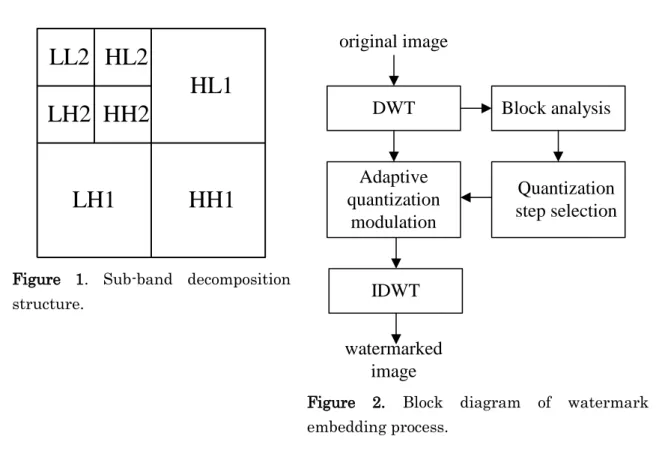
(2) watermarks are embedded into the image of wavelet coefficients from the second or the third levels. Especially, the quantization steps depend on the property or function of watermarks, and they are adaptive to the image texture feature. This is the most important points in this paper. The utilization of characteristics of human vision leads to control watermark strength adaptively according to the picture contents. The painting arts have many different properties [6] from the natural still images from the viewpoints of HVS and these characteristics clarified by using the wavelet transform watermark schemes are described in the following. Simulation results demonstrate the effectiveness of the watermarking method for the painting arts in terms of quality of the embedded image.. 2. The watermark scheme 2.1 The watermark in wavelet domain The DWT of digital image data has been focused because it was adopted on the image compression technique, JPEG2000 and MPEG4. Since the watermarking is designed for invisible watermarks, invisibility of the watermark in a watermarked image should be take special consideration. HVS theory tells that human eyes are sensitive to the changes in low frequency part of image. Therefore, it is desirable to select the low-high(LH), high-low(HL), high-high(HH) wavelet coefficients for embedding sub-band for the HVS. However, the robustness is decreasing in high frequency components because the high frequency components can be removed thorough the typical image processing such as JPEG compression and noise reduction etc. Figure 1 shows the sub-band structure using two decomposition level.. 2.2 The embedding and detection process The main steps performed in the present watermarking system are summarized in figure 2. Compute the wavelet transform of the host signal (original image data) to get the sub-band coefficients. The original image is decomposed into 7 sub-bands by taking two-level DWT. The quantization step is selected by taking the small range block analysis of the original image data. Those are just classified into two type block; flat/non-flat in the view from HVS. This classification is calculated from the standard deviation for each range block. The small range block size of original image is 4x4 pixels. The robustness depends on the magnitude of quantization step. The quantization step depends on the complexity of the small range block evaluated by the standard deviation. The quantization step for the flat block and non flat block is set to. M1 and M2, (M1 < M2) respectively. The robustness suppressed by the reduced embedding strength M1 is compensated by using the error correct method as a majority-logic. The watermark signal is embedded cyclic every 8x8 block in low-low 2-level (LL2) component of decomposed image. This justly leads to decreasing the amount of embedding bits. The results of decision which block is flat or non-flat are.
(3) recorded for the detection process. The detecting process also starts from the DWT decomposition and the quantization step used for the embedding process is detected by the block analysis of the watermarked image as same as embedding process.. original image. LL2 HL2 HL1 LH2 HH2. DWT. LH1. Adaptive quantization modulation. HH1. Figure 1. Sub-band decomposition. Block analysis. Quantization step selection. IDWT. structure.. watermarked image Figure. 2.. Block. diagram. of. watermark. embedding process.. 3. The performance analysis To evaluate the performance, the three kinds of still image are used for the simulation. One is the “Lenna” which is shows in figure 3(a) as known SIDBA standard still image. The other two are the artificial oil painting images of famous self-portraits (figure 3 (b) and (c) are by Picasso and Matisse, respectively. Those painting images have three steps processing for this experiment: resizing for reasonable size following the copyright low in 2009 [7], cropping into same size of Lenna (256x256) and the color changing from full-color to 8bit gray scale. The Lenna includes both the textured area with high frequency components and the large homogeneous areas. On the other hand, the painting images have opposite properties. In the watermark extraction, the objective measurement, peak signal-to-noise (PSNR) is employed. The results of PSNR between the original image and the watermarked image are shown in figure 4. The parameters are set as same as reference[8]; threshold T=7, M2=7, M1=2~7, Level=2( figure 4(a)), Level=3(figure 4(b)). For all sample images, the same tendency to M1 which is mentioned in the previous work [5] can be reconfirmed in this result..
(4) The robustness for dewatermark especially for JPEG compression have good property in the previous evaluation[5]; more than 80% detection rate for M1 =4~7 in the condition of the JPEG quality factor more than 30% . Hereafter, the picture quality had been evaluated in the condition of M1=4 and 7 for level2 and M1=4 for level3. The evaluation method used in this experiment was the standard subjective method described in Recommendation ITU-R BT.500-7 [8] and also described in the guideline published by Institution of Television Engineers of Japan [9]. Each watermarked picture was shown, after the original picture, to eleven evaluators who rated the quality of the watermarked pictures according to the following scoring rules: score 5 when the watermarks are “imperceptible”, 4 when they are “perceptible but not annoying”, 3 when they are “slightly annoying”, 2 when they are “annoying”. The average of the eleven scores was used as the quality level. Table 1 compares the evaluation results for three sample pictures. From figure 4 and table 1, the following results can be seen: . The PSNR of Lenna was almost the same as the other two samples when the watermark strength M1 was 7, but the quality of Lenna was degraded. When the watermark strength M1 was 4, the good quality of Lenna was obtained with the PSNR compared with the Matisse. On the other hand, the quality score of Lenna was degraded compared with other two painting samples. The reason seems to be that watermarks are more perceptible in pictures having smooth areas like Lenna than in those having messy areas like the other painting pictures.. . The good quality score were obtained for all pictures when the level was set at 3 but the PSNR was reduced for all ranges of the strength M1 compared with the case of level 2. For example, when the watermark strength M1 was 4, the quality score of Picasso with watermarked with level 3 was 0.09 point higher than that of Picasso watermarked with level 2. This property also can be seen in Lenna but not so slightly, because the messiness increased when the block size was increased. This is due to the results of entropy analysis of the painting art [6].. 4. Conclusions The watermarking schemes depend on the characteristics of the picture contents were studied and especially for the oil painting pictures were treated in the present work. The watermarks are more perceptible in pictures having smooth planes like Lenna than in those having messy planes like the painting pictures. Especially for oil painting, a lot of the messy plane due to the painting touch and the color variation can be created in the whole of picture. From these reasons, the wavelet transform based watermark was adopted because it can deal with the components of the frequencies and the multi-resolution representation (the registrations of the arts contents need.
(5) high resolution representation). The performances were analyzed with the PSNR and the quality evaluation. In this scheme, the quantization step for the wavelet coefficients means the strength of the watermark. These watermarks are adaptively embedded into different strength depending on the messiness evaluated by the standard deviation of the treated part of the image. This leads to the higher quality of the painting picture rather than the natural still picture. Future work will therefore focus on the analysis from the viewpoints of the correlations between the number of blocks per one flame of painting picture and the entropy of the pixel variations per one flame. REFERENCES [1] I. J. Cox and M. L. Miller, “Electronic watermarking: the first 50 years”, Journal of Applied Signal Processing, Vol.126, March 2002, pp.126-132. [2] A. Nikoladis and I. Pitas, “Region-based image watermarking, ” IEEE Transactions on Image Processing, Vol10, No.11, pp.1726-1740, November 2001. [3] M. A. Suhai, M. S. Obaidat, S. S. Ipson and B. Sadoun, “A comparative study of digital watermarking in JPEG and JPEG2000 environments, ” Information Sciences, Vol151, pp93-105,2003. [4] M. Iwata and A. Shjozaki, “Watermarking method for embedding index data into images utilizing features of wavelet transforms,” IEICE Transactions on fundamentals, Vol. E84-A, Jul.2001, pp.1772-1779. [5] H. Kuroda, Y. Ueno, M. Fujimura and Y. Maemura, “A watermarking scheme based on wavelet transform using adaptive quantization,” Annual reports of faculty of engineering Nagasaki Univ., Vol.33, No.60, pp.71-76, January 2003. [6] T. Muroya and M. Kobayashi, “An Analysis of “Value Variation” and “Color variation” in Images of Painting Art by means of Information Entropy”, Journal of the color association of Japan, Vol.33 supplement 2009, pp.42-43. [7] “Amendment to the Copyright Law in 2009 ” by Copyright Division, Agency for Cultural Affairs, Tokyo. [8] Rec. ITU-R,BT.500-7,”Methodology for subjective assessment of quality of television pictures”, 1995 [9] Institute of Television Engineers of Japan, ed., Evaluation Technologies for Television Pictures, Corona Publishing, 1986..
(6) (a)Lenna. (b)Picasso. (c)Matisse. Figure 3 sample pictures. (a) Level=2. (b) Level=3. Figure 4 PSNR of sample pictures. Table 1 Quality scores Level=2. Level=3. Image. M1=7. M1=4. M1=4. Lenna. 3.00. 3.45. 3.55. Picasso. 3.55. 4.45. 4.64. Matisse. 3.97. 4.36. 4.45.
(7)
図

関連したドキュメント
発電量調整受電計画差対応補給電力量は,30(電力および電力量の算
(2020年度) 2021年度 2022年度 2023年度 河川の豪雨対策(本編P.9).. 河川整備(護岸
(2020年度) 2021年度 2022年度 2023年度 河川の豪雨対策(本編P.9).. 河川整備(護岸
気候変動適応法第 13条に基 づく地域 気候変動適応セン
適応指導教室を併設し、様々な要因で学校に登校でき
「北区基本計画
接続対象計画差対応補給電力量は,30分ごとの接続対象電力量がその 30分における接続対象計画電力量を上回る場合に,30分ごとに,次の式
接続対象計画差対応補給電力量は,30分ごとの接続対象電力量がその 30分における接続対象計画電力量を上回る場合に,30分ごとに,次の式
