Architectural Institute of Japan
NII-Electronic Library Service Arohiteotural エnstitute of Japan
論
【
文1
’
●
’
日本建築 学 会 構 造 系 論 文 報 告 集
rg
q49号・
1993年 7 月Journa且of
S1
【
uct.
Consti,
Engng,
Alj、
NQ.
449,
July
,
1993POTENTIAL
EFFECTS
OF
LONG
PERIOD
COMPONENTS
IN
INCIDENT
MOTION
ON
THE
NONLINEAR
GROUND
RESPONSE
入
力波
の長 周
期
成分
が非線
形 地盤
応答
に与
え
る影響
Madan
・
B
.
KARKEE
* ,Yoshihiro
8
σGIM
ひR
月 * * ,Jun
TOBITA
* ** andKOf
.
SA
TO
* * **カル
キ.
.
一 ・
マダ
ンB
,杉
村
義
広
,飛
田
潤
,佐
藤
耕 司
The
proportion
ofthe
seismic energyin
thelong
period
rangeis
believed
to
increase
with thesize
of
the
earthquake
・
Considering
that soft sites
undergo
large
号
longation
in.
ground
period
at
higher
level
.
of shaking,
the
presence
ofl
』
argelong
period
cQmponents canbe
adestructive
conse.
quence
.
Po
仁elltial effects of successivelyincreasing
]evels oflong
Period
components areinvesti
・
gated
.
Response
of soft sitesis
seento
be
subs ピantiallyinfluenced
by
long
period
components.
The
cpnsequences ofdeficiencies
in
short andiong
period
componentsis
.
alsodiscussed
.
Various
nonlinear
.
ground
response characteristics arediscussed
in
these contexts.
KegwordS
:long
Period
comPonents,
reSl)onse sPectra comPatibleincident
motion,
nonlinear9
アound re−
S)on5e,
te
ηel of exCi’
tation,
Precl
ρminantPeriod
長
周期成
分,
応答
スペ ク トル に適 合 する地 震 動,
非 線 形 地 盤 応 答,
入力レベ ル,
卓
越周 期
1
.
lntroduction
The
ground
responseto
seismic excitationdepends
onthe
level
6f
excitation
owingto
the
nonlinearity of soft soil
layers
,
Two
lines
of research are seento
.
be
pursued
・
in
understandingthe
nonlinearity
in
ground
response.
First
,
and oftenfollowed
,
cσns三sts ofthe
evaluation ofthe
soilresponse considering material nonlinearity so as
to
match.
the
observed earthquake record.
This
line
ofresearch
has
Iesulted
in
the
development
of several methQds of nonlinear response analysis(
e.
g
.
Ohsaki
]),
Prevostz
},
Rocha
andSesmai
〕,
etc.
.
)
,
a comprehensivetreatment
of whichis
gi
マen
by
Finn4
].
Secondly ,
there
have
been
several successful attemptsin
recentyears
at thedirect
detection
of soilnonlinearity
during
stronggrollnd
shaking(
e.
g.
Chang
et al,
s},
Figueras
et a1.
E }
,
Tokimatsu
et al.
7)etc
.).
Such
studieshave
establisheClbeyond
doubt
the significance of soil nonlinearityduring
strongground
shaking.
Next
,
the
nature andthe
extent ofground
nonlinearity canbe
significantlyinfluenced
by
the
freqllency
andphase
contents ofthe
incQming
excitation.
This
aspect ofthe
nonlinearground
response
is
not cl ¢ arly understood.
To
evaluatethe
worstpossible
combined effect,
it
wouldbe
necessary
to
investigate
how
the
various site conditions respondto
variationsinthe
frequency
andphase
contents of
the
incident
motion.
.
In
the
previous
studys 〕onnonlinear response ana 】
ysisof
extensive site conditions,
itwas
seenthat
the
soft sites undergo
large
elongation ofground
periQd,
withthe
increase
in
the
level
ofincident
excitation*
Geotop
Corporation
,
Dr
.
Eng
,
艸
Prof
、
,
DepL
.
ofArchitecture
,
Faculty
ofEngineerillg
,
TQI
】oku
Univ
.
,
Dr,
Eng,
翠 零 零Research
Assoc
.
,
Dept
,
o {.
Arci
漁 ecしure,
Facuhy
o 「E
囗.
gineering
,
Tohoku
Univ
.
,
Dr
,
Eng
,
* 承 * *Graduate
Stude
皿t,
Dept
.
ofArchitect
.
ure,
Faculty
ofEn
・
gineering
,
Tohoku
Univ
.
(株 )ジ オ トップ
・
博士 (工学 ) 東 北 大 学工学 部 建築 学 科 教 授・
博 士 (工 学 ) 東 北 大学 工 学 部 建 築 学科 助手・
博士 〔工学 } 東 北 大学 工 学 部 建 築 学 科 大 学 院 生一
69
一
N工 工一
Eleotronio LibraryArchitectural Institute of Japan ArchitecturalInstitute of Japan
weighted
by
the
maximum acceleration.Consequently,
larger
amplification oflong
period
componentsat
higher
level
of shaking was observed,If
the
incident
motion already containslarge
long
period,
components,
progressively
dominant
effect on soil nonlinearity canbe
expected,In
this
connectionit
can
be
pointed
out thatthe
proportion
of energy, radiatedin
the
forrn
of seismic waves oflong
period,
increases
with size ofthe
earthquake9"'e),
owingto
greateT
relativeclisplacement
ofthe
two
sides ofthe
fault,
andto
greater
extent offaulting.
Recognition
and evaluatien ofthe
effect of suchincrease
in
long
period
components, onthe
nonlinearground
response,is
essentialfor
the
assessment ofhazards
andrisks related
to
seismic microzonation.In
this
paper,
the
nonlinear response ofdifferent
surficial site conditions, underthe
action ofincident
motions with successivelyincreasing
extent oflong
period
componenets,
is
investigated.
The
incident
motion characteristics are representedby
response spectra.The
shortperiod
ordinates, andhence
the
-maximum
acceleration representedby
shoTtperiod
asymptote, ofthe
response spectra arekept
the
same.This
way aclirect
comparative study ofthe
effectof
long
period
componentsis
rnadepossible.
Attempt
is
madeto
investigate
how
the maximum surfaceresponse acceleration at
different
site conditionsis
influenced
by
the
long
period
contentin
the
incident
motion, while the short
period
components arekept
the same.Other
aspects ofthe
effect oflong
period
components are
discussed
based
onthe
respense spectra characteristics.The
components ofthe
incident
rnotion,in
the
period
band
likely
to
have
signifiQantinfluence
on
the
nonlinear
ground
response, are ofinterest
in
this
investigation.
The
upperlimiti/in
suchband
depends
on
the
extent ofground
period
elongationduring
the
nonlinear excursionsin
response.Consequently,
the
term
long
period
is
usedin
a ratherlimited
sensein
this
research, comparedto
what mightbe
generally
understoodin
seismology.Previous
research8)indicates
that
the
predominant
period
of softsites can
be
aslong
as abouts
seconds underhigher
level
of shaking,Thus
the
period
band
extending upto
10
secondsin
the
longer
period
end was consideredto
be
sufficientfoF,
this
investigation,・
Specifically,
the
components ofthe
input
rnotienin
the
period
rangeO.
6-10.
0
seconds are assumedto
constitute
long
period
components.The
referenceto
ground
conditions,in
terms
of stiff, medium and soft,is
profusely
madein
the
discussions
that
follow.
These
terms
are ratherqualitative
andfuzzy
in
nature, and are not amenableto
easy
quantitative
determination.
Japanese
codefor
earthquake resistantdesign
ofbuildings
recom-mends aguideline
for
classification ef site conditions,based
onthe
fundamental
ground
period
T,.
In
line
withthe
Japanese
code,fundamental
ground
period
is
the
basic
guideline
here
as well.The
reference
to
stiff siteincludes
fundamental
ground
period
shorterthan
aboutO.
2
seconds.Similarly,
sites withfundamental
period
longer
than
aboutO.
6
seconds are referredto
as soft.Those
in
between
areconsidered to
be
mediurn.2.
Methodology
Generatien
ofResponse
SpectTa
Compatible
Motions
Artificial
earthquaketime
history
wasinitially
generated
to
match approxirnatelythe
response spectradenoted
astarget-1
in
Fig,
1,
considering randomphase
content uniformly varyingfrom
O
to
2
n.The
5
%
damping
response spectrumtarget-1
is
tentatively
suggestedii]to
be
applicablefor
base
layer
withshear waye velocity
400-sOO
mls(often
referredto
as engineeringbase
stratumin
Japan)
due
to
magnitude8
earthquake.The
matching ofthe
artificialtime
history
to
the
spectrurntarget-1
wasfurther
improved
by
time
domain
iterative
localized
perturbationsiZ'・i3'
in
the
accelerationtirne
history.
The
matching of
the
time
history
to
the
respective spectra, atthe
controlperiod
points,
was checked afterthe
end of each
iteration
cyclete
achieve suitablelevel
of compatibility,The
numbei of controlperiod
points
was selectedto
satisfythe
conditioni!),M,>
2ie-
in
(:ll}l-'-・・・・--・---'・・・-・・-・・'・'H"
・・---'・'H"'"-"
'
''''''''-''-'-'"'
'
''・'・・-・・-・
a
)
where,
M,
is
the
number of controlperiod
points,
.ft
ancl.fts
arethe
extremefrequencies
ofthe
response-70-Architectural Institute of Japan
NII-Electronic Library Service ArchrtecturalInstrtute ofJapan
1,2Asi"8or
O,8t8<,NE
o.4opfl
o.o
"""'----:target-3
・・"・"-"-
--・--
:target
-
2
---:target-1
:calculated /E-g.ewt2,ge.kti,#・f,tdt.-mmvwtor
¢tt'
tq
,;,l・il,lieelll/L・Ig.l
Spectrai
Damping
5%blkaniXi
nf'
,-ts',i-.l,:,"I
veitt
.i,g.2:
xs;";:e":t-,l.;i'・p.;.t,i
is'I'k
.i:.'
stll'
:i vava'xt.'
k・ls,g/L.\
',k
/
mell/si
i
Y/\
'l-iill
iil-.,f・ii,,
'
/klil/Lili
sli
'iit・i
i
7Ji,・,1tn,:.fl,L・11:,,IS}}・t".
fi/,,.ltk・ime,・itk・lme.ex1
l.pa,'.・l.L-mm'i/ltt/llli・gaj.ij,lmp
,/"::=.arm-,ot,"}m#ggk/",eE/s
ll,i・lg,,l-g,i"l'-,,i・llilii,l・ili・l'i,iige・l
ii.peiwwg,,s.,l・//.・li/tt・#igl,i・I-//1・
'
tttttmt-tttttttttwtttttt
,rtt・llt'.nt/,ts.Yt.ft+th'}#:trge' Isc,:mge.:1ff.:=:::Sme.l.:wa/mp".' /ret:!,mbt,ev:EEtt,bMYP.:l::.1!ill
:i
l//I,
,!lll'l{l,L.l'l
fi,illgei.li
l.l-ge・,ll・/f,li'/k.tw.gi;iik.l:Ii'
Il・
"gik,2・i,:,'.#'sig':t/.i・tt・.ew-#/l
lllii,l,rls-ligii,l\,il,t'il,S,ii51・i'i,i・
i//i・/;・/r//i/:,i/k'ii/I,fill・IIII/;・Il/
O.Ol
OA
1.o
10.0
Period
(Seconds)
Fig.
1
Matching
of incident mQtiens to target spectraby
time
domain
tteratiens.O,59.s"e
o.og8<-O.5
eg・.e-.E
Fig.2
Fig.3
O.53-:tg o.os<-O.5
aab8e=aE<
O,O 10,O 20,O 30.0 40,O 50.0 oo.O
Time(Soeonds) i
o
o.1 o.2 o.s 1,o 2.o s.o te.o
Period(Seconds)
(a)
ARTEQ 2compatible te spectrum target-2and{b)
Founer
spectrum.O,O
10.0
20,O
30.0
40,O
50,O
60.0
Xme(Seconds)
1
o
O,1
O.2
O.5
1.0
2.0
5.010.0
Period(Seconds)
(a)
ARTEQ
1
compatible tospectrum target-1 and(b)
Fourler
spectTum.'
O,5@g'g o.og<-O,5
egsks.E-cE< Fig.4Do lo,o x},e 3o,e 4o.o so,o 6o.o
Time<Seconds) "
o
O,1 O.2
O.5
1.0 2.0 5.0 10.0Pedod(SeooDds)
(a)
ARTEQ3 cernpatibre tospectrum target-3 and(b)
Fourier
spectrum.spectrum, and
e
is
the
spectraldamping.
The
input
motion obtainedby
matchingthe
response spectrumtarget-1
is
denoted
asARTEQ1.
Response
spectratarget-2
andtarget-3,
shownin
Fig.1,
wereobtained
by
tentatively
modifyingtarget-1
to
include
larger
spectral response atlonger
period
points.
The
input
motionARTE9
1
was nextfurther
modifiedby
the
time
domain
iteration
scheme, mentionedabove,
to
matchthe
spectratarget-2
andtarget-3
respectively.The
correspondinginput
motionsARTEQ
2
andARTEQ
3
have
successivelyhigher
long
period
components.The
level
of matchingto
the
correspondingtarget
spectrais
also shownin
Fig.
1.
The
incident
motionsARTE9
1,
ARTE9
2
and
ARTE93,
and theirFourier
spectra are shownin
Figs.2,
3,
and4
respectively,All
the
three
target
spectra correspondto
peak
ground
acceleration of400
Gals
based
onthe
shortperiod
asymptote ofthe
response spectra, andthey
have
the
same shortpenod
content(up
te
O,6
seconds).Minor
departures
in
the
peak
acceleration were adjustedfor
by
accelerationpulse
scaling method suggestedby
PreumonttZ).
This
way,the
matching ofthe
time
history,
to
the
shortperiod
asymptotein
the
target
spectra, was achieved with minimum overall change
in
the
spectral contents.The
necessary adjustmentin
the
maximum acceleration was,however,
only ofthe
order ofless
than
abouttwo
percent,
Additionally,
two
earthquake motions were censtructedto
have
unusually small short andlong
period
components,
This
wasdone
by
defining
two
additional response spectra shownin
Figs.
5(a)
and6(a).
The
response spectrumtarget-4
in
Fig.5
(a)
was obtainedfrom
target-3
by
reducingthe
period
components shorterthan
O.
2
secondsto
a minimurn.Similarly,
target-5
in
Fig.
6(a)
was obtainedfrom
target-1
by
drastically
reducingthe
components withperiod
longer
than
1,O
seconds.LONEQ3
andSORE9
1
were obtainedby
matchingARTE9
3
andARTEQ
1
to
target-4
and target-s respectively.
Architectural Institute of Japan ArchitecturalInstitute of Japan
1,2@=・e-ge
O.858<Z O,4gm o.o--tt-ttt
--":target-4
SpoenrelD:mpingS% i'(a)1 :catculated'
t.t.t
'.1''/x''//-,k'1.-i
tttt.L・・il・i.'/.v..//.t.
I・Ii,il'll・・・・ttttt・・・/'tttt....t・p-Ili'laftttttt'
t.tt.'.t''''
O.Ol O.53.sN o.o"g<-O.5
Algsi8gE
O.11,O
Period(Seeonds) 10.0o,o10.0
LONEQ320.0
30.0
40.0 Time(SeoDnds)50.06e.o'i c,IO,1 02
O.5
1.0
2.0
5.010,O
Period(Seconds)
Fig.5
(a)
Response
spectrum target-4,(b)
Compatible
tion LONEQ3, and
(c)
Fourier spectrum.1.2gg・#Bosrwo8<E o.4
-gma
o.o
O.Ol
O.5As=・e-cr
o.o-ee8<-O.5
Fig.6
h8"s8e=aE<1 Speetra]DampingSes----・-・-:targnt-S:ca1outated"-.---..-:tt
'''
-t.tt/.tt/・///s//,il,il.i.t/.tt'i/''''/.tttttr
tt/
t/tl/lttttttttt/ttttt/-tttt
.nd..tt//.qt.,
,
.t
':・lgl・k.t,'s''/'...
-
'ttttttttt'tt'
tt
't.''t.-O.1
t.o Period(Seconds)10.0
1,tl・ttttt ,SOREQIMaxO.408gtt.t' ・・,l・,e,ttttttttt
,t.t'.tt..tt
e,o10.020.030,O40.0 Time(Seconds)50.060.0o
O,1 O,2
,
O.5p,ri,Sig...d2,.)Os,o
10,O(a)
Response
spectium target-5,(b)
Compatible
mo-tion SOREQ 1,and(c)
Fourier spectrurn.The
input
motions are shownin
Figs.
5(b)
and6(b),
anclthe
correspondingFourier
spectra are shownin
Figs.
5{c)
and6(c).
SORE9
1
andLONEQ
3
were utilizedto
comparethe
relativeinfluence
ofthe
short and
long
pe;iod
components.As
uncertainties existin
the
estimation ofthe
period
band
in
whichthe
seismic energy of adestructive
future
earthquake wouldbe
dominant,
it
wouldbe
usefulto
understandthe
relativeimportance
of short andlong
period
componentsin
nonlinearground
response.Such
information
canbe
vitalin
the
seismic microzonation consideringdifferent
levels
ofincident
excltatlon
Selection
ofSoil
Profiles
for
Investigation
The
ground
profiles
from
Sendai
andTokyo
were consideredfor
this
investigation.
The
soilprofiles
were selected
te
include
a range of sites,from
the
sections acrossfirm
ground
to
bay
areas, as shownin
Figs.8(a)
and9(a).
Altogether
58
soilprofiles,
20
from
sendai and38
from
Tokyo,
were considered.Fig.8(a)
shows17
ofthe
20
sitesfrom
Sendai.
Similarly,
Fig.9(a)
shows20
ofthe
38
sitesfrom
Tokyo.
The
numbersdirectly
abovethe
soilprofiles
in
Figs.8(a)
and9(a)
arethe
sequential sitenumbers
increasing
towards
the
bay
area.The
missing numbersindicate
profiles
not shown.The
shearwave velocity
for
different
soiltypes
was estimatedfrom
the
correlation ofinitial
shear modulusG,
with standardpenetration
test
N-vaiues,
G,=1
200
×N"'S(t/m2)").
The
Tokyo
sandygravel
layer
was used asthe
base
layer
for
soilprofiles
from
Tokyo.
Similarly,
the
soft rock underlyingthe
Sendai
area wasassumed
to
be
the
base
layer
for
soilprofiles
from
Sendai.
Nonlinear
Response
Analysis
The
stiffness of soillayers
during
the
inelastic
time
domain
response wasdetermined
by
the
hysteretic
model..
The
dependence
ofthe
shear modulus, andthe
equivalentdamping
factor,
wasba$ed
onthe
Masing's
type
modeldeveloped
by
Ohsaki
et al.i5),The
soiltypes
in
the
selected seilprofiles
werebroadly
divided
into
three
types:(a)
clayey soils,(b)
sandy soil$, and(c)
sandygravel.
The
hysteretic
moclelparameters
a,fi,
andG,IS.,
for
the
three
soiltypes,
are shownin
Table1,
The
corresponding shear stress-strain
hysteretic
plots
for
a simple sinosoidal strainhistory
withincreasing
magnitude are shownin
Fig.7
for
the
three
soiltypes.
-72-Architectural Institute of Japan
NII-Electronic Library Service ArchitecturalInstitute of Japan
Sites
were assumedto
be
horizon-tally
layered,
andthe
soilprofiles
were modeled as a series oflumped
masses connectedby
shear springsand
dashpots.
The
nonlineart'ime
domain
response analysis was carriedout
by
step-by-step numerical integra-tion usingthe
Wilson's
0-method
de-velopedby
Ohsakii',
The
time
stepfor
the
solution ofincremental
equa-tions
wasthe
smaller ofthe
sampliriginterval
ofO.02
secondsin
the
input
motion and
1120
ofthe
fundamental
ground
period
T,,
Lineai
interpola-tion
was usedin・case
subdiyisionof
the
samplinginterval
was necessary.Viscous
damping
of2
%
was assumedto
representdamping
in
soil
at
initial
conditions.The
input
motion.was
assumed
to
be
acti'ng at an exposed surface ofbase'layer
by.considering
atransmitting
boundary
representedby
a
fictitious
elashpot'
eRo・8eSas18Ets2ut StrainE(%)
?o
)geO8gMIO-2
g
2x・ga.
£ gOgee-'a
mENn-2
"NOE)gpogees]o o 2 4 Time(seconds)
soE coe. ,,Uoge-le8-co-30
6 O2-2
O2-2
O2STrainE(%) SpainE(%) Straine(%)
Fig,7 Hysteretic model characteTistics :
(a)
Shear
modulus
degradatien
anddamping
factors,
and{b)
Sinoseidal
strain
history
withincreasing
amplitude togethei'withthe correspend{ng
hysteretlc
plotsfor
(c)
Clay,
{d}
Sand,
and(e)
Gravel.
Tablel
Hysteretic
Model
Pararneters.
3.
Results
of
Analysis
Predom'inant
Period
ofSurface
Mo-tion
The
fundamental
ground
period
T,
was computedfrom
the
consistent mass matrix andthe
stiffnessmatrix
b'ased
onthe
initial
shear modulus.Thus
Tc
repre$entsthe
ground
period
at verylow
strainlevel.
The
predominant
period
T.
ofthe
surface response motion was evaluatedfrom
transfer
function
analysis.
For
this
the.Fourier
spectra of response・motions were computed, and smoothedby
Parzen's
lag
window.The
smoothingbandwidth
was variedfrom
O.
2
to
1.
0
Hz
depending
onTG,
with narrowerbandwidth
for
longer
Tc.
The
transfer,functions
were computed asthe
ratios of smoothedFourier
spectra
6etween
the
ground
surface andthe
top
ofthe
base
layer,
Tp
was arrived atftom
thefundamental
resonant
peak
in
the
plot
ofthe
transfer
function.
Figs.
8(b)
and9(b)
showthe
distribution
fo
T,
due
to
three
input
motionsARTEQ
1,
ARTEQ
2,
andARTEQ
3,
for
the
soilprofiles
from
Sendai
andTokyo
'respectively.
The
clotted
lines
show
the
distribution
ofTc,
For
stSff sites,T.
andT,,
arepractically
coincident.
For
softer sites,T,
is
larger
than
T,,
In
addition,Tp
is
seento
elongatefurther
withthe
increase
in
'long
period
content ofthe
incident
motion.The
elongationin
T,
ofindividual
sitesin
Figs.8(b)
and9(b),
withthe
increase
in
long
period
components
in
the
inciaent
motion, constitutes evidence ofthe
increased
level,
of nonlinear excitation.This
effect ofthe
increased
level
of excitation withthe
increase.in
long
period
contentis
seento
correlate appteciably・ with
longer
T,,
The
content oflong
period
componentsin
the
incident
motionis
thus
seento
contribute substantiallyto
the
extent of nonlinear excitation of softground
sites.Maximum
Surface
Response
Acceleration
Figs.
8(c)
and9(c)
show theinfluence
ofthe
increased
long
perlod
contentsip
incident
motion, onthe
maximum surface response acceleration,for
sitesfrom
Sendai
andTokyo
respectively.The
three
verticalbars
for
each site represent,from
left
to
right,the
maximum surface response accelerationsdue
-73-E-zil(i+ctlilP) 2P 1 Sol]Typesafia.st e=ShearStrain r=ShearStress a,=InitialModulus S.n=SheflrStrengLh E=DampingFaetorg'=soilcenstant
Sua,e#SeilConstentse=-i-i+a[8.[P
T)+fi C}ayeysoi]sSandysoils
Sandygravel
5・o10.011.0L41.61.76oo,o1100.01300.0
Architectural Institute of Japan ArchitecturalInstitute ofJapan
.:.
HIROSE Rv. o[-se(m) 5:"-.l 1.02,O "m) .e. ,//rl,.o
NOOI-NOop(3S-15,Scr)SENDN AHMV POST
11./. 12. 13 14 ls /・I. T6 IT :e
,-cLAyEy solLs
ma
SANDY SOILSpm
SANDY GRAVELIIIIII]
soff HocKi' ii/ji{llS,,ll'l NAGAHAMA 19 mo f'li'
11x
g,・1
s・1 ..h8eg2,O
o,o
O.6@8sts}
o,o
"
uesSEIHOxu TouHeKu eis
(a)
Ground
sectionfrom
Sendai
showing17
of the20
sites.EOISHIOGAMA(b)
Predominant
period1))
correspondingto
incident
motionsARILEQI,
(Dotted
lineshowsTb
distribution).ARTEQ2,
andAR7EQ3
MaximumSurfacenesponseAcceleration
tttttttttttt-t-ttttttttttttt/
ttttttt-ttttttttt/t"tt/ttt-/--tttV--/tt"ttt/tt-tt/"ttt--ttttt.ttttttttt/t-ttt/tt/tt"ttttt"//tt"tttt./t/tttttttt-tttt/tt-ttttttttt./-t-t/ttttttttttt/tttttt/tt-tttttt-t
(c)
Maximum
surface acceleration correspondingto
AR7IEel,
AR71EQ2,
andARTEQ3
(Dotted
line
shows the maximum accelerationincident
at the exposedbase).
Fig.8
Ground
pTofilefrom
Sendai
and variation of T,and maxLmum suiface acce]eration.o
-so(m)
o,oEIS
N04-N05(3504t,OO")
SHUBU
(a)
Greund
sectionfrom
Tbkyo
showing 20 ofthe
38
sites.sJ
5.0
o,o(b)
Predominant
period
Tl,
corresponding toincident
motionsARTEQI,
AR71EQg
and ARTEQ3(Detted
line
showsIlr
distribution).
Aspdv<:}
O.6
o,o(c)
Maximum
surface acceleration correspondingto
ARTEQI,
ARTEQ2,
andARTEQ.3
(Dotted
line
showsthe
maximurn accelerationincident
at the exposed base).
Fig.9
Ground
proMe
from
Tokyo
and variation ofT.
and maximum surface acceleration.-74-Architectural Institute of Japan
NII-Electronic Library Service ArchrtecturalInstrtute of Japan
to
incident
motionsARTEQ
1,
ARTEQ2,
andARTE93
respectively.The
horizontal
dottecl
lines
show
the
level
of400
Gals
maxirnum acceleration applied atthe
exposedbase
layer.
It
is
seenthat,
for
agiven
incident
motion,the
maximum surface accelerationtends
te
decrease
towards
the
bay
areas.This
effect
is
well recognizedin
the
previous
studies[8,
16]
to
be
causedby
the
mcreased nonlinearity at softer sites.In
addition,the
maxiinum accelerations, correspondingto
the
three
incident
motionsARTE9
1,
ARTEQ2
andARTEQ3,
varyto
different
degrees
withinindividual
sites.The
incident
motion
ARTEQ
3,
whichhas
the
highest
long
period
content,is
seento
resttltin
the
largest
maximumsurface acceleration
in
softer sites.On
the contrary, the maximum acceleration at stiffer sites remainpractically
unchanged.The
effect ofthe
mcreasedlong
period
components, on
the
maximum surface acceleration,is
moredirectly
comparedin
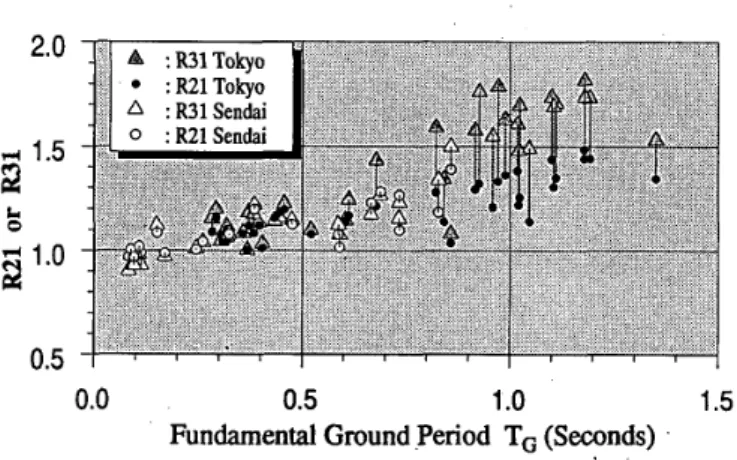
Fig.10.
For
this
purpose,
the
maximumacceleration ratios
R
21
andR
31
aredefinecl
asthe
maximum surface response accelerationdue
to
incident
motionsARTEQ2
andARTEQ3
respectively normalizedby
that
due
to
the
incident
metionARTEQ
1.
Varia-tions
ofR21
afldR31
withTc
are shownin
Fig.
10.
It
is
seenthat
the
maximumaccelera-tions
atsoft
sites arehighly
affecteclby
the
content- oflong
period
components.The
effectin
sites withT,
longeT
than
aboutO.7
:ri;k
ag
AA,/111la/#
'dada-''/
ss
'
$
,ec/
njiee
,,s
"g
,e
$,
e,k
fi"
,11i/k/ee
O.5
O.O
O.5
1.0
I,5
Fundafnental
Ground
Period
TG
(Soconds)
'
L
FIg.10 Increase in maximum surface acceleration with
long
period
components.to
O.
8
secondsis
seento
be
particularly
dominant.
The
effect of
leng
period
content onthe
maximum surface accelerationis
moderate at intermediate sites, and minimal atstiffsites.Thus,
it
is
seenthat
the
presence
oflarge
long
period
components, combined withlarge
soil nonlinearity,is
likely
te
causeincrease
in
the
maximum surface acceleration at soft sites.This
effect canbe
regarded asin
contrastto
the
general
expectation ofdecreased
maximum accelerationwith
the
increase
in
the
level
of excitation.Response
SpectTa
ofSurface
Response
'
Response
spectra
ofsurface
response motidn, at allthe
selected sites,due
to
the
three
input
motionsARTEQ
1,
ARTEQ
2,
andARTEQ
3,
were computedfor
relative comparison of response chara ¢teris-tics.
It
was seenthat
increase
in
the
long
penod
content affectsthe
spectral characteristics of surface motipndepending
onthe
local
site conditions,The
primary
and simple effect ofthe
presence
of correspondinglylarger
spectral ordinatesin
long
period
rangeis
observedin
allthe
sites.The
secondary andimportant
effectis
characterizedby
larger
spectral ordinates at short(shorter
than aboutO.
1
seconcls) andlong
(longer
than
O.
6
seconds)period
ranges.The
larger
spectral ordinates at short andlong
period
rangesis
in
contrastto
the
relatively smaller ordinatesin
the
intermediate
period
range ofO.
1
to
O.
6
seconds.As
expected,the
secondary effect was not observedin
stiff site conclitions.Figure
11
showsthe
suTface motion response spectrafor
three
sitesfrom
Sendai.
The
sites areselected
to
representtypical
variations with respectto
long
period
contentsin
the
incident motion.Fig.
11(a)
showsthe
response spectrafer
a stiffsite(
TG=O.
09
seconds), whichis
numbered6
in
Fig.
s
(a),
and consists of a singleIayer
of sandygravel
overthe
soft rockbase
layer.
It
canbe
seenthat
the
respective response spectra of
the
incident
motionsin
Fig.
1
areleast
modified.This
maybe
expectedbecause
the stiff sitestend
to
respondin
tune
withthe
incident motion atthe
exposedbase.
Fig,
n(b)
shows
the
response spectrafor
site numbered11
(
T,=O.
38
seconds)in
Fig.
8(a),
whichis
athick
sandygravel
layer
overlainby
athm
clayeylayer.
The
input
spectral characteristicsin
the
period
rangeshorter
than
aboute.
6
seconds are substantially altered comparedto
Fig.
11(a)
clue
to
the
presence
of soft claylayer,
However,
the
increase
in
the
long
period
componentsis
seento
exert only minor-75-Architectural Institute of Japan ArchrtecturalInstrtute of Japan 2.0=.9 1,5-e・g1,osg
o,sma
o.o
2.0g=・2-1.sgas81.0<E'8"
O.5ea,,
o.o
1,59g'gge1.0gxe
o,sgen
oo
Fig.11(a)
Site6fremSendai(TG=O,09
seconds).(b)
Site11ftemSendai
(Tc=O,38
seconds}.ODI
O,1
1,O
10.0
Period
(Seconds)
(c)
Site
19from
Sendai
(TG=O,86
seconds)Response
spectra of suTface motionfor
thethreesitesfrom
Sendai
2,Ogn.81.5!.g
1,o<Z
O.5gca
o.o
2.0g:-8
1.sg-8
1,O<
g
,.,ca,,
o,o
1,5
.sg
1.ogS
O.5gcA,,
o.o
Fig.12
(a)
Site
9from
Tokyo(TG=O.28
seconds),(b)
Site
22fiom
Tokyo
(TG=O.68
seconds)O,Ol
O.1
1,O
10,O
Period
(Secends)
(c)
Site
36from
Tokyo(Ta=1.02
seconds).Respense
spectTa of surface rnotion terthe thTeesitesfrorn
Tokyo.infiuence.
Fig.
11{c)
showsthe
response spectrafor
site number19
(
Tc=O.
86
seconds)from
Senclai.
The
site consists of softdeposits
in
the
bay
area, and consequently,distinct
secondary effects canbe
noted.
It
is
seenthat
the
presence
oflarger
long
period
components resultin
larger
spectral responsein
the
long
as well asin
the
shortperiod
ranges, with relatively small effectin
the
intermediate
range.Figure
12
showsthe
responsespectra
of
sites numbered9,
22
and36
in
the
ground
sectionfrom
Tokyo
in
Fig.9(a).
All
the
sitesfrom
Tokyo
consist ofdifferent
combinations of clayey and sandylayers
overlying
the
Tokyo
sandygravel
layer.
As
a result,the
long
period
componentstend
to
play
dominant
rolein
the
nonlinear response.Fig.12(a)
showsthe
response spectrafor
the
site withthe
shortestT,
(O.
28
seconds) ofthe
38
sitesfrom
Tokyo.
The
secondary effect ofincreased
long
period
componentsis
notedto
be
rather small.Similar
to
the
characteristics observedin
Fig.
11(c),
Figs.
12(b)
and12(c)
show consecutivelyincreased
secondary effects.Respectiye
preclominant
periods
ILp
are also shownin
Figs.
11
and12,
as aguideto
the
increase
in
the
level
of excitation, owingto
the
pTesence
ofincreased
long
period
componentsin
the
mcident motion.From
the
abovediscussion
it
maybe
notedthat
the
increase
in
long
period
components resultin
higher
level
of nonlinear shaking of soft sites, with consequent amplification oflonger
period
components.The
larger
spectral ordinates atshortperiod
range correspondto
the
higher
maximurn surface responseacceleration noted above.
Maximum
Acceleration
atDifferent
Layers
overDepth
In
Figs.8(c),
9(c)
and10,
the
rnaximum surface response acceleration of soft sites was seento
increase
withlong
period
contentsin
the
incident
rnotion.Fig.
13
showsthe
variation ofthe
maximumacceleration at
different
layers
overclepth,
for
the
two
sitesfrom
Sendai,
nurnbered6
and19
in
Fig.
8
-76-Architectural Institute of Japan
NII-Electronic Library Service ArchitecturalInstitute of Japan
<a).
The
two
sites are notedto
be
respectivelystiff ancl soft.
As
the
inctease
in
long
period
componentsin
the
incident
motionis
seente
resultin
the
increased
nonlinear response of softsites, an attempt was made
to
inclicate
the
extentnonlinearity
in
different
soil
layers.
For
this
purpose,
the
term
moclultis reduction ratio[16],
clefined
as:'
(Go"Gm)
A=
'
G,
'"'""HHMH'HH''H'H'H(2)where
G.
is
the
minimum shear modulusduring
response
history,
was utilized,Increase
in
the
yalue of
A
indicates
the
increase
in
the
extent ofnonlingarity, and
hence
ofthe
level
of excitation.In
additionthe
term
maximum acceleration ratiowas
defined
asthe
maXimum acceleration at anylayer
normalizedby
that
atthe
basg
layer.
Fig,13
shows variation overdepth
ofA,
the
maximum acceleration, and
the
maximumaccel-eration ratio
for
the
three
incident
motionsARTEQ1,
ARTEQ2,
andARTEQ3.
In
three
incident
motionsIn
contrast
-
.T
contents,
in
case of soft sitein
Fig.
13(b),
in
seen
that
ARTE93
causesthe
largest
values
The
increase
in
content,
is
seento
occurin
two
phases
in
Fig.
13,
increases
withthe
long
explained
in
be
thought
of asthe
product
ofthe
incident
internal
base
layer.
As
a consequence,larger
regarded asdirectly
refleciedin
the
higher
'
variation of the maximum acceleratien
from
base
sltes.
.
The
differences
atthe
base
layer
of stiffsite,three
mptionsincident
atthe
exposedbase,
In
contrast,
can
be
notedin
Fig.13(b),
This
behavior
canmaximum acceleration ratio.
In
case of stiffsite'
that
correspondingto
ARTEQ
1
is
largest,
suchthree
incident
motions approach similar values.Fig.13(b).
T.hat
is,
the
higher
maximum sites, constituting atwo-level
effect onthe
Figure
14(a)
Fig.
13(b)
clue
to
the
incident
motionARTEQ
1.
ARTE93,
Distinct
reductionin
shortperiod
comparison
to
that
atC
canbe
recognizedin
fairly
thick
soft claylayer
between
points
B
andSS:Sgnd;CC:Clar; SG
±
Sandrernvel btittaiShenr ModulllsG} ga.mmEg se-T,!4m3Tts2:th/LVb
LAEyASERE InitinlShenr MedtrlusGeModutus MaxiMUM Mmxllnum Reduetion RstiDa) Acctlerst+ofiie) AceelerattonRnt:o
O,O 1:O O:.1 OS O" OA LO LG
・',.
'//
/mum/
./
1,.
・・1''1.・/l
li'iuanyE,i
・.j・
(n)VariAtionor1.mniimumEcceterstion,nnd'msxEmum
nc:elcrEtiDnrstlo forsite No.6trom Sendai
Modulus Maxlmdm Mnxsmtm
'
Reduct[on Ratitia) Aeceleretionie) AcctltcationRntio
o,o l.e o;1o"
'/ttts'''
'/rmd
/thrmt,
/mom
'
'
'
t
/tt..
ttt/t
'
・1,''
.t
'i')・?,
,
O,S O.4 lt/ / //1
l-'f'i':'
''
'/i;-・i
1,O1,6 J.i'LO)VsriAtio]or1,maximum acoeteration, mnd maximum acctLemtion rEtio torslteNo.19ttomSertda[
t
t
'
Fig.13
Soil
pr6Me, Modulus reduction raLioA,
maxlmumacceleration, and maximum acceteratlon ratio at
different
laye[s
for
stiff and soft sites(numbered
6
and 19 respectively) from
Sendai.
case of stiffsite
in
Fig.
13(a),
A
is
seento
be
the
samefor
the
there
is
considerableincrease
in
A,
withthe
increase
in
long
period
di
¢atingthe
increase
in
the
extent of nonlinearity.It
is
of
A
in・all
the
・lay6rs
acressthe
prefile.
',
the
maximum surface acceleratien at soft sites, withthe
increase
in
the
long
period
Initially,
the
maximum acceleration atthe
base
Iayer
period
content ofthe
motionincident
atthe
exposedbase.
This
effect canbe
terms
ofthe
transfer
function
from
expgsedbase
to
base
layer.
The
base
layer
motion canmotion and
the
transfer
function
from
exposedbase
to
long
period
contentsin
theincident
motion cartbe
maximum acceleration at
the
base
layer.
Secondly,
the
to
the
surfaceis
distinctly
different
for
stiff and softbetween
maximumqccelerations
correspondingto
the
decrea$e
andbecorne,
practically
nonexisting atthe
surface.the
differences
tend
to
widen,and
become
morepronounced
at upperlayets
of soft sites, asbe
more clearly understoodfrom
the
variation ofthe
rati6 correspondingto
ARTEQ
3
is
smallest, and
that
the
maximum surface accelerationdue
to
allthe
The
tenclencyis
reversedin
cqse ofthe
soft sitein
acceleration at
the
base
layer
arefurther
amplifiedby
softmaximum surface response acceleration.
shows
the
inotions
atthe
top ofthree
layers
denoted
asA,
B,
andC
in
the soilprofile
in
Fig.
14(b)
showsthe
corresponding・ rnotionsdue
te
content
in
response ac¢elerationtime
history
atB
ln
both
Figs.
14(a)
and14(b),
because
ofthe
presence
ofthe
C
in
Fig.
1'3(b).
The
presence
oflarger
long
period
componentsin
ARTEQ
3
is
seento
resultin
the
responsedominated
by
lofig
period
components atpoint
Architectural Institute of Japan ArchitecturalInstitute of Japan
O.5=.sve
o.o).se
-O,5
O.5=.sit
o.ots-Vue
-O.5
O.5=.8e
o.o-esa
-O.5
l'/pt'ii'・1isVRFACEtMal021eg
,/...,..s.if'stt'
,T
t"t;"t.tt'ttttt,Ili'l/1'lr:.,,'lleelfgells,.,t';t.
.t/-:t.tt1,{ii'IS'-,lilk・t//t
t
'i,E..ttttttt.'ttttt'
Tpt'VIS;'l'L,y'tt"ttttt.tttt'.ttttt
ttt
''iI,ti,gtv..t.'c・S.'t'
,'s,x,l"tw"Yif:.ttiO,5=.cvedi
o.oU-o8<
-O,5
e,s=..sts
o.obg<-O,5
O,5=.gx
o.obg2
-・O.5
SURFACE'MaxO,31Sg :t.,3',,,/・.fk・,l/,t.;t\tte:':Ikl・l.liilli#ISi
isIiikli
''-'I''.,'iliS#i・・' /1,・tttt/・ir'ge,,z;ecl3/X.lime'iipt"t-・t.t・"sl{i,.l-{mp'ie.tt' LAYER(E}'MaxO.31agre,
ttt
',.''te-/'t''i':./t-.'
.1
tt
//ts,.,a..,
i
1'et..ttt..''j"''tt.'
o,o
lo.o
2o.o
3o.o
4o.e so,o 6o.o11me
(Sec)
{a)
Response to incident motien ARTEQL'
Fig.14
Response
rnotions at threetayers
denoted
A,
B,
arrdC
in
andARTEQ3.
10
Midd!eof tayer@ betiddle of laycT@
i inpuLARreel io nput:AR7EQI s
i
i
o---
・----
O o---1...,.,la`:Y,,M,i
-s
'i.;l.6',6.thO.alM-1
I
-lo
,
-10
-.ol -.cos o zaas aol
-1
ns O o.s 1 4s o o.sO,O 10.0
20,O
30.0
40,O
50.0
60.0
fime
(Sec)
{b)
Response to incidentmotiollARIIEQ3.
Fig.13
(b)
due
toIncident
Motions
ARTEQ
1ggg
2g,e,
s
.1
10 5 o'f-le le 1.52to
e.s ,.LSi,O
O,5 O.O O,5 1.0 1.5 l"indamenulGroundPeriodTG{SeDopdis}-]e
A:TokyoSines o:sorulalsim Stax.AoelentionHatoHSI o6Aza"A e,oFig.16
-O,m
-o.OS
O orcoS O.an-1
.0j
O os 1-05
O O,5StrninEfperoent) StralnElpervenO StrnineiptrcenO
Fig.
15
Effect
of theincrease
inthelong
periodcomponentson the shea[ stre$s-strain
hysteretic
behavier
atlayeTs
A,
B
andC
ofFig.
13,B
in
Fig.
14(b>.
The
increased
extent ofthe
nonlinear excitation ofthe
soillayers,
withthe
increase
in
the
long
period
contents, can
be
transparently
understoodfrom
the
comparison of shear stress-strainhysteretic
behavior
of
the
layers
A,
B,
andC
in
Fig.
13,
correspondingto
the
incident
motionsARTEQ
1
andARTEQ
3
asshown
in
Fig,
15.
It
is
clearthat
the
presence
oflong
period
components resultin
substantialincrease
in
the
level
of strain.Effect
ofDeficient
Short
andLong
Period
Components
O.5 1.0 1.5
IinndhmmuGrvundPdiodTb(Seoonds)
Effect
ofdeficient
cornponents in(a)
shert period, and(b)
long
period, on themaximurn accelera-tion.
The
input
motiQnsLONEQ
3
andSOREQ
1,
shownin
Figs.
5
and6
respectively, were utilizedto
further
investigate
the
cornparative roles ofthe
short andlong
period
cornponentsin
the
incident
excitation, on
the
nonlinearground
response.Fig.
16(a)
showsthe
effect ofincident
motion,deficient
in
shortperiod
components, onthe
maximum-78-Architectural Institute of Japan
NII-Electronic Library Service ArchitecturalInstitute of Japan
surface response acceleration.',The effect
is
:epresentedby
defining
the
ratioRL3
asthe
maximum surface acceleration correspondingto
LONEQ3
norrnalizedby
that
cerrespondingto
ARTE9
3.
It
is
seen
in
Fig.16(a)
that
RL3
remains nearly equalto
unityfor
practically
the whole range of sitesconsidered
in
this
investigation,
indicating
that
the
maximum acceleration amplification'is affectedlittle
by
components withperiod
shorterthan
o.
2
Seconds.
Similarly,
RS
1
is
the
ratio'ofthe
maximum surface accelerationdue
to
incident
motionSOREQ1
to
thatdue
to
incident
motionARTE9
1.
Variation
ofRS
1
in
Fig.
16(b)
showsdistinct
tendency
ofdecrease
in
the
maximum accelerationamplification at soft sites when
the
long
period
components(longer
than
1.
0
seconds) are reduced,it
remainingpractically
unchanged at stiff sites,The
response sp6ctra of surface motiondue
to
・incident
motionsLONEQ
3
andSORE9
1
are also shownin
Figs.
11
and12.
The
incident
motionsLONEQ3
and'ARTEQ3
have
similarlong
period
components,
andthe
corresponding response spectra canbe
comparedto
identify
effect ofthe
deficient
shortperiod
components.From
the
comparison ofthe
response spectra ofthree
sitesfrorn
Sendai
in
Fig.
11,
it
is
seenthat
the
deficiency
in
shortperiod
(shorter
than
O.
2
seconds)is
apparentin
case ofthe
stiffsite
in
(a),
as
indicated
by
correspondinglyIower
spectral amplitudein
the
rangeless
than
O,2
seconds.
However,
as the nonlinearitybecomes
dominant
in
the
response of softer sitesin
11(b)
and'
(c),
,the
effect ofthe
deficiency
in
shortperiod
ceasesto
be'of
significance.Similar
behaviot
canbe
'
noted
in
case ofthe
three
sitesfrom
Tokyo
in
Fig.
12.
The
effect ofthe
reduced shortperiod
Co'Inponents
is
seento
perSist
onlyin
Fig.12(a),
being
practically
absentin
(b)
and,(c).
Overall,
there
is
asystematic
tendency
towards
dorninance
ofthe
long
period
componentsin
the
spectral characteristics,ofthe
response spectra of soft sites,indicated
by
practically
idehtical
response spectrafor
incident
motions
ARTEQ
3,
andLONEQ3.
Contrary
to
the
insignificahce
ofthe
shortperiod
componentsin
the
nonlinear response of soft sites,
there
is
a clear andpersistent
effect ofthe
deficiency
in
the
long
peri.od
components
in
the
incident
motion,.The
seconda'ry effect notedin
the
foregoing
discussions
is
seento
be
of nopractical
consequence, evenin
case of very soft sitein
Fig.
12(c)
whenthe
incident
motion(SOREQ
1)
has
drastically
reducedlong
period
components.It
indicates
.that
the
incident
rnotiondominant
onlyin
shortperiod
componentswould
notbe
Iikely
to
cause severe excitation of soft sites,and shows
the
needto
give
adequate consideratibnto
long
period
components whiled6fining
the
incident
motion'for
seismic'mictozgnation.
.
'
'
'
4.
Conclusions
,
The
presence
oflarger
long
period
componentsin
the
inciclent
excitation caninfluence
the
nonlinearground
responsein
aifferent
ways andto
different
extent,depehding
onthe
local
site conditions,Based
on
this
investigation,
the
following
potential
consequences ofthe
long
period
content canbe
noted.1.
Soft
ground
sites undergoincreased
level
of nonlinea[ excitation, with consequent substantialelongation
in
ground
period,
asthe
long
period
componentsin
the
incident.motion
increases.
This
is
aclear evidence
that
the
presence
or absence ofthe
long
period
components canbe
detrimental
to
the
level
of shaking at soft・ sites.
Level
of excitation at stiffer siteis
affectedless
by
long
period
contents,2.
The
maximum surface re$pOnse・acceleration at softground
sitesincrease
withthe
increase
in
the
long
period
componentsin
the
incident
excitation, as a result ofthe
increased
nonlinear response andconsequent amplification of
long
period
compepents.In
centrast,the
maximum surface acceleration at stiff sites remainpractically
unaffectecl.3.
The
spectral characteristics ofthe
surface motion at stiffsites are affectedlittle
6y
the
long
period
cemponents, except