Microwear Polish (2)
著者
Akoshima Kaoru, Hong Hyewon
journal or
publication title
Bulletin of the Tohoku University Museum
volume
17
page range
115-138
year
2018-03
Standard use-wear chart of TUMRT (4): Microwear Polish (2)
Kaoru Akoshima, Hyewon Hong
Department of Archaeology, Graduate School of Arts and Letters, Tohoku University
INTRODUCTION
The present paper is the number 4 of the results of microwear analysis by Tohoku University Microwear Research Team (TUMRT). It constitutes the second part of explanation for standard identification criteria of microwear polish. The part 1, 2, and 3 of TUMRT standard were published in the Bulletin of the Tohoku University Museum, No. 13 (Akoshima and Hong 2014), No. 15 (Akoshima and Hong 2016), and also No.16 (Akoshima and Hong 2017). The present article is to be utilized with part 1 to 3, which will be available through the Tohoku University Library website (TOURS). Part 1 and 2 presented a wide range of macro-photograph database by TUMRT to explain the analytical framework of microflaking scar patterns and their variability, for the basis of statistical analysis as had been summary published in Japanese (Akoshima 1981) and English (Akoshima 1987).
The part 3 of our reports reviewed fundamental classification systems of microwear polish, named “Tohoku classification” and widely used by many Japanese analysts since 1981. The polish types were presented with typical micro-photographs and their range of appearances were shown with a number of sample micro images. In the previous volume, images of microwear polish produced with soft contact materials were included. Here in the present report, the polish images produced with various medium and hard worked materials are presented.
.
EXPERIMENTAL DATABASE
Here at No.4 report, we continue to introduce fundamental criteria of microwear interpretation accumulated by TUMRT since 1976. The team was initiated by the late Prof. Chosuke Serizawa of Tohoku University at the Faculty of Arts and Leters (now the Graduate School of Arts and Letters). For its initial history, please refer to Akoshima (2008) in English.
The database is from the first series of TUMRT project directed by Serizawa. Microwear polish data were analyzed by Kajiwara and Akoshima (Kajiwara and Akoshima 1981, Akoshima 1989). Micro-photographs were color printed
and served on file at the Department of Archaeology during 1980s. More recent results of experimental archaeology at Tohoku University will be introduced in our future reports.
The procedure and order of photographic data presentation here is basically the same as our previous reports (Akoshima and Hong 2014, 2016, 2017), so we would avoid redundancy. Representative images were chosen for presentation of “microwear polish types” for polish type A to type F2 in Akoshima and Hong (2017) in Figure 1 to 4. And the wider range of microwear polish patterns was shown for better recognition of overall wear varieties. By referring the typical polish type photos with image data from various worked materials (Figure 5 to Figure 12 for soft contact materials, that is, meat, rawhide, leather, and soft plant), the overall ranges of microwear polish patterns are recognized. The initial series of controlled experiments covered basic framework of use-wear interpretations (Kajiwara and Akoshima 1981, Akoshima 1989).
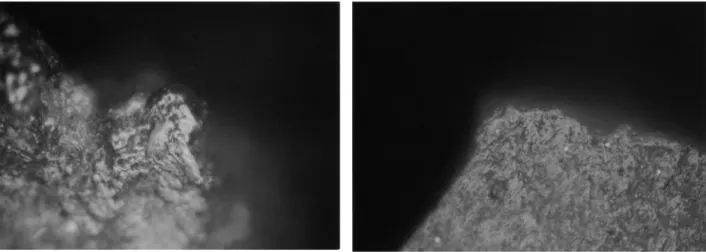
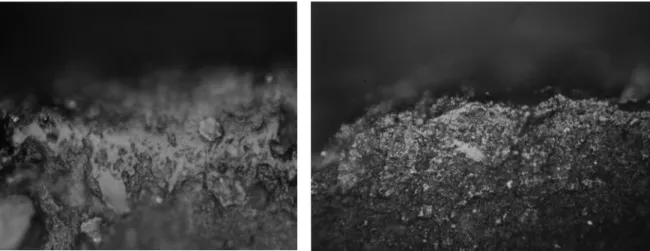
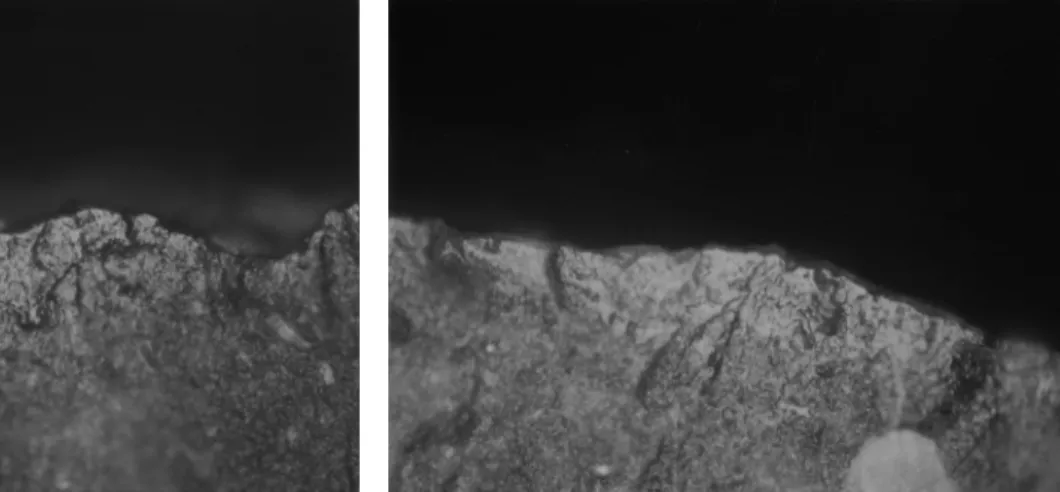
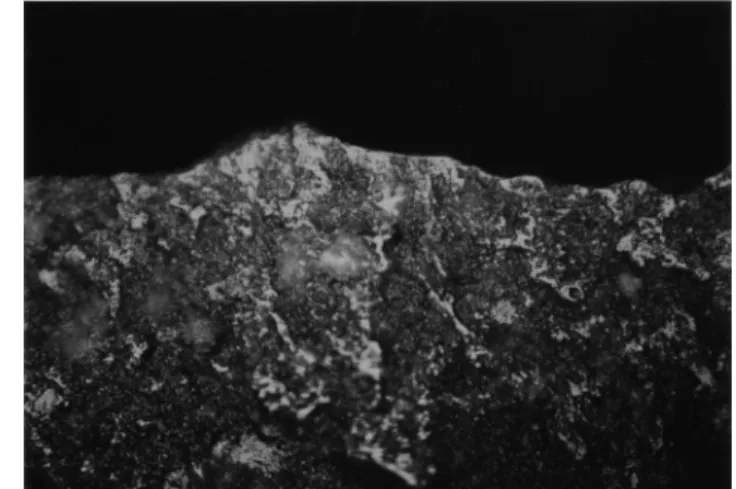
Here from Figure 13 on, experimental micro-photographs are arranged in the order from working medium (wood, bamboo), to hard materials (bone, antler). Within the category of similar hardness, they are sub-divided and arranged by the method of use, from parallel motions (cutting, sawing) to perpendicular motions (scraping, whittling). The main raw materials in our experimental project for polish analysis were the shale as in our previous report. The method of data presentation is the same as before, and we begin with the worked material category 4 (wood) to 9 (antler), from Figure 13, to Figure 30.
The Figures are captioned with the category of worked materials and working edge motions. At the end of the caption, identified polish type(s) and the experimental specimen number are shown. Microwear polish often appears as combination of multiple types (for example, D1 type surrounded by F1 type), and in such cases, type names are combined (D1F1, and so on). Micro-photographs are shown in the same order as in Akoshima and Hong (2014, 2016, 2017), with the same worked material and motion category number. For quick reference of the reader, the relevant experimental coding is reproduced here.
zelkova, 4.6 others 5. Bamboo
6. Gourd 7. Shell
8. Bone, 8.1 raw, fresh, 8.2 wet and boiled, 8.3 boiled 9. Antler, 9.1 soaked, 9.2 dry, 9.3 others
For the third digit of each photo caption number, the type of motion in use is indicated as follows.
Longitudinal, -1 cutting, -2 sawing Transversal, -3 whittling, -4 scraping Varied, -5 chopping, -6 butchering Incising, -7 graving
The sizes of micro-photographs are mostly kept constant, the same as our previous report (ca.700 microns from right to left of the photo in the case of 200 X). Photos with no magnification number were taken at 200 X when being observed. Photos with the number of “400 X” at the end of caption were taken at 400 X when being observed (the width of photo is thus ca.350 microns). These numerous photographs can be utilized as “standard polish chart” for lithic use-wear analysts. We believe it is meaningful to publicize the standard photos, with polish type classification for each image. A use-wear analyst of course needs to conduct controlled experiments for the purpose of reliable interpretation, but the type of database presented here will serve as broader reference materials.
POLISHES ON DIFFERENT CCS ROCK TYPES
We would like to discuss the relationship of micro-polish formation between the two major raw materials in northeast Japan and Europe, that is, between Shale and Flint. During decades of use-wear research, the problem of polish differences among different rock types has also been an important topic. Our team began experimental work with Shale artifacts because the raw material was in prevalent use throughout the Paleolithic and the Jomon period in northeastern Japan. As was mentioned in our previous report (2017, pp.70-71), first discovery of micro-polish formation on shale was in 1978 during the Early Paleolithic excavation at the Hoshino site (Akoshima 2008), and the polish was classified into Tohoku Univ. types by 1980 in Kajiwara and Akoshima (1981). Then similar polish was recognized on chert and other CCS (crypto-crystalline) rock types. The micro-polish types were almost identical in their appearance to those on flint rocks which had been already published a few years before by Keeley (1977). After Akoshima and Keeley met at SAA in 1981, Akoshima attempted to classify photo images of polish on flint (on publications) into the Tohoku Univ. types with a degree of success. It is our own re-classification according to the Tohoku system, independent of Keeley method of calling polishes with thename of the worked materials (wood polish, etc.).
In this early stage of polish identification, it was already well confirmed that the correlation between the polish appearances (or types) and the type of the worked materials was not exclusive. The relationship was rather probabilistic between the two. Most reports were written in the Japanese language at that time, so this fact was only recognized later in the global research community in indirect fashion, especially by the time of the “polish type controversy” in the late 1980s which was initiated by the London University group (Grace et al. 1985). The relationship was, however, very positive and the micro-polish classification was adopted as one of important criteria for identification of the worked material(s), at least in Japan.
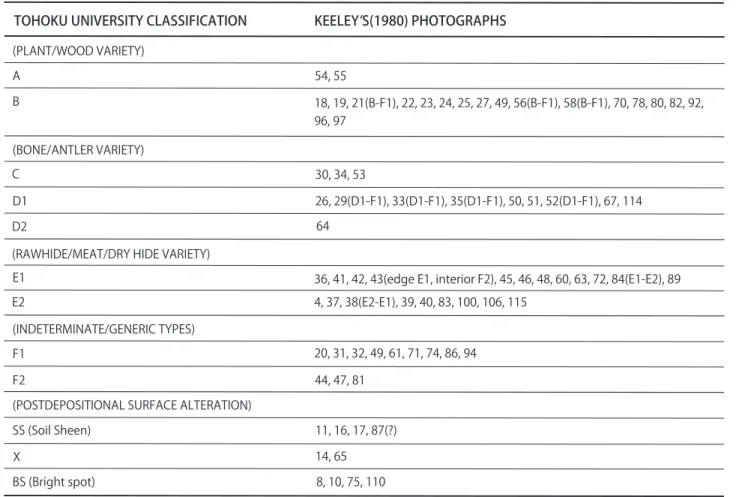
We take the position that micro-polishes should be described and classified first and then their relations to the worked materials should be investigated. In the global scene of micro-polish analysis, still the influence of the “Keeley method” has been very strong in many analysis reports, probably from the historical factors. We present the classification of micro-polishes in Keeley’s book and Vaughan’s book, according to the Tohoku criteria here. Keeley’s book (1980) has many microphotographs and they were recognized in a sense the global historical standard. Table 1 indicates our Tohoku classification types and particular micro-photographs in his volume, with their plate numbers. The reader might be familiar with the traditional polish nomenclature and aware of the existent variability, for example, the range of “antler polish”. The table is not, however, the result of consultation with Dr. Keeley, but the relationship is from the TUMRT view, the responsibility being ours.
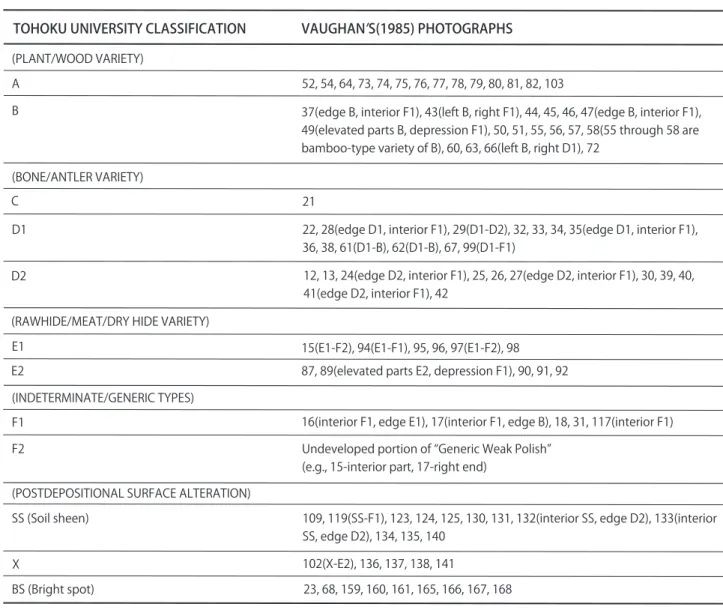
We would like to present Table 2, which is the relationship between the Tohoku classification and numerous micro-photographs in the book by Vaughan (1985). The volume entails a number of extremely clear and fine-grained micro-photographs of polishes, both experimental and archaeological, observed on the surface of European flint tools. Dr. Vaughan visited Japan in 1984 for the purpose of academic exchange with Tohoku University, Professors Serizawa and Suto who was conducting a shell midden excavation, and also made a short stay at Akoshima’s residence in Shiroishi. We had very intensive discussions about the directions of use-wear analysis. He observed TUMRT experimental specimens and we agreed that the standard metallurgical microscope should be the main tool for mircowear analysis. He also made a short visit to Tokyo University to see the late Prof. Fujimoto who wrote a general review of use-wear analysis in Japanese in 1976 (Fujimoto 1976). Regrettably, it was years later that we heard the sad news of his passing away. Many micro-photographs in Vaughan (1985) are still one of the best set of use-wear
polishes in our opinion. (Table 1 and Table 2 are adapted from Akoshima 1993, pp.56-57).
It is indicated that the varieties of micro-polishes exhibit close similarities between two major lithic raw materials, Shale and Flint. The micro-photographs presented in this article and those in the previous volume, mostly represent the entire range of polish varieties produced in the experimental framework. Typical type specimens of polish were also presented. The type classification of TUMRT, typical micro-photographic images, actual relationships with the worked materials, and related methodological problems were partially discussed in Japanese (e.g., Kajiwara and Akoshima 1981, Serizawa, Kajiwara, and Akoshima 1982, Akoshima 1989), in English (Akoshima 1993, 2010a with Korean summary, Akoshima and Frison 1996), in French (Akoshima 1995), and in Chinese (Akoshima 2010b). The detailed data-base in this volume would help to better understand the nature of polish analysis. There are still many problems including cases with other CCS rock such as Chert, Post depositional processes, Multiple stage surface alteration, Multiple stage edge abrasion, and more objective measures of polish description and classification, especially measures by attribute level analysis of micro-polishes. We would like to discuss these issues in our next report.
CONCLUSIONS
In the present article, the standard use-wear charts of microwear polish on shale artifacts are shown for medium to hard worked materials. The varieties of polish appearances are recognizable with these micro-photographs. Relevance of microwear on shale materials to that on European flint materials are also shown with tables which is related to “classic” achievements by Keeley (1980) and Vaughan (1985). We plan to continue the publication of standard use-wear criteria including cases of chert and other rock materials and recent controlled experiments.
From the very beginning of our research in 1980s, we took a consistent strategy that both the “low power” approach (e.g., Tringham, et. al. 1974), and the “high power” approach (e.g., Keeley 1977) need to be integrated into a synthetic methodology of “traceology” (e.g., Semenov 1964). In the history of Japanese use-wear analysis, however, it is only recently that the potential of the low power approach has been fully recognized (e.g., Sano, et. al. 2016). This tendency of over-emphasis on microwear polish observation using the metallurgical microscope has been a peculiar phenomenon, considering the global trends of use-wear analysis especially in both America and Europe. Keeley himself paid careful attention to the phenomena of microchipping (Keeley 1980). We began the presentation of TUMRT identification criteria from the microflaking database,
partially because of this reason of research history in Japan. On the other hand, there was a serious controversy among microwear analysts, on the reliability of polish type identification with worked materials differentiation. The controversy was initiated at London University and spread worldwide, projecting dark skepticism on the potential power of the high power approach. In hindsight, the debate (Grace, et al. 1985, Moss 1987) was considered serious because of the strategic direction of use-wear approach in which behavioral reconstruction was aimed at for its objective. With a more synthetic approach with the low power method and also theoretical refinements such as introduction of concepts of “technological organization” into use-wear analysis (Akoshima and Kanomata 2015), this sort of pessimistic perspective can be overcome. Actually, during 1990s, accumulation of steady case studies led to re-evaluation of use-wear analysis (in Japan, Akoshima 1989, Midoshima 2005, Yamada 2007, for general review and methodological developments).
Use-wear on every working edge of stone tools is in a sense the palimpsest traces from repeated use episodes by human activities. They are often overlapped, and overwritten traces. However, the organized nature of human activities at least from the advent of modern man behavior on the earth certainly retained structural traces which can be detected.
There are also a lot of factors which intervene between activities and traces, such as, post-depositional processes. Yamada (2008) points out difficulties in the case of the Early Paleolithic chert artifacts in the North Kanto area (known as “Keigan-sei Kyusekki”) for surface alteration phenomena from active geological processes and the long duration of time passed since their deposition. Yamada (1993) also discusses the attritional processes of micro-polish formation.
Rock differences, accumulation of traces, post-depositional processes, and a number of other factors might prevent from precise identification of use-wear traces. However, one of the most fundamental measure of analysis is conducting “actualistic studies” as Middle Range Research in the sense of Binford (e.g., 1981), that is, in this realm of study, open publication of results of controlled experiments. Here we are convinced that data bases such as this would be one meaningful addition to our archaeological knowledge.
ACKNOWLEDGEMENT
Prof. Hiroshi Kajiwara of Tohoku Fukushi University actually conducted many of the replicative experiments with the first author while he was at Tohoku University. His collaboration with Akoshima virtually placed the founding blocks for early research history of use-wear in Japan. We are also grateful to Prof. Atsushi Fujisawa of the Tohoku University Museum for continuing support for publication of
our TUMRT results in its Bulletin series. Otherwise, database reports of this size would face difficulties to find their space to be printed. Lastly, this article is a result of KAKENHI (Grant-in-aid for Scientific Research) by the Japanese government (JSPS), which was granted to Akoshima (2017, number 17K03204).
REFERENCES
Akoshima, K. 1981, An Experimental Study of Microflaking.
Kokogaku Zasshi, (Journal of the Archaeological Society of Nippon), vol. 66, no. 4, pp. 1-27. (in Japanese)
Akoshima, K. 1987, Microflaking Quantification. The Human Uses
of Flint and Chert, edited by Sieveking, G. de G., and M. H. Newcomer, pp. 71-79. Cambridge University Press.
Akoshima, K. 1989, Use-wear of Stone Tools. Archaeological Library 56, New Science Co. (in Japanese)
Akoshima, K. 1993, Microwear Patterns and Distributional Variability
in Terminal Palaeolithic Site Structue. Unpublished Ph.D. Dissertation, The University of New Mexico, Department of Anthropology. U.M.I. No.9424834.
Akoshima, K. 1995, Analyse Traceologique d’Artefacts en Silex. Les
Derniers Chasseurs de Rennes du Monde Pyreneen, L’Abri Dufaure: Un Gisement Tardiglaciaire en Gascogne, edited by L. G. Straus, pp.147-164. Memoir S.P.F., Tome 22.
Akoshima, K. 2008, Emergence of High-power Microwear Analysis in Japan, 1976 to 1983: Prof. Serizawa’s Legacy and beyond.
Papers in Archaeology, Ethnology, and History, in Memory of Prof. Chosuke Serizawa, pp.189-207. Rokuichi Shobo.
Akoshima, K. 2010a, Lithic Use-wear Analysis: Method and Theory Now and Then. The 15th International Symposium: SUYANGGAE and Her Neighbours, edited by Yung-jo Lee and Jong-yoon Woo, pp.99-115. Institute of Korean Prehistory and Danyang County Office. (English with Korean summary) Akoshima, K. 2010b, Recent Developments of Micro Use-wear
Studies on Stone Tools in Japan. Southeastern Archaeological
Studies, vol.4, pp.73-87. Xiamen University Press. (in Chinese) Akoshima, K., and G. C. Frison 1996, Lithic Microwear Studies
of the Mill Iron Site Tools. The Mill Iron Site, edited by G. C. Frison, pp.71-86. University of New Mexico Press.
Akoshima, K., and H. Hong 2014, Standard Use-wear Chart of TUMRT (1): Microflaking (1). Bulletin of the Tohoku University
Museum, No.13, pp.43-76.
Akoshima, K., and H. Hong 2016, Standard Use-wear Chart of TUMRT (2): Microflaking (2). Bulletin of the Tohoku University
Museum, No.15, pp.127-193.
Akoshima, K., and H. Hong 2017, Standard Use-wear Chart of
TUMRT (3): Microwear Polish (1). Bulletin of the Tohoku
University Museum, No.16, pp.69-86.
Akoshima, K. and Y. Kanomata 2015, Technological Organization and Lithic Microwear Analysis: An Alternative Methodology.
Journal of Anthropological Archaeology, vol.38, pp.17-24. Binford, L. R. 1981, Bones: Ancient Men and Modern Myths.
Academic Press.
Fujimoto, T. 1976, Technology and Function. Palaeolithic Cultures in
Japan, vol.5, pp.71-145. Yuzankaku. (in Japanese)
Grace, R., I.D.G. Graham, and M.H. Newcomer 1985, The Quantification of Microwear Polishes. World Archaeology, vol.17, pp.112-120.
Keeley, L. H. 1977, The Function of Paleolithic Flint Tools. Scientific
American, vol.237(5), pp.108-126.
Keeley, L. H. 1980, Experimental Determination of Stone Tool Uses. University of Chicago Press.
Kajiwara, H., and K. Akoshima 1981, An Experimental Study of Microwear Polish on Shale Artifacts. Kokogaku Zasshi, vol. 67, no. 1, pp. 1-36. (in Japanese)
Midoshima, T. 2005, The Study of Use-wear on Stone Tools. Doseisha. (in Japanese)
Serizawa, C., H. Kajiwara, and K. Akoshima 1982, Experimental Study of Microwear Traces and Its Potentiality. Archaeology
and Natural Sciences, No.14, pp.67-87. (in Japanese)
Moss, E.H. 1987, A Review of ‘Investigating Microwear Polishes with Blind Tests’. Journal of Archaeological Science, vol.14, pp.473-481.
Sano, K., Y. Denda, and M. Oba 2016, Experiments in Fracture Patterns and Impact Velocity with Replica Hunting Weapons from Japan. Multidisciplinary Approaches to the Study of Stone Age Weaponry, edited by K. Sano and R. Iovita, pp.29-46. Springer.
Semenov, S.A. 1964, Prehistoric Technology, translated by M.W. Thompson. Moonraker Press.
Tringham, R., G. Cooper, G. Odell, B. Voytek, and A. Whitman 1974, Experimentation in the Formation of Edge Damage: A New Approach to Lithic Analysis. Journal of Field Archaeology, vol. 1, pp. 171-196.
Vaughan, P. C. 1985, Use-wear Analysis of Flaked Stone Tools, The University of Arizona Press.
Yamada, S. 1993, The Formation Process of “Use-wear Polishes”.
Traces et Fonction: les gestes retrouves. Colloque International de Liege, Edition ERAUL, vol. 50. pp.433-445.
Yamada, S. 2007, Chapter2 Functions of Stone Tools. Seminar
Palaeolithic Archaeology, edited by H. Sato, pp. 32-49. Doseisha. (in Japanese)
Yamada, S. 2008, Keigan-sei Kyusekki (Paleolithic chert tools) and use-wear. The Archaeological Journal, No.618, pp.7-11.(in Japanese)
TOHOKU UNIVERSITY CLASSIFICATION KEELEY’S(1980) PHOTOGRAPHS (PLANT/WOOD VARIETY) A B 54, 55 18, 19, 21(B-F1), 22, 23, 24, 25, 27, 49, 56(B-F1), 58(B-F1), 70, 78, 80, 82, 92, 96, 97 (BONE/ANTLER VARIETY) C D1 30, 34, 53 26, 29(D1-F1), 33(D1-F1), 35(D1-F1), 50, 51, 52(D1-F1), 67, 114 D2 64
(RAWHIDE/MEAT/DRY HIDE VARIETY) E1
E2
36, 41, 42, 43(edge E1, interior F2), 45, 46, 48, 60, 63, 72, 84(E1-E2), 89 4, 37, 38(E2-E1), 39, 40, 83, 100, 106, 115 (INDETERMINATE/GENERIC TYPES) F1 F2 SS (Soil Sheen) X BS (Bright spot)
(POSTDEPOSITIONAL SURFACE ALTERATION)
20, 31, 32, 49, 61, 71, 74, 86, 94 44, 47, 81
11, 16, 17, 87(?) 14, 65 8, 10, 75, 110
TOHOKU UNIVERSITY CLASSIFICATION VAUGHAN’S(1985) PHOTOGRAPHS (PLANT/WOOD VARIETY)
A B
52, 54, 64, 73, 74, 75, 76, 77, 78, 79, 80, 81, 82, 103
37(edge B, interior F1), 43(left B, right F1), 44, 45, 46, 47(edge B, interior F1), 49(elevated parts B, depression F1), 50, 51, 55, 56, 57, 58(55 through 58 are bamboo-type variety of B), 60, 63, 66(left B, right D1), 72
(BONE/ANTLER VARIETY) C
D1
21
22, 28(edge D1, interior F1), 29(D1-D2), 32, 33, 34, 35(edge D1, interior F1), 36, 38, 61(D1-B), 62(D1-B), 67, 99(D1-F1)
D2 12, 13, 24(edge D2, interior F1), 25, 26, 27(edge D2, interior F1), 30, 39, 40, 41(edge D2, interior F1), 42
(RAWHIDE/MEAT/DRY HIDE VARIETY) E1
E2
15(E1-F2), 94(E1-F1), 95, 96, 97(E1-F2), 98 87, 89(elevated parts E2, depression F1), 90, 91, 92 (INDETERMINATE/GENERIC TYPES) F1 F2 SS (Soil sheen) X BS (Bright spot)
(POSTDEPOSITIONAL SURFACE ALTERATION)
16(interior F1, edge E1), 17(interior F1, edge B), 18, 31, 117(interior F1) Undeveloped portion of “Generic Weak Polish”
(e.g., 15-interior part, 17-right end)
109, 119(SS-F1), 123, 124, 125, 130, 131, 132(interior SS, edge D2), 133(interior SS, edge D2), 134, 135, 140
102(X-E2), 136, 137, 138, 141
23, 68, 159, 160, 161, 165, 166, 167, 168
Table 2. Tohoku University Polish Classification and Vaughan
’s Polish Types
(5) 4.2-4. wood scrape 1000st. type B. (SH151)
(1) 4.1-2. wood saw 1000st. type B. (SH115) 400x (2) 4.1-3. wood whittle 500st. type BF1. (SH114) 400x
(4) 4.2-3. wood whittle 1000st. type BF1. (SH96) (3) 4.1-3. wood whittle 500st. type F1. (SH114)
(6) 4.3-4. wood scrape 1000st. type F1. (SH20) 400x
(5) 4.4-2. wood saw 5000st. type B. (SH49)
(1) 4.3-4. wood scrape 1500st. type F1. (SH158) (2) 4.3-4. wood scrape 1500st. type F1. (SH158)
(4) 4.4-2. wood saw 5000st. type B. (SH49) (3) 4.4-1. wood cut 500st. type B. (SH12)
(6) 4.6-1. wood saw 1000st. type B. (SH36)
(5) 4.6-3. wood whittle 500st. type B. (SH147) 400x
(1) 4.6-1. wood cut 1000st. type B. (SH36) (2) 4.6-1. wood cut 2500st. type B. (SH102)
(4) 4.6-1. wood cut 2000st. type F1. (SH105) (3) 4.6-1. wood cut 2000st. type F1. (SH105) 400x
(6) 4.6-3. wood whittle 500st. type B. (SH147)
(5) 4.6-4. wood scrape 1000st. type BF1. (SH73)
(1) 4.6-3. wood whittle 1000st. type B. (SH147) 400x (2) 4.6-. wood shave 2000st. type F1. (SH39)
(4) 4.6-4. wood scrape 2000st. type F1B. (SH69) (3) 4.6-4. wood scrape 2000st. type F1B. (SH69)
(6) 4.6-4. wood scrape 500st. type BF1. (SH110)
(5) 5.0-2. bamboo saw 4000st. type B. (SH80)
(1) 4.6-4. wood scrape 1000st. type F1D1. (SH110) (2) 4.6-4. wood scrape 2000st. type BD1. (SH110)
(4) 4.6-7. wood grave 1000st. type D1. (SH36) (3) 4.6-5. wood chop 5600st. type BF1. (SH144)
(6) 5.0-2. bamboo saw 4000st. type B. (SH80)
(5) 5.0-4. bamboo scrape 4000st. type B. (SH82)
(1) 5.0-2. bamboo saw 4000st. type B. (SH80) (2) 5.0-2. bamboo saw 4000st. type B. (SH80)
(4) 5.0-3. bamboo whittle 1000st. type B. (SH84) 400x (3) 5.0-3. bamboo whittle 1000st. type F1. (SH84)
(6) 5.0-4. bamboo scrape 1000st. type B. (SH83)
(5) 8.1-2. bone saw 3000st. type C. (SH86)
(1) 5.0-4. bamboo scrape 1000st. type B. (SH83) (2) 5.0-4. bamboo scrape 2000st. type B. (SH84) 400x
(4) 6.0-2. gourd saw 3000st. type B. (SH77) (3) 5.0-7. bamboo grave 1000st. type F1. (SH81)
(6) 8.1-2. bone saw 3000st. type C. (SH86)
(5) 8.1-4. bone scrape 2000st. type D1F1. (SH87)
(1) 8.1-2. bone saw 3000st. type D2. (SH86) (2) 8.1-2. bone saw 3000st. type D2. (SH92)
(4) 8.1-3. bone whittle 2100st. type D1. (SH89) 400x (3) 8.1-3. bone whittle 1000st. type F1. (SH19) 400x
(6) 8.1-4. bone scrape 2000st. type D1. (SH87)
(5) 8.1-7. bone grave 2000st. type D1. (SH88) 400x
(1) 8.1-7. bone grave 1000st. type F1. (SH37) 400x (2) 8.1-7. bone grave 1000st. type F1. (SH37)
(4) 8.1-7. bone grrave 1000st. type D1. (SH38) 400x (3) 8.1-7. bone grave 1000st. type D1. (SH38) 400x
(6) 8.1-7. bone grave 2000st. type F1D1. (SH88)
(5) 8.3-4. bone scrape 2000st. type D2. (SH91)
(1) 8.1-7. bone grave 2000st. type D1. (SH88) (2) 8.1-7. bone grave 2000st. type F1. (SH88)
(4) 8.3-4. bone scrape 2000st. type D2. (SH91) (3) 8.3-2. bone saw 5000st. type D2. (SH92)
(6) 8.3-4. bone scrape 1500st. type D1. (SH93)
(5) 9.1-2. antler saw 1100st. type D1. (SH71)
(1) 8.3-4. bone scrape 1500st. type D1. (SH93) (2) 9.1-1. antler cut 4000st. type D1. (SH106)
(4) 9.1-2. antler saw 4300st. type C. (SH68) (3) 9.1-2. antler saw 15000st. type C. (SH48)
(6) 9.1-2. antler saw 1100st. type E2. (SH71)
(5) 9.1-2. antler saw 1000st. type BD1. (SH229)
(1) 9.1-2. antler saw100st. type F1. (SH229) (2) 9.1-2. antler saw 100st. type F1. (SH229)
(4) 9.1-2. antler saw 500st. type F1D1. (SH229) (3) 9.1-2. antler saw 500st. type F1. (SH229)
(6) 9.1-2. antler saw 1000st. type D1F2. (SH229)
(5) 9.1-4. antler scrape 2000st. type D1F1. (SH157)
(1) 9.1-2. antler saw1500st. type D1B. (SH229) (2) 9.1-2. antler saw 1500st. type D1D2. (SH229)
(4) 9.1-4. antler scrape 100st. type F1. (SH157) (3) 9.1-0. antler unused. (SH157)
(6) 9.1-4. antler scrape 2000st. type D1. (SH157)
(5) 9.2-3. antler whittle 2000st. type F1. (SH70)
(2) 9.1-4. antler scrape 3000st. type D1. (SH157)
(4) 9.2-3. antler whittle 2000st. type F1. (SH70) (3) 9.2-2. antler cut 2000st. type F1D1. (SH72)
(6) 9.2-4. antler scrape 2000st. type F1. (SH70) (1) 9.1-4. antler scrape 3000st. type D1F1. (SH157)
(5) 9.3-1. antler cut 1500st. type F1. (SH16)
(2) 9.2-4. antler scrape 1000st. type F1. (SH72)
(4) 9.2-4. antler scrape 2000st. type F1. (SH72) (3) 9.2-4. antler scrape 1000st. type F1. (SH72)
(6) 9.3-1. antler cut 1000st. type D1. (SH21) 400x (1) 9.2-4. antler scrape. type F1. (SH70)
(5) 9.3-1. antler cut 4000st. type D1. (SH106)
(2) 9.3-1. antler cut 500st. type F1D1. (SH22)
(4) 9.3-1. antler cut 500st. type F1. (SH94) (3) 9.3-1. antler cut 500st. type F1D1. (SH22)
(6) 9.3-1. antler cut 1000st. type D1. (SH109) 400x (1) 9.3-1. antler cut 1000st. type D1. (SH21)
(5) 10.0-8. soil dig. (SH61)
(2) 9.3-7. antler grave 500st. type F1. (SH50)
(4) 10.0-8. soil dig. (SH61) 400x (3) 10.0-. soil polish. (SH64)
(6) 10.0-8. soil dig 1000st. (SH135) 400x (1) 9.3-3. antler whittle 4000st. type D1. (SH106)
(4) 11. natural polish. (SH142) (2) 10.0-8. soil dig 1000st. (SH142)
(3) 10.0-8. soil dig 1000st. (SH145)
(5) 11. natural polish. (SH142) 400x (1) 10.0-8. soil dig 1000st. (SH142)