Managing Exploration Processes for New
Business -The Successes and Failures of
Fujifilm and
Kodak-著者
Shibata Tomoatsu, Baba Yasunori, Suzuki Jun
journal or
publication title
DSSR Discussion Papers
number
83
page range
1-37
year
2018-05
URL
http://hdl.handle.net/10097/00122642
Data Science and Service Research
Discussion Paper
Discussion Paper No. 83
Managing Exploration Processes for New Business
-The Successes and Failures of Fujifilm and Kodak-
Tomoatsu Shibata
Yasunori Baba
Jun Suzuki
May, 2018
Center for Data Science and Service Research
Graduate School of Economic and Management
Tohoku University
27-1 Kawauchi, Aobaku
Managing Exploration Processes for New Business
-The Successes and Failures of Fujifilm and Kodak-
Tomoatsu SHIBATA
TOHOKU University, Japan
27-1, Kawauchi, Aoba-ku, Sendai, Miyagi-Pref., 980-8576, Japan e-mail : [email protected]
Yasunori BABA
University of Tokyo, Japan
Jun SUZUKI
National graduate institute for policy studies, Japan
Abstract: Sustainable growth of a company requires exploration of new areas beyond its
current businesses and technological fields. Previous studies have found that companies are prone to explore areas close to their core businesses and that they engage in several types of exploration activities. This study was designed to foster understanding of the corporate exploration process, a subject that has not been fully investigated to date. We devised a theoretical framework to analyze the exploration process and discussed its effectiveness in analyzing the corporate exploration process. The activities of Fujifilm and Kodak, in exploration of new technologies and markets, were compared revealing that the fundamental cause of success or failure may be attributed to the differences in the exploration process.
Keywords: Fujifilm, Kodak, exploration process, exploration hierarchy, digital camera,
Managing Exploration Processes for New Business
-The Successes and Failures of Fujifilm and Kodak-Abstract: Sustainable growth of a company requires exploration of new areas beyond its current businesses and technological fields. Previous studies have found that companies are prone to explore areas close to their core businesses and that they engage in several types of exploration activities. This study was designed to foster understanding of the corporate exploration process, a subject that has not been fully investigated to date. We devised a theoretical framework to analyze the exploration process and discussed its effectiveness in analyzing the corporate exploration process. The activities of Fujifilm and Kodak, in exploration of new technologies and markets, were compared revealing that the fundamental cause of success or failure may be attributed to the differences in the exploration process.
Keywords: Fujifilm, Kodak, exploration process, exploration hierarchy, digital camera, exploration strategy
1.
Introduction
Fujifilm and Kodak competed intensely in the photographic film business for many years. However, the advent of digital cameras in the 2000s markedly reduced the global demand for photographic film. The fates of these two companies were very different. After a series of twists and turns, Kodak went bankrupt in 2012. In contrast, Fujifilm proactively developed new businesses and is now becoming a “total healthcare company”
centered on medical care.
This raises the question of what differentiated Fujifilm and Kodak. Many factors were involved, including their exploration strategies for new technology and new businesses. Having competed in the same business for many years, Fujifilm and Kodak had similar core technologies. For example, the two companies’ top five technical fields of cumulative patent applications between 1983 and 2012 were the same: optics, audio-visual, textile machines, basic materials, and computers. Moreover, the changes in ratios of applications in these five fields followed almost identical patterns, as described later. Thus, these two companies adopted similar patent application behaviors in these fields and retained similar core technologies.
Nonetheless, the two companies followed separate growth trajectories, which eventually led to different business outcomes. Thus, even if companies have the same capacity at one point and compete in the same market environment, their subsequent exploration strategies will influence their success or failure.
Both companies understood that digital technology would soon be the predominant type of photography business, having begun investing in exploration on digital cameras from as early as the 1980’s. This indicates that the factor that determined the success or failure of Fujifilm and Kodak was not their responses to the emerging digital camera market itself, but whether they had a consistent, long-term exploration strategy in response to the declining trends of their core film business. Thus, the fundamental question is the factors that ultimately resulted in one company having a consistent exploration strategy and the other having an inconsistent strategy. This study found that this difference arose from the different methods by which the two companies proceeded with exploration.
Put simply, Fujifilm adopted a middle-up-down process of exploration, in which top management sets the vision of the organization, and middle managers grasp and solve the gap between the vision set by top management and current conditions by facilitating team-level dialectic interactions among employees (Nonaka,1988; Nonaka and Takeuchi, 1995). In this organizational process, exploration activity proceeds down the exploration hierarchy and narrows the area of exploration organizationally. By contrast, Kodak tended to determine its area of exploration through a top–down approach, with a CEO often recruited from the outside, thereby omitting the organizational process. The CEO’s business background and past achievements may have influenced the selection of areas of exploration (Helfat and Peteraf, 2015). We show differences in these exploration processes through an in-depth case study of Fujifilm and Kodak.
The rest of this paper is structured as follows. Section two describes the framework of examining exploration processes while reviewing related studies. Section three explains our methods and data. Section four presents a comparative analysis of the exploration processes adopted by Fujifilm and Kodak. Using patent data, we demonstrate that, while Fujifilm’s exploration process was consistent, Kodak’s was not. Section five discusses the causes of these differences from the perspective of corporate exploration and examines the validity and effectiveness of the framework. Finally, section six concludes the paper.
markets
2.1. Uncertain nature of exploration
Studies have demonstrated that a company’s search activity shows a path dependency that makes their exploration activities lean toward areas close to those of their core technology (Cohen and Levinthal, 1990). Studies of the relationship between organizational competency and exploration of closely related areas have shown that companies form structured internal organizational routines to increase efficiency (Cyert and March, 1963; Nelson and Winter, 1982) and end up focusing on activities associated with closely related areas, limiting their exploration to certain areas. Absorptive capacity depends on an organization’s degree of preliminary knowledge; that is, it is closely related to the knowledge accumulated through past research and development activities (Cohen and Levinthal, ibid.). Thus, a company that has succeeded with existing technologies lacks the capacity to absorb new technologies. Therefore, the exploration and learning activities of successful companies have a path dependency, in that they are naturally biased toward closely related technologies and knowledge they have already accumulated (Helfat, 1994; Stuart and Podolny, 1996). As a result, the products released by companies that build on past achievements tend to be more similar to their existing products than products released by start-up companies (Martin and Mitchell, 1998).
Companies foster innovation by technically exploring new areas different from those of their core technologies (Bergelman, 1991, 1994). Exploration activities in closely related areas are considered positive, as they can strengthen and refine a company’s
accumulated core technologies and competencies. However, companies may become more attached to their accumulated competencies, despite changes in the external environment that have given rise to the requirement for new technologies. Core technologies may inhibit a flexible response to changes in the external environment and ultimately bring about rigidities. Companies in this situation are said to have fallen into “competency rigidity” or a “competency trap” (Leonard-Barton, 1992; Levitt and March, 1988). Therefore, companies must broaden their exploration activity and avoid sticking to closely related technologies. However, wide exploration that expands beyond closely related areas involve costs and uncertainties. Uncertainties in activities involving technological innovations are driven by the exploration activity itself (Fleming, 2001).
Studies have proposed frameworks to effectively consider uncertainties caused by exploration activities. One such framework involves exploration depth and exploration scope (Katila and Ahuja, 2002). Exploration depth refers to the frequency at which an accumulated knowledge is used, and exploration scope reflects the degree to which new knowledge is searched. Excessively wide or deep explorations are counterproductive to product development, whereas explorations with a certain degree of both scope and depth are the most effective for product development (Katila and Ahuja, 2002).
Previous studies have attempted to classify exploration scope, depending on whether an exploration crosses certain technological and organizational boundaries (Rosenkopf and Nerkar, 2001). Crossing a technological boundary to integrate technologies in different technical areas and crossing an organizational boundary to cooperate with different organizations require different skills, know-how, and knowledge. Therefore, analyses of exploration activity should distinguish between
technology and organization. Using a two-dimensional matrix, exploration activity can be classified into four types (Rosenkopf and Nerkar, 2001). For example, exploration beyond both technological and organizational boundaries and explorations of technologies within an organization but in a technical area different from its core technologies constitute different types of exploration and require different skills and know-how.
Research on technological progress has analyzed exploration activities to enhance understanding of the nature of technical advances (Nelson and Winter,1982; Rosenberg,1969). In some cases, marginal improvements in existing technologies involve exploring in several different directions, whereas, in other cases, a few directions may seem much more worthy of attention than others. Particularly in industries characterized by very rapid technological advances, the succession of advances may appear almost inevitable. These promising trajectories and directions for exploring technological progress have been termed “natural trajectories” (Nelson and Winter, 1982). The concept of “technological imperatives” has similar meanings in guiding the evolution of certain technologies (Rosenberg, 1969). These concepts indicate that, in some cases, search activities for technical advances may follow particular trajectories that appear almost inevitable.
Thus previous research has studied exploration activity from different perspectives and determined the effect of each type of exploration. However, because these studies did not consider the exploration process itself, this study proposes an analytical framework for exploration processes to understand how the exploration process proceeds in different business contexts.
2.2. Framework of the exploration process
Since this paper addresses the process of by which corporate exploration proceeds, we will consider how this process proceeds within a company. An exploration is an experimental and trial-and-error process that leads to the acquisition of new knowledge and learning (March, 1991). To acquire knowledge from exploration, it is necessary to clearly delineate the explored area, or boundaries of exploration, regardless of the technology or market. Therefore, it is first necessary to determine the scope of the area, because it defines the basic direction of the exploration activity (Katila and Ahuja, 2002).
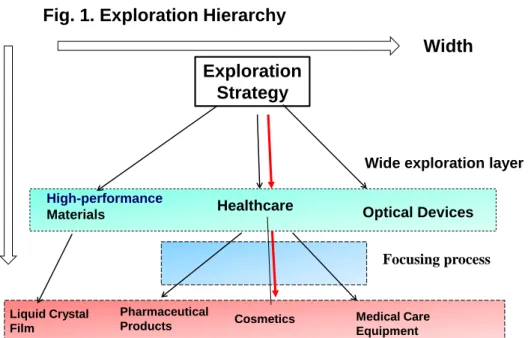
Several steps are involved in the exploration process. First, it is necessary to broadly examine candidates for exploration and define the scope of the area of exploration. Second, from among these multiple alternatives, it is necessary to determine the direction to explore further. We call the former “wide exploration” and the latter “local exploration.” These are connected by a focusing process, which uses focusing devices to determine the direction of local exploration (Rosenberg, 1976). For example, during wide exploration, Fujifilm assessed multiple business areas and then chose healthcare within certain scope. Of the possible choices within healthcare, including pharmaceutical products and medical care equipment, Fujifilm focused on cosmetics and performed a local exploration of that area. Narrowing from multiple choices within healthcare to cosmetics is an example of the focusing process, resulting in a direction of local exploration. At this stage, the company can perform a local exploration of cosmetics-related areas to generate useful knowledge.
lower levels within a hierarchy (Clark, 1985; Simon, 1981). It consists of repeating the focusing process that defines the direction (Rosenberg, 1976) and the exploration activity. The hierarchy of exploration incorporates the two dimensions of depth and scope of exploration, both of which have proven in analyzing exploration (Katila and Ahuja, 2002). In this sense, the concept of hierarchy of exploration is consistent with existing findings. Figure 1 shows the hierarchical nature of exploration activity, using the example of Fujifilm.
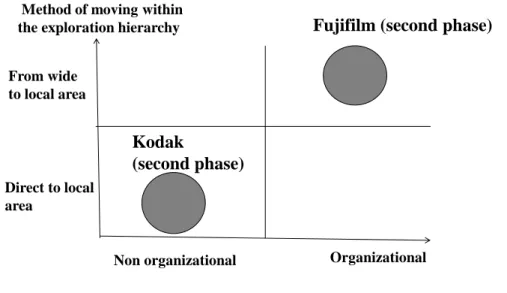
Based on understanding of its hierarchical nature (Clark, 1985; Simon, 1981), the exploration process can be analyzed from two different perspectives; that is, a method of moving within a hierarchy and a method of focusing (Figure 2). There are two types of movement within a hierarchy: from upper to lower levels, thereby narrowing the area of exploration; and determining the area of local exploration directly, without going through the wide exploration and focusing processes. There are also two types of focusing, organizational focusing, which encourages front line managers to engage in
Fig. 1. Exploration Hierarchy
Exploration
Strategy
Healthcare
Cosmetics
High-performance
Materials Optical Devices
Pharmaceutical
Products Medical Care Equipment
Wide exploration layer
Local exploration layer
Width
Liquid Crystal Film
the focusing process for areas of local exploration; and non-organizational focusing,
which does not involve organization-wide discussions of areas of local exploration. Thus,
the exploration process can be regarded as a matrix of four quadrants.
In the case of an exploration process located in the upper right quadrant, the exploration area will be narrowed within a hierarchy through an organizational
focusing process. A typical example is a middle-up-down model of knowledge creation
(Nonaka,1988; Nonaka and Takeuchi,1995), whereby senior management determine the destination of an organization, and middle managers choose the route and steer the ship by facilitating team-level interactions among employees (Nonaka,1988; Nonaka and Takeuchi,1995). According to this model, both top managers and front line managers are engaged in discussions to set the direction of exploration. Focusing and exploration activities within the organization are repeated while proceeding from upper to lower levels within the exploration hierarchy. Once the area of wide exploration is determined by interactions within the organization, subsequent local explorations proceed within that range. In this sense, this type of exploration process has the advantage of stability of the direction of exploration.
In contrast, when the exploration process is located in the lower left quadrant, the
area of local exploration is determined directly, without organizational processing from the outset. There are two typical cases. First, when a company faces a natural trajectory of technical change emerging in a neighboring industry, the company can easily identify areas of exploration and does not require a focusing process. In tandem with the rise of digital technology, the necessity of exploring digital cameras became self-evident and inevitable for traditional camera manufacturers. The second case is when top management plays a pivotal role in managerial cognitive capabilities (Helfat and
Peteraf, 2015, Helfat, 2007) and decides the area of exploration in a top down manner (O'Reilly and Tushman,2016). Top management often begins new projects to which they are personally attached through top down decision making. Both of these cases have the merit of speedy decision making because they omit the focusing process within the organization. However, in the latter case, there is a risk that the area of exploration may change every time top management is replaced, because the areas of exploration were determined in the absence of an organizational focusing mechanism. This is very close to the loss of exploration direction.
Based on this framework, we found that Fujifilm and Kodak followed completely different exploration processes. This difference affected their fates, as described below.
3.
Method and Data
This study has exploratory aspects, including the extraction of details about the personnel and organizations involved in corporate innovation activities, the gathering of
From wide to local area Direct to local area Method of focusing Organizational Non organizational
Method of moving within the exploration hierarchy
Fig. 2. Framework of Analyzing the Exploration Process
Fujifilm (second phase)
Kodak
data regarding the processes associated with these activities, and the analysis of these data. The methodology of this study included a qualitative survey and case study analysis. This research methodology gathers and analyzes abundant data, while introducing a new theoretical framework not previously described (e.g., Eisenhardt, 1989; Pettgrew, 1990; Yin, 1994).
The analysis of Fujifilm was based on semi-structured interviews with executives of Fujifilm, internal information provided by the company, data prepared by the company for the general public, and publicly available materials, including books and business magazines. The analysis of Kodak is based on publicly available materials, including books, business magazines, and academic papers. Data on patents filed by both companies were also analyzed.
Semi-structured interviews with seven individuals, two company executive directors and five directors of related departments, were conducted on July 17, 2015, January 29, 2016, and July 14, 2016. Before the interviews, we developed a profile of the company based on public sources. The goal of the interviews was to understand Fujifilm’s exploration strategy. To obtain a more complete picture of the company, we also spoke with staff in related functional areas. Each interview lasted over one hour, and some individuals were interviewed multiple times. The interviews were recorded and transcribed by a professional service. When clarification was necessary, interviews were followed up by email. A report was prepared based on the information from the
interviews and written sources, with the completed report reviewed by Fujifilm to ensure the
validity of the facts cited. We also communicated by email with Fujifilm to clarify several questions, resulting in a complete version of the corporate transformation process.
1997; Henderson and Cockburn, 1994; Rosenkopf and Nerkar, 2001). Patents contain extensive information about the inventor, the company to which the patent is assigned, and the technological antecedents of the invention, which can be accessed in computerized form. Every patent is assigned to a technical class, which we used to identify the technical areas being developed by the company.
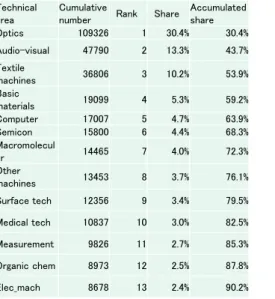
Technical area
Cumulative
number Rank Share
Accumulated share Optics 109326 1 30.4% 30.4% Audio-visual 47790 2 13.3% 43.7% Textile machines 36806 3 10.2% 53.9% Basic materials 19099 4 5.3% 59.2% Computer 17007 5 4.7% 63.9% Semicon 15800 6 4.4% 68.3% Macromolecul ar 14465 7 4.0% 72.3% Other machines 13453 8 3.7% 76.1% Surface tech 12356 9 3.4% 79.5% Medical tech 10837 10 3.0% 82.5% Measurement 9826 11 2.7% 85.3% Organic chem 8973 12 2.5% 87.8% Elec_mach 8678 13 2.4% 90.2%
Table 1. Cumulative Numbe
rs
of Fujifilm Patent Applications
in Technical Areas Ranked 1
to 13 (1982 to
2012)
Technical areas ranked 1 to5 represent the core areas of Fujifilm. About 2/3 of patent applications during this period were in technical areas 1 to 5.
Technical areas ranked 6 to
13 represent peripheral technical areas of Fujifilm.
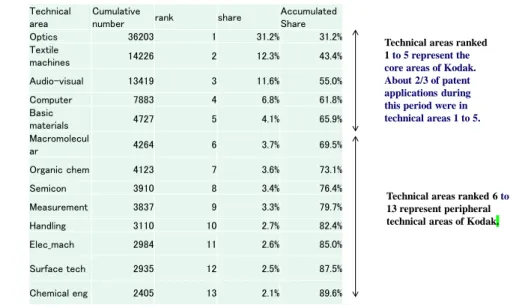
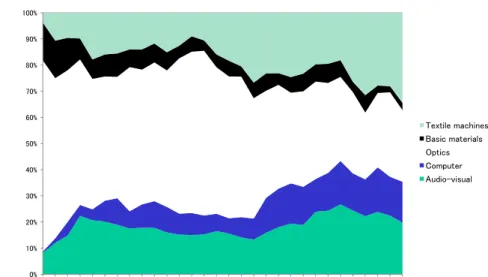
The cumulative number of patent applications by Fujifilm between 1982 and 2012 in technical areas ranked 1 to 13 accounted for more than 90% of all patent applications by Fujifilm during this period (see Table 1). About two-thirds of these applications were in technical areas 1 to 5, which we regarded as the core technical areas of Fujifilm. Accordingly, technical areas 6 to 13 can be regarded as peripheral technical areas. Similarly, we counted the patent applications by Kodak and identified their core and peripheral technical areas in the same manner (see Table 2). Because the cumulative number does not represent the ranking of applications at any specific time, we determined the changes over time in ratios of patent applications in the top five fields of Kodak and Fujifilm (Figures 3 and 4). Both companies applied for patents in the same top five technical fields: optics, audio-visual, textile machines, basic materials, and computers. Also their ratios followed almost the same patterns.
Table 2. Cumulative numbers of Kodak Patent Applications in
Technical Areas Ranked
1 to 13 (1982 to 2012
)
Technical areas ranked 1 to 5 represent the core areas of Kodak. About 2/3 of patent applications during this period were in technical areas 1 to 5.
Technical areas ranked 6 to
13 represent peripheral technical areas of Kodak.
Technical area
Cumulative
number rank share
Accumulated Share Optics 36203 1 31.2% 31.2% Textile machines 14226 2 12.3% 43.4% Audio-visual 13419 3 11.6% 55.0% Computer 7883 4 6.8% 61.8% Basic materials 4727 5 4.1% 65.9% Macromolecul ar 4264 6 3.7% 69.5% Organic chem 4123 7 3.6% 73.1% Semicon 3910 8 3.4% 76.4% Measurement 3837 9 3.3% 79.7% Handling 3110 10 2.7% 82.4% Elec_mach 2984 11 2.6% 85.0% Surface tech 2935 12 2.5% 87.5% Chemical eng 2405 13 2.1% 89.6%
4.
Comparative Study of the Exploration Strategies of Fujifilm and Kodak
1Analysis of the competition between Fujifilm and Kodak in the photographic film 0% 10% 20% 30% 40% 50% 60% 70% 80% 90% 100% KODAK Textile machines Basic materials Optics Computer Audio-visual
Fig. 3. Kodak’s Patent Application RatioTrendsin Its Top Five Fields
0% 10% 20% 30% 40% 50% 60% 70% 80% 90% 100% FUJIFILM Textile machines Basic materials Optics Computer Audio-visual
market from the 1980s to 2010s can separate their exploration strategies into two phases. The first phase, which ended around 2000, was the period during which core technologies incorporated into digital cameras were explored and commercialized. During this period, the main areas of exploration were evident and inevitable, as the technology driven natural trajectory clearly set the direction and pace of technical change (Nelson and Winter, 1982). During the second phase, when it became clear that the digital camera business could not make up for the extinction of the photographic film business, the survival of the two companies required exploration. Because new business areas were unclear, their choice of areas of exploration became strategically very important.
4.1.
The first phase: Exploration and commercialization of digital camerasIn the late 1970s and 1980s, signs of the advent of digital technology began to appear. Because both Fujifilm and Kodak understood that digital technology could threaten their photographic film business, they began exploring related technologies at an early stage. First, Fujifilm started a digital camera project at its Central Research Institute in 1977 and established a microelectronics laboratory in 1981 to develop the company’s in-house charged coupled device (CCD), a type of semiconductor. Kodak showed similar trends. In 1975, Steve Sasson of Kodak invented the world’s first digital camera (Lucas and Goh, 2009). Because the number of pixels was as small as 10,000, the image quality was poor, and these cameras could not be used as a substitute for film cameras. By 1993, Kodak had invested 5 billion dollars in research and development for digital technology (Lucas and Goh, 2009).
The progress of technological exploration can also be traced by reviewing these companies’ related patent applications. The trends of applications for semiconductor patents by Fujifilm and Kodak (Figure 5) show that both companies engaged in exploration of this field beginning around 1985. Between 1989 and 1993, Kodak applied for more patents than Fujifilm, a sign that Kodak proactively engaged in exploration of digital technology. After a relatively stable period, the number of patent applications by Fujifilm rapidly increased, beginning around 1997.
Historically, the first sign that the digital camera market would start to grow emerged in 1995, when Casio released its QV-10 model, with an image quality standard of one million pixels. This image quality standard could replace film cameras, resulting in market expansion. In 2000, Fujifilm’s digital camera (Fine Pix4700Z), equipped with its own Super CCD Honeycomb, accounted for 23% of the global market share and 28% of the domestic market share. Its success was largely due to the Super CCD Honeycomb, which enabled the camera to capture 60% more light per square inch. In April 2001,
Fig. 5. Semiconductor-relatedPatent Application Trends for Fujifilm and Kodak
Data from the EPO Worldwide Patent Statistical Database. The number of annual patent applications related to semiconductors (IPC:H01L) was aggregated based on WIPO’s IPC and Technology Concordance Table.
Kodak introduced its digital camera EasyShare to the market. It featured the convenience of easy download of pictures to a computer, as well as a longer battery life than that of competing products. Less than two years later, Kodak owned the top share of the American digital camera market (Christensen, 2006), with the two companies accounting for a large share of the worldwide digital camera market in 2000 (Figure 6).
Overall, both companies were aware of the necessity of digital camera development at an early stage, both engaged in technology exploration not long after. However, their subsequent exploration trajectory differed markedly. While Fujifilm engaged in consistent exploration of digital camera technology for about 20 years, the new CEO of Kodak, George Fisher, who had been recruited from Motorola, decided to return to the company’s core business of photographic film with investments in emerging markets. In 2000, however, George Fisher was replaced by Daniel Carp, who once again accelerated the development of digital cameras. After a period of twists and turns, Kodak ultimately returned to digital camera development. It turned out that both company had a large
0% 10% 20% 30% 40% 50% 60% 70% 80% 90% 100% 2000 2001 2002 2003 2004 2005
Global Market Share forDigital Cameras
Fujifilm Canon Olympus Matsushita Electric Casio Nikon Kodak Sony Others
Fig. 6. Global Market Share Trends for Digital Cameras
market share by around 2000.
4.2. The second phase; Exploration in the post-digital camera era
Many companies from other industries entered the digital camera market, making it highly competitive. For example, Canon entered the market in 1999, followed by Matsushita Electric Under such severe market conditions, Fujifilm’s market share gradually decreased, reaching 10% in 2004. Kodak’s share followed the same trajectory. After the commoditization and falling profitability of the digital camera, Antonio Perez, who had been appointed Kodak CEO in 2005, called it a “crappy business”. To make up for the extinction of film market, the exploration of new businesses was deemed urgent by both two companies. Decisions about which technological and business areas would be explored eventually resulted in different outcome for Fujifilm and Kodak.
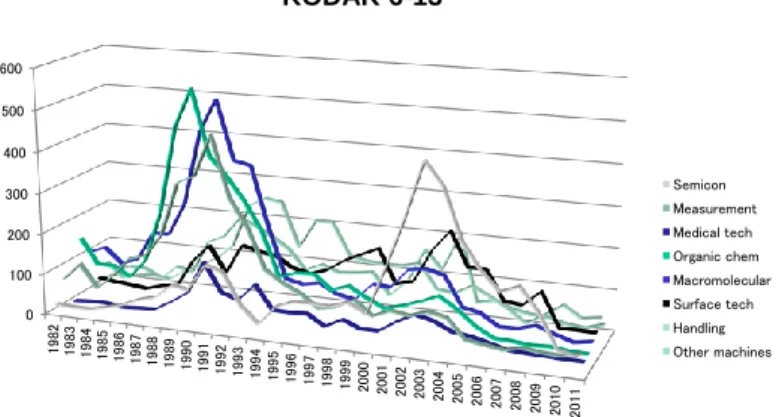
0 100 200 300 400 500 600 1982 1983 1984 1985 1986 1987 1988 1989 1990 1991 1992 1993 1994 1995 1996 1997 1998 1999 2000 2001 2002 2003 2004 2005 2006 2007 2008 2009 2010 2011 KODAK 6-13 Semicon Measurement Medical tech Organic chem Macromolecular Surface tech Handling Other machines
Fig. 7. Kodak Patent Application Trends, Positions 6–13
From the EPO Worldwide Patent Statistical Database.
The number of annual patent applications in top fields 6 to 13 containing many Kodak applications from among 35 technical classes, aggregated based on WIPO’s IPC and Technology Concordance Table.
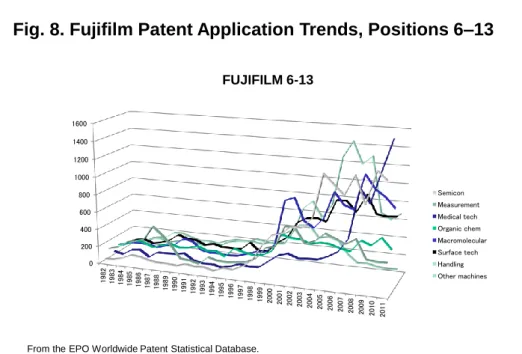
Corporate exploration beyond core technologies can be assessed by examining patent applications for peripheral technologies. The companies showed basically the same patent application patterns in their five top-ranked five fields. However, (cumulative) patent applications from 1983 to 2012 in technical fields ranked between 6 and 13 showed different trends for Kodak (Figure 7) and Fujifilm (Figure 8). Fields ranked 6–13 were chosen because these applications appeared to represent exploration beyond the boundaries of core technologies.
The number of patent applications by Kodak showed two peaks. The first and higher peak, occurring around 1989 and 1990, consisted of applications in organic chemistry, macromolecules, and methods of measurement, whereas the second peak, between 2002 and 2004, consisted of applications in semiconductors and surface technology. The technical fields of these two peaks differed, indicating a lack of consistency in Kodak's technical exploration.
In contrast, patent applications by Fujifilm showed an upward trend in almost all 0 200 400 600 800 1000 1200 1400 1600 1982 1983 1984 1985 1986 1987 1988 1989 1990 1991 1992 1993 1994 1995 1996 1997 1998 1999 2000 2001 2002 2003 2004 2005 2006 2007 2008 2009 2010 2011 FUJIFILM 6-13 Semicon Measurement Medical tech Organic chem Macromolecular Surface tech Handling Other machines
Fig. 8. Fujifilm Patent Application Trends, Positions 6–13
From the EPO Worldwide Patent Statistical Database.
The number of annual patent applications in top fields 6 to 13 containing many Fujifilm applications from among 35 technical classes, aggregated based on WIPO’s IPC and Technology Concordance Table.
technical fields, beginning in 1998. Since that time, Fujifilm has been involved in consistent technological exploration in the fields that include both its core technologies and peripheral technologies. Whereas Kodak’s exploration lost direction, Fujifilm’s technology exploration beyond core technologies showed long-term consistency.
Corporate exploration can also be analyzed by determining how much it crosses organizational boundaries (Rosenkopf and Nerkar, 2001), for example by examining these firms’ joint R&D activities with external organizations. Cooperative patent applications filed together with external organizations increased for both companies, beginning around 2002 (Figure 9). The growth in the number of such applications filed by Fujifilm was especially remarkable, indicating the company’s attempts to cross its organizational boundaries and proactively explore external technologies.
The trends in diversification and concentration for explorations by both companies can also be assessed using the Herfindahl–Hirschman Index HHI), which measures the distribution of patent applications. A higher HHI indicates a higher concentration level,
0 200 400 600 800 1000 1200 1400 1600 1800 2000 copat kodak fujifilm
Fig. 9. Trends
in
the Number of Cooperative
Patents for Fujifilm and Kodak
From the EPO Worldwide Patent Statistical Database. Aggregated based on WIPO’s IPC and Technology Concordance Table.
whereas a lower HHI indicates greater diversity. Figure 10 shows the trends in HHIs for the top 13 technical fields of Fujifilm and Kodak. The technological endeavors of Fujifilm remained concentrated throughout the 1980s, peaking in 1991 and 1992, but showing consistently greater diversification of technological development from 1990 onward. The progress of diversification slowed around 2009, becoming steady in recent years. In comparison, Kodak started diversifying its technological endeavors in the early 1980s but showed increased concentration in the early 1990’. During the first half of the 2000s, Kodak showed greater diversification of technology development but again began increased concentration in 2005.
Thus, from the 1980s to the 1990s, Fujifilm showed concentrated technological development in the optical field, eventually catching up with Kodak. Beginning in the 1990s, however, Fujifilm showed consistent technological exploration and promoted the diversification of its businesses. In contrast, beginning in the 1980s, Kodak prepared for the advent of digital technology by investing in technological exploration of
0 0.1 0.2 0.3 0.4 HHI of 13 Fields Kodak Fuji
Fig. 10. Trends
in
HHI Indices for Fujifilm and Kodak
pharmaceutical products and medical care equipment. In the early 1990s, however, Kodak started to rapidly concentrate its technological development. During the second half of the 1990s, when digital cameras became a threat to the company’s main business of photographic film, it once again started technological exploration in a variety of fields. In 2005, however, Kodak started concentrating its technological resources on the inkjet and printer businesses. These transformations once again demonstrate the contrast between the strategies employed by Fujifilm and Kodak.
4.3. Exploration of medical care products
This section will describe the technical exploration of both companies in the medical care field, focusing on two sub-fields: medical care equipment and pharmaceutical products. We will consider when Fujifilm began its exploration in the field, and how Kodak explored this area.
Figure 11 shows the trends in the number of patent applications for medical care equipment by both companies. These patents ranked tenth and thirteenth among the cumulative number of patent applications by Fujifilm and Kodak, respectively. Figure
10 shows that Fujifilm has explored technology in this field for a long time.2 Beginning
in 2002, Fujifilm showed a marked increase in the number of patent applications and increased exploration of this technology. Kodak started exploring this field a few years after Fujifilm. Between 1990 and 1995, Kodak and Fujifilm filed similar numbers of patent applications in this field, but the number filed by Kodak markedly decreased thereafter.
2 Fujifilm started to develop FCR (Fuji Computed Radiography), its digital X-ray image
diagnostic system, in 1974 and released it in 1983. This was an alternative to the traditional analog method using X-ray film.
The same trends can be observed in the number of patents filed for pharmaceutical products. As shown in Figure 12, Kodak began to explore pharmaceutical technology earlier than Fujifilm and started filing patent applications in 1986. Beginning in 1996, however, Kodak withdrew from its exploration of pharmaceutical technology, and decreased the number of patent applications filed. In contrast, Fujifilm started to file increased numbers of patent applications a little later than Kodak, around 1990. Beginning in 2002, the number of applications surged, after a stable application period of over 10 years.
These findings indicate that both Kodak and Fujifilm started to explore similar technological areas at roughly the same time, but that subsequent development was completely different. While Fujifilm increased medical care exploration in the 2000s and began to shift the focus of its business to this field, Kodak withdrew from it.
Not surprisingly, the merger and acquisition strategy is consistent with the above technical exploration. In 1988, Kodak purchased the pharmaceutical company Sterling
0 200 400 600 800 1000 1200 1400 1600 1800 198 2 198 3 198 4 198 5 198 6 198 7 198 8 198 9 199 0 199 1 199 2 199 3 199 4 199 5 199 6 19 9 7 199 8 199 9 200 0 200 1 200 2 200 3 200 4 200 5 20 0 6 200 7 200 8 200 9 201 0 201 1 201 2
Fuji Medical tech kodak Medical tech
Fig. 11. Trends in Patent Applications Related to Medical-Care Equipment
From this period, Fujifilm increased its number of patent applications
From the EPO Worldwide Patent Statistical Database. Aggregated based on WIPO’s IPC and Technology Concordance Table.
Drug for 5.1 billion dollars but sold it in 1994. In 2007, it finally sold its medical care equipment business and completely withdrew from the medical care field. Meanwhile, Fujifilm purchased Toyama Chemical in 2008 and made it a consolidated subsidiary. This was followed by its purchase in 2012 of SonoSite, a large American manufacturer of portable ultrasound devices. Through these acquisitions, Fujifilm injected more management resources into its medical care business.
5.
Differences between the Exploration Processes of Fujifilm and Kodak
The core technologies of Fujifilm and Kodak were almost identical, and both faced the same market environment, especially regarding the advent of digital technology. Thus, had both companies assessed their own core technologies and looked for new areas to which they could be applied, they would have explored the same technological and business areas. In fact, between the 1980s and 1990s, the two companies were exploring the same areas, such as medical care equipment and pharmaceutical products.
0 50 100 150 200 250 300
Fuji Pharmaceuticals Kodak Pharmaceuticals
Fig. 12. Trends inPatent Applications Related to Pharmaceutical Products
Fujifilm increased its number of patent applications
Kodak was faster and more proactive than Fujifilm.
From the EPO Worldwide Patent Statistical Database. Aggregated based on WIPO’s IPC and Technology Concordance Table.
A statement by Fujifilm CEO Shigetaka Komori confirms this: “Naturally, Kodak had also foreseen the arrival of the digital era and was cautious about it. With regards to diversification, they took steps similar to Fujifilm when they set out to develop
pharmaceuticals.” 3 Although Fujifilm and Kodak initially followed the same
exploration strategy, these strategies ultimately took entirely different trajectories, resulting in completely different business performances.
5.1. Fujifilm’s exploration process
Before its top management officially decided on which new business areas to explore, Fujifilm had been exploring new technological fields independently at the operational level. For example, in 1987 when the digital camera was being developed by its electronic image department, a group of middle managers who were interested in the company’s future spontaneously started a series of “technology strategy meetings” (Kuwashima, 2009). These meetings were attended by 10 members selected from various departments, such as R&D, manufacturing, and human resources departments. This group, which met regularly once every month, took the lead in discussing possible
future technological and business directions of the company and submitted a final report to
the senior management (Shibata, Kodama, and Suzuki, 2017). Thus, in the late 1980s,
managers at the operational level were already engaged in discussions on the future
business directions of the company.
Later, in 2000, Fujifilm officially started a company level "wide exploration", under
the leadership of CEO Komori and involving the technology development department. As part of this initiative, the company conducted a 2-year “technology inventory” project, which examined which new businesses to explore, based on technology and market. For this purpose, Fujifilm constructed a four-quadrant map, with current and new technologies on the horizontal axis and current and future markets on the vertical axis. Then, the top management determined the future direction of the organization: Komori was quoted as saying that “without identifying which fields we can take advantage of with our own technological and management resources, we will not be able to put our business on track. For that, first, we need to organize and verify what kinds of strengths Fujifilm has.”4
As a result, it was decided that the company would invest in six strategically articulated fields: healthcare, high-performance materials, graphics, optical devices, digital imaging, and documents (Fujifilm Holdings Corporation, 2016). In terms of hierarchy of exploration, this process can be identified as deciding the areas of "wide exploration". Healthcare and high-performance materials are widely defined categories that do not refer to specific products. Because healthcare has a very broad range, making it difficult to engage in the experimental or trial-and-error processes that could lead to knowledge acquisition and learning. Fujifilm needed to be more specific about this new area. After examining many options, Fujifilm decided to explore the field of
functional cosmetics as local exploration area.5
In selecting functional cosmetics, the technological synergy and business timelines of the company worked as organizational focusing devices to define the direction of
4 Shigetaka Komori, “Spirit of Management.”
5 The exploration and entry process for the cosmetics business is similar to that cited by Shibata,
exploration (Rosenberg, 1976). The term technological synergy indicates the application to cosmetics of basic technologies accumulated in the film business, such as antioxidant and collagen control technologies (Shibata, Kodama, and Suzuki, 2017; Kodama and Shibata, 2016). Despite not having a sales channel to the cosmetics market, Fujifilm emphasized the merits stemming from technological synergy. The other perspective was the timeline for product commercialization. Cosmetics can be commercialized more quickly than pharmaceutical products, and can also be evaluated in the market relatively quickly. Because the company was already in the very time-consuming business of pharmaceutical products, that balance of the timeline was also considered. Yuzo Toda (vice-president and CTO as of 2016), who spearheaded this initiative at that time, said the following:
Balance is important in business. If we invest solely in businesses with long-term goals, we run the risk of interrupting them as soon as the managers are replaced. Therefore, to get to know the market better, we decided to invest in cosmetics, a field that not only requires less development time than pharmaceutical products, but is also where we could achieve our goals relatively quickly.6
Similarly, the following statement by Naoto Yanagihara (General Manager of R&D Headquarters, Executive Officer as of 2016) also indicates that Fujifilm uses a business timeline as one of its evaluation criteria: “[Regarding photographic film-related technology], we have been keeping the areas and core technologies we believe will grow
in the mid-to-long term, even if they are not commercially profitable in the short-term.”7
6 Toda (2015) Forbes Japan, March 26, 2015. 7 “Nikkei no Monozukuri,” March 2016.
Hence, the use by Fujifilm of technological synergy and business timeline as organizational focusing devices to define its direction of exploration led the company to focus on the functional cosmetics business as a new business area (Rosenberg, 1976).
5.2. Kodak’s exploration process
Conversely, Kodak’s exploration process was conducted in a top–down manner by the initiative of CEO, generally omitting the organizational focusing process. Figure 13 provides a chronological representation of the appointment of Kodak’s CEOs and its exploration strategy. Basically, Kodak was aiming to shift from photographic film to digital cameras by promoting slogans such as “We are a digital company” and “We want to be a digital company.”8 In 1993, Kodak’s board of directors invited George Fisher
from Motorola to become CEO, an unprecedented step for Kodak, as no previous CEO had come from outside the company. Fisher’s goal was to strengthen the company’s main business of photography through digital technology. Therefore, in 1994, Kodak sold the pharmaceutical company Sterling Drug, which it had purchased in 1988, to Bayer and invested those resources in film photography in China and other emerging markets (Lucas and Goh, 2009). Although Kodak had conducted research and development on digital cameras from an early stage and tried to diversify its business by investing in pharmaceutical products, it ended up re-investing in the photographic film business. Its patent applications in the digital camera field began to increase markedly around 2001, 3–4 four years later than Fujifilm. This delay appears to have been caused by George Fisher, who decided to return to the company’s main business of photographic film.
In 2000, George Fisher was replaced by Daniel Carp, who once again accelerated the development of digital cameras. This change is reflected in the rapid increase, beginning in 2001, in the number of patent applications for semiconductors. In April 2001, Kodak introduced its first digital camera, EasyShare, to the market and secured the largest share in the American market (Christensen, 2006). Its CEO announced the company’s commitment to digital technology, not only to photographic cameras but to medical care. The 2003 annual report stated that the company had “implemented a digital oriented strategy to support revenue and sustainable earnings”, and its 2004 report stated that, “in the first full year of its digital transformation strategy, Kodak came out of the gate at a full gallop and we continue to build momentum” (Lucas and Goh, 2009).
In 2005, however, the Kodak board of directors invited Antonio Perez from Hewlett-Packard (HP) to become CEO. Perez, who called the digital camera business “crappy,” sold the medical care equipment business in 2007 and sought to enter the inkjet printer business. Once again, the area of exploration had changed. Sales of Kodak inkjet printers began in 2007, but, by 2011, HP, Canon, and Seiko Epson accounted for around 90% of the global printer market, making it impossible for Kodak to increase its share. In 2012, Kodak declared bankruptcy.
These findings indicate that Kodak’s exploration strategy was executed in a top– down manner. The CEO, sometimes recruited from outside the company, defined the area of exploration without an organizational focusing process. This type of exploration process is prone to changing direction because it is dependent on the judgment of the CEO. Two factors influence the judgment of a CEO: those attributable to corporate governance, such as demands from investors; and the CEO’s professional experience, such as background and past achievements.
For example, Fisher’s return to the photographic film business was due in part to the influence of investors seeking short-term results. Fujifilm CEO Komori shares his point of view: “In the United States, investors always demand short-term results from the managers. As I said before, even though Kodak tried to diversify its business for a while, maybe that kind of influence led them to return to photography, a field where it is
easier to secure some kind of profit.”9
9 “Editor-in-chief’s interview,” Nikkei Business, July 23, 2012.
Fig. 13. Relationship Between Appointment of Kodak CEOs and
Areas of Exploration
13
1993– Recruits George Fisher from Motorola as CEO.
Returns to photography film business; in 1994, Kodak sells medication company purchased in 1988.
2000 – Appoints Daniel Carp as CEO. Introduces a
digital camera in 2001 and commits to digitalization of medical equipment.
2005 – Recruits Antonio Peres from HP as CEO. Sells medical equipment business and enters inkjet printer business in 2007. 1993 2000 2005 B ank rupc ty
However, the reason Antonio Perez shifted Kodak to the inkjet printer business was likely due to his previous professional experience. As vice-president of HP, Perez was responsible for managing its inkjet printer business. During that time, he increased the number of printers sold worldwide from 17 million to 100 million and increased sales to over 10 billion dollars, an achievement that paved the way to his becoming Kodak CEO. Thus, Kodak’s shift to the inkjet printer business may have been due to its new CEO’s successful experiences, resulting in a strong motivation to try unique strategies. Thus, both investors seeking short-term results and previous experiences, such as the business background of a CEO, may affect the selection of areas of exploration.
These findings are supported by studies showing that the judgment of CEOs is influenced by their cognitive capabilities, such as how they think about the business. A CEO’s cognitive capabilities may, in turn, influence the success or failure of a business. For example, the difficulty faced by NCR while entering the field of mainframe computers was attributed to the cognitive capabilities of the managers and how they perceived NCR’s business (Rosenbloom, 2000). Moreover, CEOs’ cognitive capabilities have been found to be unconsciously affected by their past business experiences and accumulated knowledge (Helfat and Peteraf, 2015). Because CEOs’ past business experiences implicitly influence their judgment, areas of exploration are likely to change whenever a CEO with different business experiences is recruited from outside the company.
6.
Conclusions
This study focused on the exploration process, a subject insufficiently covered in previous studies. To better understand this process, we presented a two-dimensional framework to understand the exploration process. Our analysis of the exploration strategies of Fujifilm and Kodak during their corporate transformation processes showed the validity of this framework. In this section, we will summarize our findings and present our conclusions.
It is widely believed that Kodak’s bankruptcy was caused by its failure to properly deal with the emergence of the digital camera market. However, as Section 4 indicates, Fujifilm and Kodak were not very dissimilar in their business commitments to this market. Although their market shares gradually decreased, both initially had large market shares. Kodak introduced its first digital camera EasyShare before the market started to grow and had the largest share of the American market in the early 2000s. Therefore, Kodak did not fail due to its inability to transition from film to digital cameras. Rather, it failed because of its subsequent exploration strategy, which changed direction repeatedly.
This does not mean, however, that Kodak was late in starting to explore for new businesses. The timing of Kodak’s explorations in medical care equipment and pharmaceutical products was comparable to that of Fujifilm. However, Kodak’s changes in the direction of exploration ultimately pushed the company to bankruptcy. The comparative study in this paper explains why Kodak’s exploration lost direction, with our findings indicating that the company’s manner of managing the exploration process basically caused the company to fail.
During the first phase of exploration into digital cameras, the necessity of this exploration was obvious and inevitable, because the direction and pace of technical
change were predominantly directed by their natural trajectory (Nelson and Winter, 1982). Guided by constraints, Fujifilm and Kodak were similar in introducing related technology into their products, making a focusing process generally unnecessary. Kodak was able to return to digital camera development even after having gone back once to its traditional film photography business. These facts indicate that natural trajectory and its effect on the direction of exploration cannot be ignored.
During the second phase of exploration, after the introduction of digital cameras, the need to diversify required many alternative directions of exploration. This second phase required more difficult decisions than the first phase. Due to differences in their exploration processes, the fate of the two companies diverged during the second phase.
Fujifilm started with a wide exploration process, narrowing to a local exploration process within an exploration hierarchy, enabling Fujifilm to organizationally define the area of exploration through an organizational focusing process. Thus, Fujifilm’s exploration process can be located in the upper right quadrant of Figure 2. Once the area of wide exploration is determined through the organizational focusing process, subsequent areas of local exploration will remain primarily within this range. Therefore, areas of exploration are unlikely to change much even when the CEO is replaced. The direction of exploration will remain generally stable, and the exploration activities generally consistent.
In contrast, Kodak paid little attention to the organizational focusing process. Rather, Kodak’s CEOs recruited from outside the company often decided on a specific area of exploration in a top–down manner without an organizational focusing process. Thus, Kodak’s exploration process can be located in the lower left quadrant of Figure 2. In such a company, areas of exploration tend to be influenced by investor demands
and/or the CEO's past business experiences. Traditionally, the different business experiences and achievements of CEOs invited from different business fields are considered strengths. However, Kodak’s case indicates that, when areas of exploration are decided in a top–down manner, a CEO’s varied experience may increase the risk that the exploration strategy will lose its focus (Miller and Ireland, 2005).
These findings indicate that the framework of exploration processes can effectively explain the differences in exploration processes between Fujifilm and Kodak. This comparison may contribute to greater understanding of corporate exploration processes. However, analyses of additional cases will be necessary to establish the effectiveness of the framework presented in this study.
References
Bergelman, R. (1991) “Intra-organizational ecology of strategy making and
organizational adaptation”, Organizational Science, Vol. 2, No. 3, pp. 239-262.
Bergelman, R. (1994) “Fading memories: a process theory of strategic business exit in
dynamic environment”, Administrative Science Quarterly, Vol. 39, pp. 24-56.
Cohen, W. M., and Levinthal, D. A. (1990) “Absorptive capacity: A new perspective on
learning and innovation”, Administrative Science Quarterly, Vol. 35, No.1, pp.
128-152.
Christensen, C. (2006) “The ongoing process of building a theory of disruption”, The
Journal of Product Innovation Management, Vol. 23, pp. 39-55.
Clark, K. (1985) “The interaction of design hierarchies and market concepts in
technological evolution”, Reexploration Policy, Vol. 14, No. 5, pp. 235-251.
NJ: Prentice-Hall.
Fujifilm Holdings Corporation (2016) “Creating new vales through innovation” Fujifilm Holdings Corporation.
Fleming L. (2001) “Recombinant uncertainty in technological exploration”,
Management Science, Vol. 47, No. 1, pp. 117-132.
Helfat, CE. (1994) “Firm specificity in corporate applied R&D”, Organization Science,
March, Vol. 5, No. 2, pp. 173-184.
Helfat, CE. and Peteraf, M A. (2015) “Managerial cognitive capabilities and
microfoundations of dynamic capabilities”, Strategic Management Journal, Vol.
36, No. 6, pp. 831-850.
Gavetti, G., Tripsas, M., and Yaichi Aoshima (2010), “Chapter 3 – Fujifilm’s Second
Creation” Harvard Business School Japanese Companies Case Studies
Compilation. Diamond, Inc.
“Changing technology to value”, Nikkei Monozukuri. 2016, March. Nikkei BP.
Katila, R. and Ahuja, G. (2002) "Something old, something new: a longitudinal study of
exploration behavior and new product introduction", Academy of Management
Journal, December, Vol. 45, No. 6, pp. 1183-1194.
Kodama, M. and Shibata, T. (2016) “Developing knowledge convergence through a
boundary vision – a case study of Fujifilm in Japan”, Knowledge and Process
Management, Vol. 23, No. 4, pp. 274-292.
Komori, S. (2013) Spirit of Management. Toyo Keizai.
Komori, S. (2012) “Editor-in-Chief’s Interview”, Nikkei Business. July 23rd, 2012 Nikkei
BP.
Japanese-Style Process Industry.Yuhikaku Publishing.
Levitt, B. and March, J. (1988) Organization learning. In: Scott, W.R. and Blake, J. (eds),
Annual Review of Sociology. Palo Alto, CA: Annual Reviews, 14, pp. 319-340.
Leonard-Barton, D. (1992) “Core capabilities and core rigidities: paradox in managing
new product development”, Strategic Management Journal, Vol. 13, pp.
111-125.
Lucas, H. and Goh, JM. (2009) “Disruptive technology: How Kodak missed the digital
photography revolution”, Journal of Strategic Information Systems, Vol. 18, pp.
46-55.
March, J. (1991) “Exploration and exploitation in organizational learning”,
Organization Science, Vol. 2, No. 1, pp. 71-87.
Martin, X. and Mitchell, W. (1998) “The influence of local exploration and performance
heuristics on new design introduction in a new product market”, Reexploration
Policy, Vol. 26, No. 7, pp. 753-771.
Miller, CC. and Ireland, RD. (2005) “Intuition in strategic decision making”, The
Academy of Management Executive, Vol. 19, No. 1, pp. 19-30.
Nelson, R. and Winter, S. (1982) An evolutionary theory of economic change, Cambridge,
MA: Harvard University Press.
Nonaka, I. and Takeuchi, H. 1995. The Knowledge-Creating Company, New York:
Oxford University Press.
Nonaka, I.1988. “Toward middle-up-down management: accelerating information
creation”. Sloan Management Review 29(3): 9-18.
O’Reilly III, C. and Tushman, M. (2013)” Organizational ambidexterity: Past, present, and future” . The Academy of Management Perspective, 27, 4, 324-338.
O’Reilly III, C. and Tushman, M. (2016) Lead and Disrupt: How to solve the Innovator’s
Dilemma, Stanford Business books.
Rosenberg, N. (1976) Perspective on Technology, Cambridge University Press.
Rosenbloom, RS. (2000) “Leadership, capabilities, and technological change: The
transformation of NCR in the electric era”, Strategic Management Journal, Vol.
21, No. 10, pp. 1083-1103.
Rosenkopf, L. and Nerkar, A. (2001) “Beyond local exploration: Boundary-spanning,
exploration, and impact in the optical disc industry”, Strategic Management
Journal, Vol. 22, No. 4, pp. 287-306.
Shibata, T., Kodama, M., and Suzuki, J. (2017) “Fujifilm’s corporative transformation
process seen from an ambidextrous organization”, Akamon Management
Review Vol. 16, No. 1, pp. 1-22(in Japanese).
Simon, HA (1981), The Science of the Artificial (2nd Edition), Cambridge, Mass; MIT Press (translated by Motoyoshi Inaba and Hideki Yoshihara (1987), Science of System (New
Edition), Personal media, Tokyo).
Stuart, TE. and Podolny, JM. (1996) “Local exploration and evolution of technological
capabilities”, Strategic Management Journal, Summer Special Issues, Vol. 17,
pp. 21-38.
Yuzo Toda (2015) “The Change Leader – The Man Who Supported Fujifilm’s New