The Role of Output Tasks in Second Language
Acquisition
著者
Bau Sarora
学位授与機関
Tohoku University
学位授与番号
11301甲第16485号
URL
http://hdl.handle.net/10097/59658
博士論文
The Role of Output Tasks in Second Language Acquisition
(アウトプットタスクの第二言語習得における役割)
Saruul Borjigin
(包 薩如拉)
1
Table of Contents
Chapter 1 Introduction ... 4
1.1 Overview of the chapter ... 4
1.2 Attention and noticing in second language acquisition ... 4
1.3 Integrated model of second language acquisition ... 5
1.4 Output hypothesis ... 8
1.5 Significance and the purpose of the study ... 10
1.6 Organization of the dissertation ... 11
Chapter 2 Literature Review ... 12
2.1 overview of the chapter ... 12
2.2 Previous studies on noticing function of output hypothesis ... 12
2.3 Task difference and output triggered noticing and acquisition ... 17
2.4 Individual differences, noticing and acquisition ... 18
2.5 Summary of the findings in previous studies ... 21
2.6 Remaining problems ... 22
2.7 Research questions ... 22
Chapter 3 Methodology ... 24
3.1 Overview of the experimental design ... 24
3.2 Participants ... 24 3.3 Experimental Procedure ... 25 3.4 Materials ... 29 3.4.1 Target structure ... 29 3.4.2 Input passage ... 30 3.4.3 Reconstruction tasks ... 31
3.4.3.1 Cloze reconstruction task ... 32
3.4.3.2 Editing reconstruction task ... 33
3.4.4 True or false task ... 35
3.4.5 Testing materials ... 35
2
3.4.5.2 Picture-cued written output test ... 38
3.4.5.3 Language analytical ability test and language proficiency test ... 40
3.5 Scoring criteria and data analysis ... 41
3.5.1 Scoring of the tests ... 41
3.5.1.1 Multiple choice tests ... 41
3.5.1.2 Picture-cued written output tests ... 41
3.5.2 Scoring of tasks ... 43
3.5.2.1 Scoring of underlining ... 43
3.5.2.2 Scoring of cloze task sheet ... 44
3.5.2.3 Scoring of editing task sheet ... 45
Chapter 4 Results ... 48
4.1Noticing Results ... 48
4.1.1 Results of underlining ... 48
4.1.2 Number of attempts in task sheets of two output groups ... 50
4.2 Task performance results ... 52
4.3 Test results ... 54
4.3.1 Multiple choice tests results ... 54
4.3.2 picture-cued written output test results ... 57
4.4 Correlation analyses 1: Individual differences and noticing ... 61
4.5 Correlation analysis 2: Individual diffe rences and acquisition ... 62
4.6 Language analytical ability, noticing and acquisition ... 64
4.7 Language proficiency, noticing and acquisition ... 65
4.8 Summary of the chapter ... 66
4.8.1 Output and noticing ... 66
4.8.2 Output and acquisition ... 67
Chapter 5 Discussion ... 69
5.1 Overview of the chapter ... 69
5.2 Output and noticing ... 69
5.2.1 Task Types and noticing ... 71
3
5.3 Output and acquisition ... 77
5.3.1 Task type and acquisition ... 80
5.3.2 Individual difference and acquisition ... 83
5.4 Relationship between noticing and acquisition ... 85
5.4.1 Task type, noticing and acquisition ... 98
5.4.2 Individual differences, noticing and acquisition ... 103
5.5 Summary of the chapter ... 109
5.5.1 Output and noticing ... 109
5.5.2 Output and acquisition ... 110
5.5.3 Relationship between noticing and acquisition ... 112
Chapter 6 Conclusion ... 114
6.1 Overview of the chapter ... 114
.6.2 Summary of the major findings of the study ... 114
6.3 Limitations of the study and future directions ... 115
6.4 Pedagogical implication ... 117
Acknowledgements ... 119
References ... 120
Appendices ... 125
Appendix 1 Testing materials ... 125
1.1 Language aptitude test ... 125
1.2 Multiple-choice tests ... 128
1.2.1 Pretest and delayed-posttest ... 128
1.2.2 Posttest ... 132
Appendix 2 Treatment packages ... 135
2.1 Non-output task package ... 136
2.2 Cloze reconstruction task package ... 141
2.3 Editing reconstruction task package ... 146
Appendix 3 Treatment procedure instructions manuscript (Chinese version) ... 151
4
Chapter 1 Introduction
1.1 Overview of the chapter
This chapter provides an overview of the theoretical framework for this dissertation research in the first part. Then it goes on to present the significance of the study along with its purpose. In the final part, the organization of the whole dissertation is ou tlined.
1.2 Attention and noticing in second language acquisition
There is now a general consensus within the second language acquisition (SLA) field that attention to certain linguistic features (form) in input is necessary for learning1 to take place (see Schmidt, 2010 for a review). It is claimed in the Noticing Hypothesis (Schmidt, 2001) that “people learn about the things that they attend to and do not learn much about the things they do not attend to” (p. 30). Therefore, how to draw learners’ attention to target linguistic features effectively so as to promote the learning of those forms is the current interest of researchers as well as language teachers. This led to the proposal of focus on form (Long, 1991) or form -focused instruction (Spada, 1997). While Long defined his proposal (focus on form) as something that “overtly draws student’s attention to linguistic elements as they arise incidentally in lessons whose overriding focus is on meaning or communication ” (pp.45-46), form-focused instruction (FFI) is defined as “any pedagogical effort whi ch is used to draw the learners’ attention to language form, either explicitly or implicitly” (Spada, 1997, p.73).
Spada (1997) claimed that her definition of FFI is essentially different fr om the focus on form. According to her the difference between these two terms is that “… focus on form is restricted to meaning-based pedagogical events in which attention is drawn to language as a perceived need arises rather than in predetermined ways. . .. FFI...refer to pedagogical events which occur within meaning-based approaches to L2 instruction but in which a focus on language is provided in
1
The term learning and acquisition are used interchangeably throughout this thesis. There is a debate about the difference between these two terms in SLA field, with some researchers (e.g., Krashen, 1985) distinguishing them as two different systems: learning takes place consciously and acquisition unconsciously. However, in contemporary SLA terminology no such distinction is typically upheld (Ortega, 2009, p.5).
5
either spontaneous or predetermined ways. ” (p. 73). Therefore, the present study follows the FF I definition in operationalization of the two output tasks. According to Skehan (2003) different approaches that aim to draw the learner’s attention to linguistic forms in input, “agree the role noticing play in the language learning, whether this is through input or output” (p. 2). While noticing through input (e.g., textual enhancement; input flood; input processing) has been substantially researched (see Lee & Huang , 2008 for a review), noticing through output (i.e., noticing function of output hypothesis by Swain, 1985; 1995; 2005; see also Muranoi, 2007) has been relatively less researched.
1.3 Integrated model of second language acquisition
So how exactly does noticing affect learning? In explaining this inquiry it is necessary to have a model that explains how language learning takes place. Among several general learning models that have been proposed by different researchers (e.g., Ellis, 1993; Gass, 1988) on the process of the acquisition of linguistic knowledge in a second language2, the model proposed by Gass (1988) has been widely implemented in SLA studies because it is considered to provide a detailed explanation of the each stage learner go es through to finally achieve language acquisition. The model includes five stages that learners go through t o acquire the linguistic knowledge of L2. It begins from ambient speech to apperceived input to the final stage of output. It is presented in following figure.
2
The term second language (or L2) in this thesis refers to any language that has been learned after the learners’ first language. Therefore, although for the participants in the present study, English is actually their third language, I did not distinguish between L2 and L3, because this alone can be a research topic and thus beyond the scope of t he present study.
6 Ambient speech ↓ Apperceived input ↓ Comprehended input ↓ Intake ↓ Integration ↓ Output
Figure 1.1 Gass’s model of second language acquisition (from Gass 1988: 200)
Gass (1988) explains this model in follo wing way. Ambient speech refers to the second language input the learners are surrounded by. However, n ot all of this input data is utilized by the learners. Only certain parts of this data are going to pass through to the next stage, which is defined as apperceived input. The factors which are influencing this filtering process can be the frequency of the linguistic information, affective variables (e.g., motivation, attitudes), prior knowledge and attention. Anyway, it is clear that in order for initial ambient speech to pass into apperceived input stage, some aspects must be noticed or attended to.
Attention, in Gass’s term “is what allows a learner to notice a mismatch between what he or she produces/knows and what is produced by speakers of the second language ” (p. 203). In other words, the information which is entered into apperceived input stage is also what enables learners to notice the gap between their interlanguage (IL) and target language (TL).
Once a certain amount of data is passed into apperceived input, they go onto make their way into comprehended input stage. By comprehension, Gass refer s to the analyses learners have done to the input at this stage. She believes the analyses are multi -staged, which range from level of semantics to linguistic structural analyses. She points out that the level of analysis done to comprehended input is important for the subsequent intake stage to take place. Intake is defined in
7
this model as a process of mental activity which mediates between input and grammar. An d it is these mental activities that enable new linguistic knowledge to integrate into learners ’ already existing IL system. This integration process can: (1) confirm the current hypothesis learners hold in their IL system and thus facilitate the integrati on of new piece of knowledge into their developing IL system; (2) or if the knowledge is already part of what learners know, then this process can serve as reconfirmation and rule strengthening in IL development; (3) or reject some of the existing hypotheses and therefore make learners seek further relevant input for further intake. The final stage in the model is output. In defining the role output play in language acquisition, Gass joins Swain (1985) on claiming that ‛comprehensible output’ is necessary for successful acquisition to take place. She then explain s how output functions in the model as : “using the language forces learners to make sophisticated analyses of grammar, a factor which is important to in moving the learner from comprehended input to intake ”(p. 210). It can be inferred from this statement that in fact this model does not end at output stage. This final stage also provides feedback far back into the input stage and keeps the cycle going on.
In sum, what this model is suggesting is that learners do not learn all input they are exposed to. Only a certain amount of the ambient speech can pass into intake. And once they reach intake, they will be either integrated into the learner IL system, or it will make learners seek further input to derive the knowledge they need, which again lead s them to the input stage. Based on this knowledge they will finally be able to use the language. Then, upon using the language, they may further notice some mismatches between their IL and TL and this agai n leads to the input stage of the model.
In summarizing how the model function s, she concludes by acknowledging the important role attention plays in the whole process in the following sentence:
“In sum I am suggesting a major role for what I have cal led apperceived input, determined to a large extent by selective attention. Without selective attention grammar development does not take place. In other words, a first step in grammar change is the learner’s noticing (at some level) a mismatch between the ambient speech and his or her own organization of the target language” (Gass, 1988, p. 212).
8
Put simply, to develop their IL system, learners need to notice the gap between their IL and TL. One such way to make them aware of this gap is ‛comprehensible output’, which was mentioned by Gass in explaining the output stage in her model. This notion was first introduced by Swain (1985) whose observation of the learners from a French immersion program led her to question the role of ‛comprehensible input’ in learning. Until then, it was believed that ‛comprehensible input’ (Krashen, 1982; 1985) was the only one necessary and sufficient condition for language acquisition to take place. Swain and her colleagues found that English speaking children who were enrolled in the French immersion program displayed near native competence in listening and reading comprehension abilities, but not in their speaking and writing abilities. This led to her proposal of the role output plays in language learning, initially known as ‛comprehensible output’ (Swain, 1985) and later the ‛output hypothesis’ (Swain, 1995; 2005).
1.4 Output hypothesis
In Swain (1995, 2005), she proposed four hypothesized functions of output in language learning. They are:
(1) the noticing/ triggering function; (2) the hypothesis testing function; and (3) the metalinguistic function.
Swain (1995, 2005) explained these functions in following ways.
First, through producing the target language, learners may find out the gap between what they want to say (or write) and what they actually know. This may lead them to realize their own linguistic problems, that is, what they don’t know or only know partially. This noticing of the gap in their linguistic knowledge may trigger their paying attention to the linguistic knowledge they need from the relevant input. In so doing, learners may either generate new knowledge or consolidate their existing knowledge. For example:
Non-native speaker: And in hand in hand have a bigger glass to see. Native speaker: It’s err. You mean something in his hand?
9
Non-native speaker: like spectacle. For older person.
Native speaker: Oh aha I see you mean a magnifying glass, right? Non-native speaker: yeah, that’s it.
(Mackey, 2002, pp, 389-390, modified by the author)
In this example, the non-native speaker wanted to say magnifying glass, but did not know how to say it (i.e., noticing the gap). So when the native speaker provided him the r ight word, he picked that up (i.e., seeking answer form the relevant input).
Second, through producing the target language, learners may have the chance to test the hypothesis they hold in IL. For example:
Non-native speaker: And in hand in hand have a bigger glass to see. Native speaker: It’s err. You mean something in his hand?
Non-native speaker: like spectacle. For older person. Native speaker: Mmm, sorry I don’t follow, it’s what?
Non-native speaker: In hand have he have has a glass for looking thr ough for make the print bigger to see, to see the print, for magnify.
Native speaker: He has some glasses?
Non-native speaker: Magnify glasses he has magnifying glasses.
Native speaker: Oh aha I see a magnifying glass, right that’s a good one, ok. (Mackey, 2002, pp, 389-390)
This example shows the process of how the learner tests the hypothesis exists in his IL. At first he struggled to produce the exact word, but when finally he came up with the word ‛magnifying glass’, the native speaker provided the confirmation feedback to his hypothesis such as ‛Oh aha I see ’or ‛right that’s a good one’. Therefore, through such opportunities to produce output (say or write) and receive feedback from a native speaker or language tea chers may enable learners to either consolidate their existing knowledge or see k a solution in the input (spoken or written form).
10
Swain’s term is: “Under certain task condition learners will not only reveal their hypothesis, but reflect on them, using language to do so” (Swain, 1995, p. 132). Put simply, when learners try to reflect on a particular linguistic form in the L2, using some metalinguistic knowledge they already have about that form, they may benefit from such experience. For example:
Student : I need many practice in English to improve my fluency. Teacher : Why do you use many?
Student : Oh, right. I should use lots of instead of many, because many can only be used before countable nouns.
(Created by author)
Swain (1995) claimed that this kind of “using language to reflect on language ” output, (i.e., metalinguistic reflection) may allow learners to control and internalize the linguistic knowledge in L2. In her later work drawing on social cultural theory, Swain relabeled the output into speaking, writing, collaborative dialogue/verbalizing.
The second and the third function (i.e., hypothesis testing and the metalinguistic function) have widely been researched in the fields such as feedback and subsequent modified output (see Swain 2005 for a review) languaging and collaborative dialogue (Sw ain 2005; see also Swain & Watanabe, 2013). However, despite the importance of the role of noticing in SLA, only limited numbers of studies have been conducted to investigate the noticing function of the output hypothesis up to date (e.g., Izumi, 2002; Uggen, 2012). Therefore, the present study set s out to investigate the noticing function of the output hypothesis and attempts to address such research questions as whether or not the output actually trigger s noticing and whether such noticing facilitates the learning of the target form. In Chapter 2, the previous studies on noticing/triggering function of output are reviewed.
1.5 Significance and the purpose of the study
The purpose of this study is to examine: (1) whether providing learners with the opportunity to produce output actually better facilitates the noticing and acquisition of the targe t forms in the
11
input passage than asking learners to read the passage for comprehension only; (2) based on the results and findings of the study to explore the re lationship between output triggered noticing and acquisition; (3) as well as the possible roles task type and individual differences might play in predicting the effects of output. Findings from this study are expected to provide theoretical implications for SLA literature and pedagogical implications for L2 classroom, especially the ones in EFL situation where typically the class sizes are big and still exclusively focusing on grammar translation method. The two FFI output tasks utilized in the present stu dy can easily (by easily, I mean without much modification) be introduced and applied to such classrooms and are expected to contribute to both teaching and learning of foreign languages.
1.6 Organization of the dissertation
The chapters of this dissertation are organized in following ways. Chapter 1 introduces the theories and hypotheses that led to and framed the present study along with the purpose and significance of the study. Chapter 2 reviews the empirical studies and a ddressed the remaining problems, then sets the specific research questions of this study. Chapter 3 describes the methods that I used in the study in order to answer my research questions. This part includes the testing materials, tasks, treatment procedures and the rationales for the chosen materials as well as the criteria for scoring and analyzing the data. Chapter 4 presents the results of analyses done in Chapter 3. In Chapter 5, the results and findings from Chapter 4 are interpreted with reference to theories and empirical studies reviewed in Chapter 1 and 2. Finally, Chapter 6 summarizes the major findings of the study, then goes on to acknowledge some limitations of the study and offer some directions for future studies. It concludes with some pedag ogical implications. Testing materials and treatments packages will appear in the appendices.
12
Chapter 2 Literature Review
2.1 overview of the chapter
In this chapter previous studies on output hypothesis are reviewed. Then after summarizing the findings of previous studies some of the remaining problems are pointed out. Finally, the specific research questions of this study are presented.
2.2 Previous studies on noticing function of output hypothesis
Izumi carried out a series of studies (Izumi 2002; Izumi & Bigelow, 2000; Izumi, Fujiwara, Bigelow & Fearnow, 1999) to address: (1) whether output promotes noticing of linguistic form; and (2) whether output results in improved performance of the target form.
The first study was conducted by Izumi and his colleagues (Izumi et al., 1999) on effects of output triggered noticing and acquisition of past hypothetical conditional structure in English. They included two output treatments in their study. During Phase1 treatment, they asked the participants to first read the input passage and reconstruct, then go on to repeat the same procedure again. The Control group in this phase just read for the sole purpose of comprehension. After the Phase1 treatment, they administered posttest 1, and then, during the next week, they carried out Phase 2 treatment in which they first asked participant s to write an essay on a given topic then provided a model written by a native speaker and after that asked the participants to carry out the essay writing on the same topi c again. After that they assigned posttest 2. The treatment procedure is illustrated in the following figure.
13
Figure 1.2 treatment procedures in Izumi et al., 1999 (p. 428)
In both Phase 1 and Phase 2, the noticing was captured through underlining activities carried out by the participants in each input session. The acquisition was measured by their performance on a grammaticality judgment test and picture -cued production test.
In terms of noticing, the findings showed that the reconstruction task was more effective in drawing learners’ attention to target form and also demonstrated greater immediate incorporation of the target form than essay writing. On the other hand, with regard to acquisition, essay writing turned out to be more effective, because of the improved performance of learners in posttest 2. These findings imply that output (i.e., reconstruction and essay writing) promote noticing of the target form and thus better facilitates second language acquisition. However, it should be noted that, in terms of noticing, output group did not outperform the control group. Although in posttest 2, output group improved from pretest to posttest picture -cued production test scores, and outperformed the control group, they did not achieve the same on t heir performance on the grammaticality judgment test.
Drawing on the above findings, they concluded that although this study failed to support the noticing function of output hypothesis, since the output group did not show better noticing than the control group, the study did come up with a partial support for the facilitative effect of output on production knowledge of the target form.
14
was difficult to argue task type effect and besides whether the improved performance in posttest 2 was facilitated by essay writing task alone or by combination effect of both tasks was uncertain. Then in Izumi and Bigelow (2000), they conducted a follow up study to Izumi et al. 1999. This time they switched the sequence of Phase 1 and 2 (i.e., essay writing first and reconstruction next) to address noticing and acquisition of past hypothetical conditional structure along with the differential effect of task sequencing. Again , the noticing was measured by the underlining scores and acquisition was measured by multiple -choice recognition test and picture-cued production test. As it turned out, in terms of noticing, the output group failed to outperform the comparison group. In terms of acquisition, the results were of partial support to research question two, because the output group improved from their production posttest 1 to posttest 2. However, the comparison group manifested the same pattern as did the output group and ther e was no difference between the groups.
On the other hand, based on the findings from the performance of the output group on their immediate uptake in subsequent input, Izumi & Bigelow (2000) pointed out that providing learners with extended opportunities to produce output and relevant input was crucial in improving the learners’ use of target language. In addition, by further analyzing the interview data and production data during the treatment stage, they found that not all participants were able to realize that their IL grammar was problematic. This led to their suggestion for future studies to explore different task type which could make learners be aware of the gap between their IL and TL and different linguistic features, because it is possible that some linguistic features are not easy to be noticed.
Uggen (2012) replicated this study (i.e., Izumi & Bigelow, 2000) and investigated the effects of output on subsequent input noticing and production of target form. Only, this time she incl uded complexity of linguistic structure (i.e., present hypothetical conditional vs. past hypothetical conditional) as one of the factor that might mediate the effect of output on noticing. Namely, she hypothesized that more complex and difficult structure (i.e., past hypothetical conditional) may trigger greater amount of noticing. The noticing was measured through both underlining and stimulated recall. The acquisition was addressed through picture -cued production tests.
She found that the output group who were asked to produce past hypothetical conditional (i.e., more complex structure) outperformed comparison group in both noticing scores and production
15
posttest scores. Interestingly, the output group who produced present hypothetical conditional (i.e., less complex structure) failed to do so. Therefore, this study has only provided a partial support for output hypothesis.
Drawing on these findings she argued that structural complexity may not necessarily cause cognitive overload, on the contrary, it plays a positive role in promoting noticing. In contrast, the simple structure may appear not so salient for learners to notice. This, she argued, indicated the relationship between cognitive demand and noticing and suggested the necessity of further investigation.
A recent study by Borjigin, Suzuki and Itagaki, (2013) examined the effect of output on noticing and acquisition of the English passive voice. In addition, they also investigated the differential effect of cognitive demands of tasks. The acqu isition was measured through multiple-choice test. They carried out two experiments. In first experiment, they asked learners from the output group to read and reconstruct the input passage and they repeated the same procedure twice. The comparison group just read the passage and completed a comprehension check question. As a result, the comparison group improved but not the output group on the posttest. In the following experiment, they only included the output group with the same procedure and same testing material. However, this time they modified both the input passage and the output task. Namely, they simplified the input and then modified the reconstruction task into a cloze reconstruction task. They asked learners to only reconstruct the target form (i.e., passive forms) and any other irrelevant linguistic forms were provided. As a result, the group improved on their posttest performance.
This result led them to argue that a cognitively less difficult task may better fa cilitate the learning of the target form. However, since they also modified the input passage, whether this improved performance was resulted from the output task or the input or even, the combination of both was uncertain.
These studies were all comparing the effect of output on noticing and subsequent learning with that of comprehension as the only condition. Izumi (2002) set out to explore if output (i.e., internal attention drawing device) is more effective than input enhancement (i.e., external attention drawing device) on noticing and acquisition of the English relative clause.
16
receptive knowledge (i.e., an interpretation test and a grammaticality judgment test) and another two on productive knowledge (i.e., a sentence combination test and a picture-cued sentence completion test). The treatment procedure is illustrated in figure below. + and - indicate with or without that opportunity. Thus, output group fe ll into two sub-groups: with or without input enhancement (i.e., +O + IE; + O - IE) and similarly input only group also could be divided into two sub groups: with or without input enhancement ( i.e., -O + IE; -O - IE).
Figure 1.3 treatment sequences in Izumi, 2002 (p. 553)
The findings showed that while input enhancement treatment triggered more noticing of the target forms, it was the output treatment that promoted acquisition of the targ et form. He then went on to argue that input enhancement succeeded in drawing learners attention to form, but did no t necessarily encourage further cognitive processing that may be important for learning to take place. According to his speculation, input enhancement may have succeeded in drawing learners’
17
attention to form, but did not lead to their noticing of the mismatch between their IL and TL. Output, on the other hand, promoted both the noticing of form and the mismatch, and thus promoted ultimate learning results. Drawing on all these observation, Izumi (2002) suggested that depth and level of noticing was more important than amount of noticing.
2.3 Task difference and output triggered noticing and acquisition
As has been repeatedly pointed out by the empirical research both in output hypothesis and FFI literature, the differential effect of task type has not been thoroughly studied and worth further research. The findings from such research should contribute to the construction of theory and pedagogical application. Especiall y in output hypothesis literature, there were only limited number of studies that examined the role task types play in mediating the effect of output on noticing and acquisition. One such study was carried out by Song and Suh (2008) to investigate the differential effect of two output tasks (i.e., reconstruction vs. picture -cued writing task). They found that picture-cued writing task was more effective in promoting noticing compared to reconstruction task. However, no differential effect of task type was c onfirmed in terms of acquisition. Ghari and Moinzadeh (2011) also att empted to compare the different effect of reconstruction task and picture-cued writing task and found similar results. Song & Suh (2008) claimed that reconstruction of the whole text may attract learner attention to some other irrelevant forms other than the target form alone. This suggestion accords with what Borjigin et al. (2013) found that cognitively less demanding output task (i.e., cloze reconstruction) is more facilitative than high demanding task (i.e., text reconstruction).
About operationalizing tasks, one option Robinson et al , (2012) proposed drawing on findings from Ackerman & Ciancolo, (2002) is to match the task character and the ability the learner brings to it. In their terms “…by delivering tasks having the same or similar characteris tics, and research the ways these task characteristics make demands on the abilities learners bring to them, and the consequences of these task characteristic -ability determinant coordinates for success or failure in learning ” (p. 261).
This direction motivates the present study to explore reconstruction cloze task and reconstruction editing tasks. They are both reconstruction task s, based on same input passage, and
18
with same linguistic features to be reconstructed, only through different way s, one is by filling in the gap form, another by error correction, which is likely to draw more on m etalinguistic knowledge (Sheen, 2007).
2.4 Individual differences, noticing and acquisition
It has been mentioned in the previous chapter that SLA theories and empirical research have come to a general understanding that L2 learners need to focus their attention on the forms of the target language in some ways. Then a concern may arise along with it as to whether some learners are better at noticing forms than others and if so what makes them different.
While researchers tended to study individual differences such as language aptitude (Robinson, 2005a; Skehan 1998) and motivation (see D ӧrnyei &Ushioda 2010 for a review) and their roles in SLA achievement in general, in recent years however, there is a new tendency in individual difference research to focus on the link between certain cognitive ability (e.g., working memory, language aptitude) and the language learning process (see Robinson et al, 2012 for a review). For example, according to Skehan (1998), in adult language learning, different aspects of language aptitude may operate differently at different stages of the language learning. Namely, language analytical ability is involved throughout the whole p rocess of language learning; phonemic coding ability plays a major role only in early stages; and memory ability is involved in all stages but it is enhanced especially in later st ages. This assumption was proved to be true in a recent study conducted by Mukoyama (2009; see also Mukoyama, 2013) which investigated the acquisition of L2 Japanese by Chinese learners.
In his later work (Skehan, 2002), he also suggested that a different component of aptitude may relate to the four macro stages in learning: noticing (for example, phonemic coding ability), patterning (for example, language analytical ability), controlling (for example, memory retrieval process), and lexicalizing (for example, memory abilities).
A number of studies have attempted to address this issue. For example, Mackey & Sachs, (2011) and Mackey, Philp, Egi, Fujii & Tatsumi (2002) attempted to address whether greater working memory capacity better facilitates the ability to notice and use the negative feedback provided in interaction. The results supported their assumption that learners with greater working
19
memory capacity did benefit from this type of feedback and also demonstrate d better noticing and learning. Similarly, Sheen (2007) examined the extent to which language analytical ability mediated the effects of two different focused written corrective feedback (direct only correction vs. direct metalinguistic correction) on the acquisition of articles in L2 English. Her findings showed that both types of feedback proved to be beneficial for acquisition of the articles, and the direct metalinguistic correction feedback showed strong correlation with language analytical ability. In other words, acquisition of articles is more effective when direct metalinguistic correction is provided and the learners have higher language analytical ability.
Ranta (1998) on the other hand, focused on the grammatical sensitivity and its role in language learning. She perceived language analytical ability (grammatical sensitivity and inductive language learning ability) as the learner ’s ability to focus on form and hypothesized that learners with higher level of grammatical sensitivity would have advantage in some aspects of L2 learning. The grammatical sensitivity test was administered in the learners ’ L1, French. She found that the scores of grammatical sensitivity scores associated with higher stages of grammatical development. These findings support that there is a link between individual ’s cognitive ability and concept of noticing and subsequently a cquisition.
So far, only few studies have been conducted to see the relationship between individual differences and the possible role they play in output triggered noticing and subsequent learning. One such study was Hanaoka (2007). He examined if learners’ proficiency level had mediating effect on the effects of output (picture-prompted composition writing) on the noticing of the linguistic features in subsequent native speaker model. Learners were of two different language proficiency levels (advanced vs. intermediate). The results showed that by producing output (i.e., composition writing), the learners discovered their own linguistic problems and looked for solutions from the subsequent model and incorporated them into their subsequent revisions. However, while learners from advanced level did show a tendency to notice more problems than the less proficient group, the incorporation scores of the noticed forms into their subsequent revision were not significantly different from that of less proficient group. Besides, there was no control group in this study. What this study demonstrated was that output activity (i.e., composition writing in this study) provide learners with opportunity to notice the linguistic problems in their IL system. However, whether this noticing effect was influenced by their
20
language proficiency level was not confirmed. This might have been due to the fact that he did not divide the two groups based on any test scores. He just picked up one group of student s who were considered advanced in their department and the other group of learners who were considered low intermediate from another department in the same school.
Another study that took into account the role of language proficiency in light of output hypothesis was conducted by Suzuki, Itagaki, Takagi, & Watanabe (2009). They investigated the effect of output on subsequent input through asking their subjects to carry out a picture description task. The participants in their study comprised of two groups: low -intermediate proficiency group (first year high school students) and high -intermediate proficiency group (third year university students). Each group was then further divided into two subgroups: output group and non-output group.
Results showed that the output group outperformed the non-output group in their recall task. This indicates that noticing triggered by output facilitated the learners’ attention to relevant linguistic information in the subsequent input and thus promoted learning. With regard to the role of proficiency level in such effect, they found that the high level group outperformed the low level one regardless of the treatment type (i.e., output or non -output). They claimed this was because of the limited memory capacity of the participants in low level g roup.
Their study lent support to the noticing function of output hypothesis. However, there was a crucial limitation to this study. Output group actually received more time on task than the non-output group. This made it hard to claim that the better performance in recall study was facilitated by output activity alone. The treatment procedure in table below shows the difference.
21 Table1. Treatment procedure in Suzuki et al. (2009)
Output group Non-output group
1 Picture description writing (10 min)
2 Read model story with pictures provided (3 min)
3 Performs math task (2 min)
4 Recall model story (7 min)
(From Suzuki et al., 2009, modified by the author)
These findings on language proficiency and its role in output triggered noticing seemed to be mixed. While the high proficiency group in Hanaoka (2007) did not outperform less proficient group, Suzuki et al (2009) found that language proficiency did have a facilitative role in output triggered noticing and subsequent learning. However, as mentioned above, both studies have their own limitations and besides both studies did not divide their groups on an objective standard (i.e., some sorts of test scores). It will be much preferable to have two groups divided by a same standard.
Surprisingly, no studies have ever examined the relationship between learner ’s cognitive abilities and noticing in light of the output hypothesis. Future studies are definitely nee ded to address the relationship between these individual difference factors and noticing triggered by output tasks.
2.5 Summary of the findings in previous studies
In sum, the previous studies have all been trying to address following two fundamental re search questions:
(1) Does output promote noticing? (2) Does output facilitate learning?
22
Among them some tried to examine the mediating effect of factors such as complexity of linguistic structure (Uggen, 2012), task type (Ghari & Moinzadeh, 2011; Song & Suh, 2008), task demands (Borjigin et al., 2013) and language proficiency (Hanaoka 2007; Suzuki et al., 2009) on output triggered noticing and subsequent learning.
With regard to the first questions, the results were mixed. While some of them were able to come up with supporting or partial supporting evidence (e.g., Song & Suh 2008; Uggen, 2012) some did not.
In terms of acquisition, the findings were also mixed. While Izumi (2002), Uggen (2012) and Borjigin et al, (2013) provided a positive effect of output on learning the target forms, others failed.
2.6 Remaining problems
Although some studies have provided support for this function of the output, majority of them did not. Thus, further investigation is still necessary. Izumi (2002) has claimed that depth and level of noticing is more crucial for learning than amount of noticing. Therefore, in future studies it is necessary to look at factors which are influencing the depth of processing. For example, as Ranta (1998) found, learner ’s cognitive ability (namely, the language analytical ability) may have a role in noticing and learning of the target forms. Besides, task factors, such as task type difference, task demands may also have their role in mediating the effect of out put on noticing and acquisition. In addition, the cognitive demand from the complexity of linguistic structure also needs to be researched.
2.7 Research questions
In an attempt to address some of the above mentioned issues and to provide a better unde rstanding of the effects of output on noticing and acquisition; and the possible role task factors, along with learner factors, which might have roles to play in such processes, the following two major research questions along with the sub-research questions form the basis of this study:
23 1. Do output tasks promote noticing of the target form? If so:
(1) Which of the two output tasks better facilitates noticing of form?
(2) Is such effect likely to be mediated by learner fa ctors such as language proficiency and language analytical ability?
2. Do output tasks facilitate acquisition of the target form? If so:
(1) Which of the two output tasks better facilitates acquisition of the form?
(2) Is such effect likely to be mediated by learner factors such as language proficiency and language analytical ability?
24
Chapter 3 Methodology
This chapter details the research design and procedure of the study. An overview of the experimental design is provided first, which is then followed by a description of the participants who volunteered to take part in the study. Next, the treatment procedures and materials are described in detail. Finally, scoring criteria are explained.
3.1 Overview of the experimental design
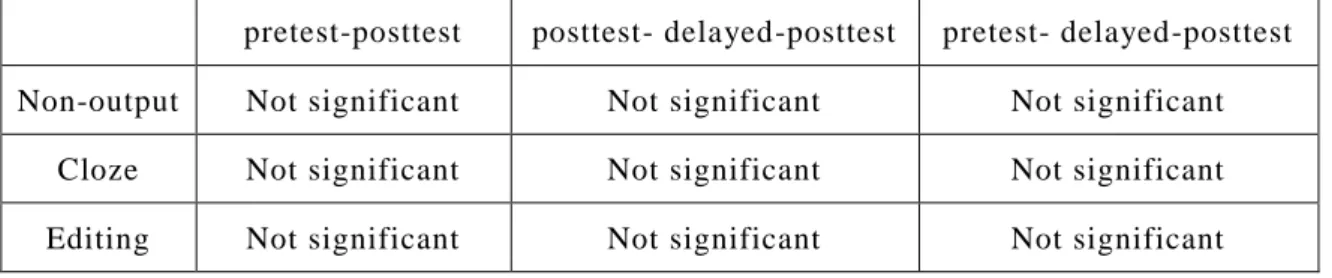
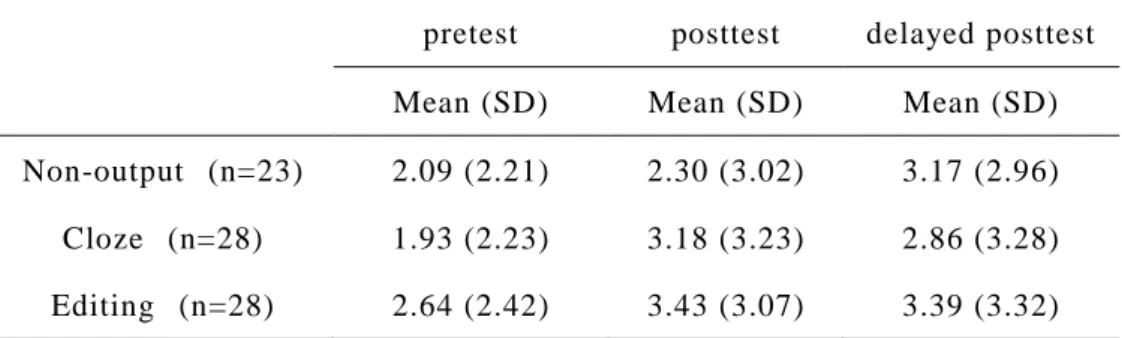
The study followed a pre-test, treatment, post-test and delayed-post-test design and included three groups: a cloze group, an editing group and a non-output group. The between-group factor is task difference (cloze task; editing task; non -output task).
The within group factor is time (pretest and postte sts). The dependant variables are noticing scores and acquisition measures (test scores). The entire procedure, including testing and treatment sessions, took approximately four hours and spanned about four weeks. A delayed posttest was administered approximately two weeks after the imm ediate posttest.
3.2 Participants
The participants were 88 (60 females and 28 males) college students in Inner Mongolia Autonomous Region, China. After deleting some incomplete data which was due to some of the participants’ absence from one or more sessions during the experimental procedure, 79 (59 females and 20 males) of them were able to contribute to the final data analysis. Table 3.1 summarizes the groups and the numbers of participants in each group.
Table 3.1 Numbers of participants in each group
Groups Non-output Cloze Editing
n 23 (5) 28 (6) 28 (9)
25
All of them were freshmen from two different classes of a national university and majoring in economics related subjects such as international economics and trade, financial management, and labor and social security. They were all of Mongolian ethnicity, and learning English as a compulsory course. In Inner Mongolia Autonomous region, there are two types of schools from primary level to tertiary level: Chinese schools, where all subjects are taught in Chinese language; and Mongolian schools, where all subjects, except Chinese, are taught in Mongolian language. The participants in this study have all been educated in the Mongolian schools where they have to learn three languages, Mongolian, Chinese and English almost at the same time from the elementary school (i.e., Mongolian and Chinese from the first grade and English form third grade).
According to the university curriculum, during the first year, the English class would be taught twice a week, every time for 90 minutes, making a total of 180 minutes of class time per week. And once they become sophomores, the English class would be redu ced to once a week which makes class time only 90 minutes per week. All of them have been learning English for over six years, with majority of them (82%) for over nine years. In Inner Mongolia Autonomous Region, English is introduced in the elementary sch ool curriculum in most of the Mongolian schools in the most of the area, but there are some schools that teach it from junior high level. That is why 15 out of 88 students who have participated in the present study have studied English for six years not nine as the rest do. However, since the number was small and the linguistic form targeted in the study (i.e., passive voice) would not be introduced until junior high school curriculum, it was considered appropriate to overlook this difference of the length of English learning.
3.3 Experimental Procedure
The whole experimental procedures were carr ied out during the participants’ regular class time. On Monday of the first week of the experiment, after being introduced to the class by the teacher who was teaching their English, the researcher made a brief self -introduction, and then explained the aim of the experiment, in which she informed the class that the experiment was to be done in order to collect data for the doctoral dissertation of the researcher, so they did not have to worry
26
about the outcome of the tests and tasks, but should try to do it as carefully as possible. Then, t he overall schedule of the experiment was explained, in which the class was told that the researcher would come to visit them during their regular class time three times over two weeks, and then on the forth week, with the absence of researcher, there woul d still be another session to be carried out under the supervision of their English teacher. This final session referred to the delayed posttests, which were carried out by the English teacher of the class without the presence of the researcher. The English teacher of the class had been present during all of the experimental procedure to help the researcher to maintain class order and after each experimental session, carried out her regular teaching. Finally, the researcher asked them to sign the consent fo rm as required by the Tohoku University, Graduate School of International Studies. Then the participants were involved in filling out the back ground information questionnaire. This took about 15 minutes. Language analytical ability test was followed, whic h took another 15 minutes. After these procedures had been completed, the researcher withdrew from the classroom and the participants went on with their regular class.
The following day, the pretests were administered, which took approximately one hour of the class time and after that the participants went on to have their regular class as well. Since there were two different types of tests (i.e., multiple-choice test and picture-cued written output test) in the study to measure the acquisition of target linguistic form (i.e., simple past tense in English passive voice), each test took almost 30 minutes to be completed. The participants were allowed 10 minutes break between the two tests.
The following Monday, the treatment session and the immediate pos ttests were carried out. First, the researcher explained the overall procedure of the experimental session that there would be two big session, one was for treatment session and the other one test session. The participants were also told the approximate ti me necessary for each session. Then the treatment packages were distributed randomly. The treatment packages were arranged in this way that if the first package was for non-output task, then next for cloze task, and then editing task package was followed. In order to make sure it could be evenly distributed, the researcher herself handed out the package one by one alone. In this way, the class was randomly divided into three groups: the non-output group refers to the students who received true or false task packages; the cloze reconstruction group refers to those who received cloze reconstruction task packages; and the editing
27
reconstruction group, refers to those who received editing reconstruction task package.
After receiving the package, the participants were told not to open it until they receive d instructions from the researcher. The treatment procedures were carried out according to the following instructions. The actual manual employed during the experime nt was a Chinese version (see appendix 3), which was the exact translation of the English version below.
(1). The results of the tasks and the following tests have nothing to do with your overall class performance, so just try your best to d o the tasks and do not worry about the results.
(2). Please make sure that you have written your student ID number on the cover page. You do not have to write your name.
(3). Now please open the cover page, and turn to the first page. Read the instruct ion carefully and then read the passage. The time limitation is 3 minutes. You are not allowed to turn to the next page before receiving instruction.
1 minute left. 30 seconds left.
(4). Time’s up. Now turn to the next page and do the task accord ing to the instruction. The time limitation is 5 minutes. You are not allowed to turn back to previous page nor turn to the next page.
1 minute left. 30 seconds left.
(5). Time’s up. Please turn to the next page and read the passage again. The ti me limitation is 3 minutes. Again, you are not allowed to turn back to previous page nor turn to the next page. 1 minute left.
30 seconds left.
28
do the task according to the instruction. You are not allowed to turn back to the previous page.
1 minute left. 30 seconds left.
(7). Time’s up. Thank you for your cooperation. Please pass the packages from the back row to the front.
(8). Please have a 10 minute break.
After the break, the immediate posttest session was followed, which took approximately one hour. There was another 10 minute break between two types of tests.
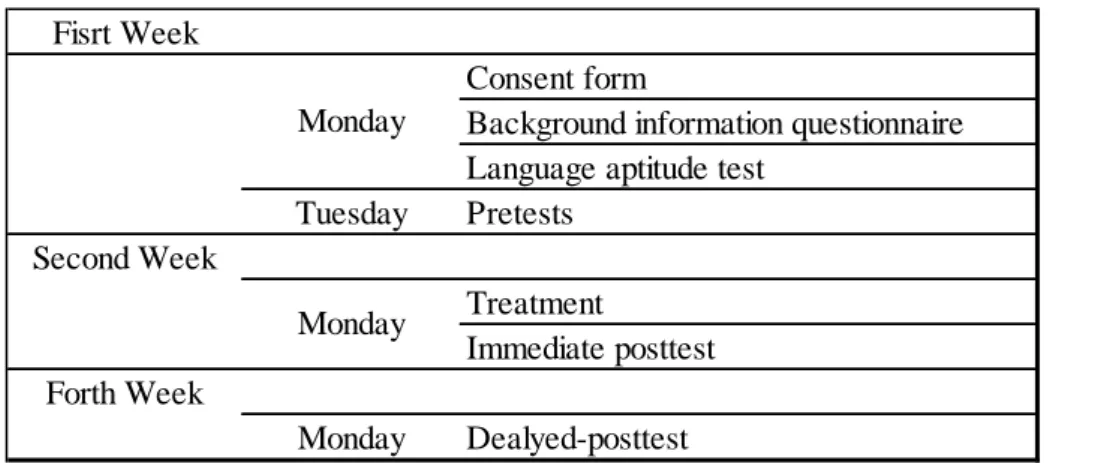
The following week, which was the third week, nothing took place. Then on Monday of the forth week, the delayed posttests were administered without the presence of the researcher. Since the English teacher has been present throughout all previous sessions and was already very familiar with the procedures of the experiment, it was considered appropriate to administer the tests under her supervision. This session was conducted just as the same with the previous two test sessions, with each type of test taking 30 minutes and 10 minute break in between. The whole experimental procedure is summarized in table 3.2 and treatment session is illustrated in figure 3.1.
Table 3.2 Experimental procedure of the study
Fisrt Week
Consent form
Background information questionnaire Language aptitude test
Tuesday Pretests Second Week Treatment Immediate posttest Forth Week Monday Dealyed-posttest Monday Monday
29 Figure 3.1 Treatment procedure of the study
3.4 Materials
3.4.1 Target structure
The simple past tense of passive voice (e.g., She was employed as a secretary) was targeted in the present study owing to several reasons. First, the passive voice has been considered as one of the most difficult grammatical structures to both teaching and learning in English (Hinkel, 2002). Secondly, in output hypothesis, it is claimed that pushed output could provide learners with the opportunity to realize the gap between their interlanguage knowledge and the target language, which indicates that learners should already have partial knowledge of the target linguistic form, but not yet perfect. Since the participants in the study were taught passive voice in their junior high school and the scores of the pretests indicate their partial knowledge of it, which makes it an appropriate choice. Finally, findings from Borjigin et al (2013) suggested that it is better to target only one specific form, rather than targeting many. In their study they included various tense s in the passive voice, which is considered one of the reasons to have caused heavy cognitive demand on the participants and thus hinder their acquisition of the passive voice structure. T herefore, the present study focuses on only simple past tense of English passive voice which is structured be + past participle of verbs.
Cloze group Editing group Non-output group
Cloze task Editing task True or False
Cloze task Editing task True or False Input 1
Input 2
30
3.4.2 Input passage
The input passage along with its picture was chosen from a text book called Side by Side, third edition, book four with simplification in order for participants to comprehend and memorize easily. The simplifications were made in several ways. First, the name of the girl in original text was Amelia, which was shortened in the present study to Amy. Second, all the complex sentences with clauses were simplified except the last sentence.
The modified input passage comprised of 134 words including the title. There were ten sentences in the passage, with every one of them includin g one passive structure, and two of them containing passive voice indicator by.
The picture was provided along with the input passage to help learners to memorize easily. To lessen the burden of the students to recall the input passage when they carry out the required tasks, the picture was also provided in three types of task sheets as well. You can see the input passage and the picture below:
A very exciting year
In January, Amy was employed as a secretary by the Inter-Tel company.
In March, she was sent to school by the company to study statistics and information technology.
In April, she was given a raise.
Just two months later, she was promoted to the position of supervisor of her department. In August, she was chosen as the “Employee of the Month”.
In October, she was given another raise.
In November, she was invited to apply for a position in the com pany’s overseas office in Bangkok, Thailand.
In December, she was provided the new position in Thailand.
At the end of the month, she was awarded the “Employee of the Year”.
She can’t believe all the wonderful things that have happened to her since she was hired just twelve months ago.
31
3.4.3 Reconstruction tasks
As has been repeatedly pointed out in previous studies (Hanaoka, 2007; Izumi 2002; Izumi et al, 1999; Muranoi 2007)
reconstruction task is considered one of the most effective techniques to elicit learner output, especially when there is a specific linguistic f ocus in the study. Through reconstruction, learners will be able to compare their interlanguage (IL) and targe t language (TL), which may lead to their noticing of the target forms. As Izumi (2002) pointed out “…one advantage of reconstruction task lies in its control over the content and form that learner s produce” thus “…maximizing the
32
equivalence between the learners’ output and the target input …” (p. 551).
Besides, it is also considered effective in input -output-input-output treatment design as in the present study hoping to capture the difference between learners’ noticing from first to second input, and uptake from first to second output.
3.4.3.1 Cloze reconstruction task
In present study, reconstruction task is operationalized in two different ways. One is in the form of cloze task, or sometimes considered as a f ill-in-gap task. The task requires participants to fill in the missing words according to what they have read without allowing them to go back to the input passage, though the picture from input passage was provided as clues to help them recall. This version is developed based on the findings of Borjigin et al (2013) in which they included two different versions of reconstruction tasks, with one of them asking participants to reconstruct the whole passage (i.e., text reconstruction) and the other asking them to reconstruct only the missing parts (i.e., cloze reconstruction) which were the target forms. They found the latter one facilitated the acquisition of the target form while the previous one failed to do so, which led them to argue that “the cognitively less demanding output task enabled participants to focus more attention on target forms and acquire them” (p. 67).
Therefore, the same form of cloze reconstruction task is adopted in this study and designed with 7 items as distracters and 12 on simple past tense in passive form which include the indicator
by. The task is shown below.
A very exciting year
In January, Amy ( ) as ( ) secretary ( ) the Inter-Tel company.
In March, she ( ) to school ( ) the company to study statistics and information technology.
In April, she ( ) a raise.
Just two months ( ), she ( ) to the position of supervisor of her department. In August, she ( ) as the “Employee of the Month”.
33
In November, she ( ) to apply for a position in the company’s overseas office ( ) Bangkok, Thailand.
In December, she ( ) the new position ( ) Thailand.
At ( ) month, she ( ) the “Employee of the Year”.
She can’t believe all the wonderful ( ) that ( ) to her since she ( ) just twelve months ago.
3.4.3.2 Editing reconstruction task
The other form of reconstruction task was carried out as an error correction editing task, also called in many studies error correction or form correction. It requires participants to identify the errors and then based on what they have read try to edit the errone ous part into correct one. Again, as has been done in the cloze task, the participants were told to provide the correct form without referring back to input passage. Error correction is a commonly practiced task in language classrooms as cloze task (Lee, 2007; Storch, 1999), but was considered having an advantage in drawing learners’ attention from meaning to form (Lee, 2007; Wong, 2003) since it asks learners to identify and correct the errors.
The numbers of distracters and passive forms are kept the same as the cloze task. The erroneous parts in this task are the parts that are missing in cloze task. The types of error targeting passive forms following the previous studies (Lee, 2007; Spada e t al, 2014) were designed in following ways:
(1). absence of be verb;
(2). using present participle instead of past participle of verb after be verb; (3). active voice instead of passive voice;
(4). using original form of the verb instead of past part iciple after be verb; (5). incorrect form of past participle.
34
error, rest of the six are divided equally into error (2) (3) (4). The distributions of the errors are shown below in the task.
A very exciting year
In January, Amy employed as the secretary for the Inter-Tel company. (1)
In March, she sended to school with the company to study statistics and information technology. (5)
In April, she was giving a raise. (2)
Just two months late, she promoted to the position of supervisor of her department. (1) In August, she chooses as the “Employee of the Month”. (3)
In October, she gave another raise. (3)
In November, she was inviting to apply for a position in the company’s overseas office on Bangkok, Thailand. (2)
In December, she provided the new position of Thailand. (1) At end of month, she was award the “Employee of the Year”.(4)
She can’t believe all the wonderful thing that has happened to her since s he was hire just twelve months ago. (4)
However, compared to the cloze task, which requires participants to reconstruct the whole passive structure (be + past participant) the editing task already provided either be or past participle, though some of them were provided in incorrect form. Thus, the scoring criteria for the two types of tasks were different.
There are two underlying rationale for these two reconstruction tasks. First, as has been mentioned in chapter 2 that Robinson et al (2012) suggested that in order to examine whether a certain individual difference associate with a particular task character, it would be preferable to keep the task difference at a minimum level. Therefore, in present study the two output tasks are designed to differ from each other in one major way. The Cloze task requires reading, recall and reconstruction steps while editing requires reading, recall, compare and reconstruction. Then one may expect that since the missing parts are so obvious in the cloze reconstruction task, it might be hypothesized that those who were involved in the cloze reconstruction task would underline more
35
passive related items in second input phase compared to those who were engaged to editing reconstruction. Editing reconstruction, on the other hand, might be hypothesized to be more effective in helping learners process the form better, since it requires a comparison stage, which put in other words, provide learners with opportunity to compare the mismatch between erroneous forms and the correct forms. Secondly, previous studies (Nassaji & Tian 2010; Storch 1997; 2007) also suggested that despite being well-used FFI tasks the effects of cloze and editing tasks have not been thoroughly researched.
3.4.4 True or false task
As for the non-output group, after reading the passage, they were asked to do a true or false task which is a well used reading comprehension task in language classrooms. The sentences provided in the true or false task avoided using passive structures in order not to provide extra input on the target form. The task was shown below:
( ) 1. Amy is a sales woman in a telephone company.
( ) 2. Amy went to school to study foreign languages, because the company asked her to do so.
( ) 3. Amy became the supervisor of her department in July.
( ) 4. The company has given raises to her three times within a year. ( ) 5. Amy wanted to apply for the new position but the company said no. ( ) 6. Amy quitted her job and moved to Bangkok, Thailand to get a new job. ( ) 7. The company awarded Amy the "Employee of the Month" twice.
( ) 8. Amy had a very exciting year, because she had many chances to go abroad to company's overseas offices.
( ) 9. Amy went to Thailand in November.
( ) 10. Since her employment in January, Amy has had many exciting experiences at work.
36
It has been suggested in previous studies that more than one type of test should be used to provide a more collectively reliable results and accordingly increase chances of coming up with more complete picture of learners’ performance (Spada et al, 2014). Therefore, in order to assess the knowledge of passive voice before and after the treatment session, two types of tests were used. These two tests were supposed to tap into two different types of knowledge about English passive voice. A multiple choice test was designed to pr ovide a measure of participants’ receptive knowledge (or sometimes called co mprehension test) and a picture-cued written output test (or sometimes called production test) was intended to examine the participants’ productive knowledge.
3.4.5.1 Multiple choice tests
Multiple choice questions are not only a well used type of test in schools, but also a very common type of exercise in textbooks. Thus the participants are well acquainted with this type of test. Besides, it has following advantages: (a) well suited to test discrete features of grammatical knowledge; (b) easy administration and (c) objective scoring (Purpura, 2004). The multiple choice test used in the present study was based on the one that had been used in the researcher’s master thesis but has been modified, since the linguistic target of that study were various tenses of passive voice whereas only simple past tense in passive voice was targeted in this st udy. However, all the distracters remained the same with the previous version. Altogether there were 10 items on target linguistic structure, that is, simple past tense in English passive voice, and 20 items on various linguistic features as distracters. E very item has four options. Despite the correct option
was/were + past participle of the verb (e.g., was injured), other three options were designed
following previous studies (Lee, 2007; Spada et al 2014):
(a) past form of the given verb (e.g., injured);
(b) had+ past participle of the given verb (e.g., had injured); (c) was/were + original form of the given verb (e.g., was injure); (d) was/were + present participle of the given verb (e.g., was injuring).